
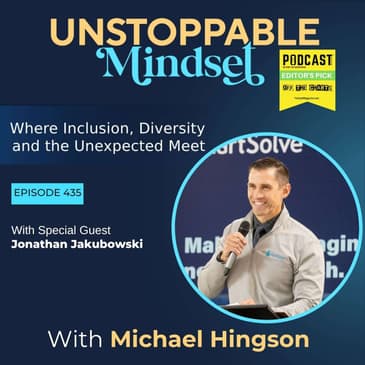
What if the solution to plastic pollution could simply disappear?
In this conversation, I sit down with Johnathan Jakubowski, CEO and founder of Smart Solve, to explore how biodegradable, water-soluble packaging is changing the future of sustainability and business. John shares his journey from early life lessons and a failed startup to building an innovative company focused on solving microplastic pollution. You will hear how purpose-driven leadership, core values, and faith shaped his path, along with practical insights on entrepreneurship, market adoption, and innovation. I believe you will find this discussion both inspiring and useful as you think about leadership, environmental impact, and what it truly takes to build something that matters.
Highlights:
00:01:27 – Learn how early life values and family shaped a foundation for leadership and purpose
00:10:26 – Discover how technology and screen use are impacting focus, mental health, and development
00:17:59 – Understand how business failure can redirect you toward a more successful path
00:22:14 – Learn how biodegradable, water soluble packaging works and where it is used
00:27:04 – Discover why microplastics are driving a major shift in global innovation
00:52:49 – Learn how leadership is built through influence, culture, and consistent core values Bottom of Form
About the Guest:
Jonathan Jakubowski is an entrepreneur, author, inventor, and public policy advocate whose work spans the private, public, and nonprofit sectors. He is the Co-Founder and CEO of SmartSolve, a company he built around a simple but powerful conviction: that the packaging industry could be reimagined from the ground up. Under his leadership, SmartSolve has developed the world's first patented 100% bio-based, plastic-free, dissolvable food packaging — a genuine breakthrough in the global effort to eliminate packaging waste.
SmartSolve's technology represents years of research, invention, and commercial development aimed at solving one of the most persistent environmental and industrial challenges of our time. Jonathan leads the company with a focus on proving that sustainability and profitability are not opposites — that the most innovative solutions can also be the most responsible ones. His work has positioned SmartSolve as a pioneering force in the zero-waste packaging space, drawing national and international attention.
Beyond his entrepreneurial work, Jonathan is a published author whose book Bellwether Blues: A Conservative Awakening of the Millennial Soul has received widespread recognition and national media coverage. The book explores the political and cultural landscape facing a generation, and reflects Jonathan's deep engagement with public policy and civic life — shaped in part by his Master's in Public Policy from Georgetown University and his undergraduate years at Bowling Green State University, where he played collegiate football.
Jonathan's commitment to service extends across sectors. He is the founder of Champions in Action, a nonprofit dedicated to empowering underprivileged youth in Guatemala, and serves as Chairman of the Board of Directors of the Forge Leadership Network, an organization devoted to developing principled leaders. His career reflects a consistent thread: identifying problems that others have accepted as inevitable, and building solutions that prove otherwise.
Jonathan lives in Northwest Ohio with his wife Missy and their four children. Whether in the boardroom, on the page, or in the community, he is driven by the belief that leadership means leaving things better than you found them.
Ways to connect with Jonathan:
🌐 Website: www.smartsolve.com
𝕏 X (Twitter): @JonJakubowski
💼 LinkedIn: Jonathan Jakubowski
📚 Book on Amazon: Bellwether Blues: A Conservative Awakening of the Millennial Soul amazon.com — ISBN 9781733428026
About the Host:
Michael Hingson is a New York Times best-selling author, international lecturer, and Chief Vision Officer for accessiBe. Michael, blind since birth, survived the 9/11 attacks with the help of his guide dog Roselle. This story is the subject of his best-selling book, Thunder Dog.
Michael gives over 100 presentations around the world each year speaking to influential groups such as Exxon Mobile, AT\&T, Federal Express, Scripps College, Rutgers University, Children’s Hospital, and the American Red Cross just to name a few. He is Ambassador for the National Braille Literacy Campaign for the National Federation of the Blind and also serves as Ambassador for the American Humane Association’s 2012 Hero Dog Awards.
https://www.facebook.com/michael.hingson.author.speaker/
https://www.youtube.com/user/mhingson
https://www.linkedin.com/in/michaelhingson/
accessiBe Links
https://www.youtube.com/c/accessiBe
https://www.linkedin.com/company/accessibe/mycompany/
https://www.facebook.com/accessibe/
Thanks for listening!
Thanks so much for listening to our podcast! If you enjoyed this episode and think that others could benefit from listening, please share it using the social media buttons on this page. Do you have some feedback or questions about this episode? Leave a comment in the section below!
Subscribe to the podcast
If you would like to get automatic updates of new podcast episodes, you can subscribe to the podcast on Apple Podcasts or Stitcher. You can subscribe in your favorite podcast app. You can also support our podcast through our tip jar https://tips.pinecast.com/jar/unstoppable-mindset .
Leave us an Apple Podcasts review
Ratings and reviews from our listeners are extremely valuable to us and greatly appreciated. They help our podcast rank higher on Apple Podcasts, which exposes our show to more awesome listeners like you. If you have a minute, please leave an honest review on Apple Podcasts.
Transcription Notes:
Michael Hingson 00:04
What if the biggest thing holding you back isn't what's in front of you, but rather what you believe Welcome to unstoppable mindset where inclusion, diversity and the unexpected meet. I'm your host. Michael hingson, speaker, author and advocate for inclusion and possibilities. This podcast explores how the beliefs we carry shape the way we live, lead and connect with others. Each week, I talk with people who challenge assumptions, face adversity head on and show what's possible when we choose curiosity over fear together, we focus on mindset resilience and the small shifts that lead to meaningful change. Let's get started. Well, hello to all of you, wherever you happen to be on this afternoon. It is afternoon for all of us here, for me and my guest, John Jakubowski, did I pronounce that right?
John Jakubowski 01:10
Nice job. Michael.
Michael Hingson 01:11
I try. I try. Good Irish name Jakubowski, yeah. Anyway, we're polished
John Jakubowski 01:16
and Irish, but I do have some Irish blood,
Michael Hingson 01:19
probably somewhere. But we're going to have a fun conversation. John is the CEO and founder of a company, and we're going to talk about entrepreneur stuff, and I think a variety of of different kinds of things. So let me just start as I love to John, welcome to unstoppable mindset. We're glad you're here.
John Jakubowski 01:38
Thank you, Michael. Love the name of the guest and honored to be on the show.
Michael Hingson 01:42
John is our second person from his company, smart solve. We had another person on Dana pringert A while ago, and now we have John, and we're glad to have you. I'd love to start one of the things that I like to do on podcast is to really give our listeners and viewers, because we are on YouTube as well, an opportunity to really get to know whoever is our guest. So I love to start by asking people to tell us about their early life. So tell us, kind of about the early John, growing up and all that.
John Jakubowski 02:14
Yeah, that's a wonderful question, and I would just say for the audience, before you listen to my interview, you you should probably check out Dana's. Think hers is probably going to be far more interesting and adventurous. I was just telling Michael how impressed I am with her as a leader on our team. I appreciate that question, Michael. And I think going back to my younger life, I grew up in Toledo, Ohio and a middle class family, middle, lower middle class family, depending on how you classify it. And the thing that I tell people all over the world, and I've had the incredible privilege of traveling to Latin America, Asia, Africa, many, many countries, and obviously all across our nation, I have the privilege of telling them that I hit the jackpot. I hit the jackpot because I had parents who loved me, who protected me, and who taught me the Bible, and you could not have established a better foundation for a life that could be lived in a way that was bent towards the good, beautiful and true. And growing up in Toledo, Ohio had its fair share of challenges. It wasn't like we were made of money and had a ton of the word, I think today, is privileges, but we were blessed in that way, and that laid a wonderful foundation for me to eventually become a missionary in Guatemala, which would lead to the foundation of an organization, a nonprofit that exists today called champions in action, has reached up to 4000 children through soccer Ministry, connecting them with life's transforming mentors, so that Guatemala ministry came from that missionary experience, which also led me to become a college football player. I played for Bowling Green State University. I was an outside linebacker, and Urban Meyer was my coach my first year, and then Greg Brandon the last four. And then that led to eventually graduate school in Washington, DC, where I studied public policy at Georgetown, and that brought me all the way back to Bowling Green, Ohio. I'd met my wife in undergraduate school, and we fell in love, and then, when we got married, moved to DC and then came back home to launch this really interesting international initiative, which took me to all these places I mentioned earlier, called a firm global development and that five year business startup ended up failing. We were unable to achieve profitability, and then that led to the foundation of smart solve, which I'm sure we'll get into
Michael Hingson 04:32
today well, and if I may also, I'd have just looked it up. Dana pragerts show was on January, 20 of this year. So episode number 415 so you can go find Dana, but now you're listening to us. So listen to this one, then go back and listen to Dana. But either way, they're both fun. Well, that's that's really pretty exciting. You've certainly moved around and and. Travel to a variety of places and and in colleges. You've you've done things. You started out at Bowling Green, but you ended up at Georgetown. What was it like being in DC?
John Jakubowski 05:09
Oh, it's one of my favorite cities, which is not a popular thing necessarily to say, with the swamp and everything. I really had an awesome experience being among people who were driven, you know, a like a, type leaders, type a, people who had a mission in mind. We connected with an amazing church there. And I love competition, so I love the thrills of the political battles. Obviously, there's, there's sometimes you can lament those being in it too long, but I really enjoyed that, and I love history, so being able to go to the various museums and to see landmarks and the sites across that city that marked the entirety of the history of our nation, it's a place that I enjoy going. The traffic was horrendous, I will say that. So I don't miss that at all. And I think we still have, I mean, I know we still have a number of really close friends that live there.
Michael Hingson 06:07
I have been to DC a number of times, primarily with a group from the National Federation of the Blind. We would go back and we would meet with legislators and talk about relevant issues that we were concerned about, that we wanted Congress to deal with dealing with civil rights and a variety of things like that. And it is just awe inspiring and totally awesome to be at the capitol to to work and interact with all these people. When we met, we met a number. I met Ted Kennedy, and actually, back in 1979 I think it was met Tip O'Neill and and a variety of people, and it's fun to to be there. I think now there are probably some exceptional challenges, but nevertheless, it's still the city that it is. And I know about the traffic back in 19 I think also it was in 77 I was in DC. We were at the DuPont Circle and office building, and it was the day before Thanksgiving, and I was going to go stay the weekend with some friends in Baltimore. See, I know how to pronounce that. And so my our friend came down to pick me up. We left Dupont Circle at four in the afternoon, and it took almost three hours just to get to the beltway to go up north to ball to Baltimore. It was just crazy. Yeah, and you think, and they say, La, traffic is crazy. I don't know. I'm think that that was pretty nutty back there.
John Jakubowski 07:40
Yeah, that's it's can be rough. Yeah, it
Michael Hingson 07:43
can be, but it still is. Is a great city. In the last year, I went to an event sponsored by the American Veterans Center, and I was asked to come back and talk about September 11 and so on. And that's really the first time I took some, some time to go visit some of the museums and memorials. We went to the Lincoln Memorial. We went to a number of places. Actually did a three hour guided tour, which was a lot of fun, and it's the first time I had a chance to do that.
John Jakubowski 08:12
Oh, no kidding. Oh, that's probably the favorite thing. Every time I'm in DC, I do some sort of a running tour at minimum to hit some of those core monuments. I think two of the greatest speeches ever written are in the Lincoln Memorial, the Gettysburg Address and his second inaugural,
Michael Hingson 08:27
yeah, by any standard. And it's just really cool though that we had a chance to do it, because usually when I'm back there, we're working the whole time, so just didn't have the opportunity. But this time, we took it and did a night tour, and it was a lot of fun.
John Jakubowski 08:42
Good for you. Absolutely can't recommend it highly enough to those who are listening.
Michael Hingson 08:47
Yeah, if you get a chance go back to DC, it is absolutely worth going back and seeing history and seeing all the things that have happened puts a lot of things in perspective, certainly. So you, you went off to Georgetown, and were there, and then you went back to Bowling Green. Is that what you said?
John Jakubowski 09:07
That's right, yeah, move back to Northwest Ohio Bowling Green. It's a city probably not many of your listeners who aren't from Ohio would think of Bowling Green.
Michael Hingson 09:17
Yeah, I know what you're saying well, and so you, you, you have, what? Four children.
John Jakubowski 09:24
Yes, four kids, and various ages. Now in the teenage phase our our youngest is eight years old, so we're still at that young, very energetic phase of a young boy. I have three boys and a girl, and they're the delight of of our lives, and part of the the greatest calling and assignment that I've been that have received from the Lord is taking care of
Michael Hingson 09:44
them well, once they all get to be like over 21 you can have that big talk with them about how they have to support their father and mother in the manner to which they want to become accustomed, right?
John Jakubowski 09:55
Well, we're talking about that now. Ephesians six one says, Honor your father and mother. Wish. Yes, commander of promise that it may be well with you, that you will live long on the earth so they get that foundation laid, which I heard from my parents. And yeah, I think there's, it's going to be a fun journey already seeing the way that they're growing in their own independence and knowledge, and some pretty amazing kids who have a have an understanding of what it looks like to live a life that's full of goodness, beauty and truth, which is laid on the foundation of Scripture. So we're very blessed by
Michael Hingson 10:26
our kids given all the things with social media and all the demand nowadays for immediate gratification, for things. Do you think it's harder to be a kid today than it was, say, when you were growing up or earlier?
John Jakubowski 10:40
Definitively, I do think screens have really affected the nature within which a child engages the world. I guess I could qualify that by saying that, in every sense, is it more difficult to be a child? I do think there are unique challenges to generations. And I'm speaking from a 21st Century perspective here, because we go back to, you know, 1000 years we're talking about an entirely different people group, where having access to food would be a difficulty, or even in different places throughout the world, where there's challenges like that. So speaking, just from the vantage point of a child in Northwest Ohio growing up today, versus my generation 10 to 20 years ago, cell phone and screen usage, as demonstrated by many authors, has really had a negative impact on childhood considerations of mental health when it comes to depression, anxiety, body shaming issues especially pronounced among females, but not limited to females. I think that that temptation looms large, and as a parent, we have to parent with significant intentionality to prevent them from finding themselves trapped in those things, those devices that can cause them significant harm. And it's
Michael Hingson 11:53
gotta be really tough to be a parent today, because you worry about the kids, you worry about all the things that go on and all the predators and so on out there, but at the same time, you can't just totally stifle or shelter a child either. They they've got to be able to stretch and grow. It's got to be a challenge.
John Jakubowski 12:09
Well, that I would recommend to those who are interested in this topic is the anxious generation, by Jonathan height, written in early 2024 if I'm not mistaken, maybe it's 2025 but it's a recent, fairly recent book, and he used a lot of data to demonstrate the harms of social media, the harms of screen usage. And he said most parents operate like flyover parents when it comes to the physical side, not flyover, but hovering. Parents when it comes to physical dangers. So more now than ever, they'll prevent kids from going on their bikes out in the afternoon because of physical scares of potential abusers or whatnot that may be out there, but they act entirely detached from their screen and cell phone usage. And he actually argued the reverse. He said, It's first of all, there's many communities in which children grow up are pretty safe and a child needs to experience the physical dangers associated with growing and developing and flying and spreading their wings. But in the in the realm of technology, there needs to be significant focus on limiting the amount of exposure and usage, because it truly prevents the full development of the brain at an early age. It's far better to wait until they're older in their later teen years to expose them to that. So he he talked about the inverse of what many parents think. To your point, I think it's there's challenges parents think of all the dangers that are out there, and we become very protective on the physical side, but we're just take our foot off the brake and put it on the gas entirely for children using
Michael Hingson 13:34
tech, yeah, and it doesn't help. I remember a device that isn't really, I guess, around much anymore the Blackberry. We don't have blackberries now, do we? I remember the first time Research In Motion had a problem one night, somewhere around midnight, suddenly, every BlackBerry went silent because they had some sort of a server issue or whatever, and people committed suicide, they just started going crazy. They couldn't access their their blackberries or anything. And you know, I I can sit here and say, if I don't use my phone for a day, it wouldn't be the end of the world, although I also view it as more of a tool. I don't do much entertainment on it and but I do do like the internet. I get a lot from the internet, but I also know that I can disconnect from it, and I and I really like the fact that I can disconnect and just take time to think and move away from that stuff. And I think it is really a lot harder for people today to do.
John Jakubowski 14:40
I think the analogy I heard that really stuck out to me. I can't remember the author. He was a leader in the homeschool movement, and he said, If you measure the power of a cell phone today, it would be equivalent to having 10,000 servants 500 years ago. So if you don't know how to administer 10,000 servants, you're going. Become a slave to those servants. So it's one of the one way or the other, someone's going to be administrating your life. Either you're going to administrate the power of that tool or it's going to administrate you. And we want to make sure that we have sovereignty over these tremendous tools that are at our disposal, because there's a lot riding on it, and certainly our focus is one of the areas that with distractions abounding, it dilutes our focus, preventing us from having the greatest impact in the most important assignments God's called us to.
Michael Hingson 15:27
Yeah, I I hear what you're saying. I had never heard it expressed quite that way, but 10,000 servants makes a lot of sense, that they're very they're very popular and and the computers in the cell phones are very powerful. So there's, there's a lot there to consider, but we still have to be the ultimate governors over it, and we really need to do more to do that. Well, once you left Georgetown, what did you start doing with your life?
John Jakubowski 15:54
Well, that's when I moved back to Bowling Green in Northwest Ohio, and my wife and I, being originally from Northwest Ohio, it made sense for us to raise our family there. And by the way, I think that was a great decision. Raising children in DC has its unique challenges, but you just, you just can't replace family either. So being around family and then having a community that was a much more foundational for us and for our children has been a tremendous win for us, and I think I thought about that a lot during covid, we moved back to Northwest Ohio in 2010 after I graduated, and then during covid, really sensed and appreciated freedom that we had to raise our children here. So that said, we moved here, started this five year business that could not find profitability. We did our best to sell innovative technologies that would would bring benefit to the world, things like energy, solar lighting for solar energy inside of the home, things like energy efficient cook stoves, water filtration systems, and we sold them in 17 different countries. The founder of that business, his name is Al caperna. He's a spiritual mentor and leader, and is also now the co founder of smart solve, the business that I run and operate today. Al invited me back to Bowling Green to run this business for him, and it was one of the most challenging segments of my life, because I'm very competitive, as I noted earlier, and I measure things very much from a win loss column. And because that business failed, we were unable to make it profitable. I felt like that was a a major loss, but one of the beautiful things in the stories of redemption, my mom, who passed away last September, had a life verse that comes from Romans 828, which says, All things work together for the good of those who love God and are called according to His purpose. So even that failure turned into a destiny, a destination. I couldn't have predicted a destiny that would allow me to now start a different company, and this company has become much more prosperous and successful, and it wouldn't have happened if I would have had success in those first five years. So it was, it was an incredible story that turned to good, and we're still here in the bowling green area now, 16 years later, after moving back home in May of 2010
Michael Hingson 18:06
so do you think that if you were to go back to that business today with what you know, would you be able to make it more successful than it was? Or was it, was it really mistakes and a lack of knowledge at the time? Or was it just that it wasn't what was going
John Jakubowski 18:23
to work? Yeah, that's a really insightful question. If I had the experience I have now from running a profitable business, I likely wouldn't have started that business up. Was it's incredibly difficult to sell through a distribution model in markets that are extremely price sensitive, and then now, knowing what I know exists in those locations to bring what they call last mile products, taking technologies to the last mile. The cost was not affordable, and then the traps, the corruption, the challenges of supply chain issues, the mentality of some of the business leaders in these locations made it significantly challenging for a business like that to have scaled so the answer is, I would have, would have started something different than
Michael Hingson 19:04
that, right? Well, so you, but you did that, and what led you to come up with this idea for smart salt? So as we were, it's intriguing all the way around, and I'm glad we're going to talk about that.
John Jakubowski 19:19
Well, thank thank you for that. And I agree it's quite intriguing, and it began as a result of the failure of a firm global development, as we began to plan for shutting that business down. I mentioned al caperna, who is the co founder of smart solve, who had started up a firm global development. Al is a I call him a serial entrepreneur. He likes starting things up anywhere and everywhere, but he's a wonderful man who also owns very profitable businesses, and one of his businesses reached out to him, asking for permission, since they knew that I was beginning to phase out of the affirm global days, asking for permission to interview me and to have me begin considering. Doing market research for a technology that they were looking at called water soluble board stock. So Al said, makes perfect sense. The timing's right, he asked me. I said, Yeah, let's, let's give it a try. I'm willing to dive in here, roll my sleeves up, and start writing some market research. And during that research phase, I discovered that there was this technology of water soluble paper, not just the board stock is kind of a different iteration of that, but the foundation of water soluble paper that had tremendous potential, way back in even 2015 to be an answer to the packaging problems that were plaguing the world at that point, I had done some basic Google research. No longer do I even use Google. I'm using mostly quad or one of the other AI tools. But back then, it was Google, and I did a ton of secondary research to find out that there were all sorts of organizations, businesses and even governments, that were beginning to take steps into reducing the amount of plastic pollution. Now, plastics been around for 50 or so years, but they were starting to wake up to the recognition that the accumulation of plastics is it looks like a growth, like a hockey stick. So the hockey stick growth means that the accumulation of it is just going to grow at an increasing amount and a compounding amount. And there aren't systems around the world that can capture all of these plastics there, and leading to significant leakage, that if it weren't stopped, there would be more plastic in the ocean than fish as measured by weight by the year 2050, and that was an Ellen MacArthur Foundation statistic. So that data led me to see there's a major movement in packaging, and this really unique and innovative raw material, of water soluble paper has a has a tremendous opportunity to be a solution in the midst of this. So I recommended back to Al and his leaders. I don't think that you should just add a product line to one of your existing companies. I think this innovation has enough potential to be its own company, an entire foundation of water soluble paper with coatings configurations and print, using that and leveraging that to be able to drive it into new market segments. Thankfully, they liked my suggestion, and said, write a business plan, and we would like for you to lead this business. So I led that business. Started it within another set of companies, and in 2016 we launched smart solve.
Michael Hingson 22:20
So basically, as I understand it, smart solve is a company that creates packaging, and when you're done with the packaging, you can make it wet and it dissolves.
John Jakubowski 22:34
That's right, that it's at its core, and it's definition, yeah. And it depends upon its and it depends upon how it's being used. In some cases, it's used as a pod that carries flower seed that you just put into the plant. In a way it goes. In other cases, it's used as a imagine a tide pod in a dishwasher, so you put it into the dishwasher, and then the dish starts the wash starts to move, and that water dissolves the packaging away and releases the detergent. In other cases, it's used with blood coagulant powders, so you drop it into the mess and put water in, and away goes the material, and the coagulant functions anywhere where there's a need for a temporary barrier is also sustainable and eliminates the concerns of plastics. That's the vision and what smart saw actually doing.
Michael Hingson 23:20
So when it dissolves, what does it dissolve to? If that makes sense. I mean, when it dissolves, does it does it just totally disappear? Or why is it not a problem? Once it dissolves,
John Jakubowski 23:36
smart solve. Paper is made of three basic ingredients. It's made of wood pulp, fiber that is sourced from FSC certified forests, which means they're managed for us. So every time a tree is cut down to be used for paper, another tree is planted. So it's made of wood pulp, it's the majority of its composition, and then a little bit of what's called carboxyl methyl cellulose. That's an ingredient. It's grass, generally regarded as safe, used in things like chewing gum. And then finally, a little bit of sodium, that is the base ingredient. And then as we add layers coatings that turn it into packaging or labels or other configurations, then those ingredients, which vary, are also aligned with our initiative to ensure that our technology is indeed zero waste. It's sustainable. It's biodegradable, as measured through independent analyzes such as OECD, 301, b, that is going to also be compostable, recyclable. So we spend a lot of money and a lot of time certifying our innovations to make sure that the claims that we make can be carried forward by our customers, so that we're not engaged in greenwashing when we deliver something to a customer, we want to make sure that they're able to make that claim.
Michael Hingson 24:47
So smart solve isn't going to be used to make soda straws in the near future,
John Jakubowski 24:53
I don't think so.
Michael Hingson 24:56
What happened to your straw? Oh, it just dissolved.
John Jakubowski 24:58
Yeah, yeah. I. Think you that's a use case, that that would be a good idea for the kinds of materials
Michael Hingson 25:05
we make. But on the other hand, none of the concept. I was in Minnesota two weeks ago, and I was really pleased at the hotel where we stayed. It was an Embassy Suites, and the straws were paper. They weren't plastic, and I just still don't see nearly enough of that.
John Jakubowski 25:24
Yeah, so I think there's a lot of innovation happening in the packaging space, and it's driven largely by these very concerning trends of micro plastic pollution. Every day you're going to see more and more articles and research demonstrating an increase of the incidences of micro plastic pollution, which is pretty much ubiquitous now in our lives, because almost everything that we do and we're involved in has the presence of plastic. Yeah, the greatest concerns are now the the effects that are happening to human health, human endocrine systems, digestive systems, reproductive systems, respiratory systems, and particularly among populations that live on the coasts because they're eating fish that have consumed micro plastics, right? That theme and that concern is driving innovation among packaging companies all around the world. Smart solves. Innovation will not solve all of those problems. We know that we have a core value of humility, but the niche where we do have potential solutions, it's a train that companies are starting to jump, to jump on, because they see the unique value proposition and benefits in a way that wows customers, for them to see that packaging disappear on top of the fact that they know that it's doesn't have micro plastics and isn't going to cause these lingering issues. It's a huge bonus that customers are embracing,
Michael Hingson 26:39
which is clearly a cool thing by any standard. What makes smart solve unique in terms of packaging and the kind of materials that you
John Jakubowski 26:48
make, smart solve is unique beyond just its material makeup. We're a company that was birthed in a vision as I wrote that business plan, one of the prayers that I made is as a steward of the earth that God has granted to me. What's my responsibility when I think of a Genesis mandate to Adam, what do I need to do as a human being to ensure that I'm taking care of the resources God has given to me? So when we dedicated the business, we laid it on a foundation of a verse from Psalm one, Psalms 127, one, which says, Unless the Lord builds the house, they labor in vain those who build it. We wanted to dedicate this company to being a company that was more than just a profit generating entity. Yes, we want sustainable profitability so that we can continue to grow and build employees and make an impact globally. And we wanted to ensure that the impacts we were making were generative. We're focused on, and you've heard me say this now several times, focused on advancing the good, beautiful and true, whether that was through the redemption of the amount of hours that an employee would work under our umbrella, and the average employee works around 90,000 hours in their lifetime. If you study Department of Labor Statistics, that is a lot of time to spend just making a paycheck. We wanted our company to be about more than just making a paycheck. We wanted to turn it into a vehicle through which employees could find their purpose. So we wanted employees to benefit from that. We wanted to see God glorified through the technologies we delivered. We wanted to see jobs created. We wanted to see companies that were leveraging our technology impacting the environment and in tremendously positive way, and now smart solve innovation with a number of world firsts, has accomplished some of those aims in a small scale, and we're working to bring those to big scale. I'll give you two examples. The first example is pure no zero. Pure no zero is the world's first 100% bio based flushable, printable substrate that is totally plastic free. So that innovation, which can be used for food packaging, is was just released in January. It's a patented innovation, and we're starting to see applications in laundry and dish in agriculture. Our very first customer was using dry coffee, instant coffee, to make this packaging a part of that process and a part of that story pure No. Zero is one such example of why smart solve is unique. A second example is the example of a technology called Fire drop. It's a world's first fire resistant class, a fire resistant, water soluble, biodegradable substrate that can be used in places like data centers. Those two innovations were truly birthed out of our core value of innovation. We have six core values, character drive innovation, joy, humility and growth. Each of them have a scripture verse that undergirds them, that anchors them. We wanted to make sure that our core values weren't simply words on a wall. We want them to be understood and habituated by the team members that are a part of our company. And the core value innovation scripture. Verse comes from Jeremiah 33 three, which says, Call to me and I will show you the great and unsearchable things you do not yet know. So through that mystery, we've prayed, and through that process, we've had some pretty incredible. Breakthroughs that turned into these unique innovations.
Michael Hingson 30:03
Well, that's pretty cool, and they're all based on the same smart sell principle, I gather, right?
John Jakubowski 30:14
That's the foundation. That's right, yeah.
Michael Hingson 30:16
So the different products that you're you're creating, in one sense, are using the basic smart solve biodegradable, 100% soluble product, which is pretty exciting and clearly a big deal. Are you seeing that industry is really beginning to accept it? Are there still a lot of skeptics in the packaging and marketing world? Are you making a lot of progress.
John Jakubowski 30:41
Well, I was at a conference in Florida where we were receiving a pretty significant award. We received the gold award from the flexible packaging Association. And there was a comment that was made at that conference that really struck me, and it was a statement to the effect of plastics in the plastics industry have lost the war for the consumer's heart. There are so many companies that are invested with equipment, billions of dollars employment. And by the way, a number of these innovations have been tremendous good for the world. I mean, think about the mass starvation that occurred in the Straits of Africa, until you had packaging that could create a shelf life long enough to get it through the supply chain. So I'm not going, even though I benefit significantly from the elimination of plastic and companies converting to adopt technologies like ours, I'll also be the first to say that there was a reason why this innovation was created. It's just gone so far over the pale that we need to rethink the innovation set create new technologies like the one that smart solve has and deliver solutions that allow customers to show companies Hey. I recognize this issue. I'm willing to pay a premium. A lot of times we're in conversations with traditionally capitalist mindset, just wanting to wanting to make $1 and the focus of the buyers is, how do I reduce the cost of my packaging? Our everyday battle is to convince those buyers, their marketing teams, their sales teams, to not purchase on the basis of the cost down, but to purchase on the basis of the value up. The customers will pay a premium. Now it's disputed as to how much of a premium, and there are certain markets where there's just so much price sensitivity, it's not going to work. But there are other markets through demonstrable effects, such as unit dose packaging, the mono dose market, like Tide Pods, demonstrates customers willingness to pay a premium when you can make their lives more convenient by measuring out and pre portioning what they're going to use. Add to that the multiplier of it being a plastic free technology. Now people get really excited. So yes, we are beginning to see adoption. It doesn't mean that we're not facing the natural headwinds of it being a very expensive technology.
Michael Hingson 32:46
How much more expensive is it than more traditional plastic type technologies that are similar? It varies
John Jakubowski 32:53
depending upon the kind of technology we're replacing. If it's replacing a heavily structured, laminated, high barrier technology, and there are some companies that use that and have no need to. They really don't need that level of barrier. They've over engineered those solutions. In those cases, our material is pretty close to on par or even a little less expensive. But in most cases, when we're dealing with technologies like a salt packet, for example, that are using the lowest possible raw material cost, our premium can be as much as 5x higher than the cost of that innovation.
Michael Hingson 33:27
On the other hand, and I know it's what you talk about, the whole issue of helping to save the planet and doing all the things that that you do, that that value up has to mean something. Are you finding people generally accepting that, or is it still pretty much a huge battle? Oh no, we
John Jakubowski 33:50
definitely are. We're seeing adoption. We're seeing increase. The real sweet spot for us is amongst what we'll call SMEs, small to medium sized enterprises, let's just say, 10 to 100 million dollar companies who are ready to be first movers. That's one of the advantages of being a small company, is you can move quickly those companies that recognize the opportunity to differentiate their brand from the more, larger established brands, and to make packaging an actual part of their solution, not just the product on the inside, but how they use packaging. These companies are coming to the table in droves, and every day we're in conversations with more and more entities issuing purchase orders to leverage the uniqueness and novelty of this innovation set. So it's very encouraging. Yes, I see an upward spike. I think it's here to stay, and it's only going to ever grow because the issue of micro plastic and now plastic pollution is also only ever going to grow.
Michael Hingson 34:39
Yeah, now I don't use tie pods, but I use the pods from Costco, but obviously they dissolve as well, but they have a liquid in them. Why is it they don't dissolve because of the liquid?
John Jakubowski 34:54
Yeah, they created a formulation that creates a specific barrier for the kind of jet. Gel that's inside of that. So the engineering makeup of what's inside of it is able to have an effect that creates positive containment. If that gel were more water based and there weren't a formula that created that barrier, then it it would absolutely dissolve. So yeah, you're very observant. And by the way, the material that holds that is similar to what's on a tide pod is called polyvinyl alcohol, PV, O, H, or polyvinyl acetate PVA. Not all polyvinyl alcohol is the same. Some polyvinyl alcohol is going to be more of a source of micro and nano plastics long term. Some of it is highly biodegradable, so it depends upon how it's made, and that's why we say not all PVA or pboh is the same. Our technology and companies are taking this on more and more replaces the concerns around having a plastics derived covering that dissolves and replacing it with a bio based derivative that has the same functionality.
Michael Hingson 35:58
So how do you convince people that going green and doing what you do really makes sense? What? What is it that suddenly creates that aha moment for them that gets them to understand this really does make more sense in the long run, and it'll be better for us.
John Jakubowski 36:14
We got to be really good at telling the story how plastic pollution is a cause for concern that's bigger than we maybe understand immediately. And there's so many opportunities that we have in life to change innovation sets with small cost incremental cost increases. Packaging is usually a very small portion of the overall whole technology that's being sold. And if we can get companies through the story of other entities having success, who are able to charge more, perhaps for the very packaging that they're delivering that makes that product more valuable in the eyes of the customer. That's one of the aims, is being a really good storyteller to those businesses to help them see this actually will create a value add for you and allow you to make a positive impact on the environment that surrounds us, being good stewards of that which God has given us, the longer battle, we're just a small entity today, growing but small is how do we help consumers to understand more of the driving concerns around how plastic pollution is negatively affecting our health, and that story now is being told by many, many entities and many movies and videos. And more and more we're reading articles about this being an issue. One that
Michael Hingson 37:24
stands out most to me is I saw a 60 Minutes report several years ago on all the plastics in the ocean and what they're trying to do to recover it and so on. But it's clearly kind of a losing battle, because there's so much more, and it's increasing every day.
John Jakubowski 37:43
Every square mile of the ocean surface is plastic, and if we continue with the current rates of the Sustainable plastic pollution reduction strategies, the Delta reduction of the increase is just a fraction of what has to happen for us to really mitigate this issue from exacerbating itself in a way that creates further human harms, harms to human health and harms to the ecological systems that surround us. I'll give you a quick example in Lake Erie in my backyard. One of the beautiful benefits of living in Northwest Ohio is being around the Great Lakes, which are 20% of the world's fresh water. So we have a wonderful fresh water source behind us, and we have pretty good collection systems relative to the rest of the world, whether that's just through our landfill waste management systems or through recycling systems. And yet, over the course of the last 10 years, research has demonstrated at universities that micro, micro plastic pollution increased by 10x over a decade. Where's all this plastic coming from? So there's a large study that's going into what the sources are, and one of the primary sources is what's called pre production pellets that come over on barges across the Saint Lawrence Seaway to some of the places where these factories exist, to drop them off, and they'll fall into the Great Lakes and, well, there's not really anything you can do about it. They're hard to see. They're invisible, and they're going to be there, going to be there for decades, and they just continue to grow and increase. So even in the places where we feel most safe, it feels as if the invading presence of increased plastic pollution is increasing at a consolidated rate.
Michael Hingson 39:21
Are we going to be able, at some point to really stop it?
John Jakubowski 39:25
I'm always an optimist. Yeah, I always believe, and I've seen, throughout the whole of human history, innovations that have changed the world, a lot of them inspired by people of prayer. We're people of prayer. We hope to be a part of the solution to this long term issue. And I'll give you a story that that anchors me in seeing that there is hope in the early 1900s in cities like Chicago, London, New York, the amount of horses that were walking on the roads of these streets increased by multiple factors to the point where there were like 50,000 horses walking on the roads of New York in a single day. Well, horses produced. A lot of manure. And on any average day in New York, you would have between three to 5 million tons of manure, or No, three to 5 million pounds of manure produced, they started running into issues over time where they didn't know where to put it. So they would put it literally in blocks that could go as high as three stories of just piled manure. And as you can imagine, it began to create its own ecological crisis, typhoid, cholera, the stench was horrible. The situation in which the people lived was very difficult. So finally, they started to make take measures of trying to move people out of these neighborhoods where the manure was being piled up. And it became such an issue, it was almost as if the population of these cities could not be sustained. That all changed in 1907 with an innovation. The innovation was the Model T car. As soon as that car hit the road and started to replace the horses, guess what happened to the manure? You started to see an immediate dissipation. I use that story because in the smart solve context, we believe that we have one of the solutions that can help us immediately take on the issue of plastic pollution, to curb that hockey stick growth in a way that goes in the other direction.
Michael Hingson 41:07
But you have to get the the message out and get more and more people to understand the value of doing it, which is, I'm sure, part of the challenge. You're right.
John Jakubowski 41:16
And the young lady you interviewed, Dana, that's what she wakes up thinking about every day when she comes into work, and we're growing that team to to tell that story more and more
Michael Hingson 41:26
time for a 60 Minutes report about smart solve.
John Jakubowski 41:29
Hey, I agree with that, Michael, let's go. We're ready for it.
Michael Hingson 41:33
Well, we've got to, I mean, I, I have been a fan of getting rid of plastic and so on for quite a while, which is why the 60 Minutes report really was attractive to me. They they've developed some pretty creative ways of getting a lot of the plastic, but still, it's a losing battle, because I think it's being produced a lot more quickly than it's being recovered so and again, where do you where do you take it when you recover it anyway, it's, it isn't something you can just dissolve. So there's an adventure to try to come up with a way to just come dissolve all the plastic. But that's another story, I assume,
John Jakubowski 42:11
and that's another innovation set that I believe others are working on. And I do think it's going to have to be part of the equation. It's, there's no single individual or entity will be able to solve this. It's going to take a whole lot of entrepreneurship and innovation, sets of ideas that hopefully can reshape the way that this current challenge is hitting us.
Michael Hingson 42:32
Yeah, it's it's not going to happen right away. So what was it like when you started to develop the product, you decided to patent it, and so on. That must have been kind of an interesting bureaucratic process to go through.
John Jakubowski 42:46
Thankfully, we live in the United States of America, if you go back to Article One section eight, you can see at the earliest foundation of our Constitution, a vision of our founders to recognize that we needed to secure rights of property and rights of innovation. So to secure that for inventors was a big deal and creating a unique opportunity that allowed individuals to take those ideas and create value sufficient enough to justify the hard work that went into that and frankly, one of the reasons why America stands apart from the other nations of the world, and how we've delivered innovation year after year, decade after decade, time after time, and now, as we celebrate our 250th I look back to many of those inventors who changed the nature of our country, and I think of as early as Benjamin Franklin and his identification of electricity. And we could go on thinking about all the wonderful inventions Alexander Graham Bell and all these wonderful leaders that made our country what has became today. That foundation had to be laid to create a process that would allow entrepreneurs to flourish with property rights, with access to taxes that wouldn't be oppressive or are crushing, and that would give people are really strong incentive and companies a strong incentive to grow. Not that we're perfect. I think there are things about our country, regulatory, regulation wise, or from a vantage point of red tape, that can certainly improve, but it is one of the distinct advantages that we have. And I would say, going through the patent process, it's a long process. It's rightfully scrutinized at a significant level, there are examiners that have to look at all of the prior art created around the subject matter that you're seeking to suggest is novel, and they have to make a determination as to whether or not it's novel enough to merit the rights to become a patent. Thankfully, this technology and now another technology since have merited that status and that novelty and giving us a wonderful foundation off of which to grow this innovation set?
Michael Hingson 44:46
So no, you, you got through, did you? Did you find much skepticism in the whole patent process, from the the the inspectors and all the other people? Or were they? Were they all pretty cool as you, as you were. Able to present and demonstrate why your product was so good.
John Jakubowski 45:03
Yeah, the skepticism is probably not the right word I would the word I would use, I would use. The examination was heavily scrutinized, as it ought to be. Yeah, the scrutiny that was applied was was necessary to ensure that not every inventor that has an idea that's just another me too deserves the right to have a patent. So the scrutiny that was set created a minimum bar that we needed to overcome to demonstrate to the patent examiner that our innovation would indeed be novel and unique, and we were able to pass that standard. So I think the scrutiny is necessary, and it ought to be a high bar to cross, to have something patented,
Michael Hingson 45:43
and I can only say that's fair. I mean, it should be a high bar, as long as it's a still a crossable bar, and you don't get opposition without real good reason for it, then that's that's a good thing. I've never patented anything, but I know people who have, and they're, they're always going to be, I think people who investigate very well, but I haven't really heard of people throwing a lot of road Well, needless roadblocks in the way of of good patents that because it's pretty clear that they're good patents and they should be done.
John Jakubowski 46:21
Yeah, there's the challenge, honestly, Michael notwithstanding, this conversation, which highlights the need to have a high bar for patenting something, but to be honest with you, there are far more patents that have been patented than innovations that came alive, meaning a lot of the inventors created ideas because in our nation, it's the first to file. So you can have any idea, and as long as you have a minimum a minimum quantity of substance, you can go through the process of submitting it, and then you have to demonstrate its novelty. But it doesn't mean that you can actually bring that technology alive. And then the next step is making it commercial or commercializable, by having a justifiable value proposition that people will pay for. By the way, this is one of the greatest virtues of capitalism over socialism, and there's an ever increasing amount of youngsters, if you look at Gen Z statistics, who desire to live in an environment of socialism. And the problem with socialism is there's equality, but everyone's equally poor and impoverished and oppressed in a nation where I don't believe in capitalism fully unbounded, I think there's a lot of merit to having companies that have certain minimum quantities of regulation operating within a specific environment, and certainly an environment of integrity, but capitalism demonstrates the need of these companies to justify their existence, to demonstrate to the consumer, hey, you spent a lot of hard earned time to make the money you're about to spend in our technology. Here's why you should do it, which means that person has a vote as to whether or not every purchase is a vote as to whether or not that technology merits the time that they're investing. It's one of the most beautiful ways of being able to serve an economy, serve a nation, is to deliver a technology that justifies the value proposition and the time spent by that consumer.
Michael Hingson 47:58
And you can, you can take that when that occurs. And I don't want to say, look at it with pride, but you can certainly look at it and feel honored that you were able to do it and be successful at it. And I think there, there are a lot of people that do that. I know one of the people who I got to know over the years. You may have heard of him, is a guy named Ray Kurzweil. Have you heard of ray? So Ray. Ray is an inventor and futurist. He invented this concept of the singularity, but his first machine was literally the ability to have a computer that could create an image of a printed page with whatever type styles or print styles were on the page and recognize the characters. No one had done that before, and he decided that his first purpose for that machine was to build a machine that would read print out loud for blind people. But the point is, he developed Omni font, optical character recognition. And of course, today it's basically free. You can get it on any smartphone and so on, but he's the guy that created it. And, you know, moved it forward, which was so cool.
John Jakubowski 49:06
That's, it's quite a feat. And it's, it's truly a virtue to deliver innovation in a way that generates somebody's will to pay, like you said, something that we should be proud of, pleased with, delighted in. And it's a virtuous thing, not withstanding the cultural efforts to denigrate business owners and to if you look at a lot of the children's movies of the past couple of decades, usually the bad guy is some wealthy tycoon who's abusing his dollars and there's significant inequality and he's cheating the system. I think that picture that's painted represents a very small minority of the hard working business owners that exist all across our country who had to work incredibly hard to solve a problem that the people needed otherwise they wouldn't pay for it and have justified, in the minds of these customers, a reason to exist. There's no more debt. Democratic process than having to go in front of customers who have to pay with their hard earned money to say, Yeah, I believe that this is worth my time. Well, capitalism and free enterprise allows for that to happen, and
Michael Hingson 50:13
I do agree that there have to be regulations. There have to be governors on on things, but you're right. The point is that people need to be able to have the freedom to create. And I think that you're you're also right that the the evil villain that we see on so many kids movies and so on is such a small amount compared to the people who are truly out there who want to solve a problem, who know that they want to solve a problem, and they work to do it for the right reasons, and as long as they don't lose perspective of that, then they're in good shape.
John Jakubowski 50:49
I think there's a lot of stories that can be told about leaders that do, in fact, have that perspective, and we're just one example of a number of others. But it's not that profit is a bad thing, which I think a lot of unfortunately, Hollywood seems to make out prophets and prophets a very good thing. In fact, profit enables a sustained ability to employ and to deploy new technology. It's just that when profit becomes the ends of our lives, the Bible says that the love of money is the root of all evil. Note, it doesn't say that money is the root of all evil. It says the love of money is the root of all evil. When people begin to love money and it becomes the ends of what they do, they're going to use any means to accomplish that. So there are examples, unfortunately, of unbounded capitalism and leaders that have abused the system and turned people into cogs and numbers, as opposed to whole human souls who have an ability, an innate ability, to be a part of that greater story. So at smart saw, we we believe that you, you really find profit through purpose. We are a purpose driven company, a purpose statement that calls us to a higher standard to glorify Christ through our character and actions as we faithfully steward his creation and resources. And we believe that that purpose actually gives us an engine of drive to create profitability in a way that not only reaps rewards financially, but certainly in many other categories, like we talked about earlier.
Michael Hingson 52:12
How do you define leadership and how do you deal with how you guide the whole concept of building teams and organizations,
John Jakubowski 52:22
some in one word, leadership is influence. All of us have the ability to influence. So if we can influence in the right direction, you can develop a culture. A culture is comprised of people. A culture is not some amorphous thing. It's people living out specific habits. So if you can influence them in a direction such that those habits reflect the intentionality of what you've curated, the purpose of the business, then you can row in the same direction, and that culture will reflect what you set out to do. Too many people allow, with passivity, the habits of their team to be derived by those team members, not at Smart solve. At smart solve. That's why we list our core values. That's why every employee has them memorized. That's why they're anchored in Scripture. Those core values must become habits, and if they are, that shared vocabulary gives us a direction that allows influence leadership to drive us towards that ultimate purpose. If you ever
Michael Hingson 53:20
read the book The Five Dysfunctions of a Team by Patrick Lencioni?
John Jakubowski 53:25
No, I've listened to a couple of podcasts on it and read a summary.
Michael Hingson 53:29
I think that it is such a good, easy to read book that really describes building teams and the importance of building good teams, dealing with accountability, dealing with trust and so on. And for my personal environment, I've learned a whole lot more about team building by working with eight guide dogs, as I tell people regularly, because while we tend to as a race, not be overly open to trust, dogs generally are. And the real challenge is learning to gain their trust, and they're also looking to gain your trust. And you learn so much from dogs. I think it's so important. We've got so many people who just have these dogs and their pets and oh, they're they're dumb animals and all that. Well, there's a whole lot more to dogs than that. I won't say that isn't true for cats too, but I work more with dogs and cats. I do have a cat and she trusts me. It's okay, but I think that The Five Dysfunctions of a Team is just a really good book. And as I said, it's very easy book to read. I got it years ago on Audible, but I just find that people really need to understand a lot more about teamwork, and when people truly do, they learn so much more about why trust and how to make trust so important in their lives.
John Jakubowski 54:52
Well, that's a wonderful recommendation
Michael Hingson 54:55
real quick. Tell me about your book,
John Jakubowski 54:57
Bellwether blues. It's a. Book that I wrote in 2020 I mentioned earlier that I love competition, so I love politics, and I was involved in politics much more intentionally as a volunteer. But from 2016 through 2023 I was the chairman of a county party here in Northwest Ohio. And through that experience, I recognized that the county that I lived in, Wood County is a swing County in a swing state, and that one recognition drew me to the cause of trying to determine, how do you how do you motivate swing voters? And as a conservative Republican, I wanted to understand what are the ways that I could awaken my generation, millennials, to vote in our direction and the results. I went through seven stories of millennials who changed their votes from having voted for Obama to voting for Trump in 2016 I let them tell their stories, and then I looked at the common thread that drove them in that direction. And really it was somebody who had a persuasive argument, but was first willing to listen if you can understand the principles of your why, why you believe what you believe, but you don't communicate those in a manner that allows someone to receive what you're saying. The greatest arguments aren't going to reach the human soul, so that the subtitle is a conservative awakening of the millennial soul. You said earlier about trust. If you can earn the trust of the people that surround you, they're going to want to hear what you have to say. Yeah. So listening really well. And then the seven millennials in this story tell it so well. There were mentors who helped influence them on that journey, whether it was a parent or a teacher or a friend who listened to them and eventually persuaded them so that, in a nutshell, is what the book is about.
Michael Hingson 56:39
Well. And you know, I think it's so unfortunate that we are losing so much of the art of conversation. People just won't listen or talk to each other, and there's no need for that. We all can learn and should learn from each other. So good for you.
John Jakubowski 56:54
Well, thank you. It was, it was a wonderful journey, and this is a good example of a wonderful conversation. So I'm honored to have been on the show and thank you for hosting. Last real
Michael Hingson 57:02
question is, what's next for smart solve?
John Jakubowski 57:06
The future is very bright. We believe that we've been given a mission and a purpose that's nothing short of divine. We have a tremendous team every day gaining more members who have tremendous opportunities to make an impact in this world. We hope we can start to curb the trend of the proliferation of micro, nano plastics in the core industries that we're targeting, and that level of growth and opportunity leads us, hopefully, to be a part of the storyline of how we were once like New York, mired in manure, three tons tall, with plastics all around us now, to becoming that solution that changes the trajectory of this dilemma.
Michael Hingson 57:42
That's cool. If people want to reach out and get a hold of you, how do
John Jakubowski 57:47
they do it? LinkedIn is one great way. I'm much less active on X than I used to be, but I have an x handle. You can check it out, check my x handle, and then smart solve is also a wonderful way to connect with us. You can see our post center, smart solve LinkedIn channel. So I'd say LinkedIn is probably the easiest way. And what's
Michael Hingson 58:04
the handle or what's what should people look for? Smart solve. Yeah, smart solve.
John Jakubowski 58:09
And then my name is Jonathan jacobowski, okay.
Michael Hingson 58:12
Well, I want to thank you for being here, and I want to thank all of you for listening and watching us today. We appreciate it. If you'd like to reach out to me, it's really easy. It's speaker at Michael hingson.com we would really appreciate it if you get a chance to give us a review. We love it because other people who might want to check out the podcast look at those reviews. And Jonathan for you and everyone, if you know anyone who you think ought to be a guest on unstoppable mindset, we'd sure appreciate it if you give us an introduction. And so with that, I want to thank you once again, Jonathan, for being here. This has been a lot of fun today.
John Jakubowski 58:44
Thank you, Michael, God bless you. Have a great
Michael Hingson 58:50
day. Thank you for being here with me on unstoppable mindset. I hope today's conversation left you with a fresh perspective, a new insight, or at least something worth thinking about if you're ready to go deeper into the ideas that shape how we see ourselves and others, I have a free gift for you. Head over to Michael hingson.com and download my free ebook, blinded by fear. It explores the invisible beliefs that hold us back and shows you how to reframe them so you can move forward with clarity and confidence. Be sure to subscribe to our podcast, leave a review and share this show with someone who can use a reminder that growth starts with mindset. When people think differently. We all move forward together. Thanks again for listening, keep learning, keep questioning and keep choosing to live with an unstoppable