
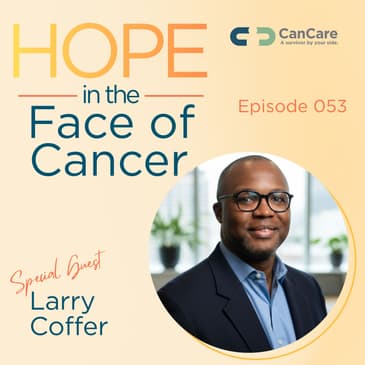
What can a cancer researcher teach us when he suddenly finds himself sitting in the patient chair?
Larry Coffer spent more than 20 years at MD Anderson Cancer Center supporting ovarian and breast cancer research, helping teams develop treatments and improve outcomes for patients. Long before his own diagnosis, cancer shaped his life through his stepfather’s battle with colon cancer. That experience inspired a career dedicated to helping others. Then, while training for a marathon, a routine physical revealed a rare cancer called extramedullary plasmacytoma. What began as a standard checkup quickly became a life-changing journey.
Larry shares what it was like to move from researcher to patient, receive treatment at the institution where he built his career, and navigate the uncertainty that comes with a rare diagnosis. He opens up about the emotional toll of cancer, the importance of leaning on friends, family, faith, and community, and how running helped him process the experience. He also discusses his work as a stem cell donor and advocate, helping others understand the life-saving impact of bone marrow and stem cell donation.
Larry’s story is a reminder that a diagnosis does not define who you are. With support, purpose, and hope, it is possible to keep moving forward one step at a time.
Highlights:
· How a routine health screening uncovered a rare cancer with no warning signs
· What changes when a cancer researcher becomes a cancer patient
· Why support systems matter even for the people who seem strongest
· How running, faith, and community can help during treatment and recovery
· What stem cell donation really involves and why more donors are urgently needed
Mentioned Resources:
CanCare- www.cancare.org
Larry’s Marathon Fundraiser for CanCare - https://fundraisers.hakuapp.com/larry-coffer
About the Guest:
Larry Coffer is a plasma cell cancer survivor, cancer researcher, stem cell donor, and marathon runner. For more than 20 years, he has led groundbreaking research at MD Anderson Cancer Center focused on ovarian and breast cancer. Then a routine physical before a marathon changed everything. Larry completed 20 rounds of radiation and rang the bell in January 2026. His running community has a special connection to CanCare, a full circle moment. Larry shares what happens when the science becomes personal, and what he found on the other side.
Love the podcast? You’ll be moved by the book. The Hope in the Face of Cancer book shares inspiring, real stories from survivors, caregivers, and healthcare heroes. Raw, uplifting, and full of heart—for anyone seeking hope and connection. Get your copy: cancare.org/hopebook.
About Our Host:
Darcie Champagne Wells is the President and CEO of CanCare, Inc., a nonprofit dedicated to providing support to the cancer community by pairing cancer patients with survivors. Since joining in November 2020 as the third President & CEO, Darcie has driven significant growth, increasing one-to-one support matches by 45% and healthcare referrals by 66%. In 2022, she initiated the Impact Acceleration Initiative to further expand support for cancer patients and caregivers. Her leadership has earned her recognition as a “Most Admired CEO” and “Woman Who Means Business” by the Houston Business Journal, and national “Fundraiser of the Year” by RAISE. Darcie holds a BS in Business Administration from Louisiana State University and an MBA from the University of Houston.
https://www.facebook.com/CanCareInc
https://www.instagram.com/cancare_inc
Thanks for tuning in to Hope in the Face of Cancer!
We’re so glad you’re here. If this episode moved you, inspired you, or brought you a little bit of light, please share it with someone who might need it. Just hit the share button on this page or spread the word on social—your voice helps us reach more hearts.
🎧 Never miss an episode!
Subscribe on Apple Podcasts, Spotify, or wherever you get your favorite podcasts to get updates as soon as new episodes drop.
⭐ Help us grow with a quick review
If you’re enjoying the podcast, leaving a review on Apple Podcasts goes a long way. It helps others discover the show and reminds us that these stories matter. Take a moment to leave a review—we read every one!
📖 Enjoy the podcast? You’ll love the book.
Check out our book, Hope in the Face of Cancer—a powerful collection of real stories from survivors, caregivers, and healthcare heroes. It’s uplifting, raw, and full of heart. Get your copy at cancare.org/hopebook.
[00:00:08] Welcome to Hope In The Face of Cancer, a survivor by your side. Here we share hope and support to anyone in their cancer journey. I'm your host, Darcie Wells, CEO of CanCare and a cancer caregiver. Whether you're a patient, caregiver, survivor, or healthcare provider, we are your cancer support community, together uplifting each other every step of the way. No one should face cancer alone.
[00:00:37] Welcome to Hope In The Face of Cancer, where we share real stories of courageous people in their cancer journey. Larry Coffer knows cancer from multiple angles. As a teenager, he watched his stepfather face a cancer diagnosis, and that experience shaped the rest of his life. It led him to MD Anderson, where he spent more than 20 years leading cancer research focused on ovarian and breast cancer.
[00:01:04] Outside of the lab, Larry became a stem cell donor and a passionate advocate for stem cell and bone marrow donation, giving a part of himself so someone else could have a healthier life. He's also a dedicated runner, someone who finds strength and clarity on the road. One day, a routine physical before a marathon changed everything, and cancer became a bigger part of his own story. Larry went through 20 rounds of radiation and rang the bell this past January.
[00:01:33] We connected with Larry on a special night, his first night back out with his running community, a community that CanCare is proud to be a part of. It was one of those full circle moments you don't plan, but you'll never forget. Today, Larry shares his journey as a researcher, patient, and survivor. What it was like to face cancer in the very place he built his career, and what he discovered when the science became personal. Larry, we're so glad you're here, and thank you for sharing with us today. Thank you for having me, Darcie.
[00:02:04] Absolutely. So, you spent more than two decades walking the halls of MD Anderson. Yeah. But before you wore that lab badge, cancer had already really touched your family. So, tell us a little bit about your stepfather's cancer journey. You were really young. Yeah. I mean, so, I was young. I mean, my family experienced that with my stepfather when I was growing up. He had colon cancer.
[00:02:30] And at one point, you know, as a kid, you know, as a teenager, you don't expect your parents to suffer that much. And really just seeing that journey with him going through the chemo, losing hair, that whole process, it left an imprint on me. You know, I just really remember him, just the strength of him. I mean, because he's a big guy. He was a big guy.
[00:02:56] And just having somebody that, you know, that strong, just going through that, it just puts an imprint on you and just tough on the family. So, you know, that was always something that I wanted to do. I wanted to get into medicine, and I think that led me to going to College of Baylor. So, yeah. And I got to say, for those that are listening and not watching, he's sporting his Baylor gear right now. Always. So, he's quite passionate about the Bears. I'm quite, no, I love, you know, love being a Baylor Bear. So, yeah.
[00:03:26] Awesome. So, tell us about your work at MD Anderson. You know, what do you do, Dave? I mean, we talked about ovarian and breast cancer research, but like, what does that look like for those of us who don't operate in that world every day? Yeah. So, my, I started off as a research assistant, you know, at the ground level. I just was at the bench doing cell interaction studies. So, looking at drugs that interacted with other agents.
[00:03:50] What my initial lab was looking at is how drugs interacted with the types of things that cancer patients were taking. So, if they were taking something in addition to their treatment, we would understand how those treatments would interact. Also, we'll look at drugs that cross the placental barriers. So, a lot of the drugs that we prescribed to patients, seeing what those doses would look like for the fetus.
[00:04:19] And that was a lot of my early initial experience, hands-on ground work. And now, as a manager and a manager of people, just trying to make sure that the teams that we have have everything they need, the resources they have, making sure the systems work, ensuring that, you know, the facilities and everything, those sorts of things work for everybody. And the protocols that they have are optimal. So, yeah. That sounds like exciting work. And you're certainly making a difference.
[00:04:47] And we thank you for what you and your team do every day because you certainly are breaking barriers for anyone facing a cancer diagnosis. So, you know, we met you, you know, serendipitously at a running event. And you've been a runner for a long time. You went in for what you expected to be a physical, right, before a marathon. And that's really when everything changed.
[00:05:16] Tell us about that experience. Yeah. So, I joined the Brian O'Neill's Running Club back 2008, 2009. And I've been running marathons. I've run six marathons at this point. And, you know, I, as, you know, everybody got hit by COVID and I was getting back into running again. And I was gearing up for another marathon in Philadelphia. And, you know, I just thought that maybe I just should do some extra tests for myself just to see, you know, my carotid artery had any plaque.
[00:05:46] And so, when I went in just for, it's just a physical, just a regular physical. It wasn't something that I thought that I had. I had no symptoms. I came in and the technician was doing an ultrasound on my neck. And she looked up and she looked down. I looked up and down on the ultrasound. I was like, this is not normal. This shouldn't be here. This is where this is at on my neck. This shouldn't be here. And she said, this mass is 17. You need to go see somebody about this.
[00:06:14] And so that it's really a miracle because I had no symptoms. I was not losing weight. I was trying to prepare for a marathon. So that was not even closest to anything on my mind. And so, you know, you have that shock of, oh, wow. Like, this is happening to me. You know, you have the statistics that one or three people will get cancer. But this is happening to me now. And so processing that in real time and then just trying to, you know, I knew where to go.
[00:06:43] I work at MD Anderson. So I was able to get an appointment and see somebody right away. But just trying to process it, not expecting that diagnosis. It just takes you back. Well, you're on the other side. You know, you're coming at the cancer journey from a different perspective as a researcher. Yeah. And all of a sudden, it becomes very personal. It does.
[00:07:07] So tell us about the diagnosis and the treatment, you know, once you went in to MD Anderson and to get it checked out. So, yeah, after a biopsy and a couple other tests, they diagnosed me with extramedullary plasmacytoma, a disease I never heard of. There's so many cancer types. This is one of the rare ones. It's a plasma cell cancer. It's a form of myeloma. So it's on the same spectrum as multiple myeloma.
[00:07:37] And so I knew my myeloma. I knew what that is. And so, of course, when you get the diagnosis, in my experience, you know, I'm looking at the literature. I'm just trying to see, oh, what does this mean? I can imagine you were very intense about that research. Of course. And so, you know, just making sure that I understood what this means for me, you know, explain that to my family. Right.
[00:08:00] So I think that for the whole journey, that was the hardest part, telling my family what my disease was and trying to explain to them, you know, this is what this means. You know, I have, you know, it's a disease on my plasm cells. And just, you know, reassuring that, you know, I can tackle this so we can tackle this together. So that's that was that's how, you know, that's how I process it. And, you know, I have been been to this for 20 years.
[00:08:25] And so on this side of it, I just I think I had more thought to like, OK, that's a panic about what what's going on with me. Understanding what the radiation is going to going to do and that type of treatment and how those effects will affect my skin and those sorts of things. So, yeah, I definitely definitely different experience on the other side. Yeah. Well, and being that it was such a rare cancer, you were fortunate to be where you are.
[00:08:54] Was there a lot of experience among MD Anderson folks with this cancer? Yeah. So I mean, I have the expert of experts that's treating me. And so they, you know, any I think the phrase that we use here and nothing is rare here. So we deal with all kinds of.
[00:09:16] And and the team is just so, you know, the team I have here and I'm not just saying as a as a employee, but the team just really cares to the to the knees. And like even as even as an employee, there is some unsurety of like what's going to happen. Like, what does this treatment mean for me? And then just trying to explain to me, even as a researcher, just to say, hey, you know, this is what's going to happen. You know, we're going to your your type of cancer is sensitive to radiation.
[00:09:42] We have a high, high thought that this is going to want to cure what you have. And so we're going to do this part first and we're going to do some tests down the line and see how things go. So you started with radiation? Yeah. Yeah. Yeah. I did 22 rounds of radiation back in December. Yeah. I kind of pushed myself. I did my radiation before I went to work. So I went to work every day of my radiation treatment. So I would plan my radiation at 7 a.m.
[00:10:12] to my radiation course. It took about 20 to 30 minutes for that, that type of treatment. And then I would I would go back, go to work, go to my office. I would walk 20 minutes to my office. And so I would in my mind, I would have this switch. So at 7 a.m. I'm a patient. And then at 8, 9, I'm, you know, back at work. So that that switch was definitely switch. I could feel that, you know, I'm back at work now trying to trying to cure some dialysis. So, yeah. Yeah.
[00:10:40] I can only imagine that gave your work a whole new kind of purpose, level of purpose. You know? Yeah. And I let lately I've been trying to demystify the research that we do. The last three years, I've been trying to do lab tours for some of the patients and patient advocates. This was brought up by Tara Arnold. She's a great patient advocate that we have here with the IBC program. And she mentioned to me, like, we want to know what you do in the lab. It's like, oh, you know what?
[00:11:08] Let's do a lab tour to kind of see, show people what we do, the patients, what we do, like what instrument we use, what type of the animal models that we use for their treatment models. And really for the, even for the staff, like seeing the patients that for them coming in and say, this is, these are the people who we're helping. And it was just beneficial for everybody around. And just trying to break down those bridges of understanding and making sure that, you
[00:11:35] know, they knew what we were doing and everything that we're doing is just for them. So yeah, that's wonderful. Love to hear that. So you went through over 20 rounds of radiation. Was there any other component to your treatment plan or did it pretty much end there? To 22 rounds of radiation. We, I did some blood work a couple of weeks ago and things are looking good. So I'm still on, on the journey. We have another course of blood work and another biopsy coming up in May.
[00:12:02] So I'll do that and they'll see how that course of treatment was working, but it seems to be, have done the process. So it seems to have worked. How do you think you're being a scientist impacted how you processed your own journey? You know, I, I think about that and I, I, I like to say, you know, I was, I had a little leg up, but when you still, you're still, I'm still a patient, right? I'm still, you know, I still process the same.
[00:12:30] I still have those, you know, I have the fear for my family and just those, those sorts of things are real. And yes, I knew some of the terminology, terminology was easy for me to understand, but you know, you're, you're still, still human. You're still trying to navigate this thing with your, your, your doctors and nurses. And, but yeah, I, I think, you know, even, even when I went to some of my, my treatments or in my appointments, I said, oh, you work here.
[00:13:00] So they knew that I knew what was going on. And so, you know, that, that, I guess that helped. And, and I think that just kind of helped me, you know, throughout the process and just, just learn about my disease. But yeah, I think I'm still a patient. I know I, I, I took it processes, processed it like that. So what did you learn about being a patient? Oh, it takes time. I mean, a patient, being a patient is, um, it's, it's, uh, it's a process.
[00:13:27] Uh, you know, I, you see people in the hallways with their families and, and, and you, I kind of understand that now, like that, that toll, there's a toll to be a patient that some people don't understand. And, um, they, um, it's, it's, you know, it's time it's, it's waiting. It's, um, worry. And those things are real. And, um, I, as I'm going through this process, I know those things are real.
[00:13:55] So, um, yeah, I, um, definitely was, um, you know, being on this side is something that, you know, just opens your eyes to the realities of it and just to all the things that, uh, that you'd have to endure. So, yeah. You talk about how you went straight from, you know, your radiation appointments right to work. And I would imagine that was part of a coping mechanism for you too. I think so.
[00:14:24] I think I wanted to, you know, I, I wanted to, to, to continue to have my mind going on something else. I still want to work and just try to, you know, I, I did, did keep my family away from my treatments. I just wanted to kind of go through that process alone. Cause I, I think I just, you know, wanted to kind of, kind of go through it and get through it and just kind of make the process faster. In my mind, I was trying to maybe make the process faster and just trying to, you know,
[00:14:53] it's a reality that, uh, that, that is new, but, um, you know, just making sure that, uh, you know, I, I, you know, could still focus on, you know, my task at hand, cause I have to come to work and try to do things for the patients that rely on me. So, um, you know, as a researcher, I still have to help, help my teams, um, make sure they, they have the optimal things that they need. So yeah, it was just really a coping mechanism for me.
[00:15:21] How did you allow yourself time to process the emotional part of the journey, you know, by pouring yourself into work, I could see how it could kind of delay or defer, you know, some of that hard stuff that there's, there's a lot of delay and a lot of defer. I, um, you know, even with, with a rare disease, trying to, to find a, a, another person with this, I, I, I'm still trying to find a couple of people who have had this visit.
[00:15:50] I, you know, there are people with my, I want to, they're, they're people too, who've gone through that process, but what is the process for me? What is extra-visual, extra-visual, like plastic side, Tomo, what, what was that process for me? So, you know, I, I, um, I have a good, good, you know, family, good friends who helped me, you know, through this process. Um, faith, um, has, has brought me, taught me a lot. And, you know, I think that, um, those things have been, been, uh, what I've relied on through this process. Yeah.
[00:16:21] Yeah. It sounds like you have an amazing support network for sure. Yeah. Have you ever been successful in connecting with someone who has your specific diagnosis? You know, I've, I haven't had yet, but I'm trying, I'm still looking and, you know, and maybe that's something I've, um, um, being called to do too, because it's, it's a, it's a rare disease. Um, I've met people with smoldering, um, plasma, uh, smoldering, uh, myeloma and, and
[00:16:47] those, um, those other, um, subtypes along the spectrum. But, um, for somebody with my specific one, I haven't yet, but you know, it'll, it'll, time will come. And I, I mean, I'm early in the journey, so, you know, I'll find a group to kind of. That would be great. Yeah. I'm sure there are others out there thinking that they're only ones too, you know? Yeah. Yeah. Yeah. Definitely.
[00:17:11] So who or what would you say was your anchor through this and maybe showed up in ways that you didn't expect? I mean, you know, I have, I have a good, my Baylor support group. I have a group of friends that, that I, um, I went to Baylor with there. They're, they've stayed with me through a lot of things.
[00:17:36] Um, I have a core, like four, four guy friends that I talked to and had helped help supporting me through this. And, you know, none of them have had experienced cancer, but they, they knew me, they knew how to support me. Yeah. And so, um, that was just, um, that was something I really needed, especially without a specific person who didn't want to with my disease and family. You know, of course the always there in my church family as well, but my Baylor family
[00:18:04] has definitely, um, definitely stepped up. I did, did lean on them a lot. That's wonderful that you have them. So you had a big milestone not too long ago. Uh, so January 15th, you rang the bell. Yeah. Yeah. That was, I mean, you, you see stories about you see, see the videos of people bringing the bell and I, uh, it was very, you know, very emotional, right?
[00:18:32] It's of course it's, it's the end of, uh, of that toll. I was going through Thanksgiving and, um, and Christmas, you know, I, I went on Christmas Eve to a treatment. So I'm really chugging through through the new year to the, um, to get finished. And it's just that, that release on the 15th, uh, January 15th, just to, um, you know, be done with this treatment.
[00:18:57] And, you know, of course my, my care team, um, the radiation therapists who were working with me, they're awesome. And just really, really helping me be comfortable, um, during my treatment. And, and it's, it's just, um, really a blessing to be, uh, be a part, um, be, been held cared with a good team. So, yeah. Yeah. Yeah. That's phenomenal.
[00:19:22] Have you felt, I know it's been, it hasn't been all that long, but how has it changed your perspective or, you know, how you feel since that moment when you got to ring that bell? I mean, one of the first things you did was get running again. Yeah. I wanted to try to get running again. I'm, I'm actually trying to train, um, and, and raise some funds for a good group of people at CanCare. So, so I'm going to be, um, running the Philadelphia marathon and raising funds for you guys, but you know, life has changed.
[00:19:52] Uh, I think, um, I, you know, been pouring myself back into my running community and running, um, uh, that's, it's a support for me. It's, you know, it's, it's relaxing and it's, uh, something I do therapeutically, pour myself back into my work and kind of refocus for myself. And, um, yeah, it's, it's, um, definitely another, uh, another chapter in my life, but, um, you know, I'm, I've been, um, I'm fortunate just to be blessed with a lot of people who've cared for me.
[00:20:22] So. Let's talk a little bit about your work. Yeah. I would love for our audience to hear, you know, what are you working on that maybe excites you the most right now? Well, exciting. I, I, I kind of do some of the, I'm doing some of the nerd work right now. Um, I don't know how much exciting this is going to be, but I am working on a database. And so, um, essentially I am organizing the material that we have collected on clinical trials for our teams.
[00:20:49] Uh, so if a clinician wants to understand what material we have to do a research study, I'll be able to help them identify the material for a clinical trial or a study that they want to develop. Um, in addition to that, um, trying to, um, map this with, um, some of the new AI models and digital twin models that we've, um, we've been, um, blessed with, with the institution. And so, um, yeah.
[00:21:16] So trying to understand, and, and with, with that, um, the digital twin model, trying to develop these, um, these, uh, treatments that are less, less toxic and, uh, and, and can, um, uh, maybe reduce, uh, the burden on the, on the treatment. So that's, that's why what I'm doing, working on now and still assisting the teams at any, um, protocols that they need and animal protocols, those sorts of things. So, yeah. Yeah.
[00:21:42] I think as lay people, we don't have an appreciation of all that goes on behind the scenes. Like there's people out there studying how all different drugs can react and, you know, how, how you can intervene on that and, and make better outcomes. There's a person for that. Yeah. There's a person for that. There's a whole team for that. Yeah. There's a whole team for that. Yeah. Really? Yeah. There are. That's amazing. So before your diagnosis, you were already really giving of yourself, um, in a very profound
[00:22:12] way. You're a national stem cell donor. What prompted that? Yeah. So, um, back in college, um, back when I was a graduate, um, graduate student, I signed up for, um, be the match, which is a stem cell, um, organization that helps match patients with people who were, uh, donate stem cells or bone marrow. And, um, I signed up not, you know, of course with my stepfather's, you know, disease and
[00:22:40] condition in mind, I signed up and wanted just to try to help back, help get back to somebody who would need, um, I got called 20 years later. So I'm in my forties and I get a call from somebody saying, Hey, you're matching a person with, um, uh, with myeloma. And, and, um, and I kind of think to myself, like, when did I sign up for something like that? I remember doing this 20 years ago. And, and, and I was like, Oh yeah, this was the thing.
[00:23:07] I did the cheek swab and they, they, um, sent my material on. So, so they, they told me like, yeah, you're, you're a, you're a good match for somebody. They, um, I think they were in their seventies and they, um, that you were, you were, you're a great match for this person. Would you want to do another follow-up test to ensure that you're, you're good potential match? I say, yeah, sure. If I can help and I can, and fortunate I was, and, um, I, um, gave stem cells. So with that process, you can either give bone marrow or you can give stem cells.
[00:23:36] And I think the preferential, um, course for me was to, to donate stem cells. And so I, I did that, um, four or five years ago. So, um, you know, I went through that process and I've been a blood donor for my whole life. So it wasn't a scary process for me to, to give blood. And, um, so I was able to do that. And, um, when I finished that, I was like, you know what, I want to do more than just, just give my stem cells.
[00:24:01] I want to make sure that, um, especially with, um, people of African-American descent to, to understand we need people on the registry. And so for the last five or five years, I've been an ambassador for this organization and trying to, to talk to colleges and talk to, um, organizations on the importance of stem cell donation. Um, this has been, this has been the, the outside of running and outside of my work has been a
[00:24:25] passion that I've, I've, I've, I've done, um, just, just making sure that they understand, you know, it, it can be scary to, to, to have being poked or being, you know, with a needle and just helping them understand the process. So it's kind of just demystifies that and just trying to make sure that we, we were getting people on the registry. We're getting that, but, um, cause there's just somebody on the end that's waiting for a donation, waiting for somebody to match them. And, and it's a genetic match that we need.
[00:24:54] And so, um, yeah, that's what I've been doing for the last outside of my work and, um, extracurriculars. That's what I've been doing. Well, it's amazing that just a few years ago, you saw that, you know, play out and, um, um, you know, there was a real person on the end of that, that got benefit of, of your stem cells for the lay folks out there. Um, like myself, what, what's the difference between giving blood and giving stem cells? What's the difference in the process and where do you go to do that?
[00:25:24] You know, for someone listening out there who says, Hey, I might want to do that. Yeah. So, um, uh, the national Maradona program is the organization that I donated my stem cells too. And so for me, when you give blood, you give, um, you know, give a couple of packets of blood, but for, for this type of process, it's, uh, it's, uh, they, they draw blood from one arm and they return the red blood cells in the other.
[00:25:49] So they're all really isolating the stem cells, um, that, um, that you've been producing. And so, uh, I, I did my, uh, uh, donation in San Antonio. Um, they, they have donation places all over the world. Uh, world, I believe actually MDRCM was another site, but I think for some reason scheduling, I couldn't go to MDRCM.
[00:26:12] So they, um, the, uh, what they do is they, they give you a drug to increase your stem cell count. They draw that blood at a, about a week out from that, um, uh, that drug, um, when you're taking that drug and, um, they want to ensure that you, um, have enough count to, to, to withdraw. And so we did that draw and, um, uh, they pack up your stem cells and, and, and put it on ice and ship it to the patient that needs it. That's amazing.
[00:26:42] Well, thank you for what you do. Thank you for making an impact like that, both in your personal gifts and in your advocacy work. It's critically important. So you've been a son watching your father's cancer journey and a researcher searching for answers and a donor giving life to strangers. And now you're a survivor. So with all those chapters behind you, um, what is on the horizon for Larry?
[00:27:10] Oh, you know, just continue, um, giving, giving the gift that God's given me. He's given me life to, to talk about, you know, my process and my journey. It's a, it's a chapter of my life that, um, that, uh, it's just new for me. Um, I'm not my diagnosis. I'm, you know, I'm still Larry. I'm still the runner researcher, um, and, and, uh, son and, and, uh, brother.
[00:27:34] And I think that, um, you know, I'm, I, I, you know, looking back at everything and I think it's, it, I think a lot of the things that happened, I think it's just God talking to me, like having a disease along the same, same spectrum as the, the, um, the, uh, the stem cell donation I gave to. So the person who was on the other end had myeloma.
[00:27:58] And so that's just one of those moments like, okay, this is happening to me. Yeah. This is something that's happening to me. Very purposeful. And when I'm coming out of treatment and finishing up my, uh, my, um, therapy, I come to my running club and not knowing who's going to be there. And I see your organization. I'm like, you know what? You don't have to talk this loud. God, someone else is pulling the strings here. I mean, it's, it's just one of those moments, right?
[00:28:28] It's like, this is, this is for me to do. And I'm, I'm just, you know, just want to just glad to be a vehicle of it. I, I, um, I'm just, it's a, it's honestly, it is when it's caught, I think they caught it really early. And so just a really, um, really fortunate, um, for my team, just, um, just catching it early, treating me early and being able to talk about, um, the disease and, and really, um,
[00:28:53] still continuing to help, um, people, uh, you know, uh, understand what cancer is and, and what it, you know, what, what it can mean. And that's, that's, that's, that's, that's, uh, that's the, uh, the new story that's being written now. So happy to do it. So as far as, um, your diagnosis is concerned, what is that path look like for you and the years to come in terms of, you know, monitoring and. Yeah.
[00:29:21] So, yeah, I'll, I'll be monitoring this for the rest of my life. It is one of those things that, um, it, it does, there's a chance, um, that it could develop into myeloma, myeloma, but, um, they're, they're a team that are really confident that the radiation is going to, to be curative. And so the goal right now is, has been curative, but I'll be monitoring my blood for the rest of my life. I'll every, I think six months and then I'll do some blood work or maybe do a biopsy, but
[00:29:50] it's something I'll monitor, but, um, I know where to go. Yeah, that's right. Down the hall. Down the hall. And so I, uh, I, you know, I I'm just put, just blessed, you know, I just, just been put in the right place and just, um, just, you know, just ready for this chapter. So I know it hasn't been all that long since you've rung the bell. And oftentimes it takes months and sometimes even years to realize the impact that cancer
[00:30:18] has had on your life and how it's changed you. Um, and sometimes there's gifts from that experience. What have you learned about yourself? How has cancer changed you? And were there any gifts that came from this journey? You know, I, um, just, I'm, I'm, I consider myself, uh, I'm, I'm a, I'm a social person, but I'm a private person.
[00:30:42] And just being able to rely on people was a challenge, but now having to rely on people because the emotional part is something that I did not expect. It was a different thing for me. And, and really being fortunate to have, we were friends that, um, that could rely on just to kind of, Hey man, I'm going through this and this is just tough. Like, um, you know, worried about this, worried about that.
[00:31:10] How do I, and really, really having, um, the ability to, to lean on people. And it's just something that I've learned to do. And maybe being more vulnerable than maybe you've been in the past. Yeah, definitely. Definitely. Definitely that. Yeah. So that's, that's, that's new and, and, but that's, that's the process now. And so, yeah, everything is growth. So, yeah, absolutely.
[00:31:34] So there's someone out there listening right now to your story and maybe they've just received their diagnosis. What would you want to leave them with? What would you want to share with them today? There, um, you know, depending on wherever you go, no matter where you go, there's a, there are people wanting to help you, um, either be your clinicians or, or be other patients
[00:32:02] there are people who are willing to give you support and just being able to reach out to them. Um, you are not your disease. You are still the whole person that you were originally, but this is just a chapter that you're going through. And, uh, just, just understand that there are people who are ready to support you through this journey. And, um, and it, there's nothing, um, nothing broken about you when you receive that diagnosis.
[00:32:30] You're, you are a fully hooked human, fully, fully full person that you are. And just know that there are people out there that are wanting to help. Yeah, absolutely. Thank you, Larry. Thank you for, for sharing your story. Um, so close from, you know, ringing that bell and for all you do and your dedication to your work and the research, um, being a stem cell donor and advocate. Um, thank you.
[00:32:59] You're, you're making an impact on so many people's lives and we are grateful for you sharing your story with us today. Not a problem at all. Well, if you or someone you love is facing cancer, CanCare is here to support you. And we encourage you to reach out to us at CanCare.org to learn more. And if you're a cancer survivor or a cancer caregiver and you feel led to support someone,
[00:33:26] maybe who's just heard those words, you have cancer, we would love to have you in our CanCare family. So visit CanCare.org to learn how to get support or to volunteer. Until next time, remember there is always hope in the face of cancer. Thank you for joining us on this episode of hope in the face of cancer, a survivor by your side. If you or someone, you know, is facing cancer or is supporting a loved one through their
[00:33:56] journey, we invite you to share this podcast as a cancer survivor. Your journey carries invaluable wisdom and insight. We would love for you to get involved in CanCare's mission by becoming a survivor by the side of someone facing cancer. Please visit our website at CanCare.org slash volunteer or click the link in the bio for more information on how to get involved. Our survivor volunteers have been a beacon of hope for so many.
[00:34:23] Thank you for your support and our efforts in the cancer community. No one should face cancer alone.