
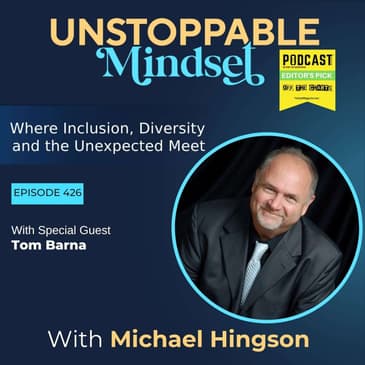
What happens when a life of constant movement, war, and personal struggle finally forces you to start over?
In this episode, I sit down with Tom David Barna, whose journey spans growing up in a military family, serving in the Marine Corps, living in a mud hut in Africa, and facing the realities of war and addiction. Tom shares how those experiences shaped his perspective on resilience, identity, and purpose. You will hear how he rebuilt his life after hitting a breaking point, found clarity in solitude, and ultimately discovered a new path as a playwright. This is a powerful conversation about growth, failure, and the importance of setting goals with intention. I believe you will find this both inspiring and deeply human.
Highlights:
00:01:04 – You will learn how growing up moving constantly shaped adaptability and identity00:20:51 – You will discover why choosing the hardest path can change your life00:24:26 – You will hear what living in a remote African village truly teaches you00:37:38 – You will feel the emotional reality of returning home from war00:50:49 – You will learn how hitting rock bottom can lead to real transformation00:59:41 – You will discover why goals need a clear plan to actually work Bottom of Form
About the Guest:
A playwright, retired Marine, former Peace Corps Volunteer, a husband-father, son, converted Catholic, always and forever on some diet, a one-time successful peddler of love and a never satisfied dreamer.
A graduate of Kaiserslautern American High School in Germany. A graduate of New Mexico State University (Who’s Who In American Colleges).
·As a twenty-two year old Peace Corp volunteer, I served in Burkina Faso (formerly Upper Volta) for two years. I lived in an actual mud hut, completely isolated from the outside world (with the exception of a small, short wave radio), and I nearly died from malaria (were it not for a traveling missionary who found me on the dirt floor). Living in an extremely poor third world country is not for the faint of heart or the naïve.
The son of a thirty year military veteran (dad is buried in Arlington National Cemetery), the son of a thirty year military civilian (mom is alive and well at 90 and still reading four book a week) and the brother of a twenty year Marine.
My own military career included assignments in Okinawa, Japan and almost twenty-four months in the middle east (first as a commanding officer in Gulf War I and as a logistics officer in the Afghanistan War immediately after the attack on September 11th.) I had the honor of serving under Jim Mattis, before his stint as war hero of lore and Secretary of Defense. After twenty-two years, I retired as a Lieutenant Colonel.
I have written over forty full-length plays (to include several musicals), forty-two short plays, author of multiple published children’s books, co-author of a thirteen part radio series, recipient of numerous artist awards and artist grants.
I have yet to see one of my plays performed on the Broadway stage; still working on that but just to be clear, I have enthusiastically embraced my own personal insanity as the prerequisite to writing for the stage. I am passionate and crazy—important traits for a writer.
As to that “peddler of love” reference… as unlikely as it seemed, this hardened Marine found himself on yet another career path; as the general manager of numerous national diamond stores (in Iowa, Illinois and Minnesota) and discovering that success was not in the selling of diamonds per se, but by selling love, memories and deep feelings. Trust me, it worked. I once testified before a judge in court how selling love was not an acquired skill, but an affair of the heart.
Now what? Other than my continued passion for writing, I’m not sure, but I’ve at times knowingly and more often than not, unknowingly trusted God with His plan, so why change now. Yeah, maybe the best is yet to come.
Ways to connect with Tom**:**
My website link:
www.Minnesotaplaywright.weebly.com
My LinkedIn link:
https://www.linkedin.com/in/tom-david-barna-6115431a/
My National New Play Exchange Tom David Barna page link:
https://newplayexchange.org/users/1245/tom-david-barna
Mankato Free Press link:
New Mexico State University Alumni Foundation email address:
About the Host:
Michael Hingson is a New York Times best-selling author, international lecturer, and Chief Vision Officer for accessiBe. Michael, blind since birth, survived the 9/11 attacks with the help of his guide dog Roselle. This story is the subject of his best-selling book, Thunder Dog.
Michael gives over 100 presentations around the world each year speaking to influential groups such as Exxon Mobile, AT\&T, Federal Express, Scripps College, Rutgers University, Children’s Hospital, and the American Red Cross just to name a few. He is Ambassador for the National Braille Literacy Campaign for the National Federation of the Blind and also serves as Ambassador for the American Humane Association’s 2012 Hero Dog Awards.
https://www.facebook.com/michael.hingson.author.speaker/
https://www.youtube.com/user/mhingson
https://www.linkedin.com/in/michaelhingson/
accessiBe Links
https://www.youtube.com/c/accessiBe
https://www.linkedin.com/company/accessibe/mycompany/
https://www.facebook.com/accessibe/
Thanks for listening!
Thanks so much for listening to our podcast! If you enjoyed this episode and think that others could benefit from listening, please share it using the social media buttons on this page. Do you have some feedback or questions about this episode? Leave a comment in the section below!
Subscribe to the podcast
If you would like to get automatic updates of new podcast episodes, you can subscribe to the podcast on Apple Podcasts or Stitcher. You can subscribe in your favorite podcast app. You can also support our podcast through our tip jar https://tips.pinecast.com/jar/unstoppable-mindset .
Leave us an Apple Podcasts review
Ratings and reviews from our listeners are extremely valuable to us and greatly appreciated. They help our podcast rank higher on Apple Podcasts, which exposes our show to more awesome listeners like you. If you have a minute, please leave an honest review on Apple Podcasts.
Transcription Notes:
Michael Hingson 00:04
What if the biggest thing holding you back isn't what's in front of you, but rather what you believe Welcome to unstoppable mindset where inclusion, diversity and the unexpected meet. I'm your host. Michael hingson, speaker, author and advocate for inclusion and possibilities. This podcast explores how the beliefs we carry shape the way we live, lead and connect with others. Each week, I talk with people who challenge assumptions, face adversity head on and show what's possible when we choose curiosity over fear, together, we focus on mindset resilience and the small shifts that lead to meaningful change. Let's get started. Well, hello once again, I am Michael hingson. I am the host of unstoppable mindset, and today we have a guest, Tom. David Barna, and Tom has a very interesting story to to tell. He's done a lot of things play, right? I don't know what all he's going to tell us all, and I'm not going to spend a lot of time giving it all away, because it's a lot more fun, as he tells it. So I'm just going to say Tom we really appreciate you being here, and welcome to unstoppable mindset.
Tom Barna 01:30
Well, thank you. You're an incredible guy. I'm humbled to be here. So give me your best shots.
Michael Hingson 01:37
Yeah, nah. No shots. Oh, vodka, I suppose. But no, no shots. Well, why don't we start? Why don't you tell us a little about kind of the early Tom growing up and some of those kinds of things that that got you started with whatever you do.
Tom Barna 01:54
Sure. So I'm I was born in McKees, rocks, Pennsylvania, which is a suburb of Pittsburgh, and I was my my parents are my grandparents are Russian. On my dad's side, they never spoke English. So I so I grew up with some grandparents who spoke Russian, and then my grandparents on the other side are French, Spanish and cattle ranchers. So my dad's side, they were coal miners, so coal miners on one side and cattle ranchers on the other. So pretty diverse, so to speak, my father was in the military for almost 30 years, and so what that means is I moved around a lot, and I always refer to myself as as a modern day gypsy. I hate the term military brat. Yeah, I think most of us do, but yeah, so that's where it started. So I spent my first seven years in in New York, of all places, upstate New York, huh? So you know, I could babble for hours, so you better cut
Michael Hingson 03:08
it well, a lot of lake effect snow up in upstate New York.
Tom Barna 03:13
Yeah, I know that's that was nothing, way more than what we get in Minnesota, which I was surprised. But yeah, no, I the the four seasons, and the snow as high as the buildings is, is how I grew up. I loved it was, yeah, it was outstanding.
Michael Hingson 03:30
Well, now isn't there a lot of snow up in Duluth?
Tom Barna 03:34
Yeah, that's, that's, they get a lot of that lake effect snow, and that's, that's good three hours from where I am right now. Yeah, I'm about an hour and a half south of Minneapolis. So we, you know, I guess in a good year, we'll get 100 inches if that's, if it's a good year.
Michael Hingson 03:53
I remember a couple of years ago here in California, we got socked in with lots of snow. Tahoe had something like 750 inches that year. And I know down here in Southern California, the ski resorts the mountains around where I live, got so much snow that some of the resorts were snowed in. Roofs collapsed because they had so much snow on them, a lot more than I'd ever heard of in California. But here where I live in Victorville, we had three inches of snow one Saturday afternoon, and it was gone the next day. So they Yeah, well, you know, on the other hand, I don't know whether it would have mattered to the kids, because the schools would have just gone and done zoom presentations and kept them in school anyway, but I I know that that the valley here where I live, although we didn't get a lot of snow, we got a lot of cold air. So you know, what do you do?
Tom Barna 04:54
Yeah, we get, for us here in Minnesota, where I'm at, February is the snowiest. Month, but January is the coldest month, so we can with wind chills 35 to 50 below zero. So yeah, don't go outside. We can get down to
Michael Hingson 05:10
zero a wind chill. And I've actually in Palmdale, where I grew up, about 55 miles west of here. I remember a couple of times when my brother and I were delivering papers, we went out and it was zero outside, pre wind chill. So it can get fairly cool here. We're about 20 850 feet above sea level, so we're in what's called the high desert, but surrounded by more mountains that get most of the snow.
Tom Barna 05:39
I spent part of my about another six years in California, in Northern California, so I spent a lot of time in Tahoe. So I love it. It's so beautiful.
Michael Hingson 05:51
We're in Northern California. Where are you?
Tom Barna 05:53
Just outside? About 50 miles outside of Sacramento. Okay, I live. Go ahead. I'm just gonna say I we lived when I was growing up. We would make do field trips to San Francisco to to see things like the ballet, like the nut cracker suite and things like that. But in general, I guess the Sacramento area not as, not as exciting you might think of California, but I loved it. We were actually stationed at a place called Beale Air Force Base, right?
Michael Hingson 06:27
I've been to Beal. I actually spoke there one year, awesome. But we lived in Novato, so we were in North Bay in Marin County. We were the northern most city in Marin County. So of course, we had things like the memories of Jerry Garcia in Marin County, but then we moved down here in 2014 and been here ever since.
Tom Barna 06:52
Well, you're in a good place. They've got a little sunshine to I mean, we'll go six months and see a few days of blue skies. So I am jealous of where you live, because it's the opposite. You see lots of blue skies.
Michael Hingson 07:07
We got a fair amount of blue skies, and when we get some of the other but that's okay. So you, you grew up, you went to high school and all that. Presumably, did you go on to college? Yeah, so
Tom Barna 07:19
I, my dad, had transferred for to Europe. So I went to Kaiser slaughter in American high school in Germany, what used to be called West Germany, which doesn't exist anymore, right? Yeah. So that's, that's where I went to school. In fact, my class, we just had our 50th reunion. So that's pretty amazing. Well, yes, I I went on to college at New Mexico State University in Las Cruces, New Mexico, and so it's the home of the largest pecan orchards in the world. Nobody guessed No.
Michael Hingson 07:55
What do you think about all this moving around that you did? How do you think that's helped kind of shape your outlook in in terms of life and so on, as opposed to being in one place all the time,
Tom Barna 08:07
I'm always amazed to meet people who've never left town. Just about a fellow the other day, he's lived in this town where I am now his entire life. I can't even imagine that. But this to answer your question. There's there's pros and cons. One is the only life you know so you don't know that you're missing anything or or that you have any advantages while you're doing it. But I can say in reflection that moving every three to four years means you learn how to make friends quickly and how to lose friends quickly. It's being, I mean, I spent six, six years in Japan, so I mean, the cultures that I've been exposed to, the People's languages, the foods, it's it has shaped me who made me who I am, obviously, and I, I suspect it might have been even more interesting, but more importantly, it I know that I'm a tolerant I'm appreciative person for people and their differences, and I like to embrace them whenever
Michael Hingson 09:14
I can. Yeah, well, I didn't move around much, but for other reasons, I think I tend to be a lot more tolerant being different from the outset anyway, but it is what you say is very true and very, very interesting, because you've been to a variety of different places and you've experienced a lot of different things. As a speaker for now, the last 24 years, I have traveled all over the US, as well as to a number of other countries, and people ask me what my favorite place is, and that's so hard, because I've enjoyed everywhere I've gone. Oh, I can think of pros and cons about most places, but I really enjoy traveling. I enjoy meeting people. Wherever I go. So I can't really say that I have some place that is so outstanding. I'd rather be there and nowhere else on the planet.
Tom Barna 10:09
Yeah, I'm with you. I would be hard pressed to name a place I didn't like. Yeah, it doesn't make any sense to me. They're all so different. So you're right. I love them all, but we'll get to this a little bit later, I suspect. But eventually, I decided that I wanted, when I started having a family, to finally settle down in a place where my my my kids, even though they've been once born in Hawaii, one's born in Japan, and one's born in Oregon. I wanted them to be from somewhere, because that's the hardest question I ever get. Where are you from? And I say, Pittsburgh. Oh, do you know this cafe or this bar? No, I don't. I don't know any of those places. But I wanted my children to be from somewhere. So even though they've lived or they were born from all, you know, basically all over the world, they do now say, when people ask them, Where are you from? They can say, you know, Minnesota. And I think there's a great strength in being able to say that. So it's it was the decision on why we chose to stop moving around.
Michael Hingson 11:21
So yeah, well, yeah, there are pros and cons, and hopefully, though, they will get to see a lot of the world, and it will help them keep a pretty broad perspective on things. How old are the kids?
Tom Barna 11:33
Yeah, so you're gonna ask me, there's gonna be tough questions. I'll have challenges with 8587 and 89 are the years that were born. So there you go, whatever that makes them so I was born, I'm married in 83 there we had 8587 89 that's it so. And then I got six grandchildren. Again. We get from 18 as the oldest all the way down to the youngest. Is I think 6am? I terrible or things like that. I just forget 4038
Michael Hingson 12:03
and 36 that's fair.
Tom Barna 12:06
They're gonna appreciate you sharing that number,
Michael Hingson 12:10
especially the girls, right? But anyways, but still I, you know, I enjoy traveling and speaking. I was out all of last week, and a couple of different places speaking, and I enjoy everywhere I go and and seeing different hotels, and even seeing how they manage what they do, is kind of fascinating. I just find it fun to be able to experience different things, and I will always make the best of it, because I think it's the way, the way to do it. The other side of it is, of course, I always do get to come home and and when I come home, as happened last night, when I got home, my cat started yelling at me because I was gone for a week. So, you know, that's the other part about
Tom Barna 12:56
it. Rightfully so.
Michael Hingson 12:58
So, yeah, yeah. Rightfully so. Who deserve it, yep, no question about it. So my guide dog and I came home, and I get yelled at, and I stitch the cat loves to be petted while she eats, so I had to spend a fair amount of time soothing the savage beast as we as we would say, Well, you're a good man. Well, we try so, so you went off to college and Las Cruces and so on. Then what did you do?
Tom Barna 13:25
So I basically, I had a one year scholarship, which, which was awesome. So then I could, I could obtain citizenship in the state and residency, and then I worked my way through college. I was everything from a key punch operator or White Sands Missile Range. Now that's
something. There you go.
Tom Barna 13:47
Nobody knows what a key punch operator,
Michael Hingson 13:49
I know. And
Tom Barna 13:50
then I actually delivered milk. I drove a milk truck, and I went to people's houses, and in some cases, I actually went in their back door and put their milk and cheese and eggs or whatever in their refrigerator. Again, probably not something a lot of people would know could be possible today, but no, but no. I worked my way through college and finished in four years, which was awesome. I was the first in my family that I know of had ever gone to college, so didn't really know what it was, and I figured out if I had planned this better going to finish in three years. But you know, I did enjoy myself. So I finished. I graduated in 1979 and I joined the PD score. Went to Africa.
Michael Hingson 14:41
Ah, now, when you were a key punch operator, okay, was Did your machine? Was it advanced enough, as it were, that it actually had a screen so that you could read the characters before you finally pushed a button and punched the card? Or did you have one of the older machines before they had screens on them?
Tom Barna 14:59
Yeah, there were. Screens. It was like, yeah, they would give you a big tray. I don't want us to call it of cards, right, like these large index cards, and it was zeros and ones. So obviously it was and so I was at my little ceiling, you're right. Punch it in zero, whatever you had to do it. And I think I was allowed to make two mistakes per trade or something crazy, but probably the most monotonous job on the planet back in the day,
Michael Hingson 15:28
that's what I did. That's what you did when I was a student at UC Irvine out in California, out here in California, somewhere along the line, probably in my senior year or first year of graduate school we were there were still all punching car well, a lot of it was key punch and we had terminals, but they had started getting some machines in where there was actually a screen where you could see all 80 characters that you typed and make sure that they all looked correct before you push the button. Then they quickly punched the card, and he went on to the next card. That was kind of fascinating, and that was a new, revolutionary thing. At the time, I didn't
Tom Barna 16:08
even know what I was doing. I mean, what I mean, I was a White Sands Missile Range. I mean, so you can suspect it was something, God knows why, but I didn't even know. But I wouldn't know if I had made a mistake, until I was really done with the Troy. So that made it, yeah, real stressful. Yeah.
Michael Hingson 16:25
Well, at Irvine we, we actually could, there was a keyboard, and you could type actual characters, and then it dealt with the zeros and ones. So it was sort of advanced. I guess that's college. What can I say?
Tom Barna 16:39
Well, this is cool, because I'd never met somebody else who's done this also so well. I didn't
Michael Hingson 16:44
punch, but I knew about them. I generally interacted from a computer terminal. Eventually, I, with the help of someone who who researched it and found out how to do it, we built a computer terminal that would print emboss in Braille, so I was actually able to truly use the computer for my first year at college. I wasn't able to read anything directly because there was no Braille device that would or a device that would print everything in Braille. But I learned how to tell the difference between when I type something and cause an error message to be printed, and when I created something that didn't have an error because it just sounded different when there was an error message. I knew I learned what the sound was so that if I didn't hear that, I decided must have typed something, right? But still, it was not the same as when I was able to actually read material, because it started being being embossed in Braille so I could read it, but it was a lot of fun. But yeah, key punch, I'm I'm very familiar with the concept, much less deck tape and other other kinds of media that people would use to program. We had a PDP 10, and we had an IBM 360 on campus. That was kind of fun. But, yeah, what an adventure. Huh? It was.
Tom Barna 18:15
I mean, I could only, I would do those kinds of jobs, typically during the summer, because during the school year, I was very focused on doing my academics, but, but, yeah, it allowed me to do a lot of different jobs. I was a resident assistant in the dorm for two years. That was, that was awesome, but I applied.
Michael Hingson 18:34
They hire me for that, and I applied for it, but they wouldn't. They wouldn't let me do it.
Tom Barna 18:38
Now, I would have hired you. Come on,
Michael Hingson 18:43
whatever, so you went off and joined the Peace Corps. Now, why did you do that?
Tom Barna 18:48
Okay, so it's kind of my, my life to to do the unexpected. That'd be a great title for a show the unexpected, but the I was grooming myself all my life, I grew up watching Perry Mason, you know, and loving it. And that's that was the life journey I was on was to become a lawyer. And I never asked myself, Why, or if I did, I studied so much law in in college, it was literally on a pre law degree program, and I discovered constitutional law, which was probably the driest for everybody else, but I love doing case briefing, but in the end, when it came time to make the big decision, you know, before taking the LSAT, and I changed my mind. I don't know where I'm I mean, I wanted to, maybe there's something. And there was a poster on the wall the Peace Corps, the greatest job you'll ever love, blah, blah, blah. So I might, I didn't even know the Peace Corps still existed. I mean, this is back in the 70s, and, yeah, it still exists. Did, and so I just did it so I didn't have to go to school. I guess, you know, it's just it. I didn't put a lot of thought into it, other than it was going to give me a break from academia. So there, you guys, I didn't even know what the process was. It was kind of a strange process, but off I went to, I went, actually, to get signed in, and everything was they joined a fraternity. They sent me to New Orleans, gave me a wad of cash. I don't, honestly, there's something slipped under your door, if you got us accepted. It was so strange. Anyway, I got, I got in, and they sent me off to to a country called today. It's called Burkina Faso. Back then it was Upper Volta. And you they spend three months in intensive training. You're like in a boot camp, a military boot camp. And you study all morning long. You study the programs you're going to go into, which in my my program was the French word for it, but it's kind of like a community organizer. And then the afternoon, we did languages, and there was, like two, two different tribes of people, plus French. So we did intensive language strings. So we did that for three months, and then it came the time to choose where you wanted to go. So you already knew what you were going to do, but where you were going to go, they gave you some choice, and I chose the furthest, most remote place that was going to be on that map. And there I went.
Michael Hingson 21:36
And why did you do that? Why did you choose such a remote place?
Tom Barna 21:39
I didn't want to be like everyone else got it. I didn't want to do the easy stuff. I wanted the toughest, most challenging. I didn't even know what I mean, what does that mean? I don't I mean, I didn't know. But I just know I wanted to be away from government and bureaucracy and people, you know, I wanted to get out into the culture, and they delivered me in the back of a Peugeot pickup truck, and we pulled up in the village. There's totally dirt roads, you know, it's it took, it took a day to get there. And they pull up into into my village, and it is a village, and in front of my mud hut, I really had a mud hut, and they dropped me off with my little bag of survival goodies, so to speak. And there I was for two years. It was an amazing, extraordinary experience, to say the least.
Michael Hingson 22:32
How were you received by people there
Tom Barna 22:36
again, I refer to this like going to Mars. No one. No one knows you. You don't know them. You have nothing in common. I couldn't talk about the Pittsburgh Steelers with them. I couldn't talk about anything. And they couldn't, you know those? These were people, good people, who were looking just trying to survive every day. Finding firewood was was a goal. In the morning, when the women got up, getting water from the well, finding something to eat, that's what their life was. So how was I received in the beginning, they kind of it was based on perception of who Americans are. They thought that I was going to as the American guy showing up in their village. I am rich. I have all the answers to life, and I have trunk truckloads of medicine and and so in the beginning, I would wake up in the morning, there'd be a line of people outside my mud hut waiting to meet me, so that they could ask me if I could help them, which I couldn't. I mean, not like that. I mean, I was there to help them as a village. But eventually, eventually, even though they were, they would call me this. The term they used for me was Nasara. And then anytime I walk around the village, and I was told eventually, initially it was stranger, but no, it actually met white guys. So it was I was received well and made some friends again. It's hard to make friends when you have absolutely nothing in common and you can't share or express or it's just hard. So I would get up in the morning and I would go to the marketplace, and I, once a week, I could find one tomato, and every morning that they would kill a goat and cook the goat meat on the grill, and I would eat goat meat. And then eventually, you know, it's you've heard of on island time. It's the same way out there. It's they say, I'll see you later. That might mean in three weeks. Very slow, slow, slow life. It's to slow down. Is the challenge, especially for an American, to go into a village and then just realize that no one's in a rush and back to. Just back when I didn't have there were no cell phones, and I had one little short wave radio I could bounce off a signal from Europe. But other than that, I had absolutely no communication with the outside world. My world were my villages. What tell me
Michael Hingson 25:14
what it was like being in a mud hut and what a mud hut is all about.
Tom Barna 25:21
So, you know,
Michael Hingson 25:23
and what, and what happens, it rains. But that's another story. Yeah, no,
Tom Barna 25:27
I was one of the fortunate ones on my mud hut. I had, like, a 10, so 10, a 10 roof, which, first of all, doesn't rain very much. I'm, I'm in the desert. I mean, in the desert, on bruises, literally, on the edge of the Sahel. I mean, it's just, it just doesn't rain. I mean, when it does, it's, it's a disaster, but it doesn't rain very much. But there's no furniture. There's no plumbing. I mean, my, my, I had a kind of a hole in the ground outside, which is where my sanitation, but it was kind of interesting. They would have these clay pots that they would fire fire. And you would, what you could do is you put them in a corner of your one of the rooms, and you, you put sand underneath it, and you, if you fill it with water. I don't I never understood the physics, but it actually the water would actually be cooler, and get cool than anything else, if you just left it outside. But then I would get one pail of water, one bucket, a bucket of water every day from a lady who would go two kilometers away and pull it out of a well, and then she would deliver it to me. And my one bucket of water was for washing, eating whatever I wanted. So, so it's, it's my mother or my grandmother, somebody sent me over, you know, eventually a hammock, which was awesome, because I didn't have to lay on the ground, on a straw mat. But I'll tell you a story. One night when I was laying in my hammock, in the middle of the night, I started like I was in being electrified, shocked like, like electricity was going through my body. It was, it was horrendous, and I fell out. But of course, there wasn't electricity. I was covered in man eating ants or something. It was a nightmare. But that's what it's like living in a mud hut. There's, there's, there's really no protection from anything, and it's you may as well be living outside, but, but you know, it is a place to collect yourself and and find some sanity.
Michael Hingson 27:40
What did you do about the bugs when they invaded your body?
Tom Barna 27:45
Yeah, so there was a hell of a swine swiping them off my body. It's only happened once. I don't even know where they came from, because there's really nothing alive out there. I mean, it was just amazing. So it was kind of shocking to say the least. But no, I didn't have there were, there were mosquitoes, which is why I, in that area where I lived, is one of the more dangerous forms of malaria, and we take, I believe that I can remember the name of the medication. It's called airline but, but there's medication that's supposed to it keeps you from dying. But there's, there's like, there's no vaccine, there's nothing preventative to keep it from from getting malaria when you're bitten, and all it does is you try to keep you alive. And we would take, I would take two pills every Sunday. But when you contact contracted the malaria, you basically OD on the pills because you need it, otherwise you wouldn't survive. And one time I caught it and and it's what happened. I don't know if you're familiar with malaria, but it's like fevers, chills. Fevers chills. Your body just goes back and forth. Finally, there's your body just gives out, and eventually you lay down a dock. But I did lay down and I was gone. I didn't really think I buy cold, cold world. You know, it's not like that. I mean, I had this for a couple days, and it was just I was delirious a little bit. But finally, I'm gone. I'm laying I'm laying there on the ground in my little mud hut. And next thing I know, I'm being awakened by an old French missionary who had was coming, just by chance, was coming through the town and came to want to see the this Peace Corps volunteer guy. So he came in on my family on the ground, and the East was French, and he their method is they could use pKa shots. So he was shooting me in my thighs, inner thighs, and he stayed with me for two or three days, nursed me back. And it was, it was fine. I couldn't give blood for seven years. But other than that, the. I've heard that you can have reoccurrences of this, of the disease, but I never did. So thank God.
Michael Hingson 30:06
So after two years, you came back.
Tom Barna 30:10
I did. I, of all places, I landed in Las Vegas, Nevada, where family was so in the middle of the night. So I go from a mud hut and and nothingness, and I land in Las Vegas, Nevada in the middle of the night, and you talk about, I can remember the shock. It was just I lost a lot of weight, so I was kind of thinned out, and I was in shock, and I ended up staying for a year. It was, I guess I was catching up on life, and it was so much fun. And so one day I said, I know this is not my destinies. To Las Vegas. It was fine for that year. In fact, that's probably too long, but so out of the blue, again, as was my nature, I go and I try to join the military. I tried the Army, the Air Force, and the Marine Corps. And the Air Force didn't have any openings. The army did and the Marine Corps did. I knew nothing about the Marine Corps, but this is, this is kind of sad any Marines are watching. But the reason I chose the Marine Corps was not because of of all that it stands for, and all that it is, but I had to go get a physical in Phoenix, Arizona, for for the military. And the army was going to send me by bus, but the marine corps were going to fly me down. So that's why I chose the Marine Corps, because they were going to fly me to my physical. Kind of sad, but that's why I chose it, and off I went. Be 22 years.
Michael Hingson 31:45
So what did you then do?
Tom Barna 31:49
So once, so I went to went to training, so I had a degree, so I was in the officers program. So it's, which is was important to me. I thought at that time I wanted to be a commissioned officer again. I didn't really know what all I meant. My dad was not a commissioned officer. So I had I was not against being a non commissioned I just Well, I have a degree, so why don't I see if I can take advantage of that? So I went through their officers training class in Quantico, Virginia, Quantico, right? And it was probably, I mean, it was, it's like being back in Peace Corps boot camp. I had no idea what I was getting. I had no idea, totally unprepared. And I'm in June and July and August. And if you know, you know Quantico, those are hot luck. And I went. I was not in shape, and I had it wasn't until I got halfway through that a light went on, and I finally realized I wanted to be a Marine. And so now I had new motivation. So got my commission, and while I went off to the next another six months of training with the Marine Corps, and it's called the basic school in Quantico, Virginia, which, again, I didn't even know I was going to have to do that. It turns out there's more school involved so much i didn't know i which is, again, if you know anything about me, it's odd that I didn't prepare a little bit, but while I was in the six month training, on a blind date, I met my beautiful wife, Carmen, and so we met in November. I proposed to her in January. We got married in March, so it's a very short and I was on the weekends because I was in training, and we just celebrated this last year, I think, 42 years together. So we our first duty station was in Okinawa, Japan, and off I went in my Marine Corps. Wow, Richie, go ahead. I told you I could blab blab blab.
Michael Hingson 33:58
Non Stop. You're You're doing fine. So you went through all the training, you decided to be motivated, and then what did you do as a Marine?
Tom Barna 34:10
So I I knew I was probably not the toughest guy on the block. And Marines are tough in general, right? I mean, that's what we count on. So I'm like, Well, I'm probably not going to be the best infantry man on the planet with the Marines. So I was able, fortunately, to choose what's called logistics. So basically it's a management of people, equipment and systems. So that was my specialty, which was another three months of training, but I got through that. Loved it. So basically, I did things initially in my career, I loaded some of the largest ships. I was in charge of loading some of the largest ships out there. I've loaded equipment and on trains and in planes. It's amazing. But I did it and my. First assignment in the Marine Corps in Japan was to a unit which, again, doesn't exist anymore, called first track vehicle battalion, which had tanks and amtraks. Those are those amphibious vehicles that swim from ship to shore. And it was amazing, because that unit always deployed, you know, when on missions out of the Pacific. I loved it, so that was my first duty assignment, and that's what I did. So I learned it. I thought I wasn't too bad at it, because I could manage people, equipment and systems within the Marine Corps.
Michael Hingson 35:34
So, so you ended up moving around again, yep.
Tom Barna 35:42
So did you know Kanawha? I had a good tour, so I ended up on a career path such that I found myself as a recruiter in charge of the check this out. My area of responsibility as a recruiter, an officer recruiter. So I recruited students, basically in college to join our programs in the Marine Corps. And I had southern Washington, all of Oregon, Western Idaho, Hawaii and Guam. So I could because Guam was over the International Date Line, right? So I could literally work eight days a week. It's pretty amazing, but so yeah, I recruited for three years, and that's where I first met General Jim Mattis. They call him an ad Dog Mattis, but I knew him. He was my boss. I knew him when he was a major and one of the most extraordinary men in my life. And I would meet him again the second time I went into the desert for war, but that was the first time. Was he was my boss in recruiting, and I was fishing in Corvallis, Oregon. There you go.
Michael Hingson 36:58
Well, so you, you've been both you in the original Gulf War, and then you fought in Afghanistan, or you served in Afghanistan as well. Yeah, so
Tom Barna 37:09
the Gulf, the first Gulf War I was stationed, and at that time I had been transferred to Hawaii. I know, tough duty, but it was a Kaneohe Marine Corps Air extension. And it was in during that tour that I ended up in Saudi Arabia in just just north or just south of the Kuwait border. So I was one of the first in, and therefore, almost a year later, was one of the first out. So that was an amazing, obviously, experience. I can tell you this, that when I went, because I've been on so many deployments and so many events where they this could be something. This might be a big this could be the big one. You know, you do that, you know, he was just like, okay, so you don't, you know, developing and you know negatively anticipation about anytime going into but going to the Middle East. Okay, so it's, it's, I'm coming home. Okay, I'll tell you two little stories about coming home again. I'm out. I didn't know that this was going to be a war when I left right, and then, of course, we all know what happened. Now I'm on my way along. The war is over. Some of the very first guys returning. So my plane lands in LA, and we give it, are given opportunity to get off the plane and go to the terminal there get a coke or whatever. I've been honest to us, they had announced over the intercom that that war veterans right out of the desert are at Gate, whatever, 16. So I didn't know that. None of us knew that had happened. So I get off the plane, I'm one of the first off, and I walk into the terminal, and it seems like 1000s of people are screaming and sharing. It was overwhelming. I had no idea. Because, again, I didn't know what went on back in the world, back back home, when people saw their TVs, Scud missiles, I didn't know any of that. I only know what I was doing out in the desert. So the second little story I'll tell you is, so I'm on the bus. We landed on Honolulu, got on the bus, head back to my base, and I, kind of, I was, I was a captain. I had a I was a commanding officer for a unit of around 230 Marines and some sailors. And so you have, you know, you have to sort of maintain a certain demeanor, right? When you're the boss, you got to keep in mind that you know that you have to set, set the pace, be the leader, set the example, etc, so you really don't have time to reflect personally and, you know, and get emotional, all that kind of stuff. So I'm on the bus heading all. Home. I'm like, a couple miles from from the base, and I internally allow myself to lose it a Marine. I was like, I was, I covered my hand my face and put my head on the window. But I I couldn't stop being so choking up and emotional. I was coming home, and then I got, I get off the bus, and I'm looking for my wife and my three babies. And they all had, they had chicken pox, all of them, so they had scarves in their heads, and they were the little girls were so very Daddy wasn't gonna love them anymore because they had chicken pox. But I grabbed all my my three kids and my wife, I embraced them, and then, then, also I could feel the lights of TV cameras were on us, so I was whispering into my wife's ear. Whatever you do, you don't pull away. I don't want any of these. This is our moment, not theirs. And sure enough, it worked out. But yeah, so I came home and moved on with my career. And so now you know, you talk about you I know
Michael Hingson 41:03
grant without all with all your traveling and all that, how did you meet your wife and how did all that work out? Yeah, so it was a blind date.
Tom Barna 41:09
So I was, I had a buddy when I was in training who had, he was dating someone, and I, I said, Well, I won that date. Can you set me up. So it was through Steve, my buddy Steve Beckel, Martin, and his now wife, Tessie. They turned me on to my wife Carmen. And so her greatest concern meeting me again a blind date, was that I wasn't going to be like eight foot, you know, nine or something, but I'm five eight, so she was appreciative of the fact that I wasn't too tall. But that's yeah, so that's how I met her. And she's a she's from the Philippines, she's a Filipina, and she's, like, we dated just on weekends, so it's only time I could see here was on the weekends. But yeah. So it's been a beautiful life with my wife.
Michael Hingson 42:05
How long you been married now?
Tom Barna 42:07
42 years.
Michael Hingson 42:09
Oh, well, there you go. We Yeah, my wife and I were married 40 years until she passed away in November of 2022 so it's rare nowadays that you find people who are married that long, but it's the greatest thing.
Tom Barna 42:22
Well, I read your book, so I know that she was an amazing person, so we were both very blessed.
Michael Hingson 42:29
Oh, I think so so. So tell me your thoughts about September 11, that I don't how did you hear about it, and what do you think about that?
Tom Barna 42:41
So at that time, I was in a Marine Corps program where I could, it's like, it's not the reserves, it's a kind of a different program where I could, I basically was would replace an active duty officer who went forward to go forward in a war. So two months every year, every April, every August, believe it or not, here I go. I'm back. I'm living in Minnesota by at this time, but I would fly back in April and August for a month each time and train in my with my unit in Hawaii, basically learning the job and position of an officer I would, I would replace if he went forward in combat. So again, you know, I am not anticipating anything. It's just it was a great program, and I love those Marines and marine force specific. So I'm as a kind of a civilian job. I work for Minnesota Department of Transportation, and the day of the attack, it's our responses were just like everybody else. At first, disbelief. My boss had a TV in his office, and we thought a little plane hit the you know, it's just like everybody else. We all thought the same thing. Nobody could imagine the severity of what was about to happen that day. Yeah. But finally, after the second plane in the to the towers, I remember distinctly telling my boss, we're going to walk and I I'm, I suspect I'm going to be called up Sure enough, within two weeks, my counterpart on active duty, he called now he's the guy I'm supposed to replace when he goes, goes off to fight the war, right? So it didn't work out that way. He called me, said, I can't believe I'm telling you this, but you're going and I'm staying. He's staying. So that's how, that's when I yeah, that's, that's how I found out about, you know, 911 was watching it on TV in my boss's office, and none of us truly grasp the enormity of it. Obviously, no, it just it was unimaginable. So you weren't necessarily afraid. I wasn't. I just knew we were going to war, and at that time, Afghanistan. And Osama bin Laden was the name floating out there again. I wasn't expecting to be shipped off to the Middle East. I thought I would just take my position and get marine force Pacific in Hawaii. But nonetheless, that's how I that's how I found out, and I I had obviously learned a lot more about it when I got back from the desert. So I would actually shipped off to I was one of the first, one of the first Marines. Again, oddly enough, I landed in Bahrain, and that was going to be our, our turn the off point into Afghanistan. So we had a base series. That's, that's where I was located initially, but so all my guys were flying and doing all those sorties, not my guys personally, but the people that I support. We're flying shorties, all the initial sorties and into Afghanistan. It's just a hop, skip, but a jump over the water from where I was. But did I answer your question.
Michael Hingson 46:03
What I'm really curious about is, and I've never really talked to too many people about this, but when we invaded Iraq, I think there, there were a lot of people who questioned whether that was a wise thing to do. What do you think about the fact that we invaded Iraq? Did we take our eye off the ball and didn't focus as much on Bin Laden as we should have? Was it appropriate to go into Iraq? I mean, those questions Saddam Hussein was a scrounge but logistically or tactically, was that the right thing to do? You think?
Tom Barna 46:41
Well, you have to my mindset at the time. I ask you a question, but my mindset of the time was, as a Marine is, and I actually did some of the initial planning into the Iraq invasions on the screen, very, very early stages, again, not really knowing what was going to happen, per se, because we were there for Afghanistan. So now you have to remember, I'm going to go back to the first Gulf War. I remember there was a lot of discussion when George Bush chose not to go into Baghdad. In fact, once we we knocked out his army and won the war, George Bush was happy to bring the boys home and the girls. So there was a lot of talk there. Why didn't we go in and just take this guy out then? But I gotta retaliate. Being up there in the desert and the edge where I was for that time, I was glad to come home. I left the politics and all of that to the generals and the incidents. So I was okay with not going into Baghdad. Then now, 10 years later, you know, we got again, and it's, it's peculiar, because I'm not again. I'm out in the in the desert, so to speak. I'm not really exposed to all of the politics and the discussions. I don't, I don't know any of that. I mean, my my head and where we were at was to do our job, and if that meant and going in to get Saddam this time, I actually was okay with go get go. Let's go get them. Now. I was ready. But again, I wasn't really, I didn't really know the good, the bad, the ugly of it, yeah, in retrospect, because I think I'm allowed some allowed to comment, to answer your question. More specifically, I was a mistake, I think in an error. I mean, it all was so dependent upon the intel that wasn't right. I mean, Saddam didn't have nukes. If he had nukes, I would have I would feel differently.
Michael Hingson 48:49
But different question, different story.
Tom Barna 48:51
Yeah, and it was but, but the Americans were being sold on the fact and everyone could support that these guys nukes and these we know he's a crazy man. We know what he's capable of, then you kind of like, yeah, we gotta, we gotta do this. Now, I don't know how I again. I don't know if it was a personal problem. What got us in that direction again, back off to Iraq, and why we didn't focus on Afghanistan, to answer your question, but yeah, I did what,
Michael Hingson 49:19
in essence, but you were a Marine, and you did what you were told. And, yeah, that's okay.
Tom Barna 49:25
It isn't. I didn't feel any moral problems with at the time. But again, I was not as exposed to what everybody else back in the country knew. I didn't, you know, the whole thing with the Secretary of State, you know, briefing the UN about the nukes and this and that, I didn't know he did that. I was had no exposure to that, so I didn't, I couldn't form an opinion. There was a stuff
Michael Hingson 49:49
I didn't know. There wasn't a whole lot of skepticism about whether what he was telling the the UN was true or not, anyway, even then. But without I was, I was. Curious. I I think that, you know, war is such a horrible thing, but I, I've always thought that we did take our eye off the ball on Afghanistan a little bit, and probably shouldn't have done that. But again, I'm not one of the people who was up there and who knew everything that there was to know, but I think that there were a number of people who did realize that the whole idea of weapons of mass destruction and nukes and all that wasn't necessarily accurate. But who knows,
Tom Barna 50:34
and you're and you know, if you go, if we had just focused on Afghanistan, I can tell you that there's a lot of complexities, similar to Vietnam, you don't always know who the enemy is. I mean, it's it would have been a long, drawn out, as it ended up being anyway. It's never going to be if we hadn't committed resources and effort towards Iraq. That doesn't necessarily mean we would have finished any sooner in shutting down, capturing, you know, bin Laden,
Michael Hingson 51:06
yeah, well, tell me, after all of that was done, you ended up becoming a playwright. Tell me more about that story.
Tom Barna 51:13
Okay, so, so I'm gonna get a little personal here. Okay, and I don't I have confessing something I don't tell hard to anybody, but, but, but I tell you like nobody else will know, right? This is way between you and me, okay, but I had a drinking problem, as one might maybe imagine. Could be. Could could be the case, but I was all my friends and family, everybody was in denial. So there was nobody grabbing me by the shoulder and saying, Tom, you know, all these things that have happened to you because of booze, you know, maybe there's a problem going on here. Maybe we should have tried. I never got that. Didn't happen. So mentally, in my mind, I knew I had a problem. When you're racing home as fast as you can to get to the bar and then you're going to close the bar, it's there's a problem. So what one night I got mugged and robbed, and I don't remember anything of that night, but it was I had a punctured eardrum, a broken finger, and but wow, it was that wake up call. And so I went out. I'm an RV here, so I have you know, I can't Berlin, went out to a local lake here and spent two weeks on the lake, on that lake, Lake Elysian. And just to collect myself and say, Okay, what that? What's going on here? You run this certain awesome trajectory, and then, you know, alcohol has, has done things to you. You You have done things because of alcohol. It's not the path anymore that you you had initially intended to traverse. So I spent two weeks asking myself, I made deals with God. I know you're not supposed to do that, but I did. I made deals with God, and I from that moment, that night, that I got mud to the today, so it's a lot of years I haven't touched a drop. I haven't I did go through it out program. I did receive help, I I went through the counseling process. I did all that and but I haven't touched a drop, and I don't have a temptation. But the funny thing is, when you're drunk, you spend a lot of time with the bars, and when you're drunk, most of your friends are at the bar and they're drunk. So one day when you wake up and you're not a drunk anymore, and you realize those aren't my friends, or if they were, I don't even know who they are, and I found myself with a lot of downtime, like, what am I going to do now? I don't have hangovers, I'm not sick. I'm not ill. It's crazy. So part of the deal when I was out at the lake was, what is it that I really wanted to do? What if I always wanted to do that? I never did. I had planned. I thought I would, to my youth, want to do it, but I never did. And I was writing, and I'm not even trained. I have no such skills. I just said, Okay, I'll do that. I said, I'll do that because I believed in myself again. I didn't I was a bit naive. I didn't realize what I don't know. I learned my first couple of years what I don't know, and then I learned it, but it was because of my drinking problem and leaving that and finding now and meeting a new life that I became a playwright. And that's I've been a playwright now for about 15 years, full time. It's, it's, it's my passion.
Michael Hingson 54:56
Has you always wanted to be a playwright?
Tom Barna 54:58
Then I wanted to. Conscious, yeah, I wanted to write. I didn't, you know, it's like, when I when I want to write, write books. I've always written lyrics. I've written lyrics all my life, poetry, but like, it didn't appeal to me as much. Like writing books. I don't even know what that means. Writing plays. What does that mean? Well, I discovered what being a playwright was all about. I'm like, Yeah, that's what I want to do, and whatever it takes, whatever I have to do, no matter how bad I am, that's what I want to do. So that's kind of weird, I guess.
Michael Hingson 55:37
So what kind of plays or things have you written?
Tom Barna 55:42
I am definitely I write a lot. So I nonstop. I have, I have a whole process that I use to develop plays, create plays, write plays, edit plays, get plays, produce, blah, blah, blah. It's a long, long process, but I write, I prefer to write full length plays and but my bread and butter, as I discovered early on, was also write short plays, because theater companies around the around the country really into short play festivals, and my odds were tremendously improved In getting produced if I wrote shorter plays, short plays, 10 to 20 minutes in length, full length plays anywhere from hour and a half to two and a half hours. So so my preference is the full length play is, it's really but it's it's so much harder to get produced because there's I change happened in our country when it comes to the theater. There was a time, 25 years ago when theater companies were making money, and we're community, theaters were making money, and the process was all these theater companies, in essence, would adopt emerging playwrights, and emerging playwrights would get would have a chance to get their work performed on stage and learn from that process. But as the years went on, theater companies, local community theater, were having a hard time making money. So they weren't going to make any money off a Tom BARDA play. They're going to make money off Oklahoma. So that's what a majority of the companies, theater companies around the country, and I don't blame them. They got to fill the seats, they got to sell the tickets, but we lost the process there where emerging playwrights could learn from the process of success, failure, etc, the whole concept of getting produced on stage. But fortunately, this new process developed in the theater world, and it's called the conferences, which I I'd be happy to share with you if you want. But yeah, so I like writing full length, and I drama, comedy. I've done musicals. I like everything. It's just, I have, I have ideas. And I was people, have I draw a blank? I didn't know what
Michael Hingson 58:12
to write about. Have you written any plays that have become fairly well noticed that we might have heard of?
Tom Barna 58:19
No, okay, not I would I have been produced across the country, but no, I watched some of your guests who've got some pretty extraordinary, accomplished writers as guests. I'm not there yet, but I've had great I have considered myself great success. I I've done well. So I'm I'm not, I'm not complaining. But no, I haven't been on New York or Chicago or LA, but the play I'm working on now, that's how I my mindset is, this could be the one. There you go. This could. But you know, my passion is such that even if it's not, I love it. I'm passionate about it. I'm still going to do it. I will tell you this the thing in the theater world. I wish I had, kind of, I had gotten to know these people sooner, and I watch you some of your shows. You can see it. There's a there's a certain community ship that exists in the in the in the arts. And I can tell you that in theater, for example, we're all that customs are rejection. Can you imagine actors auditioning and being rejected, auditioning being rejected, playwrights submitting plays being so it's kind of a we support one another because of this rejection, familiarity and that we all survive and we support one another. It's amazing the love that I have come to know in the arts world that I didn't know really was out there. They're good people, and I love them, and I'm glad to be part of them.
Michael Hingson 59:50
If you were to talk to someone who's frustrated with life, or maybe a young person so on, what do you. Is the most important life lesson that you can impart to them.
Tom Barna 1:00:04
Don't be afraid to make mistakes. Know that everybody makes mistakes. It's okay to make mistakes. It's okay to fail. But the most important advice I would give is to set goals, have goals, and then what a lot of people do is set goals, but they don't set objectives to accomplish those goals. They just they don't devise plans. Planning on your goals is just as important as setting goals and then evaluate yourself. How am I doing? You know, am I? Am I there yet? What am I? What can I do differently? But in the in the arts world, it's nothing will come easy and true, true enough. You could win your Tony Award next month, and then everybody forgets you six months later. Yeah, you have to, you have to know that that really, that world exists. So don't expect Tony's every month and and just and if you can find a passion, you got to be passionate. Like I can tell Michael you're passionate about what you do. I mean, it's amazing to see that come off you. That's what you have to have. And I don't know you can give that advice. And how does one teach passion? But find something you like, something you want, set goals. Go after it, make mistakes, fail, keep going.
Michael Hingson 1:01:33
I think one of the most important parts about what you just said is it isn't enough to set the goals. You have to have a plan to achieve them. It's like New Year's resolutions. Everybody makes all these resolutions every year. Those are great goals. Never plans how they're going to achieve the resolution. And I, I don't set new year's resolutions. I set goals for myself, but I also do think about, how am I going to accomplish this? What am I going to do? What do I need to do? And actually, sometimes I'll think about goals, and then I'll think about what I want to do and how I'm going to do it before I actually set the goal. And then by the time I set the goal, I really understand this is what the process is. This is what the the outcomes need to be. This is what I'm sacrificing to get there. But I have already decided I can do it whatever it happens to be,
Tom Barna 1:02:26
and you have been quite successful with that process.
Michael Hingson 1:02:29
I think life is fun, you know, and I think we all need to learn to live life and and also, I'm perfectly happy associating with a lot of other people asking for help. I love collaboration, so I think that's a very important thing to do. Well, thank
Tom Barna 1:02:45
you for bringing that, bringing that up, because I do want to throw this out there. Because, yeah, I know that I always teach my kids it's not about me, me, me, me. I want that to come across here, that any success I've had, or any any of the good stuff was all because of me. It wasn't. I have heroes. My mom, most amazing Joyce Barna, person on the planet. My brother, my sister, my wife, is extraordinary. My My children are my heroes. So then all of my best friends in the in the arts world, we all help one another, work with each other, and it just can't be done alone. So it's important to to be in a community, to find a community, and sometimes that starts with your family,
Michael Hingson 1:03:34
and it's more successful when it isn't alone. I've written three books, and I've collaborated. It's been a collaborative effort each time, and I've learned so much more by doing that, and I think we've written so much better materials because of that. I think that's really so important to do.
Tom Barna 1:03:53
I better not forget to name my sister Beverly. There you
Michael Hingson 1:03:56
go. Yeah. Otherwise, she's going to come and
Tom Barna 1:03:59
get you. And one last person I want to throw out there. You know, I don't know if you've ever had a muse, or is really need for a muse in your in your career, but for me, in the beginning, I had a news Frank Cesario, and this guy was amazing. He would blow smoke up my skirt telling me how great I was. He was the most encouraging person I've ever known. He would go out of his way to help me get produced. It was if you have someone like that in your life, feel blessed.
Michael Hingson 1:04:32
Yeah, yeah. It's so important. Well, I want to thank you for being here. You know, we've been doing this over an hour. We've been having fun or what? No way. And so I want to thank you for being here with us and being part of unstoppable mindset. I really appreciate it. I want to thank all of you who are out there who have listened to this podcast, who learned a lot and got a chance to listen to some really great life lessons. Lessons from Tom Barna, and I hope that you'll take it to heart. I think there's a lot that we can all get from a podcast episode like this, and I hope that you all will. I'd love to hear from you. Love to hear what you think about the episode. Please email me. Michael, H, I m, I, C, H, A, E, L, H, I at accessibe, A, C, C, E, S, S, i, b, e.com, and Tom, if people want to reach out to you and contact for whatever reason, how do they do that?
Tom Barna 1:05:31
Well, I have a website, Minnesota playwright dot, Weebly. That's W, E, B, l, i.com Minnesota playwright.weebly.com if you go on there on my website, Minnesota, playwright.weebly.com My contact information is on it. Thank you for asking
Michael Hingson 1:05:50
any place to watch or listen to there.
Tom Barna 1:05:54
Um, actually, there's a lot of really good stuff about my plays, current and future and past. So it's a good place to go. Great.
Michael Hingson 1:06:01
Well, thank you for for that. I hope people will reach out again. As I said, I'd love to get your opinions. Love to hear what you think about our episode today. We really would appreciate it if you give us a five star rating and a review. Please review us. We value that a lot. So hope that you'll do it. If you know anyone who ought to be a guest, or who you think ought to be a guest, an unstoppable mindset and Tom that includes you. If you think of anyone who you think ought to be a guest, please introduce us. We're always looking for more people to help show all of us that we can be more unstoppable than we think, the than we think we are. But again, Tom, I just want to thank you. It's been great to have you here. This has been fun. So thanks very much for your time today. Thanks, Michael, you take care, buddy. Thank you for being here with me on unstoppable mindset. I hope today's conversation left you with a fresh perspective, a new insight, or at least something worth thinking about if you're ready to go deeper into the ideas that shape how we see ourselves and others, I have a free gift for you. Head over to Michael hingson.com and download my free ebook, blinded by fear. It explores the invisible beliefs that hold us back and shows you how to reframe them so you can move forward with clarity and confidence. Be sure to subscribe to our podcast leave a review and share this show with someone who can use a reminder that growth starts with mindset. When people think differently, we all move forward together. Thanks again for listening, keep learning, keep questioning, and keep choosing to live with an unstoppable mindset. You.