
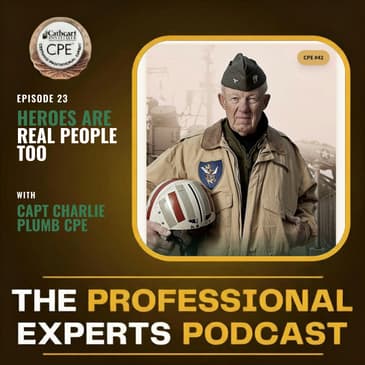
Capt Charlie Plumb CPE joined me for one of the most meaningful conversations I have had on this podcast. Charlie is Navy Captain, former fighter pilot, and a man who spent over 2,000 days as a prisoner of war in Vietnam. He came home not broken, not bitter, but clear. Clear about purpose, clear about people, and clear about what it means to grow through the hardest seasons a human being can face. That clarity is what makes him one of the most trusted voices I know.
Adversity Is Too Good to Waste
Charlie's central message is simple and earned. The men who endured the longest captivity came home the healthiest. Of all Vietnam combatants, roughly 30 percent carry PTSD. Among long-term prisoners of war, that number drops to 4 percent. Charlie does not explain that away. He leans into it. Adversity, he says, is a horrible thing to waste. You can become bitter, or you can become better. He chose better, and 591 fellow prisoners went on to produce generals, admirals, senators, and a presidential candidate.
Who Packs Your Parachute
We talked about the story that became Charlie's signature message. Years after returning home, a stranger approached him in a Kansas City restaurant and said, I'm the man who packed your parachute. That quiet sailor had done his job well, unseen and uncelebrated, and Charlie's life depended on it. The question Charlie now carries into every room is this: whose parachute are you packing? Who depends on the quiet, faithful work you do every day?
What We Covered
We explored Charlie's path from reluctant storyteller to one of the most sought-after speakers in the world. We talked about building a speaking career from scratch, the role of Toastmasters, including the club Charlie helped start inside the prison camp itself, and the bracelets worn by Americans across the country who refused to forget the men still held overseas. We also looked ahead to our Professional Expert Summit at the Reagan Presidential Library in September 2026.
Resources Mentioned
Charlie's book, I'm No Hero, is in its 36th printing. Every copy ordered through his website is personally signed. Visit charlieplumb.com to reach him directly. He answers his own emails.
In the spirit of growth,
About the Host: Jim Cathcart, CSP, CPAE is one of the top 5 most award-winning speakers in the world. His Top 1% TEDx video has over 2.8 million views, his 27 books are translated into multiple languages, including 3 International bestsellers. He is a Certified Virtual Presenter and past National President of the National Speakers Association. Jim’s PBS television programs, podcast appearances and radio shows have reached millions of Success Seekers and he is often retained to advise achievers and their companies.
Even his colleagues, some of the top speakers in the world, have hired Jim to speak at their own events. Jim is an Executive MBA Professor at California Lutheran University School of Management and serves as their first Entrepreneur in Residence. He has been inducted into the Sales & Marketing Hall of Fame in London for his pioneering work with his concept of “Relationship Selling.” He is also in the Professional Speakers Hall of Fame and has received The Cavett Award and The Golden Gavel Award.
Jim has written 27 books, hundreds of articles and he is always writing at least one new book. His most recent book is HI-REV for Small Business, The Faster Way to Profits. Audiences buy his books by the hundreds and he happily adds autograph sessions to his speeches.
https://www.linkedin.com/in/cathcartinstitute/
https://www.facebook.com/jim.cathcart
[00:00:04] Welcome to the Wisdom Parlor, a thoughtful discussion of important ideas among people who are committed to succeeding in life. This is a gathering of leaders from a variety of industries, and our role here is to help you reach the top 1% of your field of choice. I'm Jim Cathcart, so come with me and let's discover how much more successful you could be.
[00:00:37] Hey ladies and gentlemen, welcome to the Professional Experts Podcast. I'm Jim Cathcart, your host, and as always, our guests are professional experts. It's people whose business, their career path, is primarily selling their expertise as opposed to, say, a product or a particular service.
[00:00:59] And that includes coaches and speakers and authors and advisors and mentors and specialists of all types. And today we have a very unique and wonderful guest in that his background caused him to become a celebrity without ever having to want to be one.
[00:01:22] His name is Captain Charles Plumb, Navy Captain and former fighter pilot in the Navy from the Vietnam era. He was shot down over Hanoi and spent six years, over 2,000 days, in captivity in a Vietnamese prison and went through all the uglies that come along with that experience.
[00:01:51] But when he returned to the United States, contrary to expectations, you'd expect someone that went through an ordeal like that to come back beaten and bitter. But he's one of the gentlest souls I know. He's a wise man. He's a gracious gentleman. He's a brilliant businessman.
[00:02:16] And when it comes to life philosophy, he's somebody I can always admire and learn from. So welcome to the Professional Experts Podcast, Captain Charles Plumb. Jim, thank you very much. Wow. The pressure's on for me to live up to that introduction. Oh, I tell you, wait, I'm going to just keep layering it on. Oh, man. I've got a trowel here. I'll just spread more and more icing on this cake. I guess. I guess.
[00:02:45] Well, it's a pleasure to be with you and a pleasure to have you share my story. I appreciate that. About 1986, when I first met you as a member, I was a new member of the mastermind group Speakers Roundtable.
[00:03:10] And I went to Coronado Island in San Diego and joined the group at the Hotel Del Coronado, the famous hotel. And there you were. And we had the special treat, thank you, of going on board the USS Kitty Hawk. And you took us on a tour of that ship and showed us your old bunk. And we talked to the captain and we looked at the flight deck that you'd flown off. Wow.
[00:03:40] I mean, that's top of the world access. That's that super secret behind the scenes backstage pass that very few people in the world get a chance to see, especially in person with the guy who was in the room where it happened. Right. Well, it was a real pleasure to show my civilian friends, you know, what I, you know, my old home, my floating bird nest.
[00:04:10] So, you know, most people have not, who have not been aboard an aircraft carrier are really fascinated. It's a floating city. You know, 5,000, 5,000 crew aboard that ship and about 120 airplanes. So that's smaller than some of the cities here around Austin, Texas. That's right. Yeah, that's true. Wow. Yeah, that has a complete, I mean, all the things a community would have. It's got every utility. It's got a hospital.
[00:04:39] It's got, name it, right? Everything. Dining facilities of various sorts. And, of course, the general mess. Yes. And it's all self-contained. You know, it can steam for months. Well, the new nuclear carriers can steam for a year, you know. Of course. Without going into port. Without going into port. Remarkable.
[00:05:06] They have ways to replenish the crew with, you know, food and letters from home and all that stuff. But, no, it's really, it's a fascinating machine. Wow. I guess the only thing you didn't do on board was grow your own crops. That's true. Yeah. Well, Charlie, you are the newest certified professional expert.
[00:05:36] You're number 42. And that's remarkable for us as the institute that bestows those. So thank you so much for joining us in this very prestigious group of people. I'm proud of what we represent.
[00:05:55] Because what CPE represents to other people is a model for them to look at it and look at people like yourself or like me or like many of our other CPEs. Brian Tracy, Les Brown, Tony Alessandra. And say, that's what a person can do with his or her own specialty. And build an entire career around what they're especially good at.
[00:06:23] Now, your path was different in that you didn't come in with a skill set that was marketable as a speaker. You know, you couldn't go out there and say, hey, I fly airplanes. Let me explain how. Now, but the experience you had been through and the people you had been through it with and what was learned from that experience was so powerful that it applied to anyone in any field.
[00:06:51] And I've seen you present to all kinds of different groups. I remember one time we were up in, I think it was New Jersey at a casino resort. And you were presenting to the same group I was. And man, your message, your story was the same. But the way you tailored it to have meaning to them in their own industry was masterful.
[00:07:17] You would have thought Charlie only designed this presentation for this group. Well, thank you, Jim. And you reminded me of the time that you and I spoke to that admiral staff on North Island in San Diego. Well, you opened the door for me. You let me into the inner sanctum. Thank you for that. That was one of the highlights of my career.
[00:07:40] Well, but, you know, talking about piecing messages together, because I knew that you were going to I knew your presentation pretty well. I knew that you were going to talk about certain things. And so so you might remember I opened the thing in a in a uniform. OK, with all my medals and ask them what they knew about me.
[00:08:03] Well, from my medals, I could tell that I was a Vietnam veteran combat, you know, had purple hearts had been wounded in combat. And so he told me about it. They read your uniform to you. They read the answer to your question. Yeah. Right. And then I took off the shirt, you know, and I'm there in my T-shirt. OK, now, now, what do you know about me?
[00:08:26] And of course, it led in to your presentation about finding out, you know, the sociology of people just by reading the person and not and not knowing any of their background. But friggin that all and ways to to identify with them just by the personality of the guy and not by the uniform. I want to give our viewers a little insight.
[00:08:55] This was the direct reports, meaning the kind of the executive team of ComNav Air Pack, the commander of naval air force, air forces in the Pacific, which is half the world. So there's two of them. ComNav Air Atlantic, I guess, and ComNav Air Pack. ComNav Air Force, I guess, is the direct reports.
[00:09:22] All of these top level, literal top gun people like yourself, that was my audience. And Charlie was standing there. You know, of course, he's Captain Charles Plum. And they all admired him and admired what his uniform said about him. And then he took his shirt off and he's standing there in a white T-shirt, says, what do you know about me now? And I'll never forget the first response. You don't eat very much.
[00:09:55] That was so good. And it was brilliant. But then you had post-it notes. And you said, what if you knew about my values, the things that were most important to me? And what if you knew about the intellects that I had developed specific to me? And what if you knew about my personality type? And you did post-it notes all over your shirt. That was brilliant. In fact, I have used that idea in my own training.
[00:10:24] We need to do that again, Jim. We need to put that show on the road, babe. Hey, I'm ready to take it. Absolutely. Well, Charlie, I want to show something. Look. All right. Your original book, I'm No Hero, with a picture of you taken back in the day. How old were you in that film? 24. I was 24 when that picture was taken. 24 years old. Yeah. Wow.
[00:10:53] That was the day I was shot down and paraded through the jungle and in the streets of Hanoi. And then into a big celebration. I was shot down on their president's birthday. Ho Chi Minh was born on the 19th of May, many, many years ago. And so I was presented as a birthday present, you know, popping out of a cake for the present. Wow. Wow.
[00:11:23] And you had broken bones and you were quite injured, right? I was pretty torn up. Yep. Yeah. Because you had ejected out of your plane and then landed in the jungle and then they captured you immediately, I guess. Yep. Yep. That's true. And so, you know, it's amazing. I mean, no medical care, but, you know, you recover. I mean, the human body is pretty unbelievable the way it will recover if you just give it time and rest.
[00:11:51] So, and I am, you know, no, no, no worse for the punishment today. In fact, better because of it, I think. I mean, and that's the whole premise of my message is adversity is a horrible thing to waste. Yeah. And that you take advantage of the adversities in your life instead of becoming bitter about them. You know, you learn and become better because of them. So, yeah.
[00:12:18] Well, you know, I've known half, well, let's say I've known you and Jerry Coffey, who was also there with you. I've met John McCain. Right. I mean, didn't spend much time with him, but a little bit of time with him. And a couple of the other folks who were there in the prison camp with you.
[00:12:42] And what astounds me is what I was mentioning earlier, that you guys didn't come home whip puppies. You came home as upstanding gentleman. And, you know, your faith wasn't destroyed. Your attitude wasn't soured. You know, you're astoundingly different than the product we expected from a prison camp.
[00:13:12] That is very true. And people couldn't believe it. As a matter of fact, when I first arrived at Clark Air Force Base in the Philippines and that flight from Hanoi when we were released. And one of the first guys I spoke to was a psychiatrist. And I had just found out that my high school sweetheart, my wife, had filed for divorce three months before I came home. She'd held on for five years, filed for divorce three months.
[00:13:39] And so he interviewed me right after that, expecting me to go nuts. And he said, you don't seem to be showing much emotion. Isn't this a terrible, terrible news? It's terrible news. All right. He said, well, you said, you know, you should go back to your hospital room and kick down the door, you know, or tear up the pillow. Scream. You know, it's OK. Show some emotion. And he said, you have the right to be bitter. I said, Doc, I have the right to have diarrhea. Yeah.
[00:14:15] I said, I choose not to be bitter. Thank you very much. You know, I'm free. I got a doorknob on the inside of my door for the first time in six years. You know, give me a break. Yeah. Yeah. But in the first, you know, we went to the little commissary there at the Air Force Base. They were going to feed us a bunch of food and they assumed we couldn't digest anything.
[00:14:42] And so what they had was Gerber baby food smashed up rice. OK. Oh. Well, that didn't last very long. You know, wait a minute. We want a big greasy cheeseburger and a beer. Absolutely. With pickles and extra sauce and throwing some mustard. Yeah. Yeah. So, but anyway, you're absolutely right. They were all surprised and continue to be surprised.
[00:15:07] A study was done just eight or 10 years ago about all the combatants of Vietnam. 30.6% have PTSD. Nearly a third of the soldiers and airmen and sailors exposed to that war have PTSD. Of the prisoners of war, 4% have PTSD. Whoa. Yeah. That's an overwhelming statistic. Yep. Yep.
[00:15:33] 30% of the general population of soldiers that were there. Yep. 4% of the long-term prisoners of war who were tortured and abused and browbeaten for years on end. Oh, my God. And in fact, the guys who were there the longest seem to have come back the healthiest. The 4% are the guys that were shot down near the end of the war. They were not tortured.
[00:16:02] They kept their own clothes and jewelry. And then they were released just a few weeks or a month or two after they were shot down. They're the ones with the challenge. So, you know, folks are trying to explain that. In fact, I don't think you know about the documentary that's coming out on my life and the POWs. But Ron Howard came by about five years ago.
[00:16:28] Ron Howard showed up and wanted to tell our story because it is a fascinating story. Yes. And that's an important story. Yeah. It is. And 591 men have produced 18 generals and seven admirals. Most of us retired as senior grade military officers. Ninety-five percent of the POWs from Vietnam stayed in the military, continue to fly airplanes, command fleets and battalions. And amazing.
[00:16:56] We have a number of congressmen, two United States senators, a vice presidential candidate, and a presidential candidate from 591 men. So it's quite a story that Ron Howard wanted to tell. It certainly is. It's supposed to be out sometimes. You and I did some collaboration when you had been back to Vietnam and revisited Wallow prison
[00:17:25] and actually met face-to-face with one of your tormentors who could not acknowledge his role. I mean, he continued to lie about it even to this day. When you're sitting right there in front of him, he brushed it all aside and continued the ruse. Oh, my gosh.
[00:17:50] I certainly hope that footage and some of that material is making its way into the film. You know, part of it is, as a matter of fact, and it was kind of an unbelievable event when I met the rat. We call him the rat. He was a rat. Yeah. This was the camp commander in charge of all of our torture. And the first thing, when I met this guy, he wanted to hug me.
[00:18:18] Kind of unusual and not part of the Asian culture. Yeah. And he stood back and he said, I just want to tell you that my proudest achievement for the two years I was your warden was to keep you healthy and happy. And I said, bubba. Yeah. Do you not remember? Wow. I said, how about these scars, you know, I have on my wrist and my back?
[00:18:47] How about the fact that I showed up here with two testicles and went home with one? Yeah, explain that to me. Yeah. Wow. Wow. Yeah. People's capacity for denial is evidently endless. Yeah. It really is true. It's international, you know. Yeah. But go ahead. It was an interesting experience to go back and see this guy.
[00:19:17] Now, I want to put folks back into your position after that. When you got back home, when things had somewhat normalized for you again. And then suddenly you're going to the White House and you're meeting with the President of the United States and people at the top of the food chain and every kind of field imaginable. And then it unfolds since then.
[00:19:46] I would imagine you've met every President of the United States since you returned home. Is that accurate? Most of them. Most of them. Yes. So just walk us through the early part of that process. Just the exposure to that level of embrace and acceptance back into what we call normal world. Well, I mean, it's kind of a weird way to become famous, but that's kind of what happened.
[00:20:14] And in fact, you just showed the book. The title of my book is I'm No Hero because we didn't feel like heroes at all. Of course. You know, we had not accomplished our mission. You know, we'd waste a gazillion dollar airplane in the process. And then worst of all, we had surrendered. Surrender is not in the Top Gun playbook. You know, they don't teach flight upon us. Surrender. You didn't learn to surrender in your military either. That's right.
[00:20:46] So, you know, to a man, we felt guilty about being called a hero. You know, we were kind of just over there doing our job. And, oh, yeah, but you survived. Well, yeah, we all survive. You know, I mean, people go through challenges in life and they're not considered heroes, you know, when they survive cancer, you know, or when they walk away from a wheelchair or when they give birth. You know, I have women come up to me and say, I could never have done what you did.
[00:21:14] And I'd say, well, have you had children? Yes. You've been through labor and childbirth. Yes. Well, I've watched that. You know, I've watched my kids being born. And I'll tell you, I couldn't do that. So, you know, I mean, it's all relative. But, yeah, the White House, Richard Nixon, he became one of our favorites because he was finally the president that stopped the war and brought us home. Yeah.
[00:21:42] And he invited us all to the White House with our first ladies. Now, of course, I was going through a divorce, so I took my mother. Yeah, you had a first lady recently removed. Yeah. Exactly. So you took your mom. I took my mom. And to meet all these celebrities there, and, of course, the president and all this, Irving Berlin. You'd be interested in this, being a musician. Irving Berlin sang God Bless America to us.
[00:22:11] Well, you know, just pardon the interruption, but just to consider the historical uniqueness of moments in your life and mine, but in your life, the people that you met and spent face time with in one way or another
[00:22:34] were, are people that we measure entire genre by. For example, Irving Berlin as a musician. You know, Richard Nixon, a president of the United States, and on and on. Wow. Talk about a Forrest Gump experience. Right? That's pretty true. That's pretty true. No, you know, I have a very charmed life.
[00:23:04] I'm a blessed man just from all of the wonderful people that I, you know, that I've met and been able to rebel with. Truly. Like yourself. Well, thank you for that. So when you first were asked to come tell your story at a convention or a meeting, walk us through that mindset shift. Because you're home and now all of a sudden you've got to roll. Well, yeah, okay, I want to tell.
[00:23:33] But gee, I'm not a speaker. I'm a pilot. I'll tell you, the first, the first hundred speeches I made, I was hoping, it was in Kansas. I was hoping a tornado would come through, you know, and stop the meeting before I spoke. I mean, I was certainly not a natural born motivational speaker. And in fact, they had to twist my arm to tell the story.
[00:24:01] But then I found, well, one of the first times I'm in a hotel and I told a story and I'm on the elevator. And a guy sneaks in just as the doors were closing. And he's got tears in his eyes. And he said, Mr. Plum, you really, you really got to me in there. I said, why? He said, well, you know, my wife's filing for divorce. And my mom was diagnosed with cancer. I've got all these problems.
[00:24:27] And he made my problems feel more doable. Manageable. Manageable. Overcome these challenges that I faced because I've listened to the challenges that you have faced. He said, and I recognize, he said, I'll never be a prisoner of war. And I'll have to go through the physical pain of all that.
[00:24:48] But some of the pain that you talked about are the pains that I have, you know, the pains of frustration and lack of communication. Yeah, the emotional pain is universal. Yeah. Exactly.
[00:25:05] And so when I decided that there was a purpose, you know, perhaps to my experience and then a focus for my story that I could be of benefit to people with challenges. You know, it's a natural, you know, I'll just continue to do that. So that's the way it all began. I made 400 speeches the first year I was home.
[00:25:33] Oh, boss. 401 years. The first 4th of July. Okay. It's morning. I must have a speech any moment now. Right? Oh, my gosh. The first 4th of July. I spoke seven times. They assigned an army helicopter to take me around from one celebration to another seven times on the 4th of July of 1967, 1973.
[00:26:03] So it was amazing. Did you find yourself asking, did I just say? I did that one time. Five presentations, same one, five times in one day. And I actually said to the audience, did I just tell the story about that one? Oh, yeah. No, you didn't. Oh, okay. Okay, okay. I'll tell the story. Yeah. In fact, one of those seven is in a congressional record. Is it really? Yeah.
[00:26:32] So, yeah, that was a wild time. And of course, I didn't, you know, I wasn't charging any money for any of those 400. I didn't even realize. I didn't realize you could make money speaking. I did not know that. And I did a fundraiser for a guy. And it was across town. And I drove, I don't know, 25, 30 miles. And he said, you know, I want to pay you for making that speech. We've raised a lot of money because of you. I said, no, you know, I don't charge anything.
[00:27:01] He said, oh, let me pay you for some gas. He gave me three bills. The top one in the bottom was a $1 bill. And I stuck him in my pocket. Okay. I got by home and tossed these three bills. The middle bill was a $100 bill. I had never seen a $100 bill. Wow. Wow. $102. The first time I got paid was $10. And it was for gas. Okay. And I had driven from Little Rock, Arkansas to Hamburg, Arkansas, which is 130 miles.
[00:27:31] And, of course, round trip, 260, to speak at a JC's meeting. And like you, my first 400 presentations were free, but they were for Junior Chamber of Commerce meetings. You know, they were different type. But still, it never occurred to me to charge. And then I joined the National Speakers Association when it was brand new and built a career doing that.
[00:27:58] Now, how does one, let's say somebody listening to this has a very unique background like yours is, but different. And they say, well, huh, so I could build a career out of this.
[00:28:15] Well, how does one think about that in making a career path out of telling your story and presenting and advising other people from that kind of a base? The first advice, and I'm sure you would agree with this, is it's not easy. You know, it is not easy getting on the circuit. Right.
[00:28:40] And, you know, forget about agents and speakers bureaus because they don't want you until you don't need them. That's right. The only way they want you is if somebody called and said, can you get me, Charlie? Exactly. Exactly. So, you know, my advice to anybody who wants to get in this business is go speak. Speak a lot. Speak to Rotary Club. Speak to Kiwanis. Speak to JC. Speak to any audience you can find. Go speak.
[00:29:09] And then ask for critique. Record your speeches and ask for critiques. And you really do develop a style. You know, of course, there are a lot of really great books and, you know, YouTubes on making speeches. Yeah. And you've got one of the best TEDx talks around there. Thank you.
[00:29:32] And, you know, watch TEDx and watch the timing, you know, that Jim Cathcart uses. Watch the stories, you know, that we all tell in TEDx talks. Yeah, and Toastmasters too. Oh, yeah. Toastmasters are great. Because that gives you a forum for practicing with familiar faces, but time and time again. Yep. Yep.
[00:30:00] And at Toastmasters, you get some pretty serious critiques, you know. They tear you apart in Toastmasters. They do. They do. And some of them actually know what they're talking about. Well, that's true too. Last year in Santa Barbara at the Expert Summit, I had some video guests drop in. One of them was Les Brown, and he was wonderful. And another one was Daniel Rex.
[00:30:27] And Daniel Rex is the CEO of Toastmasters International. So he runs the admin side of Toastmasters International. And he was talking with us about speaking and being a speaker as opposed to about Toastmasters itself. But that was a very good perspective to gain. Love that. Wow.
[00:30:54] We had a Toastmasters club in the prison camp. Tell me about that. Well, there was a raid on one of the outlying camps. And so they all shoved us together into downtown Hanoi. The prison was not big enough for all of us. And so they put us in these rooms. I was in a room about 20 by 30. And we had 57 guys in that. 57 guys in one living room.
[00:31:23] Yeah, one living room. And so, but it was great because we were together for the first time. You know, some guys had been in solitary confinement for four and a half years. And suddenly he shoved in there with 56 other guys. So anyway, it was pretty amazing. So we started education. We taught each other classes and courses we'd had in college. In fact, University of Maryland gave us credit for the courses we had learned in the prison camp. You know, no books, no overheads, nothing.
[00:31:53] So, but anyway. Remarkable. We started a Toastmasters club. And one of the guys had been a Toastmaster. And he knew of all the, you know, the eyes habit and the hands and the gestures and the timing. And I built a clock because we had to time, you know, the speeches. So I built a little, you know, a little pendulum clock and a little escape mechanism from wire and spring and a rock. And so I could time the speeches. Wow. Wow.
[00:32:23] But we did have what we call a captive audience. Truly. That's for sure. But it was really scary. You know, I mean, it was really difficult to get up in front of these guys that knew you so well. And you knew them so well and tried to give some kind of a speech. So I decided, man, I'm going to keep you guys awake. So I designed this presentation. And it was the presentation.
[00:32:52] It was the opener, you know. I forgot what they called it. Anyway, you're telling it about your life. And so I told this story about God and St. Peter. And St. Peter is trying to convince God that this guy should live. And this guy is in an airplane. He's about to eject because his airplane has been hit by a missile. And so God, hurry up.
[00:33:21] And, you know, and so you're going through the book. And so here's his life. And I tell him about my life. You know, I grew up in Kansas, farm kid, naval academy, fire pilot, top gun school, all this stuff. And then St. Peter kept saying, hurry up, God, hurry up. He is now ejected. He's spinning through the sky. And so the final word of my speech is, okay, St. Peter, open the chute. Wow. Wow. Brilliant.
[00:33:49] Yeah, that was my opener for the Toastmaster Club. Well, and that became your signature speech. You pack your own chute. Yep. Yep. That's true. I love the story about, you know, you can see these bracelets that people were wearing that had the names of various prisoners of war on them.
[00:34:14] And people all over America were wearing those as a tribute to the person who had been captured and a way of saying, hey, we haven't forgotten you. Yep. And you've got some beautiful stories around that. Could you give us just a peek into that? Okay. Sure. I think one of the most amazing stories, the guy from Albuquerque, when he came up after my speech, he said, I've got to tell you this story.
[00:34:42] He said, my seven-year-old daughter was wearing your bracelet. There were over, I think, 10 or 20,000 bracelets with my name on them. No kidding. Wow. And he said it was wearing a sore. And he would say, you know, you're going to get that infected. Take that silly thing off. And he said, no, Daddy, I've got to wear it until he comes home. And no, no, take it off. Okay, put it on the other arm.
[00:35:10] So she put it on the other arm, and it started to wear a sore on the other arm. And it was an open sore. So she's sitting there one night watching TV, and he said, that's it. You know, now you're going to get really infected. He grabs the bracelet and pulls on it, and it breaks. The bracelet breaks apart in his hand. And that moment, she's watching TV. I walk off the airplane into freedom. Whoa. Yeah, exactly. That spooky.
[00:35:40] Wow. The moment. The very moment. Yep. Yep. Another gal. Man, and people say, hang on, hold that thought. Yeah, yeah. People say, you know, this world is all there is. There is no spirit world. There's no, you know, there's no God. There's no whatever. Really? Then explain this one. And that's not unique in all of time either. That's true. There are many, many, many thousands of experiences like that that have occurred.
[00:36:10] And humans have no explanation that's even close to justify. How do you explain that one? Yeah. Gee, that's just, wow. So I was in a press conference. I had, you know, two or three hundred photographers and reporters, you know, all asking me questions and stuff. And from the back, this was kind of an elevated thing.
[00:36:34] And from the very back, from the top, this bright redhead lady hollers at me, Charlie, blah. And the place goes silent. I've been sleeping with you for two years. And everybody's looking at her right here on my wrist. She's got my bracelet. Wow. Oh, oh, oh, oh, oh, oh. Yeah. But the bracelets were wonderful.
[00:37:00] Because, you know, part of the time in Vietnam, the bombing stopped when the peace talk started. You know, it's kind of a cessation of arms there for a while. And we wondered when the bombings, we didn't know why. We just knew that the war was, is the war over? Have we been forgotten? And that's a terrible feeling when you think that you've been forgotten in some foreign country in prison here.
[00:37:28] And you have to find out all those people wearing all those bracelets all over the country. It was very comforting. That had to go back and heal wounds that had long since scarred over. Yeah. Very true. Yeah. Very true. It's just, you think of healing only of a current condition, but I would imagine that had a retroactive echo effect. It sure did. Wow. That's so powerful.
[00:37:56] Would you, I mean, I could do this for like 11 hours with you nonstop. Okay, sure. But would you share just briefly the, the pack your chute story? Sure. Several years after I came home from Vietnam, I was living in Kansas City. I was in a restaurant with my, with my wife and some friends.
[00:38:24] And about two tables over, a guy kept looking at me and I didn't recognize this gent, but he kept catching my eye. And, and, you know, it was obvious that he wanted to talk to me. Well, in Kansas City, I was the first guy back from Vietnam in Kansas City. So I'd been in the newspaper, you know, front page. Yeah. And so it wasn't unusual for people to look at me and recognize me from, you know, from all the publicity.
[00:38:50] This guy came over to my table, pointed at me and he said, you're Captain Plum. I said, yes, I'm Captain Plum. You're the guy who flew jet fighters on Vietnam, shot down, parachuted in enemy hands. You were tortured. You spent six years as a prisoner of war. And I said, yeah, that's right. Who are you? He said, I'm the guy that packed your parachute. So I was dumbfounded.
[00:39:16] You know, I stood up and reached out a very grateful hand of thanks and I couldn't speak, but he, he grabbed my hand and shook it and said, I guess it worked.
[00:39:30] He said, I'm the guy that was a sailor.
[00:39:57] You know, when you're in trouble, if you go back in your mind, what are the things that have learned, you've learned from coaches or parents or preachers or teachers that, that allow you to overcome the problem, allow you to survive that airplane crash. And so that, that's assuming God says, okay, open the chute. Exactly. You have to count on that.
[00:40:25] And then, you know, my next question is whose parachute are you packing? You know, are you a servant? Are you a servant leader? You know, and because that's, you know, the most important thing in life, I think is to help people overcome their challenges. And so, so that, you know, that here's a, here's a thought for you. Okay. Okay. Okay. I'm doing speech coaching. Yeah. No, you're always. I talked to the greatest speaker I've ever known and I'm giving him speech. No, no, I know.
[00:40:55] This is just an idea. I thought you just say, let's assume for a moment. And I'm just talking to the audience that you have said the following statement. Hey, don't worry. I've got your back. Now, everyone in the room, say that with me. When I, when I say go say, Hey, don't worry. I've got your back. All right, go. Hey, don't worry. I've got your back.
[00:41:25] And then you pause and you look at it and you say, so who were you talking to? Whoa. I'm taking notes, Jim. Okay. Because I can see you're doing that. So who were you talking to? And then you can, of course, elaborate, you know, saying that for all of us, there's somebody that ought to be the recipient of that, that statement. And everyone's in a position to be helping someone else.
[00:41:53] Who is it you're talking to? Don't worry. I've got your back. Great. Thank you very much for that. You know, you're more than welcome for that. You are so creative. You've always been so creative. And, and, you know, I, I really appreciate that. Thank you. I've got a client, Dennis Madden, who's a CPE. And he lived in Oxnard for Ventura for the longest time. His business was in Oxnard.
[00:42:20] The Automotive Transmission Rebuilders Association, ATRA. Okay. Okay. And he hired me years ago for a small assignment and that grew into a larger assignment. And they're still my client today, 20 years later. Wow. And Dennis says, Jim, I've seen you in executive boardrooms. I've seen you on the stage. I've seen you in workshops. I've seen you one-on-one and then small groups.
[00:42:47] You are at your best when you have a problem to solve. Okay. Well, that's a good. And I think he's right. You know, when I've got an application like listening to you and I think, how would I deal with that? Then ideas like that pop into my head. Yeah. I've seen you do the same thing. We've sat in so many speakers roundtable meetings with our mastermind group over the 29 years I
[00:43:16] was in it and man, the brilliance that just kind of bubbles up, blows me away. That's a great compliment. And I think it's true. I think you are at your best, you know, when you're solving a problem, gives you a mission and it gives you a purpose, a raison d'etre. Yeah. Yeah. And I was coaching a guy yesterday who is very knowledgeable, but has not had much mileage on the platform.
[00:43:45] And I appreciate your saying earlier, the first advice is get out there and speak and speak and speak and speak and get known and refine your style, delivery and content and so forth. But anyway, he was delivering a answer or piece of his message, whatever it was. And I said, hang on. I said, that's good, but that's not you. You're reading a book to me. That's the way it's coming across. Yeah. Yeah.
[00:44:15] Let's make this more real. And I gave him an actual scenario and his answer was way better. I said, replay this video later to see the difference in your own tone and demeanor between delivering data and solving a problem. Yeah. True that. Very useful. Wow.
[00:44:37] I keep thinking about your first question about how do you take an experience and build a presentation around a story that you've had? Last weekend, I flew up to the gold country in California, Columbia, California, where they discovered gold. And there's a lot of history around this town. And it was amazing. Is that Sutter's Mill?
[00:45:05] It's close, as a matter of fact. Yeah. It's not too far from Sutter's Mill. Yeah. And it was a gathering, an annual gathering of experimental airplanes. I fly an experimental airplane. Uh-huh. And so there were probably- Like the Long Easy? Well, in fact, there were probably 15 Long Easys there and variations of Long Easys.
[00:45:27] And for your audience, the Long Easy is a very small carbon fiber, fiberglass airplane that you build in your garage. And it is, yeah, it's safer and faster and more efficient than Cessnas and Pipers and Beechcraft. Yeah. It's pretty amazing. My airplane, I get about 30 miles to the gallon on an airplane. And that's unbelievable. That's unbelievable.
[00:45:57] Good or bad? That's good. Oh, okay. Yeah. Yeah. I mean, your car, you know, very few cars get 30 miles to the gallon. Airplane, 30 miles to the gallon. Yeah. So I go 200 miles an hour on seven gallons an hour. And most air, most Pipers and Cessnas will burn 15 gallons an hour, you know, twice as much as I burn and not go as fast. But in any case, so we're all there together. Now, most of these guys built their own airplane. Okay.
[00:46:27] And they, a lot of these guys are aerodynamic engineers. You know, they've worked on spacecraft and all this stuff. They're big time. Yeah. And I didn't build mine. I fly them, you know. And so I made a presentation to them. I did a keynote presentation to the group. But the two guys before me, one was a brainiac, man.
[00:46:52] He had designed everything on AI and machine learning and all this stuff. And the second guy did not use computers. He was a trial and error guy. Okay. So you had John Henry in the steam drill. Exactly. Two worlds. Yeah. It was really amazing. These guys, ironically, you know, the trial and error guy had a faster, more efficient,
[00:47:23] stronger airplane than the guy that did it with all the AI and computer stuff. And it was quite an interesting thing. Yeah. You know, and I guess the reason I thought about that was, I think, you know, if you have a story to tell, and, you know, tell the story, you know, don't look to other people. If you can design it and try it. And it works. Don't worry about analyzing why it worked.
[00:47:51] Just go ahead and do it. You know, put your eye down the street. Don't wait. And I think there's also, there's an element in that that's universal. I do a lot of speech coaching with executives. Yep. And invariably, I'll be able to notice something that they had understood but overlooked.
[00:48:17] And that is the fundamental two parts of every concept, yin and yang. You know, you've got the physical and the intellectual or the whatever, you know, day and night. And it's like a woman I was talking with yesterday. Her last name is Grizzly. Okay. And she's a financial consultant.
[00:48:45] And I said, you've got a brand identity just waiting for you. And she said, the bear? I said, no. You don't call her. The bull and the bear. Okay. So, you know, bullish and bearish. You know, Wall Street, take that. And that's your yin and yang. And same thing for the aircraft. You know, you've got one guy that's Rocky Balboa.
[00:49:09] And he's training by lifting big old tractor tires and all that stuff and pulling weights with a rope. And then you've got, what's his name, from Russia, who's scientifically training on everything, you know, and it's all technology. And, of course, Rocky ultimately wins. But that's not always the case. But still, in everything we do, there's that yin and yang.
[00:49:38] And both have their place. It would be interesting. And one without the other is limited. It really is. I think it would be interesting to talk to all your CBEs and find out how many people did not have enough information to actually make a decision, but they made the decision anyway. See, I think that's one of the real problems is paralysis by analysis. Yeah. We wait.
[00:50:06] You know, we wait until we have all the right ideas to get into action. But, you know, it says ready, fire, aim. Yeah. Was that Tom Peters that popularized that? Yeah, somebody said that. In search of excellence. Yeah. Let's see. Ready, fire, aim. Just a second. Okay. Oh, shoot. I had a good one. It'll pop back.
[00:50:35] Oh, I know what it was. I wrote an article this morning for Top Sales World magazine, and I was mentioning in the article a conversation I had a few months ago with Brian Tracy, who's a mutual friend of ours. And Brian said to me, he said, Jim, I studied for many years or a few years self-made millionaires. And I interviewed a bunch of them. And I knew the secrets to becoming a self-made millionaire.
[00:51:03] He said, and I wasn't one. Until I decided to become one. And then with all the information I had gleaned, it was a very quick, easy path for me. But I hadn't committed to do it. Yeah. And so it didn't happen. And that's the thing.
[00:51:26] So many people, they become a perpetual student, and they never graduate and commence. Commence. And I think that moment of commitment is the big one. Like when you're sitting on the deck of that plane, I mean, deck of that ship in your plane. Yep. Oh, my. When that catapult says bye-bye, Charlie, you better damn well be committed, right? Yep. That's very true.
[00:51:57] You're pretty much out of control. You know, once you salute the catapult officer and tell him that you're ready to go, hang on for dear life. Because, you know, one night I got aboard my F-4, and I put my flashlight up on the top of the windscreen, you know. And I forgot it was there. I didn't see this coming. Oh, yeah. That flashlight. Okay. I got a 50,000-pound airplane, okay?
[00:52:27] And I got a pound-and-a-half flashlight. And the catapult shot is so extreme that that flashlight came back and cracked my visor on my helmet. How many Gs did you pull? Well, they say that you pull about 12 instantaneous Gs, but it's all on your back. Okay. 12 times the force of gravity in an instant. Yeah. Kaboom. Yeah.
[00:52:56] Yeah. Yeah. But it's not sustained. And so it's not going to, you know, but, you know, it gets your attention. And if you're, in fact, you have, you've got two throttles, okay, in your left hand here. And there's a little bar, a little steel bar that comes to you. You hold the bar with the throttles because if you don't hold on to that bar, just got the throttles, the acceleration will force the throttles back.
[00:53:24] Suddenly you're off the edge of the aircraft carrier at idle. Oh, oh. Oh, yeah. Which you don't want to. That's right. Going forward is, is giving it juice. Exactly. Going back is shutting it down. Yeah. Yep. Yep. Whoa. So, yeah, there's a lot of things that go on in that cat shot. Yeah. And then, you know, especially at night, because there's a lot going on on the deck of that aircraft carrier.
[00:53:53] You got all the other jets warming up. You got propeller airplanes. You got people running around with flashlights. And it's noisy. You know, and suddenly once you're off the deck, it gets real dark and real quiet. You know, and you're alone. Yeah. You better come up with some ideas right away. Wow. Well, I want to skip forward into something because I don't want to keep you forever. Well, actually, I do.
[00:54:20] But it's not fair to the world or to you for me to keep you for a long time. But here's my question. You actually met and knew Ronald Reagan, right? Yes. You were with him in the White House and I don't know how many other occasions.
[00:54:42] And with our professional experts summit, September 20th through 23rd of 2026, we're going to the Reagan Presidential Library near where you live and going into the situation room simulation where it's actually laid out like the actual room in the belly of the White House.
[00:55:01] And our group is we'll only have 20 people, Max, in the in the summit and maybe 30 people if you count observers in that experience. And they're going to be playing roles. So I might be Alexander Haig, you know, and you might be President Reagan and somebody else might be Secretary of State and whatever. But we're playing the actual role of actual people in a in an actual situation.
[00:55:31] That is presented instantly. You know, we're all in the room. We get our orientation and someone comes in and says, pardon me, Mr. President, we have a crisis. And they describe the crisis and then they back off and it's up to us to resolve it. So that's going to be a fascinating experience. But you are going to be observing that, assuming you can join us at that time.
[00:55:55] Through the eyes of somebody you actually knew, actually more than somebody, because I would imagine you met a number of the cabinet members. Well, I have, as a matter of fact. And Ronald Reagan was governor of California when I was released in 1973. And he stood on a spot at an air base up near Sacramento and shook the hand of every returning POW.
[00:56:23] In fact, we put a brass plaque on that spot a couple of years ago. Yeah. Pretty cool. So that was my first introduction was when he was governor. And then, of course, he became president. And I worked on his campaign and a couple of campaigns that he was on. So what a guy. You know, we need more Reagans in the world. Absolutely. I've been to that Situation Room. And it really is amazing how involved you get.
[00:56:52] You know, you're playing this role and it gets really serious. And the way that it is done there, of course, you know, there's kind of an area where you can observe everything is happening and you see what's going. But then you go into the cabinet room and express, you know, your opinion on how you should handle it.
[00:57:18] And there are arguments that, you know, that go on and fights that develop because people have various ideas of, you know, how to solve the problem. And, yeah, I'm really happy that you're doing that. Thank you. Yeah. You get emotionally invested. And that's what makes it. I did it personally before. And I was assigned the role of President Reagan. Okay. Wow. Good. So I'm the one that got to pick up the red phone on the desk and make that phone call.
[00:57:48] Wow. Yeah. Yeah. That'll be great. Of course, the whole library itself is really, really neat. You know, all of the stuff. Truly. Reagan. And, of course, he's got, you know, his plane, Air Force One, is there and you go through the plane. Yeah. It's amazing. Were you aware that I was the chair of the first public event ever held in the Air Force One pavilion? No, I did not know that. October 22, 2005.
[00:58:18] Okay. They brought the plane, built the pavilion, finally got everything finished. And Nancy Reagan, first lady, held a luncheon for all of the donors to the Air Force One pavilion. And she adjourned the luncheon. We came in and set up for a Boys and Girls Club fundraising gala dinner on the floor underneath the plane. Wow. And we had to be careful where we stepped because the paint was still wet.
[00:58:48] Oh, really? And we raised, out of 409 people, we raised $248,000 that night. Wow. That's great. That was a big deal in 2005. Yep. That's amazing. I did not. Well, Charlie, I've got to wrap this up out of respect to you and our listeners. But I'm so grateful you joined me today. Thank you. Because this is just wonderful. How do people reach you?
[00:59:15] And what do you want them to reach out about? You know, whatever you want to support or highlight or feature, by all means, please do. Thanks for that. Charlieplum.com is my website. Pretty easy. C-H-L-I-E-P-L-U-M-B dot com. And, you know, it's got all kinds of information there. It's got a place there where you can reach me directly. I answer all my emails and I get a lot of them.
[00:59:45] But I'm always interested in perspectives because everybody has a different perspective of adversity and challenges in life and how you overcome the problems of life. And so I'm always interested in talking to folks. Of course, my, you know, my book, I'm No Heroes, is in its 36th printing. And so it's been around a while. Every book that's ordered on my website, I autograph. I autograph to people. Oh, wow. Yeah.
[01:00:15] So I spend time, you know, signing my name in books. And so, but, you know, I am a very transparent guy. And so don't ask me any question that you're afraid of the answer. Because I, you know, I'm all I've got, you know. I mean, I try not to be pretentious about things. Certainly not. Well, thanks. Well, thank you.
[01:00:45] Thank you. And thank you. And that's thank you for being a guest today. Thank you for being such a wonderful, inspiring model to the rest of the people in the world. And thank you for your friendship for all these many years. I treasure having you in my life. I write back at you, my friend. I throw you the bouquets as well. And so we look forward to seeing you. Thank you. God bless you. And give Susan a hug from Paula. Can you, Paula as well. Take care, Jeremy.
[01:01:15] Take care. Bye-bye. Thank you for joining us today in the Wisdom Parlor, a thoughtful discussion of important ideas among people who are committed to succeeding in life.
[01:01:28] If you are committed to making more success happen in your own life, go right now to my website, free.cathcart.com and download my free e-book and then watch the video. If you decide that you'd like my assistance in helping grow your success, then come with me and let's discover how much more successful you can be.