
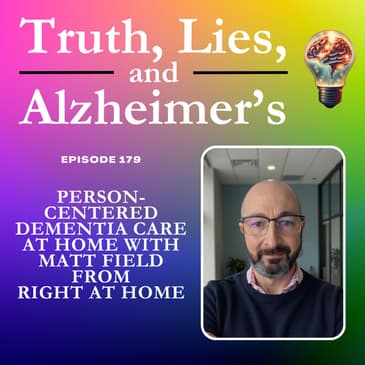
Person-Centered Dementia Care at Home with Matt Field
In this episode of The Truth, Lies & Alzheimer’s, Lisa Skinner welcomes Matt Field, Managing Director and co-owner of Right at Home, serving families throughout the Chicago suburbs.
Matt and Lisa discuss the importance of person-centered dementia care and how in-home support can help individuals maintain dignity, independence, safety, and quality of life. They also explore caregiver training, fall reduction, hospitalization prevention, and why understanding the person behind the diagnosis is so important.
About Matt Field
Matt Field has worked in home care since 2012, building Right at Home with his wife, Rachel, into a trusted resource for families caring for aging loved ones. His work focuses heavily on person-centered dementia care, caregiver education, fall prevention, and practical strategies that help people remain safely at home.
Matt also develops training programs for professional caregivers, family caregivers, and first responders. Before entering the home care field, he spent a decade in congregational leadership as an ordained Conservative rabbi, an experience that continues to shape his compassionate and human-centered approach to supporting families.
Connect with Matt
LinkedIn: https://www.linkedin.com/in/mattfieldrah/
Website: https://www.rightathome.net/north-suburban-chicago
#DementiaCare #AlzheimersCare #PersonCenteredCare #HomeCare #CaregiverSupport #FamilyCaregivers #AgingInPlace #SeniorCare #DementiaSupport #CaregiverEducation #FallPrevention #HealthyAging #TruthLiesAndAlzheimers #MindingDementia
[00:00:03] Are you caring for a loved one with dementia? You don't have to figure this out all on your own. Welcome to Truth, Lies & Alzheimer's, the show that helps you reimagine a new relationship with your loved one, a relationship a little more free of stress and anxiety. Join host Lisa Skinner and her 30 plus years of experience as she guides you on a new path to a better relationship with those you care for.
[00:00:33] Here's Lisa. Welcome everybody to another new episode of the Truth, Lies, and Alzheimer's show. I hope you know me by now. I'm Lisa Skinner, your host, and I'm excited to introduce to you a new guest to the show.
[00:00:52] His name is Matt Field, and he is here as the owner of Right at Home. It's a home health company. It has three locations in the Ohio. We're in the Chicago area.
[00:01:18] Okay, Mary, let's start over again. Sorry about that. All those Midwestern states blend together. Pause for five seconds and start again. And I had that right, three locations, right? Correct. Count to three in your head and go.
[00:01:46] Welcome back, everybody. I'm bringing a new episode to everybody today. I hope you know me by now. I'm Lisa Skinner, your host of the Truth, Lies, and Alzheimer's show. And I am very excited. That was background noise from somebody. Oh, it wasn't here. All right, we're going to have to start again. I thought you were trying to tell me something. Sorry.
[00:02:16] Do it again. Five, four, three, go. Welcome back, everybody, to another new episode of the Truth, Lies, and Alzheimer's show. I hope you all know me by now. I'm Lisa Skinner, your host.
[00:02:31] And I'm excited to bring a new guest who's here with me today to talk about a really plaguing situation that affects most people who are thrust into the world of dementia. Kind of sometimes it's because they don't want to really pay close attention to the symptoms that their loved ones have been showing.
[00:03:00] Or sometimes it just kind of comes at them out of nowhere. So we're going to be talking about the challenges that families face when they are touched by Alzheimer's disease or related dementia. But before we get going with that, I want to introduce Matt to everybody. His name is Matt Field and he is the owner of Right at Home.
[00:03:29] It's a company that offers home health services. He owns three locations in the Chicago area. So he is very well versed and experienced in the world of dementia. And as we all know, an Alzheimer's diagnosis doesn't just change one person's life. And I have said this before, but I know that Matt says this too.
[00:03:59] It changes the entire family and the family dynamics. And we're going to talk about that today, too. So every day, Matt works with families navigating the uncertainty, emotional conversations and practical challenges that come with caring for a loved one living with Alzheimer's disease.
[00:04:24] And quite often, he meets them at a point where they wish they had reached out sooner. And you know what? That's been my experience for 30 years as well. So we know that it's a chronic, ongoing problem.
[00:04:41] And like Matt and I talked about yesterday on our call, what we've both seen is that when this happens and families aren't more prepared for an Alzheimer's diagnosis, they panic. They don't even know where to start. They don't know where to start. And they often get stuck on what I call the proverbial hamster wheel, where they're in a constant state of flux and reaction.
[00:05:10] And once you're stuck on that hamster wheel, it's very difficult to get off and put yourself into a place of being proactive. So this is really why we feel it's so important to talk about this topic today. So maybe we can give you some insight and advice to how to be more prepared for an Alzheimer's diagnosis. So with that, please help me welcome Matt to the show.
[00:05:38] And Matt, I am just thrilled to have you here today. This is such an important topic and I just can't wait to hear your experiences and your insights to this as well. Thank you. Really excited to be here with you today, Lisa.
[00:05:54] Excited to have the opportunity to talk to your audience and share a bit about my experience working with families and individuals who've been navigating the dementia maze for years now. So hopefully there is at least something useful that I can say that sticks with somebody today. Oh, I'm sure there will be lots of golden nuggets that you're going to be sharing with us.
[00:06:21] But, you know, you've also found that this is an ongoing plaguing problem for families. So tell us what you've seen and what some of your experiences have been. And then we'll get into what your advice would be to families to be more prepared.
[00:06:41] Because as we all know, the World Health Organization and Alzheimer's Associations are telling us that just in the next 24 years, the number of people who are expected to develop Alzheimer's disease unless a cure or treatment is found is going to triple from the number of people living with it today. So it's even going to be a bigger problem than it is right now.
[00:07:08] So let's let's dive into that and maybe help some other families to prepare for that. Yeah, of course. So, yes, it is. It is a challenge. It is when somebody is faced with a new diagnosis or they're seeing signs that they may suspect may result in a diagnosis. It's very jarring, even if there is a family history. It's very disorienting to family members.
[00:07:38] You know, I think about in particular somebody who we took care of a few years ago. And the wife knew that her husband had early stages of dementia. She knew that he was diagnosed. She knew the diagnosis and still one of her frustrations is still he was still able to engage in life for the most part.
[00:08:07] And he was managing his own appointments. And, you know, those appointments are so important, especially early on to get into a routine with new medications and what have you. And he was missing his appointments. It's not a surprise, right, because he was forgetting he was getting confused. They were on his phone for the wrong day. He was scrolling to the wrong day. And she was just she was it was overwhelming her. She was getting angry. She was yelling at him.
[00:08:34] You know, knowing the diagnosis, having the diagnosis and having a plan built around it are two completely different things. And most families often only have the first one figured out. Yeah, let me ask you a question about this, because I've run into this forever. Was she aware?
[00:08:57] Has she been guided or, you know, been educated on how the disease typically progresses and what she could expect as he did progress through the disease? Or she hadn't even gone there yet, because I've seen this so many times where people just don't realize what Alzheimer's disease and dementia eventually becomes. True.
[00:09:27] I mean, so many people think it's just a memory disease. And you and I know it's so much more than that. Yeah. And honestly, I'm not sure if the neurologist who is working with them, if he laid it out or not. But what I would say is that for many people, there's two different acknowledgments. There is the intellectual acknowledgment and then there's the emotional. Yes.
[00:09:53] Intellectually, we may recognize, understand, realize, believe that our loved one has dementia, has whatever form they might have. Emotionally, we haven't gotten there yet. We're still expecting things to somehow come back to us.
[00:10:11] It's not infrequent that we are working with families in the earlier stages of dementia where adult children will indicate to us that they're expecting. They know it's degenerative, but they're still expecting mom or dad to come back to them in some way. And so that leads to a lot of frustration and angst. And look, it's it's mourning.
[00:10:39] And when when you have somebody you love who is diagnosed with dementia, you may be mourning them two times, not just once. The first you're mourning who they used to be. And that changes so radically depending on how the dementia presents and how it evolves. And that's a long, difficult process. And getting used to that is challenging.
[00:11:03] And then then, however, it progresses, then we're potentially mourning them a second time when you know, when we actually say goodbye at the end of their life. Very true. And I don't think a lot of people who are going through the stages of dementia realize that there is a mourning, a grief process attached to that. And then they again when they pass. But yeah, I forget what I was going to ask you. So so continue.
[00:11:34] Yeah. So, you know, I I see I see these families all the time. I work with them frequently and, you know, it presents in so many different ways. You know, another example that I remember, which is also not terribly uncommon, but just just recently there was similarly, it was a it was a an older gentleman who had the earlier stages of dementia. And he also had some some mobility issues.
[00:12:02] He had some difficulty ambulating for whatever reason, whatever reason. And the use of a walker was was not brand new, but it was fairly new in his life. And he experienced a fall. Why did he experience a fall in this particular instance? He experienced a fall because he forgot to use the walker. And it's not uncommon for somebody with dementia to forget these basic things that they need to be doing to keep themselves safe.
[00:12:32] Maybe they forget that they can't walk well. Maybe it's off to the side and he's not remembering it because it's not right in his face. And families will frequently tell themselves that in incidents like these forgotten medication or forgotten walker is is a one off. It's an anomaly. But frequently it could be so much more than that.
[00:12:54] So when we're confronting these issues and a loved one is forgetting these things that are keeping them healthy and safe, we shouldn't brush it off so quickly. We should we should honor it as as a data point, not an anomaly. It might be telling us something that we need to pay more attention to. So it's easy to look one incident and say, oh, well, you know, he just forgot this time.
[00:13:20] But by the second or third time, you know, you're lucky if that first fall is not causing an injury. But the second one or the third one may cause significant injury. So what can we do to acknowledge that forgetting that walker, forgetting those meds is part of something more than just oops, it slipped my mind.
[00:13:41] But there's something bigger going on and we need to address that to move forward and keep mom or dad or our spouse safe while they are transitioning through those stages of dementia. And how is your team trained to handle a situation like that?
[00:14:03] That's a really good question. So, you know, for my I've got two two teams, I've got my sort of administrative professional team made up of my schedulers, my field supervisors, my care managers, all that. And then I have my caregivers who are who are out in the field. Most of the professional team have a lot of extensive training and experience, have worked in nursing homes, assisted livings and what have you.
[00:14:32] It's training the caregivers, those who are spending the long hours with people with dementia who really need better training. What I've seen, unfortunately, one of the gaps in my industry is a lot of the training is built around compliance, not safety. It's great to check a box, but it's not enough to check a box.
[00:14:57] So there's a lot of online platforms out there that are geared towards my industry, towards assisted livings and what have you, where an individual will sit in front of a phone, a computer, a tablet and spend a number of hours clicking on the phone. So I'm not sure if you're working through and learning stuff, but are they really? Because again, it's about compliance. There needs to be a lot more than that. There needs to be experiential learning.
[00:15:25] There needs to be running individuals through scenarios that they're going to experience when they are interacting with, communicating with, caring for somebody with dementia, so that they understand perhaps what to anticipate, but also how to communicate. So we do a lot of training on communication. Communication, communicating with somebody with dementia is not like communicating with somebody without, as you know.
[00:15:54] And communicating with one person with dementia is not like communicating with another person with dementia. So laying out those scenarios, giving people the soft skills to understand how to approach somebody, how to speak at their level, how to enter their space and not force them to enter our space is so important in being present for somebody with dementia.
[00:16:20] Just recently, maybe a month ago, I had a conversation with a neurologist who deals with dementia and diagnoses and all of that. And he said something to me that has stuck with me ever since. And I think it ever will. And it's something that I've started to talk to families in this stage, which is in the early stages of dementia, it's important to be what he said, a silent observer. And what he meant by that was.
[00:16:51] It's our inclination with our loved ones to correct them, to bring them back to reality, reality orientation and doing that may cause more agitation. It may cause anxiety. It may land really hard where there if they're still fairly cognizant, make them feel small. And those feelings, that anxiety, the depression can actually make the dementia potentially worse.
[00:17:22] So enter their reality instead, instead of correcting them. You know, one of the examples I use frequently is, let's say it's an older gentleman with dementia and the wife died five years ago and he forgot. When's mom coming? I want to see mom. Where's mom? And we can tell him every single time, well, mom died five years ago. Well, mom died five years ago. But every time we do that, all of a sudden he's grieving all over again as if it just happened.
[00:17:50] So, so training individuals, giving them an understanding on how to communicate and how to enter the world of an individual's dementia really can change the relationship and the experience and the ability that we have to make a difference for individuals who are navigating this. I totally agree with everything that you've shared to this point. We do need to take a quick pause and go to a quick break.
[00:18:18] But when we come back, let's, let's spend the rest of the time talking about how families can be more prepared if this, if the one of these diseases does touch their life because it's, it's really important thing to understand and to act on. So don't go away. We will be right back.
[00:18:45] This podcast is brought to you by Minding Dementia LLC. We encourage you to check out their website for resources, checklists, extra content and more. Visit MindingDementia.com today. Okay, we are back and we're talking with Matt Field who owns three home care locations in the Chicago area.
[00:19:07] We are about to kind of do a deeper dive into how families can be more prepared if and when Alzheimer's disease or related dementia does touch their life.
[00:19:22] So they can be more prepared and try to manage the long journey that's ahead of them more proactively instead of being in a constant state of reaction and strife.
[00:19:40] So Matt, let's, let's, let's talk more about that because I've noticed it's been such a huge issue for families and it's, it's kind of, they get caught in the eye of a hurricane that they just can't get themselves out of. So preparedness is really important in this case. It is, Lisa. And I, when I look at preparedness, when we're talking about dementia, I think of two different stages of preparedness.
[00:20:09] One may be before there's any diagnosis that exists, maybe a family member or family that has a genetic predisposition or they're starting to see some, some signs, some memory fading and families have not yet taken the step to go through diagnostics.
[00:20:33] And then the other is after the diagnosis and working on building legal, logistical, emotional structure around reality that's already confirmed. You know, with, with, with the first model, with the first example where it's sort of pre-diagnosis and it's, you know, some of this is, is, is good advice for, for anybody, frankly.
[00:21:00] You know, I keep, I keep, I always remember my father-in-law has always had for as long as I can remember a, a binder in his desk drawer at home that says what to do when Alan dies. And it's not just dying, but it's important stuff that families need like accounts, passwords, contacts, instructions, powers of attorney, all that sort of stuff.
[00:21:29] And more recently, actually just my own family, my sister and my parents sat down to have that conversation, to go through the powers of attorney, the advanced directives, the access to accounts, the doctors, the medications all at once so that we have that, so that there is some preparedness for whatever is, you know, down the line for our family. End of life wishes, especially with dementia.
[00:21:59] I've seen so many adult children. They didn't do that. When their loved one was still of sound mind and they get to the point where they're having to make these decisions and then just feeling incredible guilt and pressure because they're not sure they're making the right decision that their parents wanted. That's like one of the first conversations we need to have as a family. Absolutely.
[00:22:27] So even before there's a diagnosis, well before that, honestly, families should have this conversation. But if there is a diagnosis and it's early and the loved one with dementia still has competency, it's so important to have those conversations to make sure your affairs are in order.
[00:22:47] You have the powers of attorney and all of that because if you don't have those before somebody loses capacity, it becomes so much more complicated. Sometimes at that point, the remaining option becomes guardianship, a court process that could be adversarial by design, expensive, slow, emotional.
[00:23:12] And most families still miss the conversation underneath all of it. Most families meeting originally start with just the logistics because logistics are safe. They're not emotional. They don't force us to have those really difficult conversations and consider those really challenging moments.
[00:23:36] Families with an elevated genetic risk, a parent or a sibling, you might know it. You might not. I myself years ago did when they were still doing these genetic tests, 23andMe and discovered I had an elevated risk of late onset Alzheimer's. I was also a supervisor and a teenager. And the next question is, what do you do with that? What do you do with that?
[00:24:04] And if you do know it, what do you do with it? For me, and this is preparedness for an individual, maybe not the loved one with dementia, but also with dementia, which is, you can change your lifestyle. You can change how you eat, your exercise, keep sugar low, alcohol low to reduce your chances of developing dementia.
[00:24:24] So part of the preparedness is also to prepare ourselves and our health for the future so that we reduce our own risk. Yeah. What would you say, just based on everything that you've experienced since you've been involved in the dementia world,
[00:24:47] what would you say is your biggest piece of advice for preparedness? And then I'll give you my two cents, what I think is based on what I've experienced and what I've seen. So what would you say to the listeners of what would be the very first thing they should do in addition to what you just said, all the legal and medical?
[00:25:12] Yeah. In addition to all that, and I would add to that if it's not too late to try and get long-term care insurance if care might be needed because it's so expensive, whether it's in a memory care community or at home. So in addition to all of that, I would say it's important for people to educate themselves about dementia, to read a few books,
[00:25:41] to have an understanding on how to communicate with an individual with dementia and to understand what to anticipate. That's exactly, exactly what I was going to say. And it's really where I've realized it needs to start. And I'll tell you why, and I'm sure you'll agree with me. We have to be our own advocates.
[00:26:05] We cannot count on the doctors to, you know, give us a manual after the diagnosis comes and something to follow because it won't happen. They just don't provide resources after the diagnosis in most cases. And I've been, you know, I've heard this from thousands of families over the decades.
[00:26:28] So we have to make sure we really take the bull by the horns and educate ourselves.
[00:26:37] And that's really going to be the key to the day in and day out preparedness is to know what we can expect and what is happening to our loved one's changing brain and the signs, symptoms, and behaviors that are going to show up unexpectedly as a result of the changing brain. Do you agree with all that? Absolutely. Absolutely.
[00:27:04] So, I mean, one of the analogies that I use is a number of years ago, one of my children was diagnosed with ADHD. Not uncommon, but great. So wonderful. Thank you, doctor. We have a diagnosis. Where's the handbook? What does this mean for me practically? What are we going to do? What do we need to know? And that didn't come. So, yes, you have to educate yourself.
[00:27:26] And in today's world, families are so much more geographically spread out than they used to be. So that adds a layer of complexity to this, which emphasizes the need to educate oneself and have a plan in advance. Sometimes we're dealing with families where there's no loved ones in town at all. Sometimes it's, you know, one of the children and all of the others are out of town.
[00:27:55] So having conversations, even with the powers of attorney in place, have an understanding on who's going to be dealing with X and Y and Z. Who, if and when mom and dad can't pay their bills anymore in a safe way, who's going to be handling that? Who's going to be communicating with the doctors? All of those things really need to be discussed well before there's a crisis.
[00:28:18] Because once there's a crisis, it becomes so much more difficult and challenging to establish a plan. Because then we're in panic mode. Then we're being reactive, not proactive. And even if you do have a plan in place and there is a crisis that comes and you sort of know which way to go, even then it's challenging so much more so if you haven't had these conversations and you don't have some sort of plan.
[00:28:49] Resources available. If nobody's in town, is there perhaps a geriatric care manager or somebody that you can lean on that can help to navigate the health care system? Do you have, if mom or dad is going to need a memory care community at some point, have you checked those out long before they ever need them? Because it becomes so much more difficult in the midst of that crisis.
[00:29:16] And moving an individual with dementia. And that's exactly the reason why I provide this podcast. And yeah, because I want to help families have an easier time understanding what lies ahead of them. And unfortunately, we are out of time.
[00:29:37] But you have really given us some valuable insights and information into how families can be better prepared for an Alzheimer's slash dementia diagnosis. How can people find out more about you and your home health company? Yeah, they can always check us out at Chicagoland.there. There's a little bit of information about us.
[00:30:07] And, you know, always happy to be a resource. Terrific. Thanks so much for joining us today. I want to mention one thing.
[00:30:15] I want you all to go to my website, mindingdementia.com, because it just occurred to me that I have already prepared a, what I call a blueprint of what families need to know after they receive a diagnosis that lists all of these legal and medical documents. And it goes into a detailed explanation, and it's free.
[00:30:42] All you have to do is go on my website, put your email in, and it'll come to you for downloading it. So it'll provide you with a really comprehensive resource to know, to be aware of what documents are out there. So when you do sit down with your financial advisor or your attorney, you can say, do we need this? Do we need this? And they can tell you if it pertains to your individual situation.
[00:31:12] So check that out. Okay. But I will be back next week with another new episode of The Truth Lies in Alzheimer's show. Again, I'm Lisa Skinner, your host. I hope you all have a wonderful rest of your week. And thanks again to Matt for being here and sharing his wonderful insights and expertise with us today. Bye, everybody. Thank you for listening to Truth Lies in Alzheimer's.
[00:31:41] We hope you found something in today's episode that helps. We understand that caring for a loved one with dementia can be the challenge of a lifetime, but you don't have to do it alone. If you're ready for exclusive access to even more great content and resources, head on over to Facebook and join Lisa's Minding Dementia Support Group. We're a community of like-minded caregivers, and we're here to help.