
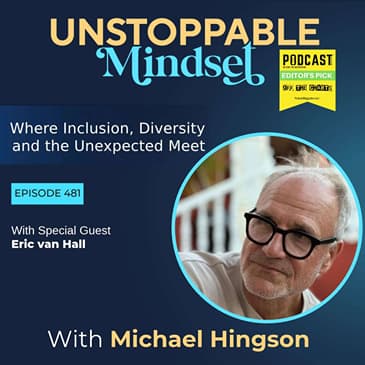
The people who adapt best to new technology are often the ones willing to experiment before everyone else is ready. I talk with Dutch entrepreneur and communication strategist Eric van Hall about a career built on curiosity, from competitive windsurfing and video production to web design, copywriting, ChatGPT, and AI technology. Eric shares why entrepreneurship requires persistence, why understanding your audience matters more than chasing tools, and how AI can support creativity when humans stay accountable for the results. We also explore AI accessibility, automation, human values, and why keeping an open mind may be one of the most useful skills for navigating rapid technological change.
Highlights:
01:28 - How windsurfing opened the door to Eric’s creative career.
15:07 - Why persistence and drive matter in entrepreneurship.
23:04 - How discovering the early web changed Eric’s career.
30:58 - Why curiosity and experimentation fuel innovation.
43:58 - How AI can expand human creativity.
59:38 - How AI could improve accessibility for people with disabilities.
About the Guest:
Eric van Hall is an entrepreneur and communications strategist with nearly four decades of experience at the intersection of creativity, technology, and media. He is the founder of CopyRobin, an AI-driven creation agency that helps organizations produce high-quality content at scale without sacrificing strategic intent or human nuance.
Eric began his career in the 1980s as a freelance copywriter and video producer, working with international extreme sports brands such as O’Neill. His early work in storytelling and audiovisual production led to the founding of The Box Office, an independent production company. In the mid-1990s, as the commercial internet emerged, he pivoted again—this time launching Mediaweb in 1995, one of the Netherlands’ first web design agencies.
After more than two decades building digital platforms, Eric identified a structural weakness in digital organizations: content production consistently lagged behind design and technology. To address this, he founded CopyRobin in 2015. Originally conceived as a “copywriting as a service” platform, CopyRobin streamlined collaboration between organizations and professional writers, removing friction from content workflows.
When generative AI entered the mainstream, Eric once again adapted. Rather than viewing AI as a threat to creative work, he repositioned CopyRobin around a hybrid model that combines AI efficiency with human judgment, strategy, and editorial responsibility. His core belief: AI can accelerate production, but authority, meaning, and trust remain human responsibilities.
In addition to his commercial work, Eric is co-founder of the Scriptorium Initiative, a thought-leadership platform focused on responsible, human-centric communication in the age of AI. As a speaker, writer, and moderator, he explores how organizations can use technology not to replace human voice, but to sharpen it. His career reflects a consistent principle: those who adapt with intent can turn disruption into leverage.
Ways to connect with Eric**:**
LinkedIn:
https://www.linkedin.com/in/ericvvanhall/
https://www.linkedin.com/company/copyrobin/
https://www.linkedin.com/company/scriptorium-initiative/
About the Host:
Michael Hingson is a New York Times best-selling author, international lecturer, and Chief Vision Officer for accessiBe. Michael, blind since birth, survived the 9/11 attacks with the help of his guide dog Roselle. This story is the subject of his best-selling book, Thunder Dog.
Michael gives over 100 presentations around the world each year speaking to influential groups such as Exxon Mobile, AT\&T, Federal Express, Scripps College, Rutgers University, Children’s Hospital, and the American Red Cross just to name a few. He is Ambassador for the National Braille Literacy Campaign for the National Federation of the Blind and also serves as Ambassador for the American Humane Association’s 2012 Hero Dog Awards.
https://www.facebook.com/michael.hingson.author.speaker/
https://www.youtube.com/user/mhingson
https://www.linkedin.com/in/michaelhingson/
Thanks for listening!
Thanks so much for listening to our podcast! If you enjoyed this episode and think that others could benefit from listening, please share it using the social media buttons on this page. Do you have some feedback or questions about this episode? Leave a comment in the section below!
Subscribe to the podcast
If you would like to get automatic updates of new podcast episodes, you can subscribe to the podcast on Apple Podcasts or Stitcher. You can subscribe in your favorite podcast app. You can also support our podcast through our tip jar https://tips.pinecast.com/jar/unstoppable-mindset .
Leave us an Apple Podcasts review
Ratings and reviews from our listeners are extremely valuable to us and greatly appreciated. They help our podcast rank higher on Apple Podcasts, which exposes our show to more awesome listeners like you. If you have a minute, please leave an honest review on Apple Podcasts.
Transcription Notes:
Michael Hingson 00:04
What if the biggest thing holding you back isn't what's in front of you, but rather what you believe? Welcome to Unstoppable Mindset, where inclusion, diversity, and the unexpected meet. I'm your host, Michael Hingson, speaker, author, and advocate for inclusion and possibilities. This podcast explores how the beliefs we carry shape the way we live, lead, and connect with others. Each week, I talk with people who challenge assumptions, face adversity head-on, and show what's possible when we choose curiosity over fear. Together, we focus on mindset, resilience, and the small shifts that lead to meaningful change. Let's get started. Hi, everyone. Wherever you happen to be, I want to welcome you to another episode of Unstoppable Mindset. I am your host, Michael Hingson, or if you prefer, Mike Hingson. But anyway, I really am glad that you're here with us today. Our guest is Eric Van Hall, all the way from the Netherlands, and Eric has been very heavily involved in a lot of tech kinds of things, and he is an entrepreneur, a communication and a communication strategist. He has been involved in a lot, a lot of different endeavors. He has formed a couple of different companies. Clearly, an entrepreneur, as you will see, and I think he probably has a lot of good business advice and business strategies and other things to to talk with us about. So I'm really glad that we get a chance to chat with him. So Eric, welcome to Unstoppable Mindset. We're glad you're here.
Eric Van Hall 01:55
Well, thank you, Michael. It's it's an honor to join you here in this podcast, and I hope that I'll be be a good guest for you and for your for your listeners, especially.
Michael Hingson 02:07
No doubt, I have no concerns at all. Well, why don't we start? Tell us a little bit about maybe the early Eric, growing up, and so on.
Eric Van Hall 02:16
All right. So I was born in May 1960 in the Netherlands, and my father was a doctor, a gynecologist, and my mother an artist, sculptor. And the first what is it? 12 years of my life, we moved seven times. So because my father was always, always his career was progressing. So then we went from one place to the next, and we actually stayed for a year in the United States. When I was nine, we we moved to Chevy Chase. That's in Maryland, near Washington D.C. yeah, because my father did research at the National Institute of Health, and so I spent a year in the primary school in in Chevy Chase, Maryland, and that also put a good basis for me connecting with the United States, and also for being able to speak English, and from there we moved then to the place where I live now, and we've been very steady there. I I went to high school, and then I went to what you would probably call college in the United States, which is university here in the Netherlands. Yeah, I. I just I I wanted to become a journalist, but I was yeah. We had a like a a system where you would get a lottery to get accepted in the journalism school, and I missed it twice, and then I decided to study history at the university. And and when I did that, I started windsurfing very phonetically. So I I was actually a semi-professional windsurfer in the early '80s. I got sponsorships and was competitive, not the main, not the real top, but but competitive, and I had a great time going from competition to competition, and that was a bit difficult to combine with with my studies. So I managed to get quite far in the study, almost all the way, but in the end, I got. I started working basically. So I I started as a windsurfer, and then when I was no longer really competitive, when I was in my late 20s, I was I became a giant. For the International Windsurfing Association, the professional windsurfing. So these were events where people jump and ride waves and do tricks, and I was I was judging that, you know. And so I went to Hawaii and to well all over the world. So it was a great time, and and there I started also writing about windsurfing and making doing photo shoots, and I got a big client called O'Neill, which is you know there it's it's a Californian brand that is specialized that builds makes wetsuits, but in Europe they also had a big fashion brand, and I did a lot of their advertising work, and that sort of launched me into my into my career.
Michael Hingson 05:50
So curious, you said you went into history. Was there a lottery for history that you you made it through, or they didn't have lotteries for history?
Eric Van Hall 06:00
They did not have lotteries for history, so journalism was
Michael Hingson 06:03
just very popular, and so they had to have a lottery for it, huh?
Eric Van Hall 06:06
Yeah, or the school was smaller; there were less less seats. Yeah, but I lost that twice, and then, but then of course, if you study history, it's also a good way to get into into journalism.
Michael Hingson 06:20
Sure, sure. But either way, you were definitely interested in writing, and so you you did windsurfing. You you you began judging it, and so on. And and you also, I would assume, wrote about it as well.
Eric Van Hall 06:37
So yeah, I wrote a lot about that. That's where it started. Well, it's actually a funny story. One of my best windsurfing friends was also a photographer, and he was specialized in windsurf photography. So he did a lot of photography where I was the subject when I was still windsurfing for my sponsors, because that was one of the reasons why I got sponsors. Is that I so often got a really good picture into in the magazines through this guy that this friend of mine who was a photographer because he was always in the water with a with a camera that had a water housing and we would jump over him basically and he he took the really good pictures and on one day I told him hey you make so many pictures, but you only sell maybe one or two every month to the magazine because it's the spread and it's the cover. But if maybe if we if if if you write some stories with the other pictures, you will get more exposure. You get you will probably sell more more pictures. But he he couldn't really write. It wasn't wasn't his thing. So I took a bunch of his pictures and I started just writing stories around those pictures. and And he submitted them to this to this magazine to the editor in chief there. And then the editor in chief said to him, "Hey, these are really nice and these stories are really nice. I don't think you write them yourself, do you? He said, "No,
Speaker 1 08:02
no. A
Eric Van Hall 08:03
friend of mine who writes those stories, and he said, "Well, I'd like to meet this friend because he's got a really nice style, and that's how basically it started. Because there, the I started writing for this magazine about yeah, it's all about windsurfing adventures, but also courses like you know how to do stuff, like how to do a certain jibe or certain maneuver. So I did and or testing equipment. So I did a lot of writing for them together with the photographer. I was traveling all around the world, and and then the marketing director of O'ER. So the O'Neill is the brand that makes wetsuits and and fashion, surf fashion. He contacted me. He said, "Hey, I think you've got a really nice way of writing about this subject about windsurfing. And he asked me if I could write advertising copy and also you know magazine, sponsored magazine, and stuff like that. So that's how I started there, and got a lot of work from that. And basically, because I'm a, I'm always interested in trying stuff. You know, experimenting, trying new stuff. And at a certain time, they asked me to write voiceovers for video productions that they made from O'Neill about windsurfing, but also about snowboarding and catamaran and sailing and other extreme sports. And so I started writing, and I really liked that writing text to the pic to the images, time coded, so that somebody else with a really nice voice would then narrate the the story, but I wrote the narration exactly timed for each shot. I really like doing that, and from there, suddenly, somehow, within two years, I ended up having a an audiovisual production company. With a with a with a friend of mine who was a real filmmaker, and so I did that for about six years.
Michael Hingson 10:07
What was that company called?
Eric Van Hall 10:09
That was called the box office. That
Michael Hingson 10:11
was the box office. Okay. Yeah,
Eric Van Hall 10:13
yeah. So that started in 1989 and lasted through 1995, and in that time, I traveled to basically all major windsurfing and snowboarding events in the world and made made productions. I also did other work, but that was the main thing. I had a really good network of broadcasters around the world, that in those time you know now everything is digital, but at that time we would still send tapes with couriers, and it was a whole logistic. Well, I don't want to say nightmare, but it was yeah. It's a lot of work compared to how you would do stuff today. You would just upload it, but then that time it was sending tapes. It was expensive using couriers. Yeah.
Michael Hingson 11:07
Well, the internet was not in its own yet, and by 1995 that started to happen. But
Eric Van Hall 11:12
exactly, exactly. So that's where my next phase started. Yeah.
Michael Hingson 11:17
So, by the way, just out of curiosity, do you windsurf at all today?
Eric Van Hall 11:22
Not now. For the last three years, I I tried maybe once or twice a year, but to be honest, my knees are are hurting so hurt so much after I windsurf or after I snowboard nowadays that it's it's no longer really attractive to do it. Yeah, unfortunately. Yeah,
Michael Hingson 11:44
I I have a brother-in-law who's a skier, and and it used to be that in the summer he was a master cabinet maker, and he also became a general contractor, building homes and so on up in and remodeling homes in Ketchum, Idaho, Sun Valley, but he is now seeing that he is slowing down some, but he still skis for right now, and and and enjoys it. But he he points out that he is now getting older, and he's gonna probably retire from his business, and or at least to a degree, and he'll continue to try to ski some, but it still isn't the same as it used to be. So I hear you.
Eric Van Hall 12:27
Yeah, yeah. It's it's it's especially when you're over 60. These extreme sports become a bit more challenging, especially because between your ears you're still 25. You know that's you think that you can still do it, and then you find out
Michael Hingson 12:44
that there are challenges.
Eric Van Hall 12:45
You pay a price. The price is pain, and I don't really like it. I actually did visit the orthopedian today. Yeah, not today, but this week. And so he says, "Yeah, you you just have arthrosis in your knees and you can if you want you can still windsurf or snowboard but if it hurts yet just take just take pain medication but there's not much they can do yeah so that's where I am
Michael Hingson 13:17
you got a lot of good memories and so on
Eric Van Hall 13:20
Oh yeah, yeah, definitely. So,
Michael Hingson 13:22
so how did you transition from the box office to doing something else? Yeah, so you already owned your own company. You were an entrepreneur. What what was it like when you decided that you wanted to start a company and you started the box office? What was it like becoming an entrepreneur? Because that's a little bit different than, in a sense, what you used to do.
Eric Van Hall 13:43
Yeah. So at first, I was like a freelance writer, so like a one-man band, and then I started getting work doing videos, and I I met the the so the the future at that time, the fiancée, let's say, of of one of my nieces, and we and he's a real filmmaker. He's a bit older than me, and he's made some really famous Dutch movies, like for like for theaters, for and and we talked about you know making videos about windsurfing and other extreme sports, and he was really into it. So we made it. We we we teamed up and started the box office, and so I was more the the field director and the producer and always traveling. And he was the did more responsible for the post production, and very importantly for the quality of the final product, because he was a real professional, and I was more like a a wild kid, you know, just experimenting and over over confident, obviously. So. So and that was a good match. So for for several years we we made a lot of productions that way, and we were successful. It was was was was great fun.
Michael Hingson 15:10
So he handled a lot of the business.
Eric Van Hall 15:13
No, I was more the business, and he did the post production. He he he was really the technical guy who, and he was like also a perfectionist, so he always made sure that the final product was up to par to be able to send it out to broadcasters and television stations, etc.
Michael Hingson 15:31
What did you learn though that helped you be successful for well over six years running the company? You were you were running a business and you had to make money and so on, which meant you had to have some business sense. What did what did you learn that helped you as you did all that?
Eric Van Hall 15:50
Well, in that at that time, I think important learnings were that you keep you keep things a bit lean and mean. So we worked with with freelance production teams. So we had a very small business. We did not have a lot of overhead. And I think the most important thing is be creative and and very very motivated, very enthusiastic and driven. I think drive is really from entrepreneurship. Drive is very important, you know, because it it sounds like a like a like a dream, you know. Oh, you have your own company, and yeah, everybody only sees the success stories.
Michael Hingson 16:35
Yeah,
Eric Van Hall 16:36
but it's really really hard, and you need to be very persistent and be and be able to deal with disappointment and and and setbacks all the time because every day something will happen that you know that you didn't see coming especially when you when you do productions like this where we took all the risks or we had a budget but all the costs, you know, if we went over cost, a production would cost us money rather than than make us money. So, so you learn to also be savvy with with with your purchasing, with your sourcing. That's very important because it's it's more difficult to make make your margins by selling at a higher price than by being careful about about how you spend your money. Did you have
Michael Hingson 17:32
a did you have a lot of fear? Oh, I'm sorry. Go ahead.
Eric Van Hall 17:35
No, no, no. At that time, I was I was fearless. Yeah, I did. You didn't have a lot of fear. You
Michael Hingson 17:41
you just were very confident. We can talk fear because,
Eric Van Hall 17:44
yeah, at that time when I was late 20s, early 30s, I I had I actually had no fear. No, I was very confident. I was I thought that I could I was going to rule the world. In the end, it didn't happen. Fear comes comes definitely comes back later in this story, yeah. But at that time, no, that was not an issue.
Michael Hingson 18:06
But you you still also learned enough along the way to be pretty successful at it.
Eric Van Hall 18:13
Yeah, it it was it was successful in this niche of and and So I think in in in the states success is probably more than here in Europe. Always connected to money, to and and from that point of view, maybe people will say it's not really very successful. But for me, it was very important that I had a really cool lifestyle and I really enjoyed my work, and I really enjoyed every day, and I got to do really creative stuff. We're always pushing the boundaries, you know. I was, for example, in 1989, I was in in Cupertino, California, writing writing for a Dutch publication for a youth publication is what they call the agenda, where you write your homework, or you you know if school kids-I don't know how that is in in the states, but in in in in the Netherlands at that time, these were like really important stuff for high school kids to for the for the identify you know for the identity, and one of the brands was O'Neill where I was working for made a made the coolest one and I did a lot of the writing and a lot of the production for that, so I was writing about Apple in in Cupertino. So I was visiting Apple, yeah, and and and there, the lady that that that showed me around in the Apple headquarters in Cupertino at the time. This so this is in 1989. She said, "Hey, but you you also make video? I yes, she sort of found that out, and I said, "Yeah, yeah, I would." Just starting with that, and then she said, "Well, we've got a machine here that you will probably find very interesting, and it was called the Avid, and this was the first Avid. It was sort of a prototype still, and she showed it to me, and it was like where you start editing video nonlinear. So back to the so at that time when we were editing video, you always you know you had to copy from a source tape to a master tape, and you could not split the tape and then put something in between. So you had to really plan out every shot and and and and time it really good because otherwise it will the video would become too long, and it was very difficult, basically editing video. And with the digitization, they they brought back the the flexibility and the freedom of splicing film, you know, real film, old-fashioned film, and cutting that to editing that into a final product, and and I did that digitally, and that was very very innovative at that time. was really new, and I was I was blown away by it, by the idea. But the the the quality of the images, you know, the digital images was still there. Was like really small, small images. It was really you could not really make a good quality production that way. But I could see the potential. And then two years later, there were when I was when I was just working in the Netherlands with my production company. We did buy one of the first Evids in the Netherlands when it was the quality had been improved a lot, and so we were one of the first companies using that new Apple editing machinery in the in the early 90s, the 1990 1991.
Michael Hingson 21:56
Yeah, I I'm familiar with Avid. I of course never used used one, but I I've heard of it through the years and and and understand the capability. I guess I never knew it was made by Apple, though.
Eric Van Hall 22:09
Yeah, at that time it was. I think Apple Apple purchased it. Oh, they okay. Yeah, yeah. But
Michael Hingson 22:17
still, the very fact that now they were starting to open. The concept of doing digital editing was was absolutely worth thinking about, and and you saw the potential of that, which was pretty good.
Eric Van Hall 22:35
Yeah, yeah. And so you you did
Michael Hingson 22:37
things with it.
Speaker 1 22:42
If you enjoy Unstoppable Mindset and would like to help us continue bringing these conversations to you each week, we've created a way for you to support the show. Your contribution helps us cover production costs and continue sharing stories, insights, and ideas that inspire people to live with purpose and possibility. If supporting the podcast feels right for you, you'll find the link in the show notes. Thank you for being part of the Unstoppable Mindset Community.
Michael Hingson 23:14
Well, so your your company, the box office, was around for like six years, and then you moved on from that. What what caused you to move on, and and where did you go?
Eric Van Hall 23:28
Yeah, so in 1994, when I did a lot of research for for a video production, that was a big production that would take place in the Seychelles and and Ethiopia. I I I started using CompuServe, which was an online. You you know about that? It was online yeah online database. Basically, you could you you could find a lot of articles there, a lot of information, and and they also had a web browser, and that's how I got into contact with the World Wide Web in 1994. Did you use Dead Sniper?
Michael Hingson 24:07
What browser did you use at that
Eric Van Hall 24:09
time? It was Mosaic built into CompuServe. Yeah,
Michael Hingson 24:13
yeah,
Eric Van Hall 24:14
yeah. It was built into CompuServe.
Michael Hingson 24:16
Right.
Eric Van Hall 24:16
And well, again, that was something that totally blew my mind. I mean, when I first started browsing the well, the the nascent web, I thought I needed to do something with it. I thought I really need to do something, and so I I started Media Web, and it was a company that was a digital. You would now call it a digital agency. So, building websites, digital experiences for customers, and so I did that. I had I hired a team, and I you know I went out and got got clients, and we built websites for a lot of companies in the Netherlands.
Michael Hingson 24:57
Yeah,
Eric Van Hall 24:58
for many years I did it for 20.
Michael Hingson 25:00
Okay, so you did that. So you you basically left the box office and went to MediaServe.
Eric Van Hall 25:08
MediaWeb, yes. MediaWeb, yeah. So so my my my my partner and I we we we well. So we we how do you say it? We just stopped with the with the box office and stopped with the audiovisual productions, and he went on his own way as a freelancer, and I started MediaWeb, and and that was a journey of 20 years, and it was a roller, also a bit of a roller coaster because it's yeah when you're always sort of in the front you know your early adopter the really earlier adopters you still have to convince so many people and it's it's a lot of work it's a lot of and that's a bit of story of my life I guess I'm always when something new comes out. I get fascinated, and I will get probably back on that subject a bit further down this this this this this talk. But so that's I was just so enthusiastic about the the possibilities of the World Wide Web that I thought I had to make my own. I had to start making websites, so I started building websites myself, and then I found out that it's actually quite difficult. So I hired a programmer and a designer and a project manager, etc. etc. And then I had to focus more on the sales and and the marketing of the company.
Michael Hingson 26:42
Well, one of the things that's an interesting parallel. So you started filming windsurfers and so on, and dealing with people who were riding waves, and then later, of course, you have the whole technological world of the digitization and everything relating to the internet. What do you think about parallels between dealing with the the waves of the ocean and so on, and the waves of digital industry as it's as it's been growing? Do you think that riding the waves is kind of the same in both cases?
Eric Van Hall 27:17
Well, I can I can say one thing for certain is that a lot of the my windsurfer friends that I knew from the 80s that ended up in the digital business as well. A lot of them also did fell on sort of the same path as I did, experimenting with with digital and especially online businesses. So I think there's a how do you call it an overrepresentation of of former windsurfers in that in that world, and why is that? Well, I think it's a bit people that are a bit ahead of the curve, like innovators or experimenters. You know, like windsurfing. I was there also very early, you know. It's and and then it becomes really big, and you ride the you ride that wave for a while, and then it gets too big, it gets too corporate, it gets, and then you start looking out for other stuff because you're surfing life basically, right? And you're not you're not a corporate person. You're not a real a person that is only you know that lives in spreadsheets. You you know you live in experiences, and so then you may there's always a risk that you could get a bit bored. So when something new exciting comes there, then you you jump onto that and latch onto that, and and it's because it gives an enormous creative boost as well. You know, if you first for me first it was writing, then it was making video, and then it was building websites, and and and then of course from about just over 10 years ago there was the next next move. I don't know if we're if we're already there, but yeah. So well, so in 2015, I was basically getting bored with having a digital agency. I didn't like it. Like I didn't like it anymore. I mean, the but I one of the things that I saw in many projects that we did, was that if there was a delay, the reason was almost always that nobody thought about writing any copy. So the clients they they loved you know talking about functionality, technology, and especially design. But oh yeah oh okay yeah yeah, and so I was chasing them for filling up the website with copy, and it was always an afterthought. And then, then an office manager was sent off with the job, and then we got terrible copy, and a sort of disgrace for the design. And that was a always returning problem, and and and it. Irritated me, so I thought, what's the reason for this? Why is this happening? And I thought, well, basically, the whole business of writing copy is still stuck in the 20th century. You know, people were just chasing freelance writers and then sending word documents by email, and I thought the whole whole workflow was just flawed, and and nobody liked it, and it's it's painstaking. It's a lot of work, and it's undervalued. So I thought if I can get all the as much pain and friction out of the process, then that might be a really interesting business. So that's when I started Copy Robin in 2015. Well, I did the the the MVP, you know, amenable viable product. I tested it out, and I found a buyer for MediaWeb, and so I managed to sell MediaWeb, and and then, but but with with MediaWeb with the web design agency, we did build the whole platform, the website for Copy Robin. So I had a new business, and the people that bought MediaWeb, they asked, "Hey, so what are you going to do now? And I said, "Oh yeah, I start a new business. It's called Copy Robin, and I told them about it, and they said, 'Hey, but that's really interesting. Can't we participate? So I had actually the buyers of my old business also invested in in the new business. So that was the double Emmy.
Michael Hingson 31:28
Well, it's it's interesting on on several fronts. You've seen the potential for different kinds of technologies, and you decided to to deal with them before most people did. Why? Why is it that you have found that as technology or as technologies change and grow, that you're able to be out in front of it and become successful using the the new changes and the new advances that come along?
Eric Van Hall 32:01
Well, first of all, you have to be very curious, and I think also you have to be a sort of a tinkerer, somebody who likes to experiment with stuff and tries things out. And even if it doesn't work immediately, if it's if it's still you know not really mature Technology that that's yeah if if you know if you if you always want to play it safe, then then you just wait for other people to make all the mistakes. And I'm you know the the the downside is that you're if you're early you're one of the people making mistakes. And if you're but but if you're if you if you hit the good technology and if you know if you if you if you do it right, then you've got the first mover advance advantage, and that's really really valuable. But it's you need to be curious. You need to be always out looking out for new stuff, and and try stuff out. You have to you you have to be have an experimental mind you know try stuff break stuff fail fail forward and try out and and and and and have fun that's the most important part is that you do stuff that you really you know I liked learning how to write HTML in 1995, you know, and I, I liked building a whole new concept around around copywriting, where I I made an online platform like a SaaS solution, software as a service kind of solution, where I had a lot of freelance writers in the database and managed to connect those to to to the clients, and had and and the difference with other platforms like Upwork or Fiverr is that we had a whole quality control layer on top of it, so that we could service the customers more like an it was like a hybrid between an agency and a SaaS platform, because customers don't like working with SaaS platforms most of the time. They just want a result, and that's why I I chose this hybrid solution, and and that was actually you know it was it did fill fill in a big need, so yeah that that that really worked out well.
Michael Hingson 34:33
Well, so I I agree with you. You got to start with a curious mind, but you obviously looked at technologies as you, as your curious mind showed you different kinds of things, and you made some determinations of what was probably going to continue to grow and continue to be something that the world would want, as you did with the internet, and then. Obviously, you did it with advertising and copywriting, and that's an interesting thing. Just a couple of days ago, I had a person on our podcast who is an advertising specialist, and one of the things that he said, which is very close to what you have talked about, is that companies don't advertise like they should. They they don't really look to to advertise to to do it well, to ask questions, to produce things that will truly get people interested in their products the way they should. And of course, you talk about the fact that people don't do copy very well, which really is is part of the same thing, but but his his point was that the more successful companies that are truly successful are also better at truly advertising, which is important.
Eric Van Hall 35:55
Yes, absolutely. Now I'm I'm personally not not very much into the advertising side of events, but like media buying and stuff like that. I don't really know a lot about that, but I do know about creativity, and and and that's very important. But yeah, I think people find it's it's it's it's really difficult for often to put yourself in the shoes of someone else, and and that's and and that's that's that's an art if you're able to have the empathy for for your customer base or for your target audience and really really you know, get into their mindset. That's, I think, the basis for all good content, be it advertising or or just content content marketing or whatever. Yeah. So that's where it all starts. If you want to be successful with with any kind of content, you need to really, really understand your audience,
Michael Hingson 37:03
and you need to be really willing to tell the story.
Eric Van Hall 37:07
Yeah. Okay. If if you're yeah, if you if if if you want to use your like a personal branding, then then you need to have a story and be open and be candid and and and also yeah be a bit interesting, yeah. And and yeah, and and that's what we're doing here. You know, we hope that that from the experiences that we discuss from from my story that that people will maybe get either get inspired or that they learn something. That would be great. So, so the but the thing is we we we're talking about why innovative stuff why why always new tech and I think it's it's it's it's just in your it has to be in your personality that you're always trying new stuff always trying something is new and you try it out so you know I was there with windsurfing really early. I was there with snowboarding really early. I needed to know about it. I saw a bit of it somewhere, you know, and I thought, hey, that's interesting. And then you and then you have to just go all in, yeah, and and spend a lot of time and a lot of practice.
Michael Hingson 38:19
Well, one of the things that you've done, because you've been curious, because you've looked at various technologies, because you have decided that, or you decided they were worth exploring, you've essentially, I think, some would say, reinvented yourself a few times over the years. How has that changed for you as you as you age, do you do you find yourself less interested in reinventing yourself, or do you continue to look for other things that may be relevant to look at down the line?
Eric Van Hall 38:51
No, that's what I said. The body may be 65, but the mind is still 25. You know, I'm I'm always still looking for the newest now, I'm very very active in AI since since a few years. That's I mean that's quite the the pivot of copy robin is quite an interesting story. I think it's good time to start talking about that. Is that of course when your when your product is copy and AI starts writing copy. You have to pay attention because this is like a really disruptive something in your market. So in the years like 2021, 2022, I was following the developments of tools like Copy AI and Jasper and all these writing tools, I was I was actually very interested in that and trying them out. But at that time, like until halfway 2022, I tested in total 10 tools and. It was interesting, but it was not there yet. I mean, the English writing was already pretty good, but since our audience and our clients were mostly, we had to write in Dutch, and the Dutch was still very bad. I mean, you could not use this AI writer to write professional Dutch copy. It was just no way. So I did make an April Fool's Day joke on the first of April in 2022, where we published an article and a social media post that that we as copy robin would no longer work with human writers. That we would do everything With AI, and and I got a lot of phone calls and emails from from freelance writers that were totally upset that that didn't realize it was the first of April. Yeah, yeah, it was one was I think my my my most successful April Fool's Day joke ever, but it was also actually with hindsight. It it had a lot of it was early. It was very early, but it's actually all happening right now. Sure. And so then I I wrote a big article in that summer comparing the 10 most used AI writing tools and sort of saying, "Well, if you write in English, it's kind of okay. If you write in Dutch, just wait. It's not good enough yet. And then in the early December 2022, I I was I was hibernating in Curacao. You know, we we had some contact when I was still in Curacao before Michael, and I was doing that there as well. And then I I heard about a new a new AI tool called ChatGPT, and I thought, okay, now I've got to try this out. And of course, I tried writing with it in English and then writing with it in Dutch, and I was, I was, that was like this moment that I thought, okay, this is going to change everything. It's going to change my business dramatically. So I experimented with ChatGPT day and night for for for the whole month of December, and and I concluded that I had to pivot my business completely because otherwise AI would eat eat my lunch, and so I I identified actually eight workflows in our business that have to do with creating content, and everywhere I thought, where can I integrate AI and make it useful? And so I spent six months working on that, reprogramming a lot of our workflows in our in our platform, integrating the OpenAI API to to generate ideas, to do keyword research, a whole lot of stuff that we do, and and actually to to produce a really good system prompt based on so we had a system prompt, and then when the customer would fill in the form for the with the briefing for the for the writing job that would generate a prompt that our freelance writers then could use in ChatGPT to to write the like a draft of like that was like 80% ready you know and and that's what we did and in June 2023 we launched this and I got a lot of publicity because I was really early, really early with that. So I got a radio interviews and magazine interviews, and it was really good for the business on that for for from that point of view.
Eric Van Hall 43:54
But the other other other end is that a lot of people were not ready for it. So I also had a lot of problem with the freelance writers adapting to this. Some of some of them were really angry. You know, some of them were just just hated it, and others were were enthusiastic. So it it it got a lot of commotion around it, and and it's been quite a roller coaster ever since.
Michael Hingson 44:21
Well, the the whole thing about AI today is is we see these arguments, these fierce battles about AI doing things and stealing creativity, and there are a number of people who say AI is a great tool. It's a great research tool, but it shouldn't be doing the writing. The writing, the creativity belongs to humans. What do you think about that?
Eric Van Hall 44:51
Yeah, I think that's bullshit. Sorry, the AI surprises me every day. Creative it can be, but it's you know garbage in is garbage out, and if you know how to talk to the AI, it can make you a lot more creative. It's it's and especially with the latest models that they surprise me with a creative maybe not so much that that you think it's it's it's very well and beautifully written because it can obviously do that if you prompt it well. It can write in any style that you want, but you have to you have to always you have to make sure that it doesn't go generic. And that's if just if you give it too little information and it goes very generic. It okay, but but that's not necessary. But that's of course what happened: is that all these freelance writers that were against AI in principle, they they thought, hey, this this AI is coming for my my work, and I have to hate it, and they didn't want to embrace it, and then so they tried it, and then they thought, ah, this is generic, and this is oh, this is terrible. Like my experience of of a year before, you know, that I thought, ah, this doesn't work. It's in Dutch. It's terrible. And when you have that experience, and you don't, you know, and you think, then basically these people they thought, okay, well, this is nothing, and then they just put it aside. So they they had this vision that they, you know, it's like if you if you try to ride a bike and you've never done it before, and you step on a bike and you immediately fall on your knee and you and you scratch your knee and then you say, "Oh, that's nothing for me. Fuck! Instead of learning to ride the bike, you know, you have to fall and get up and try and and and and in the end, and and a lot of people don't want to do that, and then just their first experience determines how they feel about the whole technology, and that I think that's a big mistake.
Michael Hingson 46:50
Well, I think it's it's a lot of fear. A lot of creators feel threatened and felt threatened by AI. You didn't, but you have a very curious mind. My belief about AI is that no matter how good AI is, there there are aspects of being a human being that I think it's going to be a long time before AI can truly emulate. But even then, it's going to emulate as opposed to totally taking the human part of it and and totally becoming human, if you will, and so I think
Eric Van Hall 47:28
absolutely. So the AI doesn't have an experience; they don't experience anything. So, but they can emulate the experiences, and they they can fool you very very good. You know, they're very avid at it now. But no, I think you know. I that one of the most important things with human interaction with AI is that if you use AI, you always have to know, have to realize that you, in the end, you are still responsible for whatever exactly, and that's what I was
Michael Hingson 48:06
getting to. That's what I was getting to. Is that ultimately, you still have to be a part of the process. I I would never want to let AI totally write an article or do any work for me without me supervising it without me looking at it, and and also using my own creativity to add my touch
Eric Van Hall 48:30
to it. Yeah, you can add your touch on the front end often more than on the back end. But so, for example, when I write with with I use ChatGPT and I use Gemini and Gemini and I don't really type texts anymore; just prompts, you know. Because because when the text is is not not not okay, I don't I don't like the final the the product the first first draft. I keep prompting. Yeah, that's right. Because the AI is always better able than me to to either embellish something or or get you know. But very often it's also that that it's more the content itself. You know that I just say. It's you know yeah you have to it still it still work it you know it's it's not a push in the button and you have a perfect final product. Although my experience is that that the the the one shot prompt prompting really good results. I get them more often all the time. So, so there's definitely a progression there, and that actually seems to be accelerating. And at this time, at this moment, there is a big hype of real agentic tools. Called Open Claw, where you can run agents on your own computer, and I'm really, really eager to try that out. But it's also very insecure, so it's it's something that you that you don't do lightly. You have to really prepare it well. But there, you know, from the people that are already experimenting with it, I I can see that these agents are very independent already. You know that they feel like you have a human almost working for you that is on its own taking decisions, and and that can go terribly wrong, and it can also give really good results. And it's it's very experimental now, but it's a it's a window on what's coming, and it's it's going fast because the especially the AI companies like OpenAI and Claude Anthropic they focus a lot on on programming because that's their core business is is writing code. So if if you want to look to the future in other aspects of AI, like for example writing, or legal, or financial, or etc. Well, look at coding, and now I understand that companies like OpenAI and Anthropic and Microsoft and Google and and and well, all the Facebook, they all meta, they all are generating ever more content with a code source code with AI, and it's getting better at an incredible pace. So it it won't take extremely long until AI can do complete jobs all by itself and deliver final product all by itself. It's it's it's it's it's going to happen. Well, I think I
Michael Hingson 51:48
think it will. I think that the the issue though is that even when AI gets to be really good, it's still my responsibility as a writer to make sure that it is saying what I want, and you know one of the and so like dealing with different sources when when AI if you do research with it and it cites something, it's always good to verify that what it found is really true, and as I point out to people, the reality is even if I ask a human being and they give me a reference or something, I'm going to check it out because humans make mistakes, and humans don't always necessarily give you the whole story, and it's not a matter of they're maliciously or deliberately doing it, but it it happens. And so, no matter what we do, there's a need to make sure that we that we truly analyze whatever it is that we're working on, and make sure that it's it's all coming out the same way and the right way, the way that we want it to be, and that's just going to continue to happen.
Eric Van Hall 53:04
Yeah. So, like I said, I mean, accountability is the main thing. I mean, you as as the you, but you know, I listened to a podcast recently with Elon Musk as a guest, and the predictions there are a bit terrifying. He says that in in in he's always sort of exaggerating, you know, and and and and puts things on a timescale that in the end takes much much longer. But he says that within a few years, of all the intelligence in the world, only 1% will be biological, and the rest will be digital, and and so who is going to run things when 99% of all intelligence is digital? I thought that was quite a spooky picture. I don't know how true it is, but I, you know, you can think of him what you want, and I'm not really a fan of him for certain reasons. But I do think that he's pretty in this field. He's pretty genius, and he's probably got the. I think it's worth listening to that because.
Michael Hingson 54:11
And which person is that again?
Eric Van Hall 54:13
Elon Musk.
Michael Hingson 54:14
Elon Musk. Right. Yeah. Yeah.
Eric Van Hall 54:16
Yeah. Yeah. So he he was in a very long podcast and listened to it, and this was one of the things that I thought. Yeah, okay. What what is a world where, of all the intelligence that's available, 1% is biological, 1% is human, or you know, in is in actually flesh and blood. Well, who is who has the power then, and that's something that we really, you know, that's sort of
Michael Hingson 54:43
well. And I, but I also think that the intelligence, as he puts it, is an issue. Even if it's 1% that 1% is a different kind of intelligence than what we see with. Digital and programming and AI and so on. So yeah, I'm I'm not sure that Musk is is there and and Ray Ray Kurzweil, for example, talks about singularity, and I'm I'm not ready to let my brain be married to computer technology as such because I just think that we're missing the fact that there is a certain characteristic in the human thinking and in the human brain that technology isn't going to truly be able to to master, and and as as it masters it, humans get better, so it's going to continue to evolve, and humans need to be able to keep that control.
Eric Van Hall 55:47
I totally agree with the last part that we need to keep control. But it's going to his point was that it's going to get be how difficult it's going to be if only 1% of all intelligence is human. Then how how do you how do you stay in control. That was basically the the dystopian future. So we need somehow we need to build in ways to to stay in control. And I think one of the things is there is that that that when we build these systems, we have to put values in there. We have to put our human values in there, you know, because humans are terrible. We have terrible. We do terrible things, but we still have also we have values. We also preserve nature where we can, and we have empathy. And machines don't have empathy. The machines. So it's it's it's, you know, I don't lay awake at night worrying about these too much, but it's it's something that's it's interesting to think about, and also what the impact is if you have a business or if you have a job, because because of the exponential speed. You see, if if if if the the the total amount of intelligence and and they they were talking also about compute and putting putting data data centers in space etc. I mean this this was the whole because it's the only way that you can get enough energy and and and room and and compute to do to do all this super intelligence and yeah how do you stay in control? Yeah, it's that's that that's quite. It can be a bit scary to think about. But I'm an optimist, you know. I'm also an AI optimist. I'm not. I'm not a skeptic.
Michael Hingson 57:33
Yeah,
Eric Van Hall 57:34
I embrace it. But I, you know, I think we do need to think about, and that's one of the things that I do with my new endeavor, where I'm involved, is called Scriptorium Initiative. Is where we where we want to help within the AI realm build an operating a operating system for trust. So build in trust and and and accountability into the into the systems, and that's one of the things that we want to develop and help help companies build you know build or incorporate AI into their into their. We are focusing then on communications. Yeah, build that into their system so that the that the the company still has a still has benchmarks for the for trust and is to be trusted by humans because in the end, yeah, trusted by humans and by their the human the human synthetic stakeholders, you know, because humans are using more and more agents to do their work. It's going to be the next two three years are going to be very very interesting because these the the developments could speed up a lot because, like I said, they start with the programming, but now that's why I think that copywriting will probably also be more and more automated, so that that human interference is less and less necessary. And I, you know, I'm also thinking about what that means for for for copy robbin and what will the future bring. You know, it's it's it's also a bit scary because I can see it now that the quality of the the the the one shot prompt text production is is has improved a lot recently. So you you know what I mean with one shot. I do. I do. AI just starts working on its own and and and corrects its own mistakes, and you know it gets better and better. That's working on the working on the product like a human would. Well, we talk we talk
Michael Hingson 59:48
about control, so that goes back to Isaac Asimov and his laws of robotics, and you know we we do need to build in governors to to try to prevent as. Much of the the nastiness as we can, and I don't know that we know how to do that yet. But I think we'll we'll see. Let me ask this question because we've been doing this a while now. As you know, I work with Accessiby, and one of the questions I would ask is, do you think that AI help make the well technology and the internet and so on more accessible, or is it going to create more barriers?
Eric Van Hall 1:00:26
I think it will make very much more accessible because if you look at these tools that are now experimental, like Open Claw, which is just running on a computer, you can just chat with it, and it does it does complete jobs for you. So if you're if you're it's it's basically on a computer. If so, if you're if you work on a computer, now you you will you you have to use a screen reader. And so so I'm not I'm not very familiar with with with all the. I mean you know a lot more about it than I do, but you still have you still have to learn to deal with a lot of obstacles. And in the end, I think we're almost there. We're practically already there. It's just the safety issues are need to be resolved. But when you have a safe solution that has the same intelligence and self, how it works, it works independently as as a as a as an agent, and you can do it safely. Then it's going to be tremendous improvement for if you can just talk to to your computer and it and it starts doing stuff immediately. And computer already knows what you need, and starts thinking ahead for you, it's that's going to happen, and I think if you have a disability, impairment, it will it will make life a lot a lot better. I'm I'm pretty sure about that.
Michael Hingson 1:01:51
I I think I think you're right. So for people who fear change and fear technology, what's what's one step they can take to maybe learn to become more comfortable with all the things that are happening in our world.
Eric Van Hall 1:02:07
Well, if you, yeah, it's it's it's it's difficult to say from my point of view because for me it's always been sort of natural. But right. But how would you
Michael Hingson 1:02:19
advise someone to yeah consider positively more change.
Eric Van Hall 1:02:23
Yeah, I think I think that I think curiosity curiosity educated the cat and didn't just kill it. You know, you have to yeah you have to try to to step outside of your comfort zone, basically, and and also be not too skeptical. You know, you know, if you think AI, if you if you have like, how do you call it that you think that that you have your your opinion is already made,
Michael Hingson 1:03:02
yeah, if you're biased, if you're prejudiced, if you're biased,
Eric Van Hall 1:03:05
prejudice, yeah, exactly. Then then that's a big break on your on your development. So you have to have an an open mind, yeah, and and and and try stuff out, even if it feels a bit counter counterintuitive, because if something feels counterintuitive, you're probably on the right track. If it feels comfortable, then it's probably not. Then it's probably not worth worth pursuing. Everything that that that yields success is hard.
Michael Hingson 1:03:37
Well, and there's truth to that. Well, if people want to reach out to you, maybe interact with you, maybe use some of your services or whatever, how do they do that?
Eric Van Hall 1:03:47
Well, they can contact me. Maybe it's find me on LinkedIn, and it's Eric with a C and Van Hall H A double L, and I'm based in the Netherlands. And if they listen to this podcast and they want to get in contact with me, that's that's a good place to start because all my other connections, my businesses, etc. is all mentioned there as well.
Michael Hingson 1:04:19
Okay, do you have a website you can refer people to?
Eric Van Hall 1:04:24
Yeah, I have two. I have I have copy robin.com if you're English speaking and.nl if you're Dutch, and I have scriptorium dash initiative.ai, and that's my new project that I'm that I'm recently started with some partners, and that's a project to help communication professionals, senior communication professionals, manage, you know, navigate through the the big changes that are that are now. Coming over them due to AI.
Michael Hingson 1:05:03
Well, you have offered a lot of really great insights. I hope people will think about what you've said and and reach out to you. I think it's worth continuing the discussion, and maybe we'll need to. Would you agree? We'll have to do a conversation. Also, sure.
Eric Van Hall 1:05:18
If they reach out through LinkedIn and mention Michael Hinkson, then I will definitely accept their their invite and and start the conversation. Absolutely.
Michael Hingson 1:05:28
Well, thanks for being here, and I want to thank all of you for being here with us today. This has been a really fun and wide ranging discussion. If you'd like to reach out to me, I'd appreciate it. You can email me at speaker at Michael Hingson M I C H A E L H I N G S O n.com. Love it if you'd give us a review wherever you're listening to or watching our podcast. If you know anyone who wants to be a guest, we're always looking for people who want to tell their stories. So, Eric, for you and everyone out there monitoring our podcast, we'd love to be introduced to other people you think would be great guests. And if you haven't been a guest and you want to be, let us know. But for now, I just want to thank you, Eric, for being here. This has been absolutely wonderful today.
Eric Van Hall 1:06:14
Thank you. It has been a pleasure and an honor.
Michael Hingson 1:06:20
Thank you for being here with me on Unstoppable Mindset. I hope today's conversation left you with a fresh perspective, a new insight, or at least something worth thinking about. If you're ready to go deeper into the ideas that shape how we see ourselves and others, I have a free gift for you. Head over to michaelhinkson.com and download my free ebook, Blinded by Fear. It explores the invisible beliefs that hold us back and shows you how to reframe them so you can move forward with clarity and confidence. Be sure to subscribe to our podcast, leave a review and share this show with someone who can use a reminder that growth starts with mindset. When people think differently, we all move forward together. Thanks again for listening. Keep learning, keep questioning, and keep choosing to live with an unstoppable mindset.
[00:00:03] [SPEAKER_02] What if the biggest thing holding you back isn't what's in front of you, but rather what you believe? Welcome to Unstoppable Mindset, where inclusion, diversity, and the unexpected meet. I'm your host, Michael Hingson, speaker, author, and advocate for inclusion and possibilities. This podcast explores how the beliefs we carry shape the way we live, lead, and connect with others.
[00:00:32] [SPEAKER_02] Each week, I talk with people who challenge assumptions, face adversity head-on, and show what's possible when we choose curiosity over fear. Together, we focus on mindset, resilience, and the small shifts that lead to meaningful change. Let's get started.
[00:00:57] [SPEAKER_02] Hi, everyone. Wherever you happen to be, I want to welcome you to another episode of Unstoppable Mindset. I am your host, Michael Hingson, or if you prefer, Mike Hingson. But anyway, I really am glad that you're here with us. Today, our guest is Eric van Hall, all the way from the Netherlands. And Eric has been very heavily involved in a lot of tech kinds of things.
[00:01:26] [SPEAKER_02] And he is an entrepreneur and a communications strategist. He has been involved in a lot of different endeavors. He has formed a couple of different companies. Clearly an entrepreneur, as you will see. And I think he probably has a lot of good business advice and business strategies and other things to talk with us about. So I'm really glad that we get a chance to chat with him. So, Eric, welcome to Unstoppable Mindset. We're glad you're here.
[00:01:55] [SPEAKER_03] Well, thank you, Michael. It's an honor to join you here in this podcast. And I hope that I'll be a good guest for you and for your listeners, especially.
[00:02:07] [SPEAKER_02] No doubt. I have no concerns at all. Well, why don't we start? Tell us a little bit about maybe the early Eric, growing up and so on.
[00:02:16] [SPEAKER_03] All right. So I was born in May 1960 in the Netherlands. And my father was a doctor, a gynecologist, and my mother an artist, a sculptor. And the first set of, what is it, 12 years of my life, we moved seven times.
[00:02:40] [SPEAKER_03] So because my father was always, his career was progressing. So then we went from one place to the next. And we actually stayed for a year in the United States. When I was nine, we moved to Chevy Chase. That's in Maryland. In Maryland, right. In Washington, D.C., yeah. Because my father did research at the National Institute of Health.
[00:03:07] [SPEAKER_03] And so I spent a year in the primary school in Chevy Chase, Maryland. And that also put a good basis for me connecting with the United States and also for being able to speak English. And from there, we moved then to the place where I live now. We've been very steady there.
[00:03:32] [SPEAKER_03] I went to high school and then I went to what you would probably call college in the United States, which is a university here in the Netherlands. Yeah. I wanted to become a journalist. But I was, yeah, we had like a system where you would get a lottery to get accepted in the journalism school. And I missed it twice.
[00:04:00] [SPEAKER_03] And then I decided to study history at the university. And when I did that, I started windsurfing very fanatically. So I was actually a semi-professional windsurfer in the early 80s. I got sponsorships and I was competitive. Not the real top, but competitive. And I had a great time going from competition to competition.
[00:04:31] [SPEAKER_03] And it was a bit difficult to combine with my studies. So I managed to get quite far in the study, almost all the way. But in the end, I got, I started working basically. So I started as a windsurfer. And then when I was no longer really competitive, when I was in my late 20s,
[00:04:55] [SPEAKER_03] I was, I became a judge for the International Windsurfing Association, the professional windsurfing. So that these were events where people jump and ride waves and do tricks. And I was, I was judging that, you know. And so I went to Hawaii and to all over the world. So it was a great time.
[00:05:21] [SPEAKER_03] And, and there I started also writing about windsurfing and making, doing photo shoots. And I got a big client called O'Neill, which is, you know, there, it's, it's a Californian brand that is specialized that builds, makes wetsuits. But in Europe, they also had a big fashion brand. And I did a lot of their advertising work. And that sort of launched me into my, into my career.
[00:05:51] [SPEAKER_02] So curious, you said you went into history. Was there a lottery for history that you, you made it through or they didn't have lotteries for history?
[00:06:00] [SPEAKER_03] They did not have lotteries for history.
[00:06:02] [SPEAKER_02] So journalism was just very popular. And so they had to have a lottery for it, huh?
[00:06:06] [SPEAKER_03] Yeah. Or the school was smaller. There were less, less, less seats. Yeah. But I lost that twice. And then, but then of course, if you study history, it's also a good way to get into, into journalism. Sure.
[00:06:21] [SPEAKER_02] Sure. But either way, you were definitely interested in writing. And so you, you did windsurfing, you, you, you began judging and so on. And, and you also, I would assume, wrote about it as well.
[00:06:37] [SPEAKER_03] So, yeah, I wrote a lot about that. That's where it started. It's actually a funny story. One of my best windsurfing friends was also a photographer and he was specialized in windsurf photography. So he did a lot of photography where I was the subject when I was still windsurfing for my sponsors, because that was one of the reasons why I got sponsors is that I so often got a really good picture into, in the magazines through this guy that this friend of mine,
[00:07:06] [SPEAKER_03] who was a photographer, because he was always in the water with a, with a camera that had a water housing. And we would jump over him basically. And he, he took the really good pictures. And one day I told him, Hey, you make so many pictures, but you only sell maybe one or two every month to the magazine because it's a spread and it's the cover. But if maybe if we, if, if, if you write some stories with the other pictures, you will get more exposure.
[00:07:35] [SPEAKER_03] You get, you will probably sell more, more pictures, but he, he couldn't really write. It wasn't, it wasn't his thing. So I took a bunch of his pictures and I started just writing stories around those pictures. And, and, and he submitted them to this, to this magazine, to the editor in chief there. And then the editor in chief said to him, Hey, these are really nice. And these stories are really nice. I don't think you write them yourself. And he said, no, no, a friend of mine who writes those stories.
[00:08:05] [SPEAKER_03] And he said, well, I'd like to meet this friend because he's got a really nice style. And that's how basically it started because there the, I started writing for this magazine about, yeah, it's all about windsurfing adventures, but also courses like, you know, how to do stuff like how to do a certain jibe or certain maneuver. So I did, or testing equipment. So I did a lot of writing for them together with the photographer. I was traveling all around the world.
[00:08:34] [SPEAKER_03] And, and then the marketing director of the O'Neill in Europe. So the O'Neill is a brand that makes wetsuits and fashion, surf fashion. He contacted me. He said, Hey, I think you've got a really nice way of writing about this subject, about windsurfing. And he asked me if I could write advertising copy and also, you know, magazine, sponsored magazine and stuff like that.
[00:09:02] [SPEAKER_03] So that's how I started there. And I got a lot of work from that. And basically because I'm a, I'm always interested in trying stuff, you know, experimenting, trying new stuff. And at a certain time, they asked me to write voiceovers for video productions that they made from O'Neill about windsurfing, but also about snowboarding and catamaran and sailing and other extreme sports.
[00:09:32] [SPEAKER_03] And so I started writing and I really liked that writing text to the pictures, to the images, time coded so that somebody else with a really nice voice would then narrate the story. But I wrote the narration exactly timed for each shot. I really liked doing that. And from there, suddenly, somehow within two years, I ended up having an audiovisual production
[00:09:59] [SPEAKER_03] company with a friend of mine who was a real filmmaker. And so I did that for about six years.
[00:10:07] [SPEAKER_02] What was that company called? That was called the box office. That was the box office. Okay.
[00:10:12] [SPEAKER_03] Yeah. Yeah. So that started in 1989 and lasted through 1995. And in that time, I traveled to basically all major windsurfing and snowboarding events in the world and made productions. I also did other work, but that was the main thing. I had a really good network of broadcasters around the world that in those times, you know,
[00:10:42] [SPEAKER_03] now everything is digital. But at that time, we would still send tapes with couriers. And it was a whole logistic, well, I don't want to say nightmare, but it was, it's a lot of work compared to how you would do stuff today. You would just upload it. But then that time, it was sending tapes. It was expensive using couriers.
[00:11:06] [SPEAKER_02] Well, the internet was not in its own yet. And by 1995, that started to happen. But... Exactly. Exactly. So that's where my next phase started. Yeah. So, by the way, just out of curiosity, do you windsurf at all today?
[00:11:22] [SPEAKER_03] Not now. For the last three years, I tried maybe once or twice a year. But to be honest, my knees are hurting so, hurt so much after I windsurf or after I snowboard nowadays that it's no longer really attractive to do it. Yeah. Unfortunately. Yeah.
[00:11:44] [SPEAKER_02] I have a brother-in-law who's a skier. And it used to be that in the summer, he was a master cabinet maker. And he also became a general contractor building homes and so on up and remodeling homes in Ketchum, Idaho, Sun Valley. But he is now seeing that he is slowing down some. But he still skis for right now and enjoys it.
[00:12:12] [SPEAKER_02] But he points out that he is now getting older and he's going to probably retire from his business or at least to a degree. And he'll continue to try to ski some. But it still isn't the same as it used to be. So I hear you. Yeah.
[00:12:28] [SPEAKER_03] Yeah. It's especially when you're over 60, these extreme sports become a bit more challenging. Especially because between your ears, you're still 25. You know, that's the... You think that you can still do it.
[00:12:43] [SPEAKER_02] And then you find out that there are challenges.
[00:12:45] [SPEAKER_03] You pay a price. The price is pain. And I don't really like it. I actually did visit the orthopedian today. Yeah. Not today, but this week. And so he says, yeah, you just have arthrosis in your knees. And you can, if you want, you can still windsurf or snowboard. But if it hurts, just take pain medication. But there's not much they can do. Yeah.
[00:13:14] [SPEAKER_03] So that's where I am.
[00:13:17] [SPEAKER_02] You've got a lot of good memories and so on. Oh, yeah. Yeah, definitely. So how did you transition from the box office to doing something else? Yeah. So you already owned your own company. You were an entrepreneur. What was it like when you decided that you wanted to start a company and you started the box office? What was it like becoming an entrepreneur? Because that's a little bit different than, in a sense, what you used to do.
[00:13:43] [SPEAKER_03] Yeah. Yeah. So first I was like a freelance writer. So like a one man band. And then I started getting work doing videos. And I met the future at that time, the fiance, let's say, of one of my nieces. And he's a real filmmaker. He's a bit older than me.
[00:14:09] [SPEAKER_03] And he's made some really famous Dutch movies, like for theaters. And we talked about, you know, making videos about windsurfing and other extreme sports. And he was really into it. So we teamed up and started the box office. And so I was more the field director and the producer and always traveling.
[00:14:38] [SPEAKER_03] And he was more responsible for the post-production and very importantly, for the quality of the final product, because he was a real professional. And I was more like a wild kid, you know, just experimenting and overconfident, obviously. So that was a good match. So for several years, we made a lot of productions that way. And we were successful.
[00:15:06] [SPEAKER_03] It was great fun.
[00:15:09] [SPEAKER_02] So he handled a lot of the business?
[00:15:13] [SPEAKER_03] No, I was more the business handler. You were more the business. And he did the post-production. He was really the technical guy. And he was like also a perfectionist. So he always made sure that the final product was up to par to be able to send it out to broadcasters and television stations, et cetera.
[00:15:31] [SPEAKER_02] What did you learn, though, that helped you be successful for, well, over six years running the company? You were running a business. You had to make money and so on, which meant you had to have some business sense. What did you learn that helped you as you did all that?
[00:15:49] [SPEAKER_03] Well, at that time, I think important learnings were that you keep things a bit lean and mean. So we worked with freelance production teams. So we had a very small business. We did not have a lot of overhead.
[00:16:12] [SPEAKER_03] And I think the most important thing is be creative and very, very motivated, very enthusiastic and driven. I think drive is really – from entrepreneurship, drive is very important, you know, because it sounds like a dream. You know, you have your own company and, yeah, everybody only sees the success stories.
[00:16:35] [SPEAKER_00] Yeah.
[00:16:36] [SPEAKER_03] But it's really, really hard. And you need to be very persistent and be able to deal with disappointment and setbacks all the time. Because every day something will happen, you know, that you didn't see coming, especially when you do productions like this, where we took all the risks.
[00:16:58] [SPEAKER_03] So we had a budget, but all the costs, you know, if we went over cost, a production would cost us money rather than make us money. So you learn to also be savvy with your purchasing, with your sourcing.
[00:17:17] [SPEAKER_03] That's very important because it's more difficult to make your margins by selling at a higher price than by being careful about how you spend your money.
[00:17:31] [SPEAKER_02] Did you have a lot of fear? Oh, I'm sorry. Go ahead.
[00:17:35] [SPEAKER_03] No, no. No, at that time I was fearless. Yeah, I did.
[00:17:40] [SPEAKER_02] You didn't have a lot of fear. You just were very confident.
[00:17:43] [SPEAKER_03] We can talk about fear because, yeah, at that time when I was late 20s, early 30s, I actually had no fear. No, I was very confident. I thought that I could – I was going to rule the world. In the end, it didn't happen. Fear comes – definitely comes back later in this story. Yeah, but at that time, no, that was not an issue.
[00:18:06] [SPEAKER_02] But you still also learned enough along the way to be pretty successful at it.
[00:18:13] [SPEAKER_03] Yeah, it was successful in this niche. And so I think in the States, success is probably more than here in Europe, always connected to money. From that point of view, maybe people will say it's not really very successful.
[00:18:37] [SPEAKER_03] But for me, it was very important that I had a really cool lifestyle and I really enjoyed my work and I really enjoyed every day. And I got to do really creative stuff. We're always pushing the boundaries. You know, I was, for example, in 1989, I was in Cupertino, California, writing for a Dutch publication, for a youth publication.
[00:19:04] [SPEAKER_03] It's what they call the agenda where you write your homework or, you know, if school kids – I don't know how that is in the States, but in the Netherlands at that time, these were like really important stuff for high school kids to – for their identity. And one of the brands was O'Neill, where I was working for, made the coolest one. And I did a lot of the writing and a lot of the production for that.
[00:19:33] [SPEAKER_03] So I was writing about Apple in Cupertino. Of course you were. So I was visiting Apple. Yeah. Of course. And there, the lady that showed me around in the Apple headquarters in Cupertino at the time – so this is in 1989 – she said, hey, but you also make video? She sort of found that out. And I said, yeah, yeah. I was just starting with that.
[00:20:01] [SPEAKER_03] And then she said, well, we've got a machine here that you will probably find very interesting. And it was called the Avid. And this was the first Avid. It was sort of a prototype still. And then she showed it to me. And it was like where you start editing video nonlinear. So back to the – so at that time when we were editing video, you always – you know, you had to copy from a source tape to a master tape.
[00:20:28] [SPEAKER_03] And you could not split the tape and then put something in between. So you had to really plan out every shot and time is really good because otherwise the video would become too long. And it was very difficult basically editing video. And with the digitization, they brought back the flexibility and the freedom of splicing film, you know, real film, old-fashioned film.
[00:20:57] [SPEAKER_03] And cutting that to – editing that into a final product. And I did that digitally. And that was very, very innovative at that time. It was really new. And I was blown away by the idea. But the quality of the images, you know, the digital images was still – it was like really small, small images. It was really – you could not really make a good quality production that way.
[00:21:26] [SPEAKER_03] But I could see the potential. And then two years later, when I was just working in the Netherlands with my production company, we did buy one of the first Avid's in the Netherlands when it was – the quality had been improved a lot. And so we were one of the first companies using that new Apple editing machinery in the early 90s, the 1990, 1991.
[00:21:56] [SPEAKER_02] Yeah. I'm familiar with Avid. I, of course, never used one. But I've heard of it through the years and understand the capability. I guess I never knew it was made by Apple, though.
[00:22:09] [SPEAKER_03] Yeah, at that time. I mean, it was – I think Apple purchased it. Oh, they – okay. Yeah. Yeah.
[00:22:16] [SPEAKER_02] But still, the very fact that now they were starting to open the concept of doing digital editing was absolutely worth thinking about. And you saw the potential of that, which was pretty good.
[00:22:35] [SPEAKER_03] Yeah, yeah. Yeah, exactly.
[00:22:36] [SPEAKER_02] And so you did things with it.
[00:22:41] [SPEAKER_01] If you enjoy Unstoppable Mindset and would like to help us continue bringing these conversations to you each week, we've created a way for you to support the show. Your contribution helps us cover production costs and continue sharing stories, insights, and ideas that inspire people to live with purpose and possibility. If supporting the podcast feels right for you, you'll find the link in the show notes. Thank you for being part of the Unstoppable Mindset community.
[00:23:14] [SPEAKER_02] Well, so your company, the box office, was around for like six years. And then you moved on from that. What caused you to move on and where did you go?
[00:23:27] [SPEAKER_03] Yeah. Yeah. Yeah. So in 1994, when I did a lot of research for a video production, that was a big production that would take place in the Seychelles and Ethiopia, I started using CompuServe, which was an online. You know about that? I do. It was an online database.
[00:23:53] [SPEAKER_03] Basically, you could find a lot of articles there, a lot of information. And they also had a web browser. And that's how I got into contact with the World Wide Web in 1994.
[00:24:06] [SPEAKER_02] Did you use Nescape or what browser did you use?
[00:24:09] [SPEAKER_03] At that time, it was Mosaic built into CompuServe. Yeah.
[00:24:13] [SPEAKER_02] Yeah.
[00:24:14] [SPEAKER_03] Yeah. It was built into CompuServe. Right. And well, again, that was something that totally blew my mind. I mean, when I first started browsing the nascent web, I thought I needed to do something with it. I thought I really need to do something. And so I started MediaWeb, and it was a company that was a digital – you would now call it a digital agency. So building websites, digital experiences for customers.
[00:24:43] [SPEAKER_03] And so I did that. I hired a team, and I went out and got clients. And we built websites for a lot of companies in the Netherlands.
[00:24:57] [SPEAKER_02] Yeah.
[00:24:58] [SPEAKER_03] For many years. I did it for 20 years.
[00:25:00] [SPEAKER_02] Okay. So you did that – so you basically left the box office and went to MediaServe.
[00:25:08] [SPEAKER_03] MediaWeb, yes. MediaWeb, right. Yeah. So my partner and I, we – so we – how do you say it? We just stopped with the box office and stopped with the audiovisual productions. And he went on his own way as a freelancer. And I started MediaWeb. And that was a journey of 20 years.
[00:25:37] [SPEAKER_03] And it was also a roller coaster because it's – yeah. When you're always sort of in the front, you know, your early adopter, the really early adopters, you still have to convince so many people. Right. And it's a lot of work. It's a lot of – and that's a bit of the story of my life, I guess. I'm always – when something new comes out, I get fascinated.
[00:26:06] [SPEAKER_03] And we'll get probably back on that subject a bit further down this talk. But – so that's – I was just so enthusiastic about the possibilities of the World Wide Web that I thought I had to make my own – I had to start making websites. So I started building websites myself. And then I found out that it's actually quite difficult. So I hired a programmer and a designer and a project manager, et cetera, et cetera.
[00:26:34] [SPEAKER_03] And then I had to focus more on the sales and the marketing of the company. All right.
[00:26:42] [SPEAKER_02] Well, one of the things – that's an interesting parallel. So you started filming windsurfers and so on and dealing with people who were riding waves. And then later, of course, you have the whole technological world of the digitization and everything relating to the internet. What do you think about parallels between dealing with the waves of the ocean and so on and the waves of digital industry as it's been growing?
[00:27:12] [SPEAKER_02] Do you think that riding the waves is kind of the same in both cases?
[00:27:17] [SPEAKER_03] Well, I can say one thing for certain is that a lot of my windsurfer friends that I knew from the 80s ended up in the digital business as well. A lot of them also did – followed sort of the same path as I did, experimenting with digital and especially online businesses. So I think there's a – how do you call it?
[00:27:45] [SPEAKER_03] An overrepresentation of former windsurfers in that world. And why is that? Well, I think it's a bit – people that are a bit ahead of the curve like innovators or experimenters. You know, like windsurfing. I was there also very early. You know, it's – and then it becomes really big and you ride that wave for a while and then it gets too big. It gets too corporate.
[00:28:13] [SPEAKER_03] It gets – and then you start looking out for a lot of the stuff because you're surfing life basically. Right. And you're not a corporate person. You're not a real person that is only – you know, that lives in spreadsheets. You know, you live in experiences. And so then you may – there's always a risk that you could get a bit bored. And so when something new, exciting comes there, then you jump onto that and latch onto that.
[00:28:40] [SPEAKER_03] And it's – because it gives an enormous creative boost as well. You know, if you – first – for me, first it was writing. Then it was making video. And then it was building websites. And then, of course, from about just over 10 years ago, there was the next move. I don't know if we're already there. Yeah.
[00:29:04] [SPEAKER_03] So, well, so in 2015, I was basically getting bored with having a digital agency. I didn't like it. I didn't like it anymore. I mean, but one of the things that I saw in many projects that we did was that if there was a delay, the reason was almost always that nobody thought about writing any copy.
[00:29:30] [SPEAKER_03] So the clients, they loved, you know, talking about functionality, technology, and especially design. But, oh, yeah. Oh, okay. Yeah, yeah. So I was chasing them for filling up the website with copy, and it was always an afterthought. And then an office manager was sent off with a job, and then we got terrible copy, and a sort of disgrace for the design.
[00:29:53] [SPEAKER_03] And that was always a returning problem, and it irritated me. So I thought, what's the reason for this? Why is this happening? And I thought, well, basically, the whole business of writing copy is still stuck in the 20th century. You know, people were just chasing freelance writers and then sending Word documents by email.
[00:30:19] [SPEAKER_03] And I thought the whole workflow was just flawed, and nobody liked it. And it's painstaking. It's a lot of work, and it's undervalued. So I thought if I can get as much pain and friction out of the process, then that might be a really interesting business. So that's when I started CopyRobin in 2015. Well, I did the MVP, the Minable Viable Product.
[00:30:46] [SPEAKER_03] I tested it out, and I found a buyer for MediaWeb. And so I managed to sell MediaWeb. And then, but with MediaWeb, with the web design agency, we did build the whole platform, the website for CopyRobin. So I had a new business. And the people that bought MediaWeb, they asked, hey, so what are you going to do now?
[00:31:14] [SPEAKER_03] And I said, oh, yeah, I started a new business. It's called CopyRobin. And I told them about it. And then they said, hey, but that's really interesting. Can't we participate? So I had actually the buyers of my old business also invested in the new business. So that was a double Emmy.
[00:31:27] [SPEAKER_02] Well, it's interesting on several fronts. You've seen the potential for different kinds of technologies, and you decided to deal with them before most people did.
[00:31:42] [SPEAKER_02] Why is it that you have found that as technologies change and grow, that you're able to be out in front of it and become successful using the new changes and the new advances that come along?
[00:32:02] [SPEAKER_03] Well, first of all, you have to be very curious. And I think also you have to be sort of a tinkerer, somebody who likes to experiment with stuff and tries things out. And even if it doesn't work immediately, if it's still, you know, not really mature technology, that's, yeah. If you always want to play it safe, then you just wait for other people to make all the mistakes.
[00:32:31] [SPEAKER_03] And I'm, you know, the downside is that if you're early, you're one of the people making mistakes. And if you're, but if you're, if you hit the good technology and if, you know, if you do it right, then you've got the first mover advantage. And that's really, really valuable. But you need to be curious. You need to be always out looking out for new stuff and try stuff out.
[00:32:59] [SPEAKER_03] You have to, you know, you have to be, have an experimental mind, you know, try stuff, break stuff, fail, fail forward and try out and have fun. That's the most important part is that you do stuff that you really, you know, I liked learning how to write HTML in 1995.
[00:33:22] [SPEAKER_03] You know, and I, I, I, I liked building a whole new concept around, around copywriting where I, I made an online platform. It's like a SaaS solution, software as a service kind of solution where I had a lot of freelance writers in a database and managed to connect those to, to, to the clients.
[00:33:49] [SPEAKER_03] And had, and the difference with other platforms like Upwork or Fiverr is that we had a whole quality control layer on top of it so that we could service the customers more like an, it was like a hybrid between an agency and a SaaS platform. Because customers don't like working with SaaS platforms most of the time. They just want the results.
[00:34:17] [SPEAKER_03] And that's why I, I chose this hybrid solution. And, and that was actually, you know, it was, it did fill in a big need. So yeah, that, that, that really worked out well.
[00:34:32] [SPEAKER_02] Well, so I, I agree with you. You got to start with a curious mind, but you obviously looked at technologies as you, as your curious mind showed you different kinds of things. And you made some determinations of what was probably going to continue to grow and continue to be something that the world would want as you did with the internet.
[00:34:59] [SPEAKER_02] And then obviously you did it with advertising and copywriting. And that's an interesting thing. Just a couple of days ago, I had a person on our podcast who is an advertising specialist. And one of the things that he said, which is very close to what you have talked about, is that companies don't advertise like they should.
[00:35:23] [SPEAKER_02] They're, they don't really look to, to advertise, to, to do it well, to ask questions, to produce things that will truly get people interested in their products the way they should. And of course you talk about the fact that people don't do copy very well, which really is, is part of the same thing.
[00:35:43] [SPEAKER_02] But, but his, his point was that the more successful companies that are truly successful are also better at truly advertising, which is important.
[00:35:55] [SPEAKER_03] Yes, absolutely. Now I'm, I'm, I'm personally not, not very much into the advertising side, but like media buying and stuff like that. I don't really know a lot about that, but I do know about creativity and, and, and that's very important.
[00:36:15] [SPEAKER_03] But, but, yeah, I, I, I, I think people find, it's, it's, it's, it's, it's really difficult for often to, to put yourself in the shoes of someone else. And, and that's, and that's, that's, that's, that's an art.
[00:36:33] [SPEAKER_03] If you're able to have the empathy for, for your customer base or for your target audience and really, really, you know, get into their mindset, that's, I think the basis for all good content, be it advertising or, or just content, content marketing or whatever. Yeah. So, uh, that's where it all starts. If you want to be successful with, with, uh, any kind of content, you need to really, really understand your audience.
[00:37:03] [SPEAKER_02] And you need to be really willing to tell the story.
[00:37:07] [SPEAKER_03] Yeah. Okay. If, if you're, um, yeah, if you, if, if, if, if you want to use your, like a personal branding, then, then you need to have a story and be open and be candid and, and, and also be a bit interesting. Yeah. Uh, and, um, and yeah, and, and that's what we're doing here. You know, we hope that, that from the experiences that we discussed from, from my story that, that people will maybe get either get inspired or that they learned something that would be great.
[00:37:38] [SPEAKER_03] Um, so, so the, but the thing is we, we, we were, we were talking about why, uh, innovative stuff, why, why always new tech. And I think it's, uh, it's, it's, it's just in your, it has to be in your personality that you're always trying new stuff, always trying something is new and you try it out. So, you know, I was there with windsurfing really early. I was there with snowboarding really early. I needed to know about it.
[00:38:06] [SPEAKER_03] I saw a bit of it somewhere, you know, and I thought, Hey, that's interesting. And then you, and then you have to just go all in and, uh, and, and spend a lot of time and a lot of practice.
[00:38:18] [SPEAKER_02] Well, one of the things that you've done, um, because you've been curious, because you've looked at various technologies, because you have decided that, or you decided they were worth exploring. Um, you've essentially, I think some would say reinvented yourself a few times over the years. How has that changed for you as you, uh, as you age?
[00:38:41] [SPEAKER_02] Do you, do you find yourself less interested in reinventing yourself or do you continue to look for other things that may be relevant to look at down the line?
[00:38:51] [SPEAKER_03] No, that's what I said. The body may be 65, but the mind is still 25. You know, I'm, I'm always still, uh, looking for the newest that now I'm very, very active in AI since, uh, since, uh, a few years. That's, I mean, that's quite an, uh, the pivot of copy robot and it's quite an interesting story.
[00:39:10] [SPEAKER_03] I think it's a good time to start talking about that is that, um, uh, of course, when you're, when your product is copy and AI starts writing copy, you have to pay attention because this is like, uh, uh, really disruptive something in your market.
[00:39:28] [SPEAKER_03] So in the, uh, years like 2021, 2022, I was following the developments of tools like copy AI and Jasper and, uh, all these writing tools. Um, I was, I was actually, um, very interested in that and trying them out.
[00:39:48] [SPEAKER_03] Uh, but at that time, like until halfway 20, uh, 22, um, I tested in total 10 tools and, um, it was interesting, but it was not there yet. I mean, the English writing was already pretty good, but since our audience and, uh, our clients were mostly, uh, we had to write in Dutch. Right. And the Dutch was still very bad.
[00:40:16] [SPEAKER_03] I mean, uh, you could not use this AI writer to write a professional Dutch copy. It was just no way. So I did make an, uh, April Fool's Day joke on the, uh, 1st of April in 2022, where we published an article and social media, uh, posts that, that we, um, as copy Robin would no longer work with human writers, that we will do everything with AI.
[00:40:41] [SPEAKER_03] Uh, and, and, and I got a lot of, uh, um, phone calls and emails from, from freelance writers that were totally upset that, uh, that didn't realize it was the 1st of April.
[00:40:55] Yeah.
[00:40:56] [SPEAKER_03] Yeah. It was what it was what I think my, my, my most successful April Fool's Day joke ever. Uh, but it was also, um, actually, um, with hindsight, uh, it, it had a lot of, uh, uh, it was early. It was very early, but it's actually all happening right now. Sure.
[00:41:15] [SPEAKER_03] And, um, so then, um, I, I wrote a big article in that summer, uh, comparing the 10 most used, uh, AI writing tools and sort of saying, well, if you write in English, it's kind of okay. If you write in Dutch, uh, just wait, it's not, it's not good enough yet. And then, um, in, in the early December, 2022, I, um, I was, uh, I was hibernating in Curacao.
[00:41:41] [SPEAKER_03] You know, we, we, we, we had some contact when I was still in Curacao before, uh, Michael. And, uh, um, uh, I was doing that there as well. And then I, uh, I heard about a new, a new AI tool called ChatGPT. And I thought, okay, I've got to try this out. And of course I tried writing with it in English and then writing with it in Dutch. And I was, I was, that was like this moment that I thought, okay, this is going to change everything.
[00:42:09] [SPEAKER_03] It's going to change my business dramatically. So, uh, I experimented with ChatGPT day and night for, for, for the whole month of December. And, uh, and, uh, I concluded that, uh, I, I had to pivot my business completely because otherwise I would eat, eat my lunch. And, um, so I, I, I identified actually eight workflows in our business that have to do with creating content.
[00:42:39] [SPEAKER_03] And, uh, everywhere I thought, where can I integrate AI and, and, and, and make it useful. And, um, so I, I spent six months, uh, working on that, uh, reprobing, reprogramming, uh, a lot of our workflows in our, in our platform, integrating, uh, uh, the open AI, uh, API, uh, to, to generate ideas, to do, uh, uh, keyword research, you know, a whole lot of stuff that we do.
[00:43:06] [SPEAKER_03] Uh, and, and actually to, to produce, uh, a really good system prompt based on, so we had a system prompt and then where the customer would fill in the form for the, with the briefing for the, for the writing job. That would generate a prompt that our freelance writers then could use the ChatGPT to, to write the, like a draft of like, that was like 80% ready, you know? And, um, and that's what we did.
[00:43:37] [SPEAKER_03] And in June, 2023, we launched this and I got a lot of publicity because I was a really early, uh, really early with that. So I got, I got a radio interviews and, uh, magazine interviews, and it was really good for the business on that, for, for our, from that point of view. But the other, other, other, other end is that a lot of people were not ready for it. So I also had a lot of problem with the right freelance writers adapting to this.
[00:44:03] [SPEAKER_03] Some of, some of them were really angry, you know, some of them were just, just hated it and others were, were, uh, enthusiastic. So, uh, it, it, it got a lot of, uh, commotion around it. Um, and, um, and it's been quite a rollercoaster ever since.
[00:44:21] [SPEAKER_02] Well, the, the whole thing about AI today is, is we see these arguments, these fierce battles about AI doing things and stealing creativity. Um, and there are a number of people who say AI is a great tool. It's a great research tool, but it shouldn't be doing the writing. The writing, the creativity belongs to humans. Um, what do you think about that?
[00:44:51] [SPEAKER_03] Yeah, I think that's bullshit.
[00:44:53] Sorry.
[00:44:55] [SPEAKER_03] The AI, um, surprises me every day how creative it can be, but it's, you know, garbage in is garbage out. And if you know how to talk to the AI, it can make you a lot more creative.
[00:45:09] [SPEAKER_03] It's, it's, uh, and especially with the latest models, um, that they surprise me with a creative, maybe not so much that you think it's, it's, it's very well and beautifully written because it can obviously do that. If you prompt it well, it can write in any style, uh, that you want. Um, but you have to, you have to always, you have to make sure that it doesn't go generic.
[00:45:37] [SPEAKER_03] And that's if you give too little information and it goes very generic. It's okay. But, but that's not necessary. But that's, of course, what happened is that all these freelance writers that were against AI, uh, in principle, they thought, hey, this, this AI is coming for my, my work and I have to hate it. And they didn't want to embrace it. And then, so they tried it and then they thought, ah, this is generic. And this is, oh, this is terrible.
[00:46:03] [SPEAKER_03] But like my experience of, of a year before, you know, that I thought, ah, this doesn't work. It's in Dutch. It's terrible. And when you have that experience and you don't, you know, and you think then basically these people, they thought, okay, well, this is nothing. And they just put it aside. So they had this vision that, that, you know, it's like if you, if you try to ride a bike and you've never done it before and you step on a bike and you immediately fall on your knee. And you, and you, and you scratch your knee and then you say, oh, that's nothing for me. Fuck.
[00:46:34] [SPEAKER_03] Instead of learning to ride the bike, you know, you have to fall and get up and try. And, and, and, and in the end, and, and a lot of people don't want to do that. And then they're just, their first experience determines how they feel about the whole technology. And that, I think that's a big mistake.
[00:46:50] [SPEAKER_02] Well, I think it's, it's a lot of fear. A lot of creators feel threatened and felt threatened by AI. You didn't, but you have a very curious mind. Yeah. My belief about AI is that no matter how good AI is, there, there are aspects of being a human being that I think it's going to be a long time before AI can truly emulate.
[00:47:16] [SPEAKER_02] But even then it's going to emulate as opposed to totally taking the human part of it and, and totally becoming human, if you will. And so I think.
[00:47:29] [SPEAKER_03] Absolutely. So the AI doesn't have an experience. They don't experience anything. So, but they can emulate the experiences that, and they, and they can fool you very, very good.
[00:47:43] [SPEAKER_03] You know, they're very evident at it now, but no, I think, you know, I, the, one of the most important things with human interaction with AI is that if you use AI, you always have to know, have to realize that you, in the end, you are still responsible for whatever you make. Exactly.
[00:48:05] [SPEAKER_02] And that's what I was getting to. That's what I was getting to is that ultimately you still have to be a part of the process. I would never want to let AI totally write an article or do any work for me without me supervising it, without me looking at it. And, and also using my own creativity to add my touch to it.
[00:48:29] [SPEAKER_03] Yeah. Yeah. You can add your touch on the front end, often more than on the back end. But, so for example, when I write with, with, I use JGPT and I use Gemini and Gemini and I don't really type texts anymore. Just prompts, you know, because, because when the text is, is not, not, not okay.
[00:48:56] [SPEAKER_03] I don't, I don't like the final, the product, the first, the first draft. I keep prompting. Yeah, that's right.
[00:49:02] [SPEAKER_03] Because the AI is always better able than me to, to either embellish something or, or, or get, you know, but very often it's also that, that it's more the content itself, you know, that I just say, it's, you know, you, you, you, you, you have to, it's still, it's still work. It's, you know, it's, it's not a push in the button and you have a perfect final product.
[00:49:34] [SPEAKER_03] Although my experience is that, that the, the, the one shot prompt, prompting really good results, I get them more often all the time. So, so there's definitely a progression there and that actually seems to be accelerating. At this time, at this moment, there is a big hype of real agentic tools. It's called OpenAI, where you can run agents on your own computer.
[00:50:03] [SPEAKER_03] And I'm really, really eager to try that out, but it's also very insecure. So it's, it's something that you, that you don't do lightly. You have to really prepare it well. But there, you know, from the people that are already experimenting with it, I, I can see that these agents are very independent already. You know, that, they feel like you have a human almost working for you that is on its own taking decisions and, and that can go terribly wrong.
[00:50:33] [SPEAKER_03] And it can also give really good results. And it's, it's very experimental now, but it's a, it's a window on what's coming and it's, it's going fast because the, especially the AI companies like OpenAI and Claude Anthropic, they focus a lot on, on programming because that's their core business is writing code.
[00:50:57] [SPEAKER_03] So if you want to look to the future in other aspects of AI, like for example, writing or legal or financial or et cetera, well, look at coding. And now I understand that companies like OpenAI and Anthropic and Microsoft and Google and, and, and, and well, all the, you know, the Facebook, they all, Mita,
[00:51:22] [SPEAKER_03] they all are generating ever more content with a code source code with AI and it's getting better at an incredible pace. So it won't take extremely long until I can do complete jobs all by itself and deliver a final product all by itself. It's, it's, it's, it's, it's going to happen.
[00:51:47] [SPEAKER_02] Well, I think, I think it will. I think that the, the issue though is that even when AI gets to be really good, it's still my responsibility as a writer to make sure that it is saying what I want. And, and, and, and, and, you know, one of the things, and so like dealing with different sources, when, when AI, if you do research with it and it cites something,
[00:52:16] [SPEAKER_02] it's always good to verify that what it found is really true. And, and as I point out to people, the reality is, even if I ask a human being and they give me a reference or something, I'm going to check it out because humans make mistakes and humans don't always necessarily give you the whole story. And it's not a matter of their maliciously or deliberately doing it, but it, it happens.
[00:52:44] [SPEAKER_02] And so no matter what we do, there's a need to make sure that we, that we truly analyze whatever it is that we're working on and make sure that it's, it's all coming out the same way and the right way, the way that we want it to be. And that's just going to continue to happen.
[00:53:04] [SPEAKER_03] Yeah. So like I said, I mean, accountability is the main thing. I mean, you as, as the, you, but the, you know, I listened to a podcast recently with Elon Musk as a guest and the predictions there are a bit terrifying. And he says that in, in, in, he's always sort of exaggerating, you know, and, and, and, and, and puts things on a timescale that in the end takes much, much longer.
[00:53:31] [SPEAKER_03] But he says that within a few years of all the intelligence in the world, only 1% will be biological and the rest will be digital. And, and so who is going to run things when 99% of all intelligence is digital? I thought that was quite a spooky picture. I don't know how true it is, but I, you know, you can think of him what you want and I'm not really a fan of him for certain reasons,
[00:53:59] [SPEAKER_03] but I do think that he's pretty in this field, he's pretty genius. And it's probably got the, I think it's worth listening to that because.
[00:54:11] [SPEAKER_02] Which person is that again?
[00:54:13] [SPEAKER_03] Elon Musk. Elon Musk. Right. Yeah. Yeah. Yeah. Yeah. So he, he was in a very long podcast and listened to it. And this was one of the things that I thought, yeah. Okay. Well, what, what, what is a world where of all the intelligence that's available, 1% is biological, 1% is human or, you know, in, is in actually flesh and blood. Well, who is, who has the power then? And that's something that we really, you know, that's sort of.
[00:54:43] [SPEAKER_02] Well, and I, but I also think that the intelligence as he puts it is an issue. Even if it's 1%, that 1% is a different kind of intelligence than what we see with digital and programming and AI and so on. Yes. Yeah. I, I'm not sure that Musk is, is there. And, and Ray Kurzweil, for example, talks about singularity. Yeah.
[00:55:13] [SPEAKER_02] And I'm, I'm not ready to let my brain be married to computer technology as such. Um, because I just think that we're missing the fact that there is a certain characteristic in the human thinking and in the human brain that technology isn't going to truly be able to, um, to, to master. Um, and, and as, as it masters it, humans get better.
[00:55:41] [SPEAKER_02] So it's going to continue to evolve and humans need to be able to keep that control.
[00:55:47] [SPEAKER_03] I, I, I totally agree with the last part that we need to keep control, but it's going to, his point was that it's going to get be how, how difficult it's going to be. If only 1% of all intelligence is human, then how, how do you, how do you stay in control? That was basically the, the dystopian, uh, future. Yeah. And, uh, so we need, somehow we need to build in ways to, to stay in control.
[00:56:13] [SPEAKER_03] And I think one of the things is there is that, that, that when we build these systems, we have to put values in there. We have to put our human values in there. Uh, you know, because, uh, humans are terrible. We have terrible, we do terrible things, but we still have also, we have values. We also preserve nature where we can, and we have empathy and, uh, machines don't have empathy. The machines, uh, so it's, it's, it's, it's, you know, I, I don't lay awake at night worrying about these. Yeah.
[00:56:43] [SPEAKER_03] I hear you. Not much, but it's, it's something that's, it's interesting to think about. And also what the impact is if you have a business or if you have a job, because, because of the exponential speed, you see if, if, if, if, if the, the, the total amount of intelligence and, and they, they were talking also about compute and putting, putting data, uh, data centers in space, et cetera.
[00:57:07] [SPEAKER_03] I mean, this, this was the whole, because it's the only way that you can get enough energy and, and, and room and compute to do, uh, to do all this, uh, super intelligence. And, um, yeah. Uh, how do you stay in control? Um, yeah, it's, uh, that's, that, that's quite, it can be a bit scary to think about, but I'm an optimist. You know, I'm also an AI optimist. I'm not, I'm not a skeptic. Yeah.
[00:57:33] [SPEAKER_03] I embrace it, but I, you know, I think we do need to think about, um, and that's one of the things that I do with my new, uh, uh, uh, endeavor where I'm involved. It's called scriptorium initiative is where we, um, where we want to, um, uh, uh, uh, help within the AI realm, build an operating, a operating system for trust.
[00:57:58] [SPEAKER_03] So build in trust and, and, um, and, uh, accountability into the, into the systems. And that's one of the things that we want to, um, uh, develop and, uh, uh, help, uh, help companies, uh, build, you know, build, uh, or incorporate AI into their, into their, into their, as we are focusing then on communications.
[00:58:22] [SPEAKER_03] Yeah. Um, uh, build that into their system so that, uh, that, that, that, the company still, uh, has, uh, uh, still has benchmarks for the, for trust and is to be trusted by humans. Because in the end, uh, yeah, trusted by humans and by their, the human, the human, um, uh, synthetic stakeholders, you know, the, because humans are using more and more agents to do their work.
[00:58:48] [SPEAKER_03] It's going to be the next two, three years are going to be very, very interesting because, um, these, um, the, the, the, the developments could speed up a lot because like I said, they start with the programming. But now that's why I think that copywriting will probably also be more and more automated so that, that human interference is less and less, uh, necessary.
[00:59:11] [SPEAKER_03] And I, you know, I'm also thinking about what that means for, for, for copy Robin and what will the future bring, you know, is it's, it's also a bit scary because, uh, I can see it now that, uh, the, the, the, the, the one shot prompts, uh, text production is, is, is, has improved. A lot recently. Um, so, uh, uh, you, you know what I mean with one shot? I do. I do.
[00:59:37] [SPEAKER_03] The AI just starts working on its own and, and, and corrects its own mistakes and, you know, it gets better and better, uh, working on the, working on the product like a human would.
[00:59:46] [SPEAKER_02] Well, we talk, we talk about control. Um, so that goes back to Isaac Asimov and his laws of robotics. And, you know, we, we do need to build in governors, um, to, to try to prevent as much of the nastiness as we can. And I don't know that we know how to do that yet, but I think we'll, we'll see. Let me ask this question because, uh, we've been doing this a while now.
[01:00:09] [SPEAKER_02] Uh, as you know, I work with Accessibee and one of the questions I would ask is, do you think that, uh, AI help make, um, the, well, technology and the internet and so on more accessible? Or is it going to create more barriers?
[01:00:26] [SPEAKER_03] I think it will make, uh, very, uh, much more accessible because, um, uh, if you look at these tools that are now experimental, like, uh, open call, which is just running on a computer, you can just chat with it. And it does, it does complete jobs for you. So if you're, if you're, um, it's, it's, it's basically on a computer. Sure. If, so if you're, if you work on a computer, uh, now you, you, you, you have to use a screen reader.
[01:00:54] [SPEAKER_03] And, um, so, so I'm not, I'm not very familiar with, with, with all the, I mean, you know a lot more about it than I do, but, um, you still have, you still have to learn to deal with a lot of obstacles. And in the end, I think we're almost there. We're practically already there. It's just the safety issues are need to be resolved.
[01:01:12] [SPEAKER_03] But when you have a safe solution that has the same intelligence and self, uh, uh, uh, how it works, it works independently as, as, as, as, as, as, as an agent, uh, and you can do it safely. Then it's going to be tremendous, uh, improvement for, uh, if you can just talk to, to your computer and it, and it starts doing stuff immediately. And the computer already knows what you need and starts thinking ahead for you. It's, that's going to happen.
[01:01:42] [SPEAKER_03] And I think if you have a disability, uh, impairment, it will, uh, it will make life a lot, a lot better. I'm pretty sure about that.
[01:01:51] [SPEAKER_02] I think, I think you're right. So for people who fear change and fear technology, what's, what's one step they can take to, um, maybe learn to become more comfortable with all the things that are happening in our world?
[01:02:07] [SPEAKER_03] Well, if you're, yeah, it's, it's, it's, it's, it's difficult to say from my point of view, because I, for me, it's always been sort of natural, but, um, but, um,
[01:02:17] [SPEAKER_02] How would you advise someone to consider positively more change?
[01:02:23] [SPEAKER_03] Yeah, I think, I think, I think curiosity, uh, curiosity educated the cat and didn't just kill it. You know, you have to, you have to, uh, try to, to step outside of your, uh, comfort zone basically. And, uh, and also be not too skeptical.
[01:02:49] [SPEAKER_03] You know, you know, if you think AI, if you, if you have like, um, how do you call it? Uh, that you think, uh, that you, that you have your, your, your opinion is already made. Yeah, if you're biased, if you're prejudiced. If you're biased, prejudiced. Yeah, exactly. Then, then that's a big break on your, on your development.
[01:03:09] [SPEAKER_03] So you have to have an, an open mind and, and, and, and try stuff out, even if it feels a bit counter, counterintuitive. Right. Because if something feels counterintuitive, you're probably on the right track. If it feels comfortable, then it's probably not, then it's probably not worth, uh, worth pursuing. Everything that, that, that, um, yields, uh, success is hard.
[01:03:37] [SPEAKER_02] Well, uh, and there's truth to that. Well, if people want to reach out to you and maybe interact with you, maybe use some of your services or whatever, how do they do that?
[01:03:47] [SPEAKER_03] Well, uh, they can, uh, contact me. Uh, maybe it's, um, find me on LinkedIn and, uh, it's Eric with a C and Van Hall, H-A-L-L. Uh, and I'm based in the Netherlands. And if they listen to this podcast and they want to get in contact with me, that's, uh, that's a good place to start.
[01:04:11] [SPEAKER_03] Uh, because all my other connections, uh, my businesses, et cetera, so I'll mention it there as well.
[01:04:19] [SPEAKER_02] Okay. Do you have a website you can refer people to?
[01:04:23] [SPEAKER_03] Yeah, I have two. I have, uh, I have, uh, copyrobin.com if you're English speaking and .nl if you're Dutch. And I have, uh, scriptorium-initiative.ai. And that's, uh, my new project that I'm doing, that I'm recently started with some partners.
[01:04:43] [SPEAKER_03] And that's, uh, a project to, uh, uh, communication professionals, senior communication professionals, uh, uh, manage, you know, uh, navigate through the, the big changes that are, that are now, uh, uh, coming over them due to AI.
[01:05:03] [SPEAKER_02] Well, you have offered a lot of really great insights. I hope people will, uh, think about what you've said and, and reach out to you. I think it's worth continuing the discussion and maybe we'll need to do this. We'll have to do another one of these also.
[01:05:17] [SPEAKER_03] Sure. If they reach out through LinkedIn and mention Michael Hingson, uh, then I will definitely accept their, their invite and start the conversation. Absolutely.
[01:05:29] [SPEAKER_02] Well, thanks for being here. And I want to thank all of you for being here with us today. This has been a really fun and wide ranging discussion. If you'd like to reach out to me, I'd appreciate it. You can email me at speaker at Michael Hingson, M I C H A E L H I N G S O N.com. Love it. If you'd give us a review wherever you're listening to or watching our podcast, if you know anyone who ought to be a guest, we're always looking for people who want to tell their stories.
[01:05:57] [SPEAKER_02] So Eric, for you and everyone out there monitoring our podcast, we'd love to be introduced to other people you think would be great guests. And if you haven't been a guest and you want to be, let us know. But for now, I just want to thank you, Eric, for being here. This has been absolutely wonderful today.
[01:06:13] [SPEAKER_03] Thank you. It has been a pleasure and an honor.
[01:06:20] [SPEAKER_02] Thank you for being here with me on Unstoppable Mindset. I hope today's conversation left you with a fresh perspective, a new insight, or at least something worth thinking about. If you're ready to go deeper into the ideas that shape how we see ourselves and others, I have a free gift for you. Head over to MichaelHingson.com and download my free ebook, Blinded by Fear.
[01:06:46] [SPEAKER_02] It explores the invisible beliefs that hold us back and shows you how to reframe them so you can move forward with clarity and confidence. Be sure to subscribe to our podcast, leave a review, and share this show with someone who can use a reminder that growth starts with mindset. When people think differently, we all move forward together. Thanks again for listening.
[01:07:15] [SPEAKER_02] Keep learning, keep questioning, and keep choosing to live with an unstoppable mindset.