
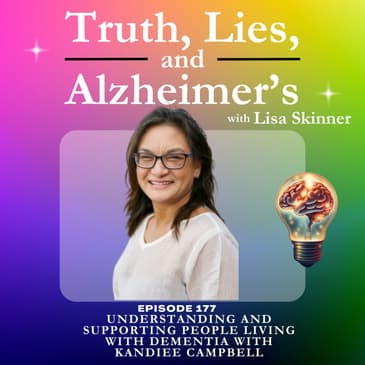
Understanding and Supporting People Living with Dementia with Kandiee Campbell
Season 5 of The Truth, Lies & Alzheimer’s Show begins with an important conversation about dementia, communication, compassion, and better understanding the experience of those living with cognitive changes.
In this episode, Lisa Skinner welcomes guest Kandiee Campbell for a thoughtful discussion about people living with dementia and the importance of meeting them where they are.
Lisa and Kandiee explore how dementia can affect behavior, communication, emotions, and everyday interactions. They discuss why caregivers and family members may need to adjust their expectations, look beyond the behavior they are seeing, and respond with greater patience and understanding.
The conversation also highlights the importance of preserving dignity and recognizing the person behind the diagnosis. Rather than focusing only on what someone can no longer do, this episode encourages listeners to consider what the person may be feeling, experiencing, or trying to communicate.
In This Episode
- Understanding how dementia can affect behavior and communication
- Looking beyond difficult or confusing behaviors
- Meeting a person living with dementia where they are
- Responding with patience, compassion, and understanding
- Recognizing emotional needs even when communication becomes difficult
- Preserving dignity and personhood throughout the dementia journey
- Supporting caregivers and families as they navigate changing needs
This episode offers practical perspective and an important reminder that compassionate dementia care begins with understanding the person, not simply managing the diagnosis.
Connect with Kandiee Campbell
Email: kandiee@kandieecampbell.com
Website: www.theawakenhopeshow.com
Instagram: @awakenhopeshow
Linktree: www.linktr.ee/awakenhopeshow
Hashtags
#TruthLiesAndAlzheimers #MindingDementia #DementiaCare #DementiaAwareness #AlzheimersAwareness #CaregiverSupport #DementiaSupport #PersonCenteredCare #DementiaEducation #FamilyCaregivers #LivingWithDementia #CompassionateCare #AwakenHopeShow #KandieeCampbell #LisaSkinner
[00:00:03] Are you caring for a loved one with dementia? You don't have to figure this out all on your own. Welcome to Truth, Lies, and Alzheimer's, the show that helps you reimagine a new relationship with your loved one, a relationship a little more free of stress and anxiety. Join host Lisa Skinner and her 30 plus years of experience as she guides you on a new path to a better relationship with those you care for.
[00:00:33] Here's Lisa.
[00:00:36] When I was a guest on her show, we have a lot in common and it turns out that once we discovered that or she discovered that I was an expert in the Alzheimer's disease and related dementia world, she shared with me that she not only had her father go through Alzheimer's disease, but also her grandfather and she shared with me some really just
[00:01:05] interesting experiences that she had that I said, well, I want you to come on my show and share those stories with my audience. I know they would love to hear them. So please help me give a warm, warm welcome to my guest, Kandiee Campbell. And let me tell you a little bit about Kandiee. So she does host her own podcast. It's called Awaken Hope.
[00:01:34] And what her background is, she's a grief and transformational coach and the host of her own show. And what her work centers around helping people navigate loss, trauma and life's most difficult transitions with compassion. I can attest to that understanding and of course, hope. Kandiee Campbell is one of the most beautiful things that we have a person with the same person with having a friend.
[00:02:03] Now, she tells us that her journey into this work is actually deeply personal, just like mine is with having eight family members who have lived with one of the brain diseases that causes dementia. Well, Candy lost five people within one year.
[00:02:25] So she truly has experienced extreme grief, extreme loss, and she is dedicated to helping others through that process. And one of them actually was her daughter. So really hitting close to home. Hopefully she'll share that with us.
[00:02:49] That season of grief for her changed her life forever, understandably. As she worked through her own healing journey, she discovered something powerful. Even in her own deepest pain, she discovered that hope can still be awakened. So she's here to tell us about that.
[00:03:17] So without further ado, please give me a help me give Candy a warm, warm welcome. I'm just thrilled that she's here today. And we're going to talk about her personal story she's going to share and how that actually overlaps and ties in with all of us who are going through Alzheimer's disease and related dementia within our own families.
[00:03:45] So welcome, Candy. I've just been looking forward to this for so long. How have you been? I've been well. Thank you so much, Lisa, for having me on your show. So I am grateful to be here to share with your audience and share with your listeners the story of my experience with dementia. And of course, you know, that also comes with a little bit of grief or a lot of grief.
[00:04:15] And the process one must go through in order to navigate that. So now when we talked, when I was a guest on your show, you brought up the fact that you're both your father and your grandfather lived with Alzheimer's disease. And they were two completely different experiences for you. One was when you were a teenager.
[00:04:42] So you probably experienced that from a different lens than you did when your father was living with it, because then you were an adult with children of your own. So I'd like to focus first on the experience you had with your grandfather. What were you seeing?
[00:05:03] What were some of the peculiarities that may have caught you off guard that you weren't expecting that were actually part of the disease? And then you had through it again with your dad at an older age, but a lot of the same behaviors that you saw with your grandfather. Right. So tell us about those two experiences.
[00:05:29] I mean, when my grandfather had it, of course, I was a teenager. He unfortunately passed away the year I was turning 18. I was graduating high school that year and he passed away. But his Alzheimer's, it lasted for quite a while. I mean, from the memories I remember, I didn't see him a lot. At first he was living in Sacramento. He was living on his own. He was doing well.
[00:05:59] But then we started noticing he would wander at night. He'd get lost. He got mugged. He was out one time, couldn't find his way back, got mugged, you know, was just being assaulted because he was lost and didn't know how to navigate back. And so my father, who's my grandfather was my father's father and his siblings decided they needed to step in and move him closer to family.
[00:06:27] I mean, you know, him living on his own was not ideal because he would forget things and he'd forget how to, you know, that he'd have to turn off the stove or it was just becoming more and more detrimental to his living, you know. And dangerous. And dangerous. I think the final straw was when he got mugged. He wandered out. Yeah.
[00:06:56] He lived in an apartment building, a high rise apartment building, wandered out and then he couldn't find his way back. Couldn't figure out how to get back. That's very common. It happens every day and it just comes on suddenly. So it's almost impossible to safeguard somebody against that because you never know when all of a sudden that short term memory switch flips off and they leave their environment thinking they are, you know,
[00:07:25] going somewhere intentionally and they're going somewhere intentionally and then they just forget who they are and where they live. And they obviously have put themselves in harm's way. That happened with my mother-in-law too. Yeah. Yeah. So when they moved, my aunt decided to move him in with her and my uncle and they lived in Banning, California. So they packed him up, moved all his stuff, moved him in and she took care of him for the remaining.
[00:07:56] Oh, it was a couple of years that he had, you know, that he lived with us and then he lived with them. And according to what I remember my aunt saying and my dad talking about, he was pretty disruptive. He'd get argumentative. He'd get angry. He'd have these emotional outbursts of, you know, he remembered a lot of the past. He would talk about my grandmother who, his wife, and she passed away in 1971.
[00:08:26] So she'd been gone a while. My grandfather, he passed away in 1988. So he lived a long time without my grandmother. Now, was there any time that he actually believed that she was still alive when she truly wasn't? He would talk about, you know, my grandmother. Now, this was coming from my father and my aunt.
[00:08:55] I didn't actually engage in a lot of conversations with him about my grandmother. But he would say, oh, your mother, your mother is, is going to cook or she is having, she'd just, he'd remember stuff that she used to do. But she wasn't there. She had been gone quite a while. And so he, but he would flash back to the past.
[00:09:24] He would be okay in the past. But the current, the future, where he was, he'd get very disruptive. In fact, my uncle, he was a, like, 6'4", big guy. And he'd have to restrain my grandfather because my grandfather would get pretty aggressive with my aunt. And my aunt was only, like, five, two.
[00:09:50] So she was a big, slightly big difference between, you know, my aunt and my uncle. But he would have to kind of control him and get him under control, especially when he'd lose his, he'd get us start getting really aggressive. And he'd want to fight. And he's like, no, you know, this is your daughter. You can't fight her, you know.
[00:10:10] But he just said, I think a lot of it, what I understood was he just was not recognizing that where he was, what environment he was in, and who was around him. So fast forward, you know, my grandfather, he passed away in 1988.
[00:10:34] Fast forward, oh, let's see, my father passed away in 2018. So this was 2015, 2015, 2016. My father was in Texas, and he was near my aunt. My aunt was the one that he congregated closer to. And that was a whole other story.
[00:11:01] But he went to Texas where my aunt was, and he started having problems where he couldn't take care of himself. He'd wander. And so through this situation, he was, they put him in an assisted living place because my father needed more care than he was capable of giving himself.
[00:11:27] But my journey with him, it was interesting because I went to see him when he was in Texas. And, you know, he'd have, I mean, he recognized me and he was okay. But as his, as his dementia and his Alzheimer's progressed, he'd forget. He'd have like a 30-second recall. We'd be, I'd call him on the phone. And I, you know, be talking to him. And he'd be remembering me when I was a kid.
[00:11:53] And situations when he was, when we lived abroad, he'd say, oh, he and my mom had been divorced. They got divorced after 31 years. And my mom had remarried. And he'd be like, oh, yeah, your mom's coming to visit. And I'm like, okay. I wasn't going to, you know, try to counteract that one. He's like, yeah, your mom's coming to visit. You're going to come visit, right? And I'm like, uh-huh. And we'd be talking, he'd be talking about something that was in the past.
[00:12:23] And then all of a sudden he'd go, he goes, yeah, you got to meet my daughter. Like I was a stranger to him at that point. And it was like, okay. At first it was a little unsettling. I'm like, wait, I am your daughter. You know, dad, this is me, your daughter. And he'd be like, oh, yeah, you got to come meet my daughter. She and her mom are coming to visit. Like I was a complete and total stranger to him in that second.
[00:12:50] Let me just pause you for one second because you've got my curiosity up. But you had any type of training in, you know, effective ways to respond to people living with Alzheimer's disease and dementia because it doesn't sound like you tried to correct whatever it was he was telling you, even though you knew that what he was saying wasn't the truth.
[00:13:19] You just went along with it. Was that instinctive? Or did you know that that doesn't accomplish anything is to correct people and it just infuriates them more? Tell us a little bit about that. I know that you are a master degreed counselor and in education and counseling.
[00:13:45] And you also hold a bachelor's degree in psychology and that you have been pursuing a doctorate in clinical psychology. Did any of that come from your advanced education or did you just instinctively not want to challenge your dad on any of the things that he was saying? Well, some of it was research just trying to understand what, how dimension Alzheimer's works
[00:14:15] and stuff, you know, because. So I had talked to professors when I was working my doctorate and they're like, no, you just let them kind of live their life. You know, you don't because they do get argumentative when you try to recorrect them or say, oh, no, this isn't right. Oh, yeah. You know, so I was like, okay. But I did some, a little bit of research. I didn't have a lot, but something just inside of me just said, you know, my intuition was
[00:14:41] like, don't try to argue with him because it was, it would like agitate him. And he, you know, so I was like, okay, I just let him be in his little world because that was where he was. And, you know, we'd progress and then he'd be like, you know, he'd be talking to me like I was a stranger. And then he'd say it would go from talking to me like I was a stranger to then he'd go, who are you? And I'm like, dad, what's your daughter?
[00:15:09] And he's like, my daughter's coming to visit. I was like, dad, it's me. And then he hung up on me. He just hung up. He just disconnected the phone. I was like, okay. So I'd call back and, you know, the nurses, sometimes he'd respond. The nurses like he went back to his room. You want us to go get him? Like, no, just let him be, you know, let him, let him be.
[00:15:35] We're not going down that road again because, you know, it was kind of fruitless at times. So futile to try to engage him when he was at that stage. But other times he'd hang up. I'd call back. He'd still be there. And they're like, I'm like, dad, how are you? And then he'd be like talking to me like I was like I was a kid. Oh, remember when, you know, we did this and we're going to go do this.
[00:16:04] And some memory or he'd be talking about memories he had. Things I could not engage in because they were before I was born. So I'm like, okay, dad, good to know. And then other times he'd talk about things that were like a little outlandish, like him going to the moon. I know for a fact my father never went to the moon. But he's like, I'm going to go to the moon. Or he went to the moon. And then did he describe the journey?
[00:16:35] No, you're just and it wasn't in great detail. He'd just say something really outlandish, which I knew I could say, oh, no. But I was just like, okay, so we'll just let him. It was safer to leave him in his own little world because I knew for, you know, keep talking to him. It'll change. He'd go from talking to me about something in the past to, you know, am I going to come visit? Because my mom and, you know, was going to be there.
[00:17:06] Which I knew wasn't true too. Because my mom didn't have any interactions with him after they got divorced other than what she needed to.
[00:17:15] And it was disheartening to watch that in this short period of time he'd go from remembering something about me when I was a kid or an experience we had to talking to me as if I was, you know, present and going to be there. To talking to me as if I was a stranger and then hanging up on me.
[00:17:43] So you, but you clearly recognized these peculiarities as being part of his brain disease, correct? Yeah. Yeah. And it sounds like you also learned to follow his cues and engage with him based on what he was talking about.
[00:18:05] So if he was talking about something from his past, you realize that he had traveled back to that past period of time in his life and was not in the present. And then he would switch and be back in the present and you just followed his cue. That's pretty accurate thing to say. Yeah. That's what I emphasize that people do because this happens.
[00:18:30] And, you know, when the short-term memory starts to fail, people toggle back and forth between a past time of their life when they were younger and the here and now. You have tuned into the Truth, Lies, and Alzheimer's show. So I am Lisa Skinner, your host, and I'm talking with my very special guest, Candy Campbell.
[00:18:55] She is sharing her experiences within her own family with Alzheimer's disease and related dementia with both her grandfather and her father. So we were talking about how she would be engaged in a conversation with her dad and she never knew what period of his lifetime he would be referring to.
[00:19:21] Sometimes he was talking about things that happened way in his past when she wasn't even born yet. And other times it would be current. So she's telling us that she just followed the cues based on what he was talking about and joined him where he was at, which is exactly what, you know, people like me who are certified dementia practitioners train people to do.
[00:19:48] Because it's the effective way to respond to the changing brain as the brain disease is increasingly causing damage. So very interesting conversation we're having. So what else can you share with us that you think would be of interest to the audience so they can learn from it?
[00:20:15] Because, you know, we all go through very similar experiences with these diseases. I think the biggest thing is, like you said, you just have to be with them where they are. I know at first everything inside of me wanted to argue and try to bring him back.
[00:20:37] You know, when this first started occurring, I would start to go down, you know, the road of arguing with my dad, which I knew was not a good position to be in because he was determined that where he was, whatever time and space he was in, that was his reality. And when you did try to correct him, you noticed the increased agitation. So you backed off. Oh yeah, he'd get mad. He'd get mad. Yeah.
[00:21:05] He was like, no, you know, and full-blown argumentative. And I was like, okay. Because he believed what he was telling you was the absolute truth. And we all have learned through the school of hard knocks that no matter what you say, and we instinctively want to fix our loved ones. We don't want to, you know, see them in distress like this and of confused state.
[00:21:34] But we've learned that it just doesn't work to try to correct them and bring them back to our reality, a healthy brain person's reality. Because what they're telling us is their reality. They believe it a thousand percent. So I find it really, I'm admirable that you figured that out and went along with it.
[00:21:59] And your relationship with him was a lot more harmonious than if you had continued to try to fix him, right? And steer him back into your reality. And that's exactly what we have discovered is effective and really works. Yeah.
[00:22:20] No, you just have to, for the person going through it, not the patient that's got the dementia or the Alzheimer's, but the person that's witnessing. The loved ones. The loved ones. Yeah. You just, you have to give yourself a lot of grace and a lot of compassion and a lot of space to recognize that the person that's in front of you, their, their physical body is there, but their mind is not always there.
[00:22:47] And, and, and you, like you said, it's going to toggle back between the past to maybe, you know, as like my father did, he went from the past to talking to me as if I was a stranger and then he'd hang up. I mean, that was, it became kind of comical. I'd laugh because I'm like, oh, he hung up on me again. I was like, okay.
[00:23:13] Uh, but at first I was like, my father just hung up on me and I get a little hurt. I'm like, what the heck? But then I was like, it became more of a routine or like I'd call it. And this was becoming a pattern. I'm like, well, okay, candy. You're not going to try to argue with him because when I, like I said, when I did try to correct him, he'd get agitated.
[00:23:39] And he was like adamant, but his point of view, his perception of where he was or what was happening was, was true. And I'm like, okay. So I just said, the hangups became a contin, uh, a regular thing for me. I mean, I, we'd end up usually with me going, okay, he just hung up on me because I don't know if he reckoned at that point.
[00:24:08] He recognized who I was. Cause like I said, he'd be talking to me. He's like, I was a stranger. And then he just like, so I learned to give myself a lot of, I had to bring in a lot of grace, a lot of compassion and go, okay. And a lot of understanding that the father that I knew that I remembered was somewhere. Different, a different person. But it wasn't, it wasn't the person I was talking to on the phone.
[00:24:38] And some, I remember one conversation. He just, he remembered everything of the past. He was, he talked to me like I was still a kid. He's like, oh yeah, you're, you know, remember, um, we're going to do Christmas this way. And we're going to, and I was like, okay. He was just completely lost in the past. And then he hung up on me, you know, I was talking and he's like, ah, he just disconnected. I'm like, okay, dad.
[00:25:08] But, um, yeah, if you try to fight it, I learned if you try to fight it and you want to bring them back into your reality. And it's just, it's an arduous climb. And it's something that you're fighting against uphill all the time. Yeah. But we instinctively respond, want to respond that way. We're wired. So it's almost like having to retrain our brains and the way we respond to things.
[00:25:33] And that's not, um, always as easy as, you know, we think it might be. It's actually very, very difficult, um, transformation to make. But unfortunately we are almost out of time. We could continue this conversation. Candy, you're just going to have to come back. And, uh, we'll, we'll expand on this even more.
[00:25:55] But I do want to, um, let people know how they can find you, uh, before you give us your, um, contact information. I just want to say one thing because this is very, um, heartfelt for me. I mentioned this when I was introducing Candy, that a lot of what she does and what I do are intertwined.
[00:26:23] And when she went through the heartbreak of losing five people within one year, she has said that that realization became her calling. Just like me having eight family members live with one of the brain diseases became my calling. And so to what she, um, does is she guides individuals through their healing process.
[00:26:52] And that's different for everybody. Helping them understand their grief. Process difficult emotions. And gradually rebuild their lives to be filled with meaning, peace, and fulfillment. And that is so similar to what I'm committed to doing.
[00:27:14] Um, so she does this through very similar platforms as I have through coaching her radio show and her guided journal. That's called hope and healing, which is a 90 day journal that I think she helps people, um, stay on track with. And she strives to create spaces.
[00:27:35] And this is identical to my mantra where people feel seen, supported and encouraged. So I want to thank you from the bottom of my heart for coming on and sharing your Alzheimer's experiences with us, but also for what you do to help other people get through their grief.
[00:28:00] There's a lot of grief that we need to deal with, with Alzheimer's disease because we actually lose our loved one, not once, but twice. Everything that Candy described tonight, today on today's episode, she was, um, losing her father more and more and more as his cognitive decline increased.
[00:28:52] But he was still with us. And now my archive page also got picked up by, um, I heart podcast. So apple I heart podcast, um, and brushwood medianetwork.com slash wake and hope. If you, all three of those will, if you type in awake and hope, you will see my picture and my show will come up. You have a very popular podcast. That is, um, something that I know for sure.
[00:29:22] So, uh, if you haven't, if you weren't aware of awake and hope tune in because I think that she's got a lot to offer with her personal and professional experiences. So thank you again for being my very special guest today. And I look forward to a continued relationship with you, Candy. I just think the world of you.
[00:29:44] Um, I will be back next week, everybody, as usual with another new episode of the truth lies and Alzheimer's show. Thank you again. I'm Lisa Skinner, your host and have a great rest of your week and please stay safe and healthy. Bye for now. Bye-bye. Thank you for listening to truth lies and Alzheimer's. We hope you found something in today's episode that helps.
[00:30:13] We understand that caring for a loved one with dementia can be the challenge of a lifetime, but you don't have to do it alone. If you're ready for exclusive access to even more great content and resources, head on over to Facebook and join Lisa's minding dementia support group. We're a community of like-minded caregivers and we're here to help.