
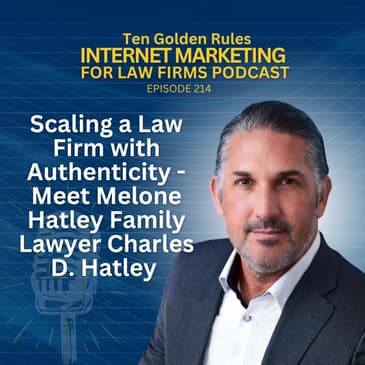
Sustainable law firm growth rarely comes from one breakthrough tactic. It comes from consistently improving the fundamentals that make the business stronger. Jay Berkowitz speaks with family lawyer Charles D. Hatley of Melone Hatley about scaling from a small practice into a firm with 12 locations across five states. Charles shares the principles behind that growth, including disciplined cash management, local SEO, authentic branding, community involvement, client feedback, data-driven decision-making, and repeatable operating systems. He also explains how the firm uses podcasting, Google reviews, Net Promoter Score, and culture-building to strengthen both marketing and operations. For law firm owners looking to scale, the larger lesson is to focus less on appearing sophisticated and more on building simple systems that can be measured, repeated, and improved as the firm grows.
Key Topics
02:06 – Charles shares the unconventional path that took him from manufacturing work to family law and eventually into building a firm with his wife.
03:17 – Discover the financial principle Charles still uses every Monday as the firm grows across multiple states.
04:26 – A simple experiment with Google Maps became one of the first major growth drivers for Melone Hatley.
06:58 – Charles explains the surprisingly straightforward approach that helped the firm generate more Google reviews.
10:14 – See how Melone Hatley decides which community sponsorships deserve the firm’s time, money, and name.
12:22 – Charles reveals why moving away from the traditional law firm image helped the firm create a more authentic and recognizable brand.
14:42 – The firm’s podcast began as a way to educate people, but a change in how episodes were reused created an additional growth opportunity.
18:57 – Charles breaks down the data philosophy the firm uses to connect marketing activity, individual clients, and profitability.
22:03 – Learn how Melone Hatley uses direct client feedback and Net Promoter Score to identify where the client experience can improve.
26:36 – Tune into The Golden Rapid Fire Questions
Resources Mentioned
Technology
- Google Business Profile (Local business listing platform) – https://www.google.com/business/
- Clio (Law practice management software) – https://www.clio.com/
- QuickBooks (Accounting software) – https://quickbooks.intuit.com/
- Microsoft SharePoint (Company intranet and collaboration software) – https://www.microsoft.com/microsoft-365/sharepoint/collaboration
Books
- Scaling Up – Verne Harnish – https://a.co/d/05BMpqAp
- Mastering the Rockefeller Habits – Verne Harnish – https://a.co/d/0i7FsqTo
- Traction – Gino Wickman – https://a.co/d/0dbKqQJd
- Eat That Frog! – Brian Tracy – https://a.co/d/0fUpWavh
- The Gift of Fear – Gavin de Becker – https://a.co/d/0bHRD0R6
About our Guest:
Charles D. Hatley, Esq. is the Chief Executive Officer of Melone Hatley, P.C., where he combines visionary leadership with entrepreneurial drive to shape the firm’s growth, strategy, and culture. Recognized for building high-performing teams and fostering innovation, Charles is committed to creating a workplace where collaboration, professional development, and accountability drive both employee success and client satisfaction.
A strategic leader with extensive experience across multiple industries, Charles has a proven record of scaling operations, enhancing efficiency, and implementing forward-thinking strategies that deliver sustainable growth. He believes that leadership is not just about guiding a firm, it’s about inspiring people, empowering teams, and building a culture where talent thrives and ideas flourish.
Before leading Melone Hatley, Charles managed offices for a national law firm, litigating high-stakes family law cases across Virginia and Washington, D.C. Today, he merges that big-law expertise with an entrepreneurial, boutique approach, ensuring clients receive practical, strategic, and compassionate guidance while feeling supported throughout challenging legal processes. Under his leadership, the firm has evolved into a client-centered, innovative practice where people – both employees and clients – feel empowered, supported, and motivated to succeed.
Beyond his leadership role, Charles shares his expertise as the host of the firm’s own podcast, I Now Pronounce You Divorced, where he explores key topics in divorce, child custody, and co-parenting.
About Jay Berkowitz:
Jay Berkowitz is a best-selling author and popular keynote speaker. Mr. Berkowitz managed marketing departments at: Coca-Cola, Sprint and McDonald's Restaurants, and he is the Founder and CEO of Ten Golden Rules, a digital marketing agency specialized in working with attorneys.
Mr. Berkowitz is the author of Advanced Internet Marketing for Law Firms, The Ten Golden Rules of Online Marketing and 10 Free Internet Marketing Strategies that went to #1 on Amazon. He is the host of the Ten Golden Rules of Internet Marketing Webinar and Podcast. He has been profiled by the Wall Street Journal, The Business Journals and FOX Business TV.
Mr. Berkowitz was selected for membership as a TITAN for Elite Digital Marketing Agencies, he is the recipient of a SOFIE Award for Most Effective use of Emerging Media, and a Special BERNAY’s Award.
Connect with Ten Golden Rules
Subscribe to Ten Golden Rules on YouTube
Check out our webinars on TenGoldenRules.com
Connect with Ten Golden Rules on LinkedIn
Follow Ten Golden Rules on Facebook
Connect with Jay Berkowitz on LinkedIn
Thanks for listening!
Thanks so much for listening to our podcast! If you enjoyed this episode and think that others could benefit from listening, please share it using the social media buttons on this page.
Do you have some feedback or questions about this episode? Leave a comment in the section below!
Subscribe to the podcast
If you would like to get automatic updates of new podcast episodes, you can subscribe to the podcast on Apple Podcasts or Stitcher. You can also subscribe in your favorite podcast app.
Leave us an Apple Podcast review
Ratings and reviews from our listeners are extremely valuable to us and greatly appreciated. They help our podcast rank higher on Apple Podcasts, which exposes our show to more awesome listeners like you. If you have a minute, please leave an honest review on Apple Podcasts.
Another topic of of the firm that has been a real success is you said your authenticity and the positioning of the brand and how you treat your clients maybe you can share some tips on that area.
Jay Berkowitz:Charles D. Hatley: Yeah, so you know I got long hair. It's up today for this. My my wife, her favorite color is pink, and when you know we were going and we were thinking about the organization. A lot of people would put on a suit. I don't remember the last time I wore a tie. It's repugnant to me. But they put on a suit. They would put on their their. My wife would put on her pantsuit that was gray or black. We'd stand there and frown in our pictures and look real serious and maybe bang on a table in a picture or something silly like that. And we're like, that's not who we are as people. So you
Jay Berkowitz:know she was very big on like, hey, I'm gonna wear pink. I like pink. That's what I want to do. I was like, hey, I'm not wearing a tie because it's not who I am. We smiled in pictures because we're relatively happy people, and when we spoke to our clients, rather than talking to about the doom and gloom that is, let's be honest, divorce is terrible. Nobody, very few people wake up and say, you know what? I want to go do a divorce today. We understood that, and we talked to him about well, the reason you're going through a divorce is for the other side. You know, we didn't just talk about it
Jay Berkowitz:so coldly and corporately. I don't know the right word, but it was just like, if you're going through a divorce, call me today. Or like, you know, if you're struggling through this and you're trying to protect your kids, give me a call because that's what we really do.
Jay Berkowitz:Yeah, I love it. Your your images are definitely authentic, and authenticity really shines.
Jay Berkowitz:Charles D. Hatley: Welcome to the 10 Golden Rules of Internet Marketing for Law Firms podcast, featuring the latest strategies and techniques to drive traffic to your website and convert that traffic into clients. Now, here's the founder and CEO of 10 Golden Rules, Jay Berkowitz.
Jay Berkowitz:Good morning, good afternoon, good evening, whatever time you find this podcast. Welcome to the 10 Golden Rules: Growth Strategies for Law Firms podcast. Got a great guest today, but as always, I start out with a very short commercial talking about something different you can do for your brand and for your law firm. And Charles and I were just talking about different things people and individuals can do after a divorce, because he's a family lawyer, and one of the things we talked about was reputation management, and that's one of the services we do at 10 Golden Rules. And so,
Jay Berkowitz:in in some instances, in high-profile celebrity divorces, there's a lot of bad stuff out there on the internet, particularly on Google. And so, one of the projects we do for clients. If your firm does get in trouble, or if an individual gets some bad, bad juju or bad stuff from a spouse, we do a project called reputation management. And one of the first things we do is buy Google pay per click ads. We re SEO the websites so that you rank for your name. We do image SEO, we do video SEO, we do a bunch of PR, and get good news at the top of Google to push the bad news down. So we do a lot of
Jay Berkowitz:interesting things at 10 Golden Rules to help your law firms grow and attract more people, convert more prospects, and get you more five-star Google reviews. So, without further advertising, welcome Charles Hatley to the 10 Golden Rules podcast. Charles, welcome.
Jay Berkowitz:Charles D. Hatley: Hey, Jay, it's it's great to be here.
Jay Berkowitz:And the firms Malone Hatley, their family and estate planning, and this is a big firm, so we're going to learn some of the secrets. 12 locations, right, Charles?
Jay Berkowitz:Charles D. Hatley: It is just now.
Jay Berkowitz:Congratulations! So first, I always like to ask people about their story, about their journey. Where'd you start out, and what got you to law school?
Jay Berkowitz:Charles D. Hatley: So you know, I'd always wanted to go to law school, and you know, I always joked that I-that's a joke. I did carry a briefcase to kindergarten and got rightfully ridiculed by other kindergartners for that. Then I, you know, went to college and found out that the other parts of college were a lot more fun than the class part. So I got to go out to the working world for a little bit and see what hard work was. Decided that maybe school was a little bit easier. Went back to school, went to law school, got out, and you know, ever since then, just really a lot of the lessons I
Jay Berkowitz:learned working in the manufacturing environment in between starting my degree and finishing my degree have really carried over.
Jay Berkowitz:And did you start with your own firm out of the gate, or did you work for someone.
Jay Berkowitz:Charles D. Hatley: I work for somebody. I started working at a small general practice firm. Never thought I wanted to do family law. Then I went to a family law firm and realized it kind of encompassed all the elements of litigation that I loved, and then ultimately jumped over and joined my wife. She was a solopreneur. Joined her at the end of 2020, and then we started to see how many people. We could actually help.
Jay Berkowitz:That's great. So, what are some of the best business development strategies you guys have obviously built a very successful firm?
Jay Berkowitz:Charles D. Hatley: You know, one of the the first strategies that that we used was to understand cash, right? You know, a lot of people try to get these real fancy documents that show them profit and loss, I've had people talk to me about using accrual accounting versus cash-based accounting, and none of that really mattered to me. I would say how much cash is in the bank at the end of the day, and how much cash went into the bank, how much cash went out of the bank. And to this day, we still, at the size we are, have a meeting every Monday morning looking at the total amount of cash in the
Jay Berkowitz:bank and the total amount of cash that we expect is going to come out. So that that was the best piece of business advice: get rid of all the noise level documents that nobody understands anyway, and just get back to the basics of cash.
Jay Berkowitz:Yeah, I remember a famous business coach had a list of like 137 business principles or something, and the first one was never run out of cash.
Jay Berkowitz:Charles D. Hatley: It's the only one you
Jay Berkowitz:need. It's definitely a big part of the part of the program. So we spent a lot of time on marketing on this podcast. What are some of the elements of marketing that have been most successful for you guys?
Jay Berkowitz:Charles D. Hatley: Piece of advice I got early was do more more often without worrying about perfection, and so I looked at what was out there, and I sat down at my computer and I was like, "What do I see when I open up and I search for something? And I saw a map. Right, you search Google. One of the first, the biggest things on the screen is a map, and so I spent a lot of time figuring out how to get on that map, and I said I want to be on that map. And so just every day, day in, day out, my focus was getting on that map. And as soon as I and so what it was was I made sure to post, you know,
Jay Berkowitz:at regular intervals, I made sure to post things with original images, not stock images. I made sure to try to tag things and use words that people would associate, and it took about I would say about six weeks when we we went from no presence whatsoever to starting to show up like third. I was so excited the day we showed up third on the map, and as soon as we showed up third on the map, lo and behold, that phone started ringing twice as much, three times as much. Then we got to second, then we got to first, and then you know that was just the biggest was keep doing it, do it more often, and
Jay Berkowitz:do it more original.
Jay Berkowitz:That's great. So it's like homegrown Google Maps SEO, and I often explain to people that there's really two, there's multiple, but there's two important parts of SEO. There's SEO on your website that you own, and there's SEO on a website that you lease from Google ostensibly, because if you run afoul of Google's terms and conditions, they'll pull your maps address, and we've seen it many times. So you know, don't do fake cheat reviews and things like that. If you get a bunch of reviews from overseas, it's not going to help. But I like what you said because essentially you're
Jay Berkowitz:doing what we call local SEO. There's in SEO we talk about architecture, backlinks, and content, and the architecture of your Google Business Profile is you get in there, you put all your practice areas, information about the firm, make sure your naming convention is good. A lot of people are doing; they're coming up with a DBA of doing business as that includes keywords. But you really have to you have to actually rename the firm with if you want to include keywords in your maps name. You said you were posting on maps, putting original images on there, tagging and and creating content and
Jay Berkowitz:updates-that's really good. What about reviews? Did you develop a program to get more Google reviews?
Jay Berkowitz:Charles D. Hatley: Yeah, we did something very weird in the legal space. We asked. That's it. We asked. We're like, hey, you know, people would call and they'd be like, oh my god, thank you so much. I'd say, could you help me out and leave a five-star Google review, if you wouldn't mind, and they would say, "Yeah, absolutely, and that was the biggest differentiator. I would go to trade shows, not trade shows, but other things where lawyers do that, and they were like, "How do you have so many Google reviews? Like, I asked. I don't know. I did what a card salesman does. I just asked.
Jay Berkowitz:Do you make it easy? Like, do you send them the link to sign up for the review?
Jay Berkowitz:Charles D. Hatley: We did. So we we I figured out how to generate the link from Google. I know there's other services out there that will help, like text the link and everything else like that. We've used those with some success, some failures, but just getting on there, sending the link straight from the Google Business Profile, the GBP, right? Sending it from that is very helpful.
Jay Berkowitz:That's great. Hey, great work figuring it out and getting it done. There's another practice that we help our firms with is getting local links and citations. And a link is when there's actually like a blue underlined link that's clickable that goes back to your website. A citation is the chamber of commerce might not put links to all their members, but they'll list. Your name, your company name, your address, and Google understands what that is, and they know the Chamber of Commerce or the Bar Association is a big, important website, and they recognize the value of that citation
Jay Berkowitz:almost as as valuable as a link. Have you proactively gone out and built links and citations as well.
Jay Berkowitz:Charles D. Hatley: We did so. What we did is, I've always believed nobody's going to give me anything for free. So I'd offer to do something for them, and I would say, look, you know, if I do this for you, would you guys be willing to like put this article on your website? Or if I, you know, hosted one of your events at my office, could we say like a picture of the event at my office, things like that, and it was a real easy way to not just ask for something for free, but to give something back to somebody. We're like, "Hey, Chamber of Commerce, do you want to come host at our our office? Yep,
Jay Berkowitz:and then take some pictures and be hosting it, Malone Hatley PC at this address, and you know that was almost fell stupidly into that because I was like, well, it'd probably be good if I could get my name on your website. I didn't understand what I was doing. I was just like, the more I can get my name on other people's websites, probably not a bad thing.
Jay Berkowitz:Yeah, well, we in SEO we call those backlinks, and some people often confuse the importance of links. When you put links from your website to the Chamber of Commerce, you're linking out, but the value in SEO is links coming in, and so it's super valuable if you do an event, sponsor an event for the Chamber of Commerce or your local softball team or the 5K run. I always say, write a check, get a link. All of your vendors and all of your your sponsorships, you want to make sure you get a link back to your website from those websites, particularly the ones in the industry, the
Jay Berkowitz:bar association, and if you guys use an investigation company and they specialize in legal, those are great links because Google sees those as relevant and important. Media links are super valuable as well.
Jay Berkowitz:Charles D. Hatley: It is a little harder to get,
Jay Berkowitz:yeah. And I touched on sponsorships. I know you guys do a lot of community activity. What's your philosophy there, and what's been successful for the firm?
Jay Berkowitz:Charles D. Hatley: You know, my first philosophy was: if I don't believe in it, I'm not doing it. You know, you get approached a lot by people that everybody under the sun has something, and it's not that I dislike it. It's just I wouldn't normally go do it. So I'm not going to put my company name on it. The second idea there is we were very hesitant to go. I remember I got invited to sponsor one hole at a golf tournament. So we got one hole, one foursome, and it was $55,000. And so just out of curiosity, I was like, "What other golf tournament is that expensive? I could literally go play with
Jay Berkowitz:golf, Tiger Woods, and I was like, "Well, you guys are a little pricey. So then, looking at the value of what I was going to get for my money, right? You said, "You know, if I do that, I'm going to get a link back. But we also looked at how are we going to scale this, right? We have 12 offices in five different states. It's not possible for me to be everywhere all at once. So we really brought on a business development person to help us identify where our time could be best used to help the most people. Right? You know, if I go and do a 5k here, or if I have somebody identify, you know, a
Jay Berkowitz:5k somewhere else where we can get more people involved, that's always more helpful.
Jay Berkowitz:Yeah, and I love what you said about believing in it, and I always bring up the example of John Barry, and he's got a national veterans disability practice, and he's a veteran. His brother works at the firm as a veteran. His dad works at the firm as a veteran, and when they go out and do community events, it's always got to be something that's going to benefit veterans, and the consistency of his branding is amazing across his website and all social media and all all their community activity. So that's part of you know finding out who you are, and then delivering that
Jay Berkowitz:message consistently across your website and all your social media and even your community events.
Jay Berkowitz:Charles D. Hatley: Yeah, it helps rather than just being yeah, like I said, disjointed, right? You know, if you're, if you if you stand for everything, you stand for nothing.
Jay Berkowitz:Another topic of of the firm that has been a real success is you said your authenticity and the positioning of the brand and how you treat your clients. Maybe you can share some tips on that area.
Jay Berkowitz:Charles D. Hatley: Yeah, so you know, I got long hair. It's up today for this. My wife, her favorite color is pink. And when you know we were going and we were thinking about the organization, a lot of people would put on a suit. I don't remember the last time I wore a tie. It's repugnant to me. But they put on a suit. They would put on their their. My wife would put on her pantsuit that was gray or black. We'd stand there and frown in our pictures and look real serious and maybe bang on a table in picture or something silly like that, and we're like, "That's not who we are as people. So you
Jay Berkowitz:know, she was very big on like, "Hey, I'm going to wear pink. I like pink. That's what I want to do. I was like, "Hey, I'm not wearing a tie because it's not who I am. We smiled in pictures because we're relatively happy people, and when we. Talk to our clients rather than talking to them about the doom and gloom that is. Let's be honest, divorce is terrible. Nobody, very few people, wake up and say, "You know what? I want to go do a divorce today. We understood that, and we talked to them about. Well, the reason you're going through a divorce is for the other side. You know, we didn't just
Jay Berkowitz:talk about it so coldly and corporately. I don't know the right word, but it's just like if you're going through a divorce, call me today. Or like you know, if you're struggling through this and you're trying to protect your kids, give me a call because that's what we really do.
Jay Berkowitz:Yeah, I love it. Your your images are definitely authentic, and authenticity really shines. And and that's what we talked about a little bit earlier. Is that when you're competing with the Morgan and Morgans or whoever the biggest firm in your practice area who's who's advertising and spending a bunch of money, what I recommend is find out that unique, authentic place for your firm. Where do you where you guys you know happy? Where are you comfortable? And then make that your brand message, and make that consistently across your website, your social media, your email signature,
Jay Berkowitz:and your community events. And so I love it that you guys have found your authentic voice and your authentic self, and you delivered that. And you also have a podcast, and we just recorded Charles's podcast. Talk to me about the podcast and how that's worked for the firm.
Jay Berkowitz:Charles D. Hatley: So, podcast was really born out of once I started running the organization. Right, I was no longer able to practice day to day law. I still loved it. I love the law. Love talking about it. And you know, not everybody that is thinking about divorce is going to go hire a divorce attorney. So we're like, well, how can we just reach people, discuss issues in law, and just kind of talk about what you would need to do? And some of what we've talked about in the past is, hey, you probably don't want to get a divorce. Let's be honest, it kind of sucks some days. But you know, we
Jay Berkowitz:really started you know talking about from that angle, and then we started bringing on guests that would talk about things that our clients are going through. You know, we we talked about, you know, when you're going through divorce, sometimes you lose your image, unfortunately, right? You've been with somebody for forever, including the time you were married and dating, maybe had kids, and everything was tied to them, and now you're rethinking about building yourself. It's a little bit easier thinking about rebuilding your brand, rebuilding like the business of you, so you can get back
Jay Berkowitz:out there. So you know the idea was to just bring that to people for free and just hand everything away for free because you know it doesn't do me any good just to save it and sit on it.
Jay Berkowitz:And do you have any qualitative or quantitative results from the podcast?
Jay Berkowitz:Charles D. Hatley: We do. We we have gotten a lot. I mean, I don't know the exact numbers, so I don't want to misquote. But you know, we've gotten a lot of traction from the podcast. And what surprised us most was when we changed the direction of the podcast itself. You know, we started inviting guests on it, not because I was looking for the guests to refer us business, but to say, "Hey, how could I actually help you? And so I said, "What do podcasts not do? So podcasts, by and large, are one and done, right? You show up, you do a podcast, it plays, it's pretty much over, and then
Jay Berkowitz:maybe you get some stuff leading up to the podcast, but after that, it's kind of gone. I said, "How can we recycle this? It's saved to a computer. It didn't disappear. We could recycle this. And so we started taking it and recycling it back for our guests, and only for the benefit of our guests, to say, "Hey, look, you know this person showed up. Here's their stuff again. We're going to replay this for this person, and we started trying to put back together episodes. And all of a sudden, those podcasts were getting huge amounts of traction. And what we were able to do was give back to our guests
Jay Berkowitz:and say, "Look, thank you for the information provided. Here's another bite of the apple being presented across our social media channels, and then here's a third bite of the apple being presented across our social media channels in a refreshed way that actually still provides information.
Jay Berkowitz:What's the most popular podcast episode you've had? The
Jay Berkowitz:Charles D. Hatley: most popular one I believe that we had was on coping with mental health, going through the mental health idea of divorce, which some people I we've dealt with are like, yes, I'm coming out to the other side. Those are generally the people that I've noticed are most needing of a little bit of mental health because they're trying to hide it, right? Other, but it was just talking through that, like, hey, it's not a big deal that this sucks. It sucks for everybody, and nobody's surprised. So you don't have to hide it.
Jay Berkowitz:That's great. Our top podcaster was actually a webinar, and it was called "Top 1010 Top 10 Tech Tips for Attorneys" with a bunch of technology strategies. And you know, I used to be very proud of our our YouTube, we we had two or 3000 views on this on these webinars, and then that webinar came out, and somehow it got the magic going in in YouTube's algorithm, and it went 20,000, 30,000. I think it's up to 95,000 views, and it pulled everything with it. So one of the the. Tips I have for doing a podcast or webinar and YouTube stuff is really just stick with it, because once
Jay Berkowitz:you get the content out there, if the content's good and people watch a lot of these videos on average, it'll catch on with the algorithm and it'll populate itself. And
Jay Berkowitz:Charles D. Hatley: yeah, I believe Napoleon Hill talked about the big wheel of marketing. You know, you set it in a river and you got to keep pushing, but once you get it going, it doesn't stop.
Jay Berkowitz:And so, yeah, we got the big wheel in our favor. So, also running a firm of of your size, you guys have some great strategies. I know you're very data centric. Talk about that part of the business.
Jay Berkowitz:Charles D. Hatley: So that really, you know, it came back from day one where I say, you know, we just looked at the cash. It was going to the data that actually mattered, right? So you know, if if I tried to sit down and say, you know, what can I do today? What can I look at today that would allow me to make a decision that would move the business forward next week? What would I need to see? And then what we found, like a lot of small businesses, is the programs and softwares that we could afford couldn't do it. And so we have spent a lot of time and effort figuring out how to hobble these
Jay Berkowitz:programs, these endpoint user programs together to pull the data. You know, look at really minuscule points, getting all the way down to like a profit and loss per client, so we can look at attribution data, right? Like what marketing activity brought this client in, and how much money do we spend on this particular client? All the way down to that, using you know a hobbled together patchwork of APIs and BI programs with your normal endpoint user, you know, QuickBook and Clio style softwares.
Jay Berkowitz:It's great, and I know you use a business operating system. Which one do you like, and how do you run your management team?
Jay Berkowitz:Charles D. Hatley: So I think they all have their benefits and pluses and negatives. The one that really spoke to me was scaling up. I think you know, if Vern Harnish had an attribution program. It would have been his book that got me. So if he's listening, that's how he got me. I'm sure I'm the big fish that he cares about. But you know, for that, what it was is as we continued to grow, you know, never pretended to be a mogul in business and understand how to communicate with people. It really helped us define a time each week where we would take a step back, focus on the KPIs and the
Jay Berkowitz:numbers that were important, talk only about how to achieve what would be an acceptable range, and not focus on you know like a lot of people really start focusing on well why did this happen why did this happen Who cares how can we fix it and how can we move forward and make it better.
Jay Berkowitz:Yeah, we're big Vern Harnish fans at 10 Golden Rules, and we started using, I think, from Mastering the Rockefeller Habits, his first book, the Quarterly Rocks, and we've done a quarterly rock brainstorming. And a rock is essentially a big project that you work on as a team, and generally they're outside of the day-to-day job function, and we've gotten great big projects accomplished by making them a quarterly rock, and then we've now adopted EOS, the entrepreneurial operating system. But one thing I love about Geno Wickman is he gives direct credit to Vern Harnish,
Jay Berkowitz:and he says every business has to have quarterly rocks, and every business needs KPIs. He calls it a scorecard in the U.S. but key performance indicators. And he's basically adopted the things he liked the best from programs like scaling up. One other business topic you mentioned that I absolutely love is net promoter score. Do you want to explain what it is and how you all use it?
Jay Berkowitz:Charles D. Hatley: So you know what that is. It's the people that would actually reach out to a friend in need and say you should call these folks, right? So Net Promoter Score is-it's a weird algorithm that if you get like an eight, 910, that's considered a promoter. 567, is a neutral, and anything below fives is negative, so your neutrals count as zero. Your eight, nines, and 10s count as one. Anything below five counts as one, and it averages out. But we-it's where you just call your clients, basically see how they feel about the services that you just offered them. And when we
Jay Berkowitz:instituted that, that there was a big pushback. Right? Attorneys don't-we do our job. We know that we try to do a good job. I hope everybody tries to do a good job. That's an attorney, but people generally do not like what we do. Not a lot of people go through a divorce and are like, "Man, you know, I'm really happy that I got to meet you, Charles. You just got me divorced, and now I get to see my kids half the time. Really, just doesn't happen. So it was a weird idea that a lot of people push back on and get in the organization. And even worse, I said we're not going to hold ourselves
Jay Berkowitz:to the standard of an attorney. So most attorneys look for a net promoter score around 30 to 40, like that's considered good. We said we're going to use industry leaders like Southwest that's getting you know 7075, and again a lot of consternation about that number, and we just kept pushing and asking our clients, and then we did a. Like our Google reviews, we did something weird, and we weren't hitting the numbers that we wanted. We asked, "What could we have done to make a difference? And then when we got a consensus across, like, "Hey, so if you rated me a five, what could I have done to
Jay Berkowitz:earn earn a 10 from you? And they would tell you. And we also did something a little bit different than most people. We don't email these surveys. We actually call our clients because we should care enough that if we're going to ask them for their time, we should be willing to devote our own time to try to get those scores. And that made a big, big difference with our clients as well.
Jay Berkowitz:I love that question. What could we have done to earn a higher score? Essentially, right? I love that. All right. Well, a couple last questions. If you know you guys are hitting the ball out of the park, if someone was just starting up and they they're like you were earlier on, where you left your firm and you're starting your own firm, what's some advice you would give a startup today?
Jay Berkowitz:Charles D. Hatley: Get rid of your ego. So the biggest thing I see when I talk to attorneys getting started is the first thing they want to do is they want to hire an assistant and pay that assistant however many 1000s of dollars per month. You don't need an assistant. You know, get rid of your ego. Draw it down to. I know everybody likes to have their dream board. Figure out the minimum amount of money that you need to live on. We'll figure out where you want your business to go. The minimum amount of money you need to live on, and then reinvest the rest of it. So long as your investment is
Jay Berkowitz:logical.
Jay Berkowitz:Great. And then how about a firm that's got two, three locations and they want to start scaling up? What's some advice you would have for those folks?
Jay Berkowitz:Charles D. Hatley: You better clear your calendar because when you start going to the number of locations like we have, it requires you to go there. And when you multiply, like, hey, you know, my people, you know, they might need to see you once a quarter. That's fine when you have three offices. That's three. That's three trips. When you have 12 offices, that's 12 trips per quarter, and now you're gone every week. So clear your calendar. Make sure that you can get to where you need to get, and you know make sure to prioritize culture across those locations. Culture is a good one. What
Jay Berkowitz:What do y'all do to build and nurture your culture? So it's an ever-moving target. Unfortunately, right? You know, a lot of bad, a lot of there's a lot of things going on in the world. Some people look at as bad, some people look at as good, but it's causing very fractured views. So, what we do is we have culture meetings every month where we invite people from different offices to join and just talk about what they would like to see in their particular offices, and we got the idea away from, you know, we need to fly in and take everybody out to an expensive lunch or an expensive happy
Jay Berkowitz:hour. Like, what can we just do as a group to come together? And you know, going back to the COVID idea, virtual happy hours. You know, making sure that we we talk to each other, little shoutouts on a company intranet. Like, right, we built an intranet. Everybody has access SharePoint on Microsoft, but you know, building that out and being able to give each other shoutouts where you tag somebody in it, and the whole company sees it. Just those little things that don't cost money are what actually moves the needle.
Jay Berkowitz:That's great. Well, thanks for that. So we're at that time where we get down to the quick one-liners, and I've been asking these questions for over 12 or 13 years, and some famous internet folks have answered these questions: Gary Vaynerchuk and Gary Jason Calakenis, among others, Tony Say, founder of Zappos, and the first one is: Do you have a personal app or strategy for productivity?
Jay Berkowitz:Charles D. Hatley: Eat the frog, right? You know, you hear everybody say it. I get up every morning, and the first once I'm ready to start work, I usually look at the thing I want to do the least, and I get that out of the way. And whatever that thing is, whatever I want to do the least is what I do first.
Jay Berkowitz:I don't know why, but I like love to have my favorite books right here beside me. It does
Jay Berkowitz:Charles D. Hatley: make a difference. You don't forget.
Jay Berkowitz:Matter of fact, eat that frog so good that we just did our second round of book club with the 10 Golden Rules team, and we read a chapter every week. And when I say we did the second round, because I did it three or four years ago, and I realized we have eight or 10 additional employees now, and we would say, you know, did you eat that frog? And they had no idea what we were talking about. So, and that's a great way to educate. So every every week we did a chapter, and in our team meetings in our L 10s, they're called in EOS. We asked someone different to talk about what
Jay Berkowitz:they learned in the chapter. Great little tip as well. Next one is: Do you have a personal wellness or and or fitness routine?
Jay Berkowitz:Charles D. Hatley: I do. I work out every morning. You know, I travel a lot over the last 26 weeks. I have spent at least three nights in a hotel every week. So mine is to just stay consistent. You know, I try to. I usually wake up every morning around 434, 45. Naturally, I don't set an alarm. I'm not one of those people. I just wake up. I wish I didn't. And as soon as I wake up, my my one goal for the day is put my feet on the floor. I learned this from somebody else. They're like, stop thinking about the whole day that you now have to accomplish as soon as your eyes open. So I've got one
Jay Berkowitz:goal when I wake up: put my feet on the floor. And as soon as I put my feet on the floor, might as well get up and go work. Out, so I usually go. I love lift weights, try to jog. I hate cardio, but I force myself to cardio, and I vacillate between trying to listen to audio books to educate myself while I work out, and just giving up and listening to music and spacing out during that time.
Jay Berkowitz:Yeah, I've I've almost moved exclusively to YouTube. If a podcast isn't on YouTube, I've got to discipline myself to go back and listen to some of my favorite podcasts, which is a good one for the next question. If you have 15 minutes, maybe you're waiting for a flight, and you've got a sec, and you're looking at your phone. What blogs, podcasts, YouTube subscriptions you have, and if it hits your feed, you immediately stop everything and read or listen to,
Jay Berkowitz:Charles D. Hatley: you know, mine. And this is kind of maybe an old school answer. Is Tony Robbins? You know, the other day it came up. I was listening to something. I was like, I had not listened in a while, and I was like, man, you know, that guy hit the nail on the head with perfection on how to talk to people about stuff. And yeah, still to this day, like all the other podcasts I listen to, you go back to his, and some reason I just I don't know. Maybe it's his voice. I don't know.
Jay Berkowitz:He's got great interviews, and he brings great energy. Have you done the fire walk? Have you been to UPW?
Jay Berkowitz:Charles D. Hatley: I have not. As much as I've wanted to get involved, I even took the bait one time and signed up to go to actually a Tony Robbins thing and see him. And then an emergency came up, and I had to travel, and I had to get my money back, which they were great about. Give them all credit. I called them; they gave my money right back. But I was like, "Man, I wish I was able.
Jay Berkowitz:Well, I've actually done the fire walk twice, and so I encourage you to do it. But it's awesome. And last question: best business books.
Jay Berkowitz:Charles D. Hatley: So my favorite book for business has nothing to do with business. It's called The Gift of Fear by Gavin De Becker, and what it's about is he was an investigator. He's an investigator, and he talked about he talked to people that had gone through serious crimes, right? Who've been victims of serious crimes, and really walked them back through on the signals they had missed, and you know walked them through, and he talks a lot about just, you know, there was a story he talks about where a guy that was a victim of the Unabomber. So a package came, they were all
Jay Berkowitz:looking at it, and one of the guys walked away. He's like, "I'm not going to be a victim of the Unabomber, and walked away. They opened the package, and it was the Unabomber. And so the whole book talks about following your intuition, listening to these small cues that exist around you, and I did not listen to it for the purpose of business. But I could not sit there and help all the things that we see in business that we know where the right answer is, and we ignore it because we overthink it. We ignore it because of some other feeling, and then two years later, we look back and like,
Jay Berkowitz:"Yep, I knew the right answer. Two years later,
Jay Berkowitz:right? Trust your gut.
Jay Berkowitz:Charles D. Hatley: Yeah, and that one really-I mean, I've listened to it probably four times in the last five years because I keep going back to it and being like, "Man, I wish I could contact this guy and have him write a business book. Everything he's saying has more to do with like you know business intuition and every intuition than almost anything else.
Jay Berkowitz:Get him on your podcast.
Jay Berkowitz:Charles D. Hatley: I wish I've tried.
Jay Berkowitz:Yeah, you try. Awesome, Charles. This was a lot of fun. I think great value and insights for people trying to build their law firm and people trying to be great. So thank
Jay Berkowitz:Charles D. Hatley: you very much for having me on.