
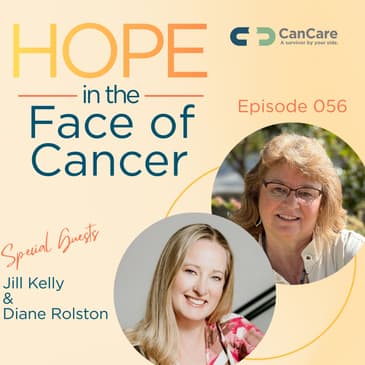
How do you find yourself again after caregiving becomes your entire identity?
When Jill Kelly, a retired physical therapist, became her husband Ron's caregiver after his esophageal cancer diagnosis, she spent more than six years balancing medical care, emotional support, and the uncertainty that comes with living through cancer. After Ron's death, grief coach and life coach Diane Ralston helped Jill navigate the painful journey of rebuilding her identity while honoring the life and love they shared.
Jill shares the realities of caregiving, the emotional weight that often goes unseen, and the challenge of learning who you are when the role of caregiver ends. Diane introduces practical frameworks that help caregivers understand why they often lose themselves and offers simple tools to begin healing without guilt or pressure. Together, they explore the importance of feeling grief instead of avoiding it, discovering personal values, setting healthy boundaries, and choosing purpose one step at a time.
Whether you're caring for someone with cancer, grieving the loss of a loved one, or supporting someone who is, this conversation offers reassurance that healing doesn't mean leaving someone behind. It means carrying their love forward while giving yourself permission to live fully again. Hope often returns through small moments, steady support, and the courage to take the next step.
Highlights:
· Learn why caregivers often lose their sense of identity and how to recognize it before burnout takes over.
· Discover practical frameworks for moving through grief without rushing the healing process.
· Hear why giving yourself permission to feel emotions is an essential part of recovery.
· Understand how values, boundaries, and self-care help rebuild a meaningful life after loss.
· Find encouragement that healing isn't about moving on. It's about carrying love forward while choosing life again.
Mentioned Resources:
CanCare- www.cancare.org
Diane’s website - https://www.dianerolston.com/
About the Guest:
Jill Kelly spent years as a physical therapist, helping others heal and rebuild their strength. Then her husband Ron was diagnosed with esophageal cancer, and the healer became the caregiver. Jill walked beside him through every stage, and after his passing, she faced the work of rebuilding her own identity from the ground up.
Diane Rolston is a life and business coach on a mission to help women find balance and reach their goals, even when life feels overwhelming. Her coaching programs have guided women around the world in honoring their ambitions while carrying the real weight of everyday life. Diane helps people rebuild new futures through seasons of change.
Love the podcast? You’ll be moved by the book. The Hope in the Face of Cancer book shares inspiring, real stories from survivors, caregivers, and healthcare heroes. Raw, uplifting, and full of heart—for anyone seeking hope and connection. Get your copy: cancare.org/hopebook.
About Our Host:
Darcie Champagne Wells is the President and CEO of CanCare, Inc., a nonprofit dedicated to providing support to the cancer community by pairing cancer patients with survivors. Since joining in November 2020 as the third President & CEO, Darcie has driven significant growth, increasing one-to-one support matches by 45% and healthcare referrals by 66%. In 2022, she initiated the Impact Acceleration Initiative to further expand support for cancer patients and caregivers. Her leadership has earned her recognition as a “Most Admired CEO” and “Woman Who Means Business” by the Houston Business Journal, and national “Fundraiser of the Year” by RAISE. Darcie holds a BS in Business Administration from Louisiana State University and an MBA from the University of Houston.
https://www.facebook.com/CanCareInc
https://www.instagram.com/cancare_inc
Thanks for tuning in to Hope in the Face of Cancer!
We’re so glad you’re here. If this episode moved you, inspired you, or brought you a little bit of light, please share it with someone who might need it. Just hit the share button on this page or spread the word on social—your voice helps us reach more hearts.
🎧 Never miss an episode!
Subscribe on Apple Podcasts, Spotify, or wherever you get your favorite podcasts to get updates as soon as new episodes drop.
⭐ Help us grow with a quick review
If you’re enjoying the podcast, leaving a review on Apple Podcasts goes a long way. It helps others discover the show and reminds us that these stories matter. Take a moment to leave a review—we read every one!
📖 Enjoy the podcast? You’ll love the book.
Check out our book, Hope in the Face of Cancer—a powerful collection of real stories from survivors, caregivers, and healthcare heroes. It’s uplifting, raw, and full of heart. Get your copy at cancare.org/hopebook.
[00:00:08] Welcome to Hope In The Face of Cancer, a survivor by your side. Here we share hope and support to anyone in their cancer journey. I'm your host, Darcie Wells, CEO of CanCare and a cancer caregiver. Whether you're a patient, caregiver, survivor, or healthcare provider, we are your cancer support community, together uplifting each other every step of the way. No one should face cancer alone.
[00:00:37] Welcome to Hope In The Face of Cancer, where we share real stories of courageous people in their cancer journey. Our guests today are Jill Kelly and Diane Ralston. Jill spent many years as a physical therapist, helping others heal and rebuild their strength. But when her husband, Ron, was diagnosed with esophageal cancer, she stepped into a different role entirely, caregiver and companion through one of life's most difficult journeys.
[00:01:05] Toward the end of her husband's cancer journey, Jill connected with Diane, a life and business coach who's made it her mission to help women find balance and reach their goals, even when life feels impossibly overwhelming. Diane has created dynamic coaching programs to help women all over the world honor their ambitions while managing the weight of real life.
[00:01:28] Diane guided Jill through many stages of this journey, supporting her as she managed the all-consuming demands of caregiving, navigated the devastating grief of losing her husband, and then helped her to rebuild her identity and reimagine her future. Diane's story of the future. What unfolded between them is a testament to the power of compassionate support and the human capacity to heal. Their story isn't about moving on or leaving the past behind.
[00:01:58] It's about carrying love forward, honoring the person you've lost, and giving yourself permission to live fully again. Diane. Thank you both for joining us today on the show. Thank you. Thanks for having us, Jepha Darcy. Excited for this conversation. It's a very new dynamic for us. This, so I can't wait to see all the nuggets we're going to have for our audience today. So Jill, I'd love to start with you.
[00:02:28] You've really dedicated your life as a physical therapist, helping people heal their bodies, either through injury or illness. So you were very familiar with that type of healing and support. And then life changed, you know, really quickly when Ron got sick. Tell us a little bit about Ron's diagnosis and how you learned that he was ill. And tell us a little bit about what life was like then.
[00:02:56] Well, Ron was diagnosed with esophageal cancer in August of 2016. He had just had a dry cough and was losing weight, really nothing to be concerned about. And we had a lung scan that showed it. You know, when people say that they're in shock or they're numb, that's, it was true for us. We just kind of, time stopped.
[00:03:26] We just kind of paused with each other. We were in the moment, you know, we hugged, we cried, we were in shock. It's like, okay, what's next? And I'm thankful that I have this memory because Ron said right away, he said, I'm not afraid to die. I'm afraid I'm not going to be able to live.
[00:03:55] Meaning the impact that chemo or the cancer might have in debilitation. But he was willing to fight and he was hopeful. And that was a strong message to take away right at the beginning. Yeah. There was just whirlwind of testing.
[00:04:17] Everything was urgent to confirm the diagnosis, to stage the cancer, to get us into more specific testing, develop a treatment plan. And the treatment started within like two weeks. But I also remember just as Ron and I stepped away from each other, just feeling this sense of peace. And it really, it's, I still feel it.
[00:04:46] It was just this warm feeling from head to toe. And my faith is important to me, was to us. And it was definitely God's peace that passes all understanding. And I just knew that God was going to be with us. I didn't know what was ahead. To some degree I did. But, you know, it's just a time, a day that time stops for you when you hear those words.
[00:05:15] I can only imagine. You, having been a physical therapist for so long, you've been in this mode of helping people heal and supporting people. How did that professional experience really translate into your caring for your husband?
[00:05:36] I treated a lot of patients with cancer from those that improved with treatments during the time they were weakened from treatments, stopping physical therapy when they transitioned to hospice. So I understood the physical challenges that would happen with chemo or less appetite or whatever the circumstances were.
[00:06:06] So I was very, very comfortable with the physical challenges. And I've been educated to work with these challenges. What came later in my profession was with experience, being able to offer hope and encouragement at the level that the patient needed, transferring to my husband, of course, but also to the caregiver.
[00:06:35] Because the caregivers would be a lot with the patient. And they need support as well as the patient does. So I definitely had confidence going into the physical care for my husband and the emotional care. Because I knew him, we'd been married for over 40 years. But it is different when it's your spouse.
[00:07:02] The other thing that came into play was my husband and my children, adult children, then relied on me for the medical questions to navigate the medical system, to ask those important questions. But I always tried to be his wife first.
[00:07:27] I just didn't want to be a medical person with medical language with him. And at the same time that my professional experience helped me manage the physical changes and safety concerns, there's always stepping back in your mind to know what to do emotionally with your spouse.
[00:07:59] And so I fully supported that hope for him. That's great. You wore so many different hats, Jill. It's really incredible. Helps strong. You know, you are. Caregiving is so critical. And the caregivers, I think, often are the unsung overlooked heroes in the whole cancer journey, right?
[00:08:29] And you probably know this better than most. How would you describe those caregiving years? Because, you know, you cared for people all your life, but in a different way than caring for your husband. And, you know, so what was that like for you? Kind of trying to step into a different set of shoes. Yeah. It just always seemed that there was something new around the corner.
[00:08:58] Ron had a major surgery right after he had some short-term treatment. And that required that I take eight weeks off of work to care for him. I learned how to give his two feedings that he required. The surgery was that they removed his esophagus and reconstructed it from a portion of his stomach. And so that had to heal.
[00:09:26] It's amazing what they can do now. So our life was every three months we were going back to the Cancer Institute for labs and scans and doctor's appointments and have him reassessed. So that's how we lived initially. And the physical caregiving after the major surgery certainly lessened. And he got back to normal.
[00:09:54] But at the first recurrence, then he was getting IV intravenous immunotherapy every three weeks for two years. So, you know, he had to live his life around every three weeks. For me, it was a challenge to work life around the surgery and the procedures. I was still working full-time.
[00:10:20] Ron had periodic hospitalizations that required that I take time off. And so even, as I said before, when the physical care lessened, there was always an emotional and mental concern of what if. Because I knew we had been told there was no cure. And so we'd been told he had one year of life.
[00:10:49] And there's just a lot of what ifs that happened with that. But the last recurrence, the chemo wasn't effective. And this was in the summer of 22. And Ron had become more debilitated by the disease, more short of breath, losing weight, more fatigued. And there just were no other options. So he was transitioned to hospice.
[00:11:18] Him being my priority, I left my job to care for him. The final month was intense, very, very different, because it was something changing every day. We thought we had a few months, and we only had one. I cared for him at home.
[00:11:48] We had a sunroom. That was our favorite room in the house. Lots of light, big room. He had the television, big enough for family and friends to visit. It was also where eventually we had the hospital bed. Our daughter took leave from work for four weeks to support me and her dad, as well as manage the house so I could just focus on Ron.
[00:12:20] Our son and his wife were expecting their first child, our first grandchild. So my son was out of town, so he was doing the best he can to make his wife a priority and his dad. The first couple of weeks, Ron, he was more fatigued. He was losing weight, but he was becoming more short of breath.
[00:12:49] And he had oxygen. He was using a walker. Initially, I just supervised him, but then every couple of days he began to really decline. So it wasn't long before I was actually helping him walk, and then walking was no longer possible. He had no appetite, and he really wanted to eat. He didn't realize he was coming to the end,
[00:13:18] and so he was trying everything. I just lost track of time. His sleep patterns changed, and when he slept, I slept. He was in a recliner because with the surgery, he couldn't lay flat. So I slept on the sofa near him, and I did that prior to hospice. Hospice was a great help for us.
[00:13:47] I allowed the nurses to explain the medical things to him when he kept saying, why am I losing weight so fast? Why are you not doing anything about my shortness of breath? I wanted to be his wife, so again, I had them explain that. And the chaplain was good, too. What was it that Ron needed for him to die peacefully?
[00:14:16] And by this point, and there had been points along the way when things were stressful, I was just barely holding on. It would be wake, sleep, do the next thing, and that's what I simply did is just I did the next thing. As a medical professional, I understood the physical changes. I understood that things weren't working as well as they should,
[00:14:42] and that we were closer. But I chose not to explain that to the children. If they ask questions for hospice, that was fine, but I wanted them to spend time with their dad. I didn't want them thinking, oh, well, this is happening, so we may only have a week.
[00:15:10] During the last two weeks, Ron didn't want me to leave the room, so that was tricky. But we made it work. Our first grandchild was born the week before he died, and he was able to hold her. He was alert for a couple of days before his final days. Great memories of that.
[00:15:36] And so being able to just sit with him during these final days was truly a privilege and a blessing while it was still very hard. But staying in the moment kept me going to the end. Thank you, Jill. I know it's a lot bringing up these emotions again,
[00:16:03] but I thank you for sharing that experience with our listeners. And Diane, I'd love to hear from you. You coach so many different women. Many of them have been in a similar position as a caregiver. What happens to that sense of identity, sense of self, like when you're giving everything you have to this other person?
[00:16:32] Just what are your observations about that? Yeah, you're right. It is a giving of everything. And I think that comes a lot of times as women. We do that naturally. Then we also do it when we become wives. We give even more. And then when we become mothers. And so bottom line is we lose a sense of self in each of those transitions.
[00:16:59] But then to be caring for someone as they're going through cancer, that is the utmost giving of self. And it's not because they necessarily choose to give up themselves. It's because they fall into what I've coined the care trap. And just as I share today, I am going to put my answers into like acronyms or frameworks and images
[00:17:26] just to make them easier to remember. Though when I was coaching Jill or when I coach other women, I definitely don't talk in this way. To make it a little bit easier. So the care trap. First is the C. It's that constant response mode. So the caregiver, they're so task focused. They're in survival mode. All they're saying is like, okay, what do they need from me next? What can I do? What has to be done?
[00:17:53] And so it's that immediate response. Like a firefighter almost. Yes, yes. And I won't even go into what that does to your nervous system. Yeah. A lot, a lot. And so then A is they abandon themselves because they need to. They shift from who they are and what they do and what they want to this identity of a caretaker, caregiver. Never.
[00:18:23] And that means a lot of times the personal needs drop to the bottom of the priority list. And this is not just the case in this. This also happens when I'm talking at conferences and I ask the room to list their priorities. Almost never is the woman's name on their own list. And if it is on the list, it's tasks that they feel like that they have to do to better themselves. So go to the gym. Read that professional book.
[00:18:52] And that abandoning self does a lot of damage. The R is reactive. So everything kind of like the first one where it's constant, but they're in reactive mode. So life becomes these like small, urgent, moment-to-moment tasks. So that long-term vision, the dreams, the goals, everything for the future goes on hold.
[00:19:21] I can remember working with someone on their business and she said, Diane, like my husband's cancer has come back. I need to put the business on hold. And so she went into that caregiver mode again for her spouse. And then E is the emotional weight, right? We're not just doers, even though the caregiver is doing, doing, doing. There's so much emotional weight that comes on. And then if they do think of themselves, they feel guilty.
[00:19:50] Like, I'm guilty because I just got some sleep or because I went and saw a friend or because I still went to work. And eventually, because they're giving up of themselves in this emotional weight, they just, they don't know who they are anymore. So caregiving is the greatest act of love, but it can also quietly erase that caregiver if they're not supported. No, thank you for that. That's so helpful for our listeners.
[00:20:18] And we'll make sure to recap that too in the show notes so that everybody can really look at that model. It makes a whole lot of sense. I'm sitting here nodding the entire time. And you're talking like, yes, this is it. So yeah, just to share too, you know, like, it's not just my experience with Jill, but my own experience of losing my father and seeing what it did to my mother and also to know what it did to me.
[00:20:46] So it's, it's nice to be able to kind of break it down into something that, that looks that way, because I really want those who are listening, who are caregiving, that that they get that support that they really need. Yeah. And the validation, I think we can all see it ourselves. I mean, I've been a caregiver three times over. I could see myself as you were going through that. I'm like, yes, went through that. Yes, went through that. So I think it helps you realize that, okay, I'm not alone.
[00:21:13] This is a normal process, a normal reaction. I know we're going to talk about some kind of tools, you know, too, and how to kind of get through and reclaim yourself in this process. So Jill, I'd love to talk a little bit about when, after you lost your husband, after Ron
[00:21:39] passed, talk to us about how you had to navigate that emptiness when he was gone, how you had to understand and walk with life without him. What was that like? How did you cope? It's, it's real interesting.
[00:22:02] Um, I like to have plan A, plan B, plan C, and, um, I had thought of every scenario, every scenario, but nothing prepared me for his final breath. Um, I wasn't even sure that I wanted to be there for the final breath. Um, I, I just didn't want to hear that last noise.
[00:22:30] I had heard it with previous people and it, it took care of itself. I was right at the door. My children were beside him and we were still immediately there. But I remember crying, um, that it, what we knew was going to happen had finally happened. I remember holding him, a medical professional on me checked his pulse and his breathing. Of course you did, Jill.
[00:23:01] I know it was just automatic. Um, but I was also programmed to call hospice first if anything happened. And so I was like, okay, we have got to call hospice. And my son gratefully said, mom, no, we need more time. Um, and so we, we took that time until we were all ready. Yeah.
[00:23:25] Um, and when the funeral home car came, professional, compassionate people, we followed them out. Um, as they put him in the car, it was midnight. Totally unplanned. Totally unplanned. Cause he had died at eight 35. It was midnight. And random thoughts pop in your brain during this time. And mine was, it's a new day.
[00:23:55] This was my first day without him, but it, it was meaningful, but it was a new day. Um, but in many ways I was just on autopilot. Uh, it's, it's funny to me now, but I was standing at the front of the church and for visitation. And I'm like, who are these people coming to see?
[00:24:22] Because it wasn't reality for me that Ron had died yet. Um, I just, you know, thought he'd gone to the beach and he'd be coming back. Um, it wasn't reality for about nine months. Um, and then I was sitting at dinner with my children. Um, their significant others. I mean, what would have been a happy time.
[00:24:49] And I look at them and I'm like, I'm no longer a couple. Um, and that was devastating is not the right word, but it, it, it really took my breath away because we've been married for over 40 years. Um, and then the, then the questions were, well, who am I now? What, what's my purpose? What am I supposed to do?
[00:25:17] Can I do this? And then there was the emphatic, I don't want to do this. Um, and it was the little things at first, um, remembering to take the garbage out on the right day because he always did it. Um, you know, someone not going through this fatigue and fog is probably like, well, that's silly, but you're not thinking clearly.
[00:25:45] I was frustrated when a house repair had to happen because it wasn't the problem that of what happened. It was the reminder that he wasn't here and he had taken care of those things. Um, and then he loved yard work. And I mean, that was his pride and joy. And I come home one day and the grass is brown and the yard's barren.
[00:26:13] And I'm like, I have not thought of watering the yard for an entire year. Wow. Not just the day, but a year. Um, so that adds stress. And, you know, I can't, I can't do this. And these were all reminders that he wasn't here and I needed to figure it out.
[00:26:40] Um, but like I said, it was nine months, uh, really before that sank in. Now, the good thing, one of the blessings was I eventually spent time with the children. They both lived in the same town and one had the new grandbaby. So I was there, um, to help with the baby. It was their first. And that was the beginning of my healing.
[00:27:06] I could love on that baby and I could be up late nights cause I wasn't sleeping. Um, I wasn't alone. Uh, because if I was alone too long, I, I felt like I wasn't part of a family. Um, and the silence alone is very, very loud. Um, so then I began to work with Diane.
[00:27:32] I had known her previously in some business, um, courses, but, um, I knew that we related with each other and I knew that she had the, the tools and the knowledge and the wisdom to get me to the next point. Um, so her coaching became the framework for more healing.
[00:28:00] She coached me as a caregiver. You're a doer. You don't have time for emotion and I'm a doer by nature anyway. So Diane got me into being, and that word was very frightening to me at first. Um, but being with the emotions versus doing as a caregiver.
[00:28:26] Um, we weren't talking per se about the future cause there's too much sadness, too much heaviness and weight, but we were talking about what is important to me. What are my values? When I'm, you know, frustrated, it's probably because one of those values isn't being honored.
[00:28:48] And then we could begin to move into thinking what the next few months and later the years would be, but, um, and also had grief counseling with hospice for 13 months, which was, was great. It was a safe place. They were very, very, very helpful. But before Ron died, I had promised myself that I would feel the emotions. I would not apologize for them.
[00:29:16] I would not say I was fine if I wasn't fine. And I would sit with them. Um, I didn't know what that meant, but I, I would be in the emotions. Um, and as I said, I'd always been a doer and now I had to learn how to feel and work through that to get out of that initial sadness. Um, and also just.
[00:29:46] You really had to discover yourself again. Yeah. Because you're not thinking clearly, you have no motivation, you're either sleeping too much or not enough. And you've done, I mean, Ron was sick for six and a half years. Um, and yeah, so then you're left with feelings. Yeah. Because you don't have to be the caregiver anymore. Uh, and it is what, what do I do now?
[00:30:15] And who am I? So Diane, every day you're helping people rebuild from whatever is going on in their life. From your perspective, you know, where, where was Jill when you guys first started working together? Yeah, well, she, she shared a little bit about where she was. And the thing is, she wasn't just grieving one loss of Ron.
[00:30:44] She was grieving two losses and we could even break it down. There's so many more losses that she had. But if we just look at the, the two, it's like the loss of her spouse, the love of her life, and also an identity collapse. A lot of times clients of mine will just, you know, take that mandatory, they get five
[00:31:09] days off and they'll jump right back into work and they'll fill every waking moment with work so that they don't have to feel. Jill was, was blessed with the ability to not have to return to work, which my naturopath actually said, if everyone should have mandatory two years off of a major loss, that they can actually have that time. And so she had that time.
[00:31:36] But with, you know, when I'm working with any of my clients through major life shifts, which could be becoming an empty nester, maybe there's a big move in where you live, maybe there's divorce or job loss. There's always that question of who am I now? Yeah. So Jill's identity had been wife for many years, caregiver with her job, medical professional, right?
[00:32:03] And now suddenly she's shifting to an unexpected early retirement, to being a widow, which the title she hated. Yeah. And so she wasn't just rebuilding who she was after loss. She was, she almost had like a clear slate. Which can be even scarier sometimes, right? Very overwhelming. Very overwhelming because there's no distraction anymore. Yeah.
[00:32:32] I just like go back. I can't go back to work. Okay. What am I doing? Just be yourself away from feeling and feeling. And that's the worst, the worst thing you can do is to just kind of abandon your emotions and go straight into the work. So the first thing we did in the coaching wasn't moving her forward. It was just permission to feel. And as Jill said, she's a doer. I'm a doer.
[00:33:01] Most people start off as doers. And so she would say like, what do I have to do? And be thinking about how do I do this? How do I be better? And I was like, no, no, no, no. Just, we're just going to be here. We're just going to take the time. And I created that space. And I created that space where she could just feel the emotions, say the things maybe she didn't want to say to other people in her life.
[00:33:27] And eventually imagine that future again, right? Because loss of a loved one, it takes away that previous vision, the previous dreams, the goals, the plan that you already had. And so our work was just writing that next chapter, but only as she was ready to take on the next piece. So how do you help someone without giving away all your secrets off?
[00:33:55] But how do you help someone rediscover themselves and start crafting that new chapter? Hmm. Yes. So, and even if I gave you the how-to, it's not going to go as well and be as powerful than if you're working with someone. Yeah. That's why I have myself, I have a counselor, I have a life coach, I have a business coach,
[00:34:21] I have these other people to help me, but I'll kind of put it into a three-part kind of easy way to look at it. The three Fs, feel, find, and forward. So first, it's the feel. And people want to jump into do, but you've got to feel and allow the grief to be present, to have space, to acknowledge what happened. A lot of people just kind of pretend like nothing happened. And it's like, no, this is major.
[00:34:51] It's almost like you had major surgery. There needs to be that healing. So the feeling is giving yourself permission to not be okay yet, to not jump into things, to not put on that happy face, to just to feel it. And you can't skip this part. Because if you try to push it down, bottle it up, it's like a geyser. It will blow. It'll blow at the time that's not appropriate.
[00:35:18] And it will be longer than if you just gave it space. And it was great that the timing for me, being that I had lost my father a couple of years previously, I knew the fog. I knew the feeling and that part. And then find is second. This is where you're reconnecting with yourself. What do you like? As Jill said, discovering your values. And I don't mean morals.
[00:35:46] I mean, the values, the things that are in residence with you that bring you joy, that make sure you're not dishonoring any values. And separating who you are from what you do. Caregivers are oftentimes in the title of the doer of the caregiver. And now it's like, okay, who am I as me as a person? And then answering tough questions. And I say tough because no matter where someone is in their life, asking these questions often are tough. What do I like?
[00:36:15] What matters now? What are my priorities? And the biggest one is what do I want? Because you're not... What's that? So that's a tough one. You know, sometimes. Yeah, I'll ask in different places. And I'll be on a morning meeting and they'll say, like, what do you mean? Like for lunch? And I'm like, no, what do you want? It's really sad. I asked someone the other day at a networking event after the typical questions. I said, what brings you joy?
[00:36:43] And she goes, can I get back to you on that? And I was like, I'm going to send you a few things. But the key thing is when you are finding it's who you are now today, not who you were before who you were supposed to be. And that is the greatest clarity. And then it's forward. Because once you've felt things and you'll still keep feeling things, we're not going to ball it up.
[00:37:11] And you're finding out what you like. Then we start to take the action. That's when life starts opening up again. You begin to intentionally rebuild yourself, your life. You make small decisions. You move from the surviving of the caretaker to actually being allowed to live again. And we don't do this in a rush.
[00:37:36] We do this just at the pace that feels good for the client. And it's just one step at a time. Because we don't want to erase the past. We don't want to snuff out the feelings. We want to build a meaningful life that includes everything that the person is reading. Thank you for that. That was very insightful.
[00:38:04] And I'm sure, Jill, as you're listening to that, you're like, okay, I remember this. I remember this. So reflect on some of the shifts that happen as you and Diane were working together. What could you see in yourself? Well, as I mentioned, I mean, it's just automatic sadness at first that lasts, you know, for me quite a while.
[00:38:30] But I remember going out with coworkers several months after Ron died. And I laughed. And I was like, oh, my gosh, I'm supposed to be sad. Yeah. Because you're just dealing with so much. You're not trying to hold the sadness. But so that was kind of the first. But then it was the year of firsts. He died in October.
[00:38:58] So there was Thanksgiving, Christmas, then his birthday, then our anniversaries. And all those firsts and those problems that happened in that first year just reminded me he wasn't here. It was kind of a slap in the face. But, you know, those struggles and those challenges were hard. But I am who I am today because of them. Yeah.
[00:39:25] And Diane's coaching was her style of coaching, honestly feeling those emotions in a safe place, not feeling rushed to be better than I was, and identifying real feelings. And here's an example of that. So I'm kind of a numbers person.
[00:39:49] So I was, you know, automatically tracking, well, it's been six months since Ron died. Heavy on my heart. You know, it's been a long six months. And Diane says, Jill, it's only been six months.
[00:40:11] And again, a wake-up call to reframe my sadness to, oh, yeah, I'm not supposed to be any better or worse than I am right now. Where I am is okay. And so she's helped me plan for those difficult, you know, make a plan for the holiday.
[00:40:40] Make a plan for a day that might seem harder than another. And in doing that, I'm celebrating the person, my husband. I'm not staying in the sadness. I'm in the memories. And it's significant. That was a huge shift. And also, as she said, giving myself permission to focus on myself.
[00:41:12] As moms, as a medical professional, as a caregiver. It did feel guilty. I did feel guilty. Just thinking about myself. I felt guilty that I could think about myself. At the expense of his death. And that was a hard, hard thing for me.
[00:41:41] But I've learned, and I'm still learning, to look at those core values that we work on. They may be different each year. And adapt the energy that I had to the circumstances that I was in. Certain things didn't need focus on. And then make those healthy changes when necessary.
[00:42:04] And Diane's coaching provided me the insight and the tools and the acceptance to make those shifts. This was a huge time of personal growth. It wasn't rapid. But I really treasure how we weeded out the junk to get to the values in me.
[00:42:35] So, was it easy? No. Not always. Do I still miss Ron? Absolutely. But it's been three and a half years. And I can truly say that I am living life. Again. Not just getting through it. And that's huge. That is huge, Jill. That is huge.
[00:43:03] And Diane, it's got to be just so amazing and rewarding to see the journey that Jill has come along. And to watch her growth and be in touch with herself in different phases of this. Tell us a little bit about what you noticed in Jill's growth and working with her over time. Yeah.
[00:43:27] There are so many different things that I could say about how well Jill has done. And one of the things that we do, because we're always on video with each other coaching, is we do this high five. High five, right? Because you need someone to acknowledge how far you've come and how well you've done. And to have someone be unbiased in that.
[00:43:53] Where, as the client, you don't have to worry about the coach's feelings as you talk about your feelings, right? Beyond the how you doing, we don't need to talk about anything else for me. But for Jill, she's made a lot of her strides from that. We look at the co-active coaching model of the being and the doing. We've talked a little bit about that already today. Ideally, we want to be living in both. When you're a caregiver, you're the doer. Then we need to move you back into the being.
[00:44:22] And then we want to have a nice blend of the two. And so with Jill's journey, she was able to move into the being. And she'd keep saying, well, what do I need to do? And she'd be trying to measure everything of like, well, why did I still get sad about that? I thought I was better. And so with time, right?
[00:44:47] So she had to get over the survivor's guilt, the gift of the early retirement, all of these pieces. But as Jill was really stepping into who she is as a woman, not as a wife, not as a mother, not as a caregiver, not as a physical therapist. Who is she as a woman? She got to really expand and explore what was most important to her.
[00:45:13] So she went from that like surviving every day and just getting through it and into really being able to be intentional about what she wanted. So we have the being and the doing, but we want to have intentional doing so that you have the time. Yeah, yeah, exactly. And that's how anyone designs a life that truly will satisfy them.
[00:45:43] We don't measure according to success. We measure according to satisfaction. And I wanted to move Jill into that place again. So she could sit in the being of what do I want? How do I want things to be? What does make me happy? And then she could look at the doing and ask herself, well, what can I do to help me to get there? So she really leaned into all the tools. It was really cool that over time she'd say, and I knew that you'd say this.
[00:46:12] And so I did that or, and I knew that this value was being dishonored. So I could do this. And so there was a lot of intentional doing in the end. Yeah. And as we continue to work together. So her actions now are really aligning with who she is. She has the time to check in and know that. And she's able to speak honestly about the things that she wants and her needs with others.
[00:46:40] And, you know, sometimes that's setting boundaries and good practice for everybody. But this is a little coaching going on here, Jill. Well, Jill, Jill's done all she's done. You know, she's done the work. She's put in the time. And this is something that everyone should do because we want to make sure our choices, our goals, what we're doing actually reflects our values and what we want.
[00:47:08] And I kind of see it like the Wizard of Oz. When it starts the old version, it's all in gray, black and white, right? And then it turns into color. Thank you for joining us on this episode of Hope in the Face of Cancer, a survivor by your side. If you or someone you know is facing cancer or is supporting a loved one through their journey, we invite you to share this podcast.
[00:47:35] As a cancer survivor, your journey carries invaluable wisdom and insight. We would love for you to get involved in CanCare's mission of becoming a survivor by the side of someone facing cancer. Please visit our website at cancare.org slash volunteer or click the link in the bio for more information on how to get involved. Our survivor volunteers have been a beacon of hope for so many. Thank you for your support and our efforts in the cancer community. No one should face cancer alone.