
What does it really mean to lead without power but still make an impact?
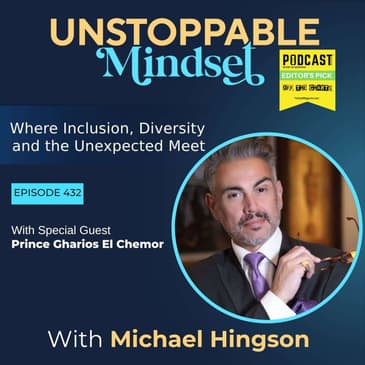
I had the chance to speak with Prince Gharios el Chemor, whose life blends royal history, humanitarian work, and a deep commitment to compassion and critical thinking. From his family’s legacy in the Middle East to his upbringing in Brazil, Gharios shares how identity, purpose, and service shaped his path.
As our conversation unfolds, you will hear how sovereignty today is less about ruling and more about responsibility. We explore education reform, the dangers of social division, and why compassion and critical thinking matter more than ever. Gharios also introduces his vision for the future through Logos One, a new education model designed to help people live with purpose. I believe you will find this episode both thought provoking and inspiring as you consider what it means to truly live with an Unstoppable Mindset.
Highlights:
00:01:15 – Hear why titles mean nothing without purpose and service00:08:26 – Learn how identity and adversity shape a global perspective00:24:43 – Understand what sovereignty means in today’s world beyond power00:36:43 – Discover how small acts of service can deeply impact lives00:43:31 – Learn why compassion and critical thinking are missing today01:02:04 – Understand what it truly means to live with an unstoppable mindset Bottom of Form
About the Guest:
HRH Prince Gharios El Chemor of Ghassan is a diplomat, author, artist, and leader recognized internationally as the heir of the Ghassanid Dynasty, the Christian Arab royal house that once ruled much of the Levant. He’s a multi-awarded humanitarian on four continents for his work in cultural preservation and minority rights. He played a central role in restoring the House’s historical continuity and securing its recognition under international law, including The special consultative status at the United Nations. He was knighted under the authority of the late Pope Francis, holds the U.S. Presidential Lifetime Achievement Award, multiple Congressional honors, and has been welcomed by heads of state, religious leaders, and academic institutions across four continents for his advocacy on behalf of persecuted Christian communities in the Middle East.
Beyond diplomacy, Prince Gharios is an award-winning best-selling author of thirty-seven books spanning philosophy, international law, spirituality, governance systems, and martial arts. In 2014, he published the peer-reviewed Middle East: The Secret History, a groundbreaking work that earned him the 21st International Cultural Award Trentino–Abruzzo–Alto Adige (awarded by the Italian government) in the History category. Seven of his works reached number one on Amazon’s bestseller list. Since several of his titles achieved #1 across multiple categories, this actually represents thirteen #1 Best-Seller achievements overall. His intellectual work includes the development of Skeptical Mysticism, the Law of the Triple Accord, and Neo-Holism, a framework that integrates reason, compassion, and systemic balance to address political and social crises. His works — including The Sovereign Perspective, Essentia, Sapientia, and Unitas — propose an integrated understanding of consciousness, ethics, and identity, bridging ancient wisdom traditions with contemporary science.
Trained in acting and filmmaking, as well as holding a master certification in Aikido from the Aikikai Foundation in Japan, Prince Gharios embodies a rare synthesis of scholarship and lived experience. His humanitarian initiatives have provided food, education, and stability to thousands of displaced families throughout the Middle East. Whether in academic forums, interfaith dialogues, or grassroots relief missions, his message remains consistent: the future of humanity depends on restoring proportion, dignity, and truth — both within individuals and the societies they shape.
Ways to connect with Prince Gharios:
Website: www.PrinceGharios.org/
Facebook: https://www.facebook.com/gharioselchemor/
Instagram: https://www.instagram.com/officialprincegharios/
Youtube: https://www.youtube.com/@theroyalherald/
LinkedIn: https://www.linkedin.com/in/hrhprincegharios
X: https://www.x.com/princegharios?lang=en
TikTok: https://www.tiktok.com/@officialprincegharios
Documentaries:
The Christian Kings of the Middle East https://youtu.be/Xt5NBNGa0q8
The Royal Legacy https://www.youtube.com/watch?v=MUAS2rq8Bt0\&t=150s
The Project https://www.youtube.com/watch?v=7TFkZk3qd3c\&t=416s
About the Host:
Michael Hingson is a New York Times best-selling author, international lecturer, and Chief Vision Officer for accessiBe. Michael, blind since birth, survived the 9/11 attacks with the help of his guide dog Roselle. This story is the subject of his best-selling book, Thunder Dog.
Michael gives over 100 presentations around the world each year speaking to influential groups such as Exxon Mobile, AT\&T, Federal Express, Scripps College, Rutgers University, Children’s Hospital, and the American Red Cross just to name a few. He is Ambassador for the National Braille Literacy Campaign for the National Federation of the Blind and also serves as Ambassador for the American Humane Association’s 2012 Hero Dog Awards.
https://www.facebook.com/michael.hingson.author.speaker/
https://www.youtube.com/user/mhingson
https://www.linkedin.com/in/michaelhingson/
accessiBe Links
https://www.youtube.com/c/accessiBe
https://www.linkedin.com/company/accessibe/mycompany/
https://www.facebook.com/accessibe/
Thanks for listening!
Thanks so much for listening to our podcast! If you enjoyed this episode and think that others could benefit from listening, please share it using the social media buttons on this page. Do you have some feedback or questions about this episode? Leave a comment in the section below!
Subscribe to the podcast
If you would like to get automatic updates of new podcast episodes, you can subscribe to the podcast on Apple Podcasts or Stitcher. You can subscribe in your favorite podcast app. You can also support our podcast through our tip jar https://tips.pinecast.com/jar/unstoppable-mindset .
Leave us an Apple Podcasts review
Ratings and reviews from our listeners are extremely valuable to us and greatly appreciated. They help our podcast rank higher on Apple Podcasts, which exposes our show to more awesome listeners like you. If you have a minute, please leave an honest review on Apple Podcasts.
Transcription Notes:
Michael Hingson 00:04
What if the biggest thing holding you back isn't what's in front of you, but rather what you believe Welcome to unstoppable mindset where inclusion, diversity and the unexpected meet. I'm your host. Michael hingson, speaker, author and advocate for inclusion and possibilities. This podcast explores how the beliefs we carry shape the way we live, lead and connect with others. Each week, I talk with people who challenge assumptions, face adversity head on and show what's possible when we choose curiosity over fear, together, we focus on mindset resilience and the small shifts that lead to meaningful change. Let's get started. Greetings everyone and welcome to another episode of unstoppable mindset. It is fall in Victorville, California, and I guess in the whole northern hemisphere for that matter. So here we are once again, and we're going to have, I think, an interesting and a fun and a very thought provoking episode today, we get to chat with someone whom I never thought I would meet, but I got to meet him on LinkedIn, and then we've met in person, and now we're chatting. And he is a Prince, Prince Gharios el Chemor Chemor. And garrios lives in Los Angeles now, and that's an interesting story in of itself. He has written 37 books more than I've written, I can tell you. And he is involved with a lot of different kinds of activities, and I'm sure that he's going to talk about a lot of those and give us some interesting things to think about. So I'm just going to say, Gharios, welcome to unstoppable mindset. We're really glad you're here. Unless you want me to call you Prince, I'm either, either way.
Prince Gharios el Chemor 02:04
Oh, thank you so much. It's my pleasure. Thank you so much for having me. And I always say that the only person I demand to call me your highness is my wife. But every time I do, she laughs on my face, so I'm thinking about stopping it. Yeah, and what does she call you? She called me Gary. I became Gary.
Michael Hingson 02:23
You became Gary?
Prince Gharios el Chemor 02:24
Yeah, because my wife is American, so well.
Michael Hingson 02:28
But do you call her princess? No, no, oh, okay, you can
Prince Gharios el Chemor 02:34
call me any way you want. I'm like, I'm not special, yeah, and I, you know, as I always like to say, you know, a title in a 21st Century from a deposed dynasty is absolutely useless as a as a person of honor, unless you know, you have, like a work like we do, like my family kept this tradition because we have a humanitarian work with the UN we can talk more about that later. But as I always say, princes are not making even street names these days anymore, so I still have to pay for Netflix like everybody else,
Michael Hingson 03:18
yeah, but I'll bet you think of your wife as a princess, whether you call her that or not, because,
Speaker 1 03:22
oh, she's, she's a queen. She's not
Michael Hingson 03:25
even a prince. There you go. See now we're talking Yeah, as it should be. Well, yeah. So I let's start with this whole issue of a deposed dynasty, and little bit about, maybe your background, where you came from, and all that, and we'll go from there, sure.
Prince Gharios el Chemor 03:47
Well, there's a, there's a some people are a little bit, you know, as, as Voltaire used to say, Napoleon, also, Churchill, History is written by the victors. So especially in the United States, people don't are not very aware of world history. So is people don't understand how some things work. And even in the Middle East, whereby my family originated. I'm European, from my mother's side, and I have a little like 3% Jewish. I'm British, French, Italian, and in from my father's side, I'm Christian, Arab, from where today is Lebanon. You're a
Michael Hingson 04:40
conglomerate all over the place,
Prince Gharios el Chemor 04:43
yeah, so I have all the all the conflicts, all the colonizers, the people that are colonized, all within an only person. I'm the, I'm the living un so, but I. Even in the Middle East, you know, because since we are like a Christian family, a Christian dynasty, even that history was, you know, political propaganda. So you're not going to promote your your enemies. So since the Muslim regimes took over our lands through history, so the story they tell is a very limited history. So in a lot of history books, people think that our rule ended in the seventh century. So people say, Well, how come you are claiming a kingdom that ended 14 centuries ago? And I always say, well, first and foremost, we rule other realms after that, even our cousins ruled until 1921, so the like 100 years ago in what today is hail in Saudi Arabia, is called Jabal shumar, Jabal shmor, which is our last name. So they were our Muslim cousins, because some part of the family was forced to convert and but and the family that escaped and went where today is Lebanon kept being Christian, which is my direct family, and the Christian branch rule until 1747, to the 18th century. So it's not like 14 centuries ago. But even if that was the case, according to international law, we have a president, which is Israel. So Israel revived a state that, you know, they didn't hold sovereignty for over 2000 years. So our claim, even if we considered the last kingdom, we have a whole kingdom, because we rule principalities up to that. We rule the Byzantine Empire too, but that was very briefly, but we had like principalities or Sheik dooms, as we call the very same politically, political unit as you have the UAE, as you have Bahrain, as you have Qatar, Kuwait. So is a is as sovereign as an empire, but is a small principality, so that those are the kinds of realms we ruled after we lost the main kingdom in the seventh century, but we we rule, as I said, my direct, direct family into the 18th century, and my cousins until 1921 so yeah, so it's A our claim. Theoretically, if you consider Israel legitimate, you have to consider our claim legitimate, although we don't actively pursue any kind of political restoration or active, you know, restoration of a territory, kingdom, or anything. On the contrary, we support all the duly established governments, the euro and de facto, because we think that there's a lot of people there wanting power, and we don't want to be another force to try to fight for power or anything like that. On the contrary, we want to help to bring balance. We want to serve. We want to help to bring, you know, a stability and dignity to the people we're not interested in political movements or topple any governments or anything like that, although I've been offered many, many times, and thank God, I'm not at all seduced by power, because I it's something that is an illusion, in my opinion.
Michael Hingson 09:08
So the family has certainly been spread out. Where were you born?
Prince Gharios el Chemor 09:14
Well, I was born and raised in Brazil, because we have, still some family members were able to stay in Lebanon, but there was a huge famine and persecution after my family lost the principality in scarta ze way, which is in the northern Lebanon, My great great great great, great grandfather was assassinated, and then his son had to flee and like, adopt different last names for their children, because the it's funny, because it could be a great movie, because the Sultan, Ottoman Sultan was a hunchback, so it was a perfect. Villain, so the hunchback Sultan wanted to kill all the members of my family, so they were able to hide for some time, but then, when the first war, already in the end of the 18th century, 19th century, it was a great don't know if I can use the word genocide, but it was a genocide of Christians because the Druze, they ally with the Ottomans and to destroy the Christians. And so started this movement in the mid 1800s until the culmination of the First World War, and then my family members and many Lebanese not just my family members, went to Brazil because Brazil is still the largest Catholic country in the world. So today you have in Brazil twice the number of Lebanese people. Then you have in Lebanon. You have around 4 million in Lebanon. You have over 8 million Lebanese in Brazil. And I made fun when I first met the Lebanese president, we had the first audience in 2017 I we just had a Lebanese descendant president in Brazil. So I said, Well, you know, the our Lebanese president has like, twice the number of Lebanese people than than here. So Isn't that ironic and funny? What did he say? No, he was laughing. He said, Yeah, you know. And it was funny because he was actually, his name was Michelle Temer. It was from Lebanese descent. And you have today, I think the Minister of Economy in Brazil is Haddad, which is also Lebanese. Yeah. So everyone has an uncle, a cousin, even in my family, we have a very funny situation, because half of the family of my cousins stayed in Lebanon, and the other half went to Brazil. So you had two brothers from the same father that one doesn't speak Arabic or French and the other doesn't speak Portuguese. So they used to visit each other with their kids and using like cell phones and other things because they they were like brothers and couldn't communicate, because one was born and raised in Brazil, and the other, and still today, like My Arabic is a joke and my cousins make fun of me, so we talk in English, because My Arabic is the Arabic of the 19th century. And again, my grandfather never used the word Lebanon, because there was no Lebanon when he left. Lebanon was created in 1946 so I think it's very interesting when a lot of people say about Palestine, oh, there's no Palestine. There was never a state called Palestine. Well, there's never a state called Lebanon, another state called Syria, and every state called Iraq, another state, any of the states that we have today, the Middle East, they're all created after the first war. So they're all creations by the British and the French. And also, a lot of people don't know that.
Michael Hingson 13:34
So what was it like for you growing up? Because however you view it, you have a very rich family and rich ancestry. So what was it like for you growing up?
Prince Gharios el Chemor 13:47
Well, it was very interesting because I I had a Lebanese grandmother and I had an Italian grandmother, so that's why I became fat. Thank God now I'm I lost weight, but yeah, I it was funny, because I inherited gout, so I was very sick with gout when I was, like, 27 years old, and I had to take cortisone. And I always tell the story, because I used to go to my Italian grandmother, she looked at me and say, My god, you're so fat. You're so terribly fat. You have to do something about that. But not today. Now eat so. So she was like, you know, I could always start I should always start a diet the next day that I visited her, because when I visited her, I had to eat. So that's how that's that how the dynamic works. But I had a very normal, let's say, upper middle class for. Upbringing, yeah, upbringing. But the thing is, because my father, when my grandfather, arrived in Brazil with his parents, he had, they had nothing. They had they escaped. They had to sell the marble from the palace. We had to bribe the Ottoman soldiers so they were able to escape. So they had, like they grabbed some jewelry and something. So they started from zero in Brazil, but then my grandfather in many Lebanese families started selling things door to door, and they made a fortune. My grandfather made a huge fortune. He had like medication distribution. He represented many laboratories for southern Brazil. And then he had real estate. He became very rich, and my father and my father was born, my grandfather was already very rich, so he had like a playboy upbringing, different than me. And then my father never worked one day in his life. So when I came, my family said, Well, let's not repeat the same mistake that, you know, we made with him. So let's, you know, ration things with him. So I started, well, I started working because I wanted but I started working, working it with 13 years old, and I always I cannot not work because I have a we talk about that I have a cognitive difference than regular people, what People call romantically gifted, which is a very is not as romantic and beautiful as people think is like, is like OCD or something like that, and hyper sensibility and stuff. So I always, I cannot not study something. I cannot not work. So is an obsession that I have. So that's why I wrote so many books. I've done so many things.
Michael Hingson 17:24
So what was your job? What kind of work did you do? At 13
Prince Gharios el Chemor 17:29
I worked in a video store, like, like Blockbuster, but was like a small one, because I watched all the movies. So people love to see me recommending the movies and Yeah, and so I always work like, I was like, 1516 I was the marketing director of a magazine, so I was always like, precautious, let's Say, and yeah. So my life was always very normal. I was always blessed. Thank God. I never had any need like I I had. I suffered a lot. I was bullied and I had a because I was different. So people, you know, they because of the way I talked in school, and I was probably the worst soccer player that have ever lived. And so in Brazil, that's the thing. So I was highly bullied. I and but other than that, and of course, because I'm an empath, so, but I never had any, let's say, need of food or anything like that, like I always had a very blessed life.
Michael Hingson 19:06
So you went to school in Israel and so on. Did you do college there? Or what did you do for college? Or did you in Brazil?
Prince Gharios el Chemor 19:13
Well, I studied two things in Brazil. I studied in a Franciscan school, the regular school, and then for high school, there is a special course in Brazil which is the equivalent of the university for theater, like Dramatic Arts. So I've done that. And then for college, I've done a course that's called Marketing and PR. So I have this two, this two trainings, one in dramatic arts and the other one in a corporate PR. Actually, my course even taught propaganda. So we studied a lot of how states work with Prop. Ghana and things like that,
Michael Hingson 20:03
two significantly different departments of study. How did you how did you combine those? Or, how did you justify having two different things, art and marketing, that's pretty different?
Prince Gharios el Chemor 20:18
Well, not to me, because I always worked a lot with media. So I'm also a filmmaker and professional actor, a SAG actor. So I'm sag here, and I'm in Brazil. It's called sated. Is the sag equivalent there? I directed a lot of even some commercials and some shows. So to me, that's very they intersect and and I have this artistic side of me that is very obsessive too. So I always have to be painting. I always have to be singing and doing something creative, because that's, that's who I am. And some people don't understand, but people that actually I'm not again, I'm not claiming i i have any special talent or anything like that. I think there are people that think better than me, people that sing better than me, but people that have this, let's say, gift, they, they have a need of putting out their work is not, oh, I skewed to paint or skewed to sing or no, this is the need that you have to manifest this energy that you have inside of you. So I give you an example when when I had had the first flare of gout was because my first wife said that I could no longer paint because of the smell of the oil paint. So I stopped painting. And then I was like, full time, the time, the full free time I had I was exercising and I was swimming, I was I wasn't my the prime, healthy body I could ever had. I had that time, and then I start feeling this small pain, and I it became, what's the what's the term I psychologically, I don't remember now the term, but it became a disease because of I could not channel that energy, psychosomatic, exactly so, because I could not channel that energy for painting. Then I got the gout.
Michael Hingson 23:06
So how long was it before you could go back to painting?
Prince Gharios el Chemor 23:11
Well, then I discovered that I could. I created a technique that I can make the acrylic paint look as almost as good as the oil and and with significant less smell and mess. So I've been painting with acrylic since then.
Michael Hingson 23:36
And you what happened to the gout? Did it basically go away?
Prince Gharios el Chemor 23:41
Well, I got significantly bad, and I had to go and have a bariatric surgery, and because I was taking cortisone, like a heroin addict would take heroin. So because I got in this vicious circle of not being able to exercise, gaining weight, eating, being depressed. So I had, almost every two weeks, I have a very bad flare. So I was like, in the beginning, I would go to the doctor for the injections, then my grandfather would come in and give me the injections. And then I learned myself to give myself the injections. They were so frequent that I had to do it myself. But thank God for the past, let's say 18 years, I had probably a couple of flares. They're very mild, and just with oral medication, I was able to I'm cortisone free for like,
Michael Hingson 24:44
18 years. That's great, yeah, well, you know, going back to some of the things we talked about earlier, in terms of you, you still identify. With the Royal House that that has not been directly in power, although I I would suspect you'd say that that you and your family do provide influence. But what does sovereignty mean to you in the 21st Century? Basically, when monarchy no longer rules, clearly, you have influence and so on. But what does sovereignty mean to you?
Prince Gharios el Chemor 25:28
Yeah, there's there's another thing that people, people don't understand. I'll give you a very, very simple example about my family. My family, even though is not officially sovereign anymore, but my family in Lebanon, they still have a palace in a city called farhatta in northern Lebanon, and non stop be we've been serving the community to the point that when my my predecessor, which was Sheik Antonio's Ashmore, was alive, he passed, unfortunately, prematurely. He was 60 years old in 1970 122, years before I was born, and he would open the doors of the palace, and people go there and ask money for medication, as you know, to send the kids to school. He would, you know, help the community like a ruler would do so because, you know, Lebanon, back then was very poor country, and he was like very, very wealthy. So until today, his sons, my cousins, that are part of the Council of princes of the royal house of Ghassan. They still do that to the community there. So we it's like we never stop, you know, doing the the service that. So who wants to watch our documentary. They can Google it. We have it on YouTube. It's called the royal legacy and the Christian kingdom of the Middle East. You see that, for example, my family provided free water that are still being used by 200,000 people in northern Lebanon for free. So we give free water to 200,000 people 48 villages in Lebanon. So thanks to my family also, dialysis blood dialysis is free for all Lebanese citizens because my cousin bought some machines, and my cousin interact with the president, who was his personal friend back then. So the President made a decree, and today, until today, no one that needs dialysis has to pay so, but my cousin passed two years before I was born and his sons. His oldest son was 15, so he left a lot of businesses for his sons. So they didn't develop the Royal House to the point that in 2008 37 years later, I was the one that took over, and then I got permission from them also, which is, in Arab monarchies, you have something that called baya, so it's like the family agrees who's going to be the next head, the next leader, and they, they give the consent, because in Europe is the succession is primogeniture, like the oldest son or daughter inherits the position. But in the Arab systems is the best qualified person according to the Council of princes, or according to the will of the last hat. In my case, they are so busy. I always say I'm the poor cousin, because they're they're rich, they I'm the one that took over this responsibility, and I have the time. So that's how, how it's done. But sovereignty, as I always say, is is a word like peace and democracy that can mean anything and everything so but unfortunately, people don't understand what it means in international law, and today, according. According to the many conventions, or in the charter of United Nations, every single people has the right called the right of self determination. Is the is a cardinal right is every single people, and that doesn't depend on anything ever is like is a right that every single people have, so is in the 21st Century, is no longer acceptable to have colonialism.
Prince Gharios el Chemor 30:32
So all all nations and all peoples have to have this right to to self determination, and I think that's unfortunately we've been having a sometimes that multilateralism and international law are not being very much respected, and we have to make sure that we we work together. Because a lot of people criticize United Nations, and I agree that maybe United Nations has a lot of things to improve, but so as everything else in mankind. So as I always say, when you your car has a flat tire, you don't throw away the car, you fix the tire. So I think it's a lot easier for us to fix the system we have, then get rid of it and go back to barbarism.
Michael Hingson 31:26
So given given all of that, and given what your relatives are doing in Lebanon and so on, how do governments view your house and how do they view all of you today. Do they? Do you think there's opposition? Do they appreciate what you're doing, because you're not really trying to seek power as such? That probably helps some. But what? What do governments think of of you and all of you?
Prince Gharios el Chemor 31:57
Yeah, well, some people the Lebanese Government, since the next president, we've been working together with them, because they seen the value that we bring. So during the covid through our one voice Foundation, we donated half a million dollars of baby formula. It's like 60 tons of baby formula and recently, amongst other small actions, but recently, this year, we we fed about 5000 people for a whole month. We thought it'd be 3000 but Caritas, which is the logistical organization for the Catholic Church, estimated in 5000 so it was like something around 1000 families, but for a whole month. So together with SOS world and giving hands Germany, we got together and Caritas, of course, which made a distribution so they're they are very like we just last Saturday, we had an intercultural, inter religious event under the patronage of The President General Joseph on so we've been working together with the government in Lebanon, because the President in Lebanon, people might not know, but the President has to be Christian. The Prime Minister has to be Sunni Muslim. The Speaker of the House must be Shia Muslim. Because, believe it or not, with all its problems. Lebanon is the only actual democracy in the Middle East, because all the 18 religions have the exact same rights according to the constitution. So but other regimes, for example, I love Jordan, and I've I lived in Jordan. I had a second residence in Jordan for two years, and we try to implement some educational projects there. Because I have, I have this, I even now have a name now. It's called the royal Gambit. It's, it's a project to prevent the radicalization of teenagers from radical organizations, and there's even a book about it that is also the royal Gambit, which is a better and cheaper way to fight terror than actually just try to fight the effects, not the the reasons, the sources of of the problem. And so I had some problems because of the fact that I'm Christian, because you know who the King Abdullah in Jordan is doing a great job. And the royal family in Jordan is amazing. And I had. Many, many friends from the royal family. But, you know, some people don't understand that, but who also has the power is not the ruler, but the person that put the paper in front of the ruler so the ruler can sign it. So sometimes the ruler has the best of the intentions, but a couple of people try to prevent that, because they don't want you to shine. And I found the same problem with the Catholic Church, too, unfortunately, and I'm Catholic, but a lot of things that I try to implement, and again, I just needed the stamp of the Catholic Church. I didn't ask for anything, and a lot of people, mostly lay men, seem to have the interest of the need to keep existing so they are relevant. And that's very sad. That's very sad because there's a lot of people that are have the best of intentions, that have a lot of holy men in the Catholic Church, like I give you Pope Francis, absolutely, but Cardinal Koch, which is a Swiss Cardinal, it's a dear friend and a great holy man. But you also have people that are not interested. Obviously, I'm not citing names, but people that just want to keep their positions, and they just want to the problems to still exist so they are relevant, because they are the ones giving aspirin to the terminal patient. Can I Oh, go ahead. No, no. Sorry.
Michael Hingson 36:39
I was just gonna say, and sometimes you just have to walk very carefully with what you do because of that.
Prince Gharios el Chemor 36:46
Oh yeah. I mean, I made a lot of people look bad, because in my ignorance, my naivete, I thought that okay, I have solutions for many problems, so let's solve the problems, right? Yeah. Why? Why should we keep suffering if we can actually solve the problems. But apparently, no they want to keep with the problem.
Michael Hingson 37:07
So So you but you do a lot of work with persecuted Christian communities in the Middle East, and especially, you know, persecuted people. What's one moment or one person that really stands out to you from all of that work?
Prince Gharios el Chemor 37:25
Well, I think that I have two moments, actually. One was in 2014 that I had this Egyptian boy I went to the school here in Los Angeles to talk about bully, because, as I said, I was bullied when I was a kid, and then this 10 year old boy asked to take a picture with me. He was Egyptian Copt. I have a very good relationship with the Copt Orthodox Church in I met with the Coptic Pope in in Cairo. So he he said, I want to take a picture with you, because you are my prince, because I'm also a Middle Eastern Christian. And that touched my heart. I had to hold very, very tired not to cry in front of him. And I said, Well, you know, if I can inspire one person, I'm happy, and the other person was in Jordan in 2016 because at the height of the Islamic State, this 40 families of Iraq, they escaped to Jordan, and they were being in the Melkite church in Jordan, took them in, and then they called me and said, we have this family. They have no food. They have nothing. They just arrived from Iraq. Said, okay, so I got my people there. We got food for this 40 families. And then I went there, and I met this old lady and and I immediately connect with her. And I said, are you okay? I said, Imagine this old lady having to skate from Iraq all the way here, you know, because they were just killing the Christians. It's ridiculous. And then she said, Yes, I'm fine. I'm being take good care and everything. But the problem is that I have to go because I have a high blood pressure problem. I have to go every day to the hospital, and then I have to stay there for I don't remember, she said, one hour waiting just to take her blood pressure twice a day. And then I said, Oh my God. I looked to my assistant and said, for the love of God, go to the nearest pharmacy and get her blood pressure machine. So. You went there, and, you know, sometimes is not, is not a money, you know, for, for, I don't know, 3050 bucks. I solved the problem and and then I gave it to her, and said, Okay, so from now on, this is for you, for you to take your blood pressure, but you also, if anyone needs you're going to be the guardian of this. So she was so happy. And again, is not just about the food, is not but about people. Must know that you care. I think that's the most important
Michael Hingson 40:37
thing, yeah. But it's not about you. It's about it's about them, and the very fact that you do care, and you're not doing it to try to gain a lot of notoriety, is what I'm hearing you say. But rather, you're doing it because it's the right thing to do.
Prince Gharios el Chemor 40:53
No, I have to correct you on this. I'm doing it because the feeling that you get. It's yeah. It's worth more than any money or any fame or anything, the feeling that that I got from it right? Knowing that I'm, I'm, I'm making that life a little better, yeah is better than anything I've ever tried. And that's what
Michael Hingson 41:19
I'm that's what I'm saying. It's yeah, it's not about you're trying to become a big guy. No, you're doing it because it's the right thing to do and you want to help people, yeah. But I
Prince Gharios el Chemor 41:30
get a lot from it too.
Michael Hingson 41:33
Sure you do. Sure you do.
Prince Gharios el Chemor 41:35
But to me, is, like, the feeling is, is, is amazing,
Michael Hingson 41:39
sure, yeah, oh, I, I, I totally appreciate it, because it's the the way I feel. If I can inspire people, if I've been able to help one person, then I think I've done good, and I appreciate exactly what you're saying. Well, you, you work with a lot of different people. You work with presidents, billionaires, you work with scientists, priests, martial artists and so on. What have you learned about the universal desire under all of that? What do they all have in common?
Prince Gharios el Chemor 42:14
Well, there is this beautiful poem that Elvis used to date when he he used to sing that song, welcome out of my shoes. And he used to say to every student that then shoot or saw things through his eyes, shouldn't watch it. Helpless. Hands well hard inside he dies. So help your brother along the way, no matter where it starts, because the same God that made you made him too, this man with broken hearts. So to me, I think it doesn't matter. That's another part of the poem that I don't remember. Like they may be kings, they might be beggars. We are all figuring things out. That, to me, is the most important thing we we have some might know a little better, some less better, but we are all figuring things out. Figuring things out. We are not special. We are special. We have a special thing about every single person we have. Every single person has something good and something special and some unique thing. But we are not better than anybody in terms of dignity and value. We are all the same, and we are all figuring things out. So when you see someone, you don't you don't know the battle that that's that person is going through. You don't know the suffering that that's that person is is going through. And that's why I say compassion is so important. We have to try to put ourselves in someone's place and and critical thinking and compassion, the two things that are missing in the
Michael Hingson 44:04
world, in my opinion, yeah, tell me more about that. Yeah.
Prince Gharios el Chemor 44:09
Well, we because of this, this thing called social media, which has great benefits too. We got together because of it, but unfortunately, give rise to some cognitive biases that we already have in one side and also gets us that that heard anonymity you know, when we are in a group or when we are Anonymous, we seem to do things that we wouldn't do otherwise if we were present and alone. There's a lot of psychological studies about it. So. We are living in times that we have this destructive zero sum division. And as I always say, is perfectly and healthy, perfectly fine and healthy to disagree, to have different opinions, as long as we are constructive about it. Let's say in politics. So you know, left and right and center is all fine if we think the way we want to think, as long as first, that idea comes from ourselves and not from some celebrity or politician that we like or dislike, but from our own critical thinking. And second, we have to realize that we're all on the same boat, a country, a state, a city is a community is a boat. So is, is not because you don't like the captain, that you're going to cheer for that boat to sink because you're going to die too. So we have to realize these things. We have to realize that we have to end this thing us against them in everything, in politics, in religion, in everything, because that's not going to get us anywhere. That's That's this destroying the critical thinking and destroying the compassion, and therefore everything become a zero sum, like you know, in order for me to succeed, you have to be destroyed, and that only leads to destruction. And unfortunately, social media is a catalyst to that.
Michael Hingson 46:32
How do we do that? How do we we regain or get more compassion? How do we get people to think more critically and and, well, don't try to just do everything for themselves. Yeah, one thing
Prince Gharios el Chemor 46:44
that people don't realize is that our brain was built, was hardwired to survive, not to be happy. So we evolved a lot technologically, but our brain is still from the caveman times in a and not just the brain like everything else, why we get gain weight? Because our body thinks we're still back in those times that we have food once a week, and then if we don't have food for many days. We have to storage the energy, otherwise we're going to die. So the same with something called tribalism. So we are trained, our mind is trained, to see everything that is different as as the enemy. So we have this natural neurological tendency of of of that. And then we have, of course, all the cognitive biases, and the greatest one is, as I always say, stupidity, which is not ignorance. We are all ignorant about something. It's impossible to know everything about everything. Stupidity is our resistance, emotional resistance to expertise and knowledge and education. So that's one of the main things, is laziness of thinking. So why would you lose time considering who God is, who's your relationship with the divine? If you can go once a week to a church, I don't see anything wrong in going to the church, please. But what I'm saying is some people go to the church because there they can get, like, a synthesized summary, and they just, it's easy, if they just take that and believe in that. Then they keep thinking the whole week about who God is, what's right and rights wrong, about religion and about ethics and moral and things like that. And the same with politics. Why should I try to understand politics? To try to understand what is a common good? If I can just look one politician that I like and just go for everything he says and and that's the problem. That's why in the social media, again, is a catalyst of that. Because you, you can be, you can insult, you can criticize you, you. We have another thing called the Dunning Kroger syndrome, which is, we think that the things that we know the least are we have. We have more security in the things that we know the least than the things that we actually know. Right? Yeah, so you put that, put it all together. We have confirmation biases because this algorithm in all social medias, they only bring you things that you to confirm what you already think. They realize what are your preferences, and then they just bring you the confirmation bias so you only hear one side of the story.
Michael Hingson 49:59
How do we change. Change that mindset.
Prince Gharios el Chemor 50:01
Oh, we have to. We have to break the cycle. We have to develop compassion. First. We have to to realize that that person might not look like you, might not like the same things as you, might not believe in the same things as you. But is a is is someone that you have to live with that person. You don't have to agree, but you have to live in the best possible way.
Michael Hingson 50:26
But again, the issue is that there is a lot of that on it. I hear what you're saying, but how do we break that cycle? How do we change the mindset so that more people will start to learn that just because we're all different, it doesn't mean that we're all less capable or less than than ourselves.
Prince Gharios el Chemor 50:47
Yeah, well, first we have to identify the stupidity. Where is this stupidity? Are we? Is a very hard process, but we have to see if our opinion is actually our own first and foremost, think, think yourself is your opinion is, I have an exercise for that which is a contemplation. So you try to, to meditate, uh, imagining a conflict that you have, and then you remember your own position in this conflict. Then you you go and you try to put yourself in the shoes of the person against you, why that person has those concepts, those ideas, those opinions. And then you try to go out and see both of you, and try to see without any dogs on the fight. You try to see the same, same conflict. You see it from at least three different perspectives. To understand it,
Michael Hingson 51:52
we've got to start teaching those concepts to people, because all too many people have children. They don't bring them up any differently. They they don't, they don't look at a broader perspective and horizon. And that's and I hear that's what you're suggesting. But we've got to start. We've got to find ways to teach
Prince Gharios el Chemor 52:10
that the best way is education. That's why I created logos, one which is a new educational system. Tell us about that? Yeah, well, because I was gifted, you know, a lot of gifted people have problems in school, because when you have like, a very deep giftness, you cannot conform with the with the system, with the mainstream system. So I can only thrive if I create my own systems. So that's why I developed a whole new system of philosophy, original. I completed Aristotle Plato's work. I refuted Machiavelli sprints. I completed some of Kant's works too, because I I have to create my own frameworks. And then I said, Well, you know, 95% of what I learned in school is useless. You're not going to never going to use it. You're never going to remember it. So why do you waste the most valuable asset we have, which is time. You know, not even Elon Musk can buy time, because time is nothing you can do to get more. So why do we basically throw away time in school in a time that we have our beautiful youth. And so why do we do that? And then I realized that, well, the actual things that you have, you really have to know you can learn in two years, which is basic math, basic history, language, you know, all these things in two years, you can learn that. So I created a system that is based on your vocation and your level. So since a child goes to goes to kindergarten, the child starts being tested by vocation and the level and everything. So this child is taken to there's one of 15 traits that can be combined to 30 point 5 billion different profiles. So today you go to school, you have only one profile. You have to follow that profile, right? So with my system, you can combine it and have 30 point 5 billion different profiles. So if you have more tendency to be an artist, you're going to be an artist. If you have a vocation and desire to be an engineer, you're going to put all your energy. All your all your time to do what you like, to do what you're born to do. I like to say that logos one was created for the child that they cannot stand still because they supposed to dance. So if you don't conform, if you don't sit still, if you don't do whatever the teacher tells you to do, you are a bad student. And that doesn't mean you're a bad student, because you're supposed to be the world's greatest dancer or the world's greatest painter, so or the world's greatest engineer if you are not good in sports. So the system we have now was created for the industrial revolution. So the world needed factory workers, people that conform and with AI, all bets are off. So my system integrates with AI, and it's self regulated and self improved by AI. So there's a book out also. It's called logos one, and that's the future of education. You're not going to be able to because, you know, we're going to have a huge change in professions. So probably the child that is in a first grade today, the profession of that child doesn't even exist yet. So I'm sure, because a lot of the depression and mental problems we have today and suffering that we have today in our society is because we have to work to make ends meet. We have to work to put food on a table, and that makes us work in things that are not very nice and are things that we are not happy to to work. And working is probably you spend most of your like life working, so you're going to be miserable if you are doing something you don't like or you're not born to do. So that's why we have all this,
Prince Gharios el Chemor 57:11
this problems in the world. So with my system, people will be happy because they will be doing what they are meant to do they love to do. And they have, as I always say, we're going to have one Einstein in each corner, because we give the tools of this that person to be what that person was born to be.
Michael Hingson 57:30
Has logos? One been implemented anywhere yet?
Prince Gharios el Chemor 57:33
No, no. I would just formulated this year. I had this idea for 15, almost 20 years ago, and I finally put everything together. So now we are going out to get it to be implemented.
Michael Hingson 57:49
You've written 37 books. Is there any kind of a common theme or thread that goes through all the books?
Prince Gharios el Chemor 57:55
Yeah, actually, they're all part of the same ecosystem, let's say so, because I see everything is inter related. For example, I created a I formulated a universal law that's called the triple accord, which everything in the world is the result of a resonance between reason, empathy and compassion. So critical thinking, compassion and balance, measured by balance. So a government, a civilization, a relationship, a friendship, everything is measured by these three elements. So with that, I developed what's called New holism, which is a model of governance, a brand new, completely new system of political system, which I always say is not left, center, right is forward. And a new way of seeing politics, a new way of seeing transcending ideology. So the same thing with the skeptical mysticism, which is a brand new epistemology, brand new metaphysics, which finally got science and reason. I'm sorry, reason and faith together. I created a new it's called juice Vera, which is a new legal system and a new penal system. I created, as I said, the Royal Gambit. I create logos one and Magnus delta, which is the higher education continuation of logos one. I mean, everything I created, I wrote about, is either related to history, sovereignty, politics, philosophy, which to me, is everything together. And I also brought the. Eastern and Western philosophy together, because I studied a lot of Buddhism, Aikido, Japanese, Shinto, Zen, Buddhism. So I brought that with the Western philosophy. And so my system is a balance between both, because I found out that everything has to be in balance otherwise the system destroys itself.
Michael Hingson 1:00:26
If you could transmit one sentence or say one thing to humanity that would be remembered in 200 years, what would it be?
Prince Gharios el Chemor 1:00:36
Well, I always, I always think that. I think as James, James Sherman, that said that, and I always like to repeat it. It's we cannot go back and make a new start, but every moment we have the chance to make a new ending, it doesn't matter how old you are. Doesn't matter how you think your life is not good, but you can always make a new win. You can always change, even if it's so hard, you can always make it better. It's up to you, you know,
Michael Hingson 1:01:16
and it really is. It is up to each of us, and if we want to make the world better place, we can do it, but it's up to us to do it, isn't it,
Prince Gharios el Chemor 1:01:26
absolutely and remember that the person, not just a person, but all the animals, all the planes, all the environment, we are all part of the same. The Science already proven that we're all part we share the same frequency. So you know, tried everyone with kindness. There's another saying that says that kindness doesn't cost anything, and buys everything, buys you everything. So be kind to an animal, to a plant, be kind to a person. Be kind, be kind. Be kind, be kind. It's never going it's never too much,
Michael Hingson 1:02:03
and be kind to yourself too.
Prince Gharios el Chemor 1:02:05
Oh, absolutely. Yeah, that's the first person you have to love yourself before learning to love other other people. And again, back to what I said in the beginning. We're all figuring things out. Don't, don't feel bad because you are figuring things out. Because we are. All are in different levels, but we all are, yeah,
Michael Hingson 1:02:23
well, this has absolutely been, I think, very thought provoking, and I think it's been been wonderful. Last question for you, how do you define unstoppable? What do you think unstoppable means?
Prince Gharios el Chemor 1:02:38
Well, in my opinion, unstoppable is that that thing that makes you, that drive inside of you, that that you know, despite of everything, everything can go against you, but you still manage to, like Nelson Mandela said, something is impossible until it's done. That's what I think is unstoppable, like you keep moving, because, you know, the universe is in constant movement. There's a breath that the Japanese would call koku ryuku, so we always breathing. So you have to keep moving. You have to keep moving. Nothing stays static is good.
Michael Hingson 1:03:27
One of the things that immediately comes to mind is that there was a guy named Roger Banister. He is the person who broke the four minute mile. And people said for years before he did it, no one can physically run faster than a mile in four minutes, and if you do, you'll die. That worked until, I think it was 1957 when he did it. And yeah, there's so many the
Prince Gharios el Chemor 1:03:51
same with the car, the same with the car. Remember? Yeah, yeah. People thought that if the car went more than 35 miles an hour, or something like that, it will explode.
Michael Hingson 1:04:01
Yeah, yep. Well, I want to thank you again for being here. I think you've given us lots to think about. If people want to reach out to you and learn more about what you do and so on. How do they do that?
Prince Gharios el Chemor 1:04:13
They can visit my website. It's Prince gharios.org's Can you spell that? Yeah, Prince, like you say it and, G, H, A, R, i, o, s.org, altogether.org, Prince darius.org, okay, yeah, and yeah, or Google, me. I have social media, I have Instagram, I have Facebook, I'll be happy to LinkedIn.
Michael Hingson 1:04:43
I know LinkedIn,
Prince Gharios el Chemor 1:04:45
yes, how we got together,
Speaker 2 1:04:47
yes, how we got Yeah, yeah.
Prince Gharios el Chemor 1:04:49
So YouTube again, you Google, you go to YouTube. Is our channel is called Royal Herald. You can watch documentary about what we do. It's called the. Legacy and the Christian kings of the Middle East. So both have history. You can watch the royal legacy, and you get both the history and what we are doing now. So it's free. You don't have to do anything. You just go on YouTube. Is everything we do is free.
Michael Hingson 1:05:19
Great. Well, thank you for being here, and I want to thank all of you for watching and listening today, wherever you are, please give us a five star rating and give us a great review. I think that garrios has given us a lot to think about today, and I hope that you all agree with that. I'd love to hear your thoughts as well. Feel free to email me at Michael H, i@accessibe.com that's m, I, C, H, A, E, L, H, I at accessibe, A, C, C, E, S, S, i, b, e.com, and garos for you and all of you listening, if you know anyone else who you think ought to be a guest on unstoppable mindset, please introduce us. We'd love to hear from you and from them, and we're always looking for more people to have come on so that we can show that we're all more unstoppable than we think we are. But again, Prince garrios, I want to thank you for being here. This has been absolutely wonderful.
Prince Gharios el Chemor 1:06:15
Thank you. My brothers. Was my pleasure, and I'm always here whatever you need
Michael Hingson 1:06:23
thank you for being here with me on unstoppable mindset. I hope today's conversation left you with a fresh perspective, a new insight, or at least something worth thinking about if you're ready to go deeper into the ideas that shape how we see ourselves and others, I have a free gift for you. Head over to Michael hingson.com and download my free ebook, blinded by fear. It explores the invisible beliefs that hold us back and shows you how to reframe them so you can move forward with clarity and confidence. Be sure to subscribe to our podcast, leave a review and share this show with someone who can use a reminder that growth starts with mindset. When people think differently, we all move forward together. Thanks again for listening. Keep learning, keep questioning and keep choosing to live with an unstoppable mindset you.