
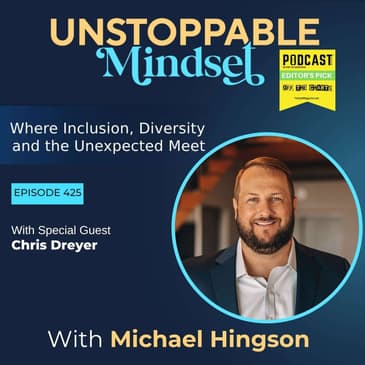
What if the real secret to business growth is not creativity but competition?
I sat down with Chris Dreyer, founder of Rankings.io, who built one of the fastest-growing legal marketing companies by mastering SEO, niche focus, and relentless execution. Chris shares how his early work ethic shaped his path, why he chose the highly competitive personal injury space, and how treating business like a math-based game helped him scale. You will hear how content, reviews, and authority drive Google rankings, why most lawyers misunderstand marketing, and how narrowing your focus can actually expand your results. I believe you will find this useful as Chris shows how discipline, data, and consistency can turn any business into an unstoppable force.
Highlights:
00:56 – How early work and family habits built a strong work ethic05:00 – Why taking the hardest job created resilience and grit12:12 – How serving people helped develop communication and confidence24:22 – Why choosing a competitive niche leads to greater success37:08 – What it takes to rank at the top of Google consistently51:16 – How doing free work early builds skill and long-term growth
Bottom of Form
About the Guest:
Chris Dreyer is the CEO and Founder of Rankings.io, the category-defining SEO agency built exclusively to help elite law firms and personal injury lawyers dominate Google’s organic search results. Under his leadership, Rankings.io has become synonymous with measurable results, helping attorneys secure life-changing cases through visibility at the exact moment potential clients are searching for help. The company has achieved what few in the legal marketing space ever have, earning a spot on the Inc. 5000 list of fastest-growing private companies for eight consecutive years, proof of both sustained growth and relentless execution.
Beyond Rankings, Chris is a builder of platforms and a voice of authority in legal marketing and entrepreneurship. He is the Wall Street Journal and USA Today best-selling author of Niching Up: The Narrower the Market, the Bigger the Prize, where he details how focus creates outsized impact. He is also a seasoned real estate investor and the host of the Personal Injury Mastermind podcast, where he interviews top attorneys and business leaders shaping the future of law. His influence extends across respected councils and networks, including the Forbes Agency Council, Rolling Stone Culture Council, Business Journals Leadership Trust, Fast Company Executive Board, and Newsweek Expert Forum, cementing his reputation as both a practitioner and thought leader.
Chris’s path to entrepreneurship has been unconventional yet relentlessly instructive. Once a world-ranked collectible card game competitor, he carried that same strategic mindset into business. After earning a History Education degree, his first professional role was as a detention room supervisor, hardly glamorous, but it provided the unstructured time that sparked his obsession with digital marketing. He began experimenting with affiliate sites and, at his peak, managed more than 100 properties simultaneously. This side hustle soon eclipsed his day job, propelling him into full-time entrepreneurship. When affiliate marketing’s golden age waned, Chris pivoted into legal SEO and quickly carved out a niche. Along the way, he also became a top-ranked online poker player, honing skills in risk management and probability that would serve him well in scaling his companies.
Today, Chris runs Rankings.io with the same competitive fire he once brought to cards and poker, driven to outthink, outwork, and outlast the competition. His mission is simple: help the best personal injury law firms win more cases, build enduring legacies, and dominate their markets.
Ways to connect with Chris**:**
website: rankings.io
https://www.linkedin.com/in/chrisdreyerco/
https://www.facebook.com/chrisdreyerco
https://www.instagram.com/chrisdreyerco/
About the Host:
Michael Hingson is a New York Times best-selling author, international lecturer, and Chief Vision Officer for accessiBe. Michael, blind since birth, survived the 9/11 attacks with the help of his guide dog Roselle. This story is the subject of his best-selling book, Thunder Dog.
Michael gives over 100 presentations around the world each year speaking to influential groups such as Exxon Mobile, AT\&T, Federal Express, Scripps College, Rutgers University, Children’s Hospital, and the American Red Cross just to name a few. He is Ambassador for the National Braille Literacy Campaign for the National Federation of the Blind and also serves as Ambassador for the American Humane Association’s 2012 Hero Dog Awards.
https://www.facebook.com/michael.hingson.author.speaker/
https://www.youtube.com/user/mhingson
https://www.linkedin.com/in/michaelhingson/
accessiBe Links
https://www.youtube.com/c/accessiBe
https://www.linkedin.com/company/accessibe/mycompany/
https://www.facebook.com/accessibe/
Thanks for listening!
Thanks so much for listening to our podcast! If you enjoyed this episode and think that others could benefit from listening, please share it using the social media buttons on this page. Do you have some feedback or questions about this episode? Leave a comment in the section below!
Subscribe to the podcast
If you would like to get automatic updates of new podcast episodes, you can subscribe to the podcast on Apple Podcasts or Stitcher. You can subscribe in your favorite podcast app. You can also support our podcast through our tip jar https://tips.pinecast.com/jar/unstoppable-mindset .
Leave us an Apple Podcasts review
Ratings and reviews from our listeners are extremely valuable to us and greatly appreciated. They help our podcast rank higher on Apple Podcasts, which exposes our show to more awesome listeners like you. If you have a minute, please leave an honest review on Apple Podcasts.
Transcription Notes:
Michael Hingson 00:04
What if the biggest thing holding you back isn't what's in front of you, but rather what you believe Welcome to unstoppable mindset where inclusion, diversity and the unexpected meet. I'm your host. Michael Hingson, speaker, author and advocate for inclusion and possibilities. This podcast explores how the beliefs we carry shape the way we live, lead and connect with others. Each week, I talk with people who challenge assumptions, face adversity head on and show what's possible when we choose curiosity over fear, together, we focus on mindset resilience and the small shifts that lead to meaningful change. Let's get started. Hi everyone, and welcome to another edition of unstoppable mindset. Today, our guest is Chris Dreyer. Chris, Chris has formed a company called rankings.ai. And I'm going to let him describe what all that is about. And he's done some pretty interesting things with it. It has been on inks top 5000 companies, growing companies for the past eight years. Eight years is a long time, which is pretty cool. So I'm sure he's got lots of adventures and lots of stories to talk about. So Chris, welcome to unstoppable mindset. We're glad you're
Chris Dreyer 01:35
here. Yeah, thanks for having me, Michael. I'm excited to chat.
Michael Hingson 01:39
Well, let's start with kind of the early Chris growing up and all that, and see where we go from there. It sounds
Chris Dreyer 01:45
good to me. So yeah,
Michael Hingson 01:46
let's go. Why don't you tell us a little bit about Yeah, school and all that stuff.
Chris Dreyer 01:51
Okay, yeah, let me, let me, and then you just cut me off at any point, because I can be a long
Michael Hingson 01:55
talker the so can I? I
Chris Dreyer 01:56
know what you mean. I, I grew up in a very small city, elkville, Illinois, my high school had 100 people in it. I was a graduating class of 28 I grew up, I would say it's kind of weird. My mom and dad, if they heard me say poor, would not love me saying poor, but I we weren't. We were certainly at the bottom of middle class or the upper or poor. I had a lot of chores. I every single weekend, I cleaned a law office with my mom or did something at the farmers market. So and at the time, it wasn't work. It was just what we did as a family, right? I didn't even understand it. We had, we didn't have city water. We had to get a truck and bring in our water, and we had well water, right? And in my family, and that was, that was early on, right? My dad was a milk carrier. My mom was a cook and and ultimately, they did better over the years and made more money. But it started off, it was a lot, a lot of grit, perseverance, working hard. And I like to share that, because my parents work ethic is very strong, very dependable, very consistent. And that's kind of where I got my drive. But that's, that's kind of how I grew up, small, small town, you know, a lot of side hustles with the parents. And once I went to college, I got that, that shock of, oh, here's a whole bunch of go from 100 to, you know, 20,000 Yeah, it's a bit of a shock there.
Where'd you go to college?
Chris Dreyer 03:36
Yeah, I went to SIU, Southern Illinois University. There in Carbondale, Illinois. I actually live in Carbondale today. And, you know, I went to college. I was always had that entrepreneurial bug, and, but I went to college, it was kind of to make mom and dad happy to get that degree and, but I just knew that I was going to own my own business. And I kind of had that conversation with them out of the gate, but so I was a terrible student. Partied a lot, you know, chase the women, so to speak, and but somehow, ended up with a degree, got a job at a high school as their JV basketball coach, and I started doing internet marketing on the side to make a little extra money because I had some downtime. And by the end of my second year teaching, I was making about four times the amount doing that that I was teaching. So that was kind of my sign, and to go pursue that full time, and that's what I did. That's when I left to do affiliate marketing and digital marketing full time was after
Michael Hingson 04:41
that second year, of course. Now the real question is, you were chasing the women? Did any of them
chase you? Oh yeah, oh yeah. Just
Michael Hingson 04:49
want to make sure it's reciprocal here. Yeah, that's that's pretty cool, though. And I was going to ask you, and you sort of answered it, about your workout. Ethic and so on. I find that if people do grow up in an environment where they're working and they appreciate what they do get and the amount of work that they do, and they develop a strong work ethic, or their parents have it, they generally do as well, although sometimes there's some rebellions, but still, ultimately, the right stuff shows through.
Chris Dreyer 05:24
Can I tell just a brief story about that? My mom, when I turned 16, it was like, you're getting a job, son, right? And it was not, we had, we were fine without, but it was like, so she took me to this place. It was called Ken's antiques, and they used to do the semi truck deliveries of aluminum, and I used to go to auctions and unload furniture. And I asked her, I was like, Why did you take me there? Well, you know, why didn't you take me to the mall? Why didn't you know to go work at a the buckle or the gap or something, you know, why did you take me? There she goes. Well, I knew if you could, if you could succeed here, you'd be fine anywhere, because it was the hardest job that I could think of. And I was like, Oh, really, thanks, Mom. Like, send me to the to the hardest job that you could think of and see if I could thrive. And I did well there. But that just kind of goes to show you the mindset that my mom had racing me, which also kind of, you know, attached to me as well.
Michael Hingson 06:26
Yeah, well, and I can appreciate course, now looking back on it, of course, but I can appreciate what she said, because if you can survive in one place, and you can if it's if it is a tough job and you approach it the right way, then you'll probably be good anywhere, and there you go.
Chris Dreyer 06:47
Yep, yep, to her credit, it was a very tough job. It is as still to this day, the hardest job from a physically demanding perspective that I had, but, but yeah, and it was good. It built resilience, you know, kind of helped me get that that put that true grit on and yeah, so that's kind of my background.
Michael Hingson 07:08
I never did really work at a job growing up, my brother did. He worked at a restaurant and so on and bus tables and did other things. But I remember, when he got his first job, he went and applied at a at a restaurant, and the owner or manager, I guess probably both said, so, you know, we'll, we'll consider you. Would you do us a favor? There's some weeds out in the in the front, would you go pull those? And he said, within about a half hour, he got the whole place completely cleaned up of weeds. And the boss came out and said, You did all of that. And my brother said, Yeah. And guy said, You're hired. You know, amazing, you know, because my brother didn't even realize, I think at first, that that was really a test, but it was, and of course, he passed, which was cool. That's a great story, but I never got really to do much work. I kind of was more the intellectual guy in the family, and finding jobs would have been a little bit more of a challenge for me. I did do some babysitting, but that was about all I could do. I've been blind my whole life, and a lot of the jobs that were available in Palmdale, where I grew up in Southern California, were not jobs I was going to realistically be able to do anyway, but I could babysit, and that worked out pretty well. Yeah, yeah. So I mainly studied,
Chris Dreyer 08:41
love it. So So studied. Can I? Can I do the reverse interview? What's some of your your top motivational books, business books? Because I'm sure you've got some that just pop top of the dome. Well, sort of, kind
Michael Hingson 08:55
of, I really have a slightly different idea about that, but I'll tell you, I've read a number of the main books in the whole motivational and and management world. One Minute Manager is a book I appreciate a great deal. And I also like Dale Carnegie books like How to Win Friends and Influence People. But for me, I point out, and even to this day point out that I've learned more about teamwork and trust and leadership from working with eight Guide Dogs for the last 61 years than I ever learned from all the management and leadership books and everything else that's out there, mainly because working with dogs, you have several things that are An issue, first of all, respecting them and the job that they do, knowing that you're really forming a team with a guide dog, where each member of the team has a job to do. So in my case, the dog, and the case of people who use guide dogs, the purpose of the dog is to make sure that we walk safely as. We're walking somewhere, but my job is to know where to go and how to get there, and then I have to learn how to communicate that to the dog, and also be the leader of the pack in the truest sense of the word, which also means that if the dog is upset, or there is any kind of an issue with the dog, I have to figure out what that is, and I have to read what is going on so that I understand that and can then figure out what is occurring and make sure that the dog stays happy so it's you. There's so much to learn about trust, and one of the main things I've learned over the years is while dogs do, I think love unconditionally, unless they're just so badly traumatized by somebody for some reason they don't trust unconditionally. But the difference between dogs and people is that dogs are open to trust a whole lot more than we are. We have just had so many things go on. We read we bought them in the newspapers, we see it on the news and so on. Nobody trusts anyone. The feeling is basically everyone has their own hidden agenda, and so you can't trust anyone. And so there's very little communications today. There's very little real interaction. And people, by definition, don't trust. Dogs are open to trust, and you can earn their trust, and likewise, they get to and can earn your trust, and it is a it is a combination and kind of thing. So what I really learn when I go to get a new guide dog every time is I'm learning how to form a team with this other dog who doesn't speak the same language I do, who doesn't think the way I do. But I have to figure out what this dog does, what this dog is all about, and I'm the one that has to become the leader of the of the team and make things work. So I think that working with a dog is a lot more of a practical experience kind of thing than just reading about whatever there is to read about in books and so on. So that's why I say that. I think I've learned a lot more by working with dogs than I ever got from all the management books in the world, any of the Tony Robbins books, or any
Chris Dreyer 12:07
of those. I love, every bit of that I just I was on x the other day, and it was talking about the the new CEO for Starbucks, right? Because the former CEO was McKinsey trained, right, but didn't have any actual experience at the helm. And then they brought back the former CEO of Taco Bell over to Starbucks, and the stock immediately shot up because of the application aspect of it. He had, he had done the job and been in the grind. So it's kind of interesting, kind of corollary there. But yeah, thank you for sharing. I was really intrigued, and I had to jump in and and ask,
Michael Hingson 12:45
Oh, fair question, and then this is a conversation, so nothing wrong with asking questions on either side. So it's perfectly fine to to be able to do that well, so what did you do right out of college?
Chris Dreyer 12:59
Right out of college, the one thing I'll tell you that I still to this day, I call myself an introvert. I don't think that, you know, introvert, extrovert. I think we have the tendencies at all times to be either one, right? But I think for me, I was more shy, but I built a lot of friends because I played sports and I knew them in college, and then they met, they introduced me to their friends. Because you got to imagine, when I had a class of 28 kids, it's like super small community versus, you know, everybody I'm interacting through their connections and their extended connections. So through college, I'd say the main education thing I got was, I did get a job waiting tables for three years, and so I got a lot of client service training, dealing with people having a ton of conversations through that, through my through my job, and also through my personal relationships with my friends and and other, you know, Students at the University, but so I think that kind of helped, helped me succeed afterwards, but afterwards, really, when I student taught at Heron, they saw my work ethic. They saw a shoe up, that I showed up, that I listened and I took action. So they, they hired me immediately, and I did the same when I was a JV basketball coach. I never missed a practice. Was always on time. Really tried to develop the kids and bring the most out of them, treated the parents well, and so I think that's what I did well, and it kind of put me in the position to have time to learn internet marketing. So I think that's kind of how it all started,
Michael Hingson 14:47
when I was getting my teaching credential at UC Irvine, and I also got my master's degree in physics from there. But I student taught at the local high school, at University High School, and I student. Taught two classes. One was a physics class, and it was kind of for they called it dumbbell physics, but you know, it was kids who were sort of interested in science, but really didn't know where they wanted to go. But the other class was algebra one, and I remember one day I was teaching, and one of the students asked a question, and I didn't know the answer to it, and I probably should have, but I didn't. But what I said was, I don't know the answer right off, tell you, what do you mind if I look at it tonight, get you the answer and bring it back tomorrow. And the kid who was an eighth grader, actually accelerated, so it was high school algebra one, but he was from the eighth grade. He said, Sure, so I went home and found the answer in the book, when I should have known that, but anyway, came back in the next day, and even before I could say anything, he said, Mr. Hingson, I went home and got the answer, and I said, Well, come up and write it on the board. And one of the things that I did with with all of my classes when, of course, we had blackboards and all that, back in those days, I would want a student to come up and be the board writer, because they write a lot better than I do. And so we, we had pretty good competitions of people who wanted to write on the board. They all thought it was kind of fun, and I did spread that wealth around, but Marty came up and I said, now you got to explain what you're writing. And he had actually found the answer, which was cool, but my master teacher was also the football coach, and when I first told Marty and the rest of the class, I don't know the answer, but I will get it after class was over, Mr. Redmond said you did something that's absolutely amazing and was absolutely the right thing to do, and most people wouldn't do it. And that was you admitted you didn't know the answer, but you would go get it rather than trying to blow smoke, because these kids can see through that in a second. And he said, So you did the right thing, and I've always felt that's the way to do it. If I don't know the answer, I'll go figure it out, but I will also tell you that I don't know the answer, and you can decide whether that's a good thing or a bad thing, but I think it's a good thing, to be honest,
Chris Dreyer 17:22
I couldn't agree more.
Michael Hingson 17:25
And so it was fun. And and what the the other part of the story, and I think I've told it a couple times on the podcast, is 10 years later, I was at the Orange County Fairgrounds, and this kid comes up to me, Well, he was, he didn't sound like a kid anymore. And he said, Mr. Hingson, do you know who this is? Deep voice. And I went, No, not right off. And he said, I'm Marty. I'm the guy that was in your algebra class 10 years ago. Nice to be remembered, but, but he he also just remembered what happened. And I think he even said it was so cool that I was honest with him about it, which was, you know, a life lesson anybody should learn.
Chris Dreyer 18:09
That's incredible. That's incredible. So
Michael Hingson 18:10
it was a lot of fun. Well, so you student taught and so on, but eventually you ended up deciding to go into the entrepreneur world. But you also were a card collector, right? A game collector, yeah.
Chris Dreyer 18:25
And in high school, I played this collectible card game. I played a combination of two. I mean, most people are familiar with Magic, The Gathering, but I also played this other game called Legend of five rings. And both, you know, the collectible card games, but they're really math based games based upon advantage and and, you know, you so now it's applicable to today. I can look at any whether it's Pokemon or whatever card game there is. It's, it was very, you know, it's force based, you know, benefits to attack and things like that. It attributes everything. But anyways, I played it competitively, and I was a top I was a world ranked player at one time. I won four state championships or CO days. No one had done that at the time in a two consecutive years, and it was just a top player, and when you get to the top, you become friends with the other top players, and then you talk strategy and and that even takes you to an even higher level. And so I did that, you know, for many years, competed all over the country. It was a great experience. And so, yeah, that in my house. My dad very so he had, he was a civil engineer. He has an engineer degree, but he was traveling. He was on the railroad at all times, and he wanted to stop traveling, so he accepted this job as a mail carrier so he could stay put. And. Yeah, and that's what he did. He retired as a mail carrier, but, you know, a top math expert to the to the point where there would be conversations where you could, like, I couldn't understand him, right? He couldn't understand himself, right? And, and, and there's many conversations in different aspects of this. But when we played games, whether it was Yahtzee or monopoly or whatever, every game, there was a math based lesson to it, like, which dice you rolled for advantage at Yahtzee, which ones to hold after the first roll. Poker games, pitch games, Rummy, every single game it was, it was game theory. It was math on what was the precise the best role, like Monopoly, the best properties and the probability to get an orange property over other properties and and how much you should spend at certain points of the game. And I realized saying that outline that's that that's not normal. Some people just play yatse and roll the dice and they roll what they want, and some people play Monopoly and just buy the properties they want. That was not how games were played in my household, and it was very applicable to poker and to the collectible card games.
Michael Hingson 21:22
Yeah. So how often did you want to buy Boardwalk and Park Place?
Chris Dreyer 21:28
Not often. But I mean, so there. That was just how I was brought up. And yeah, and it turned into a lot of what I do today.
Michael Hingson 21:42
Actually, I always like free parking. We had a thing where any money and and any kind of thing that you had to pay on all went into the free parking pot. So getting free parking was always fun. Oh yeah, but yeah, I hear what you're saying. I love monopoly and love to even play it against the computer, which was always a kind of a neat thing to do, but played Monopoly against other members of my family. Some we actually made a Well, we took a regular Monopoly board, and I think my father outlined the entire board and all the squares using elmer's glue so that we had raised lines for me to look at. Then we also did things to mark the paper money so I could tell what bills I had and and so on, and even Braille the cards. And I still have that game to this day, very neat, which is kind of cool, but monopoly spun.
Chris Dreyer 22:36
Yeah, there's a lot of games that you know, there's no winner. You take my wife wants to play Scrabble all the time, and I'm like, there's just not a winner in Scrabble. Because if I challenge you on a word, and I'm right, you're wrong. You're mad if I beat you, you know, and then if I lose, it's not fulfilling for me. That's one of those games. There's no winner.
Michael Hingson 23:02
I have a friend who plays Scrabble with his mother all the time, and and he, I think he loses more than he wins, but he's always proud when he beats her. And he's almost 60, so you know, she's, she's older than he is, but they, they play and have a lot of fun with Scrabble.
Chris Dreyer 23:21
That's incredible. That's
Michael Hingson 23:22
great. Yeah, it is kind of cool. But anyway, so you eventually decided to go off and go into the entrepreneurial world, and you started your company, or went well, when did you actually start the company?
Chris Dreyer 23:37
Started the company officially in 2013 it was attorney rankings.org, that was the original name. Now it's rankings.io, I worked at a few agencies previously, while I was also doing the affiliate marketing, and kind of got to see the agency world of providing, you know, the professional services space. And after working at a few agencies. Thought that I could do it right. I got the confidence from the competence, and that's when I launched it. 2013 we've always been focused on legal. The difference today is primarily, we're focused on a sub niche of legal for personal injury law. And, you know, we work with other practice areas, criminal defense, family law, etc. But really personal injury is the is 85% of our business.
Michael Hingson 24:27
So what is it that rankings.io? Does,
Chris Dreyer 24:31
yeah, we do digital marketing. We do search engine optimization now, AI search, we do pay per click paid social web design. A lot of performance marketing, I would say more performance, less creative and branding. And that's what we do. We work with the top, the biggest pi firms, personal injury law firms in the country. We're in chiefs, I think every state we work with about. 250 law firms across the country.
Michael Hingson 25:03
What made you decide to focus on law in the beginning?
Chris Dreyer 25:09
Yeah, I'll say a few reasons. One, I had an experience working with attorneys, and I liked working with them. So there was the like component when I worked at an agency, I had a few firms that would I spoke with, and I enjoyed it. The second thing was, if I'm being honest, the status like I wanted to tell my parents that I did marketing for lawyers, and not just, you know, any industry. And then the other thing is, is I'm very, very, very competitive, and I kept seeing and hearing these reports about more and more attorneys going to law school and and just all this competition for legal and the thing that I differ you hear a lot of coaches and mentors. They'll say, hey, go to the blue ocean. You know, everyone's read the blue ocean book, or, you know, Peter thiel's zero to one, and everyone thinks so, go where there's no competition. And I'm like, That's fine if you're Elon or Peter Thiel or Zuckerberg creating something new, but if you're going into an existing category, you want to go where there is competition, because it demands expertise, and that's the way that I've looked at it. Like, you take the agency perspective, I don't want to go to, you know, lawn care, SEO like, do they really want to do search engine optimization? Do they really have a ton of competition? Maybe that's not a great example. But you get my point where, if you go into the city, there's a ton of personal injury law firms, but there's only a few that can rank at the top. And there's, they're all trying to gather cases from one another, so they want an expert to help them, you know, get that visibility. And that's, that's the mindset that
Michael Hingson 26:58
went into it. What strikes me is interesting, though, is that with all of that, you bring a very competitive level to what you do. And I'm not sure that I find that a lot of people necessarily even do that, so you consider even search engine optimization to be a very competitive thing, I don't want to say sport, but you consider it all about competition, and you want to really bring the best and the most significant aspects of it to what you do. And that clearly has to show up when you're talking about Inc ranking you in the top companies for eight years in a row.
Chris Dreyer 27:47
Yeah, it's very status orientation. You know, that's why I like working with trial attorneys. There's a winner and loser in court, and there's only one top position in Google or on these llms, and it's, who's gonna win, who's the best? Yeah, and it's right there for everyone. Here's here's the tally. Everyone can see who's the best. And I've always loved that. I think I heard a podcast recently by John Morgan. He's the founder of Morgan, Morgan, right? Of course. And you know, he's always a character and funny to listen to, but, yeah, he talks about being insatiable. Like, how did you grow this? He's like, Well, I'm insatiable. I I want to continue to grow. And for me, it's, it's the exact same thing. It's like, I'm insatiable. We hit a milestone. I want the next milestone. It is the game that I'm playing. I am playing like my hobby is my business. I enjoy it. I look forward to a Monday. It rewards me mentally. I enjoy the people I work with. And that's that's how we're at you know, Inc, 5008 years in a row, we'll definitely be on the ninth year next year, due to our growth this year. And it's that's just, that's just how I treat it. It's just a big game. And, you know, like any game, you play Sim City, whatever, you get a little bit more money, you get a little bit more buildings, right? You do a little bit better, you hire more talent, you expand your capabilities, and you just, if you don't stop, you're going to
Michael Hingson 29:22
continue to grow. But it's a game in the mathematical sense, and it's it's a game in the the productive sense of what you're trying to do is, isn't the game just, although you obviously have to have fun in what you do, otherwise you wouldn't enjoy doing it. But it's a game in the mathematical sense of the word, oh, 100%
Chris Dreyer 29:44
and so many people don't understand what I'm about to say. But like, every move that you make is a move based upon leverage in some capacity, yeah, and you take, because our time is all limited. You take. I'll give you some examples, like from a from a distribution perspective, hosting my podcast or being on your podcast is going to have more listeners than if I go speak on stage, if I go speak on stage now that that has its own benefits of authority and and different you know, belly to belly relationships from a trust perspective, but from a distribution perspective, I would be better off doing more podcasts than I would speaking on stage, sure. So there's an advantage there, right? And then there's also advantages through pricing arbitrage, and it's if, if I hire labor and talent in in the Midwest, and I pay them above average fees and salaries, and I pay my employees well, but compare that to New York or California. And I think some people, you know, these are things that they don't talk about, but when you start to look at leverage closely, it's everywhere. Capital, economies of scale, if I you know, there's leverage based upon my my buying power in certain areas, and that's what I look for. It's an interesting way to make decisions. Is based upon that leverage component.
Michael Hingson 31:20
Do you think that that works in other kinds of arenas, other than just what you do?
Chris Dreyer 31:27
Oh, I won 1,000% yes, yeah. It works in you could see it. You know, the closest would be, closest arena would be sports. There's so many, whether it's the salary caps or the talent of one person's labor based, you know, what they can do from a utilization or capacity versus another one's people talk about it on the business side of like, you know, You have one software programmer is worth, potentially 1,000x another one just because of that individual's capabilities. So it's literally everywhere, and it's also dissecting different scenarios into fractional leverage. So I'll take give you a different way of thinking about this. Is like, you take a an SEO specialist, a top tier SEO specialist might be 100 200 grand, right, technician, right? But you you break down their capabilities into the smaller parts. You know someone that just writes, someone that just does the title tags and the website, and someone that just does the links and that, like you can assemble, that individuals that that superstars talent through the FRAC breaking it down from a fractional perspective. It's just a big game of puzzles and how you get there and you look at like what your competitors are doing and how you can, I wouldn't say, exploit in a negative way, but, but what I mean is how you can take advantage in a positive way to to help your business succeed, right?
Michael Hingson 33:15
Well, do you so if, if you're playing a game like football, of course, everybody, every team, wants to crush the other team, and it's all about winning and beating the heck out of the other guy. Is that really the way you view it, in terms of the game, as you play it, and do you enjoy being able to just crush the competition? Or is it a different mindset than that?
Chris Dreyer 33:42
That's a really good question, because I am an abundance mindset. I don't think everything is a zero sum game. It's, I'll tell you something super nerdy. I was talking to my chief of staff the other day that he's we're big gamers, big nerds. And he, we were talking about Warhammer 40k and the dwarves in that game have a book of grudges. So anybody that that goes against the dwarves, they they're listed in the book of grudges, right? Yeah. And it's like all the dwarves are trying to, you know, right? This wrong. And I kind of look like that. I'm like, treat people respect like, you know, abundance zero, you know, like, abundance mentality. Do the referral thing until it's like, okay, you've done X, Y and Z, and I could give you examples of x, y, z, and it's like, okay, well, you're not my friend. You're not my ally, so now you are a true competitor by all since you know, by all definitions, right? That's how I've treated it.
Michael Hingson 34:48
And so it isn't the joy of just beating everybody in sight. No, which is different, which is cool, because certainly. I would, I would also bet, though, that you have people who are competitors, but they're not unfriendly, so you can absolutely, yeah, you can develop
Chris Dreyer 35:10
working relationships. Rattle off, and we have great conversations. We're friends, and people are surprised when they see us, and we're friendly, and it's like, no, it's like, we have families, we have life. We want to do good work. We want to and it's so you can absolutely have that too. Yeah.
Michael Hingson 35:27
Why did you decide to specifically choose personal injury
Chris Dreyer 35:33
for me? And it's this is turning into the math conversation. But really, I looked at our revenue, and it was like over 70% of our revenue. Was from less than 50% of our clientele. And it was a clear directional signal to pursue this area. And that's it was the math like, these are our best clients. They pay the most, they stay the longest we could do the best work. Also the PI space is the Super Bowl. Is the major leagues. In the legal arena, it's, it's very difficult to rank. There's a lot of competition versus, you know, I get a family law attorney. I don't care what market you're in, Los Angeles, it's like a sneeze to get them the number one or two? Yeah, it's and I like that. I like the competition. I like having to work at it and be creative and think about different things to try to obtain that top position.
Michael Hingson 36:33
Yeah, well, so I would, I would presume that John Morgan's happy with you.
Chris Dreyer 36:40
I, you know, I had Dan Morgan as a keynote for my 2024 conference, his son. And I haven't personally talked to John. I think he's well, he says he's retired, but he's not really retired, yeah, right. The I couldn't work with Morgan and Morgan, I can have a great relationship with them, but I can't work with them because they're in every market, and my I would, they would be my only client, so that's why, but certainly have a great relationship. I've got a text relationship with Dan, but yeah, they, I think they do everything in house.
Michael Hingson 37:20
Anyways, you don't want to be the consularity for Morgan and Morgan, in other words,
Chris Dreyer 37:25
your only client, right, right? That would put a lot of risk on the old client concentration problem,
Michael Hingson 37:33
and it would, but still. So what does it mean for a law firm to dominate Google's organic search. And I guess the other question is, why is that the legal battleground that personal injury lawyers can't really ignore?
Chris Dreyer 37:53
There's, there's so much here. Okay, where do I go? That's a lot of take. You take any channel, broadcast television has been the main vehicle for channel for distribution. It's the lowest CPMs cost per 1000. The distribution is very wide, because an individual doesn't know typically, when they're going to be in an accident, right? So you got to have a lot of reach and touch a lot of individuals. There's also radio and billboards. But typically, even if they watch you on television or hear you on the radio or what have you, they still convert. They go to Google to make that conversion that go to the website. Typically, it's not always and and things are changing due to these llms and the native experiences on platform. But even today, it's still the final destination before they contact a firm. So it's really important that you show up at the top of Google to capture all of those opportunities that you've advertised for in other mediums.
Michael Hingson 39:09
How do you do that?
Chris Dreyer 39:12
Well, so you know, I'll say, I'll try to simplify for the audience. Let's just keep it really, think of like a Venn diagram of, you know, the three circles overlaying and you've got the middle. You have to do all three. The first one is you have to have excellent content. You have to have, you know, if you're an auto accident attorney, you have to have content about auto accidents. You have to have, you know, you have to have content that targets phrases and words that consumers will search for, right? It starts with the content. It has to be thematically and topically relevant. Has to be excellent content. The second component would be related to. Views. You got to get Google reviews to show up on in the LSA, the local services ads location, you have to get reviews to show up in Google Map Pack. You need reviews now on Yelp to show up on and be discovered on these different llms, particularly a chat GPT. And just due to how okay for the SEO nerds listening, let me explain, because typically when you get reviews on Yelp and when you get reviews or recommendations on Facebook, they aggregate that information to other sites, which is then the listicles that form the basis of discovery for these llms. So you got to have a review background. So content reviews and then links. Google, the way that they differentiated, again, way against lo AOL was they use links as a categorization method. So if you're trying to win an election, you want to get as many votes as possible. If you're trying to win the first page of Google, you want to get as many high quality links as possible. High quality being authoritative, relevant, trustworthy, you know, sites that get a lot of traffic, so you need great content, lot of reviews and links. That is the very 8020, high end summer summary of of how to rank in Google search and on the llms, yeah.
Michael Hingson 41:24
Well, and how does LinkedIn fit into what you do?
Chris Dreyer 41:29
LinkedIn is a bit different. I you know LinkedIn more B to B platform. I think if you're a business attorney or a B to B firm, it's an excellent channel. I use it from a distribution perspective. I get a lot of reach. I get a lot of followers on there. A lot of attorneys congregate on there. And it's a great, you know, channel for recruiting talent, and it's cited frequently if you have some type of reputation perspective that you want to control around your name. LinkedIn typically ranks in one of the top three positions for your name if you have your profile set up properly. So yeah, it's, it's, it's got great distribution from a leverage perspective, and, you know, has other applications as well.
Michael Hingson 42:15
If you were starting a law firm today, or you were advising someone who's starting a law firm, how would you deal with and start their marketing efforts? How would you organize marketing for them?
Chris Dreyer 42:28
Yeah, in the beginning I would, I would do almost all performance marketing. I would not do. I would do very little with brands, because you need to get on your your cash acceleration cycle is very poor. From a PI perspective. I'm always thinking from an injury law firm perspective, because, you know, if you get an auto accident case by the time they get treatment and go through the whole process, you know, it could be 12 to 18 months before you get paid. So you know, I would think about performance marketing, Facebook ads, Google ads, LSA, SEO, a lot of the ads platforms that are, you know, very performance driven. That would be the majority of my investment. Facebook ads. So in a vacuum, you know, different markets are, there's different channels that are more effective. But in a vacuum, I would say today, right now, Facebook ads would be the best platform, the best channel for that,
Michael Hingson 43:29
because so many, because it has such a high volume of viewers, or what
Chris Dreyer 43:34
they're well, it's just the cost per lead. The amount that you pay on that platform to reach your target prospect is going to be cheaper than say, you go to Google ads and you're paying $600 a click for a phrase, or, you know, it's just now, there's, again, this is in a vacuum. There's very effective Google Ad strategies you can get, you know, creative with performance, Max campaigns and and different strategies. But I would say just in general, Facebook ads out of the gate would be one that I would start with, and I would start the SEO early, just because it takes time to develop.
Michael Hingson 44:14
Yeah, well, that makes sense, and it does take a long time, and I think a lot of people don't necessarily understand how all of that works, but it's still something that they should, should deal with
Chris Dreyer 44:28
1,000% and, you know, it's, it's a game of, it's a long game, but it, you know, even SEO can be on a shorter time horizon, if, if You're, like, if you target Car Accident Lawyer in that phrase and that segment, then sure, yeah, 12 to 18 months is, you know, you know, even two years before you start to get some visibility. But you target dog bites, you target, you know, some other case types that aren't as competitive like you can get traction sooner.
Michael Hingson 45:00
Hmm, well, and that kind of brings up the question you You talk a lot about, and you wrote a book about niche. Why is it that going into like a smaller niche can yield sort of a greater opportunity, or by narrowing focus, you're creating bigger opportunities? Why is that? So?
Chris Dreyer 45:22
What comes top of mind? Some of the biggest, the most important reason is it all centers around this word focus. When you focus in a single area, you become better. Well, because you were better, you can you can at your you can charge more because you're worth it. The other thing is, is when you focus on a single area, you you can create, create repeatable processes, and everything is not bespoke when it comes in. So you can set up your internal productization of a certain area. You it makes training easier by immersion. So there's a lot of benefits, even even the perception aspect of it, right? So when you think of like, who's better, a generalist versus a brain surgeon, you think a brain surgeon is a specialist. And you think, Well, who do you think, just offhand, whose fees would be higher? Well, you think the brain surgeon would would charge higher fees. And so from a perception perspective, and when you're thinking about trust, the that's the other one, right? You would think from a trust perspective, they would be more qualified because they're in this certain area. So, and when we're trying to convert someone in sales, it's always a conversation based upon trust. So those are some of the main advantages, the one heavy, heavy disadvantage. Disadvantage is Tam, total addressable market. It's you focus on personal injury. You're at 50, 60,000 firms. You focus on all law firms. United States, you're at 400,000 law firms. So there's trade offs for you know, there's pros and cons on both sides well
Michael Hingson 47:03
and and that makes sense, but there is a lot of merit to the to the whole concept of specializing, and you've proven it with what you do, and you continue to be pretty successful about it. And then that makes a lot of sense, but you also do something else that I think is interesting. You've written a book, niching up, you've got a podcast, you have other things that you do, and, of course, just the company itself, but you put all of that together, and all of that not only has to help your brand, but it makes you more visible in the marketplace overall. Don't you think?
Chris Dreyer 47:42
Yeah, it certainly does, and it is our flywheel, right? It's somebody that's on my podcast could be a potential quote in my book, and I have a personal injury lawyer marketing book, right? And there's quotes from the pod. I have now a quarterly magazine that goes out. We could cherry pick a couple episodes, you know, to include in the magazine. We have retreats that are quarterly. They're, they're in person that, because we have a community, they're easier to to fill. We have a yearly event for personal injury law firms called, you know, Pim con. So it's all this, this flywheel that kind of compounds over time due to the community aspect,
Michael Hingson 48:25
but people obviously react well to it, because you continue to be successful.
Chris Dreyer 48:32
Yeah, and I think the biggest thing for me is I am I am not the the expert. I am bringing on the experts in their field, the people that are eating their own dog food, so to speak, right? They're practicing what they preach. It is, I can orchestrate a great conversation because I know the space and can ask very specific questions based upon my knowledge. But I'm bringing on, you know, Dan Morgan's on the pod. I've had, let's see Morris Bart. You know, I've had frank Azar in Colorado. I've had the biggest of the big pi attorneys on sharing what works for them, which, which is very valuable, because it's not, you know, some, you know, a consultant or me or whoever, speaking about like, Oh, this is how you can grow a law firm. It's no this is the owner of a law firm explaining how he or she is growing their law firm right,
Michael Hingson 49:31
and providing that advice for other people, which also helps you gain trust, which is pretty cool. What's the best way for an attorney who wants to stand out to truly build authority in the market?
Chris Dreyer 49:50
Well, if you're if you're b Look, okay, so there's a couple types of firms. If you're a trial attorney and you want to get peer referrals, I would say. See, I would say start a podcast would be one of the best ways, you know, interview your peer, interview other attorneys around the country, talk shop, you know, speak at C les. You know, do the those types of aspects it, you know, a podcast. I'm not saying it's not good for B to C, but it's, it has to be a different type of podcast. So I think, I think B to B, if you're a litigation attorney, a podcast would be great if it's B to C. That's, that's tricky. I think I think probably social media in some capacity, but really it's just sharing your knowledge on a platform and being consistent.
Michael Hingson 50:51
Yeah, consistency counts for a lot, and it is something you can you can show is being relevant in almost any kind of business. I mean, look at McDonald's. One thing you can generally tell about McDonald's is that their quarter pounder is going to taste the same everywhere, and it's going to be the same and, and, and companies and people can learn a lot by seeing a company that truly develops that level of trust,
yeah, couldn't agree more.
Michael Hingson 51:26
And that's pretty important to do, to be able to get someone who is going to earn that trust by vigorously working to earn that trust. And so there's something to be said for that, needless to say, so you've built a very large company. What would you say are some of the pivotal moments that sort of helped shape your trajectory? I know you've talked about some things, but what, what kind of really, are the things that stand out that really helped you create all of that?
Chris Dreyer 52:00
I think in the beginning, I did a lot of free work, and had to prove my work, prove my abilities. I think so many people just want to charge a lot out of the gate. And I think there's when you do things for people, they're more willing to reciprocate. And it from an application perspective, it makes you better. So I did a lot of free work early, a ton of free work. I took a lot of jobs or contracts that maybe not, maybe for certain, that I wouldn't take today, that were just not perfect, but like they were my opportunities that I didn't, you know, let them pass by. I think hiring the right people, having super high standards is incredibly important, people that share your values. In the beginning, I used to, every time I heard a speech or taught speech speaker talk about culture values, I used to kind of roll my eyes and say I just didn't get to get to work, right? But now I know it's more important than ever that they share my values, right? Because they're important to me, and that's how you move forward. And I think the other one, if I had to say, the bigger I get, the more important good data, is to make decisions like, if I just don't have good data, it's very difficult. I'm just guessing and and the better the data, the better decisions well.
Michael Hingson 53:32
So the the other thing that comes to mind when you talked about doing a lot of free work and jobs that you wouldn't necessarily take today, I don't know how much it really entered into your mindset, but think of all the knowledge you gathered by doing that that you might not have ever gotten. Yeah.
Chris Dreyer 53:49
I mean, that's true, and a lot of other people wouldn't have done those jobs, so that's kind of some unique perspectives.
Michael Hingson 53:56
Yeah, I when I hired sales people, one of the first things I always told them was, you're coming into this be a student for at least the first year. Don't hesitate to ask questions of your customers, because they're not if you gain their trust at all. They're not in it to see you fail. They want you to succeed, but they want to be able to trust you. And so there's a lot to be said for being a student, asking questions and learning from that. I agree. I agree, which makes a lot of sense. What's the biggest misconception that lawyers typically have about marketing?
Chris Dreyer 54:33
They underestimate how many dollars and what it takes for someone to actually be memorable or build a brand. I talked to, I heard Alex hermosi talking recently about, you know, no one really knew who Jennifer Lawrence was before the mockingbird movie, and they spent $50 million on advertising for that movie. And then, oh, suddenly, everyone knows who she is. But it took $50 million To do so. I think a lot of times people think they oversaturate a channel when they haven't even scratched the possibilities or the capabilities of a particular channel.
Michael Hingson 55:10
How do you help lawyers break through that misconception? I agree with what you're saying. I hear it a lot, in so many ways, but how do you break through that and get them to understand the value.
Chris Dreyer 55:22
It's a dance, yeah, you know, I try to get them to look at the blended cost to acquire a case, as opposed to, you know, the CAC to LTV ratio, versus trying to pinpoint each individual channel and but it is try to try to solve with data and proof over, you know, guesses, but or promises, but it is always a song and dance.
Michael Hingson 55:52
The data and proof is out there. If people can learn to look for it, it's, it's, the reality is, mostly it's not a guess, but you have to know where to look or learn how to find the data to be able to get the answers that you need to demonstrate that marketing is just as valuable as anything else. I mean, there's so many strong lessons about marketing. We talked about Morgan and Morgan, but think about it, he's out there doing TV commercials all the time, and I'm sure that that's helping his company. He and Ultima continuing to to grow, and now they got the boys all in it. And the reality is they've demonstrated that they understand something about what marketing is all about. I remember back a long time ago when it was taboo for lawyers to even advertise. And then a couple of companies out here started to do it. And finally, people realized there's a lot of value in marketing.
Chris Dreyer 56:50
Absolutely. And Michael, I should have said this in advance. I've got a I got a hard stop, I got a I got a hat, I got a client call here in two minutes.
Michael Hingson 56:59
Well, then let me just ask, is there anything else that you want to add? Or how can people reach out to you if they'd like to do that?
Chris Dreyer 57:06
Well, first of all, I really enjoyed our conversation, so thank you for having me. Yeah, you know, for anybody that has a question or wants to connect with me, the best way to get in touch with me is by email. I'm an inbox zero guy. It's Chris, C, H, R, i s@rankings.io I'm most active on LinkedIn. You'll just do a search for Chris Dreyer, and you'll find me cool.
Michael Hingson 57:29
Well, I want to thank you for being here, and I want to thank all of you for tuning in today, wherever you are, I'd love to hear from you. Love your thoughts on the podcast. Give us an email at Michael h i at accessibe, A, C, C, E, S, S, i, b, e.com, also, you can listen to any of our podcasts. They're all available. And you can find us at Michael hingson.com/podcast and you can see and hear all the episodes that you want from there. Please give us a five star review and great rating wherever you're listening and watching us, we value it a lot. And if you know anyone who you think might be able to be a good guest, love to hear from you. Chris, you as well. If you know anybody else who you think ought to be a guest, I'd love to definitely get your help to bring them on, because we're looking for all the people who want to come on and show that we're all more unstoppable than we think. But again, I want to just thank you for being here today.
Chris Dreyer 58:20
Thank you, Michael. I really enjoyed it.
Michael Hingson 58:26
Thank you for being here with me on unstoppable mindset. I hope today's conversation left you with a fresh perspective, a new insight, or at least something worth thinking about if you're ready to go deeper into the ideas that shape how we see ourselves and others. I have a free gift for you. Head over to Michael hingson.com and download my free ebook, blinded by fear. It explores the invisible beliefs that hold us back and shows you how to reframe them so you can move forward with clarity and confidence. Be sure to subscribe to our podcast, leave a review and share this show with someone who can use a reminder that growth starts with mindset. When people think differently, we all move forward together. Thanks again for listening, keep learning, keep questioning and keep choosing to live with an unstoppable mindset you.