
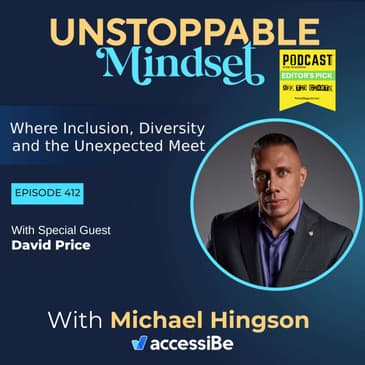
What happens when addiction, loss, and uncertainty collide with discipline, honesty, and trust. In this episode, I sit down with David Price, a visionary CEO who shares his journey from growing up with addicted parents and battling his own drug addiction to building a multi-million-dollar insurance organization in less than a year. David opens up about hitting bottom, finding clarity through recovery, and learning how mindset, patience, and consistency reshaped his life and business. We explore what it really takes to build trust, lead people well, and stay focused when growth feels uncomfortable. This conversation is about resilience, personal responsibility, and why an Unstoppable mindset is built one honest decision at a time.
Highlights:
00:10 – Hear how David Price’s early life with addicted parents shaped his resilience and stress tolerance03:18 – Learn how growing up unstable planted the seed for David’s drive to become a business owner05:01 – Discover the moment David realized addiction was no longer something he could manage alone15:51 – Hear the unexpected reason David walked into a recovery meeting that changed everything24:16 – Learn how small, achievable habits helped David rebuild his life after getting clean37:50 – Understand the hard business lesson David learned after choosing the wrong partner44:34 – Hear how losing six figures of monthly income overnight forced David to rebuild from zero53:49 – Learn why David believes trust is more valuable than money when building an unstoppable business
About the Guest:
David Price – CEO & Founder, The Price Group IMO
David Price is the visionary CEO and Founder of The Price Group IMO, one of the fastest-rising organizations in financial services.
His journey to success was anything but ordinary. Growing up in a broken home and battling drug and alcohol addiction for years, David hit rock bottom more than once. In 2013, he made the life-changing decision to get clean and rebuild his life. That moment of clarity became the foundation for everything that followed, teaching him resilience, grit, and an unshakable drive to create a better future.
In 2018, David discovered the insurance industry. With no prior experience, he earned his license and built a simple, scalable system that allowed everyday people—single moms, career changers, and those just looking for a side income—to succeed. Within 36 months, he became a millionaire, and by his fourth year he was generating more than $1 million annually.
In October 2024, he launched The Price Group IMO, partnering with top carriers and introducing a superior lead program that created even greater opportunities for people to work from home and build real financial freedom. In less than 350 days, the organization produced over $10 million in sales, cementing itself as one of the fastest-growing IMOs in the country.
Today, David’s mission extends far beyond personal success. He is dedicated to helping people reinvent their lives, showing them how to earn an income, work flexibly from home, and build businesses of their own. Many of the agents and agencies he mentors are already on track to reach six and seven figures, proving the power of his model.
Beyond business, David is a member of the Forbes Business Council and an active voice on Instagram, Facebook, LinkedIn, Twitter, and YouTube, where he shares transparent insights, strategies, and motivation for people seeking more freedom, flexibility, and purpose in their careers.
Ways to connect with David**:**
📸 Instagram: instagram.com/davidpriceofficial
🎬 TikTok: tiktok.com/@davidpriceofficial
📘 Facebook: facebook.com/davidpriceofficial
🔗 LinkedIn: linkedin.com/in/davidpriceofficial
▶️ YouTube: youtube.com/@DavidPriceOfficial
🐦 X (Twitter): x.com/IAMDavidPrice
🌍 Website: tpglife.com
About the Host:
Michael Hingson is a New York Times best-selling author, international lecturer, and Chief Vision Officer for accessiBe. Michael, blind since birth, survived the 9/11 attacks with the help of his guide dog Roselle. This story is the subject of his best-selling book, Thunder Dog.
Michael gives over 100 presentations around the world each year speaking to influential groups such as Exxon Mobile, AT\&T, Federal Express, Scripps College, Rutgers University, Children’s Hospital, and the American Red Cross just to name a few. He is Ambassador for the National Braille Literacy Campaign for the National Federation of the Blind and also serves as Ambassador for the American Humane Association’s 2012 Hero Dog Awards.
https://www.facebook.com/michael.hingson.author.speaker/
https://www.youtube.com/user/mhingson
https://www.linkedin.com/in/michaelhingson/
accessiBe Links
https://www.youtube.com/c/accessiBe
https://www.linkedin.com/company/accessibe/mycompany/
https://www.facebook.com/accessibe/
Thanks for listening!
Thanks so much for listening to our podcast! If you enjoyed this episode and think that others could benefit from listening, please share it using the social media buttons on this page. Do you have some feedback or questions about this episode? Leave a comment in the section below!
Subscribe to the podcast
If you would like to get automatic updates of new podcast episodes, you can subscribe to the podcast on Apple Podcasts or Stitcher. You can subscribe in your favorite podcast app. You can also support our podcast through our tip jar https://tips.pinecast.com/jar/unstoppable-mindset .
Leave us an Apple Podcasts review
Ratings and reviews from our listeners are extremely valuable to us and greatly appreciated. They help our podcast rank higher on Apple Podcasts, which exposes our show to more awesome listeners like you. If you have a minute, please leave an honest review on Apple Podcasts.
Transcription Notes:
Michael Hingson 00:00
Access Cast and accessiBe Initiative presents Unstoppable Mindset. The podcast where inclusion, diversity and the unexpected meet. Hi, I'm Michael Hingson, Chief Vision Officer for accessiBe and the author of the number one New York Times bestselling book, Thunder dog, the story of a blind man, his guide dog and the triumph of trust. Thanks for joining me on my podcast as we explore our own blinding fears of inclusion unacceptance and our resistance to change. We will discover the idea that no matter the situation, or the people we encounter, our own fears, and prejudices often are our strongest barriers to moving forward. The unstoppable mindset podcast is sponsored by accessiBe, that's a c c e s s i capital B e. Visit www.accessibe.com to learn how you can make your website accessible for persons with disabilities. And to help make the internet fully inclusive by the year 2025. Glad you dropped by we're happy to meet you and to have you here with us.
Michael Hingson 01:20
Well, hello everyone. I want to welcome you to another episode of unstoppable mindset. I am your host, Mike hingson, and our guest today is David Price who is by any standard of visionary CEO. He formed the price group IMO, and I asked him what IMO stood for, and he's going to tell us that, among other things, as we go forward today. But he's got a great story to tell, and I'm absolutely certain he's got a lot of interesting kinds of lessons and observations that we all can use. So without further ado, as it were, David, welcome to unstoppable mindset. We're glad you're here.
David Price 01:59
Thank you. Thank you. I appreciate it. Thank you for the great intro, and definitely an honor to be on a podcast with you. Man, really appreciate that.
Michael Hingson 02:06
Well, I'm glad that you were able to make it and you have the time to do it so you live in Puerto Rico now these days,
David Price 02:14
yes, Puerto Rico is my home. Been here a little bit over two years and enjoy the weather and the fresh air and everything that comes with
Michael Hingson 02:22
it, as we were just talking about that you had mentioned after checking it, can get down into the 60s and 70s. I know out here in Victorville in the winter, we can get down into the teens and below. So, oh well, I stay in the house, and can can keep the house warm if we need to or not. Our home is almost nine years old, so it's really pretty recent, pretty new, great insulation and solar and everything else. So the bottom line is that we stay comfortable in the house, although I wouldn't mind being in a place where it doesn't get below 60 at night, but you know, oh, well,
David Price 03:03
definitely, definitely enjoy. I'm from New Jersey, so definitely don't, don't miss the cold. Matter of fact, growing up, you know, I remember we had oil heat where you had to put, you know, tank, and you had to fill the tank with oil. And I remember there's, you know, some winters where we ran out of it, and my mom didn't have money to to get new oil, you know, put more oil, and definitely, uh, didn't have the heat in the winter for, you know, short periods of time and stuff like that. So don't, don't miss that at all.
Michael Hingson 03:34
I lived in a town in Massachusetts where our home was heated by oil for a while, and there were a few times that it was actually a rental, and the the owner also had his home attached. But the bottom line is, we did run out of oil a couple times, and we we coped with it, but still, yeah, I know exactly what you're talking about. So here we have gas heat, and that seems to be working pretty well. I'm I'm not sure whether we would have been better off if we had just gone all electric and have more solar panels on the house, but it works. Okay. So we we keep decent temperatures well. So tell us. Let's start. Tell us a little bit about you growing up, what life was like and all that. Where did you live in New Jersey?
David Price 04:28
Yeah, so I lived in man, probably about 20 places by the time I was in high school in New Jersey, I grew up to two drug addicted parents. They got divorced before I could remember, and mom had me when she was 18. So it's, you know, really two, two drug addicted kids, and, you know, lived in homeless shelters, the projects, you know, whatever we could do, I mean, hotels and stuff like. That so definitely had a rougher childhood, something that, at the time, wasn't fun. Now I look at that, and I think that helped me develop the mindset and my ability to just handle stress and different things. That helps me as an entrepreneur. My mother, she got clean when I was in middle school and and like, life started getting better then Right? Life started getting better and we stopped moving so much. We went to one school for my whole entire high school, which was really cool. That was a big goal of my mom's that she was able to do for us. And I wrestled. I enjoyed that I wasn't the greatest student. I think wrestling really saved, saved me, gave me some focus, gave me, you know, when you're really good at when you're good at a sport, you get a little bit extra love from the teachers and stuff, I believe. So I think that that really helped guide me in the right direction. But you know that that was little, short, short, brief summary of my childhood.
Michael Hingson 06:07
So did you have addictions for a while? Were you actually addicted?
David Price 06:12
Yeah, yeah. So, you know, you would think in my mind, like, you know, I love my parents. I'd say they make the same mistakes they did. But yeah, eventually in high school, somebody offered me some some drugs. And you know, I said no, a bunch of different times. And he's like, Oh no, you got to try this one, which was ecstasy, actually. And I remember trying that, and like, my first thought, like my attic mind, was like, Oh my God, this was so good. What else am I missing? And then I just became open minded to try pretty much anything after that. And you know, I struggled with drug addiction on and off for 20 years. I guess, not really on and off. I think you always struggle with it. You just do a better job coping with it. But, you know, towards the end of that time, I was pretty functional for the majority, majority of it. But then towards the end, you know, the drug addiction really takes over, and I finally lost everything, actually back into a no heat story. So I was in New Jersey. I was staying in a friend's apartment. He abandoned the apartment. He stopped paying rent. He stopped paying the electric again, no heat. It was the winter, and he had gas. So I thought, I thought it would be a bright idea to boil some water on the stove and that would heat up the place. And all it did was, you know, throw mist all over the everywhere, right? It was just like, all everything was fogged up. It was like, didn't, didn't really warm anything up. And, you know, finally, just, like, woke up one morning, and I was like, What the heck is going on? Like, I need to, I didn't know what to do. I said, I need to make a change. And I had a girl for that time, and I waited, I woke her up, and I was like, Hey, listen, we're going to Louisiana. She looked at me like, like, I was crazy, and Louisiana was my father. My father lived there, and I didn't have a good relationship with him. I haven't talked to him in years, but I knew he would give me a place to stay, which was actually my grandma's house, on her pull out couch. And that was like 2012 did it magically get clean because I moved, moved to a different area. You know, a lot of times people think you could just move, and that changes things. But I was still the same person. You know, made it a little harder to use, not knowing anyone. But I eventually walked into swaps up meeting in July of 2013 and that was the last time I used so, you know lot more to that. It wasn't just magically show up to meeting, but, but that that was, uh, to answer your question, yes, I struggle with drugs all the way up into 2013
Michael Hingson 08:51
so you did drugs all the way through college and then beyond, yeah.
David Price 08:56
So I did college. I did two years online college, and I was actually one, one class short of a associate at the time. I had a pretty good job, which I thought was my career for 1k car allowance. I was managing people, and I was always interested in business, so I wanted to go to school for for business. And I was also in the army, so I had the GI Bill, so I was using that, and I just got to, like, that last, the last class I needed. I was like, you know this at that time, my addiction was pretty bad again. And I was just like, Man, this isn't even something I'm enjoying doing. If I look at back at how I would have done it differently, is I was like, Oh, let me do all the prerequisites first. So I was doing. So I did two years of just like, boring stuff that, like I wasn't, wasn't into when I should have at least been taking the business classes and and stuff like that first, even though, you know, someone told me you should do prerequisites first, in case you want to change your major. But ultimately, I just wanted to learn about business.
Michael Hingson 09:55
Now, why did you want to learn about business? What what prompted? You to decide on that path? Yeah.
David Price 10:03
So, you know, I remember being about eight years old, and, you know, living with my mom, it was me and my sister. She's two years younger than me. Her name is Jessica, and we're living in the projects in Woodbridge, New Jersey, and my mom was just always out partying. I mean, there's times we came home, the door was locked, it was pouring rain. Didn't know where she was. And, you know, it's Christmas. Sometimes we'd have Christmas presents, but it would be because of a church donated it like you know we were. We had enough to survive, for sure, but we didn't have much extra. And my grandfather, which was my mom's father. He owned a mechanic shop in Piscataway, where he worked on, like, tractor trailers and heavy equipment. And you know, when I would go to his house, and he had a professional interior decorator, you know, the towels match the everything. Everything was just like beautiful. You know, breakfast, you had a real breakfast. In the morning, you had lunch, you had a real dinner. Everyone sat down, and I was like, oh, okay, so this is, this, is it like, it's, you know, welfare, government assistance, or there's the opportunity to be a business owner. This is what life looks like. So those were really the only two examples I had. So, so for me, I'm like, Man, I want to be a business owner. I want that. I don't want what I have. I want what my grandpa has. So I was always interested in business from a very young age.
Michael Hingson 11:30
Did he teach you a lot about business? What was how did he interact with you and help?
David Price 11:37
Yeah, I think the biggest thing is really by example. You know, I like nice things. He liked nice things. He brought us to nice restaurants. He brought me to Disneyland, like, you know, when I was, like, nine years old. And, you know, never really been on a vacation before that, and not, haven't found any vacations really after that. For a long time, he would buy, like, a new Lincoln Town Car every couple years. So it was just, again, just kind of seeing the lifestyle, you know, the lifestyle that you get to live. And then, you know, watching TV. There's, you know, some, some shows that I like, that that, you know, there are business owners and stuff. So he didn't talk to me too much about business me and and he talked to me about, like, you know, one thing about grandpa was he was a perfectionist. He was just anything he did, he's just gonna do it really, really well, attention to detail. And, you know, a lot of those things, which I definitely see how important that stuff is. Now, maybe I didn't understand as much as a kid, right? You're like, Oh, you're spending too much time doing this or that. But, you know, definitely sees that that way. That's why he was successful.
Michael Hingson 12:48
So did was he aware that you had a drug addiction? Yeah?
David Price 12:55
Yeah. I mean, I've hit it for most of my life, but, you know, after, after a while, it's pretty, pretty apparent to people close to the thing is, with the attic, and you have a lot of friends that are recovering addicts as well, and we talk about this, and it's like, we think that no one knows, and then then we get clean, and we're like, man, everyone knew. It's like, how the heck why did we think no one knew that that we were messed up all the time.
Michael Hingson 13:22
Yeah, well, so I hear, I hear what you're saying, and it's amazing how much people observe, although they may or may not say something about it. After your almost two years of college, got you an associate's degree, did you do any college after that?
David Price 13:39
No, I didn't, I know my thing. I wasn't a I wasn't great in school. I didn't like reading much. I enjoy reading now, but to me, I was, I was more of a like, let me figure this out. You know, a great example is I was out of work because, actually my addiction. I got fired from from from a career job that I had, and I needed something. So my buddy's ahead, get your job of working with the landscaper. I'm like, All right, well, I've never done that before. I guess, you know anyone could could do that. So I was working with a landscaper. And you know, if you've never done it before, you're going to be slow compared to what they're used to. And very important, when you're a business owner, times the money, and it's super important. And he let me go pretty fast, within like, a week or two, I just, I just wasn't experienced enough. And I was like, Well, I guess I'll start my own landscape company, right? And and I went and bought, you know, the trailer. I bought the lawn mower. I bought everything I needed. One of my friends was a successful he looks successful. Landscaping business. Talked to him a little bit. He said he'll coach me on some things. And, you know, start, started to put a put an ad of the Yellow Pages and and started going to work. So I was that kind of person where I rather just, you know, try to figure this out and and make it happen, versus you. You know, go to school, knowing what I know now. Now I'm in my 45 right? So, like, now I'm like, Man, I wish, you know, the times that that I was younger, that I was, you know, going to school is definitely wish I took, took it more serious, right? Because I it's not so much that I believe in school more. I believe in utilizing your time better, you know. So like, you know, when I was in high school, just not paying attention and just, you know, guessing to get by on tests and stuff, it's like, I'm there for, you know, majority of the day. So I might as well took the time to learn the things while I was there.
Michael Hingson 15:37
Yeah, well, it's all about learning. And obviously, at some point that mindset sort of kicked into you, and you decided that you really did need to learn and and take that approach a little bit more, which, which makes a lot of sense. Of course,
David Price 15:54
yeah, yeah, absolutely. It's, you know, it's, it's wisdom, right? It's just, you know, as you get older, you start learning, yeah, and I think the, you know, as I've become more successful as a business owner, you start looking back, and you're like, all right, why am I successful as a business owner? Like, what did I do? And really, you know, it's I got more information, and then I actually utilize the information I got, like that. That's really what it is, you know. And as I try to figure out how to scale my business further and have more success, it's just like, how do I find more information that I'm not doing, you know, and and you know, put put that into good use.
Michael Hingson 16:33
Well, you mentioned that you went to a meeting in 2013 and among other things, that caused you to decide to clean up your act, if you will, get a clean life and get rid of addiction and so on. What was the main thing that caused you to take the leap and go out of the lifestyle that you had into what I'm sure you would now acknowledge as a much more productive lifestyle and not have addiction and so on? Yeah.
David Price 17:01
So, you know, the crazy thing is, you know, you're taking me back, right? I'm thinking about some, some, like, memories and where I was at and, like, ultimately, it's the the mindset I was in. You know, ego is such, such a tough thing. You know, people talk about ego, and they think, like, Ego means like, Oh, I think I'm better than you, or I dress better than you, or whatever. But for me, like ego is like the inability to learn from somebody else, like that. That is where ego really hurts you. And, you know, I use drugs for majority of of my life. Well, I guess not the majority anymore, but, but for a while, was majority of my life. I'm almost 20 years and, you know, I always felt like I was in control, like I could quit if I want, I could stop what I want, right? I don't need to ask for help. You know, growing up with with my mom in addiction, she was, she was in the 12 step program, right? She was in those rooms. I was in those rooms as a kid, so I knew all about them, and I was like, Man, those people are weak minded. They can't help me. They need it. I don't need this. Like, these are the thoughts that just go through your head right when you when your head's in there and telling these things. And when I was in Louisiana, you know, same thing. I was going to figure this out myself. I didn't realize so. So my drug of choice was, was heroin. And for me, like, I thought that was the problem. What I didn't realize it was all of them were the problem, right? Which included alcohol, like, anything that was going to change the way my mood is my response to things, right? Is the problem because, you know, right now, you put drugs in front of me, like, my mind straight. It's like, really simple for me, like, no, that's bad, you know, have a few beers and you put something in front of me, it's like, oh, wait, that might sound like a good idea, right? My thinking changes when I put a substance in me. So I can't have any substances in me. So I was dating a girl, the girl that drove me from New Jersey to Louisiana. We were together in Louisiana, and she kept, like, stealing from my family. And I was like, Holy crap, dude. Why do you steal? Like, I wasn't the kind of addict that stole from that stole from people. Why do you why do you keep stealing? Like, stop it. I was like, maybe if we bring it to the 12 step meeting, they can help you. So we took a taxi. I didn't, didn't have a car. The car we got there were broke, was broke. So we took a taxi. So in my head, I was just going as a supporter. I was going to help this girl, this, this wasn't for me at all. This was so this girl would stop stealing from my family, that that was the goal and the plan. And she's like, well, you know, some of these meetings are closed, and you have to be addict to get in. They won't let you in. I'm like, Well, I got my badges. Don't worry, they're gonna, they're gonna let me in. And I'm sitting in the meeting, and all of a sudden, I'm just overwhelmed with emotion. I just start crying. And I don't know why I'm crying. At the time, I'm like, What the heck is going on? Why am I crying? Why am I feeling all this? I know now, you know, it was definitely, you know, God thing, a spiritual thing, whatever, whatever someone's beliefs are, but, but I don't think it was. I think it was, you know. So me realizing I was in that right place, and actually feeling something that was gonna keep me there. And I was like, All right, okay. And then, you know, while I'm in this meeting, I'm receptive now, and I'm listening, and they would say certain things, like one was like, Oh, if you're new, you should do 90 meetings in 90 days. I'm like, okay, 90 meetings in 90 days. That sounds good, right? And then the ego kicks in. I'm like, All right, well, I'm going to show my girlfriend that I could do 90 meetings in nine days, and tell her she should do it too. So it again. I'm still trying to help her, right? So I made the commitment to do it. She didn't do it. She went to jail a bunch of times afterwards, and I stayed clean. I you know, I did the nine meetings in nine days, and I stay clean. So it wasn't even a planned thing. It was, it was literally and again, I look at like that was God knowing exactly what needed to happen for me to get me to do what needed to be done for me to be clean.
Michael Hingson 20:55
But you, you did get clean and they, I think the the ultimate thing, I guess I would say, is that you, you had a perspective, that you allowed to be created and you grew, and so no longer was being driven by substances. It was really being driven by you and your will and your mind.
David Price 21:21
Yeah, yeah, absolutely, um, yeah. Then, you know, that's the first step, you know, get getting getting clean, stop putting substances in your body. And then, then after that, it was, you know, how do I like, I got that figured out now. And it took, took some time before I would say I got that figured out, then it was like, Well, what do? What's the next steps? Yeah, you know what's, what's the next things I could do to better myself?
Michael Hingson 21:49
Well, there's always chocolate, but that's another story. But no, seriously, I appreciate what you're saying. So what did you do after you got clean. So you said that was in 2013 so what did you do then?
David Price 22:06
Yeah, so, you know, throughout my addiction, what would happen is I would typically have my dream job, which I thought was my dream job, and I would get fired because, you know, I just, they, everyone knew I used in my industry. They just, I was just a really good worker. And like I said, I wasn't, you know, I wasn't stealing things from people, like, you know, things just look, look pretty normal in my life, but then I lose the job. Like, all right, I need to get clean. Like, I need to get clean like, I'm just, you know, I was, I was taking too much, like, I went to work, just too messed up for him, you know. And what were you doing? What kind of work I worked in the oil business and like, inspection. So I managed the inspectors that went out in the field and quantified and qualified, like the ships and the barges and the shore tanks, sort of like, you know, oil companies, like PP and Hess and so and so that would happen, and then, and then and then I would detox, I would get clean for a little bit, right? And then I would get a better job making more money. And then, like, that cycle would keep going. So this time in Louisiana, I was like, All right, I'm not going to work, like, because that would happen. Like, as soon as I have money, life's good. I'm like, I could use again, as I'm going to spend some time and really work on myself and figure out what, what the heck's going on? So I took about a year off of working, and then, then it was time to go to work, right? I was broke, so I definitely had to go to work. You know, I was bumming cigarettes from people, sleeping on people's couches, you know, I was clean, but, you know, I didn't have a car. I was still broke, I was, you know, negative net worth. And I was like, Alright, I need a job, you know. And I started talking to the people in the program, and this guy, Jason, he's like, Yeah, I can get you a job offshore. Because I was in Louisiana, they got a lot of people that work in offshore, and that's a good, good way to make some money. And I was looking to make some money. And he's like, you know, cleaning toilets as a galley, hand, basically, cleaning toilets, washing dishes and mopping floors for minimum wage, 725, an hour. And I've only worked minimum wage as a teenager before that. I mean, my last job before that was like, $70,000 a year salary. But it didn't matter. I was like, All right, yeah, I'll take it. Because I knew, like, once I started at one place, I would get to that next level. Like I just, I just had to get started. And that was, that was it. So I was out there cleaning, cleaning the floors, clean the toilets, washing dishes, and and I was just, I was like, Alright, this is, this is the next step. And you know, quit smoking. I was about nine months clean. I quit smoking when I was working offshore. I was overweight, not healthy at all, not doing any kind of exercise. And I was just like, All right, well, I guess, got to work on that. And, you know, made a goal. I'm going to walk 30 minutes a day on like a tread. Know, they had a treadmill off there, over there. Then I was eating anything, right? So I'm like, All right, well, maybe I'll stop drinking soda. And I was just looking for, like, just small, simple, easy things I knew I can do, you know, because I think a lot of times my life, I'm like, All right, well, let me get healthy. So I'm going to start running five miles a day. And it's, you know, we don't work that way, right? And I learned that. So I learned it's just like, let me find this a small thing I can accomplish,
Michael Hingson 25:27
but you, but you intuitively, at least, seem to know the things you needed to do to to better your life and your body, which I'm sure are the kinds of things that you learned over time, associating with people, of course, with the 12 step program and all that. So you, you knew what you needed to do, but you made the commitment and you established the mindset to do it,
David Price 25:54
yeah, and the goal was to make the commitment small enough I could almost definitely do it like that. That was, that was the goal. Because, you know, I was, I was a pretty good wrestler. I did scholarships go to college, you know. So for me, like making my goal, walk 30 minutes on it, try to it was, was a super, super small goal, but it just had to be, like something so simple, you know, and that's trying to teach people now, like people will come to me be like, I got a goal to do this. And, like, this huge, huge thing. I'm like, well, let's, let's start, let's start with something that you know you'll do, right? Because, you know, a lot of times people will tell me these great goals they have, but then they don't actually follow through with them. So like, I want to, I want to bring them back to Earth and find something that they can actually do, and then we could work up to that big goal. I don't want them to give up on it, right? I have, you know, now, you know, I'm way more fit now and eating better, you know, I just kept adding on to onto I just kept building on to that.
Michael Hingson 26:53
Well, giving up smoking had to be a pretty big thing to do. How did you do that?
David Price 26:59
So, you know, there's I've been a pretty spiritual person since, since I got clean. And it's a crazy story. I wouldn't believe if someone else told me this, but I'm gonna tell it. Tell it anyway. I was, I was trying to quit. I swung, like, two packs a day, and I wanted to quit. I didn't know how. Again, same thing. And one day, I was like, You know what? I'm just gonna get my knees and pray. And I got on my knees and I said, God, will you please take the desire to smoke away from me? And that was the last time I smoked. Now it didn't work that magically well, like, I still had the urge to smoke after that, but I would just, every time I did, I just, like, no, God's got this, God's got this, God's got this, and it just got easier and easier and easier. So there's, I say there's two real times where I, like, got on my knees and like, pain as an adult and prayed. And one was to stop smoking, and the second one was for patients. You know, I, you know, being an entrepreneur, you always want things to happen faster than they are, and it causes a lot of anxiety, right? It causes a lot of, like, these negative emotional feelings. And I'm like, man, what the heck is going on? And then I finally, like, stopped, and I realized I was like, Oh, I'm just not being patient. I want to be, like, way further along than I am, but like, it's, it's not unrealistic what I want. And I realized, like, it was lack of patience was causing me a lot of pain. So I got a second time as an idol to really get rid of get that fixed.
Michael Hingson 28:48
So I think one of the lessons I'm hearing here is, although you did get clean, and others can do that, it is a process. It doesn't magically, necessarily happen overnight, but it's also a process where you had to create and set the mindset that said you're going to do it, and then you had the mental strength to follow through on that. Yeah.
David Price 29:16
I mean, the, you know, I actually teach a mindset course for somebody every five weeks, they do it in a series that they do. And I mean, mindset is the most. It's super important. Everything starts with your mindset and a great mindset, could help you do great things and a bad mindset? Could, you, know, help you really, really fall apart. But, yeah, just just really, being really clear on on what it is that you want to do, understanding, right, like, you know, when I asked God to remove the desire to smoke, I didn't, like, magically think, like, that was it. I wouldn't have to, like, think about it again, you know, just realizing, like, all right, cool. Probably still going to think about, but let me, let me keep putting it in God's hands. And then same with, like, staying clean. Like, you know, I walked into a meeting. I had two in in 2013 but like, I end up going to at least one meeting a day for the first year, you know. So there was a lot of work. So it was like, you know, knowing, knowing what is that you want, come up with an action plan, but then also understanding that, like, things aren't going to go as planned either, and, you know, not quitting through that.
Michael Hingson 30:34
Yeah, do you still go to meetings?
David Price 30:37
I don't currently, so I do a lot of self development. Okay, you know, when you're you're in a 12 step program, they basically, the word is, you know, if you stop go to meetings, you're going to use and, you know, my thought process on that is a 12 step program is a self help program. That's really what it is. And, you know, I feel like, as long as I'm continuing to doing things to better myself, you know, I continue to grow spiritually and in different ways. Like, you know, to me, like using any any substance is just it wouldn't make sense in my lifestyle, like I go to sleep at eight o'clock. Like that would definitely interfere me go to sleep at eight o'clock, you know, I'm trying to, I'm trying to slow down the rate of aging. So that wouldn't, that wouldn't coincide with my goals. But I definitely see a lot of people relapse. And typically the thing I hear is, you know, they just, they stopped growing, they stopped doing things. They just started existing, you know, and I feel like that's just a really bad place or hard place to be for an addict, well,
Michael Hingson 31:46
well, I think for anyone, because I think we're here to learn, we should learn, and we should continue to learn, and we should continue to grow. When we stop doing that, then we've lost all perspective on on how to improve us and other people, because learning is a part of what we always do.
David Price 32:05
Yeah, absolutely, absolutely. You know, I was talking to one of one of my agents, and she told me she was in a funk. And, you know, we the conversation ended. I'm like, thinking, so I'm always like, Alright, cool. How do I help this person? What's the next step? And I was like, You know what? I bet you she's not reading. So I sent her a text message, like, Hey, are you reading? Are you been reading? You know? And she hasn't. And I was like, well, and I always like to bring things back to myself. I was like, I know for me, I was like, when I'm learning, I'm never in a funk like, when I'm learning, like, is, I think it's impossible to be in a funk while you're learning, like you said, like when you're not growing, and learning like you're just existing, and when you're existing then then you're in a funk.
Michael Hingson 32:49
Even if you're reading fiction. I learn a lot from from reading fiction, because the people who are creating it are exactly that they're creating it, and it may not be a factual thing based on what we consider facts. But a lot of people who even write fiction are writing very creative things that are very thought provoking, and we should take those into account as well. Yeah, no, I agree 100% Yeah. I think that's very important. So what, what work did you go into after you got yourself all clean between 2013 and 2017 and we'll get to that. But what did you do for those four years
David Price 33:29
working offshore, like I said, as a galley hand. While I was off there, I was paying attention to see what other jobs I could get. It looked like being in the safety department was a really good job. So the safety one, they don't get dirty. And then the other thing is, the pay was really, really good, so I ended up applying for a job in safety. I moved into that department, and then the job I was on, it was, it was 14 days on, 14 days off. And that's one reason why I want to work offshore, because, like, working for a month and being off for a month. So in that one it was 14 days on, 14 days off. But I'm trying to catch up with my life. So for me, like having 14 days off, I'm like, I got to do something with this time. Yeah. So actually, ran into I was at a car dealership, and this lady came in collecting, collecting a check. And I'm like, this, is this the repo people? They look like the repo people. So I started talking to her, and sure enough, she was the repo people. And I was like, What do you guys ever hire people part time? And they're like, Yeah, we're always looking for good people. I was like, you know, I do this offshore. Can you? Can you make this work? And she's like, Yeah, yeah, definitely. So I'm training up, and this is going to be my first commission, full commission job. I've never worked fully commission. I worked as a delivery driver, right? You know, where you get tips, but, like, never fully commission. And so they're training me, and during the training, right when I'm about to get ready, the. Oil economy collapses in Louisiana. Yeah, a lot of people are laid off. And you know, it's to me, it was like, such a spiritual path, because it was just like, everything just happened in line exactly how it should. Because if I didn't talk to this lady, I would, I would had no work again, and not know what to do now. I'm like, All right, well, I guess I'll be a full time repo person. And at that time, I was making more money than I've ever made before, working 100% commission. And it really showed me that commission would, you know? Because to me, everyone's scared of commission, or, you know, oh, I can't count on commission, or, you know, I can't afford commission. And to me, I was like, Man, this, this is way better, you know, I'm a hard worker. I'm an efficient worker. So it just made sense. So now I'm replowing cars for a living in Louisiana, and in 2016 they had a flood. They had a huge rainstorm, and over 200,000 houses got flooded, and tons of cars got flooded. So now I'm pulling to the neighborhoods looking for cars, and they're there. They're all missing, right? All the houses are gutted. I'm like, Oh, wow, I'm not going to be to find anyone's car, because no one's car is where it's supposed to be now, yeah. So I was like, Man, I got to make a drastic change. So I'm like, What the heck am I do now? And I was like, well, these houses need to be rebuilt,
Michael Hingson 36:21
but you were thinking about that. And so it wasn't like you were just reacting. You were you were pondering, where do we go from here?
David Price 36:28
Essentially, yeah, yeah, no. I mean, that was, that. Was it, you know, I was still, you know, going through the motions because, you know, we trying to find cars was the best thing I had. But I, you know, meanwhile, going into all these neighborhoods and just seeing all these houses, my gutted in their front, you know, all their belongings outside of like, man, these people need help. Like, it was a new problem to solve, basically, right? So, what you do? So I was like, All right, well, I don't know much about construction. These houses do need to be fixed. I do have a friend in New Jersey that owns a construction company. I called him up. I was like, hey, if I get some houses that some houses that need to be rebuilt, would you come here and rebuild them? He said, Yes. So say, All right, well now I need to know how to do estimates, and that I didn't know either. So I reached out to my other friend who did estimates, and he was out of work. So I'm like, Hey, want to start a company. We'll do 5050, partners, and he said, Yeah, let's do it. So I was just knocking on doors all day long, doing free estimates, doing free estimates, did over 100 estimates, and finally got a call and went and met the person. They had two houses, and they want us to rebuild both their houses. They cut us a check for $80,000 at that time, I didn't own a hammer. I didn't own one tool. I was driving like an old Nissan ultimo with like 200,000 plus miles on it. That was financing that bought for like 1600 bucks, you know, dead broke, and, you know, we went into business. And from there, we just kept getting more and more jobs. We were eight months in. We were invoiced over $800,000 and then I noticed my my partner, which was my roommate, seemed like he was doing drugs and he was with employees. So now I'm like, oh, man, what do I do now? So, so I had to make a decision. And I actually walked away from that business. I walked into the licensing department, took my name off the license, took my name off everything, and just, just handed over to him, because we're 5050, partners. I had no, no control over the business, over him. I mean, that was like my first business mistake I've made is bringing someone in as a 5050, partner. So now when I bring partners and I make sure I'm always 51% just to make sure that, you know if something happens, I have the control over Right, right?
Michael Hingson 38:56
Well, so what year was that? That was what? 2016 2017
David Price 39:01
Yeah, 2016 2017
Michael Hingson 39:06
and then by 2018 you started moving into insurance. Why insurance?
David Price 39:13
Yeah, so after, after, I walked from that. I really had no I had no plan. I mean, I literally walked from it. The home that I lived in was a condo that we were renting, that the company was paying for. I didn't have anything. And, you know, I ended up catching a job, working in Puerto Rico after Hurricane Maria, for seven months, doing disaster work. So that was good. And before that, I was looking for a business opportunity. I was like, All right, you know, I'm in my 30s now, nothing's I've done up to this point is going to give me the life that I really wanted. I need to find, like, the right vehicle and and just go all in and for that vehicle be right, it has to let me do what I want, where I want, with whoever I. On. And I was living in Louisiana, and I miss being by the group beach. I grew up by the beach, so I'm like, I want to move to Florida. So I need something that's going to let me live in Florida. And I was just looking at calling all my friends are business owners, and just talking to any successful person I can and just trying to get some advice. And somebody led me to insurance, and I heard insurance is a great business to be in. I didn't know a lot about it. I thought you needed, like, a degree to sell insurance. I didn't realize most states you could just take a 20 hour course
Michael Hingson 40:31
and and pass a test.
David Price 40:33
Yes, take a 20 hour course and pass the test. And I didn't realize it was, it was that easy. You know, wanted to find out how they found their people. Like, how are you selling people? So, like, when I repoed cars, I did real well, because the company I worked with would send me so many cars to find. There's no way I would have find them all. So I always had work to do. I always had cars to look for. When I was in construction, I was really successful, because so many houses were flooded, the local population couldn't handle all the work. You know, people had to come in from from different states to do it. So if I was going to sell insurance, I want something similar. I wanted more people looking for the product than was currently being served. I didn't want to, like, have to, like, talk to friends and family and sit up tents at Walmart and and flea markets. I wanted to make sure there was some kind of, uh, kind of system where, where I could talk to people already interested in insurance, and they had that system. So I got my license and got really uncomfortable for some time, and built, built a built a business.
Michael Hingson 41:38
Why do you think, since it probably somewhat goes without saying, but ever since 2018 you've been in the insurance world. What? What is it that really made it click for you? Why did why did it click? And why have you been successful? And we'll obviously talk more about that. But why have you been so successful when so many others have a problem with it and don't make a success out of it. Out of it.
David Price 42:03
Yeah, you know they there's some statistics where they say 92% of agents won't make it. And from my experience, I've hired, I hired over 5000 agents since, since I've had my license, and majority of people don't actually do what they're supposed to do. Majority people don't even do what they say they're going to do, right? So, big, big mindset issue, really, if you if you really want to break it down. So that's why most people don't have success. So my first six months, I wasn't really having the success I wanted. Matter of fact, I remember saying to myself, Man, I would have made more money working this many hours at time and a half at McDonald's, and thought about quitting since six months in. So hurricane Michael hit the panhandle, and I was like, Man, I can go there and make a ton of money. I got contractors calling me, you know, I knew disaster work inside and out. And I was just like, you know, it's only been six months. I can't really say I learned anything. Or I can't really say I tried anything in six months. Like, if I do something for six months and I quit, I can't I can't really say like it worked or not, because I don't feel like six months is a long enough sample size, right? If I was like, Hey, I'm gonna learn how to play the guitar, and then I just quit after six months. Like, I just feel like, you can't proficiently, really learn how to play the guitar within six months. So I decided to keep going. And you know, things started getting better, and things started getting better, and as they get better, like the your belief increases, and then as your belief increases, you try harder, and as you try harder, and things get better. And it's just like this, this onward, outward spiral instead of a downward spiral. But yeah, most people, they their activity is so inconsistent that they'll do what they're supposed to do for like, a week, and then they don't feel like they got the results. So then they don't do it for the following week, and then maybe the next week they do something, and then the next week they don't. I always compare it to like, going to the ocean when the water's cold, and just kind of being in, like that, that little spot where the water's right there by your hips, like half in, halfway out, and it's like the most uncomfortable spot to be in, and that's where most people hang out most, most of their lives.
Michael Hingson 44:17
Yeah, rather than jumping all the way in and realizing you can get used to it and
David Price 44:21
enjoy it. Yes, and it's way faster to get used to it.
Michael Hingson 44:25
Yeah, we had a guest near the beginning of unstoppable mindset, who loved to swim in the ocean out here in Southern California. He swam without a wetsuit. He did it all year long. And when he I asked him about what happened when he first started doing it in the winter, and he said, Well, he said, I just decided I was going to do it. But he said, as I moved closer to the ocean, I started moving slower. And he said, I realized I was moving slower. And he said I just had to decide to overcome the fear and jump in. He said, I jumped in in a couple of seconds. I was used to the water. Or he said, I've been doing it ever since. He's even swim nose to nose with a dolphin, and he has been very successful at swimming in the winter as well as in the summer, because he got used to it.
David Price 45:12
Yeah, it's amazing. It's amazing what we can get used to. I mean, we're, we're set to adapt, right? I mean, we humans can adapt to so many different things, but a lot of times we let our mind really stop us from so many different things.
Michael Hingson 45:34
So in 2018 is when you started the price group.
David Price 45:38
IMO, so actually, I started working with an insurance carrier in 2018 and I just had an agency at that time, and I did that till 2023 and the things started, things weren't the same there anymore, you know, just to politely say it, and agents weren't happy anymore. They changed comp plans, they changed the way they did a lot of different things, and it was becoming a really hard place for an agent to be successful and make money. So I decided to add some A rated carriers, right? Some add some other insurance carriers to work with. And when I did that, and they found out, they actually canceled my contracts. So I went from making six figures monthly to nothing, just just in one day, just in one day, it just happened, you know, where my pages completely got shut off. And that is, you know, when, when I started the price group, the IMO, and that was, I think, 351 days ago. And the reason I know that is yesterday was day 350 and we hit $10 million in production in 350 days. Which blows my mind so
Michael Hingson 46:52
well, since I promised we would do it. IMO stands for,
David Price 46:56
yes, independent marketing organization. So basically, what the IMO is, it's the buffer between the insurance carriers, something like Transamerica, Mutual of Omaha, American general. You know, they don't want to deal with just every agent that wants to be an agent, so they contract the IMO, and then the IMO will contract the agents or smaller agencies. So it's really just a middleman, so you don't have, you know, a large insurance company just dealing with somebody that just got their license.
Michael Hingson 47:25
Well, you said that you were when you were discontinued by the insurance agency. You said you were making like six figures a year. What kind of habits did you develop that took you to that within two or three years, so that you were actually making and became a millionaire because of all of that.
David Price 47:44
Yeah, there was a six figures, monthly, figures, monthly, it shut off. And, yeah, you know, it's trying to, I mean, there's, there's so many habits, but the the biggest, the biggest thing I see that I do different versus other people is I don't pay attention to scoreboard where somebody might be like, oh, man, I just made more money than I've ever made before in a week or a month or a day, and then they immediately, like, take off the next day, or, like, go on vacation, or they're celebrating, like, my celebration is like, Oh, look at that. Like, for instance, I told you, you know, two days ago, I just noticed we did $10 million in production since we started. Did over, like, 1000 or over 10,000 policies, right? 10,000 families. We helped. And I was like, All right, cool. Like, nothing changed. Like, I still went to work that day. I end up working, you know, till late. So, so it's just a matter of, like, really, continue to continue to put the effort in, regardless of what the results are. And then some people might look at that be like, well, that's crazy. Why is this guy work so much? And then it's, it's really like trying to see what, what's possible, you know, what, what, what you can do. You know, I was always thought like, once I would be in a spot where I'm at now, I'd probably spend a lot of time on the beach and do nothing, but sitting on the beach and doing nothing bores me, right? I mean, I could do it for a little bit, but it's like, you know, entrepreneurs, successful entrepreneurs, like solving puzzles, solving problems and doing things. And that's what I enjoy on a daily basis, yeah.
Michael Hingson 49:23
And it's, it's part of the habit, it's part of the mindset. And if suddenly you started seeing a change and something wasn't working, what would you do? So if suddenly your income started to go down, you would certainly notice it. What would you do?
David Price 49:39
Yeah, so the first thing is, you look at the numbers, right? Even not just go down, like you know, typically, it's always going up, so even if it's flat, right? I remember in 2000 I think was 2020 and 2021 at the end of 2020 I looked at the production at the end of the year, and it was almost the same as 20. 20. I'm like, wait, how'd that happen? Like, why did I grow? Because I grew very fast all the years previous, you know, by huge percentages. I was like, what happened? What? Why was there so little growth? So I'm like, All right, let me, let me look at that. And then I realized we spent the same amount of money for marketing, like, the same exact dollars for marketing, basically, from from the previous year. So that's why there was no growth. So when, when things start changing, you want to look at metrics. So I'm always looking at I always try to find different metrics. So how many agents are we hiring? How many policies are we writing? How many leads are we getting out? What's the closing ratio on the lead? So I'm checking all these metrics every single month. So that way, I'm looking at improving them. So that way, if there is a problem, we could hopefully catch it sooner than later.
Michael Hingson 50:45
Well, and that really was my point in asking the question. You you go think about it, and you look at what's going on, because you know what what works. And you will, you will figure out what isn't working, and then you will adapt and do what you need to do to change it so that you can continue to be successful. But it doesn't sound like, as you said, you're keeping score. You're doing it because you love the work that you do, and I know you've you've done over $50 million in sales and helped 1000s of families and so on. What's the real secret that caused you to be able to have such rapid growth,
David Price 51:27
vigorous honesty? You know, the to be able to do, you know, $50 million and help 50,000 clients. You know, it takes a huge team, right? It's not me. I can't do that by myself. And you know, to build a huge team, you need a good culture. And to have a good culture, you need to be someone that people people want to follow people that they look up to and people that they trust. And you know, a lot of times newer agency owners will come up to me, and they'll, they'll as like, you know, what's the best piece of advice you give me, and I was like, just always be honest, you know. Like, you can lie to somebody. You could fool them for a little bit, but eventually they'll figure it out, you know, and then you lost that person's trust. Because if I can get, if somebody's, you know, let's say someone's watching this, and they're like, You know what, I want to sell insurance. They have no experience at all. And if I could get them to, like, really, really trust me and just be really coachable and do everything that they're supposed to do, like, they'll be successful, yeah, but if they catch me lying to them, they're not going to be as coachable, and then I have a harder time helping them be successful. So I think it's just really important to just just always be as honest as you can, even if they don't like it, you know, just be as honest as you can.
Michael Hingson 52:42
I I talk a lot about using guide dogs since I've been using guide dogs since I was 14, and I talk about the fact that dogs may love unconditionally, and I think that's true unless there's something that's really damaged them, but they don't trust unconditionally. But the difference between dogs and people, by and large, is that dogs are open to trust. And it is a it is a two way process. They are looking for someone to be the team leader, but they're also looking for someone who they can follow and who they can trust and not be afraid of, and who they know intuitively is going to support them. And I think that's just as true in in any kind of business that we as human beings deal with, and it is all about trust. I think that's the most important thing that we can bring into business, is developing a sense of trust. And I I've met with customers when I was selling products, and I would learn as much as I could about what they're looking for, why they're looking for, what they're looking for, what they expect to do with it. And there have been times that the products that I had would not do what the customer wanted. And although I'm sure that some of my bosses would have hated it if they were there to hear it, I would tell the customer that this won't work, and here's why, but here's also what will work invariably by gaining that trust, what I've discovered is that in the long run, there will be greater rewards, and the customers who learn to trust me and who learn from my knowledge will reciprocate in the future. And I think that is so true. Trust has got to be the one of the, well, if not the most significant thing that any of us bring into business. And clearly, you've done that. And clearly that's what you promote. You've you've done, as you said, in less than 350 days, you've done over $10 million in in sales. And that that says a lot that there's a lot of trust there somewhere. And it's not just your team, although that's a part of it. It's also the people that that they all work with, whose trust they've developed.
David Price 54:55
Absolutely it's like, um, you know, it's way more about. Valuable currency than than money. You know, it's, it's so much more valuable.
Michael Hingson 55:05
And I would assume, if I asked you, what are or what, what lessons should other entrepreneurs learn from all of this? Trust would certainly be one of them. Do you have other things that you think that entrepreneurs really need to learn and take to heart?
David Price 55:19
Yeah, I think the the other thing is, you know, if you plan on being an entrepreneur and you're not having success yet, you got to go all in and you got to go all in on one thing, you know, what I see a lot of people do is they want to have seven or seven different businesses at once, you know, and you're spreading your focus, then, instead of, like, putting your focus on one thing, you'll be so think about, there's so many very, very successful people with just one business, right, you know, and that's, that's a big thing I see now, you know, once you have a business and it's on autopilot, and, you Know, and then it's okay to diversify, you know, people like, well, you know, millionaires have, you know, multiple businesses and multiple streams of income, you know, but, but I'm willing to bet the majority of them made their money with one and then diversified,
Michael Hingson 56:13
yeah, yeah. Or, or, or not. But they, they may very well diversified and and gone off to develop other teams and create other businesses that they've made successful, which, which makes a lot of sense. Can you give us a success story of someone within your team who you are inspired by, who has been very successful, and you've helped so many people. What's a successful story where somebody within your team has inspired you because of what they did?
David Price 56:48
Yeah, you know, we got a we got a bunch of cool, cool stories, and always get some new ones. One that pops in my head when you say is Dana. Dana got her license. So Dana reached out to me. We actually grew up in the same town. We used together. She got clean before Me, and she messaged me on Facebook. I didn't like nowhere, and she's like, Dave, I don't know what you're doing, but I want to do it too, just from some Facebook posts she seen. So I didn't even bother giving her any more information. I just sent her the link that you need to sign up for the insurance course. She told me she wanted to do it, so I figured she had all the information she needed. So I sent her the link. She quickly gets her license. And she was like, super introverted, no real sales experience, very shy, very timid, and probably the worst example of somebody that would be successful back then, that's when we went out to people's houses to sell insurance, so probably the least chance to be successful. And she she sucked. She sucked for like two years, like she's my best example of somebody that just just didn't get it for a long time. And she was a retail worker before this, so she worked in, like, the stores in the mall, right? So she had no, no experience single mom, you know, basically, just like, Listen, this isn't going to cut it for how all my daughter to live and but she just, she still went to work every day. So there's a lot of times I'll meet an agent, like, Oh, I've been Asia for four years, but, like, they didn't go to work every day for four years, right? They had a license for four years, but they didn't go to work every day. She went to work every day for two years, and all of a sudden, just out of nowhere, man, she just, she just started having success as an agent. And what was really cool with her is because she went through so much struggle and became so successful as an agent, she was able to be able to help other people go through the same thing. So now she's actually the biggest agency in my IMO. She did almost $400,000 in production last month. She leads a team of amazing people. She has other single moms on her team, and she's just, she's just crushing it. She lives in a high rise in Miami, like her daughter wants for nothing. You know, she's does Jiu Jitsu, and, you know, whatever, like her daughter does Jiu Jitsu. She's like, this little, cute, little six year old thing running around beating up boys in a ghee. But it's just cool. It's just such, so inspiring to like watch that, because it didn't come easy for her. She just kept she just kept fighting, and so So, and I think she's gonna be so much more successful than she is. She's already super successful, but, but I feel like she still has so much more potential. And it's just really, it's just, it's great to watch. It's to me like, you know, I always, I was always short on money my whole life, right? Money was always a big factor. And now it's not so now it's like, the currency that I get paid in is success stories, and that's what really drives me.
Michael Hingson 59:57
And I bet that if we were to ask. Curve. She really appreciates where she came from and what she's done and where she's going. She would say absolutely, because she has clearly had to think about it. And that mindset, that thing we call an unstoppable mindset, is, is what really kicked in for her, which is so cool,
David Price 1:00:20
absolutely, yeah. No, it's, it was it was amazing. Yeah, unstoppable is the exact, exact word for her.
Michael Hingson 1:00:26
Well, if there's someone who's listening or watching us today, who's stuck and who's kind of in a dead end job or whatever, what would you say is the first mindset shift they need to make to to move forward, and the
David Price 1:00:39
first thing is, be open minded. You know, I remember having so many different jobs throughout my life, and just like, accepting it, right? Just like, oh, there's my job. There's my dream job to start like, rationalizing it and just, you know, being open minded to something else may suit you better, you know. And a lot of times, people will get really caught up on the vehicle. And, you know, instead of the destination, you know, someone was like, Hey, David, you know, you can live, you can live on a beach. And, you know, make a million dollars a year selling volleyballs, and have a lot of free time and freedom to do what you want, like, all right, well, I'm a volleyball salesman. Then, you know, so, so the, you know, as long as it's legal and moral. You know, the thing to get the lifestyle doesn't mean too much, because ultimately, you know, you want that to open up freedom, you know, I don't spend, you know, my life's a lot more than just insurance at this point.
Michael Hingson 1:01:38
Yeah, that's stuff. Even selling insurance is stuff. It's the mindset, it's your mind. It is the the whole world that you've developed inside and outside of you that really makes the difference. Absolutely, yeah, well, I appreciate that. What's the biggest mistake you see that people make when they're trying to start a business, or they're doing a business,
David Price 1:02:04
they completely underestimate the amount of effort that needs to go into it. You know, they they want to wing it. They want to do a part time. They Another big one is they don't, they don't work hard for themselves. They don't, you know, like, if someone's at their job, and their their mother in law is like, Hey, can you pick up from the airport? They're like, No, I'm at my job. But when they're they're working in their business, they're like, Yeah, of course, I'll pick you up. We'll go to lunch afterwards, right? Like, you know, I would say the the best thing about working for yourself or that work for else, good, good and bad, depending on on what your work ethic is. So I think just gotta be real clear with, you know, when you're going to work, you'll be real clear with what you're going to do. Make sure you're doing things that are going to create revenue for your business, and then you have to be okay to say no, no to people you know, no one. You know, I'm not picking someone up in the airport, in the in the middle of the day, you know, I'll send you an Uber but you know, there's, there's certain things that that needs to get done, for for the business to run, especially, especially in the beginning. I mean, now obviously I got more freedom so I can do things like that, but in the beginning, like I got work, I got work to do,
Michael Hingson 1:03:14
and that's fair. I think that's certainly fair, and that you're the one that has to set your boundaries and your priorities, and as long as you're doing it, as you said, for good, moral and ethical reasons, then that's what you should do. And I suspect that in general, when you do that, even if somebody needs a ride from the airport, like you said, you could send an Uber. You've got other ways of dealing with it. You'll always make sure that people get what they need. I would think that that's the case. Yeah. Well, David, I want to thank you for being here. This has been enjoyable, very educational, and I hope that people will learn a lot from it. I have, and I really appreciate your time, and it's getting on toward dinner time for you will be fairly soon. But you know, who knows? It depends on how late you work. But I want to thank you for being here, and I want to thank all of you for listening. If people would like to reach out to you. How can they do that?
David Price 1:04:13
Yeah, I'm on most social media platforms, Facebook, Instagram, Tiktok, LinkedIn, as David Price official. You can also check out our website, TPG life, calm and submit your information again. TP, G life.com, and then, yeah, but okay, I think you know any social media, just feel free to reach out to me in the direct messages and be happy to help me any way I can.
Michael Hingson 1:04:45
Have you written any books yet?
David Price 1:04:47
Not yet, not yet, like I still did before I got one, I need to go through and spend some time editing.
Michael Hingson 1:04:52
Yeah. Well, you let us know when it's all done. We'll, we'll help promote. Thank you all for listening. We appreciate it. So we would really value you giving us a five star rating wherever you're watching or listening to the podcast, and if you any of you out there, and David, you as well. If you know of anyone else who you think ought to be a guest on unstoppable mindset, we would appreciate an introduction. We're always looking for more folks who have stories to tell us, so we would really appreciate you doing that. But again, David, I just want to thank you for being here and taking the time to be with us today.
David Price 1:05:26
Absolutely thank you for the opportunity, and it was definitely a very pleasure to appreciate that
Michael Hingson 1:05:34
You have been listening to the Unstoppable Mindset podcast. Thanks for dropping by. I hope that you'll join us again next week, and in future weeks for upcoming episodes. To subscribe to our podcast and to learn about upcoming episodes, please visit www dot Michael hingson.com slash podcast. Michael Hingson is spelled m i c h a e l h i n g s o n. While you're on the site., please use the form there to recommend people who we ought to interview in upcoming editions of the show. And also, we ask you and urge you to invite your friends to join us in the future. If you know of any one or any organization needing a speaker for an event, please email me at speaker at Michael hingson.com. I appreciate it very much. To learn more about the concept of blinded by fear, please visit www dot Michael hingson.com forward slash blinded by fear and while you're there, feel free to pick up a copy of my free eBook entitled blinded by fear. The unstoppable mindset podcast is provided by access cast an initiative of accessiBe and is sponsored by accessiBe. Please visit www.accessibe.com . AccessiBe is spelled a c c e s s i b e. There you can learn all about how you can make your website inclusive for all persons with disabilities and how you can help make the internet fully inclusive by 2025. Thanks again for Listening. Please come back and visit us again next week.