
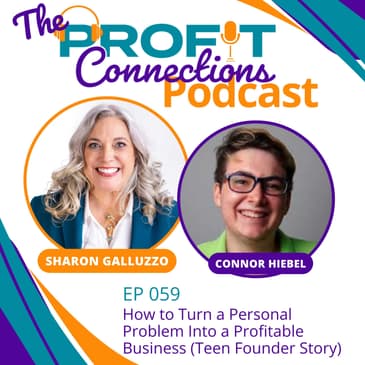
In this episode of Profit Connectors, Sharon Galluzzo talks with teen entrepreneur, bestselling author, and Island Micro Greens founder Connor Hiebel about turning personal health challenges into a purpose-driven business.
Connor shares how discovering food as medicine led him to microgreens, and how that personal healing journey became a nationally recognized brand helping people grow fresh, nutrient-dense food at home.
They also explore the connection between health and entrepreneurship, the importance of consistency, and why real success takes patience. Connor opens up about starting a business young, learning what customers actually want, and building his brand through YouTube by treating it as a search engine and educational platform.
This episode is a powerful reminder that small, intentional actions can create big results in both business and life.
Key Takeaways:
- Healing & Growth: Often happen before you see the results, which is why patience and consistency matter so much in both health and business.
- Microgreens: A simple, powerful way to bring fresh, nutrient-dense food into everyday life, even in small spaces.
- A sStrong Business: Starts by identifying a real need, testing demand, and listening carefully to what customers are asking for.
- Young Entrepreneurs: May face skepticism, but support, persistence, and willingness to learn can turn early effort into real credibility.
- YouTube: Works differently than many social platforms because it functions as a search engine, making it ideal for educational and tutorial-based content.
- Mentorship: Can dramatically shorten the learning curve and help you stay in the game when things feel uncomfortable or overwhelming.
- Health & Business: Both are deeply connected, because better energy, focus, and habits in one area often strengthen the other.
- Business Growth: Usually takes longer than people expect, but the slow season often lays the groundwork for the breakthrough season.
- Sustainable Success: Comes from staying consistent, improving little by little, and allowing momentum to build over time.
Unlock the Secrets to Building a Resilient and Profitable Business at the Profit Connectors Club - https://profitconnectors.club/
About Connor Hiebel
Conner Hiebel is a teen entrepreneur, best-selling author, and the founder of Island Microgreens, an educational microgreens company dedicated to helping people grow fresh, nutrient-dense food right at home. After facing his own health challenges, Conner discovered the powerful role that simple, intentional food habits can play in improving wellbeing. What began as a small project has grown into a nationally recognized brand that has helped thousands of people learn how to grow microgreens in their kitchens, apartments, and small spaces. His work and entrepreneurial journey have been featured in publications such as Forbes and Entrepreneur, highlighting both his innovative approach to food education and his accomplishments as a young founder. Conner is also the author of Let’s get Growing: A Teen’s Guide to Business Success, where he shares the lessons he learned building a business as a teenager and encourages others to pursue entrepreneurship with purpose, creativity, and resilience.
About Sharon:
Sharon Galluzzo, Profit Growth Strategist at Profit Connections, is the author of several Amazon Best Selling books including “Legendary Business: From Rats to Riche$.” She ran a successful multi-six figure, award winning business for more than a decade before selling it for a profit. In her more than 19 years as an entrepreneur, Sharon has coached professionals across the country from franchisors and solopreneurs to businesses on the verge expansion.
https://www.facebook.com/sharonagalluzzo/
https://www.instagram.com/sharon_galluzzo/
https://www.linkedin.com/in/sharongalluzzo/
Thanks for listening!
Thanks so much for listening to our podcast! If you enjoyed this episode and think that others could benefit from listening, please share it using the social media buttons on this page.
Do you have some feedback or questions about this episode? Leave a comment in the section below!
Subscribe to the podcast
If you would like to get automatic updates of new podcast episodes, you can subscribe to the podcast on Apple Podcasts or Stitcher. You can also subscribe in your favorite podcast app.
Leave us an Apple Podcasts review
Ratings and reviews from our listeners are extremely valuable to us and greatly appreciated. They help our podcast rank higher on Apple Podcasts, which exposes our show to more awesome listeners like you. If you have a minute, please leave an honest review on Apple Podcasts.
Profit doesn't happen by chance. It happens by design. Let's dig in, and today we are digging into some really delicious content with our guest, Connor Hiebel. Welcome Connor.
Connor Hiebel:Thank you for having me. I'm so excited to be here. I am so
Sharon Galluzzo:excited to have Connor on our podcast, and we'll get into why in a minute. But let me tell you who Connor is. Connor he will is a teen entrepreneur, Best Selling Author and the founder of island micro greens, an education micro greens company dedicated to helping people grow fresh,
Sharon Galluzzo:nutrient dense food right at home. After facing his own health challenges, Connor discovered the powerful role that simple, intentional food habits can play in improving well being. What began as a small project has grown into a nationally recognized brand that has helped 1000s of people learn
Sharon Galluzzo:how to grow micro greens in their kitchens and apartments and small spaces. His work and entrepreneurial journey have been featured in publications such as Forbes and entrepreneur, highlighting both his innovative approach to food education and his accomplishments as a young founder. Connor is also the
Sharon Galluzzo:author of let's get growing a teen's guide to business success, where he shares the lessons he learned building a business as a teenager, and encourages others to improve entrepreneur I'm sorry, and encourages entrepreneurs to pursue entrepreneurship with purpose, creativity and
Sharon Galluzzo:resilience. Thank you for that intro that was so incredible. I wanted to read Connor's actual bio, because I've known Connor for a year now, and everything that I know about him, every time I turn around, he is doing more and more incredible things as a young entrepreneur. He's blazing trails. He's making
Sharon Galluzzo:everyone healthier, and he has such a beautiful, wonderful spirit about him. And I am so so so happy to have you here today, Connor.
Connor Hiebel:I'm so glad to be here because we've known each other for so long, and to really be able to deep dive into all the cool stuff, from health to business, it's going to be so much fun.
Sharon Galluzzo:But before we get started with all that, Connor, tell us a little bit about how you started, what, what got you into micro greens. And how did you even begin this company?
Connor Hiebel:That is such a great way to introduce this because how it started, it wasn't just some random thing. It's been accumulation over the past 14 years. So my whole life, I've had genetic health challenges, and when I was super young, it was to the point where I couldn't go outside, I
Connor Hiebel:couldn't go to school, and I really had to be home schooled. It was really tough, because I loved going to school, and so we went to all these doctors, tried to figure out what was going on, because couldn't figure it out. Took 14 years to get a diagnosis. So during that time, it was, Do I go the western
Connor Hiebel:medicine route, get all the drugs, all the medications to try and fix what they don't know what's going on? Or do I go the holistic route with letting food be thy medicine? And so I really took on that saying of Let food be thy medicine. And it changed my life. And I started growing microgreens, which I'll talk
Connor Hiebel:about in a minute. Started cleaning up my diet, and within eight months, it was like night and day. It didn't start immediately, like I didn't feel like I was making that big headway. But when I started to look at the results from tests, when I started to see what was happening, I could see there was
Connor Hiebel:a difference. And my doctor said, You heal before you feel so when you're starting a diet, when you're starting a new program, just know that even if you're not feeling any different, stuff is happening. Stuff is changing. So just stick with it.
Sharon Galluzzo:I really love that point, because we want to take a drug and then feel better immediately, and we're looking for that, and that's such a really good point that your doctor gave you, and that you're sharing with us that the healing is going on even before we recognize it ourselves 100%
Connor Hiebel:and we're in this state in our culture, that we need that dopamine rush. We need that instant hit. And when it comes to health and business, that instant dopamine is not going to happen. You want to stay in it for the long haul. And when there's that time of just that inconsistent, or not
Connor Hiebel:inconsistency, but just that long period of waiting, that's when you know you're on the right track. Because it's not an instant fix. It's the things that take the longest tend to be the things that help us the most.
Sharon Galluzzo:That is such a great way to look at it, because even whenever you're doing something as simple as maybe doing a new advertisement, or you're trying a new class, or you're offering a new product, we tend to want to shorten that amount of time that we give it, to give us the ROI 100% we don't
Sharon Galluzzo:actually give it enough runway to take off. Off. We let it go 100 feet. And they were like, no, no. Didn't work. Let's change it again. And all of that. If you listen to me for a long time, you know how I I am about about continuity, about getting, you know, doing things over and over and over again to
Sharon Galluzzo:get that to get to get things running together, so that it runs itself, and that it's not starting and stopping and starting and stopping. I think that's one of the biggest mistakes that business owners make, and now you're confirming that we make with our health as well.
Connor Hiebel:Exactly yes, and it's one of the reasons why I love the books atomic habits and the slight edge, because they talk about that long hole, that motivation and the momentum, having big mo on your side is so huge, because it's all that effort in the beginning leads to it becoming easier in the end,
Connor Hiebel:and so it's so powerful. And you see a lot of these ads lately that are like, I made 100,000 by doing nothing, and it's like, there's a lot that went on that they don't talk about. So know that you're not just like the only one who's really having those challenges and really struggling.
Sharon Galluzzo:And when you hear those ads and they go oh, and it happened right away, and they don't talk about that hidden stuff, all the work that you went into, starting and stopping and figuring it out, they don't include all of that. So when it doesn't happen for us right away, after we bought into
Sharon Galluzzo:that thing. We think we're wrong, and we've made the mistake, and we're a failure, because unfortunately, that stuff is hidden, and so I really appreciate that. That's our conversation today is about, how did it start? How did you start? What you were, what 14, when you started?
Connor Hiebel:I was yes, so fasting, forwarding to fast, forwarding to covid, right when that hit, you saw the quality of our produce significantly drop. I was getting concerned. And I saw other people were so concerned. They were spending lots of money on creating gardens, doing all this stuff.
Connor Hiebel:And I realized, because I did the same thing, I created that whole garden outside and weeding and all the things. And I was like, but micro greens are so easy, and so many people weren't talking about micro greens. So I created a kit with all my knowledge from growing micro greens myself, and I realized
Connor Hiebel:how important it was to get it out there. Because what micro greens are are tiny baby veggies that are the most nutrient dense stage in the life cycle of a plant. They've been researched to be up to 40 times more nutrient dense than your mature vegetables, and they take seven days to grow. It's a tray that's
Connor Hiebel:that size, very small, and you just put it right next to your window. In seven days, you have fresh, live produce. Anyone can grow them, whether they're in boats. Are these, even NASA's grown them up in space. So if NASA can grow them, we can grow them too Absolutely.
Sharon Galluzzo:And what I love, and I want you to repeat this, because I really want people to hear because this is the thing that blew my mind so much when I met Connor and he started telling me about micro greens, is that the mature vegetable, the one that you're cooking and eating, the one
Sharon Galluzzo:you're making salads with and all of that stuff has less nutrients than the micro greens. Yes, that those little baby plants are the most nutrient dense part of the life cycle of the plant, and they are tiny. Tell me a little bit about like They're tiny. How many do I have to eat to get, you know, to get
Sharon Galluzzo:my daily supply of nutrients.
Connor Hiebel:That's a great question, and it really depends from person to person, like, in a family of three, tray like that can get, get eaten in a day, if you eat them all the time. I like to grab a handful. And about, like, one ounce is a typical serving, and that's going to give you a good amount
Connor Hiebel:of nutrition. You can always eat more. You can eat less. It really depends upon what you feel, but around an ounce is a good amount. And then, of course, more is always better. I do recommend still eating some vegetables, because you do want to have that mix of your vegetables and your micro
Connor Hiebel:greens. And a part of the reason why they're so nutrient dense is, think of a chicken and an egg. The egg is more nutrient dense because it's going to have to grow a whole chicken. Same with your seed, it's going to have to grow a whole plant. So what you're getting is the nutrition from the seed itself,
Connor Hiebel:and that's why it's so nutrient dense. And you can also think about our produce quality is significantly dropping because they're harvesting it early and they're spraying it with all sorts of stuff that we don't even want to think about, which harms our soil, and when our soil, the bacteria in there,
Connor Hiebel:starts to get harmed within the nutrition in our in our plants is significantly less, so we're creating dirt and not soil with our plants, and it's really affecting Our health.
Sharon Galluzzo:Yeah, and there's lots of studies that show that the the produce that we're growing today is nowhere near nutrient whatever you say, the high in nutrients as it was years and years ago, and that is for a whole number of reasons, which we won't get into today. But you know, far. Farming
Sharon Galluzzo:practices and seeding and and, like you said, pesticides and all of those kinds of things have worked to give us. You know that tomato that you get at the grocery store is not the tomato that when I was a kid I was able to get from the farmer next door so and
Connor Hiebel:it tastes completely different too. I went to Uruguay, which they, at the time, weren't, didn't have all the like Monsanto and all of these big corporations that were affecting their produce. I ate a tomato. I was like, oh my goodness, this is the best tomato I've ever had. It tasted
Connor Hiebel:good. And at the time, I didn't like tomatoes, but because it was fresh, it was a good quality tomato. It had flavor. It tasted so good. When I went to farmers markets and would vend with the microgreens, people would sample the microgreens and they'd be like, This tastes so good. What did you flavor it with? We've
Connor Hiebel:become so disconnected from how good produce can taste. Yeah, it's completely different now,
Sharon Galluzzo:yeah, yeah, that's so true. And I have this. I'm constantly in search of that tomato I had as a child because a tomato sandwich and bread and mayonnaise and salt and pepper and a fresh tomato was like my summer menu. I loved it. And now, whenever I get a tomato, I'm always like, it's not the
Sharon Galluzzo:same. It's not Yeah, but, and I think that it's talk a little bit about, we won't spend a lot of time, but talk a little bit about the taste of the microgreens, because you did bring
Connor Hiebel:that up. Yeah, that's a great question. So a lot of times people are confused, like, what's the difference between a microgreen and a mature plant? And it's the stage of growing it. So you have the seed, then you have a sprout, then you have a micro green. So it's a tiny baby
Connor Hiebel:veggie, and that veggie can be any type of plant that you have. So like, broccoli is going to taste like a broccoli mic or broccoli microgreens are going to taste like broccoli. Radish is going to taste like you went out and you got a fresh radish and you're eating that. Peas are like those fresh peas, they're
Connor Hiebel:nice and crunchy. You have wasabi, which tastes like wasabi. And a fun fact about that most people in America have never had real wasabi. It's usually horseradish that's been flavored and died. Then you have like, amaranth is a really cool one. It's a bright pink one, and it tastes similar to a beet.
Connor Hiebel:It's usually the mature plants used as a grain substitute. So it's really good. It's really tastes so amazing. Then you have kale is going to be I actually really like the kale because it's not as bitter and hard to chew as your mature kale. So it's a really nice, mellow one that I like to add in smoothies,
Connor Hiebel:same with broccoli and within, okay, go ahead, within your broccoli and kales, there's a phytonutrient called sulforaphane. And why sulforaphane is gaining a lot of traction right now is it's been shown to lots of research studies. You can go and search these up that it's been
Connor Hiebel:researched to reduce inflammation and do a thing with your cancer cells called autophagize, which basically needs to explode to commit suicide. So those cancer cells, it's really good for preventative, for cancer reduction. Yeah, it's in powerful. It's so powerful.
Sharon Galluzzo:So bottom line, eat your micro greens. Yes, and you said, when you were talking about that, you said you put it in a smoothie. So how, how do you eat micro greens?
Connor Hiebel:That is a really good question. So with micro greens, you can eat them plain is my personal favorite way, because I love to taste the micro greens. Then you can add them to soup, salad, sandwiches, anything you're eating in the day. Just add them in. If you want to hide them, you can add
Connor Hiebel:them to smoothies. So with your broccoli and your kale, you can hide them in anything, and you won't taste it. I'll do like a chocolate smoothie with with the those ones. If I want to have like a fruit smoothie, then I can add those ones in too. And then if I want a gingery kick, I'll add in the wasabi. So you
Connor Hiebel:can really add them in all sorts of different ways. I love the wasabi on tacos, because it adds that nice spice to it.
Sharon Galluzzo:Ooh, that sounds really good. And we're going to dig into the business side. And then at the end, I want you to talk about how people can can get micro greens, because I think they need to hear that too. But let's talk a little bit about starting that business when you were 14, covid
Sharon Galluzzo:came and you didn't have good produce. And then how did, how did you go from oh my gosh, I need to feed my body because this is a healing treatment. This is preventative, and it's really working for me, into Connor. You're a nationally recognized company.
Connor Hiebel:Now, yes, that's such a good question. And before I go there, I want to talk about something that was really huge. And you really saw in covid was that there were companies that were failing. A lot of companies. I think it was like 50% of businesses went out of business. But then you saw
Connor Hiebel:something really interesting, and that was the businesses that stayed did. Something key. They found out what people were needing, what was different, what was changing, and they pivoted and changed. So you'd look at like your restaurants, instead of going to the restaurant and eating there,
Connor Hiebel:they would do delivery, and those were the restaurants that succeeded. So there's something really key that we can learn from covid is, what is it that people are doing that's different, and how can I align my business? And that goes for any time that we're in so when I was in covid, I saw that there
Connor Hiebel:was that big need with health and sustainability, and I really focused there, because I had the same challenges. I just didn't have a big pandemic that started it all. So I really focused in on that, and it was more of an education. I was doing it for my home school project. It was just a fun learning how to do
Connor Hiebel:entrepreneurialship. And then it just expanded and exploded.
Sharon Galluzzo:So whenever, whenever you so you have a right now, you have a multi faceted business. And when you started, it was a product based business, correct, correct. So talk a little bit about starting a new business and all of those pieces that go into creating a product that you can get out to people
Sharon Galluzzo:that meets all the requirements that you needed to meet.
Connor Hiebel:It's a really good way to start, because there's so many different areas, and I could talk about this and in a lot in depth, but the main thing you want to do before you start really deciding what you're going to do is test it. Do people want this? Is there a big need? You'd see a lot at
Connor Hiebel:vendor markets, all these bracelet shops, which, that's really cool. It's really fascinating. But that's a high, high competition. There's a lot of people who are making bracelets, doing arts and crafts, you'd need to stand out, like doing something different, like maybe hand wiring, hand
Connor Hiebel:wrapping, doing the wire wrapping, where it's really unique, or something like that. You want to make sure that it stands out. You also want to make sure that people are wanting to buy it, that there's people who will spend the money that you want on that product, and then do a cost comparison.
Connor Hiebel:What are other people charging for this product, and what makes mine stand out within my niche? And so once you have that figured out, test it out. Go to vendor markets and and sell your product. See how many people are interested, what questions they ask. Because when you start to figure all that out, then you
Connor Hiebel:can talk to that target audience a lot better. And then when you get into social media, you're able to talk specifically to them in a more specified way than if you were to just start randomly. Does that answer the
Sharon Galluzzo:question, yeah, that's and that's a really good point about understanding first of all, is there a need? Is there a desire for what I have? But I love the part where you were talking about, what are they saying? How are they talking to you? What questions are they asking? Because if you
Sharon Galluzzo:pay attention to that as you're growing your brand and your product or your service, when you use the words that your customers are using, then the customers can self identify when they are looking at your materials. Yes, 100%
Connor Hiebel:and especially if you don't have all that research and development ready, that's just a quick way to start figuring it out and start implementing quickly awesome.
Sharon Galluzzo:And then talk a little bit about, you know, on your end, because it was a product, what kind of production things did you have to figure out, like the size of the tray and the box and all of that kind of stuff. Just briefly talk a little bit
Connor Hiebel:about that. Yeah, that's a really huge piece, because a lot of people in, like the coaching industry don't really have this element with the physical product. So there's a couple things you want to figure out, which is the quality. You want to make sure that you have something high
Connor Hiebel:quality. So with the tray that I have, it's high quality. It's a two tier tray, so that people can lift up the tray, put the water underneath, and then put the the tray with the micro greens back down. That way they don't risk mold. They don't have those challenges that you would if you were just using one tray.
Connor Hiebel:It's a little bit more pricey, but it's worth it, so that people get that good quality grow. The second thing you want to work look at is price. You want to make sure that you can find something that's of a good price. So you want to look around. There's different places you can look such as specific
Connor Hiebel:wholesalers, and you can look both in the US. You can look overseas. Some of the good places are, of course, China's one right now with tariffs, it's iffy. Then you have India. Is really good for your pamphlets, for research material. Then you have Mexico. Mexico's really good because it's super close to
Connor Hiebel:us. It's a little more expensive than Asian countries. However, what's really good about them is that they have a shorter lead time. So with China and India, it's going to take a couple months before you get that product. And those two, well, China more so is more likely to rip off your product, and you
Connor Hiebel:can't go after them for that. You can stop them from importing it into the US, but they can use your same exact. Product of what you give them anywhere in China. Wow, I have that. That's crazy. I have a kit going around on Alibaba that is my personal kit, and there's nothing I can do about it other than stopping it
Connor Hiebel:in the US. Yeah, it's ridiculous. So make sure, when you start doing a product to go to different countries. Don't put everything in one country, because if I gave them my specific tray, my specific seeds, all of that stuff, then they would have the whole entire kit. Now they just have the box,
Connor Hiebel:so make sure that you distribute it in different places.
Sharon Galluzzo:Oh, that was juicy. Yes, thank you for that tip. That was really something I had never even thought about. Yeah, it's really
Connor Hiebel:I didn't think about it until I started learning it all, until my kit got ripped off. Yeah, I had someone come up and be like, Hey, I hope this is you, but I don't see why it would be you. Is this your kit? And it was the same exact kit. They went to my website, they, like, got all my
Connor Hiebel:information and just ripped it off. And you'll find other kits on there. Like you see it when, when you know what it is, you can see it
Sharon Galluzzo:right, right? Yeah, yeah. Oh, wow. That's, that was a juicy tip, right there. So, oh yeah, wow. My like, I'm sorry my mind is a little bit without words right now. Um, so that was That's really incredible. Well, Connor, we I heard from a little birdie that you have a gift for our
Sharon Galluzzo:listeners. Can you talk about that?
Connor Hiebel:Of course, yes. So over the past 14 years, I've learned so much about growing micro greens, the things you want to do, the things you want to avoid the questions and misconceptions. And so I created a micro green master class that will take you from micro green beginner to micro green growers,
Connor Hiebel:so that you can grow your micro greens easily at home. So if you take out your phone and you text to the number 26786, the word micro greens all one word micro greens to 26786, I will give you my free micro green master class. It's usually valued at $250 but for you all, I'll give it to you for free. So type,
Connor Hiebel:take out your phone, text micro greens to 26786, and that way you'll get to learn the knowledge of micro green growing. And for those of you who just want to learn how to do YouTube videos. This is a great way to see some of the content, so that you can start structuring your videos in the
Connor Hiebel:way that will help get your videos viral and in that right direction. So it's a double benefit. And as I say, health is wealth. So when you start helping your health, you're going to start helping your wealth. If you look at a lot of the successful people who have already made it in
Connor Hiebel:entrepreneurship and business, you'll notice something really interesting. They take care of their health, they go on walks, they eat well, they do the things that make the difference, because they know about the power of 1% about atomic habits that you want to move forward. And if you move forward in one
Connor Hiebel:area of life, it's going to make the difference in the other area. So that health is super powerful and makes such a huge difference in where you go with your business. Awesome.
Sharon Galluzzo:Thank you, Connor. And in case you didn't get that number, worry not. You can go to our portal. It's profit connectors. Dot club. That's the website. Address, profit connect doors, dot, C, l, u, B, all of our guests are in there, all of their contact information and their free
Sharon Galluzzo:gifts. You can watch all of the podcasts in there. If you get in there, you watch this one, and you get in there and you want to see some more, they're all there, and we will have all the instructions to get Connor's free gift. I am so grateful Connor for all of the juicy, delicious, amazing value that
Sharon Galluzzo:you brought to our listeners today. Thank you for being here.
Connor Hiebel:Thank you so much, and it was so good to be on the podcast with you, because all the things that you've been doing have been so cool and so powerful, like writing your book, doing this podcast, there's so many things you're doing that you're on the right direction, and I totally see
Connor Hiebel:your success.
Sharon Galluzzo:Thank you so much. Connor, so remember and listeners build with clarity. Lead with purpose. Thanks for listening, and we'll see you next time. Bye.