
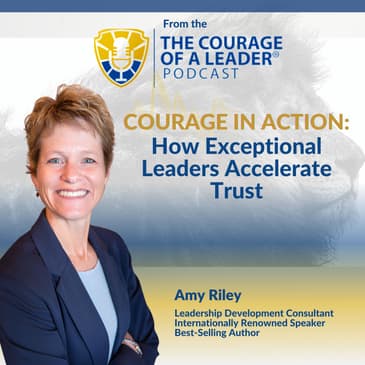
How can we build trust faster as leaders? Trust grows over time, yet we have more ability to accelerate it than we may realize. Sometimes, a single courageous action can change how someone experiences our leadership.
We look at five questions every leader should be asking about trust. We examine what happens when we extend trust first, how everyday behaviors strengthen credibility and connection, and where our good intentions may not match the way others experience us. We also explore what appropriate transparency looks like during uncertainty and why saying “I don’t know yet” can be more trustworthy than silence.
We also confront what happens when we get it wrong. A mistake does not automatically have to destroy trust. How we own it, apologize, make it right, and communicate what others can expect from us next can reveal our integrity in powerful ways. When we are willing to go first, trust becomes something we actively create through the choices we make every day.
Key Takeaways:
- Extend Trust First:Explore what can change when we stop waiting for others to earn every ounce of trust before we offer it.
- Notice What Builds Trust Daily:Consider which everyday leadership behaviors may be strengthening trust, and which ones may be quietly weakening it.
- Examine How Others Experience You:Discover why our intentions are only part of the trust equation and what else leaders need to pay attention to.
- Lead Transparently Through Uncertainty:Explore what trustworthy communication can look like when we do not yet have all the answers.
- Repair Trust When It Breaks:Consider what matters most after a mistake and how our response can shape what happens next.
Resources Mentioned
The Inspire Your Team to Greatness assessment (the Courage Assessment) - In less than 10 minutes, find out where you’re empowering and inadvertently kills productivity, and get a custom report that will tell you step by step what you need to have your team get more done. Get it here: https://courageofaleader.com/inspireyourteam/
You don't need to have all the answers to lead well. Get your copy of the Clarity Kit for just $17 to learn the five practices to bring more clarity, confidence and courage into your leadership - https://courageofaleader.com/the-clarity-kit/
About the Host:
Amy L. Riley is an internationally renowned speaker, author and consultant. She has over 2 decades of experience developing leaders at all levels. Her clients include Cisco Systems, Deloitte and Barclays.
As a trusted leadership coach and consultant, Amy has worked with hundreds of leaders one-on-one, and thousands more as part of a group, to fully step into their leadership, create amazing teams and achieve extraordinary results.
Amy’s most popular keynote speeches are:
- The Courage of a Leader: The Power of a Leadership Legacy
- The Courage of a Leader: Create a Competitive Advantage with Sustainable, Results-Producing Cross-System Collaboration
- The Courage of a Leader: Accelerate Trust with Your Team, Customers and Community
- The Courage of a Leader: How to Build a Happy and Successful Hybrid Team
Her new book is a #1 international best-seller and is entitled, The Courage of a Leader: How to Inspire, Engage and Get Extraordinary Results.
http://www.courageofaleader.com
https://www.linkedin.com/in/amyshoopriley
Thanks for listening!
Thanks so much for listening to our podcast! If you enjoyed this episode and think that others could benefit from listening, please share it using the social media buttons on this page.
Do you have some feedback or questions about this episode? Leave a comment in the section below!
Subscribe to the podcast
If you would like to get automatic updates of new podcast episodes, you can subscribe to the, podcast on Apple Podcasts or Stitcher. You can also subscribe in your favorite podcast app.
Leave us an Apple Podcasts review
Ratings and reviews from our listeners are extremely valuable to us and greatly appreciated. They help our podcast rank higher on Apple Podcasts, which exposes our show to more awesome listeners like you. If you have a minute, please leave an honest review on Apple Podcasts.
Mentioned in this episode:
The Inspire Your Team to Greatness Assessment (The Courage Assessment)
https://courageofaleader.com/inspireyourteam/
Welcome to the Courage of a Leader podcast. This is where you hear real-life stories of top leaders achieving extraordinary results, and you get practical advice and techniques you can immediately apply for your own success. This is where you will get inspired and take bold, courageous action. I'm so glad you can join us. I'm your host, Amy Riley. Now, are you ready to step into the full power of your leadership and achieve the results you care about most. Let's ignite the courage of a leader. There are some leadership topics that we can make much more complicated than they need
Amy Riley:to be. I think trust is one of them. We talk about building trust, earning trust, losing trust, rebuilding trust, and one of the things I hear all the time is trust takes time. Of course, trust does build over time. Yet one of the things I've learned through my own experiences, through coaching and developing leaders, and through interviewing leaders for my book, is that there are always ways to build trust remarkably fast. Sometimes even with a single act, and that matters because nearly everything we want to accomplish as leaders requires trust. Think about it. If I want you to tell me what
Amy Riley:you really think, I need your trust. If I want you to bring me a different idea. I need your trust. If I want you to take a risk, challenge the status quo, tell me I'm wrong, give me your best effort, or follow me through uncertainty, I need your trust. This is where the courage of a leader becomes so important, because building trust requires us to go first, to extend trust, to listen when we may not like what we're going to hear, to share information, to follow through, to admit when we don't know, and sometimes to say, "I got this wrong. So today, I want to answer five questions about trust
Amy Riley:that I think every leader should be asking themselves, not just do people trust me. I want us to look at what we actually do as leaders that accelerates trust, that strengthens it, sometimes unintentionally erodes it, and repairs it when something goes wrong. So let's dive in. The first question is: How can I build trust faster with the people I lead? Let me start with something I believe strongly. If you want to build trust, extend trust. Go first. Extend trust, and then trust is there. We often approach trust the other way around. We think, show me that I can trust you, and then I'll
Amy Riley:give you more responsibility, or prove yourself, and then I'll share more information. Once I know you're trustworthy, I'll let go a little bit more. Now there are certainly situations where we need to be thoughtful about how much trust we extend. Yet I've seen over and over again that one of the fastest ways to build trust is to be willing to extend it first. And extending trust can look very different depending on the situation. It might be giving someone responsibility for an important project rather than telling them exactly how to do it. It might be sharing information earlier than we
Amy Riley:normally would, it might be asking someone for their perspective before you've formed your own conclusion. It might be introducing someone to a valuable person in your network. It might simply be saying, "I trust your judgment. What do you think we should do? Think about how differently someone experiences you when you say that, you're not just telling them that you trust them; you're demonstrating it. One of the examples I shared in my book came from an executive that I interviewed for the book. Near the end of our conversation, I asked her who else she thought I should interview.
Amy Riley:She mentioned several people immediately, and then she went even further. She personally introduced me to a number of exceptional leaders in her network. Think about what she was doing. She had spent decades building her reputation in those relationships, and she was willing to extend that trust to me. I remember the impact it had on me. I thought I want to be worthy of the trust she's giving me right now, and that's one of the interesting things about extending trust. When someone trusts us in a meaningful way, most of us don't think, "Great, how can I take advantage of this?
Amy Riley:Instead, we think, "I don't want to let this person." Down, I know that's what I thought. Extending trust can actually call people up. It communicates, I believe in you, I believe in your intentions, I believe you can handle this. There's courage involved in that because extending trust always carries some risk. Someone might disappoint you. They might make a mistake. They might even demonstrate that they weren't worthy of the trust you extended. It's possible, and if that happens, you've learned something important. Yet, if we wait until trust feels completely risk-free, we're probably not
Amy Riley:extending much trust at all. So here's something I'd encourage you to think about: Where could you extend trust first? Is there someone you're asking to prove themselves first? Is there responsibility you could give away, information you could share, a decision you could let someone else make? What's one meaningful way you could communicate through your actions? I trust you. That's the courage of a leader. Question two: What are the everyday leadership behaviors that build trust? This is important because trust isn't built only in the big moments. It can be built in meaningful ways in dozens of
Amy Riley:small daily interactions. How you show up for a meeting, whether you do what you said you would do, whether you're actually listening when someone is talking, how you respond when someone disagrees with you, whether you keep a confidence, whether your team knows that they can count on you. Years ago, I developed a trust equation that I've used in leadership development programs to help leaders get much more specific about this. It's trust equals credibility times connection times commitment times customer focus plus co-creation. I use multiplication intentionally because these factors
Amy Riley:amplify each other. When I create increase connection with you, you're more likely to understand my experience and expertise, which can increase my credibility. When I consistently follow through, you're more likely to trust my intentions when I suggest something new. These things work together. Let's make each one practical. Credibility. Credibility is: Do I believe you know what you're doing? Can you articulate the value you bring? Can you share your expertise in a way that I can actually understand and use. Are you willing to acknowledge where you don't have expertise? And I think that
Amy Riley:last question is important. Sometimes leaders think credibility means having all the answers and all the things. I think credibility increases when a leader says that's not my area of expertise. Let's bring in someone who knows more about this than I do. That's confidence. That's humility. Others will believe you're good at what you say you're good at if you're also willing to say where you're not strong. Connection is: Do I feel safe with you? Do I feel that you understand me? This is built in very practical ways. Make eye contact. Put your phone away. Eliminate distractions. Ask questions.
Amy Riley:Listen actively. Show that you care. Respond to what someone is feeling, not only to the words they're saying. These things may sound small; they're not. Think about the last time you were talking with someone who was clearly checking email or looking at their phone, what message did that give you? Probably whatever's happening over there is more important than what you're saying. Now think about the opposite. Someone puts everything down, looks at you, and listens. That builds connection. Commitment is: Can I count on you? If you say you'll do something Friday, does it happen Friday?
Amy Riley:And if it can't happen Friday, do you proactively tell me? Do you show up when you say you're going to show up? Are you clear about what you will do and what you won't do? This one is incredibly straightforward and powerful. It's one of the easiest places for leaders to unintentionally compromise trust. We make a commitment in a meeting, and then we get busy. Then something else becomes urgent. Then we forget. We may barely remember it, but the other person might. Customer focus and co-creation. Focus on your internal or external customers. For leaders working internally, I
Amy Riley:especially like the idea of co-creation. Are we actually creating something together, or am I coming into the conversation already knowing what I want you to do? And there's no wiggle room. There's a big difference there. Co-creation sounds like here's the challenge we're trying to solve. What are you seeing? What do you think we're missing?
Amy Riley:How could we approach this differently? It moves leadership away from a transactional exchange and towards partnership. If you want to strengthen trust with your team, you don't have to start with some annoying. Initiative. You can pick one of these areas: credibility, connection, commitment, co-creation, and ask yourself what is one thing you could do differently this week that would increase trust. Trust gets built in the everyday. The third question: How might I be unintentionally eroding trust. I really want us to pay attention to the word unintentionally here. Most leaders I work with
Amy Riley:aren't waking up in the morning thinking, "How can I make my team trust me less today? We have good intentions, yet people don't experience our intentions; they experience our behavior, and sometimes there's a gap between the two. For example, you say I trust you, and then you check the details of a person's work. What did they experience? Another example, you say I really want your ideas, and then someone gives you an idea, and you immediately explain why you won't be able to do it. What do they experience? You say, "Please come to me if you have any concerns. Then someone raises a
Amy Riley:concern, and you become defensive. What did they learn? You say people are most important asset, and then you have to cancel three one-on-ones in a row because something more urgent comes up. What message are we sending? This is why self-awareness matters so much in leadership. The question isn't simply "Am I trustworthy? Most of us are going to say yes. A more useful question is, "What it is? What is it like to experience me as a leader, that's a different question. There are also some very practical ways I've seen leaders unintentionally erode trust. One is failing to proactively
Amy Riley:communicate when they can't meet a commitment. Another is using so much jar in our technical language that people feel excluded from the conversation. Another is offering advice before fully understanding the other person's situation. We think we're being helpful. The other person may experience you didn't even fully listen to me. Here's another one I see frequently. Leaders confuse control with care. They think I'm checking because I want this person to succeed, the other person might experience she doesn't trust me. That doesn't mean leaders shouldn't check progress or hold
Amy Riley:people accountable. Of course we should. The question is whether our behavior is creating clarity and support or communicating a lack of confidence. One of the simplest things you can do is assume good intentions. That doesn't mean leaders shouldn't check progress or hold people accountable. Of course, we should. The question is whether our behavior is creating clarity and support or communicating a lack of confidence. One of the simplest mindsets I found for strengthening trust is assume good intentions. Doesn't mean ignore facts. Doesn't mean to tolerate repeated poor behavior.
Amy Riley:It doesn't mean abandon accountability. It means that until the facts tell me otherwise, I don't automatically create a negative story about your intentions. Someone misses a deadline. Instead of thinking they don't care, I can ask what happened. Someone challenges an idea instead of thinking they're being difficult. I can consider what are they seeing that I may not be. Someone doesn't respond to my email. Instead of deciding I'm obviously not a priority, maybe I get curious first. Assuming good intentions doesn't make us naive. It keeps us from damaging trust based on the story
Amy Riley:we've created rather than facts. So here's the question to ask yourself: Where might there be a gap between my intentions and how people actually experience my leadership? That can be an uncomfortable question. It can also be an incredibly useful one. All right, let's move on to question four. How transparent should I really be as a leader? I hear versions of this question all the time, especially during uncertainty. A reorganization is happening. Budgets are changing. A strategy is shifting. AI is changing how we're getting work done. There may be layoffs. A major customer may be at risk, and
Amy Riley:leaders are asking, "How much should I tell people? Here's how I think about transparency. Transparency doesn't mean telling everybody everything. That's not leadership. There are things you can't share. There are things you shouldn't share. There are confidential conversations, personnel issues, legal considerations, information that's not yours to disclose. So transparency isn't everybody gets access to everything.
Amy Riley:It's being appropriate about appropriately sharing what you know, what you don't know, what you can share, and sometimes sharing why you can't share. Imagine your organization is going through significant change, and people are asking you questions you can't fully answer. You could say, "I can't talk about that. Technically accurate, not particularly trust building. Instead, you could say, "I know there's a lot of uncertainty right now. I know people have questions. There are pieces I can't share because decisions are still being made. What I can tell you is this, and then tell them
Amy Riley:what you can, and add as soon as I have information I can responsibly share, I will. Now I've given you something you can count on. I've acknowledged reality. I've respected the limits of what I can disclose, and I've made a commitment about what I will communicate. That's very different from silence. Here's what happens when leaders don't communicate: people fill in the gaps, right? And their stories are often worse than reality. This is where demonstrating the courage of a leader really matters. Sometimes we're not withholding information because it's confidential. We're withholding it
Amy Riley:because the conversation is uncomfortable. Those are not the same thing. We don't want to answer questions we don't have answers to. We don't want to worry or disappoint people, so we wait. Yet people can usually sense when something is happening, and silence can become its own message. I think trustworthy leaders get comfortable saying, "I don't know yet. You can be credible and not know. You can be confident and not know. You can be a strong leader and not know. What matters is what you do next. I don't know yet. Here's how we're finding out, I don't know yet. Here's when I expect to know
Amy Riley:more. I don't know yet. Tell me what you're most concerned about. That's transparency with leadership. It's not oversharing. It's not pretending. It's being real, responsible, and clear. Final question: What do I do when I've broken someone's trust? First, don't pretend it didn't happen. Don't hope that they didn't notice. Don't explain it away. Don't start with all the reasons it wasn't your fault. Own it. This is personal for me because I've certainly made mistakes that affected trust. I tell a story in my book about a time I was supporting a client with two different leadership
Amy Riley:development initiatives, both involved complicated schedules, multiple groups, multiple locations, global time zones. I worked hard to get each schedule right. There was only one problem: I hadn't checked the two schedules against each other. I had scheduled myself to be in two places at once. I remember my stomach dropping when I realized what I'd done. What a facepalm moment! I was so embarrassed. My first step was to figure out the best solution for the client. I got the problem down to two changes, only one of which needed to be recommunicated. Then I called my client. I didn't
Amy Riley:email her. I called. I wanted her to hear my concern and my apology in my voice. I told her what had happened. I apologized, and then I explained the solution and I offered to personally call every person who would be affected by the change, she actually told me that wasn't necessary, and I said I wanted to do it. I wanted to make sure that it would work and that everyone had complete clarity. And I'll never forget what she said to me next. She told me she felt better than ever about the initiatives, because now she knew I would make sure the programs were working for everyone. Think about
Amy Riley:that. I had made a mistake, a stupid mistake, and somehow, because of how I responded to it, trust increased. I've thought about that experience many times. We hear trust is hard to build and easy to break. Certainly, trust can be compromised very quickly. Yet, I don't believe every mistake destroys trust. Sometimes, what you do after the mistake shows people more about your integrity than they knew before it happened. So, when you've broken someone's trust, I think there are two very important steps to take. First, apologize-not I'm sorry you felt that way. Acknowledge what you did and the
Amy Riley:impact it had. I said I would do this and I didn't. I know that created additional work for you. I'm sorry.
Amy Riley:Then, do what you can to make it right, and you can ask, "What can I do now? What will help? and clearly share what you'll do differently going forward. Sometimes you can't undo the impact. You can demonstrate who you are and how you respond to it. That's the courage. Of a leader, not pretending we're never going to get it wrong, having enough humility to own it, enough integrity to make it right, and enough courage to show people what they can expect from us next time. As I wrap up this episode, I want to come back to where we started. We often hear that trust takes time, and yes, trust
Amy Riley:grows through consistency over time. Yet I also believe we have far more ability to accelerate trust than we realize. We can extend trust first. We can intentionally increase our credibility, connection, commitment, and co-creation. We can pay attention to the ways our behavior may unintentionally erode trust. We can communicate with appropriate transparency, and when we make mistakes, and we will, we can apologize and make them right. Nearly everything you want to accomplish as a leader requires trust. You want people to tell you what they really think. You need trust. You want people
Amy Riley:to challenge ideas. You need trust. You want people to take ownership. Trust. You want people to stay engaged through change. Trust is needed. You want them to follow you when you don't have every answer. You need trust. So here's the question I'd like to leave you with: Where could you extend trust this week? Maybe you could give someone more ownership. Maybe you could share something you haven't shared before. Maybe you ask for someone's perspective and really listen and run with it. Maybe you let someone make a decision without you. Maybe you have the conversation you've been
Amy Riley:avoiding trust. Always involves some risk. That's exactly why it requires courage. And when we're willing to go first, we create the possibility for something much bigger in return. Thank you for spending this time with me today. If this episode was helpful, please share it with another leader who's working to build stronger relationships with their team, and until next time, keep leading with the courage of a leader. Thank you for listening to the Courage of a Leader podcast. If you'd like to further explore this episode's topic, please reach out to me through the Courage of a Leader
Amy Riley:website at www.courageofaleader.com. I'd love to hear from you. Please take the time to leave a review on iTunes. That helps us expand our reach and get more people fully stepping into their leadership potential. Until next time, be bold and be brave because you've got the courage of a leader.