
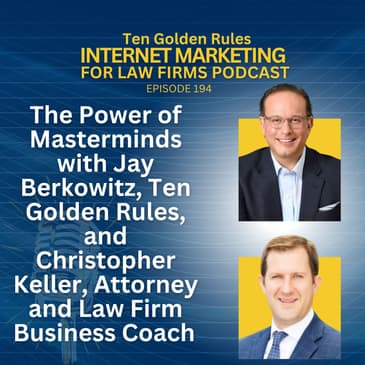
The power of mastermind groups has shaped some of the world’s greatest business leaders, and in this episode, Jay Berkowitz, CEO of Ten Golden Rules, and Christopher Keller, Attorney and Law Firm Business Coach, introduce their joint ventre, Law Firm Growth Mastermind, for ambitious law firm owners.
Drawing from their own experiences scaling businesses, increasing profitability, implementing AI, and building elite peer networks, Jay and Christopher reveal how mastermind groups create accountability, sharpen leadership, improve decision-making, and help firms avoid costly mistakes. Christopher shares lessons from growing an 80-person PI firm, while Jay explains how masterminds helped scale Ten Golden Rules into an Inc. 5000 agency. If you want to grow faster, avoid costly mistakes, and surround yourself with ambitious leaders who push you higher, this episode is your call to join the mastermind group that is right for you.
Interested in joining the Law Firm Growth Mastermind with Jay and Christopher, visit https://lawfirmgrowthmastermind.com/ to learn more and apply.
Key Topics
01:42 The episode opens with the history of mastermind groups and how the concept became one of the foundational principles behind entrepreneurial success and innovation.
02:57 A look at how legendary business leaders like Andrew Carnegie, Henry Ford, Thomas Edison, and Harvey Firestone used collaborative peer groups to generate ideas, solve problems, and build iconic companies.
03:58 The conversation explores how stepping away from daily business pressures can create clarity, spark creativity, and lead to better strategic thinking.
04:55 Introduction to the new Law Firm Growth Mastermind and why modern law firm owners need stronger peer accountability, strategic guidance, and collaboration.
06:04 Lessons from long-running CEO mastermind groups and how peer feedback can completely change the way business owners approach leadership and growth challenges.
06:51 A discussion about a pivotal hiring decision that reshaped an entire business and demonstrates how mastermind advice can unlock growth opportunities.
08:29 The hosts explain the “hot seat” mastermind format and why focused peer problem-solving helps owners tackle operational and leadership issues more effectively.
09:08 The story behind creating a more intimate, engaging, and relationship-driven conference experience through collaborative brainstorming and mastermind feedback.
11:05 Why financial transparency inside mastermind groups creates stronger decision-making, better benchmarking, and healthier businesses.
13:54 Insights from scaling a personal injury law firm from a small operation into a multi-state firm with more than 80 employees.
15:05 How mastermind groups dramatically accelerate learning by allowing business owners to implement proven strategies instead of learning everything through trial and error.
15:57 The risks of operating in isolation and how mastermind groups expose blind spots before they become expensive business mistakes.
18:04 Why execution is often the biggest challenge for business owners and how accountability systems help turn ideas into measurable progress.
19:12 What separates a strong mastermind room from a weak one, including the importance of trust, openness, and willingness to share real numbers and real challenges.
20:42 Creative marketing and advertising ideas that came directly from mastermind collaboration and helped firms gain market share more efficiently.
21:33 The growing role of virtual labor, AI tools, and operational systems in helping law firms scale while controlling overhead and improving profitability.
22:47 How coaching and mastermind accountability improve leadership discipline, decision-making, and long-term business growth.
24:53 A discussion about implementing AI tools and agents ahead of competitors and how peer collaboration creates a major competitive advantage.
26:42 Why mastermind groups function like a virtual board of directors by bringing together experts in operations, finance, marketing, leadership, and strategy.
32:25 The importance of tracking the right business metrics and how understanding operational data can dramatically improve profitability and efficiency.
37:00 How the Profit First methodology helped reshape financial management and improve business performance during periods of rapid growth.
41:24 Practical strategies for filtering and prioritizing ideas so firms can execute effectively without overwhelming their teams.
43:56 How improving intake systems, customer experience, and case management processes can significantly increase revenue and operational efficiency.
49:28 A deeper conversation about leadership, personal growth, discipline, and why improving mental, physical, emotional, spiritual, and financial health impacts business success.
Resources Mentioned
Technology
- ClickUp – Project Management Platform – https://clickup.com
- Google – Google Business & Ads Ecosystem – https://google.com
- EOS Worldwide – EOS Operating System – https://www.eosworldwide.com
Books
- Think and Grow Rich – Napoleon Hill – https://www.amazon.com/dp/1585424331
- Profit First – Mike Michalowicz – https://www.amazon.com/dp/073521414X
About our Guest:
Christopher Keller is a law firm leader, advisor, and speaker focused on helping attorneys improve performance across operations, leadership, and growth strategy. As a former law firm owner, he built and scaled a successful personal injury practice, developing systems that support consistent case flow, operational discipline, and team accountability.
Today, Christopher works with law firm owners on aligning marketing, intake, and internal operations to improve profitability and long-term sustainability. His perspective is grounded in real experience—what it takes to run, grow, and lead a firm in a competitive market.
He is known for his practical approach to leadership and his focus on building systems that allow firms to scale without losing control or culture.
About Jay Berkowitz:
Jay Berkowitz is a best-selling author and popular keynote speaker. Mr. Berkowitz managed marketing departments at: Coca-Cola, Sprint and McDonald's Restaurants, and he is the Founder and CEO of Ten Golden Rules, a digital marketing agency specialized in working with attorneys.
Mr. Berkowitz is the author of Advanced Internet Marketing for Law Firms, The Ten Golden Rules of Online Marketing and 10 Free Internet Marketing Strategies that went to #1 on Amazon. He is the host of the Ten Golden Rules of Internet Marketing Webinar and Podcast. He has been profiled by the Wall Street Journal, The Business Journals and FOX Business TV.
Mr. Berkowitz was selected for membership as a TITAN for Elite Digital Marketing Agencies, he is the recipient of a SOFIE Award for Most Effective use of Emerging Media, and a Special BERNAY’s Award.
Connect with Ten Golden Rules
Subscribe to Ten Golden Rules on YouTube
Check out our webinars on TenGoldenRules.com
Connect with Ten Golden Rules on LinkedIn
Follow Ten Golden Rules on Facebook
Connect with Jay Berkowitz on LinkedIn
Thanks for listening!
Thanks so much for listening to our podcast! If you enjoyed this episode and think that others could benefit from listening, please share it using the social media buttons on this page.
Do you have some feedback or questions about this episode? Leave a comment in the section below!
Subscribe to the podcast
If you would like to get automatic updates of new podcast episodes, you can subscribe to the podcast on Apple Podcasts or Stitcher. You can also subscribe in your favorite podcast app.
Leave us an Apple Podcast review
Ratings and reviews from our listeners are extremely valuable to us and greatly appreciated. They help our podcast rank higher on Apple Podcasts, which exposes our show to more awesome listeners like you. If you have a minute, please leave an honest review on Apple Podcasts.
[00:00:00] Come ready to be honest, right? We have to open up our books and share. And so the value is not by showing how smart you are. It's the value of exposing what is broken so the group can help you fix it. And I don't think there's any firms out there, even the biggest firms that don't have challenges and don't have problems. So we got to be honest about that. And then the firms that grow are the ones that lead the room. They assign ownership and they put what they learned into weekly execution. And that's where masterminds can be so valuable.
[00:00:28] You can compress years of learning into months. The right masterminds will sharpen your leadership. They'll help you improve your decision making and they will help you scale and avoid fewer mistakes. You may still make some mistakes, but hopefully avoid some fewer ones. And this was definitely true for me. You know, one story I like to talk about is from a mastermind group, a smaller firm that was in our group was able to really take market share and advertising in a very creative way that I never thought I ever considered.
[00:00:54] They were actually going to go into a local TV station and shooting their commercials for a fraction of the cost of hiring some big media company and media buying. And, you know, I got to see the growth of that firm through that one idea. And then I was able to go back and take some of that into how we wanted to grow in our marketing. So just the creative ideas that came from it.
[00:01:18] Welcome to the Ten Golden Rules of Internet Marketing for Law Firms podcast, featuring the latest strategies and techniques to drive traffic to your website and convert that traffic into clients. Now, here's the founder and CEO of Ten Golden Rules, Jay Berkowitz.
[00:01:42] Well, hello, everyone. As we say on the podcast, good morning, good afternoon, good evening, because a lot of you are probably watching this sometime in the future. My name is Jay Berkowitz, and I'm with my friend and co-host, Chris Keller today. I want to tell you a little bit about the topic, and then I'll introduce Chris.
[00:01:59] Today, our topic is the power of masterminds. And masterminds were first introduced, I think, to a vast majority of people by a 1937 book by Napoleon Hill called Think and Grow Rich. And as Napoleon Hill told this story, early in the 1900s, he got a chance to interview Andrew Carnegie, who was one of the group of the first what would be billionaires in today's dollars.
[00:02:25] And Carnegie hired him to go interview all of his billionaire friends and his mastermind group and write a book and explain to people why are some people super successful and why are some people who are super smart not quite as successful. And so the story of Think and Grow Rich is Napoleon Hill collected all of these success principles.
[00:02:53] And one of the core principles is masterminds. And Carnegie had a group that they called the Vagabonds. It included Henry Ford, of course, the inventor of Ford Auto, Thomas Edison, the inventor of the light and electricity, Harvey Firestone, Firestone Tires, and John Burroughs, who was more of an environmentalist. And these guys met regularly to exchange ideas. And their collaboration contributed to innovation in automobiles, electricity, industrial manufacture.
[00:03:22] Firestone told the story of he was struggling with tire durability. And during their conversations, particularly with Edison regarding rubber compounds and Ford regarding vehicle weight, this helped Firestone iterate on tire design and improved his products. And regarding leadership, the primary win was psychological. And so Edison explained that for these entrepreneurs, it was escaping the pressures of their day-to-day empires.
[00:03:49] And they returned from their mastermind meetings refreshed. And Edison noted that to be truly innovative, one must occasionally get away, often commenting his best ideas came when he wasn't working in the traditional sense. And these guys would meet up, I guess, in the summers, and they would take these road trips and Ford cars with Firestone tires and use their products. And they would actually promote their products in some of the early innovator marketing or influencer marketing.
[00:04:18] Franklin D. Roosevelt had a brain trust as the president of the United States. And this group of academic advisors were critical in designing the New Deal, designing policies to end the banking crisis, creating jobs, creating policies to deal with the Great Depression. And my partner, Chris, who you're going to meet shortly, gives masterminds a lot of credit for building his firm that got up to 80 employees that he recently sold. And he'll tell you his story much better than I can.
[00:04:47] And I give a ton of credit to masterminds for 10 golden rules, my digital marketing company, making the Inc. 5000 last year. Over the last five or six years, everything that I've learned and most importantly, adapted to our business from my mastermind has been really, really powerful. And I'll talk a little bit more about my mastermind in a minute. Chris and I, as I said, partner, are introducing a mastermind today.
[00:05:14] And we're calling it LFG or Law Firm Growth Mastermind. And so we'll give you a little bit more information on that at the end. But if you're watching on video and you're just scanning for the information, you can go to lawfirmgrowthmastermind.com for more information. Or you can just scan this code here. And I'll delay for one more second so you can get your phone out. Just get your camera and it'll take you directly to lawfirmgrowthmastermind.com.
[00:05:44] But a lot more on that in just a minute. Without further ado, I want to get into today's content and talk a little bit about masterminds and talk a little bit about what they are, how they work. And then Chris will give you some awesome examples how he's benefited from masterminds in his career. One of the early masterminds I've been involved with for 15 or 16 years is called the Strategic Four. And this is a group of CEOs.
[00:06:12] One of our founders was Phil Bakes, who is the CEO of Continental and Eastern Airlines, had tens of thousands of employees reporting to him. And I was so lucky to hang around with Phil and Jeff Michelle and Bruce Tercal and several of the early founders of this group. And one of our amazing experiences from the group is we would get together for what we called mini meetings. And that was a group of about five or six of us.
[00:06:42] And we went for a dinner. And I remember one of these mini meetings we always referred to because it was so influential on two or three of our businesses. One of my members of the mastermind was the president of an organization. And he was being challenged for his role, for his job. And the group quickly coached him on how to take control of the situation, how to get some financing in, how to get the dissident board members out.
[00:07:10] And really turned around his business and some business strategies that just rocket-shipped his business over the next six to 12 months. I was struggling with an issue. And I had a great potential salesperson. But this was a budget. This is 10 or 15 years ago. This was a budget that blew my mind. It was way, way more than I'd paid any employee and way more than I could conceive of paying a salesperson. And he wanted $8,500 a month.
[00:07:38] I was not going to go ahead with the hire because I just couldn't imagine that amount of money on our current run rate. And one of the members of the group said to me, he said, how long do you have to have this salesperson in place? And I said, well, it's a minimum three months. He said, can you afford $24,000, $25,000 to give this a try? And that changed my mindset completely. I could afford a $25,000 trial.
[00:08:04] And in fact, this salesperson was the one who introduced me to specializing in legal marketing, was very, very successful for our business. And that's what we do at Ten Golden Rules is we do internet marketing for law firms. So the mini meetings have been incredibly powerful for myself and many of the people in our group. The mastermind I mentioned earlier is called Seven Figure Agency. And there's a group of multi-seven figure agencies.
[00:08:31] So people doing more than $2 million a year in annual run rate in fees and revenues. And our group gets together regularly. And we do these things called hot seats. And hot seats are similar to the mini meeting I talked about earlier. And in this hot seat, what you do is you bring a problem to the group. And the group coaches you from their experience on how to get through this.
[00:08:57] And a lot of times the mastermind is so valuable because some of the topics you want to talk about are, in fact, your employees. And you don't want to talk about that with your employees. Some of the topics just get you to another level. And in this particular mastermind, I talked about our conference called TGR Live. And I wanted to make our conference super intimate and super engaging.
[00:09:21] Because a lot of conferences you go to, when I first started going on a regular basis to the legal conferences five or six years ago, I didn't know everybody in the room. And a lot of times you feel like an outsider. There's a bunch of private dinners you're not invited to. And so I wanted our conference to be the exact opposite of that. And so I asked the group, like, what are some of the things we could do to make our conference more welcoming and more intimate? And so we came up with doing speed networking right at the start of the conference.
[00:09:51] So before the first break, we lined everybody up across from each other. And everyone's like, oh, networking, blah, blah, blah. And then as soon as we started, the room lit up and everybody loved it. And everybody wanted more speed networking. So we did it two years ago. Last year, we did a half an hour on day one and a half an hour of day two of speed networking. People wanted more speed networking. Before lunch, we did the World Championship Rock, Paper, Scissors.
[00:10:15] We introduced ambassadors where people 15 or so of our industry, my friends and influencers in the industry, became ambassadors. And they invited people to the conference. And then they introduced themselves to everybody they didn't know at the conference and found out what were they trying to accomplish? Were they looking to hire someone? Were they looking to hire an AI vendor? And they brought them around and introduced them to all the vendors. And we made the vendors an intimate part of the conference, too.
[00:10:42] So we've made everyone says that our conference is the most intimate conference in the industry. And again, I got all these ideas by approaching my mastermind with a problem. And then we came up with a solution. One last thought, and then I'm going to turn it over to Chris, is the financial component of the masterminds. This is one of the big lawyer conferences that I go to every year. I think this one was in Costa Rica. And we were having our cocktail party. And the conference was about to start. And I was talking to one of the members.
[00:11:11] I said, well, I haven't seen you the last couple of times at this regular mastermind conference. And he said, well, you know, this group's really great. And I love the educational component of it and the networking. But what's really valuable for me is the financial group. I said, oh, that's interesting. What is the financial group? And then he explained to me that each of the members of the financial group, which is an even more private enclave of eight to 10 of the members, shares their intimate financial details.
[00:11:39] And so I got some more information from him and from the organization, the organizer of the financial group. And they explained how they did it. And then I got together with my mastermind and we created a financial group. And everybody in the group, we've hidden the names of the digital agencies, but everybody shares their revenues, their gross margins, their contribution. And we have a deep financial conversation. And it gives you a really great perspective.
[00:12:05] Am I spending too much on staff, on marketing, on different expenses, on rent, on hard costs? And we get financially intelligent as well as covering other issues with our business. So one of the things that we will be doing in our mastermind and one of the things that great masterminds do is you open the kimono. There's no competitors in the room.
[00:12:28] And you share your problems and you get great solutions from your group, including sharing your intimate financial details. Without further ado, I will stop, share and go full screen so you guys can meet Chris. And I think Chris and I actually met at a conference and he spoke about integrating IT and AI into his growing law firm. And he started a law firm called Keller Swan.
[00:12:55] And in the period of, I guess, 10, 12 years, Chris grew that to 80 employees. And at that time. And you can tell your story as well. Well, the other thing that I got to talking about Chris with is he's made a major life transformation as well. And so when he started talking about a book he was writing, I said, you know, I want to book you to speak at TGR Live at our conference. And he talked about the five disciplines that have turned his life around.
[00:13:24] And so Chris did an amazing presentation at TGR Live. And we'll share a recording of that on one of these future podcasts. If you all are listening on the digital or you can find all this great content on our YouTube channel. Then Chris recently sold Keller Swan and exited very successfully and has freed up some of his time. So now he can do coaching and masterminding. And so that's why we're launching this new mastermind together. So, Chris, why don't you go ahead and tell everyone a little bit about your background?
[00:13:54] Yeah, Jay, thank you very much. And it's always an honor and privilege to be invited to speak and be at TGR Live. I went my first year as a TGR Live attendee. And just really, like you said, it was a really intimate setting. Got to meet a lot of people and just felt the energy in the room. Great presentations left with a lot of good value. And then fortunately, I was asked to come back and speak to us last year and share my story. And if you want to put up my slides, Jay, you can.
[00:14:19] Because, you know, what this is about is what actually worked to grow my PI firm, not theory. You know, if you're a PI firm owner, my goal today is to show you how, you know, the right mastermind can compress years of learning into months and help you avoid some very expensive mistakes. When we talk about masterminds, Jay did a very good job at kind of introducing those. But they're structured groups, recurring peer-to-peer group of firm owners who share numbers, which is huge,
[00:14:48] challenges and playbooks and hold each other accountable. Here you can see, you know, I grew my firm from one employee to 80 plus people, three offices across nine states from $1 million in revenue to over $12 million plus in gross revenue. And then had a successful exit. And, you know, really what happened with masterminds is the biggest gains were speed and clarity and accountability. I was able to grow my firm because I stopped inventing everything for myself.
[00:15:16] So, you know, one thing out there is there's so much noise, right? We see so much on social media of all these firm owners who are doing great things. And how can I do that? And how am I ever going to be able to achieve that? And there's all kinds of stuff happening in the PI world now with consolidation, with private equity entering in, MSOs, AI's taking over. There's so many different coaches, consultings, all kinds of stuff that are coming to the scene. And so how do you kind of navigate all that noise?
[00:15:45] And so in mastermind rooms, I can learn what was already working in those firms and marketing, hiring, intake, leadership, operations. And then I could adapt it to my firm. I was able to get clear because, you know, other firms challenge my assumption. When you're doing this on your own and you're all on your own, where you're entering with your leadership team, it's a lot of times echo chamber, right? You know, whatever you say, everybody kind of agrees with.
[00:16:10] When you go into a mastermind group and now you're talking to firm owners who have maybe already had that challenge and they will challenge you. You know, when you bring up what your issue is and what your challenge is, it's not just an echo chamber. It's not just speaking out and letting everybody just hear you vent. They're going to challenge it. And also you'll kind of understand that other people are facing your same challenges. You're not alone. This is not something that's unique to just your firm. And that makes you feel better, right? That other people are having these problems and it's not just you.
[00:16:40] It normalizes those problems. So, you know, a good mastermind group exposes those blind spots before they become expensive mistakes. And we've all probably made some decisions hiring a company or integrating some new product or hiring an employee or bringing on someone too soon that, you know, end up costing us a lot of money. And so masterminds are a great way to work through some of that, those issues. You know, the masterminds, the good thing about it is it's a trusted peer board, right?
[00:17:07] You get to know these law firm owners, I say intimately because you're in a room locked together talking about issues. And what's cool is that you get to see their numbers. And so a lot of times we see people out in the world and we think, wow, their firms must be going so great. They're doing so good. But, you know, we never get to really open up the hood and see what's going on. And in mastermind groups, you get to see that. And so when you're in these rooms, you get to see who is operating at a high level and maybe who's not.
[00:17:37] And so you're able to talk to those owners and know that if they're kicking butt marketing, you can see why, you know that they are, and you can go talk to them about what's working and how it's working for them. And so it allows you to avoid that isolation, get some candid feedback, and, you know, you have that trusted peer board. And because of that, I was able to go out and execute more consistently because one thing I had to do is I had to report back. In these mastermind groups, we would have action items or things that we came away with.
[00:18:06] We'd always kind of ask at the end, what are we going to be held accountable for? So that at the next meeting, we had to come back and report, like, if we did what we said we were going to do, if we're going to go back and take that idea and implement our firms. And one of the biggest things I think that really separates the good from the great are the people who are able to execute. We go to a lot of conferences and seminars and we go and do a lot of things. But when we go back to our office, we get back into casework and we get to firefighting and putting out fires.
[00:18:36] And those great ideas get stashed away and put away and filed away in a drawer somewhere. And we never execute on them. And so the good thing about masterminds is that, you know, you can learn these initiatives and then go back. You decide what you're going to achieve and what you're going to accomplish. And you have to come back and report and say, did you do it or not? You know, yes or no. And so knowing that there's somebody going to ask those questions and make sure that you're doing the work, that's how you keep building a firm is forward progress. One day at a time, keep building.
[00:19:05] Jay's an EOS firm. I was an EOS firm. Having those rocks, having those building blocks, that's what allows you to keep building and growing. Jake, do you want to go ahead? The important part about masterminds, though, is getting in the right room. There's a lot of mastermind groups out there. And some are ran extremely well and some are not so well. And a lot of times it depends on who's in that room. And so, you know, you want to surround yourself with the right people. You want to be in there with serious operators who are willing to share wins, mistakes, and real numbers.
[00:19:34] And, you know, you want to be with people who have that abundance mindset that they're willing to share. Some people want to keep everything to themselves and don't want to share. Or maybe it's because they're embarrassed and they don't want to share their numbers. Or maybe it's because they think they have the secret sauce, whatever it is. That's not where you want to be. You want to be with people who are willing to openly share, talk about their wins, talk about their losses, talk about their numbers, good, bad, and ugly. And so that's really important about getting in the right room. Come ready to be honest, right?
[00:20:02] We have to open up our books and share. The value is not by showing how smart you are. It's the values of exposing what is broken so the group can help you fix it. And I don't think there's any firms out there, even the biggest firms that don't have challenges and don't have problems. So we've got to be honest about that. And then the firms that grow are the ones that lead the room. They assign ownership and they put what they learned into weekly execution. And that's where masterminds can be so valuable. You can compress years of learning into months.
[00:20:32] The right masterminds will sharpen your leadership. They'll help you improve your decision making. And they will help you scale. And you may still make some mistakes, but hopefully avoid some fewer ones. And this was definitely true for me. You know, one story I like to talk about is from a mastermind group, a smaller firm that was in our group, was able to really take market share and advertising in a very creative way that I never thought I ever considered.
[00:20:55] They were actually going to a local TV station and shooting their commercials for a fraction of the cost of hiring some big media company and media buying. And, you know, I got to see the growth of that firm through that one idea. And then I was able to go back and take some of that into how we wanted to grow in our marketing. So just the creative ideas that came from it. Also avoiding, again, in all these in the world right now with all this AI and all these different tools and all these things that are out there,
[00:21:23] being in a mastermind group with people who know what works and what doesn't work and how it works. And, you know, obviously price points and the traps to look out for. A big thing is virtual labor now. There's lots of companies that provide virtual assistance. And so be able to say, you know, wherever you had good luck, how have you onboarded those people and made them a part of your culture? How do you pay? I mean, there were people in our group who were avoiding agencies and hiring direct. How do you do that?
[00:21:50] And so, you know, there's a lot of questions that I didn't know the answers to, that I was able through mastermind groups to find out different payroll systems, different rules, laws, regulations, things to be able to help to grow our virtual assistance. We highly leveraged virtual assistance, which allowed us to scale and grow a lot more economically versus payroll attacks and benefits and those types of things. Remote security things and different things that we had to accomplish. There's so many questions that I was able to roundtable in my mastermind group and get feedback from other people who had done it.
[00:22:20] And then take back to my firm, execute, implement, and let off to grow and scale. Awesome. Well, thanks for sharing. Chris, if you had to sum things up, what would you say is like, what percentage of your success? You built your firm up, tremendous run rate, your marketing success, your revenue, you got to 80 employees. What percentage of that do you think you did with a mastermind that you wouldn't have done without a mastermind? It came down to coaching and masterminds for me. You know, one-on-one coaching.
[00:22:50] I think coaching is very important. I have that one-on-one coaching, but then masterminds are extremely important too. You know, one of the things we like to talk about is what gets measured gets improved, and what gets measured and made public gets drastically improved. And so when you have to go to a mastermind group and share your numbers, you know, I'm a competitive guy. And so when I'm in a room with other law firm owners and they're competitive as well, you know, I'm pushing. You know, I want to show up and have the best numbers in the room, or if not, figure out how I'm going to get better numbers. Right.
[00:23:19] And so that's a big part of it. And so I do think that the masterminds pushed me to be better. I was in a great mastermind group with great law firm owners across the country who were ambitious and growing and hungry and just good people. And we were a support network for people, you know, like I had, you know, there was a, one of my buddies in my mastermind group, the law was changing in his venue and he was really nervous. And so he called me and like, Hey, talk me through this. I know you've seen similar challenges in your state. And so we talked about it.
[00:23:47] I had, you know, another guy who had come up on some money troubles, wasn't, you know, expecting a bad month or two and call me because, you know, we had some challenges there. And so we were able to walk, you know, work through that together, talk about it and, and make each other feel better about it. And so, you know, just developed a lot of friends. And then also really becomes a referral network. And the attorneys are from across the country now that I can refer cases to that refer me cases, which is great as well. But I don't know that I could put a percentage on it.
[00:24:13] I just know that from coaching made me a better leader, made me accountable, gave me the discipline to execute. I mean, the biggest thing I think that lacks and what I see with my clients is execution. We all have great ideas. We have all these ideas going on, but to actually implement an executed idea is tough. And so having a coach or a mastermind group that holds you accountable to executing on your ideas, that makes the difference. So I would probably say a great deal of my success came from coaching and masterminds because
[00:24:42] it forced me to execute. It forced me to make decisions. It forced me to, you know, get traction that moved the firm forward versus kind of stalling and stagnating. Yeah, that's a great example. And you had a couple examples of things like financial things and software and AI. And I was thinking about recently, our group pulled together a session on OpenClaw and CloudCode, these new AI agents.
[00:25:07] And a bunch of the folks in my group are using these agents to do a lot of the work that is kind of like prep work for your team. I got ahead of the game about four months ago because my group, we held a private mastermind session and three or four of the folks who had already investigated these tools showed us how they were using them. And then one of the group shared the technology guy who helped him set up his computer.
[00:25:34] It's a little less technical today, still pretty technical, but showed me how to get that technically set up. And I've got a separate mini Mac sitting here and a separate monitor and separate keyboard. But over here, my agents are working away on projects for me. And then over here, I'm working on my day-to-day job. And a lot of that work is nights and weekends. But the two things that really stood out is one, I got ahead of the market because my mastermind figured out something that was working. And two or three folks shared what they were doing.
[00:26:04] And then someone helped me execute. And Chris mentioned that. It's like, so if you can figure out things before your competitors, because someone in other states figured it out, someone in your mastermind, super smart group. And then somebody shows you how to execute, like at least a dozen times. As a matter of fact, we did it today. One of the guys in our group is great at coaching account managers. And we're doing a weekly coaching session with him. And we were talking about how to onboard new clients today.
[00:26:32] And this guy's a rock star at coaching account managers. And I'm supplementing my time because I only have so much time to work individually with the account managers by using someone in my mastermind group. So obviously, we love these things. Chris, I got three or four more slides. And then we'll talk a little bit about an opportunity for folks to join our mastermind. Again, from the book, Think and Grow Rich, you know, the mastermind is kind of like a third mind. So the coordinated effort of two or more people working towards a common goal, when minds
[00:27:02] come together, they create a third mind, a source of power, insight, and ideas that wouldn't be possible individually. I'm sure, Chris, you've had the same experience where it's like, I've been in a room with these guys. And they're so smart and so successful. And so they think out of the box, like differently, that it pushes me to think differently. It just takes me to another level. Yeah. You know, in our group, they were, everybody had their strengths, right? We had certain people in our mastermind group that were exceptional operators, right?
[00:27:31] They were very good at X's and O's, putting in strategy systems and processes. We had people who were really strong on cultural, on hiring and firing and onboarding and training and those types of things are really strong there. We had other people who are extremely talented in marketing, understood digital marketing at a level that most people would dream to know. Right. And so that was the cool thing is in our group, everybody had strengths. They brought different strengths to the table.
[00:27:58] Very rarely do you find someone who has mastered all of it. That masters operations, leadership, training, onboarding, hiring, financials, marketing. I don't know that I know anybody that has mastered every single element at a high level. And so being in a room where people gave us financial feedback, you know, if they got a big settlement, the ways that you could structure it to help the firm, the tax savings and tax write-offs.
[00:28:26] So that we had some really smart people financially who knew how to get things done financially. And so it was great to be in that room and get kind of different perspectives from different people who had some real strengths. Yeah. Another way I think of it is if you're a big public company, you're going to build a board of directors, 15 or 20 people, and you're going to have a couple financial specialists, a couple marketing specialists, a couple product and supply chain specialists, a couple operations specialists, and you're going to build this board that has expertise in all the different
[00:28:54] areas that you want to be able to coach the CEO and the executive team. And so the masterminds for me over the last 10 or 15 years have functioned as my virtual board of directors. And everybody wants everybody else to succeed. It's amazing because typically you're not competitors. And the way these legal masterminds are structured is if there's a competitor in your state, he's not invited. And everybody in the group gets to vet the new members and everybody votes on making sure
[00:29:22] you've got absolute rock stars joining the group. Now you have this group of 8 or 10 or 12 people who are just pulling for you to succeed and pulling for the whole group to succeed. That's amazing how well it works, right? I remember in my mastermind group, our groups had different levels. I think we had 0 to 5, 5 to 15, 15 above or whatever. And I remember talking to my group and telling my group like, look, I don't want to go to the next level without you guys. Like, I don't want to be the one firm that goes. I want all of us to go. If I succeed, I want all of us to succeed.
[00:29:51] And that really was the mentality of our group is that we all wanted each other to succeed. And in my group, we allowed a competitor in our group because we had the mindset of abundance and they weren't really necessarily a competitor and we wanted to help each other. And they actually ended up being a really good referral source of ours. We were able to refer cases back and forth to each other. But it really is that camaraderie, that spirit of like, hey, if I succeed, we all succeed. Or if you succeed, I succeed. It's amazing. Yeah. Actually, I have the same experience.
[00:30:17] And I used to try and get in a separate breakout group from this other guy who works only with law firms because we work only with law firms. I didn't want him to discover my secrets. And now we become great friends and co-op editors, if that's a word. We often refer business like if I have a big client in a state and I get an opportunity to work with someone else, I'll refer it to him and vice versa. So we're both now openly and honestly sharing our problems and our solutions with each other. It's been great.
[00:30:45] And it's like this next bullet is like accountability, support, collective intelligence, and just kind of like summing up some of the things that we get from the mastermind. And the way we're proposing our new group will work. And we already have about eight or 10 people committed. What we're doing is we're going to have two groups. We're going to have a group sort of up to 10 million in revenue and a group 10 million and above. And if a market's taken, obviously you can't get in the group at your level.
[00:31:14] And we're going to meet in person two times a year. So we're going to meet in the fall and then we're going to meet again spring 2027. We'll always have content. Somebody discovers a great speaker. We'll bring those folks in for those live meetings. You'll get a virtual board of directors. We'll do the financial comparison and expertise. Chris has a checklist of over 100 items, financial and performance tracking items that we're going to give everyone in the group. We're going to work with their teams to complete that list.
[00:31:44] And Chris said it best. He said it slightly differently the way our group says it. We say what gets measured gets attention and improves. And Chris added a component, which is what gets measured gets attention and gets reported to the group improves because we're all competitive. And that financial list I showed you, you know, I don't want to come back and not have as much revenue or as much profit or as much correct financial metrics as the rest of the group.
[00:32:12] Well, speaking of that, Jay, I mean, a big part of it, right, is that a lot of the people that I've worked with, they're not tracking data, right, in their firms. They operate based on their assumptions, based on what they believe. And so what do we track? What's important? What do we need to track? And so we're going to help with all that, making sure that you're tracking the right data, that you are actually tracking data because it always amazes me. And I'll say for the first few years of my practice, I didn't track anything. It was just based on what I believe to be true.
[00:32:42] And what really changed things is when I started tracking the data and looking at it week over week. And every week when I was looking at the data, I had to make decisions. You know, I started saying, how am I going to improve this number, right? This can't keep going on. If my leads were going down and my leads were just decreasing, why was that? Why were my leads going down? If my signups, my conversion rate went down, what's going on? Why are we not converting? We should be converting at a higher level. You know, revenue, if our revenue was lumpy, why was it lumpy? Was it something about the settlement process?
[00:33:12] How long was it taking to get our cases from settlement to close to our clients? All those types of things. And so when I started tracking the data, then I could figure I could go diagnose the problem and then I could go fix the problem. And before, when I didn't know the data and I wasn't tracking anything, it was hard to diagnose those issues. And if I couldn't diagnose it, then how was I going to fix it? And so really, that's powerful. Wonderful. I've hit you with a couple of questions.
[00:33:38] And I know we've got a bunch of great attendees today, both in person and on LinkedIn and Zoom. I'd love to take some questions now. And guys, feel free. You know, Chris is also a business coach and obviously we're consultants for a bunch of law firms. So you can ask topics about masterminds or about non-masterminds. And I think you can just go in the chat or there's probably a Q&A function there. So we'll get some other questions that come in.
[00:34:05] So, you know, Chris, maybe before people have a chance to type, I had a question for you. What are some of the things that you learned from the group that you were able to implement into your business? Yeah, I think one of the first things is what I just said was what data was actually important. You know, what should I be tracking? What should I be looking at? And then what are the benchmark? When I got my data, was it good or not? Were my numbers really good or did they just look good to me? I don't know.
[00:34:33] And so I think that was one of the first things is really having to track data, know what data was important, know what the benchmarks for those groups were. Why was one group getting 40% profit? And I was at 7%. So, you know, if they had a similar spend on payroll and operations, why was I spending so much more, right? Why was my payroll so much more? And so understanding that those types of things. So I think that was one of the biggest things, right? And then marketing. What was working for them in marketing?
[00:35:02] What campaigns were working? And so it allowed us to try different things with marketing that we might not have tried or done. How do we not have the masterminds? And, you know, our cases grew. And too, we made relationships. You know, a lot of it was relationship-based too that allowed us to make certain relationships that allowed us to continue to grow and do a lot. A lot of power masterminds. And one thing I would say, Jay, is like for the people who are attending or who watch this later is, you know,
[00:35:29] like a self-audit and say, you know, who are the five to seven people if you have that many that you regularly talk to about your firm? And those people that you talk to on a regular basis, do they actually push you, right? Are they pushing you to be better and to be a better leader, to be a better operator? Or are you the smartest person at the table? I don't ever want to be the smartest person at the table. I want to be around in a room and around people who are smarter than me and whatever subject it is so that I can continue to learn and get better.
[00:35:57] So if you're putting yourself in a room or around tables where, you know, you're the smartest, then, you know, how are you going to grow? So in the end, too, if you're around people who are not pushing you to be better, then how are you going to grow as well? So I think you really need to take that time to audit your table and where you get your advice. Great. Well, we have a question from LinkedIn from Kelvin. What's one decision you made differently because of a mastermind that materially improved results? And how would it have played out if you were making the call alone?
[00:36:30] I think the thing I go back to the most was my profit margin. You know, as we were scaling and growing, our profit went the wrong way. And so through talking to my group, looking at my operational metrics, looking at my marketing spend, looking at our payroll expenses, I was able to make decisions that allowed me to increase that profit. Like we spent a whole lot of time, like just focused on that. One of the big principles that we implemented was profit first. The profit first book. Once we implemented that.
[00:37:00] Mike Malakowicz's book, Profit First. Yeah. Exactly. The principle is you set the profit aside first into an account and then you operate the business with the rest of the money. Yeah, exactly. And I think that was one of the biggest things because it's like we were growing and scaling. Our revenue was increasing, but our profit was going down. And I'm like, why am I working so much harder to produce less profit? Right?
[00:37:22] We really had to look at all of our numbers, focusing on the numbers, implement profit first, build out our profit first dashboard, thereby increasing our profit. Which, you know, felt good. So I think that was one of the biggest things for us was on the financial side as we were scaling and growing. With PI firms, as your demand goes up, as you have more cases, you have to hire more people to work the cases, but those fees are delayed. And so you're spending more money acquiring cases. You're spending more money handling the cases.
[00:37:51] You're spending more money on payroll costs. And so we had to really look and say, how can we handle more demand for cases and not increase our costs drastically? And so there were some strategies there. Again, virtual labor, AI, other tools that allowed us to scale and grow without having to increase operating costs in a big way, which obviously led to a better profit margin. And I made a couple notes while you're talking. And some of the things that we've taken from the mastermind and, you know, sort of solved problems for us.
[00:38:20] One was our project management software. We were struggling with the one we were using. And so I went to the mastermind. And one of the other benefits of a mastermind, and we'll do this as well with LFG, the law firm growth mastermind, is we'll have a group chat. So that group uses Facebook. My CEO mastermind uses WhatsApp. And we'll pull the group and pick the best one. But I just went to the Facebook group chat, private group chat for our Titans group.
[00:38:49] And I asked them what project management software they were using. And it was resounding. Like 80% of the room was using ClickUp. And about half of those had switched from the one we were using before to ClickUp. Then I said, hey, does anyone have a great ClickUp expert in your firm that we could use to help us, guide us through the launch? And, of course, I got that too. Another great example was we partnered with our CPA, who was also like a part-time employee of our company.
[00:39:18] And I asked the group, and I got a great CPA who understood the agency business. Another one, we recently had one of our clients got their Google account hacked. Again, I go to the group, ask the question about a dozen people had experience with Google hacks and a couple of people had like super high-level contacts at Google. We were able to get that resolved. And I mentioned the AI implementing these new AI agents came from the group as well.
[00:39:44] And I just feel like I'm six months ahead of the rest of the world and learning this stuff and getting a handle on it and getting it working for my firm. Sure, everybody's going to have agents in the next six to 12 months. We're going to have agents like crushing it in the next two or three months. So we're kind of ahead of the game there. Yeah, definitely with AI. I mean, it's changing so quickly. It's hard to keep up.
[00:40:06] And if you're running a firm, plus you got your family and everything else that you got going on in life, it's hard to stay on the cutting edge of all the technology. And so the cool thing is, is typically in these groups, like I was saying earlier, you have people who are masters at different things. And usually a lot of times there's someone who's like really tech savvy in the group and much more tech savvy than you. And they're like, let me show you what I did. And it just blows your mind what, you know, they've accomplished with tech.
[00:40:33] Another cool thing I think too, is just going back to finances is, you know, we all pay differently, right? We all pay secretaries and legal assistants and paralegals and attorneys. And so one thing that was good is, you know, understanding a strategy in which to compensate my employees. That helped. We were able to kind of bring a more objective standard and way of doing it to make sure that we were protecting our profit. Another great question from Jenna on the chat. This one's not specifically about the mastermind.
[00:41:02] Maybe it's about conferences too, but I had a great question about how you filter all the ideas coming out of a mastermind. But what's your process for choosing what to execute so you don't get overwhelmed or distracted? Yeah, you know, that's funny. So usually as a visionary leader of our firms, right, we have like 100 ideas, maybe one or two are actually good. And so what I like to call it was the parking lot, right? I had a parking lot where we parked all my ideas and that way they were there.
[00:41:27] And then we evaluate them in our quarterly meetings and say, okay, what idea can we pull out of the parking lot now that's going to move our business forward? And so it was really a decision made with a leadership team. We had a sizable leadership team. We had director of marketing, director of operations, director of HR, those types of people. And so each person could take on a project. But it was really like what's going to move the business forward? I always look at things like time, money, impact, right? So how much time is it going to take us? How much money is it going to cost us? And then what's the potential impact?
[00:41:56] And so we'd go through those ideas. We'd weigh them on time, money, impact. And then we'd pull out the decision that was going to have the greatest impact. You know, sometimes maybe it costs more money, maybe it was less. But we didn't want to overwhelm things with too many changes because people can get change fatigue when you're changing too much. So it was really a decision on the leadership team level. What are our rocks going to be for this quarter? What are we going to work on? What's going to move the business forward? But, you know, it was usually a group, kind of group vote, group effort.
[00:42:21] I actually start TGR Live with coaching on what to do with the ideas you get over two days. You know, when you go to these conferences, you get blasted with great ideas. So we give everyone a journal, first of all. And then I tell everyone, OK, what I want you to do is I want you to open three, four or five pages and then write a to-do list. And then I want you to go like four or five more pages and start your meeting notes. And what I want you to do is I want you to take really good meeting notes.
[00:42:48] And when you get a good idea, put a number one or put a little star beside it. And you see throughout my book, I have all these stars. And then what we do is we take a few breaks and we say, OK, now I want you to go through your notes, put a star beside the things that you really should execute. I wrote down what you said, time, money and impact. And that's a really good thing. And part of it is like it might be a great idea, but you just have no one with time or not the budget to implement some of the things.
[00:43:14] But so I make my to-do list and then I go back and then I prioritize the ones, twos and threes. And then I made a separate list. I left a couple of extra pages. These were all things we could do better at TGR Live 2027. So that's how I execute from the book is I take detailed notes. I put a star beside the good ideas. Then I add those ideas, the things I can actually execute to the to-do list. When I get home, I prioritize the things.
[00:43:41] Or if you're flying back from a conference, prioritize the things on the to-do list. Question from Gwen on LinkedIn. How do masterminds impact case flow in real terms? So I'll give you that one, Chris. Yeah, absolutely. So cases get put on a conveyor belt. And some people's conveyor belts are really amazing and they're efficient. And cases move through with a good velocity and they can handle a lot of cases. And other people's conveyor belts are rickety and falling apart and not working so well.
[00:44:11] And so in your mastermind groups, you can talk about what's working. Intake process, for example. I mean, we built our intake as a sales team. One call closed, put call scripts in place, KPIs in place, those types of things that before our intake was whoever was available to take the phone call, right? And phone rang in the office and whoever picked it up, if somebody picked it up, you know, did it. And so one of our big priorities was, you know, fixing intake. And we spent a lot of time, again, building an intake team, training the intake team,
[00:44:40] you know, secret shopper calls, all kinds of things. Processing some processes to make sure that we weren't leaking cases. You know, if your average fee per case is $10,000 per case and you lose one case a month, that ends up being $120,000 in revenue loss for the year. If all of a sudden that turns into one a week, now that's four a month. Over the course of 12 months, that becomes a big number. And so we started, we really focused on intake. And then from intake, where does it go? We implemented a claims verification process.
[00:45:08] We didn't want those cases to all go in the same conveyor belt. Some cases need to go one path and some need to go another path. And how is that decided? Where does that get decided? But if every case just goes into the same conveyor belt, how do you know that your best cases are getting the most attention? Sometimes maybe a really good case gets lost on that conveyor belt. So, you know, all those kinds of things that we learned through masterminds, how some firms were approaching it and how they were doing it. And then when you go to pre-suit versus litigation, what happens there?
[00:45:36] And so that's all, we all have those pain points. And we talk about how we solved our intake issues. How did we stop those leakages? How did we vet cases and get cases out of our firm a lot quicker? What was our process for referring cases out and tracking those referrals? And all kinds of crazy things. So, I mean, a lot of issues come to light. And then you hear people talking about it. And wow, that's really good. I didn't think about that. A lot about customer service, because obviously we care about customer service a lot.
[00:46:04] And, you know, I got a lot of great ideas on the customer service side of things. People, you know, there's other law firms that were providing a much higher level of service, not just in case handling and strategy, right? We were pretty good at that. But just how they service the client and how they made the client feel special. Client advisory boards and different things like that, they got great ideas from. They'd come back and share with us. So all kinds of things that make your process a lot better. I learned so much through masterminds from other law firm owners to make my process a lot better. That's great. Time on desk.
[00:46:34] Yeah. What's the average time on desk? And how do we shorten that? How do we get that time on desk a lot quicker? So a lot of creative ways to do that. Yeah, I have a couple quick answers on how it's impacted my business and our sales flow. One is these webinars. And I guess five or six years ago, the mastermind, a few of the guys were doing the webinars on a regular basis. And it's a great vehicle for us to share thought leadership. We do a different topic every month.
[00:47:01] So it might be law firm SEO or law firm AI or law firm LSAs, local service ads. Our webinars have over a million views on our YouTube channel. And every month we send out a couple emails. Hey, join us on. And the folks who are here today got a couple of our emails and signed up for the webinar. And we also create it on Facebook and LinkedIn. And people join us through the streaming service. Every month we get a couple of people who are like, okay, Jay, I've watched three or four of your webinars. And I know you get it better than my current digital agency.
[00:47:30] And I want to work with you guys. So it's a direct lead opportunity. And it's also when I go to the legal conferences now. Most people say, oh, I've seen your webinars. Or I've seen a few of your YouTubes. So it's just been great for our brand. Another example is like, and Chris and I will both be coaches if you join up with our mastermind. And we'll be available to answer questions directly for you. So one of the questions I had for my business coach for my mastermind was I needed to hire a new salesperson.
[00:47:58] And I'd been pretty unsuccessful over the years with salespeople. And he said, well, that's because you're doing it all wrong. I said, what do you mean? He said, well, you don't hire a salesperson. The first person you hire is a sales assistant. I said, okay, great. What does a sales assistant do? He said, well, first of all, they free up a lot of your time. They write the proposals. They set up the meetings. They send the emails. They do the research on the clients before the meetings. I'm like, oh my God, that would save me a ton of time.
[00:48:24] And so the first person I hired was a part-time sales assistant who very quickly grew into my full-time sales and marketing assistant. And then I said, five promotions and six salary increases in five years with the company. It was a great, great hire for our company. That's an example of where I got the right advice at the right time. And the next thing he says, develop a sales process. I keep it right here. It's on my wall. Now we have like this five-step sales process.
[00:48:52] And then the next thing, obviously, once we had the process and once we had the system, we could successfully hire salespeople. So a coach who knows your industry and knows your business can guide you to do the right things at the right time. So those are examples that I got from the mastermind. This one's a little different. I said they could ask general questions too, Chris. So from Jessica, awesome chat. If you could only work two hours per week on your business, what would you do?
[00:49:21] Only two hours? Wow. That is, that's a good one. That's tight, right? Yeah. Two hours a week on my business. What would I do? Oh, that's a tough one. And so, you know, if you look at my calendar, my calendar is time blocked. Yeah. I think Chris sold his business and now he's busier than ever. I think I work harder now, but no. So it's tough because I have time blocks. So when I was operating my firm, I had three days where I had time blocks.
[00:49:50] So I had my kind of admin time block where I was working through with my director of operations, director of HR, those types of things. I had a financial time block where I was working with our CFO and major finance and that team. And then I had a marketing time block where I was dealing with marketing. So, you know, for me to narrow down and say, what would I do two hours? I mean, honestly, I think where I would go to and probably not what you'd expect is I honestly believe to be successful. The thing that you have to do on is work on yourself.
[00:50:20] In order for your firm to reach the levels of success that it can reach, it depends on you be able to reach the levels of success that you can reach. And so, you know, what changed everything for me was really that time that I worked on myself and made myself better. So, you know, Jay talked about it. I talked about it at TGR Live is the power five, your mental, emotional, spiritual, physical and financial well-being. And when I went to that exercise, the number that was the highest for me was financial. And all those other numbers were below a five.
[00:50:49] You know, mentally, I was struggling. Emotionally, I was struggling. Spiritually, I was far from God. And physically, I was in the worst shape of my life. And as Jay knows, I just did a 50K on Saturday. I just ran a 31-mile race on Saturday through the 50K. So honestly, I think the best two hours you can spend are two hours meditating, journaling, exercising, getting outside, getting a fresh air to get clarity and creating space for you to think about your business and to make yourself better.
[00:51:18] If you're not riding those categories, it affects your business. It affects your personal relationships. It affects your professional relationships. It's going to affect your business. And so really, you know, instead of working on your business, I think you've got to work on yourself for those two hours. And so I think the most important two hours that I can give myself, and for me, I do it, I'm an early riser. I'm up by 5 a.m. Usually I'm out the door by 5 a.m. So I'm up even earlier.
[00:51:39] But it's those quiet hours in the morning that are transformative for me, that transforms me personally, that then allows me to show up as the best version of myself for my business. And when I show up as the best version of myself for my business, everyone else, you know, steps up their game. And that's what really, I think, changes things. So I think the short answer is if I had two hours, I'd spend the two hours working on myself. I think I'd give a slightly different answer. We're both EOS companies, and so we've got a great team and we've got a great leadership team.
[00:52:07] But we've got a really great relationship with strategic partners. And I've been very, very successful the last 6 or 12 months as I've nurtured these relationships with other folks who work with law firms to get referrals for people who are looking for a new agency. And so my best source of new business are these high-level strategic relationships with other trusted consultants in the legal space.
[00:52:30] So if I had to pick the two hours that would be most important for me, I would work with those guys and gals, help them with their business, send them referrals for people who are a good fit for them, and nurture those relationships so I get those referrals back. I've found that if I build a relationship with an attorney, I could get one new client or maybe he could refer me to another new client.
[00:52:53] If I build a relationship with a business coach who has 100 attorney clients or a CPA who only works with lawyers or a software vendor that is the specialist in law firm software, those guys have 50 or 100 or 5,000 clients that they can refer me to. So I'd spend my two hours with those strategic partners. Let me throw this slide up one more time, and then I'll just ask one last question. This one comes from Carmen, and she said, you both shared great mastermind experiences.
[00:53:22] What pushed you to create this opportunity for others? Want me to go first, Jake? Yeah, sure. Yeah. You know, one thing I talked about at TGR Live was being able to have an impact. So for a lot of life, for me, it was chasing money. Bigger house, nicer car, boat, all those material things that I thought truly would lead to being happy. And as I talked about with the Power 5, financially, my number was great, but in all those other areas, I was struggling.
[00:53:50] And so while I'd achieved some level of success of, you know, externally what would look like success, I had a huge sacrifice. I sacrificed my health. I sacrificed my personal relationships. I sacrificed, you know, relationship with my children and those types of things. Always chasing money. And so really for me now is about how can I have a great impact? I want to chase impact.
[00:54:11] I want to be able to make an impact on other law firm owners and other business leaders and hopefully help them to better themselves personally so that they can better their businesses. And by bettering themselves personally and bettering their businesses, they have an impact on their staff and hopefully make them better and on their clients and make that process better. And so for me, it's an opportunity to make an impact. Yeah, I have a similar thought on that one. At 10 Golden Rules, we do internet marketing for law firms.
[00:54:40] Our team's gotten really great at it because for six or seven years now, we're just like super focused on doing digital marketing for law firms. But I built a lot of expertise with EOS and running my business and building these relationships I mentioned with the other folks who are also solution providers for law firms. So I know a lot about intake. I know a lot about hiring. I know a lot about finance. I know a lot about EOS and operating systems.
[00:55:08] And so I find that I have so much to share in all these other areas that as our business has grown, I'm less time day to day with clients and I want to spend time with the law firm owners and help them improve their business in all these other areas. Of course, I'll be a resource for digital marketing, but I want to spread my wings on some of these other areas in terms of the coaching with the law firm owners.
[00:55:32] We're right just over an hour, so I think we can wrap up now unless I'll give you some more last thought as well, Chris, but please go to www.lawfirmgrowthmastermind.com. Or if you're watching the screen, you can scan this graphic, but if you're on the podcast, audio only law firm growth mastermind.com. Chris, why don't you wrap us up with the last thought?
[00:55:57] Yeah, I would just say, you know, if you have questions about masterminds or principles or coaching, you know, feel free to reach out to me. And one thing I would say, you know, Jay and I are masterminds. Like we still participate in masterminds. We, I have a coach, though I coach, I also have a coach. The role that coaching and masterminds play is just, is extremely important. So if you have questions about mastermind groups or coaching groups, please feel free to reach out. I'd love to answer those questions and have a conversation with you. Yeah. Yeah.
[00:56:25] So call chriskeller.com and jberkowitz.com. And of course, 10 Golden Rules and I'm Jay Berkowitz on LinkedIn and all the socials. Chris, this was fun. Thanks a lot, buddy. Absolutely. Thank you, Jay. Talk to you soon. Bye. Bye.
[00:56:56] Bye. Bye. Bye.