
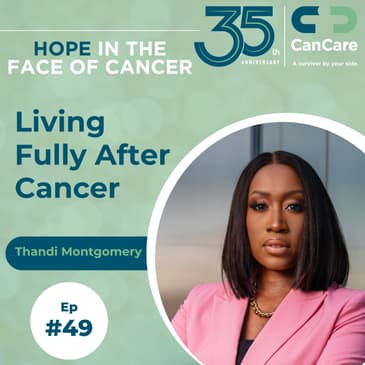
What if cancer became the moment that finally brought you back to life?
In this episode, Thandi Montgomery, coach, speaker, and founder of Thandi Monee, shares how a stage one breast cancer diagnosis at age 38 reshaped everything. A busy advertising executive and mom of two, she moved from constant motion to a life grounded in purpose, self-advocacy, and healing.
Her journey began with a simple self-exam that led to early detection and a life changing diagnosis. Through four surgeries, 16 rounds of chemotherapy, and 30 days of radiation, she chose to actively partner in her care. She blended traditional treatment with integrative practices like nutrition, acupuncture, and mindfulness. Creativity became her outlet, helping her process fear, reclaim control, and document her experience through writing and film.
Thandi introduces her RISE framework, guiding others to recognize what happened, identify needed changes, set a new path, and elevate their voice. She speaks honestly about survivorship, including fear, identity shifts, and the ongoing work of healing.
Her story is a reminder that even in the hardest moments, there is space to rediscover who you are and choose how you want to live moving forward.
Highlights:
· How self-advocacy can change the speed and outcome of your diagnosis
· What it looks like to combine medical treatment with holistic healing
· How creativity can help you process fear and regain control
· Why survivorship is often harder than treatment itself
· How to shift from simply existing to living with intention
Mentioned Resources:
CanCare- www.cancare.org
Book – www.cancare.org/hopebook
Thandi Montgomery –www.thandimonee.com
About the Guest:
Thandi Montgomery is a breast cancer survivor, coach, speaker, and founder of Thandi Monee. Through transformational programs she empowers cancer survivors to thrive and unlock their truth. Her work centers creativity, and community, offering unwavering support and whole person guidance throughout every stage of the cancer journey. She also partners with DO Cancer to expand access to education and awareness.
Love the podcast? You’ll be moved by the book. The Hope in the Face of Cancer book shares inspiring, real stories from survivors, caregivers, and healthcare heroes. Raw, uplifting, and full of heart—for anyone seeking hope and connection. Get your copy: cancare.org/hopebook.
About Our Host:
Darcie Champagne Wells is the President and CEO of CanCare, Inc., a nonprofit dedicated to providing support to the cancer community by pairing cancer patients with survivors. Since joining in November 2020 as the third President & CEO, Darcie has driven significant growth, increasing one-to-one support matches by 45% and healthcare referrals by 66%. In 2022, she initiated the Impact Acceleration Initiative to further expand support for cancer patients and caregivers. Her leadership has earned her recognition as a “Most Admired CEO” and “Woman Who Means Business” by the Houston Business Journal, and national “Fundraiser of the Year” by RAISE. Darcie holds a BS in Business Administration from Louisiana State University and an MBA from the University of Houston.
https://www.facebook.com/CanCareInc
https://www.instagram.com/cancare_inc
Thanks for tuning in to Hope in the Face of Cancer!
We’re so glad you’re here. If this episode moved you, inspired you, or brought you a little bit of light, please share it with someone who might need it. Just hit the share button on this page or spread the word on social—your voice helps us reach more hearts.
🎧 Never miss an episode!
Subscribe on Apple Podcasts, Spotify, or wherever you get your favorite podcasts to get updates as soon as new episodes drop.
⭐ Help us grow with a quick review
If you’re enjoying the podcast, leaving a review on Apple Podcasts goes a long way. It helps others discover the show and reminds us that these stories matter. Take a moment to leave a review—we read every one!
📖 Enjoy the podcast? You’ll love the book.
Check out our book, Hope in the Face of Cancer—a powerful collection of real stories from survivors, caregivers, and healthcare heroes. It’s uplifting, raw, and full of heart. Get your copy at cancare.org/hopebook.
[00:00:08] Welcome to Hope In The Face of Cancer, a survivor by your side. Here we share hope and support to anyone in their cancer journey. I'm your host, Darcie Wells, CEO of CanCare and a cancer caregiver. Whether you're a patient, caregiver, survivor or healthcare provider, we are your cancer support community. Together, uplifting each other every step of the way. No one should face cancer alone.
[00:00:37] Welcome to Hope In The Face of Cancer, where we share real stories of courageous people in their cancer journey. Today's guest is someone whose story reminds us that healing isn't just about medicine. It's about meaning. At 38 years old, Tandi Montgomery was a busy mom, two young children, and a thriving advertising executive when she found a lump in her own breast. Being diagnosed with breast cancer changed everything.
[00:01:05] What followed were four surgeries, 16 rounds of chemotherapy, and 30 days of radiation, but also a profound transformation. Through her breast cancer journey, Tandi discovered the power of creativity, community, and self-advocacy. She blended conventional treatment with holistic healing and used creativity as medicine for the soul.
[00:01:29] Today, she's a coach, speaker, and founder of Tandi Monet, a platform helping women move from simply existing to truly living. She also partners with Do Cancer, an organization empowering patients through a wide range of care programs for whole person healing. Tandi's story is about rediscovering purpose, finding beauty in the hardest moments, and learning to live with authenticity and joy. Tandi, welcome to Hope In The Face of Cancer.
[00:01:58] Thank you so much, Darcy, for having me. Yes, I'm so excited to talk to you today. I know our audience will just really be so amazed by your story as I was when I first heard it. So I'd love for us to start just by kind of going back to 2021. I mean, you were a mom with two young children, five and eight, and then your world kind of turned upside down, right? Absolutely, absolutely. Take us back to that time. So what do you remember?
[00:02:27] What kind of prompted your journey? Yeah, absolutely. And so, you know, on paper, Darcy, it looked as if I was successful, but I was on that proverbial hamster wheel just trying to exist, you know? And I, of course, I had the job. I had the title. I had the family. I had the house. But there was something missing, you know? And I didn't know at the time what was missing. But I am, when it comes to my health, I am very in tune with my body. And so every year I had my well woman's checkup. So I had that checkup maybe two months prior.
[00:02:57] Everything was fine. And then I was doing my self-exam in the shower. Good for you that you were doing. Exactly. And I found something foreign in my body. I'm like, this was not here last month or the month before. And so it was a size of a pea. It was one centimeter. It was a lump in my right breast. And again, as a busy mom, as a busy, you know, executive, sometimes it's hard to stop and prioritize your health. But I was like, you know what? I have to stop and prioritize my health.
[00:03:27] And so when I came back, I was on vacation at the time. And when I came back, I immediately scheduled an appointment with my PCP. And mind you, at that time, I was 38. So I was under the age of 40, which is the standard for mammograms. But I still decided to go and advocate for myself and say, God, something's not right. Can we please go ahead and get a mammogram? And my PCP was so incredible. She moved fast. We had the mammogram, the ultrasound, and then the biopsy.
[00:03:56] And then on November 1st, 2021, at 4 o'clock p.m., that's when I heard those three words that I wish no one would ever have to hear, is you have cancer, and specifically invasive ductal carcinoma, which is breast cancer, stage one. So what was going through your mind? I mean, how did you respond? Everybody responds so differently. Yeah.
[00:04:23] And at first, of course, I was in shock, you know, because I thought that I had checked the list to stay cancer-free. So breastfeeding both babies, like I looked at the list. Yeah, but I did everything. Yes, I was eating healthy. I was eating my kale. I was exercising, doing my yoga, downward dog. I was doing all of that. And so I was like, and it doesn't run in my family, of course. And so I was like, this is unexpected. It really was. And so, again, so many thoughts went through my head.
[00:04:51] I no longer was thinking about the presentation that I had to do. I was no longer thinking about all of my tasks. I was thinking about how long do I have to live and what's going to happen to my husband, what's going to happen to my kids if, you know, I may not be around. And so the priorities became the priorities. That's right. Yeah, life shifts. Your purpose and your focus certainly shifts. You had young kids and I know there's, you know, listeners out there who are in that same situation.
[00:05:21] How did you approach having the conversation with your kids about your cancer journey? So at the time they were eight and five, so very young. And so I was very careful. My husband and I were very careful with being honest with them, but not over promising. Does that make sense? And so it was this beautiful intersection of, okay, this is what cancer is. We explained to them how the cells grow, et cetera. But we also talked about it's going to be a journey and mom's going to be okay. We're just going to have to be on this journey.
[00:05:50] Things will change. My appearance, my energy level, but stick with us. And we also gave them roles. So my daughter was like my water coach. My son was like my walking coach, right? So he's like, mom, did you exercise today? Or my daughter, did you have enough water today? And so kind of giving them roles. I love that. And then even praying and making sure that we all juice together. We did things together so that they can be a part of the transformation journey. Oh, that's beautiful. I love the picture of that.
[00:06:19] I know that self-advocacy is very important to you. In fact, you've mentioned that you felt like self-advocacy saved your life. Absolutely. What does that mean to you? And for our listeners, what does that mean for them if they're walking through a cancer journey? Yes, I would say for the listeners, you know your body better than anyone. And so I know they have standards and guidelines. And oftentimes we go to the doctor. We may only get 10 or 15 minutes.
[00:06:49] But if you advocate for yourself, finding your voice really and to go in knowing that, okay, this is what's going on. So you go in with a plan because, again, you only have 10 to 15 minutes. So doing your own research, coming up with questions, which takes a lot of work, Darcy, right? Because when you're going through something, you don't want to take on that extra role. But I remember when I went in for my first appointment with my oncologist and my breast surgeon, I introduced myself. I say, I'm Tandi Montgomery. I am a strategist.
[00:07:18] I'm going to ask you questions, not because I doubt your ability, but I want this to be a mutual partnership. And I want us to make the decisions together. And so I really wanted to set the tone from day one. Yeah, absolutely. No, you certainly came very well prepared and took charge in that moment. I know not everybody has that personality with them. And sometimes just even being in the journey, it's so frightening. You can't even hear everything the doctor is saying.
[00:07:46] But I think knowing if you can play that role or if you need someone else to help you play that role, I think is important to you, like bringing that person who's the great note taker or the great question asker with you. Yeah, those are ways to handle that. I think that's so important, Darcy, because oftentimes I would be on FaceTime with some of my clients because they say, Tondi, I don't have that courage. And so I'll say, you know what? FaceTime me. When you go to the doctor, I'm going with you virtually.
[00:08:15] And so I would FaceTime, I would take the notes. I would ask the questions because they were in such a state of shock that they didn't know what to say. And so if you don't have anyone going with you, you know, in person, you can always call someone, FaceTime someone just so that one, the doctor can know that you have a team of people who care about you. And then two, you can have someone on the call who has that sound mind and can ask those questions for you. I think that's so important.
[00:08:44] And something else when it comes to self-advocacy is, yes, they have the standard guidelines of, you know, chemo, radiation and surgery, but having the questions of what else can I do and asking that what else opened the world to so many options when it came to holistic care, because I'm like, okay, what else can I do? And so integrative medicine was an integrated part of my journey, which helped me to heal and recover faster.
[00:09:11] Well, certainly no cancers are alike, you know, cancer journeys are alike. But for you, what did that look like in terms of, you know, tapping into integrative medicine in additional to the more traditional medicine and knowing that that would look different for everyone? Yes, absolutely. So with the integrative side for me in particular, I really focused on, you know, various supplements.
[00:09:36] Again, my integrative medical doctor, she worked hand in hand with my breast surgeon and oncologist. So she was able to see my record. She knew what I could take and what I could take. She knew the days that I could take certain supplements because certain supplements can decrease the efficacy of chemo. And so again, working hand in hand, knowing the plan. I also did a lot of acupuncture to help with fatigue, massage therapy. What else do we do? So much juicing.
[00:10:04] I mean, my diet was so important because it's important to heal from the inside and food is medicine. And so based on, you know, the green juice and there were so many things that I would take eating the kale and salmon just to make sure that my body had the protein and nutrients that it needed to fight and heal. And that's a great, I think, example for your kids too, you know, just showing how like mom's
[00:10:29] fighting and here's some ways I'm fighting by eating right and taking care of myself in this journey. Exactly. Exactly. Yeah, I love that. So during your treatment, you really turned creativity into a lifeline and you began writing and documenting the journey. Tell us a little bit about that journey and how that helped you through your cancer treatment. Yes, absolutely.
[00:10:58] So my background is in marketing. So I've been in marketing for over 15 years. And so I've learned how the storytelling and the beauty of language and copywriting, it really helps to heal. And so I tapped into that. And so I will remember I was in the infusion chair writing out my business plan for Tandi Monet or writing out what I plan to do or writing, creating my documentary. And my brother is a videographer.
[00:11:24] And he told me that, Tandi, regardless of how you're doing, I want you to record the good, bad and the ugly. And so I had a phone with me in the infusion chair. I had a phone with me when I was getting my hair shaved. I mean, everywhere I went, I wanted to record because I wanted people to see the behind the scenes of what happens in the day to day of a cancer patient. And so at first it wasn't comfortable, but I'm so glad you did.
[00:11:49] And so I turned that into a documentary called 16 Tuesdays because my chemo was on Tuesdays and I had 16 rounds. And I entered that into a film festival. I won honorable mention. I also did poetry. I did, you know, speaking, et cetera. And it really helped me to find my voice and to articulate what was inside. Yeah. Oh, that's beautiful. I mean, for someone listening who may not have the same background and skills you do.
[00:12:19] I mean, what advice would you give to someone about using creativity and creative outlets during your healing journey? Yes, I would say for me and for you as well, creativity can give you your control back because oftentimes when you are going through the cancer journey, you feel as though you have lost all control. And that is a real, a real, real statement. And so with creativity, it helps you to, again, find your voice.
[00:12:47] It helps you to decide, you know, what do you want to write? What do you want to do? And it helps you to get out what's inside on paper. And so it's so important that you, you find those moments, whether it's a haiku poem or whether it's just, just regular journaling to get those feelings out so that you can one day look back and say, wow, I went through that. And not only that, but as you heal, you can help someone else heal as well. Yeah. I love that. I agree.
[00:13:15] I think being able to look back maybe years later on that can be so powerful for the survivorship journey to say, wow, look at what I overcame. Look how strong I am. Yes. And that's the beauty, Darcy, because you learn so much about yourself. You learn who you are at the core, because especially as a female, when I lost my hair, when I lost my eyebrows, when I had the double mastectomy and I was flat for nine months, I'm like, oh my God, that was a part of my identity.
[00:13:45] And so I had to dig a little bit deeper through the tears, through the uncertainty, through the anger. I said, okay, what lesson do I need to learn? Right. And who am I at the core beyond the hair, beyond the makeup? Who am I? And so it really helped me to search deep and meet this person who had been buried for so long because I was so busy living up to expectations. I was so busy performing.
[00:14:10] But when life stops and you have to come face to face with what's going on, it makes you really reevaluate what you want, who you want to be around and where you want to go after the diagnosis. No, that's so true. We talked about who you want to be around. You've mentioned that in your hardest moments, it was your friends, your community that really helped you stay strong.
[00:14:37] What did your community look like during those days? And how did your community change during your cancer journey? Great question. Great question. And so kind of going back to what did my community look like? I was very fortunate to have family and friends, you know, in town. It really does take a village because, you know, sometimes, you know, I wasn't able to pick up the kids from soccer practice. So I had to have someone else pick them up.
[00:15:04] And so we had everyone, every time I had a chemo appointment, someone would take me. And so they had a sign-up sheet. Who's taking Tondi to chemo this week? Because my dad said that Tondi will not go to chemo alone. And so they had a sign-up sheet for that. They would come over and help me cook and meal prep. They would help me with the kids. So it was super important. And I also tapped into the kids' school.
[00:15:31] So I reached out to the counselors and to the teachers to let them know what was going on. So if they saw any difference in their behavior, they could help. And of course, let us know as well. So family, friends, the community, they all really helped to surround me. Church members as well to pray and give me care packages. So I was super fortunate to have that. That's wonderful. It's like you had a very beautiful community around you. And going back to your second question, Darcy, has the community changed now?
[00:16:01] So during the journey as well as now, I would say, yes, some people have changed. And so once you, it's called post-traumatic growth. So that's what I've gone through, post-traumatic growth. So there's PTSD. We've gone through that. But then what is post-traumatic growth? It is just like the psychological change that happens when you go through trauma. And so it makes you sit back and realize, OK, do I still want to live that same life? Do I still want to be around certain people?
[00:16:29] And so some of my circle has changed because I realized that as I grow, some people do not grow with you. And so you have to evaluate your circle of friends and your village and your community to see if these people can grow with you. If not, then it may have to be a friendly see you later. And thank you for all that you've done. And yeah, and just being very intentional about who you surround yourself with and that those people are feeding the stage of the life that you're in. Absolutely.
[00:16:59] So looking back on your cancer journey now, we often talk with survivors about the lessons, how cancer changed you. And sometimes we even use the word the gifts that came from cancer because you don't leave cancer unchanged. When you reflect on everything, was there a gift or something that you look back and say,
[00:17:24] I'm glad, you know, not necessarily glad for the cancer, but glad that cancer did this? Yes. Yes. I say yes. Yes, 100%. And I called it I call it the gift of tragedy. And so when I think about that, yes, it was it was truly a gift because it helped me to really stop. It was this catalyst of change that I had been looking for, but I wasn't bold enough or courageous enough to make that change. Right.
[00:17:52] And so it was that catalyst that helped me to say, wow, with this diagnosis of a possible life ending situation. It also helped me to remember to live because again, I wasn't living. I was just existing. So it was just this intersection of, okay, the possibility of death right before me. I was like, wow, because we all think we have time. You know, we all think we have until we're 80, 90, but we don't know. We are all going to die. We just don't know when.
[00:18:21] But our goal is what do we do now while we still have time? And so that's what cancer taught me was not to take life or the people in it for granted. And I wrote over 80 lessons. And one of my lessons was life changes. Your situation changes when your mindset changes. And so I had to change my mindset going into it, not seeing myself as a victim or, you know, why is this happening to me? Even though it's just crazy. I said, what do I need to learn from this?
[00:18:48] What do I need to, you know, what is a shift that needs to happen in my life so that I can become a better me, a better mom, a better wife, a better person overall? What were some of those shifts? Yeah. Some of those shifts were, again, evaluating what I'm eating, evaluating the circle of friends, evaluating, you know, where I want to go because I left my job. Yeah, that was a big shift.
[00:19:16] Yeah, that was a big shift after 15 years. So after my journey of, you know, being on short-term disability, a long-term disability for a year, I actually went back into advertising the same job. And I was sitting in the boardroom, Darcy, and, you know, talking about, you know, Fortune 500 companies, the revenue and all of this stuff. And I was like, I did not fight to survive, to come back to this. I need purpose. I need clarity. And I'm not getting it here.
[00:19:45] And so that was one of my biggest shifts was deciding to leave the corporate so that I can find more meaning and do something that allows people to live and not just increases the bottom line. Well, so that's a great segue. So tell us about what you are doing today. Yes, yes. So I am excited. Again, when I was in the infusion chair, I was telling myself, this is not the end. And so I was sitting there coming out like, what is the mission statement? What can I do with this Tom DeMone brand? Creating the logo.
[00:20:14] I know it sounds crazy, but I had to do those things because if not, I would not have had like that North Star or something that I can look forward to. I think everyone has to have a why of fighting. And it was my family and it was my future. Those are my two whys. I'm like, I, my family and my future. And so when I was doing that, when I had the energy, I'm sitting there thinking about, okay, well, who should I, who should I focus on? Like, what are the products? What are the services that I can do? And so that's when Tandi Monet was born.
[00:20:44] And, and so Tandi, of course, is my first name. It means the one who's loved and a gift from God. And Monet is a French name, which means she who is heard. And so bringing those two together, I really want to give women a voice and know that and remind them that they are a gift. Right. And so with that, we help them with this transformational journey of figuring out how do you shift from existing to living? Because that was what cancer helped me to do. No more existing.
[00:21:12] It's time to live your life full throttle. That's so exciting and brave of you to do. And what a blessing to so many women that you've been able to support now. And I know through, you know, the coaching that you do and the way that, you know, we came across you was through an organization called Do Cancer. So tell us a little bit about your work with Do Cancer. And, you know, perhaps since some of those listening may want to, you know, take a look
[00:21:41] and see what services they have to offer and what you could do. Yes. So Do Cancer has been a godsend, Darcy. I have to be honest. I started off as a participant in 2023. So I shared my story online on LinkedIn. That was the scariest moment of my life. And I said, you know, someone needs to hear this. And so I shared my story. And Brenna, who is the incredible president of the organization, she saw my story and she reached out and she said, you know, Tandi, we have this amazing program.
[00:22:10] We provide therapy, you know, integrative care, everything holistic, breath work, yoga. I was like, wow. And she said, and it's free. I was like, sign me up. And so they're out of California, based in California. And ever since then, it's just been a beautiful relationship, this journey of from becoming a participant to now being a practitioner and helping other people.
[00:22:36] We have had 10 cohorts so far doing the Resilient Narratives class to help people think about how do you turn your trauma into a creative expression. And so throughout these 10 cohorts, it has just been beautiful to see. We have a published author. We have someone who has done a documentary. We have someone who has done a book of poetry. It has just been beautiful to see how what was once something that I went through now being able to turn that into a program to help over 50 women so far.
[00:23:06] Oh, that's wonderful. What a legacy you're leaving through this work. And it's funny that you say you were scared to make that first video on LinkedIn because you've got a really big stage coming up. Yes. A TED Talk. Oh my gosh. Tell us about your upcoming TED Talk. I am so excited. This has been on my bucket list for two years, Darcy. And I realized that two years ago, I wasn't quite ready, if I can be honest.
[00:23:35] I wasn't ready, not from a skills perspective, but there was still brewing. I still had to heal. I was still learning. I was still becoming, which is an ongoing thing. But when I applied in January, the name of this TEDx particular is called The Next Chapter. And so I was like, this is the one I need to apply for because each TEDx has a different theme. And so I was like, this is it. This is the one. And so I applied. And out of 50 applicants, I was one of 14 that was selected.
[00:24:06] And so the talk will be in June. And so it's been a lot leading up to it from taking the masterclass, coaching, reading books to really narrow down what is that idea that I want to share. So TEDx is not about a stage for inspiration. You know, it's about what is that core idea that you can share to give other people around the world hope to have a different frame of thought that they may have never thought about before. And so I'm so excited. Yeah.
[00:24:35] You're going to have to let us know when it's live so we can share it with our audience. Yes, absolutely. Absolutely. I'm excited. So speaking of our audience, you know, I would love for you to share, you know, maybe some of the things that you use in your coaching. I know one of the tools you've talked about is with me is RISE tools, a framework that you use. So tell us a little bit about that.
[00:25:04] Maybe our audience can learn. Absolutely. So as I was going through my journey, I love acronyms. It's a way for me to remember things. And so as I do my speeches or as I do my guest lectures, I always use some type of acronym. And so this one in particular is the RISE acronym. And so it's like, how do you begin to shift from existing to living? And so I take them through this journey. The R stands for recognize what happens.
[00:25:33] And that is, of course, the awareness phase. It's hard to become if you don't first go back and realize, okay, what did I just come from? And so that's that stage of really understanding, wow, I just went through something traumatic. I need to give myself space and grace to heal. And so it's not skipping over. The reality is spending time with what happened so that you can, of course, figure out, okay, in this traumatic situation, who was I? Tandy 1.0. And who do I want to become?
[00:26:02] Tandy 2.0. And so that's the R. So recognize what happened. I stands for identify what needs to change. And so, again, as you're going through your journey, as you're going through your post-traumatic growth, there may be some things that you don't want to take with you in this next journey. Or this next version of you. There may be some things that you want to switch up, like your diet, like looking around your home to figure out, do I need to eliminate some of these microplastics?
[00:26:30] You know, really understanding the environmental toxicities. And so I went through this whole detox of, okay, what can possibly cause cancer? Of course, there are so many things out of our control, but there are some things that are in our control as well. And so just kind of going through and understanding what I was putting in my body and what I was putting on my body. And so detoxing from that as well. So that's the I, identify what needs to change. And then S is set a new path.
[00:26:59] And so again, kind of going back to, I don't want to go back to the old version of me. You know, I never want to go back. She was an amazing person. She served me well, but she has to stop right here. And so when I think about shaping a new path, Darcy, one thing that comes to mind is the chrysalis phase of the butterfly, the caterpillar. There is a lot of inner work that has to be done. So once it goes from the caterpillar to the chrysalis, there's a lot of inner work that happens that nobody sees.
[00:27:28] And that's the thing that's about it. Like, okay, let me do my yoga. Let me do my breath work. Let me heal. Let me work on me. And the beautiful part of the chrysalis is you have to, again, a part of you is dying. So the caterpillar is slowly dissolving in that chrysalis and slowly the butterfly is forming. And it's that struggle and it's the resistance that helps you to break out of the chrysalis, which makes you evolve into this beautiful person.
[00:27:54] And so I just love that analogy because again, when you think of the chrysalis, no one can break open the chrysalis because it will disrupt the process, right? And so it's important for you to stay in there for as long as you need to do the inner work, dissolve the old person so that you can become who you really are. So that phase is all about the inner work. That's the S. And then the E is for elevate your voice and help others.
[00:28:21] And so once you have gone through that phase, it will be a disservice to the entire world for you to go through something traumatic and not share it with at least one person, right? So you don't have to share with a million people, but if you can share with that person who is sitting next to you scared in the doctor's office because they don't know what's going to happen, or if you can share it on a podcast or if you can share it on, you know, social media,
[00:28:46] whatever it may be, it's so important that we learn how to share what we've been through with other people. That's beautiful. I love that. I'm going to put that in my pocket and take it with me. That's wonderful. Thank you for, and I know so much went into creating the curriculum for your work through your own lived experience. And that just makes it so rich. Yes.
[00:29:12] And sometimes Darcy, you know, for those who are listening, I don't want to paint this rosy picture, right? Because the survivorship phase is very difficult. You know, I'm afraid all the time, like, okay, is it going to come back or, you know, what's going to happen? You know, there is this fear, this underlining fear. I don't care how much faith you have because I'm a believer, but there's always this underlining fear of what if I eat this? What if I do this? What if I do that? Will it come back? Right. And so it is difficult.
[00:29:39] And so my work helps me to heal as I am interacting with other survivors or those who are going through. It's actually helping me to heal, to see that I still have purpose on this earth and I am going to use this second chance to the fullest, right? But it's not this pretty rainbow of everything is going to just be glorious. Once you go through your treatment, it's very difficult. And so I've, you know, I have a therapist. I have a group of people who I can really rely on if I'm going through one of those moments
[00:30:08] because it happens. You can see a picture of yourself when you were bald. You can smell a certain smell from the doctor's office. You can hear that beat. That sounds like the infusion and it can trigger you and take you back to those moments. And so it's important to know that it's not just going to be an easy road, but, you know, with help, with family, with faith, with focus, you can get through it. That's right. Yeah.
[00:30:34] I think for those watching the cancer journey from the outside, I think the assumption is you ring the bell, you're done. But I think in so many ways, the inner work just begins, you know, because when you're in treatment, you're focused on the healing of your body and making sure you're, you know, complying with the regimen and doing everything you need to do.
[00:31:02] But a lot of that emotional and mental and identity work, I think happens after you get through treatment. I would agree 100% because if you think about the journey of treatment, you're so heads down trying to focus on scheduling appointments, making sure the insurance is paid for. You know, there's so much going on that you really, you're heads down trying to literally survive. And then after it's like, okay, I have time now, but what do I do? You know? And so you're right, that inner work is so important.
[00:31:32] So whether it's seeing a therapist, whether it's the breath work, whether it's journaling so that you can process your feelings, it is so important for you to reconnect with yourself because you have been disconnected for so long. And so I would say that survivorship phase is about reconnecting to who you are so that you can become who you want to be. That's beautiful.
[00:31:54] Well, there's a woman listening right now who might've recently just heard those words, you have cancer. What would you want to say to her in this moment today? Well, first know that I am reaching out and giving you a digital hug. I'm there with you because I don't know exactly what you're going through. I've been there, but everyone has their own journey, their own feelings.
[00:32:24] And so I would say, lean into all the emotions. Don't try to be strong. I had to burn my superwoman cape. I said, in this moment, I will not try to be strong all the time. There's this misconception that, oh, you have to be strong. You have to be resilient all the time. No, lean into those emotions, the fear, the anger. They're there for a reason. And I would say, minimize how much time you spend there, but don't dismiss those feelings
[00:32:52] and emotions because they are there for a reason. So lean into the anger, lean into the uncertainty, but also know that there is help. Also know that find something that you want to fight for. So if it's for yourself, if it's for family, if it's for your future, find that one thing that is going to help you to say, I am going to do this and I'm going to fight for my life and for whatever else it is that you're fighting for.
[00:33:19] And I would also tell yourself, give yourself space and grace because there will be a lot of uncertainties in this journey. Case in point, when I was going back to get my double mastectomy, I was only supposed to have a double mastectomy and have reconstructive surgery. After my surgery for double mastectomy, they found that it was in my lymph nodes. And so what was supposed to be a two month journey, Darcy ended up being a 12 month journey.
[00:33:47] So when I say give yourself space and grace, you don't know exactly what's going to happen, but just allow yourself to know that you are healed, you are whole and that you can get through this. I love that. Beautiful. Thank you so much, Tandi. And just thank you for the dedication that you've, the new purpose that you found in your life and how you're pouring that out on others. What a blessing to have you out there supporting people during their journeys, whether it be cancer
[00:34:15] or other traumas that they may have found in their life. So thank you for that. And I would encourage anyone listening to look into Do Cancer. They're an incredible organization, a great partner of CanCare because they do a lot of things we don't do and we do things they don't do. So it's a beautiful partnership we're honored to have and wonderful resources. So I would encourage anyone listening to check out Do Cancer.
[00:34:43] And if you are listening and you have just heard those words, you have cancer, CanCare is here to support you. And we do that by matching you with someone who has walked the path you're currently walking. So we match you with someone who has had the same diagnosis, the same treatment journey, someone who really understands what you're going through. So we would encourage you today to reach out to CanCare so we can match you with a survivor by your side.
[00:35:10] It's a critical part of the emotional healing journey of cancer. And if you are a cancer survivor or you are a cancer caregiver and you want to give back, you know, Tandi talked about the beauty of serving others and how that's part of healing. Our volunteers tell us the same thing. They're continuing to heal from their cancer journey. And part of that healing is them giving back. So I would just encourage you if you're listening and you're in that place where you want to use
[00:35:37] your journey for good for someone else, reach out to us. We would love to have you as part of the CanCare family. And until next time, remember there is always hope in the face of cancer. Thank you for joining us on this episode of Hope in the Face of Cancer, a survivor by your side. If you or someone you know is facing cancer or is supporting a loved one through their journey, we invite you to share this podcast.
[00:36:06] As a cancer survivor, your journey carries invaluable wisdom and insight. We would love for you to get involved in CanCare's mission of becoming a survivor by the side of someone facing cancer. Please visit our website at cancare.org slash volunteer or click the link in the bio for more information on how to get involved. Our survivor volunteers have been a beacon of hope for so many. Thank you for your support and our efforts in the cancer community. No one should face cancer alone.