
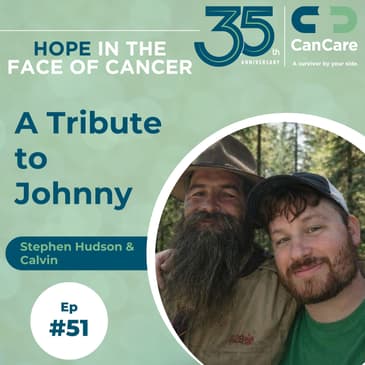
What does it mean when a stranger who understands your cancer journey becomes family?
Stephen, a brain cancer survivor, and his husband and caregiver, Calvin, share a deeply moving story about diagnosis, fear, friendship, and the unexpected gift of human connection. After Stephen experienced a seizure at work, doctors discovered a brain tumor that changed the course of their lives. Through the support of family, coworkers, faith, and the CanCare community, Stephen was matched with Johnny, a fellow brain cancer survivor who quickly became far more than a mentor.
What started as peer support turned into a daily brotherhood built on honesty, humor, and shared understanding. Johnny helped Stephen see himself as a survivor and reminded him that life was still meant to be lived fully. Calvin opens up about the caregiver role, the helplessness that can come with it, and how Johnny filled a gap no medical treatment could reach. Together, they reflect on grief, resilience, and the kind of connection that leaves a permanent mark on your life.
This conversation is a tribute to Johnny’s legacy and a reminder that even in the hardest seasons, people can show up with extraordinary love, hope, and compassion.
Highlights:
· Discover how shared lived experience can create healing in ways medical care alone cannot.
· Learn why caregivers often carry emotions differently while still becoming a steady source of strength.
· Hear how humor, honesty, and everyday conversations became part of surviving brain cancer.
· Explore how support systems from family, coworkers, faith, and community can shape recovery and resilience.
· Understand why opening yourself to connection during hardship can change the entire cancer journey.
Mentioned Resources:
CanCare- www.cancare.org
About the Guest:
Stephen Hudson is a brain cancer survivor, devoted husband, and living testament to the power of human connection. When his diagnosis turned his world upside down, he leaned on his faith, his family, and ultimately a friendship that would change his life. Through CanCare, Stephen was matched with volunteer Johnny Parry, a fellow survivor who walked beside him with understanding, steadiness, and a brotherhood that became one of the most meaningful relationships of his journey. Sadly, Johnny passed away late last year. Stephen made the courageous choice to continue with this episode to honor Johnny's life and legacy. Calvin, Stephen's husband and caregiver, has been present through every moment of this journey and is here to share his heart as well.
Love the podcast? You’ll be moved by the book. The Hope in the Face of Cancer book shares inspiring, real stories from survivors, caregivers, and healthcare heroes. Raw, uplifting, and full of heart—for anyone seeking hope and connection. Get your copy: cancare.org/hopebook.
About Our Host:
Darcie Champagne Wells is the President and CEO of CanCare, Inc., a nonprofit dedicated to providing support to the cancer community by pairing cancer patients with survivors. Since joining in November 2020 as the third President & CEO, Darcie has driven significant growth, increasing one-to-one support matches by 45% and healthcare referrals by 66%. In 2022, she initiated the Impact Acceleration Initiative to further expand support for cancer patients and caregivers. Her leadership has earned her recognition as a “Most Admired CEO” and “Woman Who Means Business” by the Houston Business Journal, and national “Fundraiser of the Year” by RAISE. Darcie holds a BS in Business Administration from Louisiana State University and an MBA from the University of Houston.
https://www.facebook.com/CanCareInc
https://www.instagram.com/cancare_inc
Thanks for tuning in to Hope in the Face of Cancer!
We’re so glad you’re here. If this episode moved you, inspired you, or brought you a little bit of light, please share it with someone who might need it. Just hit the share button on this page or spread the word on social—your voice helps us reach more hearts.
🎧 Never miss an episode!
Subscribe on Apple Podcasts, Spotify, or wherever you get your favorite podcasts to get updates as soon as new episodes drop.
⭐ Help us grow with a quick review
If you’re enjoying the podcast, leaving a review on Apple Podcasts goes a long way. It helps others discover the show and reminds us that these stories matter. Take a moment to leave a review—we read every one!
📖 Enjoy the podcast? You’ll love the book.
Check out our book, Hope in the Face of Cancer—a powerful collection of real stories from survivors, caregivers, and healthcare heroes. It’s uplifting, raw, and full of heart. Get your copy at cancare.org/hopebook.
[00:00:08] Welcome to Hope In The Face of Cancer, a survivor by your side. Here we share hope and support to anyone in their cancer journey. I'm your host, Darcie Wells, CEO of CanCare and a cancer caregiver. Whether you're a patient, caregiver, survivor or healthcare provider, we are your cancer support community. Together, uplifting each other every step of the way. No one should face cancer alone.
[00:00:37] Welcome to Hope In The Face of Cancer, where we share real stories of courageous people in their cancer journey. Today, we're joined by Stephen, a brain cancer survivor and his husband and caregiver, Calvin. When Stephen was diagnosed, his world shifted in ways no one could fully prepare for. Through CanCare, he was matched with a volunteer named Johnny, a fellow survivor who understood that journey from inside out.
[00:01:03] What began as peer support grew into something far deeper. Stephen and Johnny formed a bond built on trust and shared experience, understanding, and a steady kind of brotherhood that became one of the most meaningful relationships in Stephen's life.
[00:01:22] Sadly, Johnny passed away late last year. This episode was originally planned to bring both Stephen and Johnny together to share their story. Stephen made the courageous choice to continue with this conversation to honor the life Johnny lived, the love he gave, and the light he carried into every relationship. Calvin has been at Stephen's side through every twist and turn of this journey. As Stephen's husband and caregiver, he has seen it all. The fear, the hope, the friendship.
[00:01:50] And the grace that came from it. And the grace that came from it. And he's here today to share his heart as well. This episode is lovingly dedicated to the memory of Johnny. We hope that through Stephen and Calvin's words, you will come to know him the way they did. And that his spirit reaches whoever needs it most today. Stephen and Calvin, thank you so much for joining us and sharing your journey with us today. Thanks for having us. I really appreciate it.
[00:02:17] Absolutely. Well, I would love for our audience just to get to know you both a little bit more. So let's just talk a little bit about kind of life before cancer. What, Stephen, what do you do for a living and kind of what your interests are and just kind of what makes you you? Currently, I'm a special education teacher at an elementary school. I do resource. So it's a little different from life skills.
[00:02:45] It's more for kids who are in a genetic classroom that have certain disabilities but need extra support. So I pull them out. It's always been something that's been in my life. Ever since I was little, I was always attuned to kids who were in life skills who had different, more severe disabilities.
[00:03:08] I had a friend, Amy, who I still am in contact with her mom today. She's doing really well. And there was another girl named Stephanie who was like, she had an oxygen tank. And I was really close with her too growing up. She invited me to one of her birthday parties, which was a bowling party.
[00:03:32] So I've always just been drawn to people with disabilities and just the love they have. It's unwavering, you know? Yeah, absolutely. It truly is. And so, you know, that's how I want to give back.
[00:03:56] It's just being with my unwavering, you know, love and support to encourage them to be the best they can be in life. Thank you. I mean, thank you so much. You do incredible work. And it takes a very special person to do what you do. And it's clear. Your heart is clear. That's for sure. Calvin, how would you describe Stephen to someone who maybe hasn't ever met him? Well, Stephen's very funny.
[00:04:27] He makes me laugh constantly. And it's hard because I'm a very stoic person. So it's hard to, you know, get a lot of emotion out of me sometimes. But Stephen's like very, very good at it. And he does it through his... It's probably like a challenge. Like, let me see if I can get Calvin to laugh today. The thing that... The most important thing about Stephen, though, is, you know, his heart.
[00:04:53] You know, he holds all of his emotions out there for everybody to see. It takes the kind of bravery that, you know, a lot of people don't really have. People are not comfortable being vulnerable. But Stephen is always willing to put his emotions and his heart out there for other people to have and use in the way that they might need it.
[00:05:22] But he... I don't know. He's just... He's caring. And he notices things that people don't notice in terms of, like, other people's emotions. He's always very empathetic. Very empathetic. Yeah. Special. Very special guy. So, Stephen, take us back to the time when you noticed something wasn't quite right. Kind of what was going on?
[00:05:48] How did you ultimately end up discovering your cancer? Well, a lot of things were going on around that time before I found out. I just lost my grandma. She lives with my mom. And so we were very close. I grew up with her, all these different things.
[00:06:18] So I was very close with her. And I think this kind of, like, put into perspective a little bit more. And I guess I'll explain that better. But when my grandma passed, it was right before March, which is my birthday. You know, I started... All these things happened right after my grandma passed. And I think that she was my, you know, guardian angel.
[00:06:48] And that's in a sense. Because after she passed, I started getting little signs like the brain fog, things like that. It was very mild at first. It was so mild that I didn't even realize that at first. But it was... It just, like... I just, like, misplaced my thoughts.
[00:07:16] Or, you know, I would write something in a text message. And then I couldn't even read it back because it made no sense. And that's when it got getting... Was getting progressively worse, I guess. And that's when I, you know, I would drive to work. And I didn't even know where I was... I knew in my... I knew the way to work, obviously.
[00:07:46] But I was getting confused, you know. So I had to, like, stop and readjust for a few seconds. And so... That was... It's getting worse and worse. Eventually, there was the day that I had, you know, the seizure. So I was at work. It was a normal day. Everything was fine.
[00:08:15] I was towards the very end of the day. And... I... I was about to go to my last class of the day. But I was just feeling really, really off. And I... Instead of going to the last class of the day, thank God. I went to my principal instead. And I told her, you know, I'm feeling really weird.
[00:08:44] Like, when I'm talking, things aren't making sense. And literally within a couple minutes of me finishing that sentence, my right arm went stiff. And I was like, that's weird. Because I've never had that happen before. It's like, why is that happening? Why is that happening? And then my other arm went stiff. And then... Within seconds, I, like, fell backwards into the chair and started having a seizure.
[00:09:13] I don't remember much after that. I know I was... I kind of, like, was in and out of consciousness, I guess. Where I remember my principal was in the ambulance with me. And then I think I was in and out again. And I don't really remember much.
[00:09:32] I just know that the original place I was at, they had to take me to, like, I think it was downtown, to get a better understanding of what happened. And that's when they found out that I had the tumor in my brain. Do you remember that moment, you know, when they told you that this was a brain tumor? I mean, how did you react? How did you process that?
[00:10:03] I don't know if it really hit me the first time. Because I think the biggest thing was after, when everything's kind of, you know, settled a little bit. You know, I had the initial conversation with Dr. Tanden, I think. Yeah. Where he's the one who said, you know, you have this brain tumor. And at that point, it's like shell shock, you know.
[00:10:31] I'm glad that Calvin was there with me, you know. Because he quickly just jumped in and was asking all the questions. And I just, I was basically just, like, stunned, you know. I was in so much shock that I didn't even, I didn't talk. I don't think I had, I don't think I said anything that whole time. I'm not sure. It's almost like Calvin just took over.
[00:10:58] And from there, it's just, you know, it's like, okay, well, this is, this is the next steps that we've got to do. And, and so that, that, that's what we did. He took down everything. And he helped me process it, you know, slowly over time. Yeah. You were definitely a rock, Calvin, in that time.
[00:11:26] And, man, the caregiver is so critical, you know, to the whole cancer journey. They're just absolutely essential. And especially for those moments where you can't even process everything you're hearing, that they can, you know, help be that, that role, you know, play that role for you, I think is incredible. Calvin, what was all of this like for you?
[00:11:51] I mean, getting the call that, you know, he's been rushed to the hospital and just the aftermath of all of that. Tell us what was going through your mind. Yeah. I mean, I was at work, too. We were, it was at my previous job that I'm not with anymore. But I remember, you know, his, the secretary at the, at the, at his school had called me because I'm the emergency contact.
[00:12:16] And I had rushed all the way back to, because I was downtown, but the hospital that they were taking him to was the closest one. So I had rushed there and actually, I had actually gotten there before the ambulance had gotten there. So I was waiting when he arrived. And we were there for a little bit. And it was kind of a bit of a, you know, like a roller coaster. We didn't know why he was having the seizure at that point. They hadn't done a CT scan yet.
[00:12:44] You know, when we got there, they had gotten him into the CT scan. And they had come back saying, okay, there's this thing that's on here. It's, they said it's four centimeters long and, or however many centimeters. But they said that they didn't know what it was. They said that, well, like, you know, like your tumor, it could be an infection. It could be a lot of different things. And we weren't sure what it was, but that's when, you know, they said, well, we have to go downtown because they've got better equipment there.
[00:13:10] And that's also where the neuro, you know, department was for the hospital system. And then, you know, we got there and this was all at night. They transported us, you know, from there downtown, probably maybe about like 10 o'clock at night by the time this had happened. And they had taken him in for his CT scan. Or his MRI is more, you know, his bigger MRI, more sensitive equipment in the morning, maybe like four or five in the morning.
[00:13:38] And then it wasn't until about like 10 or so AM that Dr. Tandon, who was a surgeon and Dr. Shue, who's his oncologist, came in to talk to us about, about it. And I remember thinking, you know, and leading up to it, you know, when he was getting the brain fog, you know, I was attributing it to stress, you know, because he has a stressful job and the world is stressful. And you just lost your grandmother.
[00:14:08] Yeah. And I remember thinking, you know, it didn't even really occur to me that it could be something like that because that's so, it's so far fetched, you know, just the idea that that could happen. But it does happen, you know. And so, you know, I'm a very compartmentalized kind of person, the way my mind works.
[00:14:28] So, you know, obviously it was emotional, but I felt like I couldn't be emotional right in the moment that I needed to hold space for myself sometime, sometime later for that.
[00:14:45] Because I knew that he was going to need me to come in and be the facts person, the data person, the remembering person, the archivist, the recorder, you know, all those things that, you know, you need to be, you know, functional. So, you know, just to make sure that, you know, every step from that moment forward, we need to make the right decisions and we need to make them fast and we need to make them, you know, in a healthy way.
[00:15:14] So, I didn't allow myself to be too taken by it at first. It wasn't until, you know, I think, you know, a couple of days after that I started to let myself feel my emotions for it as well because I was finally able to. But it's so hard.
[00:15:39] I remember the first couple of days, how strange the atmosphere, the air hung in a way that was very strange. Everything just felt so silent because in those moments when that happens, you don't know what to do. So you don't do the things you normally do. You don't watch television or listen to music or play a video game, something that we enjoy doing. And you just hang in your feelings about it.
[00:16:08] And it feels, and then the world just feels so silent. And I remember thinking how off-putting and strange that was. And you don't have a choice but to start feeling those emotions. And yeah, it was a couple of days after that where I was sitting in that silent world of this just happened to us. And the world just changed in such a profound way that, you know, I finally allowed myself to start, you know, feeling it. Yeah.
[00:16:36] The fear and the, you know, empathy and, you know. Yeah. So when the doctors came in, after they had run all the tests, did they have a diagnosis at that point? Well, no, they knew that it was, you know, a tumor. They knew that it was most likely, you know, they, you know, his type of tumor is a slow-growing tumor.
[00:17:06] They kind of were able to tell from the MRI scan. At least they had a very good idea of the type of tumor that it was, you know, I guess. I can remember what it was. It was, well, after they had done the pathology. So, you know, they had to, in order to get the real information, they had to wait until they actually got some of it out so that they could have like an actual sampling of it to do the pathology to really kind of, you know, do it so.
[00:17:34] And it was then that they, you know, like when we had gone in, the pathology was ready is when he was ready to get the staples removed. Because he had the staples in his, in his head from the scar. So it wasn't until after his surgery, which was maybe about three weeks, maybe, you know, two and a half weeks after the diagnosis is when he was having his surgery. You know, and they said that it was an astrosarcoma.
[00:18:05] Something along those lines, you know, and, and, and it's, and the good, I mean, I don't know what the good thing about, well, my understanding, I'm not, you know, a brain doctor. Is that, you know, it's harder for a tumor that's in the brain to spread to other parts of the body. So it's not like, you know, you get liver cancer, you have to worry about it going to the lungs, about going to, you know, your kidneys or, you know, any number of different things. The brain, brain tumors typically stay in the brain and they don't, they don't travel around the body.
[00:18:33] So it's not about like stage one, stage two, stage three, where are you in, in the growth of the cancer, but it's more about, you know, with brain, what my understanding is with brain tumors, they're graded. It's not stages, it's grades. And they said that his grade, they, they weren't sure of what they should grade it, a two or a three. But eventually they decided to grade it a three. So it's, I guess, kind of on the lower end of the three, you know, and I guess the gradient goes up to four.
[00:19:03] Or five, maybe. I'm not sure. Like how, how high the grading goes. But I remember that we found that out when, when we went into, when they were there to take the staples out of his head. So it was, you know, weeks after you, you know, the, the emergency room visit before you really had, had the surgical procedure. And then, you know, time after that to learn. I can't imagine what that waiting was like.
[00:19:33] Stephen, how did you, how did you cope in that time before having all the answers? It was, it was scary. Because even if I'm thinking before all of this, before the surgery, all of that, I, I had, I remember a specific conversation I had with my principal.
[00:19:59] You know, and this was obviously after I, I had, you know, you know, I had the seizure in her office. But I, she pulled, I pulled her aside and I'm like, I'm really nervous about the surgery. I don't know what's going to happen. And the biggest thing that she said is, what, what's your biggest fear? And I said that I'm not going to be able to teach anymore. That I think maybe I won't even be able to talk anymore. You know, it's your brain.
[00:20:27] You don't know how this will affect you. And she said, she said, no matter what, you'll still be a great teacher. And we'll make, we'll, we'll, we'll, you'll figure out a way to, to get the information out there. Even if you can't talk, you know, she said, she was so confident in my ability to get through. No matter what. And so that really stuck out to me. So that, I.
[00:20:57] Yeah, that had to have been a huge relief to get that level of support from your employer. Yes. And I think that it is really helped me, you know, go through this. My mom's very, very religious as well. You know, she had from the day we found out all this stuff. There's a whole team of people just praying over me. Um, and it was, it was just, it was just amazing, you know?
[00:21:26] So to cope, I feel like it was a lot easier leading up to it. Cause I felt like I had so much support, you know, which, which, which I understand most people don't have that, you know? Um, but I have Calvin, I have my mom, I have a team of people who are praying over me. You know, I have my boss who was super understanding.
[00:21:50] Um, and so it, it made it a little bit easier, even though I had my own doubts. It, it, it made it, um, sorry. Yeah. Even though I did have doubts initially, I think it was quickly calmed by the huge support system I had all around me. That's beautiful. That's wonderful.
[00:22:18] So you must've felt at some point, or maybe Calvin, you noticed this, um, that even though you were surrounded by incredible support system, there was something missing that made you, you know, reach out to CanCare and ultimately find Johnny. Tell, tell us a little bit about that decision and kind of how you, what led you there?
[00:22:39] Um, I think at first I, I have a counselor at my elementary school and she, her mom went through breast cancer. And so she's like giving me all these different ideas of what I can do to reach out or to find stuff. Um, and so I, I was thinking a lot on that and I was trying to find different support groups and I think I was on my phone.
[00:23:08] You know, and so I was, I found CanCare and, uh, I, I, I don't know if it's different from web browsing versus a phone or maybe I just didn't understand the format exactly. But I signed up and then I completely forgot about it for a while, um, until I found an email and it said, you matched with Johnny.
[00:23:34] And the biggest, the biggest joke I always say is like, what is this tender? You know, because we call ourselves the match.com of CanCare. So yeah. Because like, what do you mean? Like we, we, I matched. Cause I didn't even like reach out or, you know, so I guess by some, some way he found me and he decided to match with me.
[00:23:58] And that was, you know, that ended up being the biggest blessing out of all of this, you know, like it started off really, really easy. And it, it was, you know, like it was just like stuff that he learned that helped him through. And then it just, it evolved so much. Yeah. Like he really became a brother to me, you know, it's, it was amazing.
[00:24:27] The things that we could just talk about, not just really, not even just about cancer, but just about our day. Just how, how we go through life and the experiences we have. We talked literally every, every day, you know, it, yeah. Yeah. And it felt weird if it wasn't like, you know, a whole, a whole big, like a whole day of not talking. Like, that'd be weird. You know?
[00:24:58] It's like y'all became brothers, like almost immediately just had this amazing connection. Absolutely. Yeah. And of course he taught me great coping skills. Yeah. Um, he taught me that I, to say like, I am a survivor and I, you know, that's something that I'm still. Understanding, you know, at times, because sometimes it feel, it still doesn't feel real.
[00:25:25] And now that Johnny is passed, um, it's been harder to get back in that mindset of, um, being a survivor. But even today, I don't know. I see your pen. Yes. I see your pen. Yeah. Johnny bought me that pen, you know? Oh, wow. And he is the same one that he would wear all the time.
[00:25:50] Um, I think even with Julian, um, when we were meeting with him before this happened, um, he was wearing it. So this is kind of my way of saying like, oh, he's still with me, you know? He's absolutely still with you. Yeah. Um, but. Calvin. I'm curious. Go ahead. Sorry. Calvin.
[00:26:16] What did the introduction of this relationship with Johnny and how did, how do you, from your perspective, how did it change things? Um, I mean, it was very welcome. Um, you know, there's only so much I can do, you know, I don't have brain cancer, you know, and I can plan and I can make sure that we're eating right. And I can try to keep his spirits up.
[00:26:42] Um, but I'm not, um, you know, I'm not, I'm not, I'm not really good at that sort of thing. You know, it's not, it's not, it's just, it's just a limitation that, you know, I have, I'm really, really good at a lot of the other stuff that he needs, but I'm not always really great at, you know, saying the right things. Um, and, um, and what's even needed, um, in this, I mean, this was, you know, cause you didn't connect to Johnny until this was after he had done his, uh, radiation. Yeah.
[00:27:12] And he was, he had already maybe done like a month or two of, of, of the chemo. Yeah. Cause you, you, you, you did, you did the surgery and then you didn't start the chemo until like August, um, afterwards. Cause they had to wait and it takes, it takes a while. Like, um, so he got connected with him and, and, and this whole time he just didn't really have anybody. Steven didn't really have anybody to talk to about it. And I would try as much as I can, but I come from a very logical place.
[00:27:41] So, you know, a lot of my advice, a lot of my, everything is like, you know, like seeing this from like a logical way. If you, if you can, if you can wrap your brain around it logically, then you can wrap your brain around your emotions and how you feel about it. But that's not how Steven works. That's not how Johnny works. And he needed somebody like Johnny, like, like the way that Johnny works in order to really help him through it. And, and so I, and, and, and I'm so grateful that, that Johnny was the person that he got blessed with. Yes.
[00:28:08] Because, um, because, um, you know, I can imagine if it were a lot of people probably are going to be nervous about connecting with someone that they don't even know. Right. Lives in a different state about something that's so personal. And so, you know, and, and so, you know, and so scary and to be able and, and, and the Johnny Steven combination, these two people being able to come together. It was, it was a perfect match.
[00:28:35] It was a perfect mix because there are two types of people that aren't going to have those kinds of, of kind of, you know, those, those, those reservations about connecting with somebody that they're not already, that's not already a part of their, of their lives, of their social sphere, you know, of whatever. And, and so, you know, it was just a matter of time, even if, even if there was no cancer in either of them, if you had ended up getting the two of them together, at some point they would have formed this relationship anyway.
[00:29:05] Because, because, because, because they had that, that similarity and, and being able, and, you know, my understanding is Johnny had had a couple mentors before. Or mentees before us. And I was his third, third mentee. He had two. Yeah. But he hadn't, he hadn't developed anywhere close to the kind of relationship with them that, that you had with them. So it just seems like it, I mean, truly it's a cliche, but meant to be like, I think about all those prayers that were covering you in this time.
[00:29:33] And I can only imagine, and I get the chills thinking about that. Johnny was like an answer to prayer. I mean, he was just the perfect match for you. And it's life changing. It's so beautiful. I'm, I'm just so happy that you got to have that time with him. And tell us, tell our listeners, because they don't have the benefit of knowing this man, who we've all grown to know and love.
[00:30:01] Describe Johnny to, for our listeners, so they can get a little bit better of an idea about, I always look at him as kind of like the mountain man with the big heart. I don't know. Yeah. Johnny was one of a kind. He was in Palo Alto, California. He was a park ranger. He was also a Boy Scout leader.
[00:30:31] And so he, he loved the outdoors. He gave his life to being outdoors, you know, that was a. Sorry. It's okay. It's okay. He was very adventurous. He loved to take him and his wife would always go to different places. She's normally, she's originally from South Africa, which is super cool.
[00:31:01] So they want to go there often to visit her family. And they go like the most recent that I think I can remember is that they went on a trip to Arizona before he passed. And so there's just a lot of different things that they've done throughout their life, you know, where they've just enjoyed life.
[00:31:29] And they don't take anything for granted. And he experienced everything he could, you know, especially with his wife and his kid, Wyatt. So I think that's his name, Wyatt. Yeah.
[00:31:43] And so it's just, it's just such a blessing, you know, to have the opportunity to know someone like him because I don't think I'll ever know anyone else who has just the spirit that he had. You know, and the biggest thing before he passed, I remember this will always be ingrained in me.
[00:32:13] But, you know, there was a day that Johnny tried to contact me and it was a really bad day for me. I just, I didn't feel up talking. And so I didn't answer. And I'm sorry, I'm just an out mood to talk. I get it. I get it.
[00:32:44] He understood in a way that probably no one else could. He was just really an amazing, loving person who just understood without needing to say anything. Absolutely. A lot of love. A lot of love there.
[00:33:10] Tell us about a memory or a moment with him that you'll always carry with you that made you laugh. So many.
[00:33:22] But the biggest thing is we'd always, he'd always have his humor about things, you know, like he'd say, you know, like when something goes wrong or people act kind of like crappy, you know. He, his thing to say back is like, well, I have brain cancer. What's your problem?
[00:33:52] You know, like, I'm going through so much more and you're, you're acting like this. It makes no sense, you know. So that's something that's so, so funny that immediately sticks out to me. He always has, he always has like a quick joke to like ease tension and things like that. So, you know, there's not, there's so many things that he does that makes me laugh and makes me feel better.
[00:34:20] So it's hard to like pinpoint a specific thing. But, you know, talking about that, like, I asked six out to me the most is that he would say silly things like that. I can see him saying that. I love it. What do you feel like you're going to carry most with you about him, about your relationship, about what he taught you and the time y'all had together?
[00:34:50] I think the biggest thing is just the connection we have. I mean, I still, I still have him saved as a contact. You know, I see him every day when I opened my phone because I had him pinned to my messages on my texts. Yeah. You know, I see him every day. I think about him every day.
[00:35:18] I, there's times where I had, where I had like my, my mom's friend, her son made a little thing. Like he cowered out in memory of Johnny and, and, and he put it, I asked him to like put it in on a tree in a forest.
[00:35:46] And I think I still have the, one second. Let me find it. Yeah. He, he likes to go running and, you know, he knew that Steven was having a hard time after John's passing. And, yeah, he just, and he's been getting into woodworking and wood carving or wood burning. So, um, he had wanted to do something nice for him. And so he found this place, um, that was sort of, you know, not because not developed yet.
[00:36:16] It might not be developed for a long time. So he wanted to stay there for a long time. Yeah. Um, you know, and, and we had gone out there. Yeah. Yeah. So I'm looking right now. This is the, uh, the, the, the latitude and longitude of where he put it. Yes. There we go. So if anyone's in Houston and would like to visit this, these coordinates. Okay. You can see the memorial for our dedication for Johnny. Yeah.
[00:36:45] I'm in the middle of it. Because he loved the outdoors. He loved just picking in everything, you know? So. That's beautiful. Oh, what a special tribute to him. Yeah. I don't know if that went through. Did it show? I was able to see it and we'll, we can put it in the notes, um, of the episode too. So for all our listeners, we're going to put, uh, these coordinates and in the notes.
[00:37:11] Um, so a place of, uh, refuge in the woods where we pay a tribute to, uh, a precious Johnny. So thank you for sharing that. I love that. Calvin, um, you know, we, the caregiver role is so hard. You know, you want, you want to, you want to fix it and it sometimes can be powerless.
[00:37:34] So I can only imagine that it was a relief, a breath of fresh air, you know, to have Johnny in this role. Um, talk a little bit more about that from your perspective, um, and how essential it was for this journey. Yeah.
[00:37:53] Well, like you said, um, you know, there's a feeling of helplessness that comes from, you know, I'm very much a, whenever a problem is in front of me, my first thing is, let's not worry about blame. Let's not worry about, um, you know, it's, it's always, it's always like, how do we solve the problem? And my mind immediately goes there. And, and part of that is, you know, to protect myself from the emotions, especially for something like this, you know?
[00:38:22] So, you know, I protect myself in that way by being logical and, and, and like, let's, let's focus on finding the solution. What do we need to do? Because, you know, the emotions can come later. And I've been doing that for a long time and there's only, you know, like, and, and I'm not, I'm not, I'm not like I'm a robot or anything, you know, like, like I'm able to help Steven a whole lot.
[00:38:47] Um, you know, even not even on the, on the emotional side and making sure that we see things from, you know, the most positive perspective. Um, but, you know, there's only so much my words are, we're going to be able to do for Steven because even if they weren't coming from a completely logical place, which wouldn't be very helpful, um, you know, they're tempered with emotion as well.
[00:39:10] Um, there's just, there's this thing that's missing that I could not provide because I did not have the lived experience of it. And that's what Steven was looking for. Um, and, and that's, it's what he needed. And so, I mean, when I remember the first time he had talked to Johnny, he was like, yeah, he's Space Kai. You know, it was before like, they really, really, really, really, really, you know, like really, really connected. And he's like, yeah, we're going to talk yet for sure.
[00:39:37] Um, and then it became like this regular thing, you know, like they didn't, it wasn't like every day right off the bat. I don't know. They talked a couple of times, but then like they had, they had developed that relationship that now it was like every day. And it was almost, I'm not going to, it's not like, it's not like Johnny lifted a burden off me. I don't feel like that's what it was.
[00:39:55] It's just like he became, um, kind of, um, a partner, you know, part of the family, for me in a way to be able to, you know, be another, another, another tool in our, in our, in our tool bag to, to combat the, the, the feeling of helplessness, the, the nervousness, the, the, the fear of the future.
[00:40:18] Um, and that's the thing that Johnny was so great at, um, was providing perspective because perspective is so important when you're faced with any kind of hardship. Um, and that's one thing that, um, I feel like I'm pretty good at and Johnny was really good at and Steven needed, um, perspective.
[00:40:42] And, um, and, and with Johnny's help, we were able to provide him a perspective that kind of helped Steven, um, you know, fill that missing piece. You know, the piece that was missing for several months after his diagnosis, uh, before he met Johnny about, about, you know, about, um, his place in the world now that he has this diagnosis and, and, and what's to come.
[00:41:08] Um, um, and I think that was the biggest thing that Johnny was able to provide and something that I'm forever grateful for him. Absolutely. So time, uh, can often give us a lot of perspective. As you look back, Steven, on your cancer journey, we often, you know, ask the question, was there a gift? And obviously cancer in itself, in and of itself is not a gift by any means,
[00:41:37] but it often can change things in a way that nothing else could. As you think about who you are today and how cancer changed you, is there a gift that came from all of this? There's been so many gifts. Um, I really realized, um, how people really show up for people when they need it.
[00:42:06] Um, and not just Johnny, you know, he was the biggest gift and I could, that'd be the easiest answer, you know, but aside from Johnny, the biggest gift to just seeing how people show up for you in general, when you need them. Um, when, um, when you're feeling at your lowest point, uh, people will always be there to help you.
[00:42:29] Um, I've had people at work who had, who did mill trains, you know, when I was going through recovery, they, you know, I had so many people just stopping by, um, when I, through all this, I had, um, um, my, one of my, my mom's friends, her kids wrote multiple affirmations that I had to open every, every day.
[00:42:57] Like I pulled out a new one every day just to go through my, my healing process. There'd be different things like brain teasers or pictures of saying like, oh, you're the, the cancer warrior, or you're kicking the, kicking his butt, you know, type thing. Um, so it's just, it's just, those are the gifts that I really, really reflect on.
[00:43:23] And, you know, of course, Johnny is the biggest gift. And I, I, of course, I wish I had more time with him. Um, but I'm so grateful for what I, what I did get to have with him. And because that was, even though it was a short time, it was the best time. And I will always remember that. That's right. That's right. He'll always be with you.
[00:43:54] Well, I ask this to both of you, for our listeners, for anyone who's listening, who may be going through those early stages, learning about a diagnosis, thinking about the journey that is ahead of them. What message would you want them to hear from you today? What message of hope? I would say, don't sell yourself short.
[00:44:21] You know, when I think about, you know, the gifts that can come from is, you know, your term, your gift that can come from this cancer is not the gift, but it's what you find out and what you learn about yourself, um, you know, by going through the experience. And one of the things that I feel is a big gift for Steven, one for me, uh, mostly for Steven is, um, he got the chance and opportunity really to realize just how strong he actually is.
[00:44:50] You know, I think of before the diagnosis, um, maybe, you know, he was just an irregular guy, but then you go through it and you realize like, oh wow, Steven, you know, I mean, I've been married to him for a long time before the diagnosis and I had no idea just exactly how strong he could really be. Um, when, you know, pushed, when push comes to shove, that's that, that he had that inside
[00:45:16] of himself and he was able to pull it out with my help, with Johnny's help, with the help of his very enormous, very, very blessed support system. And, um, and that, that, that is just a huge gift. You don't sell yourself short. You never know how much you have inside of you. Just keep going and, um, and find, find those little moments that remind you just how awesome
[00:45:42] you are and how strong you can be, uh, because you're going to need, you're going to need that strength, you're going to need to be able to rely on it in those moments, you know, in the middle of the night when everything feels dark and feels like it's an insurmountable mountain. You're going to need to be, have something to remind you that you have the ability to climb over it. And, um, and I think that's one of the things that Johnny, um, was really able to help Steven realize.
[00:46:12] And, and, and what I was just watching unfold in front of me over those first couple of months and, and now, and now we, now we've, it's been two years since the diagnosis. So, um, do we have a lot more perspective even now? Yeah. That's the one, yeah, just exactly how strong he really actually was, which I was both surprised by, but also so, so grateful that, that, that he had it in himself because it's so important. Yes.
[00:46:39] Um, from my perspective going through this and I don't know if you're going to leave this out, but I might cuss a little bit, you know, but from my perspective, knowing that I went through this and the thing I would say people who are just now finding out about it, you know, be like, holy fuck, you know, just like, this is crazy.
[00:47:10] Think about it. Take all the time, you know, but also don't wait, you know, cause I didn't know. I mean, right now you do know, you, you know, to go out there and experience life, you know, Johnny didn't stop. He just kept going. He showed up every day. He did his job. He, he acted like nothing was wrong, you know? So be like Johnny and experience the world.
[00:47:38] Don't let this affect you to where you're like, I don't know what to do anymore. I guess my life is over, you know, don't think that way. Cause Johnny would never think that way, you know? So I, to me, just like live like, like, live like him, you know, live like experience the world. If you want to do something that you were nervous about doing, just do it. Just jump off, you know, jump off the deep end.
[00:48:06] You won't, you'll never, you'll never know until you try, you know? So it's just like, of course, have your feelings, cuss, be pissed off at the world, but then realize that there, that there's so much more in the world that you can experience that you can go through. So that's what I would say to people listening. Thank you for that. I'm going to ask you a tough question. Okay.
[00:48:36] What do you want to, what do you want to say to Johnny right now? Johnny, I think about you every day. I've already said that earlier, but I truly mean it. I, before I go to bed, I, I, I always ask God to just come into my dreams and bring him with, with him to my dreams.
[00:49:04] You know, I care so much about Alita and, and, and why it, and I, I want so much to reach out and say, how are you doing? Cause I know it's hard for me. I can't imagine how they're going through it.
[00:49:26] Um, but I don't want it to bring up negative feelings for them. Cause I know they're going through their own journey with it. Um, but you know, I just wanted to note that I always think about not just him, but his whole family and just, I, I care about them.
[00:49:51] Um, and I'm here, you know, to pass on his, not only his memory, but I'm here for the, to celebration of, of his family. If they ever needs to talk, you know, cause that's, that's what I would do. I would, I would want to, I, I, I know he would want me to pass on in the, his memory
[00:50:18] as well as the great things he did for, for other people, especially me. Um, and I just say, thank you for being in my life. I love you. Um, Johnny, I love you so much. Uh, you really were like the big brother to me. So, like I said, uh, it wasn't a long time that we were together, but it was the best
[00:50:48] time that we had together. And so. One that will make an imprint for the rest of your life. Absolutely. If we had glasses right now, I would say lift, let's lift a toast to this precious man. Um, we just want to salute you, Johnny. Thank you. Thank you. Thank you both. I know that this was very difficult.
[00:51:16] And I just thank you for wanting to honor his memory for one, uh, and just celebrate the incredible human that he was. Um, but also to give hope to people out there listening, um, that relationship can be found in really unexpected ways. And to open yourself up for help in ways maybe that you, um, couldn't imagine.
[00:51:45] Take a step out there. Connect with people. Um, whether it's can care or other resources that they can be true gifts in this journey. True gifts. Absolutely. So I thank you both. Thank you both for sharing your story, for your vulnerability, for your heart and your love, uh, for Johnny. And you're always, you're always, you're always our family.
[00:52:16] So just know that you, you're always family to us. Thank you.
[00:52:48] Thank you. We would love to have you in our can care family. It is truly a gift to be able to give your heart and your experience to someone walking that path. And there's just nothing like it. You know, someone who can really understand what you're going through. So I just encourage you to reach out to us at cancare.org to learn more about the support we can provide you or that you can provide to others.
[00:53:16] And until next time, remember that there is always hope in the face of cancer. Thank you for joining us on this episode of hope in the face of cancer, a survivor by your side. If you or someone, you know, is facing cancer or is supporting a loved one through their journey, we invite you to share this podcast as a cancer survivor. Your journey carries invaluable wisdom and insight.
[00:53:42] We would love for you to get involved in can cares mission by becoming a survivor by the side of someone facing cancer. Please visit our website at cancare.org slash volunteer or click the link in the bio for more information on how to get involved. Our survivor volunteers have been a beacon of hope for so many. Thank you for your support and our efforts in the cancer community. No one should face cancer alone.