
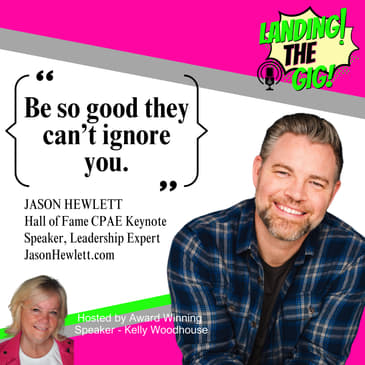
What if the reason you're not landing more speaking gigs isn't your marketing, your fee, or your sales strategy, but the speech itself?
After more than two decades as an entertainer and professional speaker, Jason Hewlett has learned that becoming more bookable starts with becoming unforgettable on stage. He and Kelly dig into what it takes to create a presentation people immediately want to recommend, from sharpening your message and stage presence to becoming more quotable, repeatable, entertaining, and memorable. Jason introduces the idea of developing a “killer 15” minutes that can become the foundation for keynotes, TED-style talks, videos, and other opportunities. He also gets candid about speaker fees, including how to know when it's time to raise yours, negotiate without automatically discounting, find creative ways to bridge budget gaps, and recognize when walking away from a gig may be the right move.
Visit JasonHewlett.com to learn more about his work and keynotes.
Resources
Mistakes Speakers Make and How to Fix Them is a practical mini-course designed to help speakers of all levels identify and overcome the common pitfalls that can hinder their success. Drawing on insights from Kelly Woodhouse’s "Landing the Gig" podcast interviews and her extensive experience as a TEDx and keynote speaker, and bestselling author, this course provides actionable strategies to enhance your speaking impact, open doors to new opportunities, and boost your revenue.
This mini-course is Free for 14-days and after that it will be $199. If you consume it in the 14-day period, then you can keep it forever. https://app.hiro.fm/channel/mini
About Kelly:
Kelly Woodhouse is an award-winning international speaker, bestselling author, publisher, and coach. A burn survivor since the age of 2 on 75% of her body, she transformed a story of near death into one of resilience and triumph. From being called the “scar-faced girl” to gracing the TEDx stage twice, Kelly’s journey has inspired millions worldwide. Her documentary Still Beautiful aired on TV, and her Goalcast video surpassed 10 million views.
Global TV named her one of the Most Inspirational People of 2020. You must ask yourself HOW? How did the scar-faced girl find the strength in her scars? Goalcast Video on fb which has received over 10 million views: https://www.facebook.com/dailygoalcast/videos/566114747146421/
https://www.KellyWoodhouse.com
https://www.linkedin.com/in/kellyfalardeau/
https://www.facebook.com/kelly.woodhouse.2025/
https://www.youtube.com/@KellyWoodhouse2
TEDx talk - U.G.L.Y. is Still Beautiful: https://youtu.be/KMBZvjetRqQ?si=V61xjiCxI5tNBL0F
Thanks for listening!
Thanks so much for listening to our podcast! If you enjoyed this episode and think that others could benefit from listening, please share it using the social media buttons on this page.
Do you have some feedback or questions about this episode? Leave a comment in the section below!
Subscribe to the podcast
If you would like to get automatic updates of new podcast episodes, you can follow the podcast on Apple Podcasts or your favorite podcast app.
Leave us an Apple Podcasts review
Ratings and reviews from our listeners are extremely valuable to us and greatly appreciated. They help our podcast rank higher on Apple Podcasts, which exposes our show to more awesome listeners like you. If you are enjoying the show, please leave us a review on Apple Podcasts.
Music Credit
Our sincere thanks to Raquel Soto for generously allowing us to use "Raise Your Voice (Ink And Impact Awards Theme Song)" as part of this podcast. We are grateful for the opportunity to feature this inspiring music and appreciate her support of the show.
[00:00:00] Everybody's got a story, what's yours? Yeah? Let's write forever. You have a message worth sharing, but landing the right speaking opportunities take more than being great on stage. Welcome to Landing The GIG, the podcast that takes you behind the scenes of the speaking industry. I'm your host, Kelly Woodhouse, and each week I bring you honest conversations and practical strategies to help you strengthen your message.
[00:00:29] Stand out through event organizers and turn more speaking opportunities into impact and income. Now let's land the gig. Hey there everybody, welcome. I'm Kelly Woodhouse with Landing The GIG. And this is the show where I talk to event planners, speaker bureaus, agents, and speaker coaches to find out how can speakers land more gigs.
[00:00:56] And today my guest is Jason Hewlett. I met him through my coach, Laban, and he's just an amazing, beautiful soul. And I love his energy and what he does. And so I thought we have to have Jason on the call. So welcome, Jason. Kelly, I love your energy and I appreciate that intro. You said my last name perfectly. Most people don't. So well done.
[00:01:19] Well, most people don't know how to pronounce my name. So once they hear it, then they're like, Oh, okay, that makes sense. But when they first try it, they always mess it up. So I get you. I'm with you. I've been introduced all kinds of names to the stage. So I just walk up there and take the mic and do it anyway. Exactly. So Jason, how did you get started in the speaker world?
[00:01:44] I actually got started because I was an entertainer in Las Vegas and I was a singer impressionist for a show called Legends in Concert where I was an Elton John impersonator, believe it or not. And through the years, I morphed that show into a one man show that could be done at corporate dates. And so I began charging a fee as a one man entertainer. And eventually people said to me, you know, you're entertaining, but you're also motivating.
[00:02:13] And I was like, I didn't realize that. And they said, we'd love to have you speak on leadership to us. And so slowly but surely my career has morphed into being a keynote speaker. So I went from the 9pm entertainer slot to the 9am keynote speaker slot. Doesn't mean that I don't still entertain. Of course, I entertain within the keynote speaking that I'm doing, but it's been quite a shift.
[00:02:41] And yeah, I've been doing that now, I guess, in terms of like, if you said, when was the launch date of you as a speaker? A lot of people might attribute it back to about 2016, when I changed my website and everything and said, I am now the speaker. Hard to book me as the entertainer. I was doing the entertainment since 2000. So I've been in this industry, corporate speaking, entertaining all that for 24 years. Holy smokes. That's amazing.
[00:03:10] That is amazing, isn't it? Well, and you know, Elton John is one of my favorite singers of all time. So I was really excited when you were singing with us on, you know, Laban's coaching call. So it's pretty cool. Yeah, let's see. Let's give a little blue jean baby. L.A. Lady seems just for the band.
[00:03:34] Yeah, there was a fun time where I got to sing a lot of his songs and I it's hard to pick which great song to sing. You know, there's so many good ones. Can you feel the love tonight? There's so many good songs, but it was a fun time in my career. I still keep it in the speech because it makes sense as I'm teaching leaders how to discover the signature moves of the people they lead. So it's a nice piece.
[00:04:01] I love it. So I was going to ask you if you still do the impersonation. So, oh, yeah. Yeah, that's what sets me apart and makes me extremely bookable in some ways. And in other ways, it actually hurts my bookings because there are people that can't quite understand as an event planner how somebody doing music comedy impressions would be able to be a good keynote speaker. And so in some ways, it's been a it's been a roadblock.
[00:04:30] And in other ways, it is absolutely what sets me apart from anybody else in the world that is a keynote speaker. Most people are not singing, doing parodies and comedy to teach leadership. And so, yeah, it just depends on the planner. Well, but the thing is, to me, that is what makes you more engaging as a speaker. Like, to me, there is nothing worse than a boring speaker.
[00:04:59] You know, I don't even know how some kids get through school, because if your teacher is boring and not engaging, how do you expect kids to stay in school and listen to boring teachers? So, all right. Yeah. And you know what I found is that there are there are meeting planners that just say, we don't want somebody coming in here and doing anything necessarily entertaining.
[00:05:26] We need content, we need takeaways, we need numbers, facts, figures and PowerPoint slides. And so that's great. That's who they're looking for. I'm not their guy. But if they're looking for somebody who can engage the audience, who can entertain them, maybe lift them up with some comedy, some inspirational stories. I'm more along the line of a motivational speaker, technically speaking. And that's been great for me.
[00:05:53] I still use slides, but my slides are like beautiful images. And I do have takeaways, but they're extremely simple in order for somebody to apply it immediately. So, yeah, it just depends on what they're looking for. Yeah, I know that's one of my pet peeves is when people have really complicated slides, because then you're reading them and you're not paying attention to you.
[00:06:19] So, yeah, I think it's important to have simple engaging slides and beautiful pictures, like you say. Yeah, you have to really consider what the audience is able to comprehend while you're speaking. And if it's not image heavy, I think that it's doing a disservice quite a bit. I've sat through a lot of presentations in my day.
[00:06:40] And because I'm a keynoter, I often am following the CEO, the CFO, the CMO, the COO. And they're usually trying to implement new procedures, policies, goals and ideals and so forth. And they have a lot of numbers and things that are showing up on those screens. And it's quite a stark contrast to go from that guy, which is what they need. I get it.
[00:07:10] To me, you know, doing this fun, entertaining presentation, essentially. And so it's a it's a big change and everybody should consider their slides quite often. I like to say you need to continue, continually push yourself to upgrade your slides, upgrade your speech. Make sure that you are, as Steve Martin said, so good they can't ignore you. I love that.
[00:07:37] I think one of the greatest compliments that I got, I was speaking at an event in South Carolina. Was it no in Tennessee? Anyway, not the point. The point was there were two other speakers before me and they were boring. And one of the ladies came up to me and she said, I was so scared you were going to be another boring speaker. And she said, and you weren't.
[00:08:04] And she said that one hour felt like five minutes and I just wanted to keep listening to you more. And I was like, oh, that's cool. That's one of the, you know, the greatest compliments you can get is that you're not the boring speaker. Great compliment. And that says a lot to you to recognize that those speakers prior, those are sometimes they can be a room killer and a convention slayer in terms of, oh, man, they put everyone to sleep.
[00:08:30] What I like to look them as is we've set the bar at a certain place and now we're going to jump over it. Yeah, that's so true. So we'll have some fun. Exactly. Okay. So Jason, what are speakers doing wrong? Why are they not landing more gigs? Oh, goodness. I just spent three days teaching speakers who came to where I live in Utah, just south of your beautiful location in the Rocky Mountains.
[00:08:59] I was teaching speakers that came from all over the country about this very thing, which this is what's cool about doing this conversation with you. But a lot of people think that it's about your marketing or it's about your fee range, or perhaps it's your topic or, you know, there's lots of different ways. Maybe you're just not good at sales, but I truly believe that it comes back to that Steve Martin quote I just said, be so good they can't ignore you.
[00:09:29] And what I was teaching those speakers how to do was to create their best 15 minutes possible on stage. If you have such a good message and you're so good at telling it, and it's a conversation with the audience mixed with performance. There's very few greats that I know that aren't speaking quite often or all the time. And so I just say, are you working on your message? Are you working on your stage presence?
[00:09:58] Are you working on the words that you're sharing? Because the words matter. They make all the difference. Are you repeatable, quotable, memorable? All of those things add up to make it so that what you say people are going to share you. If they record it or if they see you at an event they're going to tell others about it. If every event you do doesn't lead to another event, something was wrong with that presentation. And so you need to face that.
[00:10:27] And I believe that a majority of speakers think I'm the best. I'm already great. I have nothing to worry about, nothing to improve. And so they work all day trying to get gigs. But in reality, it is important to work to get gigs. But it's really important to work on your presentation, the way you say it, the way that you frame it and make it memorable and repeatable.
[00:10:54] I love that because it's so true that it's not like when you have that presentation, they everybody just wants to refer you. Right? Yeah. And to me, that's one of the greatest compliments. If you're not getting off the stage and having people rush up and say, I'm going to share you with this association or this client because that was so great. I need to have them hear it. If you're not getting off the stage, then yeah, something's off with the presentation.
[00:11:23] And I don't want to frustrate all of the listeners and viewers of this great podcast, but I do want everyone to consider for themselves, how hard are you really working at making the presentation so outstanding that it is absolutely bookable? Right. Because if you're not landing gigs, it possibly could be that something's a little bit off. And I've gone through that challenge as well.
[00:11:49] A lot of people might think, oh, he's entertaining so he can get all the gigs. No, that's not right. There's lots of entertaining speakers that don't speak very much because they're mostly entertaining and tagging a message on the end. Where in reality, they need to work on their messaging, even though their entertaining is really good. That's a hard thing for people to reconcile because they think my talent will take me to where I need to be.
[00:12:16] When in reality, it might be that we need to fix the words we're saying in order to better deliver the content the client needs, coupled with the entertainment that comes along with it. So there's a lot to this. Yeah, it's not just about, you know, crafting a one hour speech and scripting it all out and then just getting up and performing it. It's all about everything that goes along with that.
[00:12:42] So, so, Jason, you know, I watched one of your YouTube videos and you talked about setting the fee. And I wanted to talk to you about that because I know that with a lot of speakers, that tends to be the big, one of the biggest issues is how do I know what to charge? How do I ask for the money? You know, can you share about that? Sure. Yeah. When you're talking about my YouTube videos, I appreciate that.
[00:13:08] For the last six months, I have been investing in making YouTube how to videos. And a lot of the how to's are regarding the speaking business because that's what I've been doing for so long. So I appreciate you even talking about it. And I only have a few hundred subscribers because the channel's brand new. But I'll tell you, the people that are watching those videos are finding some great value. So that's been a fun thing. Maybe we'll have to link link to the channel on this podcast.
[00:13:36] But I can tell you this. If you go to the National Speakers Association in the United States, or if you go to, they have them obviously in Canada, they have them all over the world. They're not allowed to talk about fees. And it's highly discouraged to talk about it anywhere else because in general, we don't talk about money. And so that's almost like a taboo.
[00:14:04] But I know that because we're friends here and we can talk about some things that we can. So I'm going to just share some of the ways that I've established for myself the numbers. And obviously, it changes depending upon the place that you're at. But when I first started my career, I was just lucky to charge to get my expenses paid.
[00:14:25] So I would go do a speech for free or a performance for free and ask for gas money or food money or hotel expenses or flight expenses. And that was the first sort of hurdle to getting a fee. And then eventually it was like, well, I'm glad I got the expenses covered. Now I wonder if I can actually get some money for it.
[00:14:51] So if I recall, I started around $100 and I got a hundred bucks 25, almost 25 years ago. And that was really exciting, you know, get a hundred bucks to speak. Then, then I tried to up the fee to 150 and then to 300 and then to 500. And then from 500 jumping to a thousand, because I thought, well, if they have 500, they should have a thousand.
[00:15:17] Really, it became a thing where I was experimenting to see what the market could handle. And so if it was a birthday party, I knew they had a small budget. If it was a wedding, that was going to be tricky to get money at all.
[00:15:31] But then it came down to rotary clubs and girls and boys clubs, the boys and girls scouts, the athletic teams at high schools or fundraisers for the school band or music groups. And eventually got really creative at figuring out how to establish my fee and say it confidently.
[00:15:56] And find out that oftentimes I was above what they had in their budget. Right. So I would say I'm a thousand dollars, let's say, to a school and a school would say, oh, wow. Well, we only have $300 for that school assembly. And then it was a matter of saying, is it worth it to me to lower my fee? Is it worth it to possibly capture some footage?
[00:16:21] Is it worth it to get in front of those kids and practice a little more and bless their lives? And so then I would see if I should do it for myself that take the $300. Sometimes I'd get really creative and I would say, OK, well, my fee is a thousand and you have 300. Can you help me to get other schools in the area on the same day?
[00:16:44] And so if your assembly is at nine in the morning, could you help me get another school or two more that could help me get to my fee that would round out my day? And it was interesting to watch this happen, Kelly. People would actually become my agents while they were trying to book me in terms of helping me get other opportunities to bring me to town. And that was a cool, creative way to make things happen. Eventually, we would set up fundraisers when I was in town.
[00:17:14] So, for example, if people listening are like, I want to speak at schools. Well, that's a great place. It's hard sometimes to get a fee at first until you become, you know, known for what you're going to be delivering. But I would get $300 at one school and 300 at another. And then I would do a fundraiser night for the choir trip as they were trying to go to Washington, D.C. and sing in the choir. And we would have the choir come and sing and people would buy tickets. And then we would split some of that fundraiser money.
[00:17:43] That was a cool time. That was decades ago that I did that. And so those were some creative ways. Most of your listeners, I would imagine, are looking for more of like the corporate market or associations and other opportunities. I've always been of the mindset that if you're so good, they will talk about you. And so go and do any speech anywhere for anyone and let them know what you want to speak to in terms of an audience.
[00:18:13] So all you have to say is when you're doing a presentation is say, when I speak at other corporations, and that puts in the mind of the listener, oh, I need to have her come and speak at my event. Or I know somebody who could have her come and speak for us. And so that's a really smart thing to do is to seed what you want the audience to consider to help you get more gigs in the future.
[00:18:42] That's been helpful to me. Excellent. So what, how else do you think people should handle that money question? Like, like, I know one of the things that I did very similar to, okay, so someone, my fee was $1,000, they could only pay 300. So there's been times when I said to them, okay, well, my fee is a thousand, you only have 300. Is there any way you can get it up to 500?
[00:19:10] And they'll be like, oh yeah. Okay. Yeah. We can probably find $200 more in the budget and pay you 500 or, or something like that. So, um, that's some of the things that I've done to help to get the fee a little bit higher. So that's a great idea. And some of the, the ways that I've learned through the years that negotiation is tricky and you have to be willing to walk away from an opportunity in order to stand firm with your fee.
[00:19:37] I know that a lot of the speakers associations teach that they say, establish your fee. If you can't get it, you need to walk away. But then you also need to consider the fact that if you want to make a living, you're going to starve to death. If your fee is at a place that every person you talk to can't afford it. So then you need to really consider what are your options.
[00:20:00] So, uh, when, when a company, let's say has called me in the past and my fee has slowly crept up from that $100 to 150 to 300 to 500 to 1000. Then I went from a thousand to 2,500, 2,500 to 5,000, 5,000, 7,500 to 10,000. And then once you get into 10,000 range, that's really interesting times, you know, that's a, that's a, a lot of gigs are not available anymore.
[00:20:29] And then you, then you keep jumping to 15, 20, 25. Um, I mean, I've, I have gotten $50,000 to speak overseas, but my normal fee, if you were to call me, it's 25,000. Now, does that happen every time? No. No. And I can honestly say that it's, it's okay because I make reasons to do those events.
[00:20:52] So for example, if, if I'm charging 25,000 and they only have 10,000, let's say we can have the conversation where I think to myself, is it worth it to get the video footage? Is it worth it to get in front of this client? Will it lead to other opportunities? Right? There are all kinds of reasons why I could justify it, but I will have the conversation and say, okay, well, we're, we're about a 30. A third of the way there. So there's a bit of a fee discrepancy.
[00:21:19] Can I ask you, do you have sponsors that would be able to, uh, or be interested in having me talk about them during the presentation that perhaps they could pay an extra 5,000 to have me come and speak on their behalf. And so by suggesting sponsorships that can ignite in their minds, how that would be helpful. It's also interesting to be able to add in something and say, okay, uh, you have your speaker budget and this is what you've paid everyone in the past.
[00:21:49] I understand, but I'm curious, tell me about your training budget, your education budget. Are there other places within that, that you would be able to pull because you could, we could establish this as CT credits and other kinds of education opportunities for your people. And so sometimes they can draw from other places, but there are times when there's absolutely no wiggle room and they cannot meet my fee.
[00:22:17] And I'll say to them, okay, well, because they'll say, what's your best offer? And I'll say, well, my best offer is 25 K. That's my, that is my fee. And I don't discount it, but here's some language that a friend of mine, Tim guard is a hall of fame speaker taught me years ago. He said something to the effect of once a month, I'm happy to consider the best offer of a client that can't reach my fee.
[00:22:48] Once a month, I'm happy to consider a best offer. So please send me your best offer. And I can't accept what you've already said to me. So please consider something a little bit better. I've found that to be great language because then I'm not saying, okay, I'm discounting it to 10,000 for you. Then you become established at that among, you know, the people they talk to and they'll even tell other people within the organization.
[00:23:17] They'll say, oh yeah, he was willing to come all the way down from 25 to 10,000. And so instead it's a matter of saying, I'm happy to consider your best offer. And then see what they come back with. It's a bit interesting, Kelly. I've found that some companies will say, we have, we have $10,000 and I'll say, what's your best offer? And they'll come back and they'll have 21, five. I'm not kidding. It's the weirdest thing. And that's double what they started with.
[00:23:47] I know. It's over double. And I'll say, what happened? And they'll say, oh, we, we went to a sponsor or we, we figured we didn't need all these speakers that we're going to have. And we're just curious, would you be able to come in and do it at 21, five? That's the highest we've ever gone. Would you also be able to tack on a workshop after your keynote or something to that effect? And I'll say, oh, I'm really proud of you guys.
[00:24:13] They, they doubled the fee for the keynoters in the future is what they've done. And it allows me to continue to push the bar up for other speakers in the future to get more. Where some speakers have said, you know, maybe they'll say, I'm, I'm a $10,000 speaker. And that person knows in their mind, their budget is 10,000. And they'll be like, I bet they'll do it for five, you know, because the last guy did.
[00:24:38] So that slowly raises the, or lowers the bar for every future speaker. So my, my whole goal is to continue to push them to realize that we do charge a lot. It is valuable and they do need to stretch to have me. There's also been times where I've walked away completely from the gig. And even if I needed it and I'll say, you know what? I appreciate that you pushed all the way to $20,000 to try to have me.
[00:25:07] But I, I feel like we need to have this conversation perhaps next year and see if we can get closer. And let me tell you, Kelly, when you play hard to get, they will come after you and give you your fee. But you have to be willing to walk away. There have been clients way back when, when I was in that $10,000 range that would come and say, we only have $1,000. And the last few speakers did it for that fee.
[00:25:38] And I would say, well, I'm 10,000 and I'm not moving off of that. Let's talk next year. And they think I'm joking, but I'm not. I walk away from the opportunity. And it's funny, Kelly, for years they've come back and they would be like, we have 3,000 now. And I'd say, you're that much closer. Sometimes it just depends on my confidence level. Maybe, maybe I have a lot of bookings lined up so I can walk away from some opportunities.
[00:26:07] But yeah, there have been some companies that I think to myself after I look online at them and I say, well, that's a hundred million dollar company. How would they not have $10,000 for me to come speak? That's crazy. So I'm not going to do that. But if it's a, there was a place called, you know, Nanaimo, right? I do. Yeah.
[00:26:31] They had a little, little children's, like, it was a children's center for development and things for this group. And they were, they needed somebody to come in and do a fundraiser for them. And I remember we said it's 25,000 and they about fell on the floor. And they were like, we can't do that. We're a children's development center. We're doing a fundraiser. Yeah. We want to save funds, not bank funds.
[00:26:58] It's really hard to get to Nanaimo as well. And so it's, you know, you've got to fly from where I live in Salt Lake City to Seattle, to Seattle, to Vancouver, to Vancouver. You'd take a, you'd take a seaplane or a little, you know, a little boat. Anyway, I found that this client, I loved their efforts so much.
[00:27:26] I loved what they were doing so much. I researched them and I said, oh, we're going to make this work for you. I need you guys to stretch. I need you to get a couple of sponsors, but we're going to make it work. I just need you to provide for my wife and I to have a nice trip to come up there. And so a part of it was they put us up in a nice place. They made it so we could have a helicopter ride versus the ship that took too long.
[00:27:52] Like they made everything work with their connections to make it so that I was absolutely happy to not get my full fee. Right. And that's an interesting place to be in bookings where you're absolutely happy to not get your fee because you know you're doing something good for the community. You know they've worked hard to get you there. Now I'm thrilled to be a part of it. And yeah, I've done that event twice for them in the last five years.
[00:28:19] It's been a wonderful experience, but it's a relationship with them and they know I'm going to deliver. And they also know that I charge a lot, but I'm not going to charge them that because they can't make it happen. And I'm all in on their efforts. So my next question is, how do you know when to increase your fee? Oh, that's a great question. There are a couple of times to do that.
[00:28:49] I'd say when you're getting your normal fee so much and there's not much pushback. So let's say I charge $10,000 and I'm getting that every single time. That's nice to sit there for a year, two, three, until you realize I'm killing it at 10K. I should now up it to 15. That's when you know. And the market will tell you when to move your fee.
[00:29:16] Unfortunately, a lot of speakers get it in their minds. They think, well, that guy's getting 10 and that guy's getting 10 and I'm better than that guy. So I'm going to move my fee from 10 to 15. And then they price themselves out. So you don't want to do that.
[00:29:35] You want to move the fee up when either you're being booked so much at that and there's very little pushback or something in your life has significantly happened that makes it so that, let's say you had a movie come out about your life or you had a TED Talk that went viral or you had a bestselling book. Those can allow you to then say, I know a lot of authors are in that $2,500 to $5,000 space.
[00:30:02] And if they have a bestselling book all of a sudden that everyone's talking about, they're going to be too busy to write another book if they take every $2,500 speech. So it's maybe time to move it to $5,000 or it's maybe time to move it to $10, depending on how busy you want to be as well. Because if you're an author, you need to have time home to write.
[00:30:26] So then you need to have a fee that's high enough that would say, yeah, I can justify leaving for a few days and go doing the gig. And then that allows me to write. Does that make sense with that fee? Yeah, it makes sense. And I'm glad you put it in that perspective because I was always taught, as soon as you have a TEDx talk, you can raise a fee. As soon as you become a bestselling author, you can raise a fee.
[00:30:49] So I like that you put the whole other spin on it where if you're getting your $10,000 fee all the time and it's too easy, then raise it. Can be, yeah. Yeah, and I know people that have been in that five, usually people don't just land on $5,000, they do $5,500 just because they say, well, if I can get an extra $500 on top of the five. So $5,500 is a great spot for a lot of speakers I know.
[00:31:19] And they just sit in that forever. And that's happy for them because all they need is four gigs a month and they have the greatest life in the world, right? And so I know a lot of speakers that do that and other speakers that have said, I'm getting the 5K all the time, so I'm going to jump it up to $7,500.
[00:31:39] And then they've got to re-educate their audience and their clients to say, yeah, I had to raise the fee because I was doing too many things at that fee range. So I had to raise it up. And obviously, there have been clients for me that knew me when I was 5K. And now they call me back, you know, 15 years later and I'm 25K. They go, why are you 25? We thought you were 5K. You did it for 5K.
[00:32:09] And I go, yeah, that was in 2005. The cock of the living going up, St. Dan. Yeah, I say, I appreciate that you think I'd still be that fee, but here we are almost 20 years later. I'm in the Speaker Hall of Fame. I've won awards in Las Vegas for entertainment. I'm, you know, I've had a great book and other things that I've done that there's no reason why I wouldn't raise this fee. I mean, it's almost a silly conversation to have.
[00:32:38] But I have had clients that have come and said, we thought you were 5K and now you're 25 and they go and find that money. And others just say, go jump in a lake, man. We're never giving you that. And I say, okay, that's all right. Let me help you find somebody in your fee range. And then I help my friends get the gift. Oh my God, that's so cool. Okay, so you were mentioning about this past weekend you were helping speakers. So clearly that means you work with speakers.
[00:33:06] So tell us more about how you work with people and how they can connect with you. Yeah, the best way that people can connect is just through my email, jason at jasonhewlett.com. And it doesn't mean that I have ample time to talk to everybody, you know, all day about their speaking life. But if you want to set up a time where we could have a quick consultation, if you will, and just see where you're at. I have lots of coaching friends that are amazing that I refer people to.
[00:33:35] And equally, I put on my own events once in a while. And that's fun, whether it's virtual or in person. And I'm doing more of that lately. It's been a fun thing. So yeah, that's a great way to get a hold of me. My email is jason at jasonhewlett.com. So that's the best way. So tell us about the event that you just had this weekend. I want to know more. I wish I could have been there. Thanks. Yeah.
[00:33:59] When I first got started in showbiz, I asked a fellow who was the owner of the Legends and Concerts show in Las Vegas. I said, what is the secret to making it in this business? And he said, you need a killer 15. If you can do a killer 15 minutes, you will be able to live off of that for the entirety of your career. And I thought, I don't know. We'll see. So I put together my best 15. And he's right.
[00:34:29] And I've since taught that to as many speakers and performers as possible by saying, if you get your best 15 put together, you can expand that into an incredible one-hour keynote. You can nail a TED Talk. You can put together great videos, live streams, be an awesome podcast guest. You can make a living off of a killer 15 minutes. And so that's what we taught these folks that came to Utah.
[00:34:56] We only had nine people because we only have time to deal with nine people in terms of saying, we're going to listen to your 15. And then we're going to have, we had Hall of Fame judges come and judge them and give them advice. And then for the next two days, we worked on their presentation, coming up with new stories that could replace what we had seen, the structure of the speech.
[00:35:22] And then the last day they presented it and it was astounding, the difference. It was like going from pretty decent local speakers that you would see somewhere to TED Talk worthy talks. It was incredible, the improvement over a three-day period. It was quite reaffirming to say, I know that the work we are doing is good work. And so, yeah, that was such a fun thing.
[00:35:50] It was creating your best 15 minutes. Oh, I love it. So when are you doing it again? Yeah, actually, that's funny. It was not put on by me, actually. It was put on by Cheryl Knowlton. And Cheryl Knowlton was the chapter president of our Mountain West chapter at NSC. And so Cheryl put it on and I was essentially her guest to help coordinate and do some things with her.
[00:36:18] So, yeah, it was put on by her and I promote her because I think she's brilliant and she just knows how to run these. We were thinking we were just going to do a couple other virtual ones into the future, but this went so well. We'll probably be doing one in April, probably be doing another one later in the year, maybe two more in person, and then we'll be doing virtual as well. The virtual three-day events, I thought at first that's crazy.
[00:36:47] But Kelly, I love the virtual. It's awesome. You can get so much done and have such great synergy. And then, of course, there's nothing like being in person, and so we'll continue to do those as well. Yeah. Well, you're going to have to let me know when you do the next one so we can promote it for you. And maybe I can come down to Utah. I haven't been there for a long time. So it'll be fun to come. Oh, my gosh. We'd love to have you. Yeah.
[00:37:09] We're essentially, we need to vet every person that wants to come because we need to have people that are going to turn off their phones for three days. And, like, be fully present. We need people that are going to support others and create a safe space for creation and learning. And, you know, that's a gutsy thing to share a speech and then have it ripped apart and then fix it and make it better. That's a big thing.
[00:37:37] But I think if you're willing to do that kind of work, that's the kind of person we want there. And we're going to keep it to small groups because then you get extreme personal care. And that's fun for us. Yeah. And I think that is so important. You know, I've been with coaches where, you know, you maybe get five minutes of their time and you can't do anything. And you can do a little bit in five minutes. But, you know, you want more, right?
[00:38:01] Like, you want that dedicated time so that you really get to craft your speech and you really get to get your message, you know, tuned up. So, you always need to look. I've always found it with the group thing. It's a hit or miss. And I think we've got a nice formula here because it made it. We had chosen such good speakers already that were coming as well as some that were, that had very little experience.
[00:38:26] But we knew because of the personalities of everyone there that there would be a lot of mentoring within the group itself, plus the judges that are all hall famers and CSPs that came, certified speaking professionals. They were all very careful and very loving. And I think that's important in a place of creation to be able to help another speaker to get to that next level. Love it. I love that. Okay, Jason.
[00:38:54] So, one last time where people can get in touch with you. Well, my website, Jason Hewlett.com is the normal place you'd send everybody. But I would say if they want to go check out the Jason Hewlett channel on YouTube, I have two channels. I have one that's kind of more about comedy and music and messaging. But then I have this new how-to channel that's a bit smaller in terms of followers. But we're looking for specific people to follow it. So, we'll set that up in the links to your podcast.
[00:39:23] And then I'd say if anyone wants to reach out, LinkedIn is also a great place to say hello. So, it's just so cool that we get to hang out here, Kelly. And I'm thrilled that our buddy Laban Ditchburn, probably one of the greatest men I've ever met, has introduced us. So, what a great thing to get to hang out with you. Yeah. And I'm so appreciative that you wanted to hang out with me because, yeah, you're right. Laban is a beautiful soul. Just love that man.
[00:39:51] And I'm proud to have him as my coach. And, you know, I mean, not everybody wants to share their contacts. And the coolest thing about Laban is when he knows that there's a fit, he's happy to share. So, I'm so glad and honored that he introduced us. So, thank you. Yeah, me too. Hey, it's great to know you. And I'm excited to hear you speak sometime. And I'm proud of you for doing a podcast. A lot of people put them together and then they slowly fade away. I'm impressed that you continue rolling with it. You're awesome.
[00:40:21] Oh, thank you so much, Jason. So, there you go. There's another episode of Landing the Gig. Thank you for listening and watching. And thank you, Jason. You're just such a beautiful soul. And, you know, let's just get our message out there in a bigger way. So, thank you. Thank you. You're welcome. Thanks for listening to Landing the Gig. I hope today's conversation gave you a new idea you can use to grow your speaking career
[00:40:49] and learn more of the opportunities you're ready for. Before you go, check out my mini course, Mistakes Speakers Make and How to Fix Them. It will help you recognize the common mistakes that may be holding you back and show you practical ways to become a stronger, more bookable speaker. You'll find the link in the sound note. Follow the podcast so you never miss an episode. And I'll see you next time on Landing the Gig. Bye.