
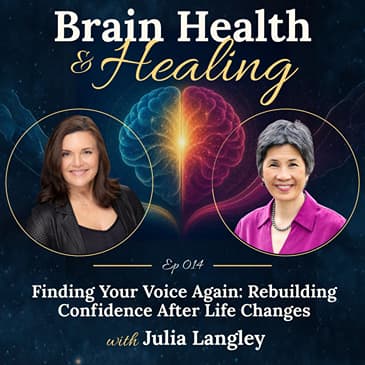
How can you rebuild confidence and reconnect with your sense of self when life no longer looks the way it once did?
In this conversation, Sandra Lee welcomes veteran Cirque du Soleil performer and voice coach Julia Langley, who reflects on the profound changes that followed a traumatic accident and the years of challenge that came afterward. Julia shares what it was like to face changes in her abilities, career, body, and expectations—and the gradual realization that moving forward did not necessarily mean returning to the person she had been before.
Their conversation explores resilience, authenticity, self-acceptance, and the role our voice can play in expressing who we are. Julia also reflects on learning to recognize her strengths differently, slowing herself down during difficult moments, and asking questions that help her consider what her next step could be.
Along the way, Sandra and Julia invite you to explore what it may mean to stop measuring yourself only against a former version of your life.
Where might something you have viewed as a limitation be inviting you to discover a different strength, expression, or possibility?
What You Are Invited to Discover:
- A different way to consider recovery when returning to your old life may no longer be the only measure of progress
- The connection between self-acceptance, authenticity, and feeling more confident using your voice
- Where qualities you have tried to hide may contain strengths you have not yet recognized
- The role slowing down and asking different questions may play when emotions feel overwhelming
- A possibility that opens when a difficult experience becomes part of your story without becoming your entire identity
Free Gift:
Follow the link to Julia’s calendar and set up a time for a free voice assessment. You can bring any questions during that time. http://www.julialangley.com/
About the Guest:
Julia Langley was the featured singer for Cirque du Soleil for 18 years. She has clocked 15,000 hours on stage in 20 different countries and the entire USA. Julia has appeared on CBS, ABC, and Fox affiliates throughout the US and has been featured in the South Florida Sun Sentinal as well as the New York Post. She has 15+ years of defining singer’s and speaker’s strengths and building personalized stage confidence and presence. She is a best-selling author in the field of public speaking, and has written and directed over 15 original stage plays. Julia has trained celebrity performers and olympic athletes to step into their unique performance power.
Julia is a public speaking figure and singer that entertains and educates on resilience, confidence and self-development, and has dedicated herself to empower others so that they may share their voice and passion with the world.
Resources:
Share your Story with Sandra. Schedule a 10 minute call to share about your head injury, and how it has impacted your life - https://shinewithsandra.com/brainstory
Join Sandra Live on Facebook for Better Brain Briefs every Thursday at 8:00 a.m. Pacific, where you can ask questions and catch the replay for a limited time: https://www.facebook.com/SandraLeeInspiration/
Download your Free Audio Gift, Imagine What’s Possible, at https://shinewithsandra.com
Join the Brain Health & Healing Private Facebook Group - https://www.facebook.com/groups/brainhealthhealing
About the Host:
Sandra Lee has spent almost 40 years helping people feel and function better by addressing what standard treatment often misses: the unresolved trauma and emotional patterns stored in the body. She is the creator of The Spectrum of Anger™ and The Witnessed Body™, which integrates Intuitive Sound Healing and Combat Brain Training to support brain injury recovery, brain health, and dementia. Her work is grounded in the belief that symptoms are messages, not malfunctions, and that when those messages are finally received and released, the body can do what it already knows how to do.
Website -https://miracleinspirations.com
LinkedIn - https://www.linkedin.com/in/sandra-lee-701662250/
YouTube - https://www.youtube.com/@sandralee1miracleinspirations
Thanks for listening!
Thanks so much for listening to our podcast! If you enjoyed this episode and think that others could benefit from listening, please share it using the social media buttons on this page.
Do you have some feedback or questions about this episode? Leave a comment in the section below!
Subscribe to the podcast
If you would like to get automatic updates of new podcast episodes, you can follow the podcast on Apple Podcasts or your favorite podcast app.
Leave us an Apple Podcasts review
Ratings and reviews from our listeners are extremely valuable to us and greatly appreciated. They help our podcast rank higher on Apple Podcasts, which exposes our show to more awesome listeners like you. If you are enjoying the show, please leave us a review on Apple Podcasts.
Original theme music by Bradford Tilden.
Disclaimer: Everything you hear on this show is for educational and informational purposes only. It's not medical advice, and it doesn't diagnose or treat any condition. Please consult your medical practitioner before making health decisions.
Welcome to Brain Health and Healing. I'm Sandra
Sandra Lee:Lee. This show is for people living with head injuries and
Sandra Lee:the families and supporters who love them. If you are ready to
Sandra Lee:reclaim your life, identity, and dreams for the future, you are
Sandra Lee:in the right place. Welcome, everybody, to Brain Health and
Healing:Receiving Adversity's Gifts. I have another wonderful
Healing:guest with me today, who has something that is different that
Healing:she does, and the way that she got to it through her journey of
Healing:having had an injury to her brain. I look forward to
Healing:learning about this from her. Please meet Julia Langley. She's
Healing:a friend of mine that I have met through networking, and I have
Healing:loved my time with her. She is a veteran Cirque du Soleil
Healing:performer of 18 years and a best-selling author in public
Healing:speaking. Now she coaches people, speakers and singers,
Healing:and how to use their voice, how to find their authentic, unique
Healing:voice, and be that, and be bold and confident in themselves.
Healing:Bold and confident voices is her business, so please meet my dear
Healing:friend Julia Langley.
Julia Langley:Hello, and thank you for having me. I'm so happy
Julia Langley:to be here with you today, Sandra. Thanks.
Sandra Lee:So, tell us about your injury and how that got you
Sandra Lee:to where you are today.
Julia Langley:Well, as I'm going to have to take you back
Julia Langley:to 2019 for a few minutes, and you know, at that time, I was I
Julia Langley:was flying high with my career. I was working with Cirque,
Julia Langley:traveling pretty much all around the world, living in South
Julia Langley:Florida. You know, just boating, having fun, just living life
Julia Langley:large, and it's really amazing how that can all stop in just an
Julia Langley:instant. I jumped in my car to get my oil changed, carried my
Julia Langley:bike, so I dropped my car off, got on my bike to go get coffee,
Julia Langley:and crossed an intersection and got hit by a car. And then not
Julia Langley:just a tap, not just a little bit that literally run over, and
Julia Langley:it was a big car. It was a big jacked up jeep, and I'm sitting
Julia Langley:on my bike when this happens, and she just basically T-bones
Julia Langley:me from the side, and I go up on the well as much on the hood as
Julia Langley:I could on a jeep and out into the middle of the road. So I had
Julia Langley:a traumatic brain injury from it. The Jeep, the grille of the
Julia Langley:Jeep, the roll bar hit the left side of my head, right about my
Julia Langley:temple, and then I flew through the air. And then the back part
Julia Langley:of my head, because I was not wearing a helmet, the back part
Julia Langley:of my head hit the pavement, and it, you know, it's changed my
Julia Langley:life in an instant, truly. So, it's amazing how you can just go
Julia Langley:from the top of the ladder to bottom.
Julia Langley:One decision, and not really a bad decision, just a decision
Julia Langley:that I made. It was an interesting journey recovering
Julia Langley:from that because once you do hit rock bottom, it really
Julia Langley:changes your perspective on things. Simple things like
Julia Langley:opening a Tupperware container, asking someone to bring me
Julia Langley:something because of the brain injury, I couldn't name the
Julia Langley:object. I could see it and I could point at it, but I
Julia Langley:couldn't say I need a spoon or I need a fork at that time. When I
Julia Langley:first had the accident, they did not diagnose in the trauma
Julia Langley:center any of my. I had five broken bones, and I walked
Julia Langley:myself out of the trauma center that day, and that's a whole
Julia Langley:nother story for another day. So, didn't really receive the
Julia Langley:best of care that I needed. So, but unfortunately, I had a lot
Julia Langley:of family and a lot of local friends that just rallied around
Julia Langley:me and really supported me. I was dry. I I got in my car and
Julia Langley:drove because you know I shouldn't have been, but I did.
Julia Langley:And I would get lost in intersections that I would drive
Julia Langley:every day. I was be confused, and that at that point, that's
Julia Langley:when they stopped me from driving for a while until I
Julia Langley:could recover, and then finally, got diagnosed with all the
Julia Langley:broken bones.
Julia Langley:My leg was broken in two places, so driving was really not the
Julia Langley:smartest thing I'd ever done. But I didn't know not to, you
Julia Langley:know. So it really changed everything about my life at that
Julia Langley:time. It was very hard. It was very. I I couldn't exercise. I
Julia Langley:couldn't walk. I couldn't work. I couldn't function. Really,
Julia Langley:couldn't do anything. And I remember saying, "Just one more
Julia Langley:week, and I'll be back to work. Just one more week, and that
Julia Langley:week would come, and I wouldn't be better. It's really a very
Julia Langley:hard thing to process when you're going through it, even
Julia Langley:when you have a great support system. And I said that all
Julia Langley:along. You know, I have an amazing support system with my
Julia Langley:friends and my family. I know that there are people that have
Julia Langley:to go through it alone, and I can't even imagine how difficult
Julia Langley:that must be for them. I had medical advocates, and I still
Julia Langley:had a hard time. I had a big fight on my hands, and I had
Julia Langley:medical advocates. So there's so many things that play into it
Julia Langley:that people don't even think about, and it impacted my entire
Julia Langley:life.
Sandra Lee:So what was your work at that time,
Julia Langley:well, I was well between Cirque when I was on
Julia Langley:contract with them. I was traveling, but when I was off
Julia Langley:contract with Cirque, I would be home, and I had a regular
Julia Langley:training program for singers. So I was working with. I had a full
Julia Langley:roster at the time of clients that I was working with vocally,
Julia Langley:and but I couldn't see them. I couldn't get to them first of
Julia Langley:all, and I couldn't sit long enough to even to train them.
Julia Langley:And plus, I had broken, I had broken wrist, and I had my hands
Julia Langley:were black from the accident, and I couldn't move my fingers,
Julia Langley:so I had damage, you know, to both of my hands.
Julia Langley:So I was unable to play the piano, which I'm classically
Julia Langley:trained, and I play when I train. And I was unable to do
Julia Langley:that. I was unable to drive, and so it really came to a grinding
Julia Langley:Halt, and and again, I just mentally couldn't. You know,
Julia Langley:mentally, you're just taken out of the game, and you just
Julia Langley:focused on your health, and it's really all I could do at the
Julia Langley:time. Most everyone was really understanding, but you know, it
Julia Langley:was really funny. A year after that, I get a text from someone
Julia Langley:who was not understanding, who was like, "I don't know why you
Julia Langley:stopped working with us. So, like, you don't even people
Julia Langley:can't think that would someone would be that actually that
Julia Langley:insensitive. But people do it all the time.
Julia Langley:So you're dealing with all of these health issues. You're
Julia Langley:dealing with your life not looking the same way, and then
Julia Langley:all of a sudden, someone sends you this text about how dare you
Julia Langley:not teach my voice lessons to someone? You know, why did I?
Julia Langley:I'm so uncomfortable with it, and I'm like, I couldn't even
Julia Langley:walk across the room, much less you know work during that time.
Julia Langley:So there was, there's just so much that you're dealing with
Julia Langley:aside from your health. So many other things that that come into
Julia Langley:play that create massive amounts of stress and trauma in your
Julia Langley:life, and and that was really just the beginning for me
Julia Langley:because that's that happened in 2019 right on the heel before
Julia Langley:the pandemic.
Sandra Lee:Wow! So how did how did you recover?
Julia Langley:Well, it took a while. Again, I had a good
Julia Langley:support system that I had proper good medical care aside from the
Julia Langley:trauma center, that was not good. But I did after that had
Julia Langley:some medical advocates that really got me in with some great
Julia Langley:doctors. I had a surgery a year for the next four years. I had
Julia Langley:spinal cord surgery, hip, shoulder, and knee surgery over
Julia Langley:the course of the next four years. So, how did I recover
Julia Langley:with a lot of challenges and a lot of difficulty and a lot of
Julia Langley:grit and and a lot of just I'm not staying here. I'm not
Julia Langley:staying in this place.
Julia Langley:I refuse to let this win. No, it your life doesn't look the same
Julia Langley:though, and you have to be willing to because you know when
Julia Langley:you're I was size two working out doing yoga classes and
Julia Langley:weights and running and swimming I was doing all this stuff and I
Julia Langley:went to being able to do nothing, and surgery after
Julia Langley:surgery after surgery. Your body it takes its toll on your on
Julia Langley:your body. So the recovery doesn't look. You have to start
Julia Langley:to understand that recovering doesn't look like what it looked
Julia Langley:like before. So there's a that's a starting. It's a kickoff
Julia Langley:point. So I. At it as sort of being reborn, a chance to change
Julia Langley:things. I mean, you can look at it like, "Why did this happen to
Julia Langley:me? Or you can look at it like, "Okay, now what? Now what are we
Julia Langley:going to do with what we've been given? So it's hard because I'm
Julia Langley:not a size two anymore, and I can't do like power yoga and
Julia Langley:then go swim and ride a bike for five or 20 miles.
Julia Langley:Or yeah, I can't do that. But I have found new levels of what is
Julia Langley:it? New levels of happiness. I consider myself to probably to
Julia Langley:be the best person I've ever been in my life now, and
Julia Langley:that's-I think it started then. So that's how I look at getting
Julia Langley:hit by the car. That's how I look at the brain injury that it
Julia Langley:was a catalyst to take me to a different place in my life and
Julia Langley:to make me better, and it did, but it wasn't easy. That kind of
Julia Langley:growth is very, very hard and painful sometimes. Very painful,
Julia Langley:But, but is good receiving
Sandra Lee:adversity's gifts.
Julia Langley:That's exactly right. But you know, it it's
Julia Langley:easy for people to say that to someone that's in the middle of
Julia Langley:it. When you're in the middle of it, it seems like it will never
Julia Langley:end, and you you ask the questions over and over, like
Julia Langley:how can I change this? What can I do? What? So it's a constant
Julia Langley:shoot, correct, aim correct, and you cannot give up, and that is
Julia Langley:the main thing you cannot give up. Do I still have consequences
Julia Langley:from that today? Yeah, I still I still have health issues.
Julia Langley:Sometimes I can't physically do the things, and so when I do
Julia Langley:that, I just put my feet up for 30 minutes and say, "Okay, my
Julia Langley:back's hurting. Put my feet up for 30 minutes and give myself
Julia Langley:some grace, and then I get back up and keep going, and I'm
Julia Langley:pretty energetic. I have a very, very full life right now, so you
Julia Langley:know I have a lot of stamina, and I think tenacity is the best
Julia Langley:word for it because that's what I'm not going to let that define
Julia Langley:my life. I will let it help me grow, but it does not define who
Julia Langley:I am,
Sandra Lee:and that's what it takes to get through.
Julia Langley:It does. It it does. Sheer Will and a lot of
Julia Langley:prayers. I'm a person of faith, and I pray a lot. I have
Julia Langley:conversations with God all the time, and you know, seeking that
Julia Langley:alignment, seeking the center where I need to go, what I need
Julia Langley:to do because it's not always clear. There's a lot of
Julia Langley:fuzziness and all of that. That's not clarity at all, and I
Julia Langley:I always seek that. So I try to slow myself down to find that
Julia Langley:clarity when I am in that place of fog. And if it will come, it
Julia Langley:will come if you can just still yourself enough, and those are
Julia Langley:the the lessons I've learned from it. and And I have to tell
Julia Langley:you, the the the next few years after that accident, we're just
Julia Langley:you can't imagine. I and and I'll do a rundown very quickly.
Julia Langley:Accident, pandemic hit, and you know, I sort of looked at that
Julia Langley:like, okay, everyone got laid off from Cirque to Slay, so we
Julia Langley:got our yellow slip in the mail, if you will, whatever you want
Julia Langley:to call it, pink slip, whatever it is. And I came back to my
Julia Langley:parents' house and spent to spend some time with my aging
Julia Langley:parents. You know, they're getting older, and thank God I
Julia Langley:did, because six months after I came home, my dad died. So I got
Julia Langley:to spend six months with him, going to breakfast, riding down
Julia Langley:the road, listening to Johnny Cash, 530 in the morning, going
Julia Langley:to eat with with the old men at the cafe, the local cafe. I
Julia Langley:mean, it was very storybook, you know, but that's what we did. I
Julia Langley:didn't know he was going to pass away, but he did. And then one
Julia Langley:month after my dad passed, my family home got hit by an f3
Julia Langley:tornado, and was just basically the the roof came off, the back
Julia Langley:wall was knocked down in the backyard. And I had to move my
Julia Langley:mom out, and then we had to basically rebuild, and then we
Julia Langley:ended up got robbed. I mean, it's it was ongoing; it never
Julia Langley:let up for a very long time, and I thought, "Wow, you know what
Julia Langley:is this a test? And that's where I learned to always ask that question.
Sandra Lee:Mhmm
Julia Langley:I'mbeing tested in a very extreme way. Will I
Julia Langley:pass or will I fail? And then I, I'm not one to fail. So I said,
Julia Langley:I'll pass the test, whatever it is you got. Come on, let's go.
Julia Langley:You know, and so that's how I that's how I look at things.
Julia Langley:There's two questions I always ask, and one is, "What are you
Julia Langley:trying to show me, God? What is that I need to see? And number
Julia Langley:two, "How can I pass this test? And those two questions get me
Julia Langley:through pretty much every challenge that I'm faced with.
Julia Langley:They slow me down. They keep me from getting triggered. It makes
Julia Langley:me stop and think of my own reaction and how I want to
Julia Langley:respond to things, what my next step is. I think that's the
Julia Langley:biggest thing. Those questions slow you down long enough that
Julia Langley:you can think through it in a more rational way, and that's
Julia Langley:that. That's my mo at this point. So the growth has been
Julia Langley:astronomical. Yes, there were major challenges, but here we are.
Sandra Lee:Yeah. So you specialize in supporting singers
Sandra Lee:and speakers, and having their unique voice. And so, as I hear
Sandra Lee:you talk about your unique and incredibly like powerful
Sandra Lee:experience that comes through in your story, in your voice, and
Sandra Lee:how you use your voice. So, share with the audience how all
Sandra Lee:of this incredibly intense experience contributed to the
Sandra Lee:value that you contribute to the people you work with.
Julia Langley:Well, I. I think that there's a searching there
Julia Langley:where you're really certain. I spoke of clarity, and I think
Julia Langley:that there's a searching there where you're searching for that
Julia Langley:clarity. And for me, it was about, and this is where I
Julia Langley:learned, and I'm going to tie it back in in just a second to
Julia Langley:other people. I learned then what authenticity really meant,
Julia Langley:and I realized that I really wasn't, although I thought I
Julia Langley:was. And most people think they're being authentic, and
Julia Langley:they're not really being authentic. You're hiding
Julia Langley:yourself. There's some way or another that you're hiding, and
Julia Langley:I was hiding. As a result of these challenges that I went
Julia Langley:through, there were a lot of things about myself that I
Julia Langley:learned to accept, and when I learned to accept those things,
Julia Langley:then I started using my voice in in ways that, when things needed
Julia Langley:to be said, I could say them in a very rational, clear way, even
Julia Langley:when they were difficult conversations.
Julia Langley:There were things knowing when to not say anything at all, you
Julia Langley:know, and learning that the way I interact with the world is not
Julia Langley:broken because you go through life thinking you're broken. A
Julia Langley:lot of people, you probably nearly everyone, because I work
Julia Langley:with a lot of people on this. This is the number one problem
Julia Langley:that they have when they want to use their voice: is that they
Julia Langley:feel somewhere along the way they've learned that they're not
Julia Langley:good enough, that their voice is broken and they can't do
Julia Langley:something. Well, you might not can do it this way, but you
Julia Langley:might be able to do it this way. Let's shift our thinking just a
Julia Langley:little bit, and let's look at what we do have in our arsenal
Julia Langley:of strengths. And not all of the things in our arsenal are going
Julia Langley:to be strengths. So let's take those things over here that
Julia Langley:aren't. Let's pull them back, and let's take those things that
Julia Langley:are and push them forward. Now that is not faking it. That is
Julia Langley:actually taking who you are, your strengths, who you are, and
Julia Langley:using them to fulfill your potential, that is authenticity.
Julia Langley:It's not putting on a performance in the sense of like
Julia Langley:there's a couple of different ways we can use the word performance.
Julia Langley:Perform we can perform. You know, I perform every day. Being
Julia Langley:performative. Is different. Being performative is putting on
Julia Langley:a show, a fake show. To be a real artist, performances about
Julia Langley:truth, and we can go down this rabbit hole and talk about it
Julia Langley:all day long. It's a very, very fine line. It's a very hard
Julia Langley:thing to recognize in yourself, and you may know it deep down
Julia Langley:when you're not being truthful, and then not even be willing to
Julia Langley:come to terms with it or know how to change it. So, what I do
Julia Langley:when I work with people is we go down that rabbit hole, and we
Julia Langley:find out who you really are, what makes you different, what
Julia Langley:makes your voice different from the next guy or the next person,
Julia Langley:what makes you special. I I have I have one client I work with,
Julia Langley:you know, six three, a skinny, all arms, all legs, gangly, and
Julia Langley:was hunched over his entire life because he felt so awkward. And
Julia Langley:we took that and started using that on stage.
Julia Langley:Those arms and legs, and we used them in way we chose material on
Julia Langley:stage that that he could do that accentuated that as opposed to
Julia Langley:making it look awkward. He started winning every audition
Julia Langley:he went to. Now this, I'm speaking in terms of theater. I
Julia Langley:work with a lot of different people from leadership roles on
Julia Langley:up. This is specifically theater, but this is just one
Julia Langley:example. He started winning auditions after that because he
Julia Langley:found that sweet spot that used those qualities that make him
Julia Langley:who he is, and so instead of being embarrassed about that, he
Julia Langley:turned that into gold, and that's that's my whole premise
Julia Langley:of my business and what I and and what what makes me different
Julia Langley:from your standard vocal, I mean, there are a lot of good
Julia Langley:vocal coaches out there, but this makes me different because
Julia Langley:it's focused on the the the individual,
Sandra Lee:yeah,
Julia Langley:who they are.
Sandra Lee:So I like giving our audience for brain health and
Sandra Lee:healing something practical that they can apply to their life.
Sandra Lee:So, what do you have for the audience who might not ever
Sandra Lee:actually speak with you about how they can be themselves?
Julia Langley:Well, the first thing you have to do is you got
Julia Langley:to calm yourself down, because I think that a lot of times we get
Julia Langley:in these emotional loops, and that we can't get ourselves out
Julia Langley:of them. All right. So, like I said, the two questions. I think
Julia Langley:that that those are really two good things. These are the
Julia Langley:things I do for me that calm me down. I ask those two questions
Julia Langley:as stated earlier. God, what are you trying to show me? Number
Julia Langley:two, what is it that is this a test, and how can I pass it? So
Julia Langley:when you start saying how can I pass this test, then you start
Julia Langley:it. It comes out of the emotional and goes into the
Julia Langley:rational, and you start thinking of how you can be proactive.
Julia Langley:I think this helps with the brain injury because you say,
Julia Langley:"Okay, okay, I can't do this, but I can do this. So let me
Julia Langley:shift my thinking over here and let's see how we can use this.
Julia Langley:But you have to slow yourself down. So a breathing exercise,
Julia Langley:um, and and I did not mention earlier, but I was diagnosed
Julia Langley:about three months after my accident with PTSD, and we
Julia Langley:didn't. This is a whole nother thing. And there are because so
Julia Langley:I never had a panic attack. I didn't even know. I didn't know
Julia Langley:normal people could get it. I just thought this was something
Julia Langley:that our veterans suffered from, and I never had a panic attack
Julia Langley:until after that. So, calming myself down was key. And I think
Julia Langley:for anyone that's suffering the brain injury, that calming
Julia Langley:factor helps that centering. It helps you come out of the
Julia Langley:emotional, go into the irrational, which is what we
Julia Langley:want. I hope that answers your question.
Sandra Lee:Oh, that's wonderful, wonderful practical
Sandra Lee:information for anybody and everybody. Like this is just how
Sandra Lee:to live your daily life.
Julia Langley:It is. It really is. We don't even practice that
Julia Langley:in daily life. I don't think a lot. Or I mean, but many people
Julia Langley:don't. You know, they and they get wrapped up in the moment,
Julia Langley:and that's the trigger. You know this buzzword trigger that
Julia Langley:everyone talks about. They get triggered, and then they don't.
Julia Langley:They don't come out of it, and and then they just you can't
Julia Langley:stay in that. Now everyone has things that set them off from
Julia Langley:time to time, but how are you going to handle that when it
Julia Langley:happens? Are you just going to let it go wild, or are you
Julia Langley:going. Are you going to take control of of your life and your
Julia Langley:mind? Yeah. So, for people who want to connect with you, yes,
Julia Langley:how do they do that? And do you have something you can offer
Julia Langley:them? I would love to offer them a quick, not quick 20 minutes, a
Julia Langley:20 minute call for a voice assessment, and I would love to
Julia Langley:talk to you and hear what you're facing. And you can get that.
Julia Langley:All you have to do is go to my website, which is julia
Julia Langley:langley.com, and set up a call. Get on my calendar, and I think
Julia Langley:it. You can do it in third. Actually, it's a 30-minute
Julia Langley:increment. I think it's set up for 30 minutes, and you just get
Julia Langley:on my there. We I can answer your questions. Any questions
Julia Langley:that you might have about fear, about even if it's about
Julia Langley:resilience, because part of part of learning how to use your
Julia Langley:voice is being resilient. It's it's not giving up. All right,
Julia Langley:it's keeping going. Or specific voice questions that you may
Julia Langley:have, I would I would be happy to to have a chat with any of
Julia Langley:your audience members. I hope you will call me.
Sandra Lee:That's wonderful. So the information on how to
Sandra Lee:contact Julia for that assessment is in the show notes.
Sandra Lee:So definitely go there and check that out. So I have a different
Sandra Lee:question. Sure. I know you have like a mission here in the
Sandra Lee:world. When you are at the height of the implementation of
Sandra Lee:that vision, and it's all happening the way you dream,
Sandra Lee:what do you see happening? What do you see yourself doing?
Julia Langley:Well, I my dream is that I want to have a full
Julia Langley:array of products that people can tap into and get what they
Julia Langley:need when they need, and I'm in the process of building that
Julia Langley:right now. So this will be digital products that people can
Julia Langley:buy to do on their own, including vault and library full
Julia Langley:of exercises that can address some of these things that you're
Julia Langley:talking about. Even if you don't consider yourself a singer,
Julia Langley:these exercises that I'm working on right now they trigger 12
Julia Langley:different centers of the brain. So it's not just working on your
Julia Langley:voice, we're working on on so many different things. Not only
Julia Langley:that, you're working on your confidence. You're working on
Julia Langley:authority. There's just so many things. So that's one thing, and
Julia Langley:that's in the works right now. I've been building that as we
Julia Langley:speak. But in addition to that, I have courses. I have, and if
Julia Langley:you're a musician, I have music practical guides to music
Julia Langley:theory. I don't know how many musicians you have on here, but
Julia Langley:I have all an array of products. In addition to that, I am
Julia Langley:writing. So, and we see this in this fullness. So, hopefully,
Julia Langley:we're looking at this in the next year to a year and a half
Julia Langley:that we're going to have a full university, basically, of
Julia Langley:products that you can use to focus on performance, auditions,
Julia Langley:voices, speaking, you know, confidence, fear, all of these
Julia Langley:things.
Sandra Lee:Amazing! So definitely connect with Julia
Sandra Lee:and take advantage of that voice assessment that she's offering
Sandra Lee:you. That's wonderful. So, what is the last thing you want our
Sandra Lee:audience to take away? What's the coherent point you want them
Sandra Lee:to remember?
Julia Langley:I want you to know that every single person
Julia Langley:that's listening here today has something special about them.
Julia Langley:You may sit there and say, "My my second grade teacher told me
Julia Langley:that I should shut up. My parents said shut up. My my
Julia Langley:other teacher said get out of choir, quit now. I can't believe
Julia Langley:that people say this to others, but they do, and I know that
Julia Langley:somewhere along the way you did a show and tell, and someone
Julia Langley:said that you're not good enough to be speaking. You need to be
Julia Langley:quiet. This is where I want to come in and say to you that
Julia Langley:there is something special about you, and that you need to
Julia Langley:discover vocally in your voice. And your voice is not just this.
Julia Langley:It's not just your your vocal cords. Your voice is your whole
Julia Langley:body. Right? It's nonverbal communication. It's your smile.
Julia Langley:It's your face. It's your voice. It's how you hold yourself. Your
Julia Langley:posture. There's something special about you. And if you
Julia Langley:need help finding it, I'm your girl. All right, I can help you.
Julia Langley:But I'm not even. Trying to do that, I just want you to know
Julia Langley:that it's there, and if you haven't discovered it, go on a
Julia Langley:journey to seek it out, because everyone needs to use their
Julia Langley:voice.
Sandra Lee:Drop the mic on that one. Thank you so much for being
Sandra Lee:here with Brain for having healing, Julia. It has been
Sandra Lee:delightful.
Julia Langley:It's my pleasure.
Sandra Lee:Thank you for being here for Brain Health and
Sandra Lee:Healing. We will see you again next time. What a wonderful
Sandra Lee:conversation we had with Julia! Oh my goodness, finding your
Sandra Lee:unique voice, and I love how she shared all the intensity of her
Sandra Lee:experience and how that really contributed to the work that she
Sandra Lee:now does with people. And if you have any interest at all in
Sandra Lee:finding your voice and getting your message out there in the
Sandra Lee:world, then definitely take advantage of that call with
Sandra Lee:Julia. She's so wonderful. And then again, thinking about how
Sandra Lee:are you going to apply her message, her practical strategy
Sandra Lee:of you know, slow down, and how am I getting through this test?
Sandra Lee:Apply that to your daily life and the difference that makes
Sandra Lee:for you. Go over to the Brain Health and Healing Facebook
Sandra Lee:group and share the value that you got out of this interview
Sandra Lee:today, and how it's going to make a difference in your life.
Sandra Lee:Thank you so much. I am Sandra Lee with Brain Health and
Sandra Lee:Healing. If you want to share your story of brain injury or of
Sandra Lee:overcoming adversity, I would love to hear it. I invite you to
Sandra Lee:a complimentary 10-minute share your story call. This is not a
Sandra Lee:sales call. It's an opportunity to share your experience. Go to
Sandra Lee:shinewithsandra.com/brainstory, and to hear what your body's
Sandra Lee:been trying to tell you, get my Imagine What's Possible audio
Sandra Lee:gift. Go to shinewithsandra.com. Your body heals itself every
Sandra Lee:day.