
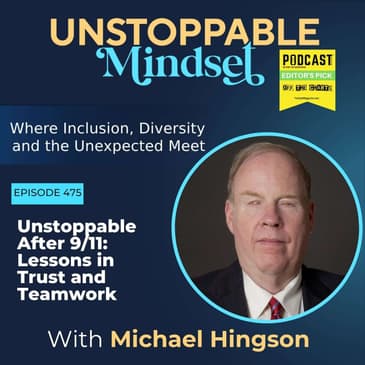
The lessons I carried away from September 11 did not begin that day, and they certainly did not end there. In this solo episode, I reflect on how my parents taught me not to accept the limits others placed on blindness, how my guide dogs taught me about trust and teamwork, and how September 11 confirmed so much of what I already believed about fear, leadership, change, and possibility. I share why I work hard not to worry about things I cannot control, why I believe we can never truly go back to “normal,” and why strong teams are built through trust rather than control. I also challenge some of the ways we think about blindness and disability, because different does not mean less capable. I hope these lessons help you think differently about fear, change, leadership, and what it really means to live with an unstoppable mindset.
Highlights:
00:46 – Why the lessons of September 11 began long before that day.
08:56 – How Michael learned that blindness is not the real barrier.
17:13 – Why focusing on what you can control can reduce fear.
24:28 – Why getting back to “normal” is not always the answer.
32:30 – What guide dogs taught Michael about trust and teamwork.
1:01:37 – Why disability does not mean a lack of ability.
About the Host:
Michael Hingson, blind since birth, was born in Chicago to sighted parents who believed in raising their son with a can-do attitude. Treated like all other children in his family, Michael rode a bike did advanced math in his head and learn to read and write – Braille that is! Michael’s family relocated to the warm Palmdale area of California when he was five years old. It is here that Hingson had his first adventure with Guide Dogs for the Blind and received his first guide dog. He later went to college receiving a bachelor’s and master’s degree in Physics along with a secondary teaching credential from the University of California at Irvine.
Michael then enjoyed a nearly-30-year career working for high tech companies spending most of his time in management roles.
Michael Hingson’s life changed dramatically on September 11, 2001 when he and his guide dog, Roselle, escaped from the 78th floor of Tower One in the World Trade Center moments before it collapsed. Soon after, Michael and Roselle were thrust into the international limelight where Michael began to share his unique survival story and 9-11 lessons of trust, courage, heroism, and teamwork.
Mike has served as The National Public Affairs Director for one of the largest Nonprofit organizations in the nation: Guide Dogs for the Blind; He has served as the vice president of the National Association of Guide Dog Users; Michael has held a seat on the Fort Worth Lighthouse for the Blind. He is the chair of the board of directors of the Earle Baum Center for the Blind and is the vice chair of the Colorado Center for the Blind; Michael is The National Ambassador for the Braille Literacy Campaign of the National Federation of the Blind.
Until October 2019 he worked as the CEO of the Do More Foundation, the non-profit arm of Aira Tech Corp, a manufacturer of assistive technology which makes a revolutionary visual interpreter for blind people. In January 2021 Mike joined accessiBe as its Chief Vision Officer to help advance the company goal of making the entire internet fully inclusive. He held this position through June of 2026.
He is the author of the #1 New York Times Best Seller: “Thunder dog –The True Story of a Blind Man, a Guide Dog & the Triumph of Trust” – selling over 2.5 million copies Worldwide. In 2013 Mr. Hingson published his 2 book “Running with Roselle”- which Is the first of its kind- A story for our youth shedding light on one of Americas Darkest Days. Mr. Hingson’s third book, “Live Like A Guide Dog”, was released on August 20, 2024. This book shows readers how they can learn to control fear and not, as Mike would say, “become blinded by fear in the face of crisis”.
Aside from his talents and advocacies, Mr. Hingson has traveled the Globe from Japan to New Zealand, the Netherlands to his hometown, Chicago. Speaking to some of the world’s most elite: from former President, George W. Bush to Larry King, to Fortune 500 companies and colleges and Universities Nationwide. After sharing his story of survival on hundreds of TV and Radio programs, Michael is now an Expert hired by many of today’s major corporations and organizations. Speaking and consulting on the importance of Teamwork and Trust, Moving from Diversity to Inclusion, as well as offering Adaptive Technology Training – spearheading innovation for ALL! - Thus, bringing organizations to the forefront of the ever-changing competitive modern world.
In June, 2024 Mike was inducted as an alumni member into the honors Fraternity Phi Beta Kappa.
Currently Michael lives in Victorville, California with Alamo, Michael’s eighth guide dog and his rescue feline, Stitch.
More information on Mr. Hingson is available on his website. Here also is a link to Mr. Hingson’s press kit:
https://www.dropbox.com/scl/fo/q8uxu9u7pap4puj5de7rg/h?rlkey=22bziy0wmghf8111kad73685y\&dl=0
http://www.michaelhingson.com/live-like-a-guide-dog
www.michaelhingson.com/podcast
Facebook, https://www.facebook.com/mhingson
https://www.facebook.com/michael.hingson.author.speaker/
https://www.facebook.com/Roselle911GuideDog/
https://www.facebook.com/groups/1568642850718948
Twitter, https://twitter.com/mhingson
LinkedIn, https://www.linkedin.com/in/michaelhingson
Youtube channel, https://www.youtube.com/channel/UCfCx2L9OVN38Dv4mX6udP8g
Thanks for listening!
Thanks so much for listening to our podcast! If you enjoyed this episode and think that others could benefit from listening, please share it using the social media buttons on this page. Do you have some feedback or questions about this episode? Leave a comment in the section below!
Subscribe to the podcast
If you would like to get automatic updates of new podcast episodes, you can subscribe to the podcast on Apple Podcasts or Stitcher. You can subscribe in your favorite podcast app. You can also support our podcast through our tip jar https://tips.pinecast.com/jar/unstoppable-mindset .
Leave us an Apple Podcasts review
Ratings and reviews from our listeners are extremely valuable to us and greatly appreciated. They help our podcast rank higher on Apple Podcasts, which exposes our show to more awesome listeners like you. If you have a minute, please leave an honest review on Apple Podcasts.
Transcription Notes:
Michael Hingson 00:04
What if the biggest thing holding you back isn't what's in front of you, but rather what you believe? Welcome to Unstoppable Mindset, where inclusion, diversity, and the unexpected meet. I'm your host, Michael Hingson, speaker, author, and advocate for inclusion and possibilities. This podcast explores how the beliefs we carry shape the way we live, lead, and connect with others. Each week, I talk with people who challenge assumptions, face adversity head-on, and show what's possible when we choose curiosity over fear. Together, we focus on mindset, resilience, and the small shifts that lead to meaningful change. Let's get started. Well, hello, everyone. I am Michael Hingson. I am your host on Unstoppable Mindset, and this happens to be episode 475. Yeah, we've done a lot of these, and most all of them have been conversations with people who said that they wanted to come on the podcast and talk about one thing or another. And I was really pleased to have them. This episode is going to be a little bit different, as the last few have been. Episode 472, which we published on September 4, was a talk I gave in April of 2024, which told my story of being in the World Trade Center on september 11, on episode 473 on the eighth of September, Michelle Abraham interviewed me, and we talked about a number of things around september 11 and so on. Episode 474, which was published on the 11th of September, 2026. was a conversation with Bob Ellis, who was in the Pentagon on September 11, 2001, an escape, and we hear his story, and we got to chat and kind of talked about notes from both of us. Now it's episode 475, and it was suggested that I ought to talk about things that I learned from September 11th and how my life has changed, and I'm going to do the best I can to talk about all that. So you're just going to be hearing me today. I hope you won't go away. I hope that you'll enjoy it. I just returned from speaking all week from September 9th through September 11th in Kilgore, Texas, at Kilgore College, they did an incredible job of doing some things to help people become aware of September 11th. They actually had in the library and around the library at Kilgore College a monument to September 11th. They had some columns or portions of columns from the World Trade Center. They had a list of all of the names. They had flags in a in a in several rows with the names of all of the people who were lost on September 11th. They had a timeline from my book Thunderdog: The Story of a Blind man, his guide dog, and the triumph of trust at Ground Zero-a timeline of what I experienced, and they also had, I think, a timeline of just the World Trade Center events in in general. Well, okay, so all of that happened. I got back last night, and now here it is, Sunday. It is the 13th of September, and I'm recording this so that we can publish it on Tuesday, september 15. So that's a little bit of a long way to get to where we are. But as I said, people asked me to talk about what I learned that day, and how I proceeded and progressed from that day, but I have to go back to long before September 11th to really do everything justice and to put it all in context. So let me start this way. I believe that I have said a few times on this podcast, and certainly in some of the speeches that I've given, that I was born two months premature, and I was given a pure oxygen environment when I was born, because I was born early. Medical science had started to hear that even too much oxygen might not necessarily be a good thing, but the doctors in Chicago where I was born didn't buy into that concept yet, and so the result was I was given a pre-oxygen environment, and my retinas didn't develop as they should, and I became blind. So was I born blind? If you're very technical, no. But for all intents and purposes, yes. The doctors told my parents to send me to a home, to send me away, because no blind child could ever.
Michael Hingson 04:59
Grow up to amount to anything, and all I would be would would end up being a drain on my family, sucking up all the love that my parents might have had for their older son, two years older than I, my brother Ellery. But the reality is, my parents said you're wrong. He can grow up to do whatever he chooses, and we're going to give him that opportunity. And I grew up with that idea. I grew up with that concept. My parents told me at some point when I was still fairly young about what the doctors had said, and they said, "You know, we think that you can do whatever you want. We want you to have that opportunity. Well, they did a number of things to help the process along. For example, we lived in Chicago until I was five, but at the age of four, typically children in in Illinois start or in Chicago start kindergarten, and I did as well. My parents worked with other parents and the school district to start a kindergarten class for children who were blind, and there were a number of preemies in the Chicago area. In that class, Miss Lapree, my teacher, taught me Braille. See, I remember her name. Taught me Braille. Taught me other skills. Taught the other blind kids because it was a kindergarten class for blind children. Taught us all a variety of different things that we could use, and then unfortunately, in a sense, I guess after kindergarten at the age of four, and it was over, my father had gotten an offer and took a job out in California, and we moved to California. Well, in California, kindergarten starts at five, and even though I had had a course in kindergarten already, I had to go through a second year of it, but we didn't have any kind of facilities to teach us or teach me about Braille going forward, getting me Braille books and so on. So kindergarten, first, second, and third grade, I didn't have access directly to textbook material. My parents helped me though. My father taught me math. He was an electronics and electrical engineer. I was doing algebra in my head by the time I was six. My mother read other assignments to me, taught me the spelling words because in first, second, and third grade you learned to spell, and in theory beyond third grade as well, of course. But what happened for me was that I learned about spelling by my mother teaching me how to spell the words, and then she would say the words, and then I would spell them. Well, that ended up going even further because typically in classrooms, what happened was that when it came time to take the actual spelling test, which happened on Fridays, the teacher would say the words. All of us or all the children in the class would write down the answers. Then we would exchange papers, and the teacher would then write the correct spellings on the board. Not in my class. I had to. Well, I got to get up. I. I don't want to say I had to. That's a lesson that I want to get to. wasn't that I had to get up. I got to get up, and actually spell the words out loud. I remember once missing a word, at least starting to miss a word, and somebody made a noise, and I realized, oh, that must be wrong, and I corrected it. But I learned how to spell words, and I learned to spell them out loud for the whole class, and not be afraid of them, and that way students could grade each other's papers. And so, in a sense, I could say that's where I started to learn how to be involved in doing public speaking, and I learned not to be afraid of standing up and and saying things as long as they were the right kinds of things. Well, between third and fourth grade, I got access to Braille books. Cora Hershberger was hired by the school district to come in. She was a resource teacher with training in dealing with blindness and blind kids and so on.
Michael Hingson 08:56
And there were a number of us, and she she was able to get us books, she was able to work with each of us and prove our Braille skills and my Braille skills especially, and so on. So I tell you all of that because I want to put things in perspective, and I think that the most important thing is the doctors told my parents that I couldn't do anything. My parents said, "Of course he can, and they brought me up believing that I could. So I rode a bicycle to school. Everybody still thinks that's amazing. One of the important things that I have learned over the years, and I've learned to articulate it even more effectively. I hope, certainly, I believe better since the World Trade Center, and I became a full-time keynote public speaker, which I've been doing for 25 years, I have learned to discuss this whole concept of blindness and accept the fact that there are going to be a lot of people who have eyesight who get it wrong. They think that, like the doctor said, blind people really can't do anything. You can't absorb the same material, or at least you don't get the same. As sighted people do, so you really aren't going to be able to do the things that we can do. And I have learned that I can't be angry at that. I've learned that in reality, I need to articulate the fact that blindness isn't the problem. The problem happens to be the misconceptions and poor attitudes that people have about blindness. It would be so easy just to be upset every time I hear some comment that talks about what I can do and what I can't do. You can't really ride a bicycle. That's amazing that you could do that. I can't imagine anybody else doing it. I know lots of blind kids who rode bikes, and I'm sure that they still do. Blindness isn't the problem. The reality is the problem consists of the misconceptions and poor attitudes that sighted people have about blindness. Whether you like it or not, that's the way it is. Blindness isn't the problem. We can learn to do the same things pretty much that you can do, and we can learn to do things that you can't do, and we learn all of that and use that knowledge to help us move forward and be more effective. What can I do that you can't do? Try walking around in the dark. You can't do it. You don't know how to do it. You don't have the techniques to do it. One of the things that has cropped up over the past significant number of years is restaurants do something called dining in the dark. Dining in the dark, and there are organizations that promote that, and they say, "Oh, you get to learn how blind people eat and how much of a challenge it is. That is so disgusting that people do that because dying in the dark isn't going to teach you anything about blindness. You don't get the training that you need in order to function as a blind person. Just like I don't get the training to learn how to function as a sighted person. Although I've spent a lot of time observing sighted people, and I understand a lot about eyesight, and I understand what you can do, and I accept that. But I expect, and I think it is reasonable for you to understand and accept that I can do lots of things. That it's not about eyesight. I wrote a book in 20, and it was published by Thomas Nelson Publishing in 2011. I and Susie Florey wrote the book. It's called Thunderdog: The True Story of a Blind Man, His Guide Dogs, and the Triumph of Trust at Ground Zero. And there is a section near the end of the book called Guide Dog Wisdom. And number two in Guide Dog Wisdom includes a sentence that says, "Don't let your sight get in the way of your vision. You all strictly deal with eyesight, and if it's not something that you can see with your eyes, or you don't really separate eyesight from vision, you tend to really misunderstand so many things. But the reality is, don't let your sight get in the way of your vision. Recognize there's a whole lot more to life than eyesight.
Michael Hingson 13:01
SEAL Team Six, other military teams, so many other people learn how to use those other senses, and that's the same thing that we as blind people do. We learn to use our other senses. They're not magically enhanced simply because we go blind, but rather we learn how to use those senses? I hope, or we try to, and by doing so, we improve them and we develop them. And those of us who truly do that are a lot more better off, and we're able to do so many things that people think are amazing, but they're not. They're not really amazing. They're certainly not amazing to me. Anyway, I grew up believing all of that, and of course, I was also very fortunate to have a number of jobs throughout my career. And the final result of all of that was I ended up getting the opportunity to open an office in the World Trade Center for Quantum ATL, the company that hired me to open an office in New York, and there we were on September 11th when everything happened. The night, as September 11th ended, was spent by me and my wife Karen. By the way, Karen was in a wheelchair her whole life. We got married in November of 1982, and we were married through into November of 2022. We were married 40 years. Karen was in a wheelchair her whole life. It was a great marriage, as I love to tell people. She read, I pushed, worked out well. How do I push a person in a wheelchair? Well, she used a manual chair, and when we got to curbs and so on, she would stop, and she would hold the wheels, and and I knew that she had stopped. And I would tip the chair back. She might say, "There's a curb. I would tip the chair back onto its back wheels. We'd roll down off the curb, put the chair down. We'd cross the street, tip the chair up. Front wheels go up on the curb on the other side, unless there was a ramp to go up. And we continued on our way. It's not that magical. It is just what I learned to do, and I enjoyed it. and And I enjoyed Karen's company and so on for 40 years. We were locked down during the pandemic and so on. We'll get to some of that in a bit. But I learned overall that in reality, what my parents taught me was true. Blindness wasn't going to be the problem; eyesight was going to be the problem. And that night after September 11th, we kind of tried to make sense of it. It was me and Karen and a friend of Karen's who I also got to know, and who became a friend of mine. Tom Painter had come down. Tom and Karen went to the same high school, but we all ended up in New Jersey. And Tom came to visit us, actually visit Karen after September 11th started. When he heard about the terrorist attacks, he just came down, not knowing whether I was in the office or not. But I was, and Karen and Tom, well, Tom stayed with Karen and and drove her to pick me up at the Westfield, New Jersey train station at about 7p.m. on september 11. We went home with my guide dog Roselle. When we got home, I took Roselle's harness off because I was going to take her outside. She would have none of it. She ran off. She grabbed her favorite tug bone and started playing tug of war with my retired guide dog Linnie. Well, that was kind of fun, and I didn't think a lot about it. But I went. That was interesting. The next day, I contacted Guide Dogs for the Blind because several people from there had visited us in the World Trade Center, and among others, I spoke to the head of the veterinary department, and I said, "So, tell me, how is all this going to affect Roselle? Because everybody's talking about how it's going to affect everyone and all that, and and he asked me, "Did anything threaten directly Roselle? Did anything really threaten her? And I said, No, not really. Nothing directly affected her. And he said, Well, there you go. Dogs don't do what if. They live in the moment.
Michael Hingson 17:13
And when you took the harness off, it was over for her, and she was ready to go play. She wanted to relax. She wanted to play, and she did. Oh, and yes, we did eventually get her outside. But the bottom line is, I think that's one of the most important things that I learned coming out of September 11th, and I, I kind of knew it beforehand, but I really got to understand it afterward. We what if everything to death? We what if anything that comes into our lives, well, we're we're in a war with Iran. Well, what if Iran bombs us? What if Iran does this? What if the Hooties do that? What are we going to do? What if our government takes us to war in the first place? Well, they have. The bottom line is, though, we don't have control over all of that. We do have control over some things in our lives, and those are the things that we should worry about. We should stop worrying about everything else. And people say, "Well, it's natural to worry. No, it's not. Not any more natural to worry than it is not to worry. We learn to worry because we're taught that. But the bottom line is, if we learn only to focus on the things over which we truly have control, and be aware of the other things, but don't let them worry us. Don't let them cause fear in our lives. We will live much less fearful and much more stress-free lives than in any other way. If you want another example of why I believe this, on September 11th, David Frank, my colleague who had come in to be involved with the seminars, David had come in the night before, and he came to our office about 8o'clock in the morning on the 11th of September. When we were escaping from the towers, we ended up downstairs and outside. David saw fire in Tower Two, and the way we happened to walk took us very close to Tower Two. We were at Broadway and Vessi Street, maybe 100 yards away from Tower Two. And when David stopped, he said, "You know, there's fire in Tower Two. I want to take pictures of it. And and I also wanted to try to call my wife Karen to let her know that we had gotten out of the towers, I couldn't get through. The circuits were busy because, as we later learned, people were calling and talking to loved ones. But anyway, David had just started putting his camera away. I had put my phone away, and a police officer yelled, "Get out of here! It's coming down right now! And we heard this sound I describe as kind of a combination of a freight train and a waterfall. I could hear glass breaking, metal clattering, and then just the building collapsing straight down. We didn't necessarily know that it was going to do that, but it did. It did exactly what it was designed to do. Anyway, everyone turned and ran. David ran. I turned 180 degrees. With Roselle, and started running back the other way. And as soon as I started to run, I thought to myself, "God, I can't believe that you got us out of a building just to have it fall on us. And I heard in my head a voice as clearly as you hear me right now-a voice that said, "Don't worry about what you can't control, focus on running with Roselle, and the rest will take care of itself. And I had this absolute sense of conviction that if we worked together, we would be fine. Well, we were. Where'd that voice come from? It was God talking to me. I grew up with my father very seriously believing in the concept of God. If you don't, that's fine. That is your choice. I've had people on my podcast who don't necessarily have strong beliefs and convictions about God. I do, but it's not my job to force people or compel people to believe in God. I will tell my story, and people can accept it or reject it as they choose. But that's what happened to me, and I've realized from that time on: don't worry about what you can't control. And I really, truly work very hard to focus on not worrying about the things that I don't have any influence over.
Michael Hingson 21:16
I like to be aware of them. I hear from people all the time today about don't watch the news. I don't like to watch the news because it just makes me so angry and so fearful. And my response is, I'm going to watch the news because I want to know what's going on. And sometimes I'll yell at politicians through the TV, but I won't really overall get angry at them. I will hear it. I will either accept it or decide I don't have any influence over it, so I'm not going to worry about it, and I don't because it isn't going to help me to worry about it. It isn't going to help anyone else to worry about any of those kinds of things. Don't worry about what you can't control. Focus on what you can and leave the rest alone, and that's one of the basic premises of the third book that I wrote, which was published in 2024, entitled "Live Like a Guide Dog: True Stories from a Blind Man and His Dogs About Being Brave, Overcoming Adversity, and Moving Forward in Faith. And that book was written by me and Carrie Wyatt Kent. The book was published by Tyndale House, and is out there for people to to read. The first book was published by Thomas Nelson Publishing, which is now part of Harper Collins, and a lady, Jeanette Hanscom, and I wrote the second book, which is called Running with Roselle, which is really a book more for children, teaching them about me growing up, Roselle growing up, and how we met. A little bit about the World Trade Center. That one was self-published, but all three books are available wherever you can find books, so you can get them always from Amazon, of course. And so I hope that that you'll get them and read them. They will help. Live Like a Guide Dog probably is the best book for me to talk about in terms of things that I learned over the years, but if I really summarize mostly what happened for me after September 11th, it is that what happened on that day validated everything that I've believed about me. Certainly, what I believe about God, but it validates everything that I've ever thought about blindness, blind people, what we can do, the challenges we face, some of the issues that other people have, and the validation is certainly something that helped what I learned. But I learned other things along the way, and you know I want to talk about some of those things. The first, as I said, is don't worry about what you can't control. Focus on what you can, and let the rest take care of itself.
Speaker 1 23:56
If you enjoy Unstoppable Mindset and would like to help us continue bringing these conversations to you each week, we've created a way for you to support the show. Your contribution helps us cover production costs and continue sharing stories, insights, and ideas that inspire people to live with purpose and possibility. If supporting the podcast feels right for you, you'll find the link in the show notes, thank you for being part of the Unstoppable Mindset Community. One
Michael Hingson 24:28
of the things that happened to me almost immediately after September 11th is I started hearing people say, "We got to get back to normal. If we don't get back to normal, that's a problem. We got to get back to normal. And I always reacted internally, at least pretty negatively to that. And I finally realized why I reacted to that statement about we got to get back to normal. The reason I reacted to that statement, and I still react to to myself to that statement, is normal will never be the same again. We can't get back to normal. If we get back to normal the way it was prior to September 11th, the same thing will happen again. We can't do that. We have to get back to a different normal, and and in fact, normal is probably going to be an ongoing, constant process of change. We ought to learn not to fear that either. Change is all around us. We always say that, but then we don't like change. It's kind of a paradox. But the reality is, change is all around us. And what we really need to do is to learn how to focus in change. And we need to learn that in reality, we can deal with change. And if we have any influence over it, then we should do something about that too. But the bottom line is, getting back to normal prior to September 11th isn't going to help any of us, and and it isn't going to happen. So that is an one thing that I will say definitely. I learned from September 11th: normal will never be the same again. As I said a lot earlier, I think I probably learned about public speaking at least the beginning of it by doing the spelling tests and so on. But after September 11th, the media got my story, and that happened because Joanne Ritter, the public and information services person at the time at Guide Dogs wanted to write a story, and I kind of agreed. And I said, "That's fine. And then she said, "I'll bet you'll be on TV. What television show do you want to be on first? So I kind of just sort of flippantly said, "Larry King Live. That was on the 12th of September when I talked with her. On the 13th, she called back and she said, "Larry King wants you on his show on september 14, which was a Friday, and they sent a car to pick me up, and and I recall Karen and and Tom one as well, and anyway, we went into the World Trade Center, not to the World Trade Center, but we went into New York, and I appeared on CNN, which was the first of five interviews with Larry. Larry also, by the way, at my request, wrote the foreword for Thunderdog. So when you read Thunderdog, you'll get to read Larry's words as well. But after being on Larry King, the media really got my story, and a lot of things happened after that. I started getting literally calls every day for interviews. People wanted to talk to me about September 11th and ask questions and so on. And one of the things that I learned was that talking to reporters could be a great therapy because they would ask virtually any kind of question you can imagine. And of course, a lot of people said things like, "Well, did you know what happened on September 11th when it was happening? And I said no. And they said, well, of course you didn't. You're blind, you know. And my response is, anybody who says that really needs to not let their sight get in their way or their vision to be polite about it. The fact of the matter is, as we were going down the stairs, no one knew anything about what was going on. When I got into the stairwell, I began smelling an odor, and it took me four floors to realize I was smelling the fumes from burning jet fuel. I did a lot of travel for my company, and so I was in airports a lot. So I recognized that smell. People were speculating about what they were smelling. People were speculating about what was going on. Nobody had a clue.
Michael Hingson 28:20
When I realized I was smelling jet fuel, I observed it to everyone around me, and they said, "You're right. That's what we're smelling. It's burning jet fuel. We must have been hit by an airplane. You see, no one knew. We had no clue. Superman and X-ray vision just aren't real. And the bottom line is, nobody knew what was actually happening on September 11th. Blindness have nothing to do with it. People want to feel more comfortable by saying, "Well, most people probably did know, but you're blind. You didn't know. We've got to get away from these habits of thinking that just because somebody is different than we are, that they're less than we are. That's just not true. In any case, the bottom line is that we we really deal with those kinds of things, and that helped me as as time went by recognize and realize that normal would never be the same again, and it validated more my belief that blindness isn't the problem; it's the misconceptions and poor attitudes that people have about blindness that tends to truly be the problem that we face. So, as I began to talk with reporters, I didn't think about what was actually happening. But later, I realized when people started saying, "Well, did you ever get counseling or therapy, and I said no. And then it just popped into my head to say I probably had the best therapy around. I got interviewed by hundreds of reporters that asked basically any question that you can imagine, and I learned to answer those questions without being upset, especially when they were asking pretty derogatory questions or making derogatory comments. Your dog led you down the stairs. No, my dog did not lead me down the stairs. Guide dogs do not lead; they guide. And I understand the definition of lead, but it's a little bit different than what people were truly saying. What they were saying is you didn't know anything, and the dog took you all the way down the stairs because the dog could see. No, in fact, Roselle didn't lead me. Roselle's job wasn't, and no guide dog's job is to lead a person or to take charge. The dog's job is to make sure that we walk safely. I also have a job on the team. My job is to make sure that I know where we're going and how to get there. A lot easier now than it was 25 years ago, but the bottom line is that I'm the one that has to direct the dog and give the dog commands, and the dog needs to make sure that we carry out those commands safely. We are a team; we work together. I've always kind of known that guide dog schools didn't necessarily early in my guide dog career, express it that way, but it's it's a much stronger statement now. They recognize that truly we're a team. We each have a job to do on the team, and we have to work together to make the team work, which is true of any team. I've mentioned Seal Team Six earlier. They're a team. They work together. The firefighters in the World Trade Center and the other people who who were around there worked as a team, and they had to work as a team in order to develop a level of trust and a relationship where essentially each person knew what the others on their team were going to do, and it gave them more of a confidence to be able to function. Teamwork is so crucial in our world, and I learned, and and again on September 11th, it was totally validated how teamwork is so important. Roselle and I worked together well. The firefighters worked together well. Yes, we lost people, but the team really is so important, and we need to recognize that anyone listening to this ought to work in any of the things that they do to develop teams. Being alone makes no sense; it isn't going to work. You're going to have to and should learn to work with other people to make teams work better. I've seen companies where when they have award ceremonies, the leader of a team or the boss of a team gets an award, but the rest of the team doesn't really get the same recognition.
Michael Hingson 32:30
If a leader is truly doing a good job at creating a team and being a part of a team, then that leader is really enhancing everyone else on the team, and that leader is the person who should help to make sure that when awards are given, that everyone on a team is recognized. We need to to learn and realize that a team is a bunch of people. It's not just one people, but they learn to work together, and that is also so important. And as I learned more and more about the events of the World Trade Center, I learned and realized more about the whole understanding of teamwork and trust and the value of it. I knew about it with me and Roselle, and I recognized the concept of teamwork. But certainly, September 11th again validated that a whole lot more effectively than anything else that I could think of, but I worked with eight dogs over the years, and working with eight dogs from my first guide dog Squire, who was a golden retriever, up through my current guide dog Alamo, I've learned probably I think more than I ever learned from experts and teamwork and sales and so on and motivation. I learned more from those dogs than I ever learned from the human experts because of the fact that one, I had to build a team with a creature who didn't think the same way I did, who didn't talk the same language that I did, and that expected things from me, and and as one of the things that I've learned is that dogs who are guide dogs really want the human to be the pack leader because it is the pack leader, it is the human who's supposed to tell the dog what they want the dog to do, and dogs take that so incredibly seriously. I mentioned Linny. Well, I didn't mention her, I think, by name. But Lenny was my fourth guide dog, and we were out in in San Diego at a company meeting one Friday in May of 1999, and we came home. It was a Saturday morning that we got home. I flew a red eye home, fed Lenny, and then rested and and all that. But Saturday night, when it came time to feed Linny, I called her. She wouldn't come. Karen even called her. She wouldn't come. We went. Upstairs and found her lying on her bed, kind of really not very responsive. We got her to a veterinarian, and it took a few days for the veterinarian to diagnose what she had as something called glomerular nephritis, which is a disease where the kidneys, the glomeria of the kidneys, which would normally pass out bad stuff from the kidneys but not the good stuff. They were passing out the good stuff as well, and Lenny was was not doing well. We were able to reverse that, but she had to retire from being a guide dog. In fact, we thought in late June of 1999 that we were going to lose her. We went off to a a meeting, not a meeting, but we went off to a hotel to say goodbye to Linny, if you will, on like the second of July. But Linny didn't pass away then, and she did get better. And then Roselle came into our lives, and Roselle and Linny became really good friends, but I mention all of it because I had no clue what was happening to Linny. Guide dogs love their jobs; they take them very seriously. And the fact of the matter is, as I learned, and especially after September 11th, I learned that these dogs will work till they drop. They will. They will do everything they can to please us, because they love what we do. They love us, and we need to bestow the same kind of love on them, which is all part of what teamwork is all about. Well, the bottom line was with Linny. She was with us for three more years, and she got to play with Roselle a lot, and so on.
Michael Hingson 36:41
Of course, as I also mentioned after September 11th, but I again, especially because of what happened to Linny, but then afterward on September 11th, I realized how much it was important for me to do all I could to keep the team relationship a positive, strong one, to recognize that in reality these dogs work so hard on their own part to make the team's relationships work. They they deal with what they have to deal with. They get very stressed if we're upset. They take it very personally if we get upset, even if we're not necessarily upset at them; they still take it very personally. The more stress that a guide dog faces in their lives, the harder it's going to be for them, and frankly, the shorter their lives are going to be. So I learned, even before September 11th, but especially after September 11th, to do all I could to keep the stress away from the dog. As we were going down the stairs on September 11th, I constantly encouraged and praised Roselle. What a good dog! Keep going. What a good job! Good girl, Roselle. Even if I wasn't able to hold the harness because the stairs were so crowded that Roselle couldn't walk next to me and had to walk behind me at heel, and I would just hold the leash. I kept praising her because I wanted her to know for her I was okay, and I had to focus on not being afraid and letting that fear come out. Well, I was fearful like anyone was, and in fact, I love to tell people. Being a great fan of science fiction, I have a great imagination, and I was listening for the building to make creaks and groans, and you never knew what was going to happen. Fortunately, it didn't all the way down. But the bottom line for me was that doing so kept me focused. And I and I learned later that while I might have been afraid on September 11th, partly because I was encouraging Roselle and working to sound very calm and confident, I was able to also help other people, but help Roselle and keep Roselle from being afraid and and being stressed. And I work very hard to do that with my guide dogs that I've had since even more than prior to September 11th. My current guide dog Alamo and I travel the world speaking all over the place, if you will. We've been to Israel. We've been well, actually, Alamo didn't get to go to London, but we've been to Israel with my seventh guide dog, Africa. We went to the Netherlands, Alamo and I have been to Wisconsin. I've been to a variety of places, and of course, all around the the world, all around the United States, to Canada, everywhere. And again, I don't necessarily know a lot about where we're going in advance, but I ask a lot of questions so that I can learn where we're going to go, so that I can give the dogs the appropriate commands. I mentioned Wisconsin's. I've been all over the United States. It's been an honor, and I'm going to continue to do that. If anybody wants a public speaker to come and talk to their organization, please reach out to me. I'd love to hear from you. My email address is really simple. It's speaker@michaelhinkson.com. We'll put that in the show notes, and love to hear from you. So anyway, I learned a lot about teamwork from working with eight guide dogs, and I continue to learn every day. I think it's very important for me to learn and to focus all that I can to make sure that I do what it is that's necessary to make a team work, and I believe it is all about the team. I've mentioned that I've written three books, and each one was a collaboration with someone else: Susie Florey with Thunderdog, Jeanette Hanscom with Running with Roselle and Carrie Wyatt Kent with Live Like a Guide Dog, and and the fact of the matter is those collaborations I think were very important.
Michael Hingson 40:49
They made the books come out a lot different than I might have imagined them coming out by themselves and the way I would have written them without having collaboration, and probably Live Like a guide dog more than more than the other two, just because of the way it all went. But with live like a guide dog, we focused on each of my my guide dogs and the lessons that we learned. So I mentioned Squire, who I worked with in high school and then went to college with Squire, and Squire was was all around where wherever I was. One night in a dorm, I was with a roommate. Well, actually, a person who lived in a room next door to mine, and I was in his room. We were dealing with a physics problem. By the way, my master's degree is in physics. I have a secondary teaching credential, but I was in with Richard dealing with a physics problem. When I went back into my room, there was no Squire. I didn't realize that a couple of the students decided to play a trick and kidnap him. I went looking around the dorm. I even went into the bathroom and opened the shower door and called Squire, and nothing was totally quiet, and finally, I was getting a little bit concerned. And one of the people said, "Oh well, look, we took the dog. We'll show you. They went into the bathroom, opened the shower door, and out comes Squire. He was in on it. He didn't do a thing when I opened the door, but when the other people did, then then he came out. I wasn't mad at him. Sneaky dog that he is, he had a great sense of humor. But I got vengeance because that that person didn't tell the other people that they showed him where showed me where Squire was. I went and hit Squire somewhere, and then I went back out into the main part of the dorm and I started going, "Who took my dog? What's going on? Where is he? And all the other people said, "Oh, come on, he's in the bathroom. And they went in and opened the door to the shower. No Squire, and they were starting to worry about what happened to him. And Squire, of course, was again not making noise. But eventually, I brought him out and I said, "Okay, I found him. I knew where he was. We're playing a trick on you just like you played a trick on me. That'll teach you. I learned that dogs have a sense of humor that day, but I also learned how much I valued having Squire around, and so Squire worked with me up until and through my first graduate year in physics at UC Irvine, and then Squire retired and went to live with my parents. And in 1973, I got my second guide dog, Holland. Holland was with me through 1986. He worked for almost 13 years, and in fact, was two weeks from retiring when he collapsed in our backyard one day, and we took him to the vet. And the vet said, "I could probably bring him out of whatever he's got, maybe a stroke or a heart attack or both, but he won't have a good quality of life. And so we said goodbye to to Holland. Holland and Squire were both golden retrievers, but again, Holland so strongly reinforced all the things that that I had felt about teamwork, and I learned so much more from him about what I needed to do in order to to function well, not just with a dog, but in my whole life. Then I got Klondike, who was my third guide dog, who was also a golden retriever. Soon after I got Klondike, well, about a year after I got Klondike, suddenly one day he had a very strong grand mal epileptic seizure, and we took him to the vet, and they put him on some medication that wasn't really helping that. And we then kept trying to to deal with it, and finally, and during that same time, I was looking for a job. I had owned my own company for four years, but decided I wanted to go back into the workforce, and and I finally got a job with a company.
Michael Hingson 44:52
And on one of the first days that I worked there, Klondike had four grand mal seizures in the. Period of time, and we thought we were going to have to say goodbye to Klondike. But I talked to our veterinarian, and he said, "You know, before we do that, I want to send him to a neurologist who did an electroencephalograph. And he said, "I didn't see much, but he said one thing he did was to take some blood tests, and he said I noticed that his Klondike's thyroid level is low, and low thyroid levels in dogs like Klondike can make them more susceptible to have seizures, just like it can for children. Well, we put Klondike on synthroid, synthetic thyroid, as well as on phenobarbital to control the seizures. The synthroid had much more of an effect than the phenobarb did, Klondike actually became a much more active and playful and interactive dog, and did not have from that time on for the next seven years that he worked for me as a guide dog never had a single seizure. So the thyroid theory was a good one. Again, with with Klondike, it was about developing a team and recognizing that we had to work together. Well, then I got Linny, and again I mentioned Linny only worked for three years. Linny had glomerular nephritis that was really probably from a tick bite where the tick had Lyme's disease, and we didn't know any of that was happening until that night that Linny didn't wake up at all or didn't get up from her bed, and we finally got it diagnosed. And then I got Roselle. Now Roselle was a a wonderful dog. One of the things that I've always said is that when I get a new guide dog and I tell the trainers I want a dog with an on-off switch. That is, I want a dog that knows when the harness is on, it's time to work, and when the harness is off, then they can play. Clearly, Roselle had that when she was in harness. She was very focused. She did develop a phobia of thunderstorms, but there were a few times that we had thunderstorms, and she was able to continue to guide, even though she would shake and she would shiver a little bit. But she continued to guide. She focused. In fact, there was a thunderstorm the morning of September 11th, about 12:30 in the morning. But there was no thunder when we were going through what we did in the World Trade Center, so none of that caused her to be fearful. But again, Roselle was a dog that that taught me a lot about observation, learning what the dogs do, what what they fear, and how to help keep them focused and calm. And so I did that. My sixth guide dog was Meryl. Meryl only worked for about a year. Roselle retired in 2007. Merrill worked from 2007 to 2008, but Merrill became very fearful of guiding, and so ended up not being a guide dog very long. And I I'd never experienced that, although I had heard other people who had issues where dogs didn't work very long. Lenny only worked for three years, but a dog that didn't work for more than a year-that was unusual for me. However, poor Meryl wasn't able to do well as a guide, and so she retired. And then we got Africa. Now Africa was my seventh guide dog. Africa's mother was Fantasia. In January of 2006, we were working. I was working at Guide Dogs for the Blind, and we applied to be what were called breeder keepers. That is, they were the the people who would keep a breeder dog in their home because the guide dogs for the blind bred their own guide dogs and so on. And breeder keepers would keep dogs in their homes so that the dogs weren't just cooped up in kennels all day, and we volunteered to do that. And the director of breeding, Marina Hall, called us and said, "I've got four dogs for you to look at. I think one's better than the others for you, but I want you to come and meet these dogs. So we went down, and and she made the comment again. I think one dog is going to be better than the others.
Michael Hingson 49:02
And and I said, well, if you think so strongly, but which one is it? Well, she finally sort of told us. She said, I didn't want to tell you, but I'll tell you. So she did. But anyway, the first dog who came in was a dog named Fantasia, and it works sort of the same way that when people get guide dogs, you're in a room. The dog is allowed to come in, and you see how the dog reacts to you. When I met Squire for the first time, I was sitting in a chair. They let Squire in. He came over and started sniffing me all over. Didn't leave me. He just started sniffing. And Bruce Benzler, who was the apprentice instructor at the time, later became director of Guide Dogs for the Blind, CEO anyway, anyway. Bruce then said, "Looks like you found a friend already, and we became friends. But anyway, when when Fantasia came into the room, she took one look at Karen and leaped into Karen's lap. She had no fear of the power wheelchair that Karen was using by that time. The other three dogs, we still looked at them, and they all expressed one level of fear or concern about being around this wheelchair. But Marina said Fantasia was the one that we thought you'd like best and would like you best, and she was. So anyway, in 2006, we got Fantasia in January, and later that year, she had a litter of puppies, and then in early or mid 2007, she Fantasia had her second litter. I guess it was late in 2006 she had the second litter, but anyway, by the middle of 2008, when we had to retire Meryl because she wasn't working out very well, we were notified that they found a dog that they thought would be a really good replacement for Meryl, and that's a dog named Africa. And Karen and I realized Africa was a name that we suggested as as breeder keepers that they could name one of their puppies if they had puppies who came from an A litter. And the way it works, by the way, is when a litter is born, they're assigned a letter of the alphabet, and they got a big book, and they go into that book and they get the next names that are available. They don't use names of current guide dogs, so when a dog retires, then they can start using that name again. But anyway, Africa was a name that we suggested, and as soon as we saw the email that said Africa, we knew Fantasia was Africa's mother. Well, Africa came and joined us, and mom and daughter did really well, and Roselle was still with us. So the three of them have a lot of fun together, but again with Africa, I learned about teamwork and doing the things that I needed to do. Every dog is different, and one of the things that I developed over the years was an understanding that to truly develop a relationship with a dog takes probably close to a year by the time we really are totally comfortable with each other, but I worked with Africa. We became good friends. Africa became good friends with Roselle. Of course, Africa liked her mom, and all worked out really well. Developing those teeming relationships is so important, and you can learn a lot more about them if you get live like a guide dog. I think you'll find them all very interesting to to read about. So in 2017, I noticed that Africa was starting to slow down and not do as well. She wasn't able to see as well at night. Sort of typical signs of a dog getting older, even though I work to to keep stress out as much as possible, but I applied and in 2018 on the 9th of February, Africa's puppy raisers, Bill and Peggy Sproul from San Francisco or San Diego rather, came to visit us in Victorville, and we had offered them the opportunity to take Africa because we had Fantasia, and we had Africa. And if we kept Africa and Fantasia, and I got a new guide dog, Karen would have a hard time taking care of two dogs when I traveled, because I was doing a great deal of travel by then as a keynote speaker, and so the Sprouls came and got Africa.
Michael Hingson 53:26
Left our house, Africa didn't even look back. She was gone. We had visited her several times since then, and and in in the Sprouls home, Africa died in 2020. But we we got to visit Africa several times and it was a lot of fun and and she she loved us and all that and remembered us anyway on the 11th of February two days later I went to Guide Dogs for the Blind and I met Alamo who was my first black Labrador and I met him we we met in the room and he kind of sniffed me a little bit and walked around the room. But then came back and sniffed me, and then I took him on leash back to our our dorm room at Guide Dogs for the Blind, and I decided I'd sit on the floor to to visit with him. And the next thing I know, this big, huge, 60 pound Labrador is in my lap. Alamo was and is a lapdog, but he doesn't know a stranger, which is great. I mentioned earlier that I always said that when I get a guide dog, I want a guide dog that has an on and off switch. Another thing that I require is that guide dogs that I get be raised by cats. I have known of animals who of guide dogs who don't like cats, and I would not want that because we always have had cats. And by that time, when we got Alamo, we had Stitch, who we rescued in January of 2015. So now here it is, February of 2018. So I knew that we needed to have a dog that wasn't going to be. Be afraid of cats. Well, so Stitch and Alamo kind of walked around each other a little bit when we first went home, but they got to like each other pretty well pretty quickly, and they have been together ever since. Alamo has been on a number of aircraft, as I've mentioned over the years, he went to Israel with me. He didn't go to England when I spoke in 2024, but he's been to other places and will continue to travel with me. I work really hard to keep the stress out of his life. I don't want him to become any more stressed than he ever has to be, and he feeds off of how I behave, as as I've learned guide dogs do. So that's one of the most important things that I've learned is to keep that stress out of his life. I would point out that is just as much true for human teams. Don't stress out your team. If you are a leader, your job is to enhance what those leaders, what the team does. Your job isn't to boss them around. If you're doing that, you're only causing more stress, and you're going to find you're going to have a big job turnover, much more than you really should. I've always felt that my job isn't to boss people around when I hire them, my job is to enhance their abilities by using the skills that I have and learning to work with them to give them the benefit of what I know and to use the benefits of what they know to learn myself as well, so that we become more effective. And the people who really get that do very well. The people who didn't get that tend not to last very long at the company because they don't perform very well. Because I know that in reality, I add value to the team by working to add value, not bossing the team around. I think there's a big difference between leaders and bosses, and I've learned that over the years. That leaders are people who can enhance what other people do, who work to make the whole team effective and not just try to boss people around. In late 2020, I discovered a company called Accessibe, A C C E S S I capital B E. Website is accessibee.com. Was a company that made products to help make internet websites more inclusive, and at first, they had some challenges because they were using a lot of AI stuff to make their products work, and they sort of did. But there were there were challenges. But one day in January of 2021, the founder of the company, Sheer Eckerling.
Michael Hingson 57:41
contacted me and said we're interested in you joining the company. I had been looking at possibly selling their products because the pandemic had hit, and I thought I could sell them from home because we were locked down. And and he said, well, you know, we we'd like you to not sell as a partner, just on your own, we'd like you to join the company. Well, he asked what I was doing, and by that time I had started to learn about podcasting because I couldn't travel and speak all over the world. So what I decided to do was to look at using podcast as a revenue source. And Shear said, "Well, you know, we we're really interested in having somebody do a podcast for us. And I said, "What do you want? And he said, "I want to just get somebody who will do a podcast to show that we're part of the world. And you join the company; you could do that in part. I joined the company, and he didn't have any specific agenda for the podcast. So, in August of 2021, I began Unstoppable Mindset, and soon it became unstoppable mindset where inclusion, diversity, and the unexpected meet. And I'll explain all of that in a moment. But the point is that we started the podcast. I created the title. I recreated the description, and I wanted the podcast to be conversations. And as anyone who has been on the podcast knows, we don't do interviews as such. We do conversations, and I ask people to send me materials to help me prepare to be able to do the conversation. And so a number of times we've had diversity experts on people from the DEI world, and when I ask them what they do, they say, you know, we focus a lot on diversity, and I say, what does that mean? And they say, well, we deal with race, gender, sexual orientation, and so on. And we chat for a little while, and then I say, but you haven't talked about disabilities. And they say, oh, disability is not a minority. And I say, what do you mean? He said, well, disability is a social justice thing. It's not like race, gender, or sexual orientation. And my response to that is balderdash. I like to use balderdash. I could go back and use what Colonel Sherman Potter did on Mash and say monkey muffins. But anyway, balderdash because diversity should include disability because it is a minority. Even the Center for Disease Control says that. Adversity, or that that people with disabilities are a minority of about 25% of people in the United States. Well, so the bottom line for me is that I would say to them, "What do you mean you're you're not including it? And they say, "Well, it's a it's a disability, but it's social justice. It's always about being a lack of ability, and as I have learned, especially since September 11th and and beyond, disability does not mean a lack of ability. You might want to think it does. You might want to try to make that fit, but it doesn't. And I learned that most effectively in March of 2023 when I went to something, by that time Karen had passed, and I was working with a person who had been Karen's caregiver, who decided to work for me. Very grateful for Josie doing that. Josie entered my name in the contest to be a guest at the Kelly and Ryan Oscar after party, which was going to be held the Monday after the Oscars at the Dolby Theater, well, I didn't even know she entered me, but I got a call the Tuesday before the Oscar after party and the Oscars, and I was and I picked up the phone and they said congratulations, and I said for what? Oh, you won an invitation to come to the Kelly and Ryan Oscar after party, and I went really well. Anyway, I went down with my niece and nephew, Tracy and Charlie Green. The there wasn't room for taking Josie, her husband, and her mother and her five kids. So it was just me, Tracy, and Charlie.
Michael Hingson 1:01:37
We got up to our room about 3o'clock in the afternoon on the Saturday before the Oscars, the day before the Oscars, we put our luggage in our room and we were coming back down the main stairwell staircase actually from the third to the first floor in the Hollywood Roosevelt. It's a very open staircase, and all of a sudden I heard people screaming, and it took me a while to to try to understand what's going on, and finally I couldn't figure it out. I said, Tracy, what's going on? And she said, Oh, we just lost power and lighting on the stairs, and and power and lighting in and around the entire hotel. Now it didn't bother Tracy. Tracy had known me for a long time, but people were panicky because they weren't getting all the light they expected, even though the windows were open, the the shades were up on the first floor in the lobby, and so on. Lots of light, but it wasn't all that people expected. And I thought about that, and what I learned from that was, it proves that disability isn't a lack of ability; it proves that disability is a characteristic that we all have. Thomas Edison and others worked on the light bulb, and Thomas Edison is credited with developing the electric light bulb back in 1878. But in the 148 years since the light bulb was developed, all society has done in that regard is worked very hard on coming up with better ways of providing light on demand, so that you sighted people could have all the light you want when you want it. Nowadays, we have smartphones, we have flashlights, we have other ways of getting light on demand. But as the Americans with Disabilities Act would describe it. The light bulb is simply, or any piece of technology that produces light on demand, is simply a piece of technology that provides light on demand to light-dependent people who otherwise don't function well without it. The bottom line is, disability is not a lack of ability. We got words like discrete, discern, disciple. What is discern? Is it a lack of discern? What is it? What is disciple? A lack of viple? No. Disability is not a lack of ability. Disability is a characteristic that every certain, every single person on the planet has. But the reality is, what we need to understand is that the characteristic of disability is different for different people. It doesn't mean, however, that you should judge someone just because their capabilities and gifts are different than yours. And that's kind of one of the last things I'd like to leave you with. The reality is, disability is something that we all have, whether you like it or not. The fact of the matter is, I have my own set of gifts. I have a master's degree in physics. I have a secondary teaching credential. I have learned to function, and and I can do a lot of the things that you can do, but I don't necessarily do them exactly the same way. So what? The bottom line is I can do it. Left-handed people do things differently than right-handed people. People who are deaf or hard of hearing may do things differently than people who do hear. And by the way, you'll notice I said deaf or hard of hearing, not deaf or hearing impaired, like blind and visually impaired. Visually impaired, I have learned and articulate now pretty effectively. I hope visually impaired is a horror. Term that the professionals in the field of work for the blind created visually we're not we're not different simply because we're blind. Just because we are blind, it doesn't mean we look different. Visually is inaccurate and grammatically incorrect for us. Impaired we are not. Just because we don't see, don't call us impaired. Blind and low vision is much more effective and much more relevant to talk about. So, when you talk about me or other people who have some eyesight, maybe or have no eyesight, it's blind or low vision, not blind or visually impaired. I've given you a lot of information. Some of you have heard some of this on past podcasts, but I hope that this has been helpful, and I will say that either I've learned new things, and I have learned new things since September 11th, like what I just talked about.
Michael Hingson 1:05:49
But I've also learned to articulate more effectively things that I knew even prior to September 11th, but that I have learned to articulate more effectively and more strongly since then, I'd love to share them with you. Anytime you have an organization that needs a speaker, you're welcome to email me at speaker s p e a k e r at michael hingson m i c h a e l h i n g s o n.com, or you can go to my website michaelhingson.com m i c h a e l h i n g s o n.com and we'll put these in the show notes. Also, I'd love to have you come on the podcast. I believe that Unstoppable Mindset is a podcast where anyone can come on and talk about things they've done to show themselves and others that we're all more unstoppable than we think we are, or than we think we can be. So I want to thank you for being here with us today. I hope that this has been helpful for some of you who have listened to most of my podcasts. Maybe some of this you've heard before, but I hope you've learned some new things. I hope you will go get our books, Thunderdog, Running with Roselle and live like a guide dog. I hope that you'll enjoy them and that you'll you'll read them. And again, if you'd like to be on the podcast, let me know. We are always looking for more people to come on the podcast. So again, I want to thank you for being here. And next week we'll get back to our regularly scheduled program, actually starting on Friday, september 18. We'll be getting back to our regularly scheduled program. But for now, I want to thank you for being here with us. Thank you for listening. Thank you for watching, and just make it a good day and help the good guys win no matter whatever happens. Thanks very much. Thank you for being here with me on Unstoppable Mindset. I hope today's conversation left you with a fresh perspective, a new insight, or at least something worth thinking about. If you're ready to go deeper into the ideas that shape how we see ourselves and others, I have a free gift for you. Head over to michaelhingson.com and download my free ebook, Blinded by Fear. It explores the invisible beliefs that hold us back and shows you how to reframe them so you can move forward with clarity and confidence. Be sure to subscribe to our podcast, leave a review, and share this show with someone who can use a reminder that growth starts with mindset. When people think differently, we all move forward together. Thanks again for listening. Keep learning, keep questioning, and keep choosing to live with an unstoppable mindset.