
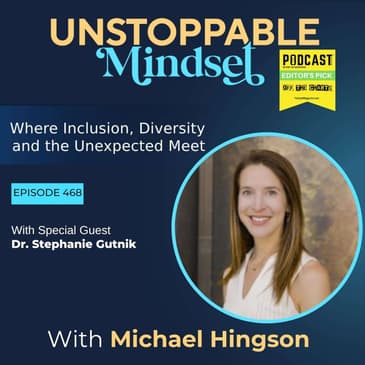
Success does not always mean moving faster, achieving more, or keeping up with someone else’s timeline. Dr. Stephanie Gutnik has built a career across marketing, business development, media, travel, and entrepreneurship, yet some of her biggest lessons have come from learning when to slow down. Stephanie and I explore burnout, wellness, fear, AI, social media, intuition, and why our lives rarely follow a straight path. We talk about doing your best without needing to be the best, trusting your instincts, letting go of what you can’t control, and staying open when life changes the plan. I believe you’ll find useful ideas here about personal growth, resilience, and creating a life that feels like your own.
Highlights:
0:10:15 - How high achievement can lead to burnout, stress, and health issues.
0:16:09 - Learning to control fear instead of letting fear control you.
0:24:30 - How asking, trying, and taking initiative can open new career paths.
0:35:35 - Doing your best matters more than being the best.
0:45:26 - Knowing when to stop pushing and let life unfold.
0:58:37 - Trying more helps you discover what you’re capable of.
About the Guest:
Dr. Stephanie Gutnik is President of tuxedo concepts, providing management consulting and public speaking to organizations across the world. Her focus areas are integrated marketing communications, business transformation and corporate wellness. She is also the author of the children’s book, “My Very Best”.
Stephanie has spoken globally from Taiwan to Brazil, with notable events including Advertising Week New York and London, Ad Age’s Business of Brands in Chicago, Brand Innovators in New York, Possible in Miami and AdAI in Toronto. Her articles and interviews can be found in publications such as Adweek, AdExchanger, Digiday and the Association of National Advertisers. She has also been a juror for the likes of The Drum and Future is Female.
As EVP Omnichannel at Wilkins Media, Stephanie has previously held roles as Global Chief Strategy Officer at Billups, Global Head of DOOH at Yahoo, Vice President of Digital Strategy and Programmatic Sales at OUTFRONT Media, and Vice President, Business Development at Broadsign. She sits on the Board of Directors of the Canadian Association of New York and Jewish Community Foundation of Montreal.
Stephanie graduated with a BA from McGill University and has a MBA and doctorate from Edinburgh Business School.
Ways to connect with Dr. Stephanie**:**
People can follow me on LinkedIn (https://www.linkedin.com/in/stephaniegutnik/)
Tuxedo concepts (tuxedoconcepts.com).
My book is available through Amazon and directly through Book Baby (https://store.bookbaby.com/book/my-very-best)
About the Host:
Michael Hingson is a New York Times best-selling author, international lecturer, and Chief Vision Officer for accessiBe. Michael, blind since birth, survived the 9/11 attacks with the help of his guide dog Roselle. This story is the subject of his best-selling book, Thunder Dog.
Michael gives over 100 presentations around the world each year speaking to influential groups such as Exxon Mobile, AT\&T, Federal Express, Scripps College, Rutgers University, Children’s Hospital, and the American Red Cross just to name a few. He is Ambassador for the National Braille Literacy Campaign for the National Federation of the Blind and also serves as Ambassador for the American Humane Association’s 2012 Hero Dog Awards.
https://www.facebook.com/michael.hingson.author.speaker/
https://www.youtube.com/user/mhingson
https://www.linkedin.com/in/michaelhingson/
Thanks for listening!
Thanks so much for listening to our podcast! If you enjoyed this episode and think that others could benefit from listening, please share it using the social media buttons on this page. Do you have some feedback or questions about this episode? Leave a comment in the section below!
Subscribe to the podcast
If you would like to get automatic updates of new podcast episodes, you can subscribe to the podcast on Apple Podcasts or Stitcher. You can subscribe in your favorite podcast app. You can also support our podcast through our tip jar https://tips.pinecast.com/jar/unstoppable-mindset .
Leave us an Apple Podcasts review
Ratings and reviews from our listeners are extremely valuable to us and greatly appreciated. They help our podcast rank higher on Apple Podcasts, which exposes our show to more awesome listeners like you. If you have a minute, please leave an honest review on Apple Podcasts.
Transcription Notes:
Michael Hingson 00:04
What if the biggest thing holding you back isn't what's in front of you, but rather what you believe? Welcome to Unstoppable Mindset, where inclusion, diversity, and the unexpected meet. I'm your host, Michael Hingston, speaker, author, and advocate for inclusion and possibilities. This podcast explores how the beliefs we carry shape the way we live, lead, and connect with others. Each week, I talk with people who challenge assumptions, face adversity head-on, and show what's possible when we choose curiosity over fear. Together, we focus on mindset, resilience, and the small shifts that lead to meaningful change. Let's get started. Hi there! Welcome to another episode of Unstoppable Mindset. We're glad you're with us wherever you happen to be. Hope you're having a good day. Our person that we get to chat with today is Dr. Stephanie Gutnik, Doctor No Less. We'll have to find out about that, but she is is here from Toronto, where right now it's pretty cold because we're recording this on the 30th of January, so it's cold where she is. It's not quite as cold where I live in Victorville, California, but we're doing okay and we'll cope. So Dr. Gutnik is the president of Tuxedo Concepts, and I'm not going to go into any detail about it because I want to leave all that for her. So we'll just do it this way. Stephanie, welcome to Unstoppable Mindset. We're glad you're here.
Dr. Stephanie Gutnik 01:49
I am so glad to be here. Thank you.
Michael Hingson 01:51
Why don't you tell us a little about maybe the early Stephanie growing up and all that? Let's start with that.
Dr. Stephanie Gutnik 01:57
All right. The early Stephanie grew up in Winnipeg, Manitoba, which is even colder than Toronto is this time. So I'm definitely used to snow and negative temperatures, and I just had a wonderful, wonderful upbringing to be in the prairies. You get perspective on a lot in life, and was very close with family, friends, and then very quickly I wanted to discover more of the world, so I left to study at McGill for undergrad, and it's in Montreal, in Canada. And my life took shape around that. I traveled the world. I continued my academic pursuits and certainly climbed my way up in the business world as well.
Michael Hingson 02:47
How did travel to various places sort of shape your outlook on things?
Dr. Stephanie Gutnik 02:54
I've always had the travel bug. Growing up, we would go away to you know different parts of the states and some warmer destinations with a family road trip as well. And then as I got older, it was it was Europe, it was Australia, and I was always very happy to travel alone or with groups of people that I met for the first time. And I was just really curious to see what life was like in other places, and that translated very nicely into my my working reality, where I was largely in marketing and business development throughout my career, and I was with companies at first that were rapidly expanding internationally. So I was able to open an office in China and set a business plan for you know hiring in the Middle East and go to South America and speak and and grow the business. So I'm really grateful because when I meet people now, typically wherever they're from, I can you know pick my favorite food that I ate while I was there, and we have something to smile about and talk about.
Michael Hingson 04:04
That's pretty cool. Well, I I haven't traveled as as much as you have, but I've traveled enough, and I enjoy travel. I enjoy going to different places and meeting people and experiencing different customs. And even around the United States, there's so many diverse and different kinds of environments. It's it's pretty fascinating.
Dr. Stephanie Gutnik 04:25
Very much. Do you have a favorite place in the U.S.
Michael Hingson 04:29
Oh, it's still going to be California because the weather's better.
Dr. Stephanie Gutnik 04:34
I hear you. I
Michael Hingson 04:35
my favorite place is probably in the San Diego area because I think it's still the best weather anywhere. It's a temperate climate. It's a good climate. It doesn't really get cold to freezing very often, although it can in the winter. But it warms right up during the day. So I really like San Diego. We enjoyed my wife and I living in San the San. San Francisco area. We lived in a town called Novato, which is in the North Bay of the San Francisco area. We lived there for 12 years, and I enjoyed that too. But San Diego still has the best weather.
Dr. Stephanie Gutnik 05:12
The air in La Jolla is is delicious.
Michael Hingson 05:17
Oh yeah,
Speaker 1 05:18
yeah,
Michael Hingson 05:19
and and of course that's the whole point. La Jolla is such a nice place, and it's northern San Diego County, and you've got the beach, and you've got the university there, and so many other things that make it a nice place.
Dr. Stephanie Gutnik 05:32
Very true.
Michael Hingson 05:33
Now I live in Victorville, which is kind of up on the high desert of California, so it's not exactly the same. And I never thought I would live here. But we moved here because it was the only property in Southern California when we wanted to move down to be closer to family. It was the only property that we or place where we found property where we could build a home, and we wanted to build a home because my wife was in a wheelchair her whole life, so we wanted to build an accessible home, and that's what we did. So we've been here now. I've been here for well. We moved down in July of 2014. So my gosh, it's going to be 12 years in five months,
Dr. Stephanie Gutnik 06:13
isn't it? It's funny that you say that because I always find in life there just you find yourself in circumstances that you did not plan, and then they become rather permanent, and you can't really envision your life without that place or that circumstance.
Michael Hingson 06:30
I hear you. I agree. And well, and you know, this house is very comfortable. I like it. My wife unfortunately passed away in November of 2022, so it's me, a dog, and a cat, but I enjoy it, and I'm I'm perfectly happy here. I said I never thought I would live in Victorville, but that's okay. That is where I am, and the house is wonderful, so I I'm I'm fine with it. If I had one thing to say about Victorville, it is the drivers up here all think they own the road, and they're as far as I'm concerned. I ought to be able to get a driver's license because I could drive as well as a lot of the people up here. I don't see the problem myself.
Dr. Stephanie Gutnik 07:12
But up until recently, I hadn't driven a car in like at least 12 years, just from living, you know, in more cosmopolitan cities, and really enjoying a good walk.
Michael Hingson 07:24
Yeah,
Dr. Stephanie Gutnik 07:24
just yeah.
Michael Hingson 07:25
But you drive now?
Dr. Stephanie Gutnik 07:27
No, I've just been behind the wheel to break that. Break that.
Michael Hingson 07:31
Just to get into that habit. Yeah.
Dr. Stephanie Gutnik 07:33
Totally. Yeah.
Michael Hingson 07:35
Well, and Toronto, you you can certainly get around Toronto without a lot Of grief,
Speaker 2 07:41
totally,
Dr. Stephanie Gutnik 07:41
yeah. I am. I very much value the ability to live somewhere where you can just run out and pick something up to eat, or you know, see people around you. I think it's important. Certainly, it feeds me.
Michael Hingson 07:58
Yeah. So, and I and really, for the most part, enjoyed living in New Jersey and working in New York City. New York City is a great place to be able to get around. It's pretty easy to to travel anywhere in the city, subways and all that. Now, it wasn't as easy for my wife because she was in a wheelchair her whole life, and a lot of subway stations and so on aren't accessible. But one day, it was actually before we moved back there. We were both we were in the city, and my wife wanted to go see the UN, and it turns out that she could go downstairs in the hotel where where we were staying, and I was doing other work. But she was able to get a bus that took her right to where the UN was. She could wheel across the street and take a tour of the United Nations and so on, and then take the bus back home because everything was accessible. So she was really excited about having had the opportunity to do that.
Dr. Stephanie Gutnik 09:09
I love that.
Michael Hingson 09:11
Yeah, I was at.
Dr. Stephanie Gutnik 09:12
It really is, and it's important. I was at Yahoo for a couple years, running a division there globally, and when I started, it was part of Verizon Media. Yes, Verizon Media, part of Verizon, and the work that groups were doing on accessible features and technology really intrigued me. And you kind of think there should be an element of that at every company producing whatever it is that they're doing because it makes such a difference.
Michael Hingson 09:41
Well, when you think about it in terms of, let's say, in the U.S. for example, the Center for Disease Control says that up to 25% of all people have a disability. Now, I disagree with that, and I'll come back to that in a moment. But they say 25% have a disability, and so often. Often companies don't deal with that. They're leaving out 25% of their prospective customers because they don't want to make things accessible. And there is so much evidence to show that companies that do create accessibility get the brand loyalty and they get the business,
Dr. Stephanie Gutnik 10:21
yeah.
Michael Hingson 10:22
And the reason I object to 25% is my belief is everybody has a disability. For most of you, it's light dependence. You all don't do well when the lights go out, unless you happen to have a smartphone or a flashlight or whatever. So I describe disability as a characteristic that everyone has. It's just that it manifests itself differently for different people, but that's that's that's my view on it. And one of these days, we'll get more of society to recognize that there is a lot more that they need to do to to to deal with preventing this whole business of leaving so many people out.
Dr. Stephanie Gutnik 11:00
I mean, I couldn't agree more with you. By the way, and there's also, you know, call it disability or whatever you want. Everybody has something in their life that you know it either doesn't make it as easy or makes it their own. And so the whole point of you know when you talk about a customer base, really just interacting as humans, it's how do we how do we understand that everybody is dealing with you know one thing and what can we do and you know throughout my throughout my working career I was somebody who like despite being born in Winnipeg I should have been born in Manhattan because my work ethic is one where I'll work day and night and be very happy about it. I walk quickly. I get things done quickly, and so it was. You know, if you if you give me a challenge, I'll do anything to you know fulfill it. And I think what has what I've seen with myself and amongst others in my network, is that that type of personality begets a whole slew of other issues: burnout, health issues, stress. And so, one thing that I developed and have started to take on the road. I know you're a public speaker. I am as well. I call it the wellness workshop, and it's not you know get up at five in the morning and do your yoga and then your 30 minute meditation and then your your 5k run or it really is much more more tangible and certain tips and tricks that we can do when we're on an airplane or you know in a hotel or just in a period where we're feeling overwhelmed, and I really believe that we have to be cognizant of what's going on with each other in the workplace and just in general, and be able to offer some of the these these guidelines to just help everyone, you know, be okay, if you will.
Michael Hingson 13:00
One of the things that I have adopted as a pretty hard line way of living is when I'm flying to travel and speak. I don't want to work on the airplane going or coming. Rather, I'll use that time to sort of mentally prepare because when I get off the airplane at a destination, I know I'm on until I get off until I fly out again. There are going to be people who want my attention and all that. So I use that time to relax, and then when I leave again, I don't want to work. I want to be able to kind of unwind. So I like to read and do things like that, but I I use those airplane flights basically as a time to unplug.
Dr. Stephanie Gutnik 13:49
Yeah, and see, you're being mindful of the space that you need to let yourself unwind and be that much more productive, and have your battery recharged when you're when you're landed. But I think more
Michael Hingson 14:01
people should do that. And there are so many different kinds of things that we can do. We collectively, as a society, tend not to be overly introspective. We don't think about things. So something doesn't go right. We consider it a failure. We worry about it. We fret about it. But what we don't do is listen to our own inner voice, and we don't analyze well. So, what was the real problem here? What am I afraid of? What can I do to make sure that this doesn't happen again? We don't ask ourselves those questions.
Dr. Stephanie Gutnik 14:31
Oh wow! I kind of needed to hear that actually today. So, thank you for bringing that up. You're very right.
Michael Hingson 14:37
Is that because you haven't figured out why you live in the snow.
Dr. Stephanie Gutnik 14:41
I'm working on that. Yeah, there you are. Yeah, cold is actually very good for our vagus nerves. So yeah,
Michael Hingson 14:48
well, I it it gets fairly cool here at night. It was down to oh what 27 degrees, so it was like minus. Two or three Celsius a couple of weeks ago here, and but I am I I can keep pretty warm, and when I'm sleeping at night, my cat sleeps right up next to me. She does it because it keeps her warm, but it helps keep me warm too. So I'm not complaining.
Dr. Stephanie Gutnik 15:19
There you go.
Michael Hingson 15:20
But I minus
Dr. Stephanie Gutnik 15:21
minus two. By the way, that's beach weather.
Michael Hingson 15:24
Yeah, yeah. Well, there you are. Yeah, fine. You go to the beach then. But I, but I think that we we really do need to collectively and individually think about the need to unplug to to not just always do every single thing and that the same way, and then when there's a problem, we don't take time to think about it, which is a real problem.
Dr. Stephanie Gutnik 15:51
There's also the concept of I don't know if we're raised with this or if at some point we think this is what happens in society, but to think that our lives are almost like a staircase, and that the older we get, the further up the staircase we should be going, is is quite a fallacy. Because again, it you know you're gonna it's just not how it works. Sometimes things stay flat. Sometimes you're gonna go down a few steps. And no, this is called. We're all about the unstoppable mindset here, right? So it really is. If you're falling down a few stairs, what do you do to get back up? I would say,
Michael Hingson 16:31
right? Yeah, and that's and that's it. And you have to really look for that answer, which is which is
Dr. Stephanie Gutnik 16:40
the issue. So,
Michael Hingson 16:41
yeah, go ahead.
Dr. Stephanie Gutnik 16:42
I was just going to say, like, is that something that people can learn, or is it something that you, you know, is ingrained in you from a younger age?
Michael Hingson 16:51
Well, I think that for some people it it may be, and I think, but it is a matter of life. It is a matter of upbringing. I think it is something that people can learn. So during the pandemic, I wrote my book "Live Like a Guide Dog: True Stories for a Blind Person and His Dogs About Being Brave, Overcoming Adversity, and and Moving Forward in Faith. And what I talk about through as the basic premise of the book is that in reality, we can learn to control fear. I will not say we should never be a. We should never say we're not afraid. We should never say that. Oh, I don't ever experience fear. We do experience fear, and it's evidenced in so many ways. But you can either allow fear to overwhelm you and and as I would put it, blind you, or you can learn to control fear. You can learn that fear can be a very powerful tool to help you. And my evidence of that is that I learned so much prior to September 11th about what to do in emergency and other things like that. And all of that clicked in on September 11th. But I realized during the beginning of the pandemic that I'd never taught other people to do the kinds of things that that I do, and that I still tend to do. And so, I wrote "Live Like a Guide Dog" to to try to teach people by using examples that I learned from my eight guide dogs and my wife's service dog about how to live. So, the example I use most often is people. What if everything to death? Well, what if this happens? What if that happens? What if this? What if that? And the reality is, 95% of that will we have no control over, and all we do is create fear and worry because we keep going "What if" about this, and there's nothing we can do about it. I'm not saying that we shouldn't be aware of things, but we don't have to worry about them. We don't have to focus on all the stuff over which we have no control. Dogs don't. What if anything? And I learned that because on September 11th, when we got home, I was going to take my guide dog Rozelle out. I took the harness off, and she ran off and grabbed her favorite tug toy and started playing tug of war with my retired guide dog Linnie. And when I talked to the people, the veterinarians at Guide Dogs for the Blind, where I got Roselle, I talked to them the next day. They said, "Well, did anything threaten her at the World Trade Center? And I said, "No. And they said, "There's your answer. When the harness came off, it was over for her. They don't. They don't. What if? And we should learn that.
Dr. Stephanie Gutnik 19:27
And she wasn't. She wasn't processing what just happened. She just moved on.
Michael Hingson 19:32
She moved on. You know, and and people still today fear it, and they worry about so many Things as I said, the the fact is we should be aware, but it doesn't mean that we have to worry about, especially if we don't have control over it. I rented office space in the World Trade Center in late 1999, early 2000, and. I was able to get office space because there had been a bombing in the World Trade Center in 1993. It wasn't much of a bombing. It was an explosion in a parking lot on the fourth sub sub level of the World Trade Center. So it wasn't the last. Yeah, it wasn't a big thing, but the occupancy rate by the time I was looking for office space, had dropped to 80% and why? If if something were to happen, something would would happen. But people worried about it, and so many people left the World Trade Center, and I thank them for doing that because I got a great rate, and we rented office space there. So fine, but but the fact of the matter is that we worry about so many things over which we just don't have control,
Dr. Stephanie Gutnik 20:48
right? So you're a bit of a risk taker too in that sense.
Michael Hingson 20:51
Well, in a sense, but you know, so there was a bomb that a car something exploded, and I understand that, but was it a true risk to go off and rent space in that building and that complex afterward? Well, is there risk in doing it today with the new complex? The fact of the matter is that there are always going to be things that can happen. the The question is, is it really taking a risk, or are you being silly and putting yourself in harm's way? I won't do that if I can avoid it. But that doesn't mean that I'm not gonna gonna be out there and try to live my life and and help others do the same.
Dr. Stephanie Gutnik 21:38
That's the biggest thing: not living in fear of of so many different variables,
Michael Hingson 21:44
right? So you went to McGill, and you you worked in you graduated with what degrees in business or what?
Dr. Stephanie Gutnik 21:53
No, I graduated with a bachelor of arts in political science and communications. Okay, I went to McGill thinking that I was going to become a broadcast journalist. I loved the idea of being on camera and in the heat of something going on. And I've been told that I ask a lot of questions, and it's just it comes naturally. I'm very curious, so I love speaking to people and getting their opinions on various things, and then bringing that all together for what hopefully is a representative story of multiple truths, right? And I'm still like that to this day. So everything, if I had you know strength, it would be how do I compile a lot of information and then kind of organize it to to cut certain things out and really get at the crux of whatever it is that we're dealing with. So I loved I loved that. I still do. I had an internship at CTV Montreal, so it was a big news station nationally in Canada. And you know what? It was one of those things where I just didn't feel like a fit for me at that time, and so again, it's what do you do after? Oh, I was entering my my last year of undergrad, and I I thought, okay, maybe I'll just go do a master's because I really loved. I've always loved school, and instead, I got the advice: just go out there and pick something and work a little bit and figure out, you know, what it is that you want to do from there. When you're, I graduated a year early, so I was 21. It is hard to know what you want to do, right? I think a lot of young people find themselves in that position, and instead of, I guess, going back to the idea of fear, instead of being paralyzed by it and not doing anything, just do something, and at least it puts you on some sort of path. So, what did
Michael Hingson 23:44
you do?
Dr. Stephanie Gutnik 23:45
I got lucky. I ended up working for News Corp in Montreal for a couple of years in advertising sales, and that introduced me to the world of advertising. It helped me refine sales sales, you know, efforts and and skills, and I think that understanding how sales work, whatever you do in your life, that's going to come in handy, right? So I was doing that, and I was dealing with agencies and marketers for various different brands, like L'Oreal, for example, Denon, and I liked what they were doing. So then that led me to a job in marketing for a software company, and that's the story: is marketing turned into business development and partnerships, and launching a new tech effort and expanding with that company across the world. And I was able to lean into a lot of writing and speaking, and that's that's how my career evolved. And I did my MBA while I was working for that company, so there were a lot of lots of studying during plane rides. So not quite the unwinding, but it was definitely a break. From the actual work,
Michael Hingson 25:02
well, that's fine, and you, you, you've you've done a lot with it. So you got your master's degree. Where did you get that from?
Dr. Stephanie Gutnik 25:11
That was from Edinburgh Business School. So I did that remotely because I was traveling a lot, and I had a lot of business in the UK. So it made sense to do something around there, and again from there I was recruited to. I built a lot of my own positions while I was at this company, always going, "Oh, this isn't being dealt with. Why don't I take a stab at it and see what happens? Oh, there's a gap here. Let me figure that out. Even you know, the Middle East is one that I like talking about because at the time we were not doing any business there, and I had a hunch that I was like, "Look at all the research. We should be there. We should have a sales rep at least. And the CEO at the time said, "No, no, it's it's not really. I don't agree. So we made a deal for a small amount of money. I was able to figure out my trip and see if I could make a business plan, and so I took a flight from Montreal that had two stops to get there. Lost my luggage, and I know. But on the way back, I mean, long story short, the company now has a thriving business in that region, and while I was there, maybe there's a certain age at which you don't know any better. But I think I've always had this and always will. Is I was raised to understand that if you don't ask, either you don't get or you won't know. So I reached out to the editor of Golf News, which is their biggest paper there? And I said, "Hey, you know, I'm here growing a business in this industry. Can I write an article for you? And he said, "Yes, and it was published. And so stories like that is it kind of defines my life. I always like to figure out what else I could do and and learn from it and push the envelope a little bit.
Michael Hingson 27:02
Yeah, sometimes you have to to take a stand. Sometimes you you have to develop your own mental toughness. And when when people disagree, you unless they can really present some strong argument, then you really just need to to push forward. And and clearly that's what you did,
Dr. Stephanie Gutnik 27:21
yeah. And look, sometimes you're right, and sometimes you're wrong, and that's a learning experience in itself, and that's part of being humbled. And I think that's equally as important.
Michael Hingson 27:32
Yeah, and it's all part of the adventure of life. If
Speaker 3 27:40
you enjoy Unstoppable Mindset and would like to help us continue bringing these conversations to you each week, we've created a way for you to support the show. Your contribution helps us cover production costs and continue sharing stories, insights, and ideas that inspire people to live with purpose and possibility. If supporting the podcast feels right for you, you'll find the link in the show notes. Thank you for being part of the Unstoppable Mindset Community.
Michael Hingson 28:13
What made you decide to get a doctorate?
Dr. Stephanie Gutnik 28:16
Ah, so after the MBA again, I loved school, and I figured, why not just keep going? And I was moving to New York, and it was my mom who said, "You know what, Steph? Like, you're. I think I was I was 26. She goes, "Just enjoy your life a little bit, and she wasn't wrong. So I took a few years, and after that, it was still at the back of my mind. I still really wanted to continue and take my education as far as I could. So I thought long and hard about what I would want to study for that kind of time. And you know, it's not going to change the world. But I studied the advertising effects of mass media and ones that have been changing as a result of you know the whole media landscape has been digitized, so that's what I did. And actually, the the brand that I worked with for my research is a company out of California called Goodr. So they they make sunglasses, and I worked with their marketing team, and it was just a wonderful experience. And again, it's a different way of thinking. By that point, I was very much an executive, and I had been at private and public companies. And going back to school in that sense and learning, you know, in the business world, everything is about being concise, which I think is a very powerful skill to have. And in academia, you slow things down, and you really look at the whole picture plus all of the small, small details that build it. So, I'm an impatient person, and that definitely took some some work, but I loved the whole process. It wasn't easy, but I'm very happy that I did it.
Michael Hingson 30:03
So, when did you get your PhD?
Dr. Stephanie Gutnik 30:05
I graduated. I want to say two odd years ago, two or three years ago.
Michael Hingson 30:11
Congratulations! Well, that's cool. Thank you
Dr. Stephanie Gutnik 30:13
very much. Yeah.
Michael Hingson 30:15
How how do you think that AI is affecting the the world of media, the world of public relations and marketing, and so on.
Dr. Stephanie Gutnik 30:27
So, despite working in ad tech, I myself am quite a luddite. I I'm very removed. I don't have too much social media, and usually with technology, unless it really benefits me, I'm not going to be the first. I'm not going to be an early adopter, if you will. So with AI, I appreciate you know the the code and so on that it's built on all of the the knowledge behind it and how it works. And I definitely think there's so many realms in which it's going to help us advance as a society, and I think that with advertising and marketing and media, AI helps take out. It's there's something that preceded it in terms of media buying called programmatic that I've spent a lot of my career dedicated to, and programmatic just really automated media buying and selling, made a little bit easier than picking up the phone and calling two dozen different vendors to put a campaign together, and so with AI, it does that even more so. It just takes out a lot of the more tedious and redundant work from media planners to strategists and helps us understand a little bit better how marketing dollars are actually put to work, and how effective they are in terms of the results that we see. But here's the thing: is as much as AI is going to simplify certain processes, we, at the end of the day, are human beings, and the reason why, as far as I know, nobody's really mastered the stock market yet. It's because we're driven by emotion and we're fickle, and think it takes a lot for a machine to understand how we think and how we work. And so the same thing applies to advertising because for an ad to be effective, it has to strike a chord with humans somehow. So I think that by nature of us being human, the the world of advertising will still have media departments and creative teams, and have to continue to think about you know the strategy behind what it is that we're doing.
Michael Hingson 32:34
How about social? What would you say? Well, I I think there's a lot of truth to all that. I think that AI is a tool, and different people will use it in different ways. And I'm not going to even go to the negative aspects of it because the the reality is most anything that we create, somebody will find a way to misuse it, and and I can't worry about that. But I do see the value of AI and the AI technology, in terms of how it can help us codify or create different kinds of aspects of whether it's marketing or or anything else, AI can assist us. But it is a tool, and we're still the humans, and we're going to be the ones that will be in control. I'm not ready to accept that it can take over in the end. I don't think that's going to happen.
Dr. Stephanie Gutnik 33:28
I'm still. I'm still not even thinking about
Michael Hingson 33:32
it. Yeah, I just think I think there are a lot of ways that we can use it. AI has done already a number of really good things for us collectively, and I think that's great. That doesn't mean that we're all going to use it, or that doesn't mean that we'll all use it extremely, well, in an extremely productive way all the time. But it is out there, and I think it's again, it's one of those things that's worth learning about and understanding because it's going to be here. It's not going away,
Dr. Stephanie Gutnik 34:07
right?
Michael Hingson 34:08
How about social media? That's the that's the other one that's become even more pervasive.
Dr. Stephanie Gutnik 34:14
And social media, again, just by nature of who I am, I am not big on it, and it's not knocking it. I just know that it's not, it's not something that I want to have in my life to the extent that some others do want it in theirs. I'm really good with just doing my own thing and focusing on my little bubble in terms of you know the restaurants that I choose to go to and what food I'm eating and and all of that and with the people who are in my life I love hearing from them directly and getting updates and seeing their pictures so I definitely I use LinkedIn for business I think it's fantastic yeah and it's a wonderful platform to to build a profile and interact with people. Your world that way, and I think that there's a lot of people doing the same with other platforms. And so, when I look at social media from a business perspective, I think it's amazing. And when I look at it from a personal perspective, again, it's not for me, but I I think if people enjoy being on it, that's totally up to them. I can't. I just don't really have the patience to to. I'd rather do something else. I'd rather work on, you know, either my my full time job or my my business is on the side, or go for a walk. Quite frankly. Well,
Michael Hingson 35:39
I think again, I'm I'm I'm kind of with you. I think that, especially personally speaking, people who spend hours a day on social media are missing out on so many other kinds of things that would would be even better. And and a lot of that has to do with personal contact with other people, which you don't have. No matter what people may say, you don't have when you're just dealing with communicating through social media. That's not the same.
Dr. Stephanie Gutnik 36:08
It's true. Plus, there's the element. Yeah, and there's I think people feel pressure, and we see this. It goes both ways, but I do think there's a bit of a pressure to put your best foot forward in a social media environment, right? Whether it's Photoshop or editing or posing for you know a lovely photo when you're not doing great, whatever it might be, and I think that's slowly changing. But for me, it's more. Think we're all just trying to do our best, and you know, I don't. It just doesn't work for me on a personal level.
Michael Hingson 36:45
Yeah, I think we should try to be doing our best all the time, anyway.
Dr. Stephanie Gutnik 36:48
Yeah, that's true. Exactly. We should. Well, that actually leads me to. This is a. You know, I'm. I'm going to go for it. This is a plug. It's. I wrote a book called My Very Best for that reason. Actually, I was going to talk to you about that. Yeah, go
Michael Hingson 37:03
ahead.
Dr. Stephanie Gutnik 37:04
So you know exactly what you're doing. Yeah. And by the
Michael Hingson 37:07
way, I would appreciate it because I don't think that you did send me a picture of the book cover that we can put in the the notes, the show notes. I
Dr. Stephanie Gutnik 37:14
did, and I will follow up with that again. Thank you so much. It's that was something that I've always wanted to do. When I was younger, my mom tells me about how I used to bring a stack of books over to her to read to me, and I definitely have fond memories of reading books to my sister, who's younger than me. And I've always just loved children's books because they're they're so beautiful in their simplicity and the way that they can frame a young mind into being curious and imagining and learning so much about the world, and so I wanted to definitely write a book about the values that my sister and I were raised with. She told me that she was having our first child about a year ago at this time, and so in that time frame, I was like, "This is the moment. This is when I have to write a book. And so I wrote it for for him and her, my nephew. And it was one thing where I just I started with writing out the the copy, and then I needed to get it illustrated, and then from there I was like, you know what? I've done all this work. Let me let me publish it. And so I just was a big learning experience and so much fun. And I had readings, and I just went to go see it on the shelf at Canada's biggest bookstore called Indigo. And I'm I'm so thrilled. So I wrote it because my parents really-they raised my sister and I to really understand that it's not about being the best; it's about giving something your best effort. Because that way, you know, if you do well, great-you worked really hard to get there. And if you don't do well, you're not going to be wondering, hmm, if I only had tried more, because then you're disappointed with yourself. So it's about setting yourself up to always be proud of who you are, and that's really important to me.
Michael Hingson 39:11
Are there any books, other books inside of you that may come on in the future?
Dr. Stephanie Gutnik 39:14
Oh, well, that one I I'm loving right now. If we consider my thesis, my doctoral thesis, a book, that one will put you to sleep because it's long and quite academic. Many theses
Michael Hingson 39:31
will do that.
Dr. Stephanie Gutnik 39:32
Yeah, and I think I quite like. I can see moving forward the more journalistic style articles. So maybe there are a few of those that address very specific moments or questions. Maybe we'll we'll see some of those come out. And what about you? Given that you are also you're a New York Times bestseller, do you have anything up your sleeve?
Michael Hingson 39:53
Not at the moment, but we'll see down the line. But one of the things that that I believe. His and I and I've roused about this even on the podcast a few times. I think that textbooks are so boring, and they shouldn't be. I think that every every textbook that that someone writes ought to have some personal things in it to help draw readers into being more excited about learning more about what's in the textbook. So a physics book is is real lovely, but it's very boring. Why don't Why don't they have Why don't the physicists, the scientists who create those books, put in as part of what they do some stories about their efforts, some stories about the discoveries they've made to really make the books more personal and to draw people in. Publishers don't want that, but the reality is it would really attract, I think, a lot more interest in textbook material. And and the same thing with technical journals and technical manuals. They're so boring, and there's so much more that could be done with them. I think that would would attract people much more than than they do today.
Dr. Stephanie Gutnik 41:07
There's something about humanizing and adding a little bit of maybe even imperfection. Dare I say, like, hey, this is what happened, and let's be real about the situation. That yeah, makes it more entertaining for sure. Yeah,
Michael Hingson 41:20
yeah, which I think makes makes perfect sense, and and it would be I think a wonderful thing to do. Well, maybe we'll have to start a new publishing company and insist that the people who write books for our company do that. Some to think about it. I'm with you. We
Dr. Stephanie Gutnik 41:38
can we can offline on that.
Michael Hingson 41:40
Yeah, ought to be able to do something with it. Well, so anyway, for you, so you wrote the children's book, and and it's out there. Did you self publish it, or was it published by a company?
Dr. Stephanie Gutnik 41:53
Yeah, I went through a company based in New Jersey, and they just had the perfect platform and distribution for me, and it really-I would say-around the time that I was 35, which is now when I turned that age, I really started thinking about like you know, okay, our life doesn't have to be cut and paste, and there really is no manual. And I had thought that for most of it, I would look at people that I admire or respect, or people around me, and look at them, evaluate the milestones that they had reached by specific ages, and then I'd look at myself, and you know, sometimes I was feeding those milestones. In my opinion, like I, I worked my way up the corporate ladder very quickly, but there were other ways in which, at the time, I thought I was lagging or, or dare I say, failing, because certain other elements of my life weren't where other people's were, or I thought it should be. So I've been going through a process really of of letting that go, and again, just to your going full circle to what you said earlier, just being a bit more introspective and appreciating that we're all again trying to just do our best here, and nobody's journey is going to look the same. So with that has just come. I've always again I've always wanted to try new things, but it always is. I'll wake up in the morning and go like, you know, what do I want to do today? Who should I reach out to to see if there's some way to collaborate or have a new experience? And it's just made for really fun travels and stories and successes and and learning experiences. And I'm, but I'm working on that. I can say that as much as I want, and I think, you know, it's it's really believing it that is a bit more of an effort.
Michael Hingson 43:48
Well, there you go, and you know, it'll it'll be interesting to to see how it all comes out as you go forward.
Dr. Stephanie Gutnik 43:54
Yeah, did you have that at all throughout yours? As you know, those periods of of Like plateaus,
Michael Hingson 44:02
I think probably so, but I but I don't think that I really ever thought that that I was failing. There were times that that things were not happening the way I would like, and usually what I needed to do was to make an adjustment in my attitude to understand why things were going slower or not the way I expected, and sometimes they weren't going the way I expected because I had the wrong expectations. And again, I love introspection, and those are things that I learned along the way. And I also discovered that when I reevaluated and said, "Oh, maybe this really wasn't the right way to do this. Let's look at this. I think that's that's an important thing to do, but I usually find, and I still do, that if something's not working right. Usually, my inner voice, if you will, will tell me what is good, what's working, what's not working, what should be done, and I have to be the one to pay attention to that. and And if I don't, then I can get into trouble.
Dr. Stephanie Gutnik 45:15
It's amazing how much our our gut instincts really know what's best for us in certain situations, and how sometimes it takes a minute for our brain to to get there too.
Michael Hingson 45:29
Yeah. Now, are you a spiritual person at all?
Dr. Stephanie Gutnik 45:32
Oh, totally. Another good segue. Yes, I believe in the scientific method, obviously. So, so that's that's that. But I am comforted by the idea that there's a lot more to what we're doing here than what is commonly accepted.
Michael Hingson 45:50
Yeah, I think I think that's absolutely true, and that gets back to my comment about the inner voice, which is, if you want to say God talking to us or however you want to view it. It doesn't matter. the The point is that I think the information is there if we learn to listen and and accept it. Our our own minds absorb so many things that we tend to forget about, but all that information is there for us to use if we would, but tap into it,
Dr. Stephanie Gutnik 46:24
yeah,
Michael Hingson 46:24
or allow it, or when it and it when it tries to tap us on the shoulder and say do it this way, we need to learn to listen.
Dr. Stephanie Gutnik 46:32
Ooh, and that's a great point too. Is for people who are used to propelling, you know, things forward, and you had mentioned what's out of our control. That's another really important word that I speak about in wellness and has been given to me. Yeah, do I see a do I see a psychic? Absolutely. I often get the words render because, again, sometimes it's just it's being able to to accept, and I do a little bit of Kabbalah in terms of reading and and learning about how that works. And the the term actually means to receive. So when we look at what we're doing here again, I think you want to put out some energy to put things in motion, and then there's a point where you just have to let life come to you.
Michael Hingson 47:21
Well, and I think also it's it's so helpful at night to when when falling asleep, even you want to do something. Ask your ask yourself, what do you think about this? Should I do this? Give me guidance and give me insight as to what works. The more of that we do, the more we develop our mind muscle to be able to get the information and process it and do something with it, and that will help us. But it it has to be a discipline that we create and develop to really work on getting that information and seeking it every day, and listening to what our minds are telling us. I, people probably will get bored with this because I say it often on the podcast, but I talk about Trivial Pursuit. You know the game. How often do we get a question asked on a game, Trivial Pursuit, and we immediately think of an answer, and we go, "Oh, that was just too easy. That can't be it. And we think a little bit more about other options, and we choose a different option. But the first one that we thought about was really the right answer.
Dr. Stephanie Gutnik 48:33
Yes,
Michael Hingson 48:34
exactly. And the point is that happened, and people agree. Now, what do we do about it? Well, we learn to listen to that inner voice.
Dr. Stephanie Gutnik 48:42
The same thing happens with students, by the way, on exams. Multiple choice is not always that easy because so many students have the tendency to second guess themselves.
Michael Hingson 48:53
Yeah,
Dr. Stephanie Gutnik 48:54
and it's usually that their first instinct was the right answer.
Michael Hingson 48:57
Right. Yeah. If they would just but listen and learn; they'll get the right answer by doing that. And and the reality is that I think there are some studies that have been done that people that truly do learn to listen and take those first answers and use them tend to be right a whole lot more often than they otherwise would have been,
Dr. Stephanie Gutnik 49:21
yeah. Again, trusting our instincts,
Michael Hingson 49:25
right? Yeah. So, what kind of projects are you working on now?
Dr. Stephanie Gutnik 49:30
Oh, well, again, I I'm an EVP at an ad agency, so that's my that's my full time project. EVP. But then I always EVP, Executive Vice President.
Michael Hingson 49:40
Oh, EVP. Okay, yeah,
Dr. Stephanie Gutnik 49:41
yeah. Okay,
Michael Hingson 49:42
VP. Okay, got
Dr. Stephanie Gutnik 49:43
it. Yeah, with an E. You know, if we're if we're looking at, so that keeps me very busy. And then on the side, I always again, I think it's very important to have an identity outside of work, and this is something that I actually had to learn. Because for a while there, my my job title and so on was my whole life, and you can do have hobbies and so on. The side for me, it has to be more constructive than that. So the other things that I have on the go is I have my company Tuxedo Concepts, where I do all different types of consulting work. I have clients across the world in the world of media through to you know a private equity fund called Links Equity, and I'm actually working on a protein superfood snack right now called Balance Bites. So that's another I'm snacking all the time, and I have a massive sweet tooth, so usually I'm going for like the brownies and the cookies, and I work with the founder of this brand, and they're packed with a lot of nutrients that give me a lot more energy throughout the day. So that is something that I definitely want to bring to more people.
Michael Hingson 50:58
Oh, that's exciting!
Dr. Stephanie Gutnik 50:59
It lines very nicely with this this whole wellness kick that that I'm trying to bring to others, but not not in the lifestyle that's impractical to some people or makes them you know not even want to think about it. More so again with those ideas of if you're feeling overwhelmed or anxious, splash some cold water on your face, right? Like there's there's certain tips like that that you don't have to go to a yoga studio or sign up for a gym membership. Though you know you should be exploring physical activity. It's what are small things that we can be doing for ourselves to bring us back into the moment.
Michael Hingson 51:37
Do you think there are things in your life that that you're not doing that-that you should be doing, or that that you miss.
Dr. Stephanie Gutnik 51:46
Oh, on a personal level, I feel yeah. At this age, that probably from a family perspective, I should be getting on that. But that is one of those things that is so out of our control, and I find that in those instances, just it's very easy to look at what we don't have and yearn for it, but that can be depressing. So instead, it's it's much more fulfilling to look at what we do have and lean into that. Right?
Michael Hingson 52:19
Yeah, I know that when my wife and I got married, we both pretty much thought we knew what we wanted in a partner, and we kept looking until we found it. We found each other, and and that worked. But we were I was 32 and she was 33, so we didn't get married right away, but the other side of it is we met in January of 1982, and we got married in November of 1982 because it clicked. We knew what we wanted, and we saw things in so many ways exactly the same. But there were also times that we disagreed with things. But you communicate. You you work through it, right?
Michael Hingson 53:03
So, for example, she didn't want to have children because she felt that that would be kind of hard on her body being in a chair in her case, and I was fine with that. But our our solution to that was we'll be glad to entertain nieces and nephews and things like that because at the end of the day, we can either sell them to the gypsies or send them home,
Dr. Stephanie Gutnik 53:24
and that's beautiful, right? You still have such a wonderful impact on other people, and that's a thank you for sharing that. And one of my one
Michael Hingson 53:34
of our nieces lives about three miles from me, and we see each other all the time. She and her husband, and now their kids are grown and have kids of their own, so we we get to see everybody.
Dr. Stephanie Gutnik 53:47
That is lovely. What about you? Are there any things that you still have on your bucket list that you'd like to be doing right now?
Michael Hingson 53:55
Well, I certainly want to do more speaking because I want to keep that going. I'd like to to travel more, but it's not nearly as fun for me, at least traveling alone. But one of these one of these years, certainly in the next two or so years, I'll probably decide to take a cruise because I love cruising. Yeah, me
Dr. Stephanie Gutnik 54:15
too.
Michael Hingson 54:16
And I and I can do really fine cruising. I think that's a lot of fun to
Dr. Stephanie Gutnik 54:21
do. Definitely. Which which part of the world would you cruise in?
Michael Hingson 54:25
You know, I'm pretty open on that. I I first of all, I've been to New Zealand. I'd love to go to Australia, but as far as cruising, I'm pretty open. I'd like to to do a cruise up and down the Mississippi River, but I'd like to to to do some cruising around Europe or other places as well. I think it'd be fun.
Dr. Stephanie Gutnik 54:46
Yes, I I very much agree. My family went on. I was very fortunate. We did four cruises together, my parents, sister, and I all over the Caribbean and Mexico, and then I did one in South America, and I've done one. In Greece and Turkey, and I also I took a catamaran with about a dozen strangers in Thailand for almost two weeks. Yes, well, because why not?
Michael Hingson 55:12
First cruise that we took, Karen was a travel agent at the time, actually, and her family wanted to go on a cruise. We did a two week Trans Panama Canal cruise, that was a lot of fun. Loved it. Then we did a cruise to Mexico, and I think we did another cruise in the Caribbean, and then the last cruise we took was to Alaska, which was a lot of fun.
Dr. Stephanie Gutnik 55:42
Okay, that is wonderful.
Michael Hingson 55:45
Yeah. Was there anything
Dr. Stephanie Gutnik 55:45
in Alaska that surprised you?
Michael Hingson 55:48
Nothing that surprised me. It was just fun to go for me and and Karen actually. Although it's fun to get off and tour, we're fine if we're just on the ship the whole time, even just because it's the it's relaxing, it's the attitude and and and having fun. But but I would like to go and and cruise some. I think we'll do that sometime in the near future.
Dr. Stephanie Gutnik 56:13
Well, I mean, I'm all for it. You let me know when you go. Want to go? Yeah, I'm down.
Michael Hingson 56:20
Yeah, we'll have to do that. That'd be fun, but yeah, we'll kick off
Dr. Stephanie Gutnik 56:24
our textbook company on the cruise.
Michael Hingson 56:26
There you go.
Dr. Stephanie Gutnik 56:27
Multitask
Michael Hingson 56:28
books afloat Inc.
Dr. Stephanie Gutnik 56:30
Love
Michael Hingson 56:33
it, but I think there's there's so much to do that you know we'll make it work. So you um um we talked about a little bit, but you really feel that having been in a variety of cities has helped your life perspective.
Dr. Stephanie Gutnik 56:48
Definitely. Look, the the way that you're just talking about travel, it's the same thing. Where I've lived in four cities and have traveled to many more, and it shapes you certainly when you when you make moves, I moved a couple times for work, for example. You are often finding yourself somewhere where you're alone, and you have to build a whole new community and support system. And sometimes that can be very lonely. And as much as I love spending time with myself, or but I think overall it really proves to you that you can be resilient and you can make you know wonderful things out of situations that you you didn't know what would happen, right? So similar to you not knowing that you would live where you do now, yeah, it's a beautiful testament to what we can do as humans, what we're capable of.
Michael Hingson 57:44
Life's an adventure.
Dr. Stephanie Gutnik 57:46
I know. I love that theory.
Michael Hingson 57:48
So, for you, what's been one of your biggest learning lessons over the last year? Since I assume you still believe that you learn all the time,
Dr. Stephanie Gutnik 57:57
I learn all the time. And again, I think it really is just going back to the spirituality element. Man plans, God laughs. I definitely have thought that there's a lot in my life that I had the ability to plan out. And even when I think things are going in a certain direction, the universe has this fun way of you know establishing a plot twist and seeing how I react to it. So yeah, maybe it's it's not take certain things as seriously and and kind of learn to go with the flow a little bit more. That's the biggest lesson there.
Michael Hingson 58:33
Good for you. That's a that's a very important lesson.
Dr. Stephanie Gutnik 58:37
Yeah. So maybe it's a little bit later in life, but you know, it's never too late for these things.
Michael Hingson 58:43
Never. What would be
Dr. Stephanie Gutnik 58:44
one of yours?
Michael Hingson 58:46
Well, I think for me, spending more time being introspective has has been a great lesson for me, and I've learned to to step back and again not plan so much, as you said. Man plans, God laughs. I don't know. I would say God laughs. God's just patient, and He says, "Go do what you're going to do, and then let me know when you're ready to get real. But you know, I I think there's a lot of truth to that. So for me, I'm just constantly learning to be a little bit more patient,
Dr. Stephanie Gutnik 59:22
a good one too.
Michael Hingson 59:24
So, what kind of advice would you give to an up-and-coming entrepreneur or person about living life?
Dr. Stephanie Gutnik 59:32
Ah,
Speaker 4 59:34
just
Dr. Stephanie Gutnik 59:35
do do everything. Do everything that you want to do. Really, would be because I think that like the more that you try, the more you are learning about what you are capable of and who you are as a person. The more different types of people that you meet, the more opportunities that might come your way. And some of it you're not going to like. That's a learning lesson. And some of it. You're going to love. So, if there's, so I would say do all of that, and then the other one is, is make it happen, because nothing will come to you if you are not going after it. And I just said that we have to surrender and let things come to us, but I really believe that there has to be not a manifestation, but really just some intention to push us in a certain direction, and that that hard work is necessary in anything that's really good that comes to us in life. Anything that's good is going to take work.
Michael Hingson 1:00:36
The only thing that I would add to that is when you said there are things that might might be happening. That might happen that you don't like. My only comment to that would be: step back and try to figure out why you don't like them, and see if there's really a reason. Because we we we are such a knee jerk reaction society. It's always good to analyze and go, what really is the issue here?
Dr. Stephanie Gutnik 1:01:00
Yeah, you're so right.
Michael Hingson 1:01:02
Well, I want to thank you for being here. This has been absolutely fun. It has now been over an hour, and it's got to be past the beginning of your dinner time.
Dr. Stephanie Gutnik 1:01:12
It's almost past my bedtime on a Friday night. How about there? You go. Well,
Michael Hingson 1:01:17
I really appreciate you doing this and and spending the time with us, and I I've learned a lot, and I hope other people have. If people want to reach out to you, how do they do that?
Dr. Stephanie Gutnik 1:01:27
Oh, please reach out on LinkedIn. It's just Stephanie Gutnick. You'll find me.
Michael Hingson 1:01:33
Spell that if you would, just to play safe.
Dr. Stephanie Gutnik 1:01:35
Yes, absolutely. S T E P H A N I E, and the last name is Gutnick. G U T is in Tom and is in Nancy I K.
Michael Hingson 1:01:45
So hunt down Stephanie on LinkedIn.
Dr. Stephanie Gutnik 1:01:49
Stephanie doesn't know who Tom or Nancy are, but she just thought that those would be helpful names. Well,
Michael Hingson 1:01:54
there you go. Well, hey, whatever works. Yeah,
Dr. Stephanie Gutnik 1:01:57
exactly.
Michael Hingson 1:01:58
There you are, Michael.
Dr. Stephanie Gutnik 1:01:59
Thank you so much.
Michael Hingson 1:02:00
It's been a pleasure. Well, I want to thank all of you for being here with us, and hope you've learned some things today, and that you've enjoyed it. Wherever you're monitoring our podcast, please give us a five star review. But even more, or rating, but more important, give us a great review. Reviews are things that people like to see when they're thinking about what podcast to listen to, so we value your reviews greatly. And if you'd like to reach out to me, it's easy. It's speaker, S P E A K E R at Michael Hinkson, M I C H A E L H I N G S O n.com. Love to hear from you. If you know anyone who ought to be a guest on the podcast, let us know. Stephanie, you as well. Always looking for more people, and so I appreciate you doing that. And with that, Stephanie, once more, thanks for being here. This has been fun.
Dr. Stephanie Gutnik 1:02:50
Thank you so much. I very much agree.
Michael Hingson 1:02:55
Thank you for being here with me on Unstoppable Mindset. I hope today's conversation left you with a fresh perspective, a new insight, or at least something worth thinking about. If you're ready to go deeper into the ideas that shape how we see ourselves and others, I have a free gift for you. Head over to MichaelHingson.com and download my free ebook, Blinded by fear, it explores the invisible beliefs that hold us back and shows you how to reframe them so you can move forward with clarity and confidence. Be sure to subscribe to our podcast, leave a review, and share this show with someone who can use a reminder that growth starts with mindset. When people think differently, we all move forward together. Thanks again for listening. Keep learning, keep questioning, and keep choosing to live with an unstoppable mindset.