
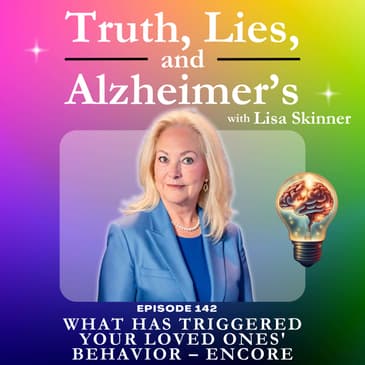
We’re revisiting this episode because its insights remain as powerful and relevant today as when it first aired.
In today's episode of the Truth, Lies, & Alzheimer's show, Lisa goes into depth about how effective communication is key to working with Alzheimer's disease and dementia sufferers. Probably the most difficult challenge for family members and caregivers to overcome is the ability to understand what people who are living with dementia are trying to tell them, especially when they can no longer articulate their wants and needs the way they did when their brains were healthy.
As the progression of the disease continues to worsen over time, so does the disconnect between us. This is the very reason why it is so important to learn to recognize what has triggered your loved one's behavior and what it is they are desperately trying to tell you. Lisa will share with you many tips and solutions about what you can expect and how to best respond to these occurrences.
In her "What's News" segment, Lisa shares a recent article that talks about how cognitive decline after retirement is a universal trend along with 4 ways to reverse it.
About the Host:
Author Lisa Skinner is a behavioral specialist with expertise in Alzheimer’s disease and related dementia. In her 30+year career working with family members and caregivers, Lisa has taught them how to successfully navigate the many challenges that accompany this heartbreaking disease. Lisa is both a Certified Dementia Practitioner and is also a certified dementia care trainer through the Alzheimer’s Association. She also holds a degree in Human Behavior.
Her latest book, “Truth, Lies & Alzheimer’s – Its Secret Faces” continues Lisa’s quest of working with dementia-related illnesses and teaching families and caregivers how to better understand the daunting challenges of brain disease. Her #1 Best-seller book “Not All Who Wander Need Be Lost,” was written at their urging. As someone who has had eight family members diagnosed with dementia, Lisa Skinner has found her calling in helping others through the struggle so they can have a better-quality relationship with their loved ones through education and through her workshops on counter-intuitive solutions and tools to help people effectively manage the symptoms of brain disease. Lisa Skinner has appeared on many national and regional media broadcasts. Lisa helps explain behaviors caused by dementia, encourages those who feel burdened, and gives practical advice for how to respond.
So many people today are heavily impacted by Alzheimer's disease and related dementia. The Alzheimer's Association and the World Health Organization have projected that the number of people who will develop Alzheimer's disease by the year 2050 worldwide will triple if a treatment or cure is not found. Society is not prepared to care for the projected increase of people who will develop this devastating disease. In her 30 years of working with family members and caregivers who suffer from dementia, Lisa has recognized how little people really understand the complexities of what living with this disease is really like. For Lisa, it starts with knowledge, education, and training.
Thanks for listening!
Thanks so much for listening to our podcast! If you enjoyed this episode and think that others could benefit from listening, please share it using the social media buttons on this page.
Do you have some feedback or questions about this episode? Leave a comment in the section below!
Subscribe to the podcast
If you would like to get automatic updates of new podcast episodes, you can subscribe to the podcast on Apple Podcasts or Stitcher. You can also subscribe in your favorite podcast app.
Leave us an Apple Podcasts review
Ratings and reviews from our listeners are extremely valuable to us and greatly appreciated. They help our podcast rank higher on Apple Podcasts, which exposes our show to more awesome listeners like you. If you have a minute, please leave an honest review on Apple Podcasts.
00:00:00
Lisa Skinner: Hello to all of you who have tuned in to listen
00:00:03
to this episode of the truth lies and Alzheimer's show. I am
00:00:08
Lisa Skinner, your host, and I'd like to shout out a very warm
00:00:13
welcome to all of you who have joined us today. Thank you so
00:00:18
much for being here. There are so many aspects of living with
00:00:24
dementia that are unexpected and can surface out of nowhere at
00:00:29
any time. These are what I call the hidden or secret faces of
00:00:35
Alzheimer's disease, and as many of you know, they show up
00:00:41
unannounced are completely unpredictable, and that is the
00:00:48
reason why it's so important to be prepared for anything that
00:00:52
emerges on this journey. And to be honest with you, I don't
00:00:59
think there's much doubt that what makes our relationships and
00:01:05
caring for those who live with Alzheimer's and related dementia
00:01:09
so challenging is the disconnect that occurs in our ability to
00:01:14
communicate effectively with one Another as the progression of
00:01:19
disease worsens over time, it clearly becomes more and more
00:01:25
difficult to know what your loved one is trying to tell you
00:01:29
when they are no longer to able to articulate their wants and
00:01:32
needs to you. This is the very reason why I cannot stress the
00:01:38
importance of arming yourself with an arsenal of tools and
00:01:42
strategies so you can be as prepared as possible when these
00:01:47
situations arise. And just like we can count on the sun rising
00:01:53
each morning, you better be sure we can count on these situations
00:01:59
arising unexpectedly every day, and I want to remind you,
00:02:04
because I've said this before, not every strategy works for
00:02:09
each situation every time. So the more tools you have
00:02:15
collected in your toolbox, the more options you will have to
00:02:19
use to try to diffuse a situation from escalating into a
00:02:24
catastrophic reaction where it can just really get out of
00:02:28
control. So what I'm going to share with you today are some
00:02:33
triggers and responses to some of the behaviors that occur as a
00:02:43
result of this disconnect and communication, they typically
00:02:48
manifest as behaviors, and this is really the way that the
00:02:55
person you're caring for or your loved one is trying to tell you
00:03:00
that there is something genuinely wrong. They are not
00:03:04
trying to be difficult. They are not trying to make your life
00:03:09
hard. They are not trying to be spiteful. They honestly can no
00:03:16
longer tell you what is bothering them so they will
00:03:20
behave in a way to get your attention, trying to relay a
00:03:24
message to you. And these are the things that you must learn
00:03:29
to recognize. That is their way of communicating with you. You
00:03:36
learn to recognize the behaviors, and then you're going
00:03:39
to have to learn how to identify what the trigger was for that
00:03:45
particular behavior. So the tips and the tools that I share with
00:03:50
you, you want to just kind of file them away or collect them
00:03:55
in your toolbox, as I said. And if one thing doesn't work, you
00:04:02
can try another, and the more tools you have to pull out and
00:04:08
try, the better equipped you're going to be for any circumstance
00:04:14
that will arise. So environmental issues can create
00:04:21
behavioral problems in people with dementia. Examples of
00:04:26
environmental related issues are sensory overload. So in other
00:04:31
words, too much going on around them, being around unfamiliar
00:04:37
people, noise, lighting, something that startles them,
00:04:45
agitating behaviors of others in the environment. People with
00:04:51
dementia pick up other people's moods and emotions, and they can
00:04:56
mimic those emotions, and that's. Other thing I wanted to
00:05:01
mention, because people lose so much of their cognitive skills,
00:05:06
what it really comes down to, at the end of the day, is
00:05:10
everything that they are reacting to is basically comes
00:05:15
down to raw emotion, because they no longer have the ability
00:05:20
to reason things out or to think things through. So these
00:05:24
behaviors are raw emotion, trying to tell you that they
00:05:30
need or want something. Tasks presented to a resident with or
00:05:36
a person with dementia can create these behavioral
00:05:41
problems. Here are some of the task related issues and
00:05:45
solutions. So in terms of issues, if a task is
00:05:50
overwhelming to a person, that can be a trigger, if they feel
00:05:56
rushed, if it causes them to become overstimulated if a task
00:06:03
is too complicated, if they are not able to focus on a given
00:06:10
task, and if they have a poor attention span. So here are some
00:06:16
of the solutions to those issues. Keep things simple, slow
00:06:22
it down, stay calm and be gentle. Take one step at a time,
00:06:32
always make eye contact and repeat instructions as needed.
00:06:40
Communication can also contribute to a person's
00:06:44
behavioral challenges. Without effective communication, the
00:06:48
psychosocial quality of life of the resident quickly
00:06:51
deteriorates. Now communication can be verbal, nonverbal, or
00:06:57
both. Now verbal communication is the words we use. Nonverbal
00:07:05
communication are your actions, your body language and your
00:07:10
facial expressions, your tone of voice, expression of emotion and
00:07:18
your inflections are also considered part of nonverbal
00:07:23
communication. Effective communication is the key to
00:07:29
working with people with dementia. So when communicating
00:07:33
with people who have dementia, it helps to face them directly,
00:07:40
speak slowly, use their name
00:07:46
and then wait for a response from them. Don't rush. Repeat it
00:07:52
if necessary. Use cueing or modeling behaviors. Smile at
00:07:59
them at all times, then they will not absorb feeling a
00:08:06
sternness coming from you or that you're mad or upset with
00:08:10
them, and then praise them always and reassure them that
00:08:16
everything is fine and they're doing great now, according to
00:08:21
the Alzheimer's Association, there are three basic steps to
00:08:26
assist in identifying common behaviors and causes. Step one,
00:08:33
identify and examine the behavior. You should ask
00:08:37
yourself the following questions, what was the
00:08:40
behavior? Was it harmful to the individual or to others? What
00:08:46
happened just before the behavior occurred? Did something
00:08:51
or someone trigger that behavior? Other questions you
00:08:56
may consider in order to examine the behavior include what
00:09:01
happened immediately after the behavior occurred. How did you
00:09:07
react? The Alzheimer's Association suggests that you
00:09:12
should consult your loved one's physician to identify any causes
00:09:17
related to medications or an illness that may be developing.
00:09:24
So step two is explore potential solutions. The Alzheimer's
00:09:30
Association also recommends identifying the needs of the
00:09:35
person with dementia and evaluate if these needs are
00:09:39
being met. So some of the questions you may consider in
00:09:43
your exploration is, Can adapting the surroundings
00:09:48
comfort the person? How can you change your reaction or your
00:09:55
approach to the behavior? Are you responding in. Calm and
00:10:01
supportive way. It is very important to keep in mind that
00:10:06
the person with dementia may be using these behaviors to
00:10:10
communicate his or her needs in the only way he or she knows
00:10:15
how. This is why you as a care provider or a family member,
00:10:21
need to be cautious of your response. It can make all the
00:10:26
difference in the world. Step three, try different responses.
00:10:32
Again, once you attempt new responses, you should evaluate,
00:10:38
did your new response help in this situation, the Alzheimer's
00:10:44
Association asks, Do you need to explore other potential causes
00:10:49
and solutions? If so, what can you do differently? There are
00:10:55
many, many resources you can use to discover positive solutions
00:11:00
to challenging behaviors. And I want to also remind you again
00:11:07
that if your response works at that time for that given
00:11:13
situation, and then the same thing happens again and you try
00:11:17
that same response, it may not work this next time. So the more
00:11:24
responses you have to pull out of your toolbox, the more
00:11:29
chances you will have of diffusing the situation. So
00:11:35
below, I mean, what I'm going to share with you now is a list of
00:11:40
what we call 13 R's, what is called a solution focused model.
00:11:48
And the solution focused model focuses on what you can do right
00:11:52
now to change the person's behavior, rather than focusing
00:11:58
on the problem that made the person display a difficult
00:12:03
behavior. Now this approach does not focus on the past, but
00:12:08
instead focuses on the present and the future. The 13 R's are
00:12:16
number one, remain calm your voice and your body language.
00:12:22
Number two, remove the trigger. You want to eliminate the source
00:12:28
of agitation, but you have to figure out what that source of
00:12:32
agitation is. First, not an easy task. Number three, redirect the
00:12:38
person, so guide them to another task. Number four, reassure them
00:12:46
by making positive statements. Number five, Repeat if
00:12:52
necessary. Number six, revise present, one step at a time.
00:13:02
Number seven, respond, which is listening and paraphrasing their
00:13:10
words. Number eight, reference, validate their point of view.
00:13:18
Number nine, remind, always encourage reminiscing and
00:13:23
praising past accomplishments number 10 reflection, which is
00:13:31
physically acknowledging communication. In other words,
00:13:35
one example would be by nodding your head to them. Number 11 is
00:13:40
reinforced. You can do this by praising positive behaviors
00:13:47
number 12 reporting incidents, and what they mean by that is,
00:13:53
write down, keep a journal of things that trigger behaviors so
00:13:58
you will have a reference to look for in the future, and then
00:14:05
13 reevaluate, establish the root cause and assess it for
00:14:13
controlling the situation. So next, I'm going to share with
00:14:21
you some very specific behavioral responses that you
00:14:24
may see in people with dementia, each type of behavior you may
00:14:30
observe, followed by some suggestions that you can do to
00:14:34
help minimize the undesired behavior when a loved one
00:14:40
displays anger or agitation. Here's some tips, do not express
00:14:48
impatience. Maintain calmness, smile and reassure. Speak slowly
00:14:56
and offer comfort. Redirect. Attached to a quiet area, engage
00:15:04
with them in a favorite past time, offer a favorite food or
00:15:09
beverage and whisper. When the person becomes aggressive, it
00:15:17
can help to again remain calm while you approach them, get
00:15:23
help, if necessary, use what's called change of faith
00:15:29
technique, and what that means is you get a different person to
00:15:34
come in and see if that will make a difference, to diffuse
00:15:39
the behavior, again, called change of face. Attempt to
00:15:45
redirect the person, and when you do, redirect them to a safe
00:15:51
area, for example, their room or a quiet area. Provide a
00:15:57
distraction. You can use a known interest to distract them when a
00:16:08
person with dementia is anxious. It also helps to identify the
00:16:13
trigger and time of the occurrence. It's helpful to keep
00:16:17
a journal of these things and reinforce positive behaviors,
00:16:23
help the resident, help the person with dementia, reduce
00:16:27
anxiety, encourage viewing family photos for discussion,
00:16:33
that's a great distraction, Keep them busy and use relaxation
00:16:40
methods. One of the really effective ones is give them a
00:16:45
hand massage. They love that, and it's very calming. Now, here
00:16:49
are some things you can do when the person has increased
00:16:53
behaviors in the late afternoon and evening, often referred to
00:16:58
as sundowning. Prepare for raised anxiety, turn lights on
00:17:06
ahead of time. Minimize their distractions, remove any
00:17:12
clutter, provide a safe place for them to rummage. Offer
00:17:18
favorite items of interest. Offer snacks and drinks and play
00:17:24
soft music in the background. That is very effective.
00:17:31
When a person is disruptive, you may seek their attention,
00:17:36
approach them in a friendly manner, redirect them to a
00:17:41
private area, if possible, inform them of a change in
00:17:46
routine, encourage an independent activity, involve
00:17:54
them in any plans, If possible, and help them gain their coping
00:18:00
skills. Here are some things you can do to help with sleep
00:18:05
problems. Monitor their sleep patterns, determine cause such
00:18:11
as hunger or discomfort, provide daily exercise, establish
00:18:18
routine napping, if necessary, remind them that it's their
00:18:24
bedtime. Provide security items such as a favorite picture or
00:18:30
stuffed animal. Create rituals such as hand massages, drink,
00:18:36
prayer, beds, etc, and wind down activity participation after
00:18:43
dinner. Unless requiring exercise, it's always best to do
00:18:49
more stimulating activities earlier in the day and wind down
00:18:55
as the day progresses, on supply night lights, if they're
00:19:00
preferred, and reassure them that you will check on them
00:19:05
throughout the night. Now, tips for handling agitation include
00:19:12
address any chaos in the environment by reducing noise
00:19:17
levels and the number of other people, avoid moving household
00:19:22
objects around whenever possible. Familiar object
00:19:26
located in the same places provides them with a sense of
00:19:30
security. Change the immediate environment. When the person
00:19:35
with dementia becomes agitated again, play soothing music. It's
00:19:40
magical. It's powerful. Safety proof the environment to allow
00:19:47
for as much autonomy as possible with the least number of hazards
00:19:54
handling communication problems include giving reassurance. Is
00:20:00
trying to use a touch if verbal support isn't working. Again,
00:20:05
limiting outside distractions. Turn off radios and television.
00:20:11
Listen for the meaning of the feelings behind their words.
00:20:17
Speak clearly and loud enough to be heard, and then, of course,
00:20:23
use nonverbal means of communication, such as body
00:20:27
language, facial expressions and touch. Many people with dementia
00:20:33
have ongoing communication problems. This is going to
00:20:39
include forgetting words using repetitive phrases and other
00:20:45
things that you will notice now how to handle delusions,
00:20:50
hallucinations and paranoia, along with Anxiety, delusions,
00:20:56
hallucinations and paranoia are extremely common behavioral
00:21:02
issues in people with dementia, and they may occur as a result
00:21:07
of changes in physical health of the brain. So some tips for
00:21:12
handling delusions, hallucination and paranoia
00:21:16
include probably the most important thing is avoid arguing
00:21:22
or trying to impose a sense of truth or reality into the person
00:21:28
with dementia. Why it absolutely does not work. Don't feel the
00:21:37
need to play into the lie. You can be honest while still
00:21:42
providing dignity and respect, and then reassure that person by
00:21:47
saying things like, I am so sorry. You are getting upset by
00:21:52
this. Let me see if I can help and then redirect the person
00:21:58
with dementia to divert their attention to something more
00:22:01
appropriate tips for handling sleeplessness and sundowning. So
00:22:08
insomnia and sleeplessness also known as sundowning, are again
00:22:15
common behaviors in people with dementia. They occur due to a
00:22:19
combination of factors and can be worsened by exhaust, by being
00:22:25
exhausted after a day's events. So some tips on handling
00:22:32
sleeplessness and sundowning include avoid giving your loved
00:22:36
one alcohol, caffeine or sugar, considering hiring help at night
00:22:42
so you as a caregiver can get enough sleep without having to
00:22:48
leave your loved one with dementia unattended. Discourage
00:22:53
napping during the daytime, talk to a healthcare provider about
00:22:58
natural sleep induced medication such as melatonin, and turn the
00:23:03
lights on and close the curtains well before sunset to eliminate
00:23:09
confusion about the time, particularly in the winter
00:23:13
months. And then the last tip I have for you today is how to
00:23:19
handle wandering. It's not always easy to find out why a
00:23:24
person with dementia is wandering, but caregivers can
00:23:28
use these insights to help them more effectively deal with that
00:23:32
problem. You can add child safe plastic covers to doorknobs. You
00:23:38
can consider having them carry a GPS tracking device, always have
00:23:44
a current photo on file, just in case the person with dementia
00:23:48
goes missing, register them with the safe and sound program in
00:23:55
your local area. Install door alarms and set them to go off if
00:24:00
the door is opened, and finally, install locks that require a
00:24:06
key, keeping safety issues in mind for all people in the home.
00:24:11
So those are hopefully some very helpful and valuable tips for
00:24:17
you to consider while encountering some of these
00:24:21
challenging behaviors that will occur. So in my segment, what's
00:24:26
news, I want to share with you an article that I stumbled upon.
00:24:34
It was in Fortune, well presented by CVS Health, and the
00:24:40
title of the article is called cognitive decline after
00:24:45
retirement is a universal trend. Here are four ways to reverse
00:24:50
it. The article was written by Aaron Prater, and it was
00:24:55
published on May 19, 2023 so.
00:25:00
And this is what the article tells us now. It was authored by
00:25:04
researchers at the University of Cologne in Germany and the
00:25:08
University of California San Francisco. The researchers
00:25:13
interviewed nearly 9000 European retirees, ages 50 and older,
00:25:19
from 17 countries each completed six memory assessments over the
00:25:26
course of 13 years. Their findings retirement was
00:25:32
generally associated with a moderate decrease in Word recall
00:25:37
and memory decline accelerated after retirement. This was true
00:25:43
in all countries involved, even in those with more generous
00:25:48
welfare systems and higher pension benefits, like Germany,
00:25:52
Austria, France and Belgium, versus those with low public
00:25:57
pensions, like Portugal, Greece, Israel, Estonia, Poland and
00:26:02
Slovenia. The study showed that postponing retirement can
00:26:08
protect against cognitive decline, especially among the
00:26:12
more highly educated. But let's face it, the article says life
00:26:19
is short for those who can and wish to retire on time, here are
00:26:25
four tips for staying mentally sharp during what should be the
00:26:29
most joyous season of your life. So keep or get connected. A
00:26:35
quarter of Americans age 65 and older, are socially isolated.
00:26:41
According to a 2020 report from the National Academies of
00:26:45
Sciences, Engineering and medicine, while loneliness is
00:26:50
miserable, it's also more, it's also more, it poses a health
00:26:58
risk as deadly as smoking a dozen cigarettes a day the US
00:27:04
Surgeon General, Dr Vivek Murthy recently told attendees of
00:27:09
Fortune's brainstorm health conference, retirement often
00:27:13
means loss of the community you worked in perhaps for decades.
00:27:18
So keep connected to others by taking classes, volunteering,
00:27:23
hanging out with friends, or picking up a sport. The second
00:27:29
recommended advice is to keep active. It's never too late to
00:27:35
begin an exercise routine, even if you didn't do it in pre
00:27:39
retirement, or if you fell off the wagon at same point, get up
00:27:44
and get going again. The third one, keep your stress to a
00:27:51
minimum. There are many, many ways to keep stress at bay. A
00:27:56
few of them are get a good quality sleep and do your best
00:28:03
not to introduce any new stressors in your life. And then
00:28:09
finally, keep working. Ideally, you're in a situation where you
00:28:15
you might not have the financial need for a typical nine to five
00:28:19
day like you did when you were working, free retirement, but
00:28:24
you have just as much to contribute to society as the day
00:28:29
before you retired. If it brings you joy, consider volunteering
00:28:35
contract work or a part time job in the field you love.
00:28:39
Regardless of pay, you'll reap the benefits of connectedness
00:28:44
and cognitive acuity and typically accompanying work,
00:28:49
hopefully without all the stress. So I think that's some
00:28:53
pretty good advice. I have known a lot of people who have retired
00:28:58
and then just seem to cognitively decline within years
00:29:02
of retiring. So I think this is some really sound advice to
00:29:06
follow for those of you who want to stay sharp even in your
00:29:12
retirement years. So that's what I have for you today. I want to
00:29:19
thank you again for listening. We always have so much to cover
00:29:24
in our current episode and upcoming episodes. And as you
00:29:29
know, I really it's so important for me to provide you with
00:29:33
information that you will find helpful and valuable throughout
00:29:38
this journey. Remember, and I can't emphasize this enough,
00:29:44
dementia awareness occurs every day. The kindness is the ability
00:29:51
to speak with love, listen with compassion and act with
00:29:55
patience. These are all very necessary. Attributes to have in
00:30:01
order to outlast Alzheimer's disease. This show is all about
00:30:07
you and how my experiences, expertise and strategies can
00:30:13
help you and your loved one have an easier time while struggling
00:30:17
through this disease. I know how difficult it is, therefore I
00:30:23
would love it if you would send me your comments and suggestions
00:30:26
on what topics you'd like me to cover on this weekly show. I
00:30:31
genuinely look forward to receiving your thoughts and
00:30:34
ideas, and in the meantime, take care of you, talk to y'all next
00:30:39
week.