
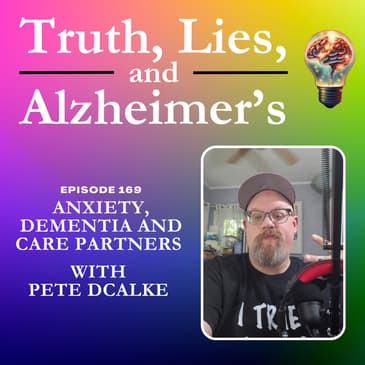
In this episode of Truth, Lies & Alzheimer’s, we welcome Pete DCalke, a Chicago native and host of Pete vs Anxiety. Pete is on a mission to make mental health a part of everyday conversation by creating space for honest, raw, and meaningful discussions.
In this episode, Pete brings that same honest and thoughtful perspective to Truth, Lies & Alzheimer’s. Together, we explore the importance of open conversations, emotional well-being, and the power of making people feel seen, heard, and less alone.
Pete believes the way we check in with each other matters. Instead of stopping at the usual, “How was your day?” he encourages a more meaningful question: “Hey, how’s your mental health?” That simple shift can open the door to connection, understanding, and support.
Throughout the conversation, Pete shares from the heart and helps highlight why honest dialogue is so important, especially when discussing difficult subjects such as mental health, caregiving, brain health, emotional well-being, family experiences, and the impact Alzheimer’s disease and related dementia can have on individuals and loved ones.
About the Guest
Pete DCalke is a Chicago native and the host of Pete vs Anxiety. Through his show, Pete brings together therapists, everyday people, and everyone in between for conversations that are raw, real, and genuinely informative.
Pete is passionate about helping break the stigma around mental health, one conversation at a time. His mission is to encourage people to move beyond surface-level check-ins and create space for more honest conversations about how we are really doing.
Why This Episode Matters
Alzheimer’s disease and related dementia do not only affect memory. They impact families, relationships, emotions, identity, and the way people experience the world around them. Mental health also plays an important role in how people cope, communicate, support one another, and move through difficult seasons.
Conversations like this help bring awareness to the human side of these experiences. By sharing real stories and thoughtful perspectives, this episode reminds us that support often begins with listening. Whether you are a caregiver, family member, professional, advocate, or someone simply wanting to better understand others, this conversation offers encouragement and connection.
Key Takeaway
Honest conversations have the power to help people feel seen, heard, and less alone. When we ask better questions, listen with compassion, and make mental health part of everyday conversation, we create opportunities for understanding, connection, and healing.
Visit our Website - https://www.mindingdementiasummit.com/
About the Host:
Author Lisa Skinner is a behavioral specialist with expertise in Alzheimer’s disease and related dementia. In her 30+year career working with family members and caregivers, Lisa has taught them how to successfully navigate the many challenges that accompany this heartbreaking disease. Lisa is both a Certified Dementia Practitioner and is also a certified dementia care trainer through the Alzheimer’s Association. She also holds a degree in Human Behavior.
Her latest book, “Truth, Lies & Alzheimer’s – Its Secret Faces” continues Lisa’s quest of working with dementia-related illnesses and teaching families and caregivers how to better understand the daunting challenges of brain disease. Her #1 Best-seller book “Not All Who Wander Need Be Lost,” was written at their urging. As someone who has had eight family members diagnosed with dementia, Lisa Skinner has found her calling in helping others through the struggle so they can have a better-quality relationship with their loved ones through education and through her workshops on counter-intuitive solutions and tools to help people effectively manage the symptoms of brain disease. Lisa Skinner has appeared on many national and regional media broadcasts. Lisa helps explain behaviors caused by dementia, encourages those who feel burdened, and gives practical advice for how to respond.
So many people today are heavily impacted by Alzheimer's disease and related dementia. The Alzheimer's Association and the World Health Organization have projected that the number of people who will develop Alzheimer's disease by the year 2050 worldwide will triple if a treatment or cure is not found. Society is not prepared to care for the projected increase of people who will develop this devastating disease. In her 30 years of working with family members and caregivers who suffer from dementia, Lisa has recognized how little people really understand the complexities of what living with this disease is really like. For Lisa, it starts with knowledge, education, and training.
Thanks for listening!
Thanks so much for listening to our podcast! If you enjoyed this episode and think that others could benefit from listening, please share it using the social media buttons on this page.
Do you have some feedback or questions about this episode? Leave a comment in the section below!
Subscribe to the podcast
If you would like to get automatic updates of new podcast episodes, you can subscribe to the podcast on Apple Podcasts or Stitcher. You can also subscribe in your favorite podcast app.
Leave us an Apple Podcasts review
Ratings and reviews from our listeners are extremely valuable to us and greatly appreciated. They help our podcast rank higher on Apple Podcasts, which exposes our show to more awesome listeners like you. If you have a minute, please leave an honest review on Apple Podcasts.
Lisa, welcome everybody to a brand new episode
Lisa Skinner:of The Truth, Lies, and Alzheimer's Show. And I'm Lisa
Lisa Skinner:Skinner, your host. I'm really, really excited about today's
Lisa Skinner:discussion, because I have a very special guest here with me
Lisa Skinner:today. His name is Pete DCalke, and he actually is the host of
Lisa Skinner:his own podcast called Pete Versus Anxiety Podcast, and
Lisa Skinner:interestingly enough, I met Pete at a national publicity summit
Lisa Skinner:where probably 80 or so of us were introduced to podcasters
Lisa Skinner:and television producers and things like that to hopefully be
Lisa Skinner:invited onto their platforms to have a discussion, and Pete and
Lisa Skinner:I discovered that we had something very, very, very much
Lisa Skinner:in common. He's had two of his grandmothers who have been
Lisa Skinner:diagnosed with one of the brain diseases that causes dementia.
Lisa Skinner:So we hit it off immediately, and then we decide he decided
Lisa Skinner:that June would have been a great month, was a great month
Lisa Skinner:to have me on, because it was Brain Health Awareness Month,
Lisa Skinner:and we're dedicated the episode in honor of his two
Lisa Skinner:grandmothers, but let me just tell you real quickly about his
Lisa Skinner:podcast, he hosts a very bold and uplifting weekly podcast
Lisa Skinner:that tackles the realities of mental health head on. Each
Lisa Skinner:episode dives deep into meaningful conversations,
Lisa Skinner:blending heartfelt storytelling with expert insights to break
Lisa Skinner:down stigma and spark connection. Is any of this
Lisa Skinner:sounding familiar with my podcast. Yeah, so across the
Lisa Skinner:board I think we can all agree that whatever it is that's
Lisa Skinner:causing a person's anxiety, there definitely is a connection
Lisa Skinner:between, you know, the other things that are going on in a
Lisa Skinner:person's life and Alzheimer's disease and dementia, you know,
Lisa Skinner:caregivers, family members, they experience one of the highest
Lisa Skinner:burnout rates from caring for people who are living with
Lisa Skinner:cognitive impairment, it's so, so difficult because you lose
Lisa Skinner:the ability to communicate, and it just makes it so, so
Lisa Skinner:difficult. So, we're going to start off by welcoming Pete, and
Lisa Skinner:I'm just so, so grateful that you were able to come onto my
Lisa Skinner:show, and we can talk about this further, but why don't we start
Lisa Skinner:off by you sharing with us the experience you had with your two
Lisa Skinner:grandmothers, and why this has, you know, really resonated with
Lisa Skinner:you and this topic.
Pete DCalke:Well, you know, when, when they were going
Pete DCalke:through it, it's hard to watch, because you remember what they
Pete DCalke:were at one point, you know, sweet, loving things like that,
Pete DCalke:but then you, you start to realize that they forget who you
Pete DCalke:are, and it's like you have to constantly remind them, hey,
Pete DCalke:I'm, I'm so and so, which, you know, a lot of us thought it's
Pete DCalke:just okay, getting old, but it's not, but their situation was
Pete DCalke:even worse, you know, I remember hearing stories. My sister
Pete DCalke:stayed with one of them, and she was trying to kill her in the
Pete DCalke:middle of night. She was literally just chasing around
Pete DCalke:the house, like, you know, kind of thing. And I'm like, uh,
Pete DCalke:yeah, that doesn't sound great, you know. Underneath the
Lisa Skinner:grandmother was chasing your sister around the
Lisa Skinner:house, and she really felt threatened.
Pete DCalke:Graham, Grandma was thinking that Grandma Neal
Pete DCalke:thought that my sister was somebody she didn't know it was,
Pete DCalke:because she forgot, yeah, she, she just,
Lisa Skinner:that's very tall,
Pete DCalke:yeah, she had no idea who she was, so she's like,
Pete DCalke:I heard I heard a story where my sister was telling me she had to
Pete DCalke:put locks on the door at night because she was afraid she'd get
Pete DCalke:up in the midnight, not realizing who she is, and try
Pete DCalke:and do it again, I was like, you know, and it's, it's always like
Pete DCalke:you hear these stories, but like, we, we covered in our
Pete DCalke:episode, like, you know, not a lot of people have a lot of
Pete DCalke:information about these things, you know. Yeah, and then my
Pete DCalke:grandma, Betty, on the other side, she, she had really bad
Pete DCalke:memory loss, so she started really forgetting whoever was,
Pete DCalke:so we had a memory book that we had put together for her that
Pete DCalke:she could remember who everybody was, so we all contributed to
Pete DCalke:our own things, and you know, we all remember her, you know,
Pete DCalke:she's always welcoming, always doing different things for us to
Pete DCalke:make us feel welcome to come visit her, and things like that,
Pete DCalke:but the watcher slowly deteriorate, it was just, it was
Pete DCalke:hard, because it's like, you know, the person who you knew
Pete DCalke:she was, she's not that person anymore, she just kept
Pete DCalke:forgetting who everybody was, little by little, and you know,
Pete DCalke:the book was a nice kind. And reminder, and when she passed, I
Pete DCalke:actually have the book in my own, my own way of things. I
Pete DCalke:have all this, all the books, and all the pictures and stuff,
Pete DCalke:they're in there. So it's really cool. So I can look back on it,
Pete DCalke:you know, show it to my kids, and be like, because they didn't
Pete DCalke:get the meter, you know, they just knew, like, my mom,
Pete DCalke:grandmother had passed, didn't know really north, because they
Pete DCalke:were still kind of young. So it was like, this is a good way to
Pete DCalke:remember who she was,
Lisa Skinner:that was her legacy that she left behind for
Lisa Skinner:your children, so her memories will live on indefinitely. That
Lisa Skinner:was a great idea. So, Pete, let me ask you this, because a lot
Lisa Skinner:of over the 30 years that I've been helping families, a lot of
Lisa Skinner:them have said to me it feels like I have lost my loved one,
Lisa Skinner:not once, but twice, because when they're still with us, they
Lisa Skinner:can't remember us, and they lose themselves, they lose the
Lisa Skinner:ability to recognize their loved ones, and then they eventually
Lisa Skinner:pass, so it's like we have to really go through the experience
Lisa Skinner:of grief twice. Does that resonate with you? Did you feel
Lisa Skinner:that way at all? Can you,
Pete DCalke:yeah,
Lisa Skinner:can you kind of expound on that for
Pete DCalke:us? It's hard, because you know, remember now,
Pete DCalke:if you, you were when you're a kid, you remember her being
Pete DCalke:someone else, and now, now here as an adult, you understand
Pete DCalke:these things, but you're watching her deteriorate. So,
Pete DCalke:you've already lost the original person you saw, and now you're
Pete DCalke:seeing this new person who has no idea who you are and can't
Pete DCalke:remember things, and has moments where she doesn't even know
Pete DCalke:where she's at, freaks out, and things like that too. I know a
Pete DCalke:friend of mine in Canada, she stays with her dad now, and he's
Pete DCalke:the same way sometimes. She says he has episodes and things like
Pete DCalke:that, you know. And it's hard because you know you really do
Pete DCalke:lose them twice, or like I said, you're losing the original
Pete DCalke:person you knew and you all grew up with. To now she's she's
Pete DCalke:somebody you can't even remember your own name, and you have to
Pete DCalke:constantly remind them, like, hey, this is so and so, and even
Pete DCalke:at that, she still may not even remember you after you've been
Pete DCalke:reminded them of that, too. You know, it's tough for a lot of
Pete DCalke:people to understand. And then when they pass, then you, it's
Pete DCalke:like you're grieving twice, because the person you remember
Pete DCalke:her to be versus where she was at when she, she eventually
Pete DCalke:passed. You know, that's why when people pass, like I always
Pete DCalke:tell them, just remember the good things that they were. So,
Pete DCalke:you know, that's that's the lasting memories we all try to
Pete DCalke:keep, or the great things that they were, not what,
Pete DCalke:unfortunately, it happened later on, where you're slowly losing
Pete DCalke:them, and they're losing it themselves, you know. So, you
Pete DCalke:got to constantly play, you know, hey, listen, remember,
Pete DCalke:this is, you know, it's stressful at times, because you
Pete DCalke:don't know when it's going to happen, and with anything, it's
Pete DCalke:hard, you know, you got, you go to that moment where you're
Pete DCalke:like, you know, it's unpredictable with most
Pete DCalke:conversations, go to, you know, it's very unpredictable, you
Pete DCalke:know, you can't predict when they're going to do something,
Pete DCalke:you know, and you'll have episodes and things like that
Pete DCalke:too, and you just got to kind of play it by ear,
Lisa Skinner:yeah, and I've had a lot of adult children and
Lisa Skinner:partners of people living with dementia, they say that's one of
Lisa Skinner:the worst hurts that exists. It cuts to the core when your loved
Lisa Skinner:one doesn't even recognize you as their spouse or their or your
Lisa Skinner:mom or their dad, but I think one of the things that we just
Lisa Skinner:have to continue to remind ourselves, and you mentioned it
Lisa Skinner:earlier that the resources are limited, and the information is
Lisa Skinner:limited, and that's why I always, always emphasize, learn
Lisa Skinner:as much as you can about what it's truly like for people to
Lisa Skinner:live with these neurocognitive diseases that strip us of our
Lisa Skinner:cognitive abilities, because this, what we just talked about,
Lisa Skinner:you and I, this is part of the disease.
Pete DCalke:Yeah,
Lisa Skinner:and I think a lot of people who don't aren't
Lisa Skinner:expecting it or not quite wrapping their heads around that
Lisa Skinner:concept, they just feel so hurt that this person that they've
Lisa Skinner:had a relationship for a very, very long time all of a sudden
Lisa Skinner:doesn't know who they are, so it does. I don't know that it makes
Lisa Skinner:it any easier, but if you can constantly remind yourself that
Lisa Skinner:this is the disease that you are experiencing, that you are
Lisa Skinner:witnessing. It might make it a little easier to accept.
Pete DCalke:Yeah, yeah. What would you say
Lisa Skinner:to that?
Pete DCalke:I'd say be very sympathetic, you know.
Pete DCalke:Understand, like you said, you know, we have all these great
Pete DCalke:devices on our hands, but we can't take five seconds to learn
Pete DCalke:what these people deal with, you know, it's similar, like when I,
Pete DCalke:when I deal with people, I talk to me about BPD, it's like take
Pete DCalke:time, the same thing, learn what these people are going through,
Pete DCalke:I think those are all great points, you know, like take 10
Pete DCalke:minutes and realize that you know this ain't about you
Pete DCalke:anymore, it's about them, like once you understand what they're
Pete DCalke:going to be going through, prepare yourself, and like we
Pete DCalke:just. There weren't a lot of information out there, and it's
Pete DCalke:crazy that there isn't, like, it's like this has been around
Pete DCalke:for a while. We all things like this have been happening, but
Pete DCalke:we, there's still not a lot of knowledge that's known about it,
Pete DCalke:you know? Or we're not educating enough people, or people don't
Pete DCalke:even, don't even take five minutes to look for this, you
Pete DCalke:know. The internet being a fast place, you go to Google, type
Pete DCalke:in, you know, whatever you're looking for, and you'll have
Pete DCalke:access to everything at your fingertips, but nobody wants to
Pete DCalke:do that, because their first reaction is, "Oh my god, they
Pete DCalke:forgot me. But it's like I said, it's not about you anymore, it's
Pete DCalke:about them now. You have to understand that that person you
Pete DCalke:once knew is going to slowly deteriorate, and it's going to
Pete DCalke:be a rough ride. It's never easy. It's just like having
Pete DCalke:cancer, and you went the same way. These people are going to
Pete DCalke:deteriorate little by little, and you're going to have to
Pete DCalke:prepare yourself for what may happen next, because you don't
Pete DCalke:know when they're going to leave you at any time, and it is hard.
Pete DCalke:It's never easy losing people.
Lisa Skinner:No, so this probably hits close to home for
Lisa Skinner:you, because you host your own podcast and live in the world of
Lisa Skinner:anxiety from a lot of different perspectives, right? I don't
Lisa Skinner:know how much, how many people that you speak to are actually
Lisa Skinner:feeling anxious and nervous and frustrated because they are,
Lisa Skinner:they really are experiencing the world of dementia, but I think
Lisa Skinner:it's all interrelated, so I think we'd all love to hear more
Lisa Skinner:about how you help people and the types of, you know,
Lisa Skinner:predicaments that your clients, your listeners come up against,
Lisa Skinner:and the professionals that you have come on your show as
Lisa Skinner:guests, because I think that there's a common thread with all
Lisa Skinner:of us, no matter what's causing the anxiety, so let's, let's
Lisa Skinner:speak to that, because they hear me all the time about dementia,
Lisa Skinner:but you know, we're kind
Pete DCalke:of
Lisa Skinner:approaching this from a completely different
Lisa Skinner:perspective, and I can't wait to hear how you have seen that,
Lisa Skinner:that this topic is, is really, they're, they're interrelated.
Pete DCalke:Yeah, they are very much interrelated, like, you
Pete DCalke:know, you have to think that a lot of people go through
Pete DCalke:depression as well, rest of losing people, things like that.
Pete DCalke:In the show, we've covered God, we covered everything. I, when I
Pete DCalke:did the show originally, I set out to have the conversation to
Pete DCalke:break the stigma about mental health. Later on, I decided to
Pete DCalke:go even bigger. I'm like, you know, what? Let's invite the
Pete DCalke:most interesting people I can find, different stories, you
Pete DCalke:know, and just start to understand what some of these
Pete DCalke:people deal with, you know, like BPD was one. I had an expert
Pete DCalke:come on, finally, Dr. Jenny Bellinger came on, and we were
Pete DCalke:talking about that, and it was an interesting thing, because I
Pete DCalke:was actually in a relationship with somebody, and I was talking
Pete DCalke:to her about it a little bit, about what it, what it was like,
Pete DCalke:because a lot of people demonize that as well, you know. Then
Pete DCalke:we've had somebody come with OCD and explain to you that OCD
Pete DCalke:isn't what you think it is. All these little cute comments of,
Pete DCalke:oh, I'm so OCD, it's really hurtful to them, because you
Pete DCalke:have no idea what these guys are dealing with, you know. There,
Pete DCalke:there was a girl last season, we had, she was like, we were
Pete DCalke:starting to talk about something else, and she got into the
Pete DCalke:story, like, once you hit record, this thing goes
Pete DCalke:anywhere. She went down the story to tell us that, you know,
Pete DCalke:something happened when she was six years old. Didn't know about
Pete DCalke:it until she started doing hypnotherapy, you know. And then
Pete DCalke:we got into the whole conversation about that for 50
Pete DCalke:minutes, and it was like it's an emotional roller coaster. It's
Pete DCalke:rough, you know. And my anxiety levels through the roof, because
Pete DCalke:I'm like, oh God, where is this thing going next? Because you
Pete DCalke:don't know where these conversations are going to lead
Pete DCalke:you to, you know. You just kind of add the, you know, when you
Pete DCalke:hit record, when we're doing the show, it's like, get ready,
Pete DCalke:because we don't know where this is going to take us, depending
Pete DCalke:on what it is they're dealing with. I've had people come on
Pete DCalke:with DND, which it used to be called multiple personality
Pete DCalke:disorder, and those were interesting individuals as well,
Pete DCalke:because if you watch them, it's more of a small little ticks,
Pete DCalke:and things like that, you know. They, they talk, you know, you
Pete DCalke:have to notice these things, but after a while, you know, I start
Pete DCalke:to understand, like, where a lot of these conversations are
Pete DCalke:going, so I can anticipate a little bit of where we may go.
Pete DCalke:But there are some that have left me speechless for a little
Pete DCalke:bit. I was just like, whoa, wow, because it's this, this is
Pete DCalke:someone's life they went through. There's people that go
Pete DCalke:of season one or season three's first episode. She came on and
Pete DCalke:she dropped the bombshell on us. She called me drug addiction,
Pete DCalke:everything under the sun. This one had been through everything,
Pete DCalke:and then told us, you know what? What she tried, she tried to
Pete DCalke:take her own life and described exactly how she did it.
Pete DCalke:Everything else, you know, it's like you get into those
Pete DCalke:conversations and it gets intense, you know. And you know,
Pete DCalke:some days when I'm, I'm recording like five or six of
Pete DCalke:these episodes, it's like it's a rough day for me some days. So,
Pete DCalke:sometimes I have to check out and reschedule things, which,
Pete DCalke:you know, it's great thing about pre-recording stuff is I can,
Pete DCalke:hey, listen, I'm not, I'm not gonna be able to give you 100%
Pete DCalke:Pete. You know, and usually it's because I've gotten into an
Pete DCalke:intense conversation of narcissism, and some of those
Pete DCalke:other ones are really hard for me to get through those
Pete DCalke:conversations, are tough, because I lived through that
Pete DCalke:stuff.
Pete DCalke:It's like, you know, you're reliving it in your mind as
Pete DCalke:you're going through these things, you know, and these
Pete DCalke:people are telling their side of the story, how it is for them.
Pete DCalke:And when you start relating to a lot of them, and it's like, it's
Pete DCalke:tough, because being an empath, I feel a lot of those emotions.
Pete DCalke:I know most places I can feel the energy of everybody around
Pete DCalke:me. And things like that too, and it's, it's raining some
Pete DCalke:days, you know. I love what I do. I love what I do, though.
Pete DCalke:Don't get me wrong,
Lisa Skinner:I totally relate to what you're saying, Pete,
Lisa Skinner:because I absorb people's emotions too, and I have my
Lisa Skinner:entire life, and it is draining, and it's not something that we
Lisa Skinner:really have control over. I don't think there's an off
Lisa Skinner:button. It just, it's just, it is what it is, but it's some
Lisa Skinner:people say it's a gift. I don't know if I consider it a gift,
Lisa Skinner:because I mean it's you
Pete DCalke:understand things from other people, you're more,
Pete DCalke:you are attuned to what people are telling you now. There's
Pete DCalke:ways to protect your energy. I've had a lot of energy healers
Pete DCalke:come on, and different people do energy work type things have
Pete DCalke:told me different tips on ways to protect your energy, so if
Pete DCalke:you go somewhere you don't feel the strain, but it's still a
Pete DCalke:conversation at the end of the day, you're still feeling your
Pete DCalke:emotions of what's going on. These people are coming on and
Pete DCalke:telling you their stories about what they've been going through,
Pete DCalke:and some of them, they really pick at heartstrings. I think
Pete DCalke:the only time I've ever shed a tear in the show, was I was
Pete DCalke:talking to a woman named Tiff Carson during the first season,
Pete DCalke:and she was talking about her brother and his drug addiction,
Pete DCalke:and it was, it was rough, it was a rough story to listen to, you
Pete DCalke:know, and I was choking up on the camera with her, but I was
Pete DCalke:like, it, because you feel it, these people are telling you
Pete DCalke:about what is going on, and it's, it's crazy, because, like,
Pete DCalke:at the same time, you know, it's like you don't know what people
Pete DCalke:are going through, because if you look at it like the internet
Pete DCalke:now, most people will tell you that everything's great, but
Pete DCalke:really the vaccine, it could be a complete mess, because no one
Pete DCalke:wants to talk about these subjects, and it's the whole
Pete DCalke:idea of the show was just that to create that safe space where
Pete DCalke:people come in and we could talk about anything, and you're not
Pete DCalke:being judged, because I understand a lot more than most
Pete DCalke:people do, you know, I've been there for a lot of these things.
Pete DCalke:I've been through my own journeys of things too.
Lisa Skinner:We have covered a lot of mental health conditions
Lisa Skinner:that exist and people live with day after day after day. We
Lisa Skinner:talked about multiple personality disorder, we talked
Lisa Skinner:about narcissism. We talked about OCD. If there is one
Lisa Skinner:thing, or maybe a couple things, that you've learned as you've
Lisa Skinner:mentioned that you've lived with a lot of things yourself,
Lisa Skinner:experienced it. What would you want the listeners who are tuned
Lisa Skinner:in today to know about living with one of these mental health
Lisa Skinner:disorders? What they should do, what they shouldn't do. I know
Lisa Skinner:that each condition is different, but there's a lot of
Lisa Skinner:commonalities between them too. So, what, what would you say is
Lisa Skinner:the most important piece of advice you could give people who
Lisa Skinner:don't know what to do, they don't know how to deal with
Lisa Skinner:whatever it is that's causing their anxiety?
Pete DCalke:I absolutely love this question. You know, since
Pete DCalke:starting the show, I've learned a lot of things. Breath work,
Pete DCalke:for example, is really great for those moments when I feel like
Pete DCalke:my heart starts racing when I know I'm close to an attack of
Pete DCalke:some sort. You know, just, it's real simple. You breathe in, you
Pete DCalke:know, all these kind of things. You know, I do journaling as
Pete DCalke:well. Joining is really great. Just get the thoughts out of
Pete DCalke:your head. Basically, it's the idea behind this. You know, I
Pete DCalke:meditate a lot, too. You know, a lot of people tell people I
Pete DCalke:meditate, talk to my inner child, you know, and things like
Pete DCalke:that helps, you know, reduce that thing. But, you know, I can
Pete DCalke:tell a lot of times, I can tell when it's coming, because I know
Pete DCalke:what science looks for. If you're experiencing anything
Pete DCalke:like that, my first suggestion is choose to get some help. You
Pete DCalke:know, we all are out there dealing with these things, but
Pete DCalke:if we don't know what you're dealing with, it's the hardest
Pete DCalke:part. You know, you know, don't don't feel like you're alone
Pete DCalke:either, because there's plenty of us out here that deal with
Pete DCalke:things that you'd be amazed a lot of people don't tell you
Pete DCalke:about, you know, and things like that too. You're not alone,
Pete DCalke:honestly, and it's okay not to be okay. You know, you hear a
Pete DCalke:lot of people say that, but it's really the truth, is that it's
Pete DCalke:okay not to be okay, you know. If you don't know what it is
Pete DCalke:that you're dealing with, you know, and then you find out how
Pete DCalke:better to attack it, you'll find that your life will be a little
Pete DCalke:bit better. I push it off for like 39 years, I didn't even
Pete DCalke:think about it, you know. I had an incident happen, always 10,
Pete DCalke:it caused these things to just build up, you know, and it was
Pete DCalke:horrible, but now I have better control of it, people come up to
Pete DCalke:me and tell me how different I am versus what I used to be, and
Pete DCalke:oh, they always ask me what I did differently, and it's like,
Pete DCalke:you know, now that I dress my anxiety and everything else, I
Pete DCalke:don't feel so, you know, I don't feel like it takes control of
Pete DCalke:me. So, with the idea of the show, like it's called Peep, for
Pete DCalke:it's anxiety, because every day I battle my anxiety, some days
Pete DCalke:I'll wake up, and it's full flight, it's full throttle.
Pete DCalke:Sometimes it's not, you know. Sometimes I could wake up in the
Pete DCalke:middle of night, and wake up, my heart's racing, and I can't go
Pete DCalke:out to sleep, but it's like the trigger that something's going
Pete DCalke:on. I need to be alert of, you know, turn it into a superpower,
Pete DCalke:like I did. You know, like, you know, if it wasn't for me having
Pete DCalke:anxiety, I wouldn't have this show, but have this opportunity.
Pete DCalke:People like Lisa, and everybody. Else I've met through all this
Pete DCalke:time doing the show, it's been great. I make new friends all
Pete DCalke:the time. I have new podcasts, friends I have too. I have other
Pete DCalke:people that go podcasting because of me, and you know they
Pete DCalke:ask me all these different things. But understand, you can
Pete DCalke:expand your toolkit, you know, there's plenty of things you
Pete DCalke:could do out there. I have an anxiety journal friend gifted me
Pete DCalke:in the beginning of this show that I use too. It helps make
Pete DCalke:your thoughts retreat, redirect your thoughts other places, you
Pete DCalke:know. Sometimes people could see me talking to myself out loud,
Pete DCalke:and it's like, well, what are you doing? It's because of
Pete DCalke:getting the thoughts out of my head. I used to do what I call
Pete DCalke:downloading my brain to people, too. I'd send sound clips and
Pete DCalke:just random thoughts coming through my head, and it'd be
Pete DCalke:complete gibberish. And my friends knew what I was doing,
Pete DCalke:because they're like, if you get a message from Pete at two in
Pete DCalke:the morning, and it's just a wave file, you know. Exactly
Pete DCalke:what you're about to get, it's probably just complete chaos,
Pete DCalke:but it's the thoughts are going through my head, and if I get
Pete DCalke:them out of there, they won't be bouncing around and cycling
Pete DCalke:through, and things like that. You know, and we all deal with
Pete DCalke:it differently,
Lisa Skinner:you know. I think a lot of people, I think a lot
Lisa Skinner:of people listening to this today can completely relate to a
Lisa Skinner:lot of things that you just described, we are running out of
Lisa Skinner:time, but before we wrap, I just want to ask you one more
Lisa Skinner:question, because I think you're an ideal person to address it.
Lisa Skinner:What is your feeling? You probably have a lot of people
Lisa Skinner:who you mentioned it earlier in the conversation, what, what is
Lisa Skinner:your, what are your thoughts about repressed memories? Do you
Lisa Skinner:think it's a real thing, because there's a lot of controversy out
Lisa Skinner:there about it. I personally believe it is a total real
Lisa Skinner:thing, and it happens to a lot of people. But what are your
Lisa Skinner:thoughts on that?
Pete DCalke:I agree with you, I think it is a lot of times, you
Pete DCalke:know, they talk about the brain cuts off these memories, and
Pete DCalke:they're still there to
Lisa Skinner:protect us,
Pete DCalke:exactly
Lisa Skinner:ourselves. Yeah, I
Pete DCalke:think it's, yeah, it's got to be yes. Because if
Pete DCalke:you think about it, the way that works is that the brain cuts it
Pete DCalke:off and it goes to your subconscious, and then your
Pete DCalke:subconscious is where a lot of that stuff will be, you know, a
Pete DCalke:lot of people don't realize your subconscious is way more
Pete DCalke:powerful than your, your other parts of your brain, and things
Pete DCalke:like that too. But that's why hypnotherapists, when they go in
Pete DCalke:there, they have to be careful, because these memories are in
Pete DCalke:there, and they unlock them, and then you find out that, okay,
Pete DCalke:when something happened, that my brain cut off, but my body
Pete DCalke:remembers, you know, and a lot of times, you know, like, how do
Pete DCalke:you explain that to somebody? Then exactly what is a reprise
Pete DCalke:memory? Because it's there, it's still there, it still exists. It
Pete DCalke:just, you just don't remember it, because they cut it off to
Pete DCalke:protect you.
Lisa Skinner:You know, that reminds me of a lot of examples
Lisa Skinner:that I've used in my show of be careful not to correct somebody
Lisa Skinner:who is having a delusion or a false belief, and a very common
Lisa Skinner:one is that your loved one might tell you that their spouse or is
Lisa Skinner:waiting for them at home, but they really passed away years
Lisa Skinner:earlier, and they're telling you this, and can you imagine this
Lisa Skinner:is reminding me under the connection between that and
Lisa Skinner:repressed memory. If we try to correct our mother, let's say,
Lisa Skinner:and say, "Mom, what are you talking about? Dad passed away
Lisa Skinner:five years ago, and she believes wholeheartedly that dad's
Lisa Skinner:waiting for her at home. You might be telling her something
Lisa Skinner:that actually throws her into a panic. Like, what are you
Lisa Skinner:talking about? What happened? He was fine when I left him this
Lisa Skinner:morning. Now you're telling me he's gone. So be careful with
Lisa Skinner:the correcting, because I want to emphasize, if they're telling
Lisa Skinner:you something that doesn't make any sense to you, they believe
Lisa Skinner:it wholeheartedly. This is their reality, even if it's temporary.
Lisa Skinner:She could snap out of it in the next minute, and you know, come
Lisa Skinner:back to the same reality that, that you know you're living in.
Lisa Skinner:But if she's telling you that something, she believes it at
Lisa Skinner:the moment. So, I think that this is probably another example
Lisa Skinner:of, you know, a professional needing to work with somebody
Lisa Skinner:very carefully and very cautiously who actually has
Lisa Skinner:buried something into their subconscious, and when it's
Lisa Skinner:brought to light, you don't know how they're going to react to
Lisa Skinner:it, right?
Pete DCalke:No, I agree 100%
Lisa Skinner:Yeah, so anyway, this is a great place to wrap
Lisa Skinner:this conversation up. It's been extremely insightful, extremely
Lisa Skinner:powerful. I hope a lot of people, these picked up some
Lisa Skinner:golden nuggets from it today, but thank you so much, Pete, for
Lisa Skinner:coming on the show today. Where can people find you? I think
Lisa Skinner:that you probably have some people that want to check you
Lisa Skinner:out and listen to your podcast after today's episode,
Pete DCalke:right, guys. Very simple, Spotify all the way down
Pete DCalke:to iHeartRadio. Pandora, I'm everywhere. You can find your
Pete DCalke:podcast at YouTube, if you prefer the video version of it.
Pete DCalke:If you need to, just go to Pete vs Anxiety podcast.com but I'm
Pete DCalke:on every social media site possible, so you can find me
Pete DCalke:anywhere. I made it accessible to everybody, because there's
Pete DCalke:that. Oh, why use Amazon? I'm everywhere, probably see you.
Pete DCalke:I'm everywhere I could possibly be at this moment.
Lisa Skinner:That's great to know. So great resource for
Lisa Skinner:people, caregivers, family members dealing with anxiety
Lisa Skinner:every day. Now you have another resource to turn to to maybe
Lisa Skinner:help you through that aspect of being part of the dementia
Lisa Skinner:world. So thanks again for being here, everybody. Thanks again,
Lisa Skinner:Pete, for coming on and contributing your valuable
Lisa Skinner:insights to us. And I'll be back next week, everybody, with
Lisa Skinner:another brand new episode of The Truth, Lies, and Alzheimer's
Lisa Skinner:Show. I'm Lisa Skinner, your host. And have a great rest of
Lisa Skinner:your week. Try to stay happy, try to stay healthy, and we'll
Lisa Skinner:be back next week with another episode for you. Bye for now.