
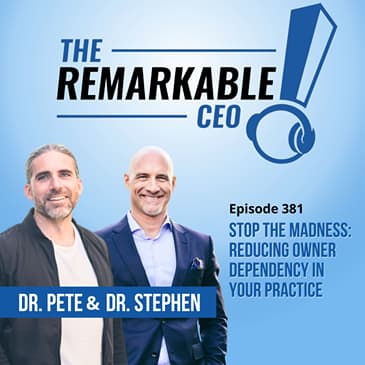
Your practice and business has an addiction…YOU.
Everything starts with you, depends on you or goes thru you. You are the bottleneck. The very thing that made the practice successful may now be keeping it stuck. When every important decision, standard, problem, number, and handoff ultimately runs through the owner, adding more patients, people, technology, or effort can create more complexity instead of more growth. YOU are the Operating System…and THAT is the problem.
Dr. Pete and Dr. Stephen expose the hidden cost of becoming the practice’s operating system and challenge CEOs to replace owner dependency with systems that create accountability, visibility, and leverage. Through the Chiropractic Operating System, the five engines of the practice, and the Audit → Optimize → Automate framework, they show why the next level is not about making the CEO less important. It is about making the CEO relevant at a higher level while building a business that can scale, perform, and create freedom without depending on constant owner intervention.
One key change: More growth. More freedom. More optionality. More enterprise value.
In This Episode You Will Discover:
- A simple two-week test that exposes just how dependent the practice may still be on its owner.
- Why the behaviors that created early success can quietly become the ceiling on the next stage of growth.
- The “tyranny of more” and what happens when more patients, people, effort, or information are added to the wrong operating system.
- A different definition of business success built around scalability, durability, and transferability.
- The shift from solving every problem personally to leading through systems, scoreboards, accountability, technology, and AI.
Highlights
01:22 - A different diagnosis challenges the assumption that another tactic is what a stuck practice actually needs.
03:58 - A simple vacation test reveals what the business may still be unable to do without the owner.
07:11 - The behavior that created early success begins to reveal how it can eventually become the ceiling on future growth.
09:59 - The instinct to add more gets challenged by what happens when greater volume meets the operating system already in place.
14:16 - A hidden pattern emerges when the owner repeatedly becomes the workaround for every weakness in the business.
17:48 - One uncomfortable question tests whether the CEO truly owns the business or the business still owns the CEO.
20:43 - The question a CEO asks when growth stalls is fundamentally different from the question an owner/operator asks.
21:14 - A three-stage framework establishes the order that has to come before AI and automation can create meaningful leverage.
22:58 - The real transformation becomes clear when the owner stops trying to become indispensable and starts becoming relevant at a higher level.
28:03 - Returning to the two-week test paints a very different picture of what freedom looks like once the business can perform without constant owner intervention.
33:55 - Dan Anticich from Success Partner Twoconnect, joins Dr. Andrew to discuss how chiropractic practices can improve lead conversion, patient reactivation, and operational efficiency through dedicated offshore support. They explore how virtual team members help practices protect marketing investments, strengthen patient communication, reduce administrative workload, and create scalable systems that support sustainable growth.
Resources Mentioned
Watch the webinar "Build A Practice That Pays You More, Needs You Less, and Grows While You're On Vacation" here: https://webinar.theremarkablepractice.com/replay
To learn more about the REM CEO Program, please visit: http://www.theremarkablepractice.com/rem-ceo
For more information about Two Connect please visit: https://twoconnect.com.au/
Book a Strategy Session with Dr. Pete - https://go.oncehub.com/PodcastPC
Prefer to watch? Catch the podcast on YouTube at: https://www.youtube.com/@TheRemarkablePractice1
To listen to more episodes, visit https://theremarkablepractice.com/podcast or follow on your favorite podcast app.
[00:00:00] Doc, your practice has an addiction. Okay, that's a strong way to start Dr. Stephen. It is it is but I want every chiropractor listening to us right now to hear this. Your practice has an addiction and the addiction is you. Not your team, not your overhead, not Facebook ads, not insurance, not the economy.
[00:00:24] Hello and welcome to the Remarkable CEO podcast, a show dedicated to chiropractors who want to transform their job into a business so that they can have a remarkable practice as part of a remarkable life, not instead of one. With your hosts, Dr. Pete Camiolo and Dr. Stephen Franson.
[00:00:57] Welcome to another episode of the Remarkable CEO podcast, Chiropractic's number one business podcast. I'm Dr. Pete Camiolo. And I'm Dr. Stephen Franson. And the core premise for our conversation with you today is that your practice may be stuck at 500k, a million, 1.5 million, 2 million, 3 million or anywhere in between.
[00:01:20] Not because you need another tactic, but because the business has outgrown its operating system. In most owner operated chiropractic businesses, the owner is the operating system. Can I get an amen? He's 3.0 diagnosis is explicit. Dr. Stephen, the practice grew, but your operating system did not reach.
[00:01:49] Doc, your practice has an addiction. Okay. That's a strong way to start, Dr. Stephen. It is. It is. But I want every chiropractor listening to us right now to hear this. Your practice has an addiction and the addiction is you. Not your team, not your overhead, not Facebook ads, not insurance, not the economy.
[00:02:14] You. And before somebody turns this episode off because they're offended, stick with us. Because we're not saying that you're the problem. We're saying that you have become the operating system and that is a problem. And that is a very different diagnosis. Exactly. Because if you're doing a half a million a year, a million, five, 2 million, 3 million, and you've been stuck there. Maybe the question isn't, what do I need to do next?
[00:02:41] Maybe the question is, what operating system does my business need next? Because the operating system that got you here may be exactly what's keeping you from getting there. All right. So let's start with a test. It's really simple. You're listening right now. So just answer this honestly. If you disappeared from your practice for two weeks, what would break?
[00:03:07] Now, it's not, could I technically go away? We know you could. What we're asking is, what would actually happen while you were gone? Would new patients continue coming in at the same rate? Would conversion stay strong? Would patients stay on track with care? Would your associates perform at the same level? Would the team hold each other accountable? Would your meetings happen? Would the numbers get looked at? Would collections stay strong?
[00:03:37] Would problems get solved without somebody texting you? That's the one right there. Because there are chiropractors listening to this saying, of course I can take two weeks off. Okay. Can you take two weeks off without being the remote control for your practice? Without the calls, without the texts, without the emails, without somebody saying, Hey doc, sorry to bother you, but... That's not a vacation. That's remote work with a better view.
[00:04:05] And this one of those stresses that the TRP test of 3.0 is going to unveil today. Because vacations expose the business. You've heard us say this on previous episodes. If you leave and new patients plummet, or conversion stalls, or compliance drops, the team loses accountability, collections contract, listen, you're still fielding questions from the beach. That vacation did not create those problems.
[00:04:35] It reveals them. Exactly. Vacations are a stress test for your business. That's how the TRP 3.0 material frames it. Okay, docs, so let's make the diagnosis. Your practice has systems. Probably lots of systems. You've got an EHR. You've got scripts. SOPs. Checklists. A CRM. Team meetings. Maybe even dashboards.
[00:05:04] Marketing campaigns. An office manager. Associates. Software. Agencies. So you have systems. But that doesn't necessarily mean that you have... An operating system. Because here's the big giveaway. Who connects all those systems together? You do. Who remembers what needs to happen? You do. Who notices when something isn't happening? You do. Who catches the drop ball?
[00:05:34] You. Who answers the weird question that isn't covered in the SOP? Still you. Who knows whether the numbers are good or bad? You. And who holds the standards? You. Who ultimately makes sure the practice works? You. So here's the diagnosis. You are the operating system. And that's why your practice is addicted to you. Now, there's something important here, Dr. Stephen.
[00:06:03] We're not beating up the owner. No. Quite the opposite. If you're doing half a million dollars, congratulations. If you're doing a million, congrats. A million five, two million, three million. You've built something significant. And there's a very good chance that you being the operating system was exactly what the practice needed at one point. Yes. Early on, that was your superpower. At 300,000, you can know everybody. You can personally oversee everything.
[00:06:32] At 500,000, maybe you can still watch every important number. At a million, you can still personally train most of the team. You know the patients. You know the scripts. You know what's in the bank account. You know what the marketing and marketing is doing. You know who is performing. You know who is struggling. And when something goes wrong, you jump in. You save it. Which is why you became successful. That's why this makes it so deceptive.
[00:07:01] The very behavior that got rewarded on the way up eventually becomes the behavior that creates your ceiling. Because the business continues growing, but your personal bandwidth doesn't. More patients. More employees. More doctors. More marketing. More handoffs. More payroll. More complexity. And more decisions. And still only one you.
[00:07:26] That's why one of the most important lines in this entire TRP 3.0 conversation is, the practice grew, but your operating system did not. That's right. All right. So here's a metaphor. Think about your phone for a second. You get apps on your phone. And every year, those apps become more sophisticated, right? So they demand more processing power from the phone. More memory. More capability. More capacity.
[00:07:53] And at some point, you can't solve the problem by simply downloading another app. Because the operating system underneath it can't support what you're asking it to do. Exactly. And chiropractors, we do this all the time. The practice gets stuck. So what's our first response? We need more new patients. Download another app. Let's hire another associate. Ooh, another app. Let's spend another five grand on marketing. Ooh, an expensive app. Let's hire another CA.
[00:08:23] Another app. Let's buy another piece of software. Another app. Let's go to another seminar. Hey, it's another app. And none of those things are inherently bad. That's the important distinction here, guys. You may actually need more new patients. You may need another associate. You may need new software. You may need training. And you probably do. But what if you're adding all of those things onto an outdated operating system?
[00:08:50] Then more can actually create more complexity. Which brings us to what we call the four more mistakes or the tyranny of more. So more mistake number one, Dr. Steven, more new patients. More new patients will fix and fill my practice. Yeah, this is probably the most common run. We're stuck in a million. We need more new patients. But let's say your conversion system isn't working.
[00:09:19] What happens when we pour 50 more leads into it? We lose more leads. If retention is broken. We create more dropouts. If the team is already at capacity. We create more overwhelm. If your financial systems are weak. We may create more revenue without actually creating proportionally more profit. So volume isn't necessarily the solution. Sometimes volume is the amplifier. Exactly.
[00:09:46] More volume amplifies the operating system that's already there. Put more new patients into an extraordinary system. Beautiful. Put more new patients into a broken system. You get a bigger mess. Let's talk about more mistake number two, more grind. So I'll just work harder. Ah, the chiropractor's favorite drug. We know how to grind baby. Something breaks, stay later.
[00:10:15] Somebody quits, take their responsibilities back. Marketing slows down, just get personally involved. Conversion drops, start doing every consultation and report a findings yourself. Ouch. Team isn't accountable, start watching everybody. Collection slip, start checking every report. And the practice improves temporarily. Which reinforces the behavior. Exactly. That shit's like catnip to us chiropractors.
[00:10:45] You think, see, they need me. But what actually happened? The business became more dependent on you. And every time something slips, you quietly take it back. That's the exact pattern called out in TRP 3.0. And that's not scalability. That's dependency disguised as dedication. All right. So more mistake number three, more people. This is what we say. We need more people.
[00:11:15] Yeah, great. Let's hire. How about a new associate? Same unclear operating system. How about a new front desk person? Same broken handoffs. Same broken handoffs. Maybe a new office manager. Same unclear accountability. I know, a new marketing agency. It's been at least two or three months since we hired a new agency. Ah, more tactics on the same leaky foundation. Here's the lesson. People do not fix broken systems.
[00:11:44] Great people can compensate for broken systems for a while. But eventually great people get frustrated by broken systems. And here's the irony. If there isn't clarity around roles, workflows, standards, scoreboards, and ownership, every new person can actually create more questions. And where do those questions go, Dr. Pete? Back to Doc. Exactly.
[00:12:09] So now you've hired somebody to create capacity and somehow you're busier. All right. Let's talk about more mistake number four. I know. I just need more knowledge. Right? So this is a classic. I just need to learn more. How many books are on your shelf? Ouch. How many podcasts? Careful. We're on a podcast, Doc. Right. I mean other podcasts. All right.
[00:12:37] Seminars, courses, conferences, coaching, videos, AI prompts, management tools, leadership books, marketing books. And eventually you have 47 things that you should be doing. You're shooting all over yourself as Demartini says. But no sequence. Yeah. No implementation. No accountable owner. No scoreboard. No operating system. Information isn't the bottleneck anymore. Implementation is.
[00:13:07] That's why TRP 3.0 says you don't need more information. You need transformation. And that goes one step further, right? So it sounds like this. You don't need more homework. You need implementation. You need the system to be installed with the people that run your practice. All right. So there's a hidden fifth mistake, Dr. Steven. Okay. There's actually one more thing we need to talk about. Yeah. And this is the hidden mistake. Here's it. Here you guys ready for it. It's doing it alone. Yeah.
[00:13:36] This one's sneaky because you're good at solving problems. And that's probably one of the reasons you became successful. Something goes wrong. You solve it. The team members struggling. You fix it. System breaks. You compensate for it. Marketing isn't working. You jump in. The associate has a problem. You handle it. And eventually, without realizing it, you become the workaround for every weakness in the business. And the workaround becomes the operating system.
[00:14:06] There's a paradox here. The more competent you become, the more dependent the practice becomes on you. And that's huge. Because every time you rescue the system, you prevent the system from learning how to function without you. And that's the hidden mistake identified in the TRP 3.0 system. You become the solution to every problem. And the practice doesn't know how to function without you. All right. So let's go to the addiction test. Right?
[00:14:36] So we said it from the beginning in the opening that you have a problem. And that problem is your practice is addicted to you. Okay, Doc, let's make it personal. We're going to give you the practice addiction test. Don't overthink it. You know the answers. Just count how many of these sound familiar. All right. Your team regularly says, let me ask Doc. You have to approve decisions that somebody else should own. You're still the best salesperson in the building. Or how about this one?
[00:15:05] You're the only person who really understands the numbers. Marketing slows down without your energy. How about every difficult patient eventually gets escalated to you? The team behaves differently when you're out of the office. How about your patients don't fully trust seeing the associate on you unless you personally endorse it or maybe even insist on it? Meetings lose their effectiveness without you. You're the keeper of standards.
[00:15:35] You're constantly answering texts, Slack messages, emails, phone calls. And the most painful one, you can't completely disconnect when you're on vacation with your family. And here's the big one. It's just faster if I do it myself. Or how about it's evil twin? If I want it done right, I got to do it myself.
[00:16:00] Listen, if you're nodding your head right now, I know we are, the system may be overwhelmed. Yeah, if your symptom is overwhelmed, it's actually the diagnosis is owner dependency. Yeah. And the underlying condition? Is an inadequate operating system. Doc, what's the alternative? We have to redefine what a successful practice actually looks like.
[00:16:26] We're not projecting here, but you know revenue matters, profit matters, impact matters. But a remarkable business should ultimately become three things. Scalable, durable and transferable. Scalable. Can this thing grow without requiring proportionally more of you? Yeah, that's all brute force. We need to learn leveraging systems, people and communications, right? So it's all about leverage. How about durable? Durable.
[00:16:56] Can this thing continue to perform when you're not even there, like in your absence? Man, that sounds like a dream. All right, transferable. How about this? Could somebody else eventually operate or even own this business without you being the secret ingredient? And that's the distinction between building a business and owning a job. The TRP framework explicitly uses these three characteristics, scalable, durable and transferable as the test.
[00:17:25] Which leads to an uncomfortable question. I hope you're ready. If the business cannot perform without you, do you own the business? Or does the business own you? All right. So let's prescribe the solution here, Dr. Pete. I just want to leave. I don't want to leave these guys hanging here in pain, right? The answer isn't for you to become less important. Yeah, it's for you to stop being the system. Exactly.
[00:17:52] And that's where we're introducing here just formally as part of TRP 3.0, the new version of the chiropractic operating system. You've heard us talk about COS before. That is the DNA of the remarkable CEO program. But COS, the chiropractic operating system in TRP 3.0 is infused with AI, with artificial intelligence. It's an actual operating system for how the practice runs. Standards. Processes.
[00:18:22] Ownership. Accountability. Scoreboards. Meeting rhythms. Training. Visibility. Workflows. Automation. Continuous improvement. So, instead of every load leading back to you. The business has a system for knowing what happens, who owns it, when does it happen, how do we know it happened, what's the number, what happens if the number's off, and who owns fixing it.
[00:18:50] And importantly, this isn't just a binder of SOPs sitting on a shelf. Right. An operating system has a rhythm. The chiropractic operating system, or COS, you'll see it in all of our work in TRP. It is the DNA of the TRP 3.0 system. And that's the upgrade. All right. So, from everything routes to the owner and through the owner. To everything runs through the operating system.
[00:19:20] I love it. And inside the COS, the chiropractic operating system, we've organized the core performance of the practice around five engines. You've heard us talk about these. Okay. So, if you've heard part one of this series, these things are going to sound familiar, right? Engine one is attraction. How predictably do new patient find you and ask for help? All right. Engine two, conversion. How consistently do the people who show up actually start and commit to care?
[00:19:49] Engine three is retention. How well do patients stay, comply, get results, complete their care, and refer? All right. Engine four, team building. And I love this question. How much of the practice runs without you touching it? That's a CEO question. And finally, engine five, collections. The money. How clearly do you know what the practice keeps, where it's leaking, and what needs to change?
[00:20:15] These are the five engines presented in TRP 3.0 as the five engines powering the practice. All right. So, here's where this changes how you think, Doc. Because when the practice is stuck, the owner operator asks, what should I do? The CEO asks, which engine is constraining the business? Guys, that's a totally different question. Because now we're diagnosing the machine instead of blaming the driver. Okay.
[00:20:45] So, once we've found this constraint, what do you do about it? Right? So, in TRP 3.0, we have a methodology for you to follow. And it comes down to three words. You know, we love our frameworks, Dr. Pete. This is about audit, optimize, and automate. So, let's talk about audit. What actually happened? Where's the gap? Where's the leak? Where is the reality? Are current brutal facts different from our remarkable standard? All right. So, number two, optimize.
[00:21:14] So, what's the right process? Who is the owner? What's the workflow? What's the KPI? What's the rhythm? And only then... Automate. Which repeatable pieces can technology and AI carry? That's right. Once again, only then. You shouldn't be automating a system that hasn't been optimized, right? So, and this connects directly back to part one of this series.
[00:21:42] Because part one was all about high tech and high touch. Yeah. Keep human, work human, and let AI and technology carry more repeatable work. Okay. And this is really important. Don't automate chaos. Oh, goodness. Because a broken process automated... Is just a broken process that happens faster. COS gives us the structure. AI gives us leverage. And humans provide...
[00:22:12] Leadership, judgment, trust, connection, and touch. That's the 3.0 model. Audit, optimize, automate with human ownership maintained while systems, workflows, and AI take on the appropriate repeatable work. All right. Now we get to what I think this whole episode, Dr. Steven, today is really about. The ascension. From owner-operator...
[00:22:42] To remarkable CEO. All right. So, understand what we're saying. The goal is to not make yourself irrelevant. The goal is to make you relevant at a higher level. Yes. That is it. You guys have heard us say this before for years. You've been listening to the podcast. Your practice doesn't need you to be its operating system anymore. It needs you to become its CEO. So, you move from... Doing... To leading... Remembering... To measuring... Answering... To developing...
[00:23:11] Fixing... To coaching... Reacting... To planning... Hero... To leader... Owner-operator... To remarkable CEO. And in the TRP 3.0 transformation... That becomes... Job... To business... Owner... To CEO... Chasing revenue every month... To compounding growth... Time in the practice... To time on the practice...
[00:23:40] A doctor-dependent delivery... To consistent patient results... Carrying the team... To leading the team... Working overtime... To more vacation time... Your next level doesn't necessarily require more of you... It requires a better version of you... Running a better operating system... All right... So, there's another belief system that we've got to break here.
[00:24:09] This is a limiting belief, Dr. Pete, and we hear it all the time. A lot of entrepreneurs actually measure their value... By how indispensable they are. They need me. Yeah... Nobody converts like I do. Nobody can manage the team like I can. Oh yeah... Well, nobody understands the numbers like I do. And nobody handles the patients like I do. Yeah... And all of these things make you feel valuable. But here's the paradox... Indispensability isn't leadership.
[00:24:37] In fact, it's said that the strength of the leader... Becomes the weakness of the organization. Sometimes, it's evidence of dependency. And there's a case study... In the TRP 3.0 world... The materials that captures this beautifully. It's actually Dr. Nick Silveri... Because he had plateaued. He's actually been a guest on our podcast... Several times over the years. His practice was described as essentially... Flying by the seat of his pants. His words. Then came the operating system. The meetings. The dashboards. Accountability.
[00:25:08] The practice broke a million dollars. Three associates. And... He got himself to the point where... He's in the practice about one day per quarter. Yeah, because the other days of the week... He's built another seven-figure business. Right? So the guy's got two seven-figure businesses... Running the chiropractic operating system. Right? So here's my favorite line from Dr. Nick. Every time I do less in the office... The office grows. That's the paradox. The goal isn't for you to matter less.
[00:25:35] It's for the practice to depend on you less. So let's go back to where we started. Two weeks. You disappear. But this time... Imagine a different answer. Marketing and new patients... Continue to show up in the practice. Leads get followed up with. New patients get scheduled. Conversion stays strong. Patients stay on track. Associates deliver a consistent experience. And the team knows the numbers.
[00:26:04] Meetings happen. Problems get identified. Accountability owners... They are there and they solve them. Collections continue. AI and automation carry the repeatable work. And nobody texts you on the beach asking where the password is. That's freedom. Yes. But it's also something else. It's evidence. Evidence. Evidence of what? That you've actually built a business. A business that pays you more... And needs you less.
[00:26:35] A business that's scalable... Durable... Transferable... And a business that supports your remarkable life instead of competing with it. Hey Doc. Stephen Franson here. If you're like me, you know that we're in the business of saving lives. And when business is good, everybody wins. That's the good news. But here's the bad news. Most chiropractors don't own a business at all. They own a job. It's a job they love, but it's a job.
[00:27:03] And far too often, it feels like that job owns them. Is this true for you? Do you own a business or a job? Have you built and do you run your practice on brute force? Does it rely fully on your time, your effort, a pound of your flesh? Are you responsible for all growth? For all new patient generation? How about new patient conversions? Is it all up to you? How about patient care and delivery? Are you a sole practitioner?
[00:27:31] An owner-operator who owns the practice, but is also the only one that is head down and bum up, taking care of all the patients? Is revenue generation or collections all up to you? Let me ask you the most telling question. Doc, what would happen if you took 90 days off? What breaks? In my experience, most on-purpose chiropractors do not lay awake at night worrying about their practice. They worry about their business. Let's slay that dragon.
[00:27:59] The Remarkable CEO program has helped hundreds of chiropractors, just like you, turn the job that they love into the business that they've always wanted. Are you ready to run and build your practice on leverage instead of brute force? Do you want to create the scalability and durability that will allow you to make a bigger impact and a bigger income? What would it mean to grow your practice, increase your productivity and your profitability? Do you want to get your time freedom back? Are you ready to turn your pirate ship into a battleship?
[00:28:28] If this sounds like you, then the Remarkable CEO program is for you. Just last year, 53 of our Remarkable clients received the 7 Figure Club Award, meaning they hit the million-dollar mark for the first time, or their next million-dollar level. Be it 2 million, 3 million, 10 million, up to 36 million and growing. Now, Doc, is it crazy to imagine that your practice could be next? Click the link below and learn how to apply for the next cohort of the Remarkable CEO program.
[00:28:57] We look forward to working closely with you in creating the business that supports your remarkable life. Doc competes with it.
[00:29:32] Hey, crew. We're going to be able to do that. And Operation Dog Food, what we said is like, we're going to practice what we preach. We're bringing this into our own company. And we're going to be able to demonstrate to you guys. We're going to be walking it ourselves and Tartapete has been such an adventure this year. All year, we've been leveraging AI to make us more effective, more efficient, make us more productive, more profitable. And it's been awesome. Today was just an example of, hey, let's have some fun. We did a webinar last night. That was a summary that AI had spit out for us.
[00:30:01] You know, we're leveraging our own AI, internal AI. You've probably heard of Kara. So at this point, if you have it, you will soon, which has the TRP brain, all of our content in there. We just upload our material to it. And this is what she produced basically an outline. And we said, hey, just give it to us in a script, like a manuscript for a movie. Right. So we'll go back and forth. This was a summary of the two hour webinar that we did last night, which was extraordinary.
[00:30:30] And that was a lot of fun walking through that with you, Dr. Pete. Yeah, I love it. And like you said, Dr. Steven, we committed to practicing what we preach. But before we preach, we're going to practice it. And we've been this whole year digging deep into the high touch, high tech concept. And we said, hey, there are certain pieces of the business that are high touch that are not going to change. We just need to get better at those as we communicate. Then we said on the high tech side, we are exposed. We have to go. We have to walk this road. And so we have spent the year doing that.
[00:30:59] And so, man, this was fun, Dr. Steven. I loved just every minute of that. It was unique. It was different. You and I have been doing episodes almost for over seven years, right? Every single week, you know, we get in the studio. We do this. So this was fun. If you enjoyed this, guys, we want this to inspire you for, okay, how can you apply using technology to your business, to your content creation, to what you're building in your business? We want to encourage you to do that, to leverage that. And here in TRP, we have released officially TRP 3.0.
[00:31:29] We are, everything we're talking about is real. Everything we just shared with you, you know our heart, especially if you've been listening to us for years. That is the song. That's the drum we beat. And we're taking TRP, the chiropractic operating system, to a whole nother level. So if you're not jamming with us, if we're not doing business and life together, hey, you have an awesome opportunity to hook up. We'd love to be a part of what's the next iteration of your business because, guys, we have to continue to evolve. We have to stay on the tip of the sphere, just like BJ and Didi taught us. We need to keep doing that. This is the next iteration of chiropractic. That's exactly right.
[00:31:58] So if you liked this conversation, we'll put a link to the replay of that webinar that we taught that was all on this content. So you'll find that in the show notes here below. And this, again, is us practicing what we're preaching. Right. And in Operation Dog Food, that's a business expression for practicing what you preach. This is us giving you an example of like, how can we use how are we leveraging AI internally? So Dr. Pete and I, we meet every other week. We are in the studio. We record several sessions. Right.
[00:32:27] So this is we prepare for our recording sessions. We do some homework. We show up with whatever God's put on our mind or on our heart. Right. We bring a message and we do a bit of our homework and you show up and say, OK, so this is what I'd love for us to be able to talk about today. And since, you know, we've been leveraging AI, it's made us more efficient, more effective to be able to say, hey, let's bring this content to the podcast. And we're usually just riffing on the on the conversation today.
[00:32:52] We actually had an opportunity to walk through a script that was prepared through AI that was basically like here. This is what came out of the webinar last night. These are the high points. This is the narrative. This is the storyline. Get after it. So, guys, just a way for us to showcase how you can leverage AI to become more efficient, more effective, because the truth is, is most people are doing stupid shit with AI. So they're just doing more stupid shit faster.
[00:33:17] So it's supposed to focus on the things that they should be focusing on where they can actually impact humanity through chiropractic care and through your office. Right. So we want to keep you guys focused. Focus is what takes busyness and turns it into productivity. And we're practicing what we preach. We appreciate you guys for listening in. Click the link below and listen to the replay of the webinar. And if you'd like to jump on a call with us to find out exactly how you can leverage AI in your practice, we'd love to have that conversation. Set up a call with us.
[00:33:44] We'd love to talk this down with you, like specifically what problems you're trying to solve, what goals you're trying to reach. That's what we do, guys. We're going to help you see more people. That's how we make an impact on humanity. That's how we restore health. Please stick around for more business insights from this week's bonus interview with our remarkable success partner dedicated to helping you more successfully help more people. Enjoy.
[00:34:09] We're here with Dan from 2Connect, one of our fantastic success partners in Australia. Dan, tell us a little bit about the specific problems that 2Connect solves for chiropractic clinics that are engaging with 2Connect and using them for their services. What problems do you guys solve as a business? Yeah, thanks, Andrew. Great to be here. Basically, the problems that we're solving is helping with certain administrative aspects of practices.
[00:34:36] So that very often can break down into the problems of specific to lead conversion and patient lifecycle and reactivation. So what we hear a lot as we're talking to chiros is a kind of low level anxiety about are we following up on leads, A, quickly enough and B, enough times. They might take multiple calls. Do our front of house staff really have the bandwidth to be doing that?
[00:35:04] So there's a feeling that, no, we're probably not. We're leaving revenue on the table there. The other piece as well is about reactivation. So, you know, we've got this big database of people that have come in. Maybe there's people 6, 12, 18 months we haven't heard from. Do we have any real meaningful engagement with them? Probably not so much. So again, there's a problem there with not maximizing that database and not going back and getting conversions, running campaigns.
[00:35:33] And then probably a third would just be other administrative aspects. So there might be things that can sit behind the scenes that can be done from an offshore perspective, because to be clear, what we're talking about is a dedicated team member working in the Philippines for the practice. And this might be things like x-ray roll ups or it might be doing certain aspects of reporting, you know, punching numbers into spreadsheets right through to, as I say, the more sort of patient facing roles.
[00:36:00] So I guess kind of in a nutshell, what you're talking about is finding a labor force outside of the local area. And, you know, I've got a busy practice. I've got numerous CAs and finding an A player is difficult. We've had hiring processes where we get 150 to 200 applications and maybe three of them are worth actually pulling into the clinic and having a face-to-face interview. So that can be super frustrating.
[00:36:28] So you're talking about finding a specialized labor force outside of your local area, specifically the Philippines. Yeah. And so from the sounds of it, you've helped people with their marketing and lead follow up and lead generation or taking them from, you know, a prospect into a patient, converting them to a patient. Yeah. You've also, you know, interesting, you mentioned like ruling up x-rays, those kind of little tasks. Yeah.
[00:36:56] You find specialized people that can do that sort of stuff, train them up for what we want to achieve. Yeah, absolutely. The way that the model works is that we have a chat with the car and go like, what's the role profile? Like, what are you after? What's the need? Where's the pain? And then we go, okay, well, here's a position description. Does that meet that? Any tweaks to this? Any arrangements? Any adjustments? And then it's like, yes, let's go forward. And if it's go forward, give us a couple of weeks.
[00:37:22] We'll come back with three to four candidates who meet that brief, who have some kind of background. So it might be, say, a medical background or even if sometimes it can be a more salesy background, for example. And we go, right, here's these three to four candidates. Which one do you like best? And then maybe we can do some role plays or some scenario-based testing to really de-risk it and make sure we've got the right person. And then, yeah, we deploy them. So, yeah, it's a pretty simple model.
[00:37:50] Basically, a lot of it rests on us. It's de-risk because you're not paying anything until that person's actually starting work. And it's also you're not having to bring on another employer and all of the employment liability with that because they're employed to our legal entity in the Philippines. We manage all of the HR, the payroll, the holiday management, all of that. And they align to, you know, Australian time zones. They align to your national holidays. So all of that heavy lifting is done in the background. You just get that full-time team member.
[00:38:20] You get to select the one that you want. Yeah, we're off and running. Yeah, that actually sounds like a major problem solver for a lot of particularly busy practices. But even, I guess, you've probably had scenarios where people who are, you know, solo practitioner or not too many staff have engaged with your services to really help them expand and grow. So, you know, for example, for our build docs who are just starting out and just starting to get the clinic rolling.
[00:38:48] And they need somebody specialized, but they've got a jack of all trades at the front, which is often what happens when you hire your first CA. I guess you guys can add an extra dimension into specializing particular roles reasonably quickly from what they need. That is the case. Or I will say, I want to be transparent about this. I do understand that often there's a certain point or a certain scale where this starts making more sense.
[00:39:15] And often that is maybe there is two to three plus fully loaded chiropractors where you start to go, right, we've got CAs. But those CAs are busy and we've got admin building up. Again, these things, are we calling people enough? That's when this model can probably really start to come into play and the ROI starts to come into effect.
[00:39:38] Yeah, I just wanted to be clear about that because solo practitioners, often just that single CA might be covering things and we do provide full-time roles. So there is a, that's, again, that's where that sort of ROI stack up starts to come into play. Yeah. Okay. So in terms of that ROI, what kind of ROI can a CEO expect from investing in engaging with 2Connect, bringing in somebody offshore, a virtual chiropractic assistant?
[00:40:07] Yeah. Have you got a case study or an example? Yeah, sure. Yeah, we've got multiple case studies. And I guess the underlying maths is that getting one of our virtual CAs or patient support representatives or lead conversion specialists,
[00:40:25] it's going to cost between 55% and 65% less than hiring someone onshore, but for that requisite level of skill set. So if you start to think about that and where the ROI, say for like the back doctor or, or Cairo H3, or some of these businesses that we've worked with, well-being chiropractic as well,
[00:40:50] is it's when you're going, right, we've got this full-time resource who's costing half what a normal person would cost. There's no, you know, superannuation or anything like that to worry about. And the call volumes that are being made because they're dedicated to this is usually six, sevenfold.
[00:41:08] So therefore, we've seen conversion rates, you know, double and triple based on just being able to deploy that cost-effective resource appropriately to that, you know, that conversion funnel basically. And again, similarly, sometimes there's a split or a hybrid role where they're doing some of that lead conversion stuff, but also they're taking admin away from the CA. So that's where the ROI kicks in.
[00:41:34] And there's also, I think, critically a real patient and actual customer satisfaction piece as well. So what I mean is the front of house COs, the people physically there are able to, you know, the phone is not ringing as much basically, and they're not having to make as many phone calls and maybe there's inboxes being taken care of at a certain level as well. Therefore, that's going to translate into a more present patient experience.
[00:41:57] And also what that also means is that that output is happening from the offshore perspective. So in terms of, I guess, when we're talking about the direct ROI and we talk about the, you know, cost to acquire a customer. Yeah. So it's, I guess, a bit of a balancing act, right? Because if we're going to invest in offshore help and we're going to invest in, you know, digital marketing,
[00:42:22] which is, you know, reasonably expensive for a chiropractic profession, unless you're doing it really right and you've got your ads optimized, all that kind of stuff. But it's still an expense. One thing that I don't like with my digital leads that I've paid to acquire is I don't like them sitting in our CRM waiting for someone to touch them. And we know that there's so much data on this that the faster you call that prospect once they're in your CRM,
[00:42:52] the higher the likelihood of them actually coming into your practice. And I think it was something like the research was 87% more likely if you call them within the first five minutes. Now, I run a busy practice. I know my CAs work hard. Often they just don't have the time resource to do that. So I guess what you're talking about is a protection of the ROI that you're already putting into marketing to, you know, funnel in those leads.
[00:43:19] And also you mentioned the reactivation campaigns. You're right. We've got a whole bunch of a large database of people that have only stopped coming in because they just kind of lost their way. It's not because they didn't love chiropractic. Yeah. Because, you know, they weren't having a great experience. They just kind of got a little bit lost and they slipped through the cracks. Yeah. Or often there's something really small and we see our clients being smart and doing reactivation campaigns that aren't, hey, you haven't been in for a while. Do you want to come back in?
[00:43:47] And it's more you can almost position it as like a feedback gathering kind of survey kind of piece. So you're calling saying, I'm not sure if you recall, but eight, 10 months ago you came in and we're just doing some, doing a piece of work to understand what that experience was like. Was there anything, what was that experience for you? And sometimes doing that, somebody can bring it up, bring up that thing, whatever that was, that was that barrier that made them come back.
[00:44:13] And then, of course, what you can do is do work to go, oh, okay, well, if that's the case and you can overcome that objection and get them back in as well. So it can be a multifaceted. So you're getting feedback from the market about what your patients are feeling, especially the ones who aren't coming back. You can start building that up and go, listen, what I'm hearing is, you know, you can build lists of these are the reasons that people aren't coming back in. Some of them might be known.
[00:44:37] You might go, sure, you know, maybe it's money related or maybe it's, but maybe there's an experience that they're having that you're not aware about. So, again, it's that patient care. So, yes, quicker to call. Also, the reactivations, getting information from that database and getting conversions from that. But also, you can just perhaps layer in a patient lifecycle touch that you never had before because you've now we've got resource to do it.
[00:45:02] Wouldn't it be good if, you know, after X point or Y point, they got a call and were asked this specific question or, you know, we're given this specific piece of information, for example. So it can really, you can really start to get smart and much more interactive with your client base. And I think probably the beautiful thing about that, especially in an age of, you know, bots and automated calls and all that kind of stuff is we're actually talking about speaking to an actual person. Yeah.
[00:45:31] Human touch, which is, you know. And listen, on that point, I would just want to bring something up, which I think is fair. Sometimes people say, OK, you know, offshore resource, I get it. It's cheaper. Sure. But, you know, what is that accent like? What's the English like? And I'd say two things to that. One, this wouldn't be up and running successfully in this space if we weren't talking about people who were great, bubbly, empathetic communicators.
[00:46:00] So, you know, absolutely the expectation is that they have a very high level. The second piece is that you don't have to take our word for it. The way that the model works is you see the candidates, you make the choice. And if you simply said, well, these candidates aren't, you know, up to scratch from any perspective, but if it was communication perspective, then it's on us to find you some better candidates. I just wanted to take that off the table because I know that sometimes people go offshore. I've got concerns about, you know, how that's going to come across with our brand.
[00:46:31] Yeah, that is something that we take care of and you are always in control of that. And you know what? I think it's a bigger problem in people's mind than it actually is in reality. I actually have somebody from the Philippines who's local, who works on my front desk. And nobody bats an eyelid when she rings them and makes a genuine call from the front desk. They go, oh, yeah, that's, she works there. Yeah. The more multicultural your workforce is, the less people are stressed about it.
[00:47:01] Do you know what I mean? That's what I believe for sure. I think we've actually kind of touched on this question, but the next thing I wanted to ask you was when we consider what's important next in kind of looking at the future trajectory of the chiropractic profession, the way the world is heading, how are you helping chiropractors to prepare to succeed in the future? Yeah.
[00:47:24] Look, I think what it is, as we sit in that critical piece, which is where the remarkable practice sits, which is with chiropractors who are going, how am I looking to build that business machine? Really, that funnel, all of the metrics that sit behind it, you know, CAC to LTV, all of these critical metrics. As you start moving in that direction, naturally, you're measuring those things so that you can improve those phases.
[00:47:52] You can improve each stage, you know, whether it be conversion, whether it be lifecycle, whether it be whatever the case may be. And what offshoring allows is to say, hang on a second. Traditionally, this phase of what we do, this part of our offering just incurs this amount of cost and this amount of effort in terms of recruiting new people, recruiting CAs to come in. And actually, it turns out that the CAs that we hire a lot of them, they're good with our people, but they don't really like, you know, getting on the phones.
[00:48:20] That's a bit of a sort of a have to do and that kind of thing. So it completely changes that equation. And we can come and say, right, let's look at all that overall business. Let's look at that pain and let's look at that cost. And let's fundamentally change that. We can cut that in half or even better. And we can move to a more metrics based approach where we are using these metrics and getting more metrics input from these people as well,
[00:48:44] because they have the time to be actually putting in things into spreadsheets or into CRMs and things like that, measuring that, building reports off the back of that. I'd say the thing is what we're doing is we're helping chiropractors scale with just dramatically reducing that operating costs from a people perspective. But that kind of bandwidth and those types of roles we're also seeing is helping feed into improved metrics as well.
[00:49:12] Yeah, those are probably the key points that I'd make. OK, perhaps a final thing as well is if there is a point where practices maybe are thinking of growing and there's maybe multiple practices or multiple locations as well, this solution can work really well for that. So we've got one person who can now be working across two locations, three locations or however many locations that you need.
[00:49:36] So it's basically a way of helping accelerate growth by driving efficiency, reducing costs and improving the way that you're working with metrics. You know, you mentioned that CAC to LTV ratio, right? And, you know, we're also talking about protecting that investment that you put into marketing. And if you can optimize your marketing funnel for the same amount of ad spend, then your CAC goes down. Yeah.
[00:50:03] And if we're doing it efficiently, even if we add that expense of, you know, offshore, the CAC still goes down because it's significantly more optimized and perhaps converting prospects from, you know, I don't know, throw some numbers out. 20, if we can get it to 30 or 40% of the immediate ROI. Yeah. Yeah, that's exactly right.
[00:50:25] And I'm sure you've heard this, but we do, again, hear that anxiety of like, well, I would like to put some more money in the top of the funnel and spend more money on marketing, but I'm not really sure we're going to catch it. Like, we're just going to get money in. But that's more calls and we're already struggling to make those returns. So it does free up and make that growth feel a little bit more possible, a little bit more sustainable.
[00:50:48] But it's not just the CAC, it's the LTV as well, because if you're able to communicate more regularly at more critical touch points with a patient and again, get back into those traditional someone who, right, the LTV has come to an end, not if we're doing reactivations in smart ways as well. So it's both ends of that. Both ends of the scale. That's the dream.
[00:51:12] So I guess what we're really talking about is two connects can come along and they can plug that leaky bucket, whether plug the hole in that leaky bucket, whether that leaky bucket represents, you know, the marketing funnel and just leads prospects just dropping out of that funnel because they're not getting called fast enough. Or the genuine patient base who people are leaking out of that bucket just because they get lost and there's no reactivation campaign. Yeah. So that sounds like a wonderful solution.
[00:51:39] Now, I've actually got one other question that I'm just going to throw in there. There's a lot of different offshoring kind of agencies. Sometimes people go searching for themselves. You touched on this briefly, but what sets 2Connect apart from those other agencies and the option of looking for offshore labor? Yeah, there's a couple of things. I think the DNA of 2Connect is interesting because it's a family run business.
[00:52:05] And the story actually is, is that the Kukla family who set up the business lived in the Philippines for a long period of time. And the founder and MD actually basically grew up there. So there's a real understanding and connection with the country, with the people, with the culture, and also a deep understanding of the workforce and what it takes to do business over there.
[00:52:26] So there's kind of a dual mission for 2Connect, which is, yes, to serve our clients with excellence, but it's also to provide great working opportunities for hardworking Filipinos and their families as well. So, for example, we have private health insurances built into the offering. So we've got a really good reputation over there of looking after our people incredibly well.
[00:52:49] The other piece is that part of our basis, our partnerships over in the Philippines was that it started from a medical background. So we've always understood how to operate in that space, the importance of looking after patients and having, yeah, how to source those people and look after them really well. So those are probably the key points. And quite frankly, now, I think that 2Connect has more chiropractic clients than, frankly, anyone else.
[00:53:14] So we've carved out a niche and we've got to work with the remarkable practice and really spend some time understanding how chiropractors work and what the drivers and needs are. Yeah. And look, we're a unique profession and our needs and focuses are completely different. And having somebody who understands, you know, you're already talking about cost to acquire a customer versus lifetime value ratios, all that kind of stuff.
[00:53:38] So it's good to see that we have these success partners that can genuinely fix a problem for our remarkable client practice or our remarkable practice clients. But also that they add value to their community. I remember you talking about like you guys even go above and beyond to make sure they get a birthday cake or something for their birthday. And that helps improve. Company policy, yeah. Employee retention is what we want, right? If we get an A player, we want to hold on to that A player. Sounds like you guys are nailing it. Yeah.
[00:54:08] I'm sure that after our little conversation, a lot of people listening are like, you know what? This is the solution that I need to help scale my practice further. But what's the best way for a listener to learn more or take the next step to get in touch with you? Yeah. Thanks, Andrew. So firstly, I'd say there might be some listening who say, well, this is definitely something I need. And there might be another demographic who are just saying there might be something there.
[00:54:32] And even if it's not now, I'd kind of like to figure out a little bit how it might work, even if it's in six to 12 months that this might come into focus more meaningfully. So more than happy to, I just want to make that clear, I'd be more than happy to speak to absolutely anyone wherever you're at on that stage. Even if it's a 10, 15 minute little fact finding mission and we can throw some pricing around, answer a couple of questions and check in in six to 12 months. I'm completely fine with that. So basically, my name is Dan Anderson. You can find me on LinkedIn.
[00:55:01] If you go onto the 2connect.com.au website, you can submit via a form there and I'll get in touch with you from there. Or, well, yeah, that's pretty much it. You know, the 2connect website, go there, get in touch. And I'd love to chat and we can arrange a time to go through things. And I'm sure if anyone listening just went, oh, okay, I don't know which one I'm going to do.
[00:55:27] Fail safe is just send a message to somebody at the Remarkable Practice and we'll put you in touch with Dan. Absolutely right. Appreciate that. Thanks for your time today, Dan. And as always, it's a pleasure. Thanks for listening to this episode of the Remarkable CEO podcast. Remember, what the world needs now is chiropractic. And what chiropractic needs now is more successful chiropractors.
[00:55:53] If you like this podcast, please subscribe, share with a friend, and leave us a review. And if you'd like to connect with us personally, direct message us on Facebook, LinkedIn, or Instagram. Now go and be remarkable.