
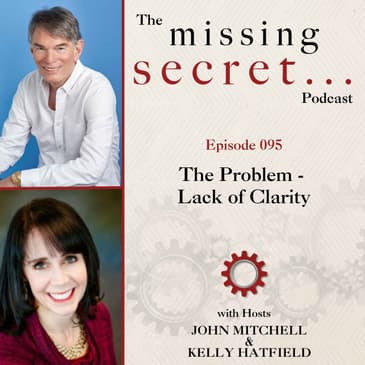
In this episode of The Missing Secret Podcast, John and Kelly talk about the effect of having a lack of clarity. In the advanced leadership of self methodology, it’s all about clarity. You define exactly the person you want to be, exactly what you want to accomplish, and precisely how you are going to achieve your clearly defined goals. You then feed that clarity to yourself each day as your morning routine.
After 21 days, then the right actions start happening automatically. And those right actions create the life you desire. But it all comes back clarity. John and Kelly talk about how most people, probably 98% of people, have a level of clarity at two or three on a scale of 1 to 10. In terms of what they want and how they are going to get it. And the effect of that lack of clarity is it causes a person to keep replicating the life they have. As opposed to creating the life they desire.
John and Kelly also talk about the process of having a clear vision and feeding it to yourself each day. Then from that clarity, it gives you an enhanced ability to iterate that vision. Later in the podcast John and Kelly talk about an interesting concept called you are the problem and you are the solution. But it gets us back to clarity. When you do thinking time sessions around you are the problem and you are the solution, watch what happens. Clarity comes to you in terms of what the actual problem is then you can likely see that you’re also the solution.
Buy John’s book, THE MISSING SECRET of the Legendary Book Think and Grow Rich : And a 12-minute-a-day technique to apply it here.
About the Hosts:
John Mitchell
John’s story is pretty amazing. After spending 20 years as an entrepreneur, John was 50 years old but wasn’t as successful as he thought he should be. To rectify that, he decided to find the “top book in the world” on SUCCESS and apply that book literally Word for Word to his life. That Book is Think & Grow Rich. The book says there’s a SECRET for success, but the author only gives you half the secret. John figured out the full secret and a 12 minute a day technique to apply it.
When John applied his 12 minute a day technique to his life, he saw his yearly income go to over $5 million a year, after 20 years of $200k - 300k per year. The 25 times increase happened because John LEVERAGED himself by applying science to his life.
His daily technique works because it focuses you ONLY on what moves the needle, triples your discipline, and consistently generates new business ideas every week. This happens because of 3 key aspects of the leveraging process.
John’s technique was profiled on the cover of Time Magazine. He teaches it at the University of Texas’ McCombs School of Business, which is one the TOP 5 business schools in the country. He is also the “mental coach” for the head athletic coaches at the University of Texas as well.
Reach out to John at john@thinkitbeit.com
LinkedIn: https://www.linkedin.com/in/john-mitchell-76483654/
Kelly Hatfield
Kelly Hatfield is an entrepreneur at heart. She believes wholeheartedly in the power of the ripple effect and has built several successful companies aimed at helping others make a greater impact in their businesses and lives.
She has been in the recruiting, HR, and leadership development space for over 25 years and loves serving others. Kelly, along with her amazing business partners and teams, has built four successful businesses aimed at matching exceptional talent with top organizations and developing their leadership. Her work coaching and consulting with companies to develop their leadership teams, design recruiting and retention strategies, AND her work as host of Absolute Advantage podcast (where she talks with successful entrepreneurs, executives, and thought leaders across a variety of industries), give her a unique perspective covering the hiring experience and leadership from all angles.
As a Partner in her most recent venture, Think It Be It, Kelly has made the natural transition into the success and human achievement field, helping entrepreneurs break through to the next level in their businesses. Further expanding the impact she’s making in this world. Truly living into the power of the ripple effect.
Reach out to Kelly at kelly@thinkitbeit.com
LinkedIn: https://www.linkedin.com/in/kelly-hatfield-2a2610a/
Learn more about Think It Be It at https://thinkitbeit.com/
LinkedIn: https://www.linkedin.com/company/think-it-be-it-llc
Facebook: https://www.facebook.com/thinkitbeitcompany
Thanks for listening!
Thanks so much for listening to our podcast! If you enjoyed this episode and think that others could benefit from listening, please share it using the social media buttons on this page.
Do you have some feedback or questions about this episode? Leave a comment in the section below!
Subscribe to the podcast
If you would like to get automatic updates of new podcast episodes, you can subscribe to the podcast on Apple Podcasts or Stitcher. You can also subscribe in your favorite podcast app.
Leave us an Apple Podcasts review
Ratings and reviews from our listeners are extremely valuable to us and greatly appreciated. They help our podcast rank higher on Apple Podcasts, which exposes our show to more awesome listeners like you. If you have a minute, please leave an honest review on Apple Podcasts.
Welcome to the Missing Secret Podcast. I'm Kelly Hatfield.
John Mitchell:And I'm John Mitchell. So, the topic today is the problem, lack of clarity. That is a problem, isn't it?
Kelly Hatfield:It's a huge problem. I'm so excited to dig into this today.
John Mitchell:Well, you know, we we mentioned it last week that typically most people lack clarity regarding who they want to be and what they want to accomplish. And, you know, on a scale of 1 to 10, they're probably a two or three. So, let's talk about that downside of that lack of clarity. What's your thoughts on that?
Kelly Hatfield:Well, I think about at the times of my life, you know, when I reflect back on my life and on, you know, the year different, you know, kind of decades and everything, specifically when we're talking about clarity, I think about the amount of stress that I had in my life as a result of like not having clarity around the direction that I wanted to go in or being uncertain how to get, you know, like having a vague idea of where I wanted to go, but uncertain about how to get there, you know, or whether I was doing having clarity around whether I was doing the right things, you know, to lead to where I wanted to go. And I just think about, you know, when I didn't have the level of clarity I have today, like, first of all, you spend a lot of bandwidth and energy second-guessing yourself. Yeah, I think we may have talked a little bit about this either personally, John, or in our last. But when you don't have clarity when you don't have clarity, too, you lack confidence.
John Mitchell:And when you lack
Kelly Hatfield:confidence, it's harder to tune into that intuition and that knowing that you have because you don't really know, because you don't have a lot of clarity around. So, like it's this kind
John Mitchell:of
Kelly Hatfield:cascading, you know, effect that affects your identity, you know, at a real base level because without that clarity, it it's hard to get confidence without clarity.
John Mitchell:Well, I love how you connected the the dots. So, clarity goes to confidence goes to intuition. Yeah,
Kelly Hatfield:trusting yourself, you know.
John Mitchell:Right, right. You know, one of the things I sort of see, too, is that, well, two things. One is is people don't really realize they don't have the clarity, and secondly, they don't know how to fix it. And, of course, you know, you can't fix a problem that you don't realize you have. But, so, that first issue is the vast majority of people are lacking in clarity about who they really want to be and and what they want to accomplish, especially in their their career. And so, let's assume that they acknowledge that they lack that clarity, now the question is, well, how do I get it? Well, I see that you've got to have a system for creating it, because if you don't have it, you can you can muddle through a little and and improve it, but of course, in this methodology, I've spent I've spent 20 years thinking through clarity in each area of of a person's life: themselves, their health, their romantic relationship, their career. So I am well versed on on figuring out clarity, and the template and the algorithm is all built around that, but I guess the the main point I want to make is that you almost have to have a system for establishing that clarity and a system for evolving that clarity. Do you agree with that?
Kelly Hatfield:I do agree with that. I think, you know, we've talked and and touched on this on many an episode, you know, around, you know, if because we're trained to think so shallow and in 10-second intervals, you know, it's becoming, I think clarity is becoming more and more of a challenge for people without them even realizing it, you know, because I think there are many people who can relate to this. So let's even just say, you know, you are sitting in the doctor's office, you know, waiting. What's the first thing you do? You're picking up your phone. You're, most people are picking up their phone. They cannot stand the downtime, the boredom. It's like boredom is good. Yeah. Being there, observing, letting your mind
John Mitchell:Thinking.
Kelly Hatfield:Yeah, thinking. Those things are good, and I think that we've been trained through, you know, these devices to not think deeply and to just and to think so much externally, you know, be influenced so much by the external stuff versus, you know, looking internally, and so I agree with you wholeheartedly that thinking deeply and having clarity about your life, you know, you need to have a system, because otherwise, you know, this autopilot that's being created and the way our brains are being trained is making, I think, it even more and more difficult than it's ever been.
John Mitchell:Well, you know, the little pearl of wisdom that you gave me after our last podcast was so helpful about about clarity and this issue of, you know, defining on a scale of 1 to 10 how most people are, caused me to go and change my book, because it was just such a, great point, and and I started, so I changed it on Saturday, and then I'm thinking about it a little more, and I realize that the the real problem with lack of clarity is that you end up recreating your life, continually recreating your your life because you don't have clarity about where you're going. So that's the negative effect of it. Does that make sense?
Kelly Hatfield:Yeah, absolutely. You know, and I think about it, too. Yeah, if you don't have clarity of, you know, again, it's that old analogy about your GPS. If you haven't plugged in where you are and you haven't plugged in the destination of where you want to go, it's really difficult to get to, you know, where you want to go if you're not if you're unfamiliar with the area, you know? And so, I it's the same kind of thing, and and I think, John, too, you know, one thing that was around the topic of clarity, and understanding the brain and how the brain works, for me, understanding the role that your reticular activating system plays, and and when you provide it with clarity, you know, what happens? That it filters in the things that it knows what to look for, otherwise, it is just so easy to get distracted. You know, to have to have something that may be really meaningful to you right in front of you, right under your nose, but you can't see it because you don't have the clarity around what your brain should be looking for and the opportunities it should be looking for. And so, for me, too, understanding that connection point with your actual brain and how it works and this mechanism that it has, and then how that relates to clarity, that to me was one of the things, along with understanding, you know, that 95% of our thoughts are unconscious, and our actions are unconscious, was the reticular activating system and how clarity influences that.
John Mitchell:Right. Right. Yeah, and and you know you brought up a great analogy of using a GPS. If you can't key into it exactly where you're going, it's not going to be able to give you the the directions to get there. I mean, that's a perfect example of of how it works. And I'll I'll give you another example like this happened to me this this weekend. Now Now, keep in mind, I I have a clear vision of where I'm going for the next 3 years. and just as a a quick recap for people, I'm I've started the Center for Advanced Leadership of Self, and and I'm now teaching the methodology to MBAs instead of undergraduates. I mean, what a difference that makes! They're 28 rather than 20, and they spend, you know, 200 grand of their own money to get an MBA versus mom and dad paying for a college. So they're the perfect two-percenters. And so so starting the the center, and one of the things that that I see is that that I'm also going to hold a annual summit that basically convenes this this new discipline, advanced leadership of self, and and it and it gets created. And so I, on Friday, I I'm, of course, I'm reading all that my life GPS template every day. So I go have lunch with this brilliant professor at the University of Texas that that I've known for a number of years, and he's so brilliant. In fact, he was just put on the National Institutes of Health Board of Directors, which decides where funding for medical research goes. So he he is a big-time player, and we're talking about it and and he he knows how the bureaucracy of the University of Texas works. He says to me, You're going to create this industry once you have that worldwide summit that you host. That will that'll be the event that that launches the industry. Well, you know, I hadn't I mean, I was planning to do it, but I didn't realize that is the seminal event that launches this new academic industry. And so, you know, just a little outside input from from from somebody else makes the
John Mitchell:dots that I was already seeing connect. And, you know, it's so powerful when But when you have a clear vision already, the the the vision morphs and morphs in a way that it can't morph if you start with an unclear vision. Mhm. And so, you know, and of course that was pivotal, because I'm I, you know, I I want my life work to be, you know, launching this this academic and leadership discipline. And so he gave me that that just that right little bit of input, and and I bet you've had the same experience where somebody on the outside has has given you a just a little pearl that tweaked your vision, right?
Kelly Hatfield:Well, hello, I'm talking to one.
John Mitchell:Well, thank you. Thank you. But I was really thinking more But although we can stay on me, but I was thinking about when you went to Denver, and, you know, you had a vision.
Kelly Hatfield:Yeah. You had a
John Mitchell:vision, but you meet this guy, and he changes that vision, right?
Kelly Hatfield:Yeah. Mhm. Yeah, absolutely. You know, and then gets And And again, too, I am the type of person where, you know, once I see, like you put, you know, like that saying you put your money where your mouth is, like I can see that what you've done has created these kind of outcomes and results, I'm like, okay. You know, so I know it's possible, and then now too, I'm like, okay, well, how can I, you know, take the best of this? How can I replicate exactly what he's doing? And then, oh yeah, by the way, now that I know exactly what I need to do, I can iterate now as I go and continue to improve and, and, you know, evolve because I've got the insight that I didn't have before and the clarity that I didn't have before around what I needed to do. So, absolutely, those, you know, those people who can give you that that little pearl that then, you know, put moves you in another direction, is priceless.
John Mitchell:Right, and, you know, I see that AI used in your thinking sessions can oftentimes give you that that pearl, but there's also something about just another human being that's not AI. But, you know what, maybe as we wrap this up, you know, I've been enamored with this idea that you're the problem and you're the solution, that idea. I may have mentioned this, I don't know, I went and saw the women's basketball coach here at the University of Texas, and and he is a he is a powerhouse guy. The University of Texas has been to the Final Four the last two years, and he is he really wants to win a national championship. And I was telling him I would like to do a presentation to the, you know, 15 players on his team about you're the problem and the solution because one of the things he has a problem with today is he had two really superstar players leave the team this year and transferred elsewhere. And, you know, tremendously frustrating because he'd been recruiting them since eighth grade, you know, and and they were both freshmen. And so, you know, he gets them here and then they they leave, and and there were extenuating circumstances, some of it's money, obviously. But I was telling Vic, I said, You know, at the end of the day, they look at it like you're the problem, the University of Texas is a problem, when in reality, they're the problem. If they wanted more playing time, they should have done better in practice and and improved in the ways you wanted them to improve in. So so I'm I've created this PowerPoint that really addresses that and teaches how to use thinking time to apply the idea that that you're the problem and you're the solution. And so I don't know if if that would be helpful to you if you were doing something, but you got the same problem, you know. I mean, they think you're the problem, and and the company's the problem, right?
Kelly Hatfield:Right. Yeah. And I think, too, when it just goes back to what we've talked about, which is that radical accountability. Like I am exactly where I am because of, you know, for good, for bad, for otherwise, because of the actions that I personally have taken. Right. You know, so I, you know, I think that everybody, you know, so you know, if you're looking at it from the player's perspective again, okay, then I'm the issue, then I also can create the solution to the to whatever the issues are. And the same thing as a coach. Okay, if I've got people leaving, you know, what what is it that, you know, is happening that is influencing them wanting to make a move? And some things are out of your control. You can't do anything about the money, you know what I mean. But, you know, what is it that, you know? there's a level of accountability, I guess what I'm saying and not necessarily I don't know where I'm going with that particular scenario, but there's a level of accountability like any time you are unhappy or you are in a situation like, stop, burst and, you know, look at yourself and then figure out, okay, what is the solution? So in this case, you know, you know, one of the things that he's doing is he's going to bring you in to talk to them about that, right? You know, to you know, help help them understand. But I think I just that radical accountability and understanding that I'm the problem, and I'm also the solution to the problem.
John Mitchell:Right, right.
Kelly Hatfield:And there's power in that. That is it. Like I think when some people hear that, like, you're the problem and you're also the solution, you know, immediately because ever you know, we are all so geared to look through a negative lens, you could almost get on the defense, you know, where it's like, Well, I'm not the problem. Man. You know, and it's like, Oh, you're the problem.
John Mitchell:Oh no, you're not the problem.
Kelly Hatfield:Yeah, no. You're the problem. Believe me, if you don't think you're the problem, you're the problem. Yeah. You know, so I think My
John Mitchell:very The very thinking you're not the problem tells me you're
Kelly Hatfield:the problem. Exactly. Exactly. So I think that, you know, if you can flip that to be like, Well, wait a minute, you know, if I'm contributing to whatever the circumstances are, then I also It means that I can contribute to the circumstances in a positive way. Right. Like I can. You know, so I think to me that's empowering, that's exciting to look at it through that lens, like, Oh, if I'm the problem and I'm also the solution, well then that's easy. I can fix. You know, I can do whatever I need to do to get to where I want to go.
John Mitchell:Right. Well, and you know, it's sort of we now have come full circle back to the topic today: clarity. You know, when you're when you're analyzing, I'm the problem and I'm the solution, it's coming down to clarity, you know. What is the problem? When Once you see what is the problem and what the real problem is, almost invariably it's you, and then you can see how you're the solution. So, amazing how it works.
Kelly Hatfield:Yeah, absolutely.
John Mitchell:Okay, well, until next time, we'll see you.