
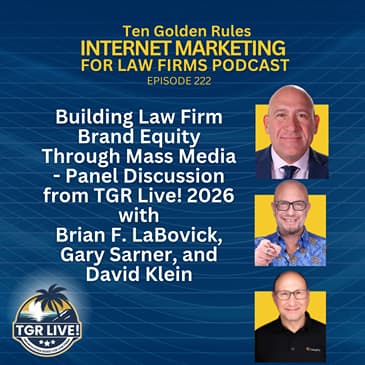
Your next client may choose your law firm long before an accident happens. In this panel discussion from TGR Live! 2026, Jay Berkowitz shares the stage with Brian F. LaBovick of LaBovick Law Group, Gary Sarner of ROI360+, and David Klein of ConsulTV to explore how television, radio, and connected TV build a memorable legal brand. Brian shares his firm’s evolution from a boxing-inspired identity to advertising rooted in humor, results, and community involvement. Gary explains how radio frequency, local relationships, and dashboard visibility can strengthen a firm’s presence without matching larger competitors’ budgets. David connects brand awareness with audience targeting and measurable viewer engagement. For law firm owners, the larger lesson is to build recognition before the need arises, support it across complementary channels, and use performance data to refine the investment.
Key Topics
00:00 - Brian F. LaBovick, LaBovick Law Group - Building brand recognition before a prospective client needs an attorney.
02:09 - The progression from brand identity to differentiation and trust, illustrated through the firm’s evolving commercials.
09:06 - Bringing community safety initiatives into the firm’s public-facing brand.
12:14 - Defining an authentic identity, mission, and core values that guide the entire firm.
14:47 - Gary Sarner, ROI360+ - Using radio to build reach, frequency, and a recognizable local presence.
18:16 - Checking streaming coverage and understanding the separate opportunity of dashboard visibility.
23:19 - Creating authentic advertising that encourages people to search for your firm by name.
27:43 - David Klein, ConsulTV - Connecting brand building with the targeting and measurement capabilities of streaming television.
34:17 - Reaching your ideal audience across streaming platforms, with a motorcycle campaign example showing how household targeting works.
38:09 - Measuring website engagement after ad exposure and using that information to refine campaigns.
40:54 - Panel Recommendations and Audience Q&A - Getting started, choosing an audience, and navigating media targeting and competition.
Resources Mentioned
Technology
- Warrior Vision (Traffic Camera Footage Technology) – https://www.labovick.com/18-wheelersemi-truck-accident-lawyer/
- Adelaide (Attention Measurement Platform) – https://www.adelaidemetrics.com/
- IHS Markit (Automotive Audience Data) – https://cdn.ihs.com/www/pdf/IHS-Markit-automotive-offerings-brochure.pdf
- Netflix (Streaming Platform) – https://www.netflix.com/
- Hulu (Streaming Platform) – https://help.hulu.com/article/hulu-find-it-on-hulu
- Philo (Streaming TV Platform) – https://www.philo.com/
- Tubi (Streaming Platform) – https://tubitv.com/welcome
- Roku (Streaming Devices and Platform) – https://www.roku.com/
- Pluto TV (Streaming Platform) – https://pluto.tv/
- YouTube TV (Live TV Streaming Platform) – https://tv.youtube.com/welcome/
- YouTube (Video Platform) – https://www.youtube.com/
- Spotify (Audio and Podcast Platform) – https://open.spotify.com/
- Amazon Prime Video (Streaming Platform) – https://www.primevideo.com/
- HBO (Television and Streaming Content) – https://www.hbo.com/
Podcasts
- The Joe Rose Show – Joe Rose – https://podcasts.apple.com/us/podcast/the-joe-rose-show/id950359597
- Big O Radio Show – Orlando Alzugaray – https://podcasts.apple.com/us/podcast/id1444520159
Other
- Together for Safety – https://www.labovick.com/blog/together-4-safety-a-united-stand-to-prevent-crashes-and-defend-victims/
- Golden Gavel Awards – https://a-list.law/golden-gavel-awards/
About our Guest:
Brian F. LaBovick is the Founder and Visionary of LaBovick Law Group, a consumer litigation firm serving clients in Florida and Massachusetts. A personal injury attorney with more than three decades of experience, Brian combines client advocacy with a strong commitment to community involvement and traffic-safety education.
Gary Sarner is the Founder of ROI360+, a media strategy and buying agency he launched in 2021 after more than three decades in radio. He helps law firms build recognizable brands through radio advertising, strategic media placement, and campaigns designed to strengthen their presence in local markets.
David Klein is the Director of Business Development at ConsulTV, where he helps law firms and their agencies strengthen advertising through connected TV, streaming video, and programmatic media buying. With more than 20 years in marketing and digital advertising, David focuses on audience targeting, brand awareness, and measurable campaign performance.
https://www.consult.tv/
About Jay Berkowitz:
Jay Berkowitz is a best-selling author and popular keynote speaker. Mr. Berkowitz managed marketing departments at: Coca-Cola, Sprint and McDonald's Restaurants, and he is the Founder and CEO of Ten Golden Rules, a digital marketing agency specialized in working with attorneys.
Mr. Berkowitz is the author of Advanced Internet Marketing for Law Firms, The Ten Golden Rules of Online Marketing and 10 Free Internet Marketing Strategies that went to #1 on Amazon. He is the host of the Ten Golden Rules of Internet Marketing Webinar and Podcast. He has been profiled by the Wall Street Journal, The Business Journals and FOX Business TV.
Mr. Berkowitz was selected for membership as a TITAN for Elite Digital Marketing Agencies, he is the recipient of a SOFIE Award for Most Effective use of Emerging Media, and a Special BERNAY’s Award.
Connect with Ten Golden Rules
Subscribe to Ten Golden Rules on YouTube
Check out our webinars on TenGoldenRules.com
Connect with Ten Golden Rules on LinkedIn
Follow Ten Golden Rules on Facebook
Connect with Jay Berkowitz on LinkedIn
Thanks for listening!
Thanks so much for listening to our podcast! If you enjoyed this episode and think that others could benefit from listening, please share it using the social media buttons on this page.
Do you have some feedback or questions about this episode? Leave a comment in the section below!
Subscribe to the podcast
If you would like to get automatic updates of new podcast episodes, you can subscribe to the podcast on Apple Podcasts or Stitcher. You can also subscribe in your favorite podcast app.
Leave us an Apple Podcast review
Ratings and reviews from our listeners are extremely valuable to us and greatly appreciated. They help our podcast rank higher on Apple Podcasts, which exposes our show to more awesome listeners like you. If you have a minute, please leave an honest review on Apple Podcasts.
What's most important about a radio commercial, and as Brian said in your TV commercials, be who you are. You're going to hear and see so many different legal law firm commercials in your markets. It's the number one category in local advertising. But if you are true to your brand, the people that want to find you are going to search for you. You said something interesting. People search car accident attorney near me. The actual goal is for somebody to type in your law firm and find you because they've seen or heard you.
Speaker:Welcome to the 10 Golden Rules of Internet Marketing for Law Firms podcast, featuring the latest strategies and techniques to drive traffic to your website and convert that traffic into clients. Now, here's the founder and CEO of 10 Golden Rules, Jay Berkowitz.
Speaker:Brian F. LaBovick: When I've been asked to talk about TV advertising, one of the things that I got wrong when I first started thinking about it, but that I've learned very quickly over it, and I think that a lot of people get wrong in TV advertising, is that they think TV advertising is being done to bring in your next case, and I think that is fundamentally the wrong way of thinking about it. Fundamentally, the concept of TV advertising is run by a marketing concept where consumers make 70 to 80% of their decisions before they ever need the product, so TV advertising is not about bringing
Speaker:in the next case today. TV advertising is about creating a situation where you're bringing in the next case when it happens to the consumer in six months from now. In other words, you have to create a situation where you live in the mind of the consumer because 70 to 80 percent of the time they're making that decision before they ever type in who is the best personal injury lawyer near me. Okay, so they go out there and they say, "I now have an accident case. This now is part of my life, I've had this accident attorney on TV for the last three years. He's living in my mind. She's living in my
Speaker:mind. That's a brand that I know, like, and trust now. And they get online and they type "best accident attorney by me," and you better be there. You better be there on the radio. You better be there on connected TV. You need to be there on TV, and your web better be great. If you're going to advertise in TV, you need to be everywhere because the concept is no longer. And I'll bet there are TV advertising attorneys here. I'll bet Rob probably feels this way. There was a time when TV advertising would drive in a call right then. You would be able to stick a commercial on TV and watch your
Speaker:calls go up. That that was 2530 years ago. Now you don't see that as often, right? What you really see is people that are you're living in their mind. The TV advertising may go off. You may get those calls, but it's because you're there and they're waiting. I was in an accident yesterday, and I need to be there. So when we got into TV advertising seven or eight years ago, and really went hard in it. I was playing in it for years. We needed to answer a question, right? Because what we've learned is that there are three maturation levels that you go through, right? You go through this identity
Speaker:level in the market, right? You go through what you hope is a differentiation level, which you'll go through regardless of whether you intend to do it or not, so you need to be intentional about it. And then in the end, you have a mature concept, and you can be a little more playful. You can be a little more active with it, but you have kind of a mature, trusted brand concept, and you're going to run through that in the market if you get into TV advertising, whether you attack it from the front end or the back end. But you're going to go through that. So instead of like taking a ton of time in
Speaker:this, I'll just play how we developed our brand over seven years because we were looking to answer one fundamental question: Who are we? All right. So there are three stages that we went through. We want to know who we are. We want to know why we're different, and we want to know why clients should trust us. So, in the first commercial, we had a key concept. Right, we wanted to know who our brand identity was. If I start a meeting in my firm, every single meeting starts by asking someone, "Who are we?" and they will say we are warriors for justice because that's the brand identity that we
Speaker:wanted to create seven years ago. And I give high marks to Chris and to Michael Mogul's team for coming in and interviewing us and getting deep and understanding who our brand was. What worked? We had strong metaphor. We had strong visuals. What didn't work is that. There wasn't a direct call to action in this, right? It was just an identity commercial.
Speaker:All right, see if this works. Everything that I've done in my life has been about fighting. I learned early on that I enjoyed fighting back. I've just enjoyed and has always been drawn to the fight. We understand that after an accident, it can be one of the darkest times that a client can go through. They're in this terrible place, and they don't see a light in the future. If you've been injured in an accident, let the Lubovik Law Group fight for you. All right. So that was our first entry a long time ago, seven, eight years ago, we had our Michael Mogul brand video, slow walk video, which I
Speaker:think are all beautiful and wonderful. It's about a three-minute video, and it's what we call our brand anthem. It lets people know who our identity is, and we put that into the market. It didn't drive a lot of cases. It's been eight years, and when people see me after 50 commercials in the market. They still say, "Oh yeah, you're the boxing lawyer guy, right? The guy that had the boxing. It hasn't been on for seven or eight years." That's the identity, right? So we have that identity, and we decided over time we did a market study, and we found it's a very aggressive identity. It's a
Speaker:little off-putting. People wanted something friendlier. They wanted something fun, and we thought one of the great things that we have in our brand is that my wife was a part of it, and we wanted her to be a part of it. So we ended up having her join me in the commercials. In this commercial, this was her entry into
Unknown:it. I'm Brian Labovick with the Lebovic Lawn Group. Don't you dare take the insurance companies, small jack. We'll rain down thunder on the insurance companies. We don't bark, fight, and get you the big check you deserve.
Unknown:Ryan, what are you doing?
Unknown:Brian F. LaBovick: I was laying out an action hero commercial.
Unknown:We don't do those cheesy commercials. We are real lawyers helping real people with real problems.
Unknown:Finesster.
Unknown:Brian F. LaBovick: thank you, thank you. All right. So the truth is, is that was the first commercial that drove calls. All right, immediately started drawing calls like our TV changed at that point. We had done those the first set of commercials. We came up with this concept. We thought it's a little edgy, it's a little funny, and it really helped. Right? We then it played so strong that we actually had another one after it, where we walk into a bar and the TV commercial is playing behind the The bartender he goes, aren't you that lawyer, that superhero lawyer? And I was like, I don't
Unknown:know what you're talking about. He goes, Yeah, that guy. And he points to the TV. We only wanted to just keep the commercial running in a new way because it was working. We just had to come up with something. So so after we did that, our brand became more playful. Our brand became more accessible. We still kept the warrior for justice mentality. We wanted because people kept talking about boxing, so we wanted to bring that fighter mentality back to the market. But the the brand kept maturing, right? So our identity was starting to sink in as being warriors for justice. We ended up
Unknown:having some interesting technological things that we put out there. We developed something called Warrior Vision, where we have the traffic cameras filming the accident cases, so if you need your accident in Florida, we're filming the traffic camera. We're recording the traffic cameras so you can get that done. So that was another technical advantage that went into the market, and then we decided to get back to the boxing. So we ended up doing this commercial recently. After an accident, don't let the insurance company get you on the road, caller. Click Labovic.
Unknown:Insurance offer $500. The Labovic result
Unknown:$120,000.
Unknown:Insurance offer $6,000. Our result
Unknown:Brian F. LaBovick: $350,000.
Unknown:Insurance offer 50,000. Our result
Unknown:$4.1 million.
Unknown:After a crash, Labovic Law Group fights to get you what you deserve.
Unknown:Ouch! Hit hard. Don't wait. Don't hit
Unknown:late. All
Unknown:Brian F. LaBovick: right. So Esther's the badass in the group. That's for sure. So yeah, the concept is that we want to live in the mind of the consumer because they don't need us right now, right? We want the brand to be strong. We want the number to be strong. We pay a lot of money for the number. All of that adds up to living in the mind of the consumer, so that in six months from now, we're still there when they type in "best accident lawyer by me" and they run across us and all the other people in this county that are advertising with me, which are many. All right. So the real role is
Unknown:to capture demand, not to capture demand, to create demand memory, to make sure people remind us before the accident happened. All right. One more thing, because we added it in here. So we are now evolving. We created a foundation in the county, and we go to all the high schools or many of the high schools a year, and we present to them in different. Ways we do traffic accident crash reconstruction, which is really a big production where Jaws of Life fly in, and we're on a football field, and they cut the top of the car off, and they arrest a kid, and a hearse comes in, and we
Unknown:pull a dead kid off the ground, and we take him away, and we do an entire narration about how awful traffic accidents are, and that's a foundation that we created, and we have buy-in with police, with fire rescue, with a bunch of government agencies to get that done, and it really has a great impact on the kids. We've done that for about seven years, and I thought that it was brilliant because it's a really great thing to do. It ties into who we are, but it also hopefully would develop business, and it hasn't is the truth, right? But it's so powerful, and we just haven't gotten that message out
Unknown:there to the public. So this year we made this new concept of Together for Safety brand, and we're starting to bring that to the market in a more sincere way. So this is the next evolution of the brand. These commercials just started here recently, and we're going to keep doing this using PSAs, basically to tie my brand to this foundation that we have.
Speaker:Every parent hopes their teen makes it home safe. This live reenactment shows what really happens when life changes.
Speaker:Brian F. LaBovick: Community crash reenactment and safety fair,
Unknown:where families come together to learn and connect. This community means a lot to
Unknown:Brian F. LaBovick: us. Yeah, and prevention starts when families and first responders and schools all come together.
Unknown:Join us on January 31 for the community crash reenactment and safety fair because our teens deserve to come home safe.
Unknown:Brian F. LaBovick: So that's the next iteration. All right. So the idea is identity, differentiation, trust, results, and now the fourth aspect of this is community. Because we have always said in our firm, and we truly believe, you got to give to get. So give to your community. Take care of them. They'll take care of us. That's it. Thank you.
Jay Berkowitz:Thanks, Brian. That was awesome. I'm just going to ask you two quick questions, and then we'll get over to Gary. I mentioned in my presentation that one of the differentiators that we need today is to build our brand. Now, not everybody can afford to get on TV, but what I said is, if you get your brand message right, you can get on social media. You get it correct on your website, all your socials, even your email signature. Once you figure out that brand message, you Julio showed us that you can do 2.3 billion video views for free. How did you go about picking that Warriors
Jay Berkowitz:for Justice? What was the exercise people would go through to figure out what's their brand that resonates with their firm? Because you just got to pick it and then go with it.
Jay Berkowitz:Brian F. LaBovick: So I have a theory that there is one leader in a firm that every firm has one leader, like the real the leader amongst the leaders. Sometimes there's a firm of four guys or four women or four people, and and they have like, if they were being honest with each other, there's one personality that really has set the tone, right? Whatever that tone is going to be, it has to be very intentional, and I think it also has to be very authentic to the person. So I think that people sit around a room and they talk about it. We have a small group in our firm. We have a leadership
Jay Berkowitz:of six people, and we sat down and we fought over every concept, every word of the following three questions: Who are we? Which is Warriors for Justice? What is our mission? To maximize justice by aggressively fighting for our clients' rights, and what are our core values? Fight to win, passion to serve, relentless innovation, and own it. And we behavioralize all of that for the firm, and all of that is known by rote by every human being on our firm. And it's because when we sat in that room for like six months, meeting after meeting, talking about every single syllable and all that I just
Jay Berkowitz:told you, it became very clear that these were things that were important to me as the leader of the firm. So, as the guy who founded it, as the person who directs it, as the impetus for why we go forward and why we do this, that's what I believed, and I think that you all should be really honest with your firms and figure out what you really believe, and make your business model work to that true belief. So, if you guys are warriors for whatever you do, and that's truly what you do, then live by that. Try cases. Be aggressive. Do that. If you're not, then be true to who you are. If you're
Jay Berkowitz:a, we want to get justice done quickly for people, or we want to move things through. Whatever that thing is, you want to be true to it. Fight for it. And when you're authentic to it, it reeks from you. It leaks out, and it becomes. It became that that definitional moment. I was a. I got my bar license in '90, and we didn't take off until 2016-17 when we came up with these identities, and we went from 5 million to 15 million in a matter of two years. So, it's it's really important.
Jay Berkowitz:That's awesome. All right, thank you very much, Brian. Thanks for sharing. So I mentioned that Gary's done a great job getting a dominant place for radio, but one of the other things that he'll probably talk about is radio also has the screen in your car, and whenever I see the screen in the car, it's almost always a law firm, and it's one he represents down here in South Florida. So Gary, take it away.
Gary Sarner:Thank you for having me, Jay. Good morning, everybody. I'm going to start with a question. Have you eaten at McDonald's this year? Raise your hand. Wow, this room is different than most. Generally, you get less than 20%. Who in this room listens to the radio during the week? Radio in your car, terrestrial radio, streaming radio on your phone, or through a player in your home, or a stereo system if you're really old like me. So we got good responses in here. Generally, we see people do not raise their hands about eating at McDonald's or listening to the radio, but 90% of all
Gary Sarner:Americans purchase something at McDonald's every year, and 86% of Americans listen to the radio every single week. Pretty wild statistics. Now, for me, I spent 35 years working and managing radio stations here in South Florida, and I still, to this day, believe it is the best medium for your business. Why? It got wide reach. Black, white, Hispanic, anybody that you may want to reach can be reached, but local influence. It is a local medium. There's a connection that people have with DJs in every market, and if you think back, we're all adults in here, to your childhood. There are DJs
Gary Sarner:that you listened to, that you still have memories of, and songs that you could sing to this day from the 70s, 80s, or 90s, depending on how old you are. It's a far more cost-effective medium than television today. With a CPM, for those who don't know what that is, the cost to reach 1,000 people in your messaging, and it is far lower than anything else that is out there. Flexibility, frequency. We purchase for our partners a ton on the air. We outshare anybody in the market. We'll get into that a little later. You can be more targeted with digital radio as well, if it's something that you
Gary Sarner:choose, and you could change your commercial within 24 hours, especially with someone like us because we have production people all over the country. And there's trust. There's trust with DJs. There's trust in traffic and news. And yes, it's all available on your phone to this day. You'll hear a lot of people talk about streaming audio. I still call it streaming radio. So when you're listening in your car and you get to your office, if you want to listen to your favorite radio station, you could turn it on right within an app on your phone and be hearing it. And what we do at ROI 360 Plus is
Gary Sarner:make sure that your commercials or some of your commercials are also heard on the stream, because if you speak to radio stations directly, they won't always tell you that you're not on the stream when you buy the radio commercials. Like I said, 86% of Americans are reaching the radio. Jay mentioned the dashboard. We own the dashboard in just about every market that we're in across the country, couple of examples in Georgia, in seven markets with Ken Nugent, Steve Gersten, who's here. We met at a conference just like this three years ago, three years ago this month, and Michigan Auto Law
Gary Sarner:owns the dashboard. And by the way, he also was able to get on a couple of stations where he it was already purchased by somebody else, but they didn't purchase it correctly. So having the right partner to buy your media matters. And then in Philadelphia, Lundy Law and this. This is an interesting story. Len and his son Jordan were not big fans of radio, but they said, "You know what? We're going to give this a shot." And Jordan left the NFC Championship game. Eagles, I don't know who the hell they were playing, but it was at night, and he called me up as he's driving home. The year they
Gary Sarner:won the Super Bowl, that was two years ago, right? Jordan called me and he's like, "Gary, the most amazing thing I've ever seen a sea of orange, every single car coming out of Lincoln Financial Field, I think it is, had orange in their dashboard, their big logo right in everybody's face, and that's something we do all over the country. Our strategies, I think, are second to none. We want to make sure that you have more in your market than Morgan and Morgan. You're never going to outspend them.
Gary Sarner:It's impossible to outspend Morgan and Morgan in any market they're in, but you can outshare them. Radio, TV, and David will tell you about the connected TV. We also get our law firms interviews within their markets, so they could speak to their community about things that matter in the community. And if you're doing radio and you're not getting that, it's something that you should look into. Audiences are followed. Media consumption on the phone, like I said, you can go from your car to your phone and listen to the same station wherever you are. It's accessible anywhere, and people do it
Gary Sarner:on a day in and day out basis. I want to play something for you. I don't have all the types of commercials that you brought today because radio is different. And by the way, this is a pet peeve of mine. It is radio. It is not audio. Audio you could listen to podcasts, but streaming radio and terrestrial radio are one and the same. Quite proud of what we were able to do this year, which was win our first Golden gavel, which is the Academy Awards of Legal Marketing. So we we were fortunate; we had three of the five nominations in the radio category, and Kaufman Townsley. This is an
Gary Sarner:interesting story. I had a client in St. Louis, and I met Todd, the owner of Coffin Townsley, at a conference. He's like, "I want to work with you," and I was couldn't do it. First relationship ended the following day. He owned every asset in St. Louis within 24 hours, and here's a commercial that we produced and wrote for him to win the Golden Gavel.
Unknown:This is Attorney Todd Nissenholtz of Kaufman Townsley, and this is a sound of our attorneys walking into court. Because when an insurance company offers a lowball settlement, we go to trial, prepping endlessly, interviewing witnesses. We know the loss and the cost of an accident, and when it's needed, we go to war for you and take the fight to the insurance company because we've been in your shoes. Kaufman Townsley, real people, real results. Call 314-500-5000.
Gary Sarner:What's most important about a radio commercial, and as Brian said in your TV commercials, be who you are. You're going to hear and see so many different legal law firm commercials in your markets. It's the number one category category in local advertising. But if you are true to your brand, the people that want to find you are going to search for you. You said something interesting. People search car accident attorney near me. The actual goal is for somebody to type in your law firm and find you because they've seen or heard you. These are a few of the firms we work with across
Gary Sarner:the country. We're quite proud, and if anybody has any questions whatsoever, I am happy to help anybody from the smallest to the largest of firms across America.
Jay Berkowitz:Thanks, Gary. Of course, I have a question. So you said something that tweaked something in my head, which is everybody has a favorite DJ, and I realize the DJ is very important part of radio listenership, and a lot of my radio listenership is still sports radio, and there's a couple guys in town that. I still listen to one. Actually, left and started his own podcast. Josh, no, Orlando, Alzgary, or whatever. Big O, big O, big O. But my question is, I still want to manage my content. Like I want to listen to the morning guy, but I might be listening to it in the afternoon or
Jay Berkowitz:something. So it's available streaming now on YouTube and iTunes; those are my go-tos. But I'm sure it's on Spotify and everywhere else. So I'm still listening to my favorite DJ, but I'm managing my timing. So how do you take advantage of that? I guess you're still they still embed the the ads, right? And
Gary Sarner:so Orlando is not on the radio. Yeah,
Jay Berkowitz:forget him. But the
Gary Sarner:so a podcast to Joe Rose,
Jay Berkowitz:who's on the yeah,
Gary Sarner:you have to purchase the podcast separate from buying the radio station. So what is on the radio, Joe Rose on WQAM? That's that stuff does not live within the podcast. They repurpose it and they resell it, and it could be another advertiser that owns that. I personally don't recommend buying audiences that small because only 2% of the people are going to need a personal injury attorney this year. I want to reach the masses as often as possible.
Jay Berkowitz:So, what percent listened to Joe Rose this morning, and what percent listened to Joe Rose by choice later in the day?
Gary Sarner:I would have to actually look that up
Jay Berkowitz:by station,
Gary Sarner:by station, but
Jay Berkowitz:generally
Gary Sarner:by DJ. But it is a very small portion.
Jay Berkowitz:I'm still a small percentage that
Gary Sarner:time
Jay Berkowitz:shifts,
Gary Sarner:tiny,
Jay Berkowitz:not a good investment. And this is not a question. This is more of just a clarification because you made the point, but I think the one small thing because the Lundy's told me the story as well coming out of the game. Everybody was listening to the post game show, and I would the first thing I do? I get in the car. You listen to the post game show, so that's why every dashboard was orange because everybody was listening to the same radio station, and that's why coming out of the Eagles playoff game.
Gary Sarner:Now here's the interesting part: we do a lot of business with the group that owns WIP in Philadelphia. That is the one station we do not buy any commercials on. We do get some bonus inventory, but we own the dashboard
Jay Berkowitz:only.
Gary Sarner:So if they hear Pon La Hockey, they're seeing Lundy Law.
Unknown:Awesome!
Gary Sarner:It's wild.
Jay Berkowitz:Well, great job. Thank you. Big round of applause for Gary. All right, all right, David. Thank you for getting here. His flight got canceled Sunday. He emailed me. He got in about 1o'clock last night, and these guys are great at getting you that additional digital buy to TV, or maybe you just do OTT on its own, and you can be very targeted. So take it away.
David Klein:Great introduction. Thank you for having me, Jay. Thanks. I see a lot of faces that I know out here. So good to see you, Jeff. So great. Yeah, these guys did a great job, and I'm just going to piggyback a lot of what they said. So let's just dive in. I thought I'd just share a little bit about myself. So this is my crazy family from our Christmas gathering this year, but the reason I showed this is that I've been doing legal advertising for 20 years, and I started in the PPC SEO space. And as right now, I'm deeply immersed in the connected TV area. I've been doing it for about
David Klein:five years, and I draw the analogy: when I started 20 years ago, there was this thing called the Yellow Pages. You might remember it. I'm not going to make jokes about it anymore because it's gone. But the point is, there was a fundamental shift, a paradigm shift of how people search for businesses. They used to look at the Yellow Pages. That was incredibly effective 30 years ago. Now, of course, Google has taken over that. The shift that's happening now in connected TV that I'm going to talk about is different in the sense that it's still TV, so the consumer doesn't really know and
David Klein:doesn't care. They watch TV a lot and they watch commercials, and that's it. The way that it's distributed, measured, and what you can do with connected TV compared to linear TV is extraordinarily different, and that's where the shift is, but to the consumer, unlike say PPC, where the yellow pages just went away, the consumer still watches tons of TV, and that 32nd spot is still a 32nd spot to a consumer. So, to Brian's point about influencing that that decision making, you still have to be in the mind of the consumer, and they just they're consuming content. So let's talk about that. So,
David Klein:first thing is how much do people watch TV? Gary was talking about the radio listening. Listen, the amount of commuting people do. They're in their cars. They listen to a ton of radio. They still have time to watch lots of TV. And I also I share this because so many of the folks that we work with directly when we're in the knowledge. Worker space. It's not as much TV consumption, but ultimately across the board, people are still watching tons and tons of TV a day. On average, the average household watches four to five hours of TV per day. What's that? Okay, I was just going to say, if you if
David Klein:you had anything to add, jump in there. Well, but you know what? But most of us in here are. That's why I wanted to make this point because most of us. I like my NBA. Other than that, I really don't watch a lot of TV. So the point is, but but this isn't about us. It's not about the people we know. It's about the masses, and the masses still watch tons and tons of TV. So then the question is, well, great. There's so many options out there, and I always like to say, look, it all works from the time that people were selling dates at the Tigris and Euphrates River 5000 years ago, when the
David Klein:first markets were open. You put a sign out and you said, I'm open for business, and my business is better than the next guy. So there's tons of different ad choices. So there's a company called Adelaide. They're out of Europe, but they do a lot of market research and they talk about what they refer to as attention units. And this is the point of where again you're trying to influence that decision, which mediums have the most attention units. And there's a lot of math and science behind this, but it's Adelaide, so it's looking at CTV shows up towards the top of that in terms of the the
David Klein:measurable outcomes in terms of your increase in revenue, increase in profitability, etc. CTV is at the top of that list. So the reason I bring this up is that when we think about, and I loved what Brian said. As a matter of fact, I almost got off the stage because, really, you just hit it on the head. Is that all of this works together?
David Klein:So we think about if you are growing your law firm, if you had a spoke, if you had a wheel with one spoke, that would be a very weak wheel. It would fold on itself. But if you have lots of spokes. That wheel is really strong and it rolls really smoothly. So you want a brand, you want to do lead generation and intake. And so I'm just going to play this short video just to talk about. Okay, we. I don't think this is like profound. I think most of us in this room are familiar with that. The question then becomes: What's the most efficient? How do you generate the highest ROI, the highest
David Klein:profitability for your firms, and this is an interesting approach. And this comes from Adelaide, who is again an international market research firm.
David Klein:So everything you do needs to be memorable. So you need short-term sales activation and long-term brand building, and you need them working together, and you need them to be balanced. Our research suggests that the optimum effectiveness tends to be achieved when about 60% of the budget is devoted to long-term brand building, and about 40% to short-term activation. We call this the 6040 rule. But our latest research shows that rule, that balance, changes depending on category and context. What we're finding in the data is, as the digital economy evolves, sales activation is becoming much
David Klein:more efficient. What that means is that activation, as it becomes more efficient, requires less budget, and so almost counterintuitively, the optimum split is shifting away from sales activation towards brand building. To put it simply, in a digital world, emotional brand building is more important than it's ever been.
David Klein:And so that sales activation in our world, that's going to be bottom of the funnel marketing. So it's going to be the SEO, the PPC, and it is counterintuitive because. And Gary brought this up in his great comments: is that we're trying to influence the decision of what people search for. We know when we all want to look for a business, what do we do? We Google it. That's just the way that consumers interact with the business world, the question is, what do they Google? So now this is where, and what this gentleman is talking about is because PPC has become so efficient, you have to do
David Klein:more to influence what that decision, what the what they're going to Google, and more importantly, the decision that they make. So if they've seen your ad on TV for the last five years, much more likely to choose you over people they're unfamiliar with. So where does connected TV fit into all of this? So the couple things that I wanted to point out is that connected TV, just as a quick and Jay is absolutely correct. I hate all of our terminology. OTT, connected TV. It's it makes me nuts, but it's all the ads that are seen on all the streaming platforms. I think that's one thing to be really
to emphasize:is that in the connected TV world, we get this question all the time. Well, what are the best platforms? Well, guess what? Every single campaign, we have data on that that shows which which publishers are generating the best results. But when we think. Connected TV. Don't think of it as just Hulu or Netflix or Filo or Tubi or Crackle. It's all of those because guess what? The consumer they don't know and they don't care. They they plug their smart TV in that they bought from Walmart and they open it up and they've got a Roku stick already built into that thing. And guess
to emphasize:what? They have 10 different streaming platforms that they can choose from without even doing anything, it just comes with the TV. So, with that being said, with all of these options on publishers, it's not about the content, but it's about the audience. So, one of the really fun conversations that we have with our clients is what is the messaging that you have now. In Brian's case, he showed some amazingly great brand building, awareness building ads. Those are not necessarily audience specific, but we can certainly be audience specific. So whether it's in motorcycle Spanish, workers'
to emphasize:comp, etc. So I wanted to point that out. That in terms of the, we're trying to reach the audience, and so where would those ads appear? So I just wanted to point out because, and this is also getting to the discussion of the podcast. This is another example. We see YouTube TV takes up a lot of the space. I get a lot of questions about YouTube TV, but in terms of the people that are actually subscribers to YouTube TV, it's a really small percentage compared to say a Pluto, a Tubi, a Netflix. Now YouTube.com. That's a different story. There's much, much more usage on YouTube.com, but
to emphasize:YouTube TV is smaller. So I just wanted to put in perspective the millions and millions of monthly active users, and what our approach is. Let's reach all of these publishers, but reach the audience that you're trying to reach, so I thought it would be worthwhile to talk about how does the targeting work. A lot of times we get questions about, well, is this online behavior? Is this their search? No, that's what Google does. That's why you advertise on Google because it's their search data that they're using. In the consult TV world, what we're using is something called an infographic. Has
to emphasize:anyone heard that term before? Is that a home? Okay. So what we all have an infographic. How do we have an infographic? Because if you own a home, if you own a car, if you have a credit card, a checking account, a mortgage, on if you have any type of loans, all of that information is anonymized and packaged, and that creates an infographic for all of us. So the data bits that we use, for example, this is really straightforward and very direct.
to emphasize:Is so for motorcycle ads, for example, we have data bits from companies that have DMB information that has all the motorcycles registered to the households in a particular market, so we can show motorcycle ads to households that have a motorcycle registered to that particular home, and that comes from DMV information that's purchased by IHS Markit, and we use those data bits to then serve motorcycle ads to those individual households. All of this information is PCI compliant. It's anonymized, but that is how the targeting works. And then we append that data bit to the IP address for
to emphasize:that individual household. So that's how we're able to do the geographic targeting and the audience targeting. Any thoughts or questions? Actually, I have 26 seconds. Can I have another? I want
Jay Berkowitz:you to hit one slide, which is really important.
David Klein:Okay,
Jay Berkowitz:which is there's a lot more tracking now today in OTT, right? Can you show us an example of that? Because I think the game changer is it used to be like TV, where the only way you could track it is if you had a different digital phone number, a different phone number. Now that you can track, people saw your ad. They came to your website. They filled out a form. They saw your ad. They came to your website on your on their phone. They've made a phone call.
David Klein:Great segue. Thank you for the thanks for for cueing me up. So this is something new new in the sense that we've been doing this for about the last year. So what Jay is talking about is we refer to this as performance TV. So the way that this works is we ask clients to put pixels on their website, and then we're able to measure viewer engagement. So what do I mean by viewer viewer engagement? So the the first piece of this is how many website, how many people saw your ad on connected TV, and then came to your website. So we can tie that back to they saw your ad, they came to
David Klein:your website. I know a website visitor is not a lead, but it's a measurement. It's viewer engagement. What if they downloaded a form? What if they submitted a form? What if they started a chat? What if they hit your click to call button? These are all items that we can measure in our dashboard, and the measurement is nice. But what's really fun is that we're able to make changes to your campaign based on publisher, based on creative, based on day part, back to which ads, which day parts, which publishers are driving the most engagement. So this is all the next iteration of being able to not
David Klein:only know where we're serving the ads and what audience. Seeing the ads, but then also having data to be able to make changes to your campaign based on who's engaging the most.
Jay Berkowitz:Next slide. So that
David Klein:is the and then the last slide is I did want to put up my contact information. So please, anybody that's interested in chatting with me, you can shoot me a text, email, carrier pigeon. I'm easy to reach, easy to find, and also just wanted to throw because I appreciate Jay so much, and wanted to put out a little offer that if you wanted to give us a try, for example, and I'm also just to be really transparent for like a we're coming up on the warmer months for most of the country, so motorcycle ads typically run starting in April, May. They run through the summer into the
David Klein:fall. So this is a great way to get into this. If this is not something that you're doing, you want to learn about it. A $3,000 budget will get you going on a motorcycle campaign. So here is an offer for the group, and I appreciate your time. Thanks you for having me.
Jay Berkowitz:Awesome, thank you. So $750 in free YouTube ads. Is that also good for non-law firms?
David Klein:Sure.
Jay Berkowitz:All right. All right. I'll take you up on that. Well, thanks, guys. Real quick, if someone wants to get started with TV, radio, OTT, one super quick thought: What should they do, Brian?
Jay Berkowitz:Brian F. LaBovick: What leads to riches?
Jay Berkowitz:Good one, Gary.
Gary Sarner:Pick one of them and own something.
Jay Berkowitz:Very good, David.
David Klein:Choose your audience.
Jay Berkowitz:All right, we got a very consistent theme there. Okay, we'd love to get a few audience questions. We got mics in the back. We got mics in the back. So one up here, please, pal. Come on up. Cassidy, who we're going to hear from later today, out of the Virginia market.
Cassidy Lewis:Hey, you guys, this is a really good panel. Brian, I have a question for you. What you said about TV being essentially branding, I tell my team there's either a campaign for an intake today or an intake tomorrow, and tomorrow can be in three years, right? I agree with that, but that hasn't been the story with legal marketing. We always choose that daytime fringe to put our ads on, and I think we talked about this. When you said you got serious about TV, did you change your buy to do more evening, weekend sports, or did you keep that split to really focus on daytime? And I know
Cassidy Lewis:David, you mentioned this too, which it just makes so much sense to me. But I didn't come from legal. I came from Fortune 500s. We bought primetime TV, right? So, did you change your buy when you say you got serious about TV?
Cassidy Lewis:Brian F. LaBovick: Yeah, we did, and it's only because we went with a much larger budget. Like the the budget just increased, and we we increased the broad spend. Just so everybody knows, I consult with her for my marketing. she's just trying to set me up with a question. She's going to answer that I didn't do well later. She's going to be like, "Why didn't you say this? You're supposed to say." I was like, "But yeah, we we just broaden the atom. We did a lot of daytime. And in retrospect, if I were to to go backwards, I probably would have done less on broader spectrum to start with the
Cassidy Lewis:branding, and then brought it down to a more targeted audience over time. But yeah,
Jay Berkowitz:okay, great. One up here, please. Here comes Maria. Tell us your name and your firm, please.
Unknown:Jonathan Gowdy. I'm with the Miller Law Firm out of Atlanta. So, question about the radio. Very fascinated by it. One of the how granular can you get with the targeting with the radio? Like, can you target by zip code, city, gender? Like, what is it?
Gary Sarner:You can with streaming radio. You cannot with terrestrial radio. So in terrestrial radio, I tell people own the market, own the African American, own the Hispanic, or own the white.
Unknown:So, like for Atlanta, we would just have to just do the whole Atlanta region.
Gary Sarner:Correct.
Jay Berkowitz:Great. Another question, and one over here, please.
Steve Gursten:Great panel. Well, my question is to the panel: Looking into the future, over the next couple of years, with the money coming from ABS law firms and from MSOs now, from hedge funds, from private equity, do you see prices exploding?
David Klein:So we're actually seeing a lot more competition right now. CPMS. This is a very big generalization, but at least in the short term, CPMS have stabilized. They've come down a little bit because the inventory has opened up so much. Now Netflix, HBO, a lot of these platform, Amazon Prime, they didn't have ad inventory even a year or two ago. Now there's millions and millions of more spots, billions of more spots to fill. So at least in the short term, I see that as being stabilized. There's also a huge, and I'll throw this out: there's a huge opportunity for legal advertising to
David Klein:stand out because there's not. As much legal advertising on streaming as there is on the local linear TV stations. Going forward, though, as the business cycle takes hold and that inventory gets filled up, and then the inventory decreases, the demand continues to go up. There may be an increase, but at least in the short term, I think it's stabilized for the next year or two.
Jay Berkowitz:I just want to clarify something with David, and then over to Gary. One more thing for David. So it's interesting. You're saying there's more inventory now. So does that mean that Netflix and Hulu and everybody is showing more ads as opposed to more subscriptions with no ads?
David Klein:Yes.
Jay Berkowitz:And how did they do that?
David Klein:So their fastest growing tiers, like in Netflix, for example, 40% of Netflix subscribers now have some ad-supported tier. Two years ago or three years ago, that number was zero. There was zero ads on Netflix, and now four out of 10 people are watching ads on Netflix.
Jay Berkowitz:So they just have a different level subscription, and some of them have ads. Great,
Gary Sarner:Steve. And this is stuff we've talked about in the past. As private equity MSOs and all this big money comes in, and these big brands, you still get to be who you are, what you want to be, and the bigger brands don't necessarily correlate to everybody wanting them. There's not a law firm in America that I've heard of yet that has a 10% market share in their market, excluding small small towns where there may be one lawyer. Not everybody wants Morgan and Morgan.