
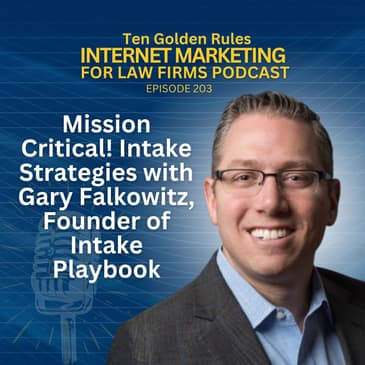
Many law firms invest heavily in marketing but overlook the intake process that ultimately determines whether leads become clients. Jay Berkowitz and Gary Falkowitz, founder of Intake Playbook and one of the legal industry's leading intake consultants, explore why intake is fundamentally a sales process built on speed, trust, empathy, and consistency. Gary explains why availability is often a firm's greatest competitive advantage, introduces his Decision in Three and Three by Three by Three frameworks, and shares how better training, persistence, and performance metrics dramatically improve conversion rates. He also discusses how AI can eliminate delays without sacrificing the client experience and reflects on the personal loss of his son, Ethan, and how that experience reinforced the importance of genuine human connection. Law firms that treat intake as a strategic business function convert more qualified leads, strengthen client relationships, and increase revenue without increasing marketing spend.
Key Topics
00:03 – Gary shares his journey from prosecutor and trial attorney to becoming one of the legal industry's leading law firm intake experts.
07:10 – Why availability is the first competitive advantage and how answering every inquiry immediately improves client conversion.
14:05 – Why intake should be treated as a sales process and how understanding consumer psychology builds trust with potential clients.
21:10 – Gary shares the personal story of losing his son Ethan and explains how that experience reshaped his perspective on relationships, empathy, and choosing legal counsel.
26:00 – The Decision in Three framework for quickly qualifying cases, setting expectations, and preventing potential clients from leaving before signing.
30:15 – The Three by Three by Three follow-up strategy using calls, texts, and emails to maximize lead conversion.
35:00 – Why immediate responses to calls, chats, and web forms matter more than ever and how AI removes delays from the intake process.
43:20 – How the Intake Performance Audit helps firms identify revenue leaks and improve operational performance.
45:45 – The essential intake KPIs every law firm should monitor, including contact rate, qualification rate, and conversion rate.
50:10 – Tune into The Golden Rapid Fire Questions
Resources Mentioned
Technology
- CaptureNow (Conversational AI Intake Platform) – https://capturenow.com
- Litify (Legal Case Management Platform) – https://www.litify.com
- SmartAdvocate (Legal Case Management Software) – https://www.smartadvocate.com
- Lead Docket (Legal Intake Software) – https://www.leaddocket.com
- Captorra (Legal Intake & Marketing Software) – https://captorra.com
Books
- The Complete Guide to Law Firm Intake – Gary Falkowitz – https://a.co/d/0740nXxl
- Outliers – Malcolm Gladwell – https://www.amazon.com/dp/0316017930
About our Guest:
Gary Falkowitz is a nationally recognized authority on law firm intake, client acquisition, and conversion strategy. He serves as CEO of Intake Conversion Experts, President of Maximum Intake Consulting, and Managing Partner of The Falkowitz Law Firm, helping attorneys across the country improve intake performance, increase signed cases, and maximize the return on their marketing investments. Through consulting, outsourced intake services, and training, Gary has worked with hundreds of law firms to build high-performing intake systems that drive measurable business growth.
Before launching his intake-focused companies, Gary served as Managing Attorney at Parker Waichman LLP, where he led initiatives to strengthen the firm's brand, improve conversion rates, expand referral relationships, and optimize marketing ROI. Today, he is widely recognized for helping law firms bridge the gap between lead generation and client acquisition by combining proven sales principles, operational excellence, and data-driven intake strategies.
About Jay Berkowitz:
Jay Berkowitz is a best-selling author and popular keynote speaker. Mr. Berkowitz managed marketing departments at: Coca-Cola, Sprint and McDonald's Restaurants, and he is the Founder and CEO of Ten Golden Rules, a digital marketing agency specialized in working with attorneys.
Mr. Berkowitz is the author of Advanced Internet Marketing for Law Firms, The Ten Golden Rules of Online Marketing and 10 Free Internet Marketing Strategies that went to #1 on Amazon. He is the host of the Ten Golden Rules of Internet Marketing Webinar and Podcast. He has been profiled by the Wall Street Journal, The Business Journals and FOX Business TV.
Mr. Berkowitz was selected for membership as a TITAN for Elite Digital Marketing Agencies, he is the recipient of a SOFIE Award for Most Effective use of Emerging Media, and a Special BERNAY’s Award.
Connect with Ten Golden Rules
Subscribe to Ten Golden Rules on YouTube
Check out our webinars on TenGoldenRules.com
Connect with Ten Golden Rules on LinkedIn
Follow Ten Golden Rules on Facebook
Connect with Jay Berkowitz on LinkedIn
Thanks for listening!
Thanks so much for listening to our podcast! If you enjoyed this episode and think that others could benefit from listening, please share it using the social media buttons on this page.
Do you have some feedback or questions about this episode? Leave a comment in the section below!
Subscribe to the podcast
If you would like to get automatic updates of new podcast episodes, you can subscribe to the podcast on Apple Podcasts or Stitcher. You can also subscribe in your favorite podcast app.
Leave us an Apple Podcast review
Ratings and reviews from our listeners are extremely valuable to us and greatly appreciated. They help our podcast rank higher on Apple Podcasts, which exposes our show to more awesome listeners like you. If you have a minute, please leave an honest review on Apple Podcasts.
So the brand plays a tremendous role on someone reaching out to you, that does not mean it just does not mean that they hired you, they're reaching out to you for an adequate level of reassurance that they did the right thing by reaching out to you. If your team doesn't provide that adequate level of reassurance and confidence, and doesn't have a roadmap, and doesn't explain what it's like to be a client at our law firm. It doesn't matter what your brand is, it just doesn't matter. Yeah, you'll sign a bunch, don't get me wrong, but you're going to lose a bunch. You're going to lose a lot of law firms. There are a lot of cases that are won by Joe Schmo in his mother's basement, because Joe Schmo had a wonderful conversation with this potential client, and trust was built. So, I don't want you or anybody else to think that small, that smaller case, you get called, you're gonna win. It's not like that. It's not like that. The odds might be in your favor, but you better
Gary Falkowitz:check a lot, about two dozen other boxes.
Speaker:Welcome to the 10 golden rules of internet marketing for law firms podcast, featuring the latest strategies and techniques to drive traffic to your website and convert that traffic into clients. Now here's the founder and CEO of 10 Golden Rules, Jay Berkowitz.
Jay Berkowitz:Welcome, everyone, and good morning, good afternoon, good evening. This is the 10 Golden Rules internet marketing for law firms podcast. Great guest today. We'll get to Gary in two seconds. If you're a regular, you know, I do one short commercial at the start of these podcasts, and today I'm just going to talk a little bit about LFG, the law firm growth mastermind. We launched it at our Tingleton Rules Growth Strategies conference, and Chris Keller and myself have started a mastermind. Now, if you haven't been in a mastermind, and if you're not currently in a mastermind, you're missing out. I'm in a great mastermind with other agency owners, and it's one of the smartest rooms I've ever been in. Some of these guys are doing unbelievable things, they're ahead of the game on AI. We decide which software we're going to use, because nine of 10 of the people in the room are using software, and masterminds are an incredibly powerful way to save you time, get you to
Jay Berkowitz:the right answers on things, and you've got a virtual boardroom of 15 people, law firm owners at your same level, who are going to help you answer the questions in your business and hold you accountable to get the results you need. In addition, Chris Keller and myself, Chris recently sold his law firm, and he built a very successful law firm with 80 employees. So, you've got the advantage of myself helping you with marketing and business strategy, Chris helping you run the law firm. So, if you're interested, just drop me a note, Jay at 10 Golden rules.com Can find me at 10 Golden Rules, or I'm Jay Berkowitz on all the subjects. So, without further ado, I want to welcome a friend and long time we've probably known each other for 10 years and hang out at conferences and are currently working together with clients, and Gary Falkowitz is easily one of the best known and most respected experts on law firm intake. What is intake? Hopefully you know and curate your intake
Jay Berkowitz:system, but intake is basically how you answer the phone, how you manage incoming calls, chats, and form fills, and how you follow up with folks and convert them to clients. And it's basically a sales job. You can't just answer the phone with a receptionist anymore. It's super competitive, and you've got to track your numbers, so Gary's going to get into all of that. Gary Falkowitz, welcome to the 10 Golden Rules Internet Marketing for Law Firms podcast.
Gary Falkowitz:Thank you, Jay, and thanks for having me here. Excited to once again talk business with you, and show your audience and my audience how we could all do a better job through intake. Thanks for having me, buddy.
Jay Berkowitz:Yeah, you're right. It's welcome back. It's Gary's been here at least once, then maybe twice. So, Gary, I always like to start with your journey, since you did it before. You can give us the quick version, but where did you start out in business, and how did you become one of the world's leading intake professional experts.
Gary Falkowitz:Thank you. Very too kind. I can talk about it, obviously, for a while. So I'm going to fast forward through being an assistant district attorney prosecutor in Brooklyn, New York, then fast forward through being a medical malpractice defense attorney and jump right into getting hired at a national personal injury law firm in New York, Parker Wakeman. I got hired there as a personal injury attorney to represent folks who were injured by the fault of another, but what I realized almost immediately. Which I had not known prior to being hired was that this is a business, and I didn't know up until this moment it wasn't clear to me that I was going to embark on a path that was going to be focused on how to run a business. I was a lawyer, and I loved speaking with my clients. I loved helping, but once I realized that it was a competitive business that required patience, that required a gamble, that required systems, and that required people to all be pulling in the same
Gary Falkowitz:direction, it intrigued the heck out. I actually, within a few weeks of being hired, I went to my boss, and I said, Jerry, Jerry Parker. I said, yeah, we love Jerry,
Jay Berkowitz:by the way, longtime friend of 10 golden rules, and
Gary Falkowitz:Jerry's the best, and I wouldn't be where I am today without him, and he knows that. But I said, Jerry, I love, I'd love to get involved in the front end side of the business, and he sort of gave me one of those looks, and said to me, "That's really nice, you, Gary. Appreciate you sharing that with me. Now, please go back to your office and do what I paid you to do. And I remember I literally still have the document that I created that I wanted to memorize when I was going to meet with him to ask for this front end. I didn't know what it was. I wasn't necessarily referring to intake, it was just front of the business to learn business,
Jay Berkowitz:right? Yeah, that's
Gary Falkowitz:it. Lo and behold, about a year and a half or so later, an opportunity presented itself, or they presented it to me, to become the managing attorney of the intake department, this national PI practice. To say that I dove in would be an understatement. I immediately sat behind the intake staff to hear what they were saying, to look at the scripting that they were using to learn every little nuance that they had, and how I was learning what the marketing was like, who our referral relationships were with, you know, what our follow-up cadence was, what our scripting was, and I fell in love with the process. I think I fell in love with the idea that I could improve upon the process, but I also fell in love with the fact that I think we became sort of the leading firm at intake, and when I realized that the rest of the industry was sort of improvising, and yet still making money, and still successful, depending upon how they define success, but I assume it's based
Gary Falkowitz:upon profit, they were still very profitable, but they were leaving a lot of money on the table, I decided at that point I was going to bet on myself, and I was going to help our industry one way or another at intake. Then I could, I'll quickly go through how I wrote my own book, The Complete Guide to Law Firm Intake. I began consulting with law firms, I've consulted with hundreds of law firms nationwide opened up a call center called Intake Conversion Experts that was acquired, then opened up a company called Capture Now, which is still in existence. Then started my own audit company, I mean, you name it, and I'm involved in intake all day, every day for law firms, and that's my story in a nutshell.
Jay Berkowitz:That's awesome. So, for beginners, people who still have the receptionist answering the phone, and they're making some of the obvious mistakes, like, you know, she goes to the restroom and they miss phone calls and things like that. Why don't you give us the sort of beginner's guide? What are two or three things that every law firm should start out to professionalize their intake?
Gary Falkowitz:Let's start at the basic premise here, which is, if you are a plaintiff's law firm, you are not the only game in town, right? You are competing, you're competing with more law firms than you can name, you're competing with more law firms than you can imagine. You obviously decided to invest resources, likely financial resources, into generating leads for your firm. So, here we are. Two basic premises: one is you're competing, two is you invested. So, if you're going to compete and you're going to invest, you now need to make sure that every single person that reaches out to your firm speaks when somebody is able to share their story, because the moment that they realize that this firm or your firm doesn't have the resources to at least hear their story, you lose, right? Forget, I don't care about the type of lawyer you are, I don't care what law school you went to. I don't care about your GPA or your LSATs. I don't care about the bar exam. I don't care how many
Gary Falkowitz:people you have working at your law firm. What I care as a claimant, as a victim, and I happen to be one, by the way, which we'll talk about, I'm sure, at some point. What I care is, are you available when I want you? Are you available when I want to share my story? Because if you're not, I just move on. So, regardless of the size, whether you're a solo practitioner, whether you're one of the biggest law firms in the country, you need to be able to answer the question, are we available, and if we're not, how do we make ourselves available the second, not the minute, not the hour? So this second that the potential client wants us to be available, and that answer, you know, I can't give it to you in 10 seconds, right, because it has to do with technology, it has to do with people, it has to do with whether you have the right integrations in place, but I think availability is number one.
Jay Berkowitz:That's interesting. I haven't heard it phrased that way, but it makes a lot of sense, the human side of it, and just the instinct side, because most people, when they first deal with a law firm, and, like, you have been, I guess, at least in three accidents, all rear ends, and when you first get into this, do I need a lawyer, there's a lot of bad press out there about lawyers, so you're not sure until you get into it. Then you realize you need a lawyer, because the insurance company is not your friend. I always like to say nationwide, it's not on your side.
Gary Falkowitz:Yeah,
Jay Berkowitz:and you figure that out pretty quickly once you get in an accident, but the consumer doesn't - they don't know all of the things we know about the law firms. What you said was, are you available to help me? And the first thing is just listen. I like that. That's a slight insight that, yeah, I'll just have to, you have to answer the phone and quickly and listen to them, and that's 99% of it. It's certainly a large portion of it. It's a large portion of it, you know. We can get into the relationship aspect and to the responses to questions or
Gary Falkowitz:hurdles or objections, but I think we also have to understand, and you just sort of hinted at it, we have to understand the psychology of the consumer, you know. Use the word consumer before I said potential client, and you also used the word sales before. Let's all get comfortable right now, this minute. Let's get comfortable with the idea that anyone that reaches out to your law firm is a consumer, and now what you do is sales. You got to get comfortable with that. I remember I was not. I will admittedly tell you that I tried really hard to stay away from using the word sales when it came to intake, because I thought sales was when you were selling a product, not necessarily a service, a legal service, when someone was injured, and it took me a while, and then when I finally turned the corner, I never looked back. This is absolutely sales. It's a different type of sales. It's the sales on another level, but it is absolutely sales. And when you think about the
Gary Falkowitz:psychology of the consumer or potential client, I want you to understand that there is not a default level of trust that the consumer has with a law firm or with a lawyer, we don't have a great reputation. Our industry does not have a great reputation. They think we're only in it for the money. They know that, unfortunately, a lot of law firms don't return phone calls, and most people that they speak with did not have a good experience with a lawyer. So now we're going up against those beliefs from consumers, and it might justify, or at least explain why some consumers will call you at the scene of the accident, because they maybe have been a client of yours in the past, or their friend, or cousin, or family member was now they that, and that trust is really high, or they call you nine months after the accident, because it took them that long to be convinced that either A, they couldn't do it themselves, or B, there's this one lawyer that they just had to call, and they had to
Gary Falkowitz:gain the courage and confidence to do so, and regardless of the timing of when they call, I want you all, you all, you law firms to understand that just because it took them nine months doesn't mean that you're the firm they're going to choose, you're one of the options, that's the assumption we need to make, that we are one of the options, and if we ever take the position of entitlement, oh, why you called, I could put you on hold, or you can leave a voicemail and I'll call you back, or I'm not sure, you know, we can help you or not, so I'll have to think about it and review that those are all entitlement perspectives, there is zero room for that approach at intake and legal, and so when we understand that, we then understand going full circle that when the claimant does call, we need to be available at that moment, because hit
Jay Berkowitz:a few things there that I think are interesting. One thing is you said you might not be the only option. Have you ever tried to quantify what percentage of folks shop their case and what percentage of folks take the first person who is available, and does that differ by the size of the case?
Gary Falkowitz:You asked two different questions. Let me explain to you how they're different, I. I'm not going to give you specific numbers, it's not fair of me, and people make up numbers way too often, but the overwhelming majority, overwhelming majority of potential claimants will hire the first law firm that they have a conversation with. Overwhelming majority, you wanted to put a number out there. Sure, 80% I will also go with this. The overwhelming majority are going to reach out to multiple law firms again. Want to put a number out there? Go right ahead, 75 80% I've listened to 1000s and 1000s of phone calls, I've reviewed probably 10s of 1000s of intakes. I know the ones that are admitting that outright admit you're the second or third or fourth law firm I spoke with, or I already have a lawyer, I'm not happy with them, I'm looking for a second opinion, or I haven't got someone alive. There's so many I just admit. And then there are ones that you could read through the,
Gary Falkowitz:the tea leaves, read the tea leaves, and go, yeah, they're definitely shocked, just based upon the excuse that they give. So, let's, let's all understand that the one that has the first conversation. All else being equal, by the way, if your conversation stinks, you're not signing that claimant. If your conversation isn't decisive, you're not signing that claiming. If your conversation doesn't include confidence or not building a relationship, you're not signing that claiming. But all else being equal, if you are confident and you can build a relationship, dot, then you are decisive and you are reassuring. Dot, and you have the first conversation, you will win the overwhelming majority of the time. But to answer your other question, you better assume to win, you better assume that claimant is calling multiple law firms. I like to use this analogy. I think you'll like it, Jack. If I asked you, and now we're both probably not in the best shapes of our lives, but if I asked you
Gary Falkowitz:right now to run around the track as fast as you can, and maybe I time you, and it's 45 seconds, and now I asked you to race somebody who is about your speed, and now run around the track while you're competing against somebody you and I both know you're going to run faster when you're competing with somebody, which is why I want everybody out there, tell your intake specialists, starting from the top. If you're an owner, we are competing. We are competing. We don't get to jog around the track and say it was our fastest lap. We are competing, and if we are in our using our A game, we're going to lose, no matter what your name is, Morgan and Morgan, or Falkowicz Law Firm, or anybody in between, or below, or above. It doesn't matter, you will lose.
Jay Berkowitz:By the way, just for clarification, you wouldn't want to put me in that race. However, I'm a tennis player. If you hit a drop shot and the points on the line, I'll probably get to the ball one way or another. I have a little bit of speed for about seven feet. You're
Gary Falkowitz:looking to, you're talking to a college tennis player, that's exactly right. If you told me to sprint from the baseline to the net, and now in the point someone had a drop shot that just went over to the net, and I have to go get it on one bounce, you're damn right I'm going to get there faster to get my racket under that wall. Tell that's
Jay Berkowitz:about the only time I run, so just to go deeper on that question, because it's something that really intrigues me. You know, I've always operated under a slightly different assumption than the answer you gave, is you know what percentage of people shop, and I guess I have two assumptions, like one is if I just get bumped in some little fender bender, and you know, I talk to the insurance company, and they're not - they don't seem like they're playing ball, and there's some injuries. I'm probably going to have to go to the chiropractor. I'm definitely just going to probably go with the first guy I talked to, but I've always been under the assumption, heard this conversation with several attorneys, if it's a death case and family member, you deal with the funeral and everything else, and then you have some time to go meet with a couple attorneys. So, the simplest case, you're going to hire the first one. If it's a more complex case, and obviously there's not the
Jay Berkowitz:urgency of time, you will shop around. Is that too simplified,
Gary Falkowitz:or so you hit on a couple things. The one's very emotional, and I'll get to that in a moment, and the other is more superficial. So, let's start with the simple car accident case. That's where your brand comes into play. Most marketing pieces out there are marketing to the masses, they're marketing to the rear end collision. I understand that they talk about the result being $4.6 million I get it,
Jay Berkowitz:yeah,
Gary Falkowitz:but they're really marketing to the folks that have smaller injuries, which is why you're bringing
Jay Berkowitz:more volume of smaller, more
Gary Falkowitz:volume. Right, so the brand plays a tremendous role on someone reaching out to you. It just does not mean that they hired you. They're reaching out to you for an adequate level of reassurance that they did the right thing by reaching out to you. And if your team remember, I've listened to a lot of calls, if your team doesn't provide that adequate level of reassurance and confidence, and doesn't have a roadmap, and doesn't explain what it's like to be a client at our law firm. It doesn't matter what your brand is, it just doesn't matter. Yeah, you'll sign a bunch, don't get me wrong, but you're going to lose a bunch, you're gonna lose a lot of law firms. There are a lot of cases that are won by Joe Schmo in his mother's basement, because Joe Schmo had a wonderful conversation with this potential client, and trust was built. So, I don't want you or anybody else to think that smaller case, you get called, you're going to win. It's not like that. It's
Gary Falkowitz:not like that. The odds might be in your favor, but you better check a lot about two dozen other boxes. You also brought something else up. Many people know my story. My life changed, turned upside down just over three years ago, may 3, 2023 My oldest son, Ethan, as an eighth grader, just won a big tennis match for the varsity high school varsity tennis team, he was playing as an eighth grader, that's how good he was. Tremendous young man. After they won, they went out to celebrate at Buffalo Wild Wings, and on their way home, another driver driving in the wrong direction, 95 miles an hour, with alcohol and drugs in the system, hit my son's car. He was in the back, he was in the passenger back seat.
Jay Berkowitz:Sorry, sorry again. We've talked about this.
Gary Falkowitz:Thank you, thank
Jay Berkowitz:you for sharing your story.
Gary Falkowitz:My son was killed, and another boy also in that car was killed. I'm still hoping to wake up from that day and share with everybody this terrible nightmare I had, but until that happens, I'll just share what a tremendous young man Ethan was and is. But the reason I bring him up is because I then, too, needed a lawyer. I know all the lawyers in our industry, I know many, many lawyers, yeah, many of the best lawyers throughout the country, in my town, in my state, and I reached out to a handful of them. I even had a law firm come to my house, a very well-known law firm, come to my house with two partners dressed in a suit, suit briefcases.
Jay Berkowitz:Yeah,
Unknown:spent an hour. They never followed up. The lawyer that I ended up hiring was a lawyer I hadn't known before, but he did little things that made me feel less like a number and more like I was going to become family, and that was the difference, and I bring that up because I spoke with multiple law firms, five six law firms, and I'm an educated consumer.
Jay Berkowitz:Were you shopping for the legal expertise at a very high level?
Gary Falkowitz:I was looking at expertise, experience, it was really important to me that there was going to be a personal relationship created. I did not want a business relationship. This was more about what the end goal. I knew there were major challenges. The law was not in our favor, still isn't all that other stuff, but I was looking for to create a relationship, and you
Jay Berkowitz:wanted someone to take care of your family,
Gary Falkowitz:absolutely,
Jay Berkowitz:in addition to doing the legal work.
Gary Falkowitz:Yeah, that's right. And I did not want to be the lawyer on the case. I am a personal injury lawyer. I have gone to court. I did not want to be the lawyer. You
Jay Berkowitz:had other things on your activity list that, yeah,
Gary Falkowitz:so I bring that up, obviously, for many reasons. One, because I always bring Ethan up, but two, because don't fall into the trap, big case, small case, do not fall into the trap that because somebody called you, you won. You still have to have that conversation and convey what that caller needs to be conveyed to them, and it's different for each caller, just like you asked me about what it will, what it was for me. For some people may have nothing to do with a personal relationship, for some people might very well be just what your attorney's fee is, or how much money can I expect, you know, how long this is going to take, or do you know, have you have any experience with a side swipe at this corner in this neighborhood? So, you need to figure out on that, is that this is sales 101 You need to figure out what your caller is looking for and give it to them. That's the goal in every call, and that's why it's so important. You can't just hire someone off the street or
Gary Falkowitz:teach them one or two things and tell. Them, your qualification criteria, and tell them, here's the script, and say, have at it, good luck, it doesn't work that way. So they need to be trained in what to hear, for how to listen, and how to respond.
Jay Berkowitz:So we talked a little bit about time, but there's the example of the person whose car is damaged, and they need their car to get to work, and the insurance company is humming and hawing, and they have a time urgency. How does the firm determine what is the decision criteria? And it's a much more sophisticated decision, obviously, in your case.
Gary Falkowitz:So one of my Gary isms is decision in three, we need to be able to convey whether we want to represent somebody within three minutes of speaking with them, within three minutes, that is not difficult. You know, what are the calls I'm listening to these days? It takes us four minutes just to get the contact information we're looking for, because we're looking for their Aunt Sally's address when she was six years old. That's not important at the beginning of the phone call. We've got to make a decision within three minutes. That doesn't have to get the case signed within three minutes, but we gotta let the caller know why, because there's a call I listened to just recently where someone called on their lunch break, and by the ninth minute the caller said, I have to get back to my office. I'll call you guys back later. And it was a perfect case, right? It was your rear end, clear injury, clear liability, and she hung up. I promise you, I bet you everything I have that had
Gary Falkowitz:the intake specialist said within three minutes. By the way, mrs. Johnson, based on what you just told me, this is exactly a type of case we can help you out with. What I'm going to do is ask you a few more questions at the end of this call. I'm gonna get you signed up, so we can begin working on your case right now. Had she said something like that at the three minute mark, I promise you, mrs. Robinson, or whatever her name is, would have told herself, you know what, I'll be late to the office, let me finish this call, let me get signed up, so it's one less thing I have to worry about. We do not get to play the game of just asking questions and not telling someone whether we can help for 15 or 20 minutes, and that's what's happening in our world. So I answered your question partly because you have to make the decision within three minutes, but in terms of when you, when you need to get that case signed, just don't quit too soon, be aggressive, it might take two months. It might
Gary Falkowitz:take two months. I'd rather a claimant tell me, mr. Falkwoods, please stop calling, then me tell my intake specialist, you know what, you've tried enough, stop calling. No way, no way. The way to win in our industry is to be fast and to be persistent. If you can check those two boxes, you're going to win so much more than everyone else. Fast and persistent,
Jay Berkowitz:what percentage of the calls are signed on the first call, and what percentage do you have to be persistent and follow up with the person?
Gary Falkowitz:Yeah, the best law firms right now are signing qualified leads on the first call at a rate of about 70 to 80, 70% Okay, it's pretty high. Okay, that means you got to be persistent with the other, you know, 20 to 30% I would also tell you that percent of your qualified leads are going to take more than two weeks of follow up, 10% of your qualified leads are going to take more than two weeks of follow up, what that means though is that 90% of your qualified leads should be signed within two weeks, for the best firms, they'll be fine. They'll be signed within one week. What's my point? Don't ever say we tried for three days, we didn't get it signed. Let's quit. That's my point.
Jay Berkowitz:And those 10 to 20% of folks who don't sign, they're first of all, a lot of times, you know, and I've listened to not 1000s of calls, but hundreds of calls. Lots of times, someone is calling for a family member. One of our best cases, the niece called for her aunt, whose husband fell off a scaffold five stories and survived a multi million dollar case. And I always tell people, like the niece was calling for information, actually was a chat, so she wasn't going to call the firm, wasn't her case, wasn't going to fill out a form, never give me her email, and it was a chat, and thank goodness they, we converted that one. So I guess my question, it's two-part question. Part one is that last 10 to 20% what's the protocol? How do you follow up? I've heard about the 321 and there's a lot of different ways. What's the best approach?
Gary Falkowitz:So one of my approaches I like to share with a lot of law firms, it's three by three by three, which is three methods of contact, so that's email, phone call, and text message three times each for each of the first three days, minimum. A minimum, three calls for each of the first three days doesn't mean you get the call lead comes in at 915 okay? You call it 916 918 921 doesn't work that way, that's actually one call right there. If you're calling within 15 to 30 minutes multiple times, I count that as one phone call, meaning from a three by three by three perspective, but I want you to, I want to give you just a great example, you get a phone call from a local number that doesn't look familiar, you ignore it, you get a call again from the same number right away, you pick it up
Jay Berkowitz:more often than not,
Gary Falkowitz:more often than not. Why? Because now you think it might be important. I think it might be someone in my kid's school. I can't ignore that. What if it's about one of my kids or my family or my parents? Who may someone needs me? It's local and someone is obviously thinks it's important. It's not coming up as spam on the phone, right? That's why we call two, three times in a row right away. That's why we do that.
Jay Berkowitz:Do you also believe in call, text, call, like a lot of firms are talking about? I call, they don't recognize my number, I text them. This is Gary from the Fall Quits Law Firm. I'm responding from your note on our website. I'm going to call you again, you know. Please pick up.
Gary Falkowitz:Absolutely. I also believe in sharing your contact card, so they could save it in their phone, and then they know you call every time you call it, but you also have to understand your TA, the people that are reaching out to you, a lot of them are working. They took a taxi or a cab because their car is broken down, and they have to go to the office because they don't want to get fired, right? So, why you call at nine, at 1230 and at 630 because you're trying to catch them either on the way to work or at lunch or when they're home. Why do you call the weekends? Because they're not working on the weekends. This is what it takes to win in our industry, and that's my three by three by three. The other thing I would say is you should never turn down a lead for non responsiveness without at least trying for 10 different days, 10 days, you got to do it, otherwise you're leaving money on the table. It's not an aberration. It's not so crazy to think that someone is
Gary Falkowitz:having a really tough week and can't speak with you right now. It's not crazy to think that. So, why would we be crazy to say, well, they're obviously not interested. That's a silly assumption, and a costly assumption to make. If you're getting into this industry, let's go full circle here. If you're getting into this industry, there's a good chance you're a lawyer first and a business owner second. I don't know many business owners first that became lawyers second, which means that we're all learning on the fly, which means that we have to understand the sales aspect of our business. It is a business. Your law firm is a business, granted you might kick butt at maximizing the value of your retained cases, and that's awesome, and that's part of winning. Totally get it, but you also have to maximize your retention rate, your conversion rate, your qualification rate, your contact rate, things of that nature to ensure you put yourself in a position of maximizing revenue,
Jay Berkowitz:let's talk a little bit about calls, chats, forms, and Texas, which is a slightly different version of chats for some consumers. First of all, what percentage of leads come from calls, forms, chats?
Gary Falkowitz:You know, it's such a.. I hate to be the lawyer in the conversation here, and say it depends, but it really does depend on the type of law firm, and how much marketing they've done, and how the public knows of them, right? So, I'm not.. I'm gonna let you answer that question, that's your expertise, but I will say this.. I will say this for all of us, for many, many, many, many, many of us, our attention span, given where we are technologically, is minimal and limited, and we change what we're interested in doing. We change our activities very quickly. We change our interest throughout the day. We change what we did five minutes ago to what we're doing now. They're completely different things, and it's a new world. It's a new world, because the options in front of us and the distractions in front of us have never been seen before. So, having said all that, it means that there's this requirement that when somebody reaches out digitally to us, that we respond to media.
Gary Falkowitz:I remember all these stats out there. Oh, if you respond to a web lead within five minutes, you're 15 times more likely to convert that web lead. Five minutes, five minutes is like another year. You, that's enough. I may have forgotten what I did five minutes ago. So, when you call, I may not even know why you're calling. We gotta look at things within seconds, and I'm not exaggerating. It's actually one of the reasons after our call center was acquired, my business partners and I are like, "What's the future here? It's right before AI. What's the future here? We said, "Well, we need to think automation is the future. We think that there's got to be, we got to remove the delay, we got to remove the ring time, we got to remove this whole someone getting back to a claimant when they have the resources or availability to do so, kind of, that's that doesn't work that way anymore. So we created capture now, right? And then we use AI and conversational AI to ensure that every time
Gary Falkowitz:somebody calls, whether it's nights overflowing, weekends for many of our clients, or primary for some of our clients, or every time somebody submits a web lead, there's no more delay. An immediate call is made to that claimant within seconds, so that they remember. Oh, wow, first of all, you get credit, right? The claimant goes, 'That was fast, awesome. And now they have this conversation where you're available, and they get to share their story. Same thing goes when someone calls Jay. I don't know about you. How many times have you tried to make a dinner reservation, and it rang four times, and you hung up because you said, "I'm not going to wait. There are other Italian restaurants that I would go to. This is not the only one in town, so if you're not available to pick up my call, I'll just go somewhere else. Don't think that law firms are any different if they're not available to pick up their calls, they'll just go somewhere else. And that sort of answer your question, you know,
Gary Falkowitz:we're talking seconds. The more you can remove the delay, whether it's rank time delay, whether it's call back delay, or any other friction type of delay that you have in your firm, the better you will perform at intake, and obviously as a business owner.
Jay Berkowitz:Capture now is an AI phone answering, it's an AI human sounding system, right?
Gary Falkowitz:Yep, it is.
Jay Berkowitz:It'll pick up the call if you miss the call after you can set the number of rings, right.
Gary Falkowitz:Absolutely, well, it picks up, and it also does get them forward the call to capture now, either as an overflow call, because your team aren't available for three rings, now goes to capture now, and capture now picks up in the first ring every time, or for nights and weekends, you can have just capture now pick up on the first ring, that's what you want, right, that's what you want, and that's why, then we also have the outbound capabilities, where if a law firm gets web leads or chats, now you can even say, 'call me now and capture now calls right now. There's no more delay anymore. There's no more, 'Oh, I call you reached out to us 15 minutes ago. No, no, that's you're too late on that one. We don't have this
Jay Berkowitz:capture now. Identify that it's an AI.
Gary Falkowitz:If the law firm wants us to, yeah, we can. That's it.
Jay Berkowitz:Can have a name, or it can just have a
Gary Falkowitz:name. It's a virtual assistant, your
Jay Berkowitz:automated agent. And
Gary Falkowitz:absolutely, yes.
Jay Berkowitz:And I think you know it's probably still a little bit foreign to a lot of people, but it's becoming more and more common, and we're, we're all getting more and more comfortable with, you know, certainly over the last four or five years, we've become more comfortable with chat. It's mostly because it works, right? Like I always explain to people, like four or five years ago, when you asked a chat question, they gave you a link to the same page you were on, and it was really frustrating if they answered at all. And now chats are typically very reliable and responsible, whether you're dealing with an e-commerce site or a law firm, the chat generally gets you an answer that makes sense really, really quickly, sometimes better than the human,
Gary Falkowitz:which, by the way, is why Caption Now also has chat, because some of the chat companies out there are still charging the same number they were charging five years ago, yet they have 1/10 of the resources, so explain that, but that's neither here nor there, so basically
Jay Berkowitz:AI scripted all the logical things,
Gary Falkowitz:correct?
Jay Berkowitz:Can you handle my case? Can I speak to an attorney? All of those things can be done with a voice agent or a chat agent. That's great,
Gary Falkowitz:or right, or transfer into a phone call. That's exactly right.
Jay Berkowitz:And calls back instantly when there's
Gary Falkowitz:informant. Yep, form fill.
Jay Berkowitz:That's awesome. Yep,
Gary Falkowitz:Jay, something you touched. touched upon, and I just want to bring it up, because it's everybody gets nervous about AI, and I don't know how much I should rely on AI. I think from this perspective, no, I'm not going to talk about as an AI expert, that's not fair, but from an intake AI perspective, what the world is seeing is that we have less patience for, if you want to call it inefficiencies, or inadequacies, or a wasting time. We have less patience for that. And what AI is doing, at least from a caption now perspective, it is making everything much more efficient, much more transparent. There's no more.. hold on one second. I just got to get the door. Or, oh, there's loud noise in the background over here. Let me shut the window. You know, all this stuff that's just wasting time and then frustrating the caller, asking someone to repeat themselves six times, or not listening. What was your name again? All that's gone. It's out the window. It should not be
Gary Falkowitz:accepted. People anymore for what we do as an industry, and that's why. Listen, I would love to say, as people, we're, you know, we're better on the phones than AI. Listen, some people are wonderful. There are some amazing intake specialists out there. I love them. You know, I'm very proud of how I could talk on the phone, but from a business standpoint, if I could remove conversation time with wasted conversation, ring time with the inability to create a connection or listen well. I'm removing all these frustration points in a conversation. Why wouldn't I do that at a less expensive rate, at a more transparent and reliable with a more transparent, reliable process? Why wouldn't I do that? It makes all the sense in the world, not just an intake and other things as well.
Jay Berkowitz:So, let's talk about some quick tips, like if you're a newer firm, maybe you left a firm and you started your own PI shop, and you're one or two years into it, and you haven't really done any intake, you haven't studied intake. What's one or two of the basic things a small firm with a small traffic phone system should do.
Gary Falkowitz:Listen, whether it's Caption Now or another conversational AI solution, that's got to be something you're considering. I would be overwhelmed trying to hire somebody. What the cost of that would be, what the training would look like, what mistakes they might make that would scare the crap out of me. So, if I had this turn switch opportunity to, I'm probably saying that wrong, to just sort of plug in my response to both web leads and phone calls, that's a no brainer. That's a no brainer that just makes your path to your goals, so much more linear and so much more predictable. So that's number one.
Jay Berkowitz:So, if you're a big firm, you're Jerry Parker, you're Rob Levine, you're an intake expert. What are some of the advanced tips that they should be looking at?
Gary Falkowitz:So, something that I've been, that's been on my mind for years, that I'm finally able to create with the technology available to me is, I call it the intake performance on it, the IPA, and what I do is it's akin to all the consulting I've done over the years, and I subscribe to a report in your CRM, and I have an integration of multiple CRM, solidify smart advocate, lead docket, captor, and I get, you know, hundreds of data points, I bring them into my methodologies, right, in my systemized framework, and then I give you a weekly audit that looks back at all the leads that were created in the last 30 days and tells you where all of your leaks are, where all the reasons that you might be losing cases, may have lost cases, may have rejected cases for the wrong reasons, or leads for the wrong reasons. It's my way of proactively helping many, many law firms rather than going one law firm at a time. So, beyond excited about something like that, I think in any business, if
Gary Falkowitz:you don't have an automated audit that you're using to ensure that things are healthy, or to catch when something might be lost, then you're likely leaving a lot of money at the table. So that's something that some of these larger law firms, many of them on my clients, are signing up to. And when you get the audio, you also have access to my master class. I mean, that's a whole other.. we can talk about that for another hour one day, but I think that as you get larger, you need to have systems in place, alarms in place to let you know where the leaks are. Otherwise, you're gonna leave a lot of money at the table.
Jay Berkowitz:We'll have links in the show notes if you want to check out Gary's master class or learn about capture. Now, one of the key things that we spend time on, a 10 golden rules, and I know you do too, is the numbers the data, and we give the law firms a download of all their phone calls, all their chats, all their form fills, and they give us feedback on who signed on as clients, and we go through the data very detailed with the team every month in our performance meeting. What are the key data points that people should be tracking in intake, and first of all, Jay, let me tell you, I have spoken with a number of law firms that love what you're doing with Tang Golden Rule, so keep doing what you're doing, it's making a tremendous difference in terms of the data points we're talking like necessary KPIs, key performance indicators that law firms, even I work with, need to know. So, number one, they know the contact rate, the successful contact rate. What percentage of leads
Gary Falkowitz:that they received are they successfully having a conversation with? Are they successful at getting in contact with that claim? You got to know that, because if the then, by the way, the benchmark should be greater than 95% but you have to know that, because it might tell you a lot about your marketing, it might tell you a lot about your intake and their prowess and their response time. They got to know their want rate, whether I like that, that's either want or qualification, they're synonymous, right. So, what percentage of your leads are meeting the criteria? You have for retention, not assigning or meeting the criteria for retention. Now, there's so many other factors that go into this, because you want to assume that your team has the authority to make that decision, but your team has the authority to say this person qualifies, as opposed to a law firm that says, "Oh, thanks for sharing, let me get back to you. That's a problem. So, your qualification rate.. I'm
Gary Falkowitz:not going to tell you what it should be. I could tell you that I've worked with law firms where the qualification rate is as high as 50% which is incredibly high, right? It tells you that the marketing is working. It also tells you that as a firm they're willing to sign, then investigate, and they're willing to tell a claimant that they signed. Hey, I'm sorry. Unfortunately, we got the police reports on really something we can help you out with. So, the attrition rate is higher when the qualification rate is high. I've also worked with law firms where the qualification rate is low as 5% For them, it's fine. For me, it would give me a lot of anxiety, because I would think I'm leaving a lot of money on the table. It's such a low qualification rate that maybe that means that their criteria is way too strict, right? But then that begs the question of whether they're referring out the other 15 or 20% of their leads that may have real value, right? So you got your, your successful
Gary Falkowitz:contact rate, you got your qualification rate, then of course you have your conversion rate, something I'm very proud of teaching many, many law firms. Is what percent of the leads that you qualify, and by the way, that also needs to be synonymous with sending an agreement out. There's no such thing as qualifying a lead and not sending an agreement out. The moment you qualify it, in that same conversation, the agreement goes out. So, what percent of those leads, those qualified leads, then you ultimately sign your numbers should be greater than 90% If you were greater than 95% you're in the top 1% of the industry. Okay, 90% is the minimal benchmark. Under 90% you're leaving way too much money on the table. Why? Why? Because these people reached out to you, every single person reached out to you, which means that we must have done something wrong. We couldn't sign them. Were we too slow? Were we not reassuring enough? Did we not create a strong enough relationship? Did we not
Gary Falkowitz:answer their questions well enough? We failed somewhere if we wanted someone who reached out to us and didn't sign them. That's our fault, and I think it's really important as a business owner, as a manager, to look in the mirror a lot and say, what could we have done better? You know, it's one of the reasons why I created the intake performance audit, right? It kind of gives you your reflection on how things are going. I think it's important we know that we got to know where we fail.
Jay Berkowitz:No, that's a great thing, and I recommend hiring Gary, because a few of our clients have had some real revelations, and I'm talking about folks who we've worked with them on their intake, they've had other intake professionals, and it's really valuable to get that second set of eyes, and Gary really drills down on the numbers. We do audits for a lot of firms who have their own digital agency partners, and they bring us in, and it's a second set of eyes, like here's some things that you're missing in SEO, here's some things, some backlinks that you guys should have, that your competitors have, here's some obvious things in your pay per click setup that you guys could fix, here's what's not right and not is right about your local service ad setup, so bringing in an expert to give you that extra set of eyes is highly recommended.
Gary Falkowitz:Absolutely,
Jay Berkowitz:Gary, we're at that time where I ask you the quick one liners. This is the easy part for you. You just give us quick answers. I'm a productivity expert and a personal development student. What's your personal productivity tips, hacks, or apps that you use to stay efficient,
Gary Falkowitz:I create a checklist every single day, and it's important that I check the boxes that need to be completed. That's my first productivity hack. My second one is
Jay Berkowitz:this digital or paper is the actual box. Yes,
Gary Falkowitz:that I have a book in front of me right here, and I am writing things down all day long, every day, and at the end, what I do is, at the end of every day, I will look back at the four or five or six pages of notes I took throughout the day and remind myself of what I have to come back to, or what the to do item is. So, I'm a big to-do list individual. I think it helps both personally and professionally. Think it's also great for relationships. So, that's one hack that I use another one is I always make time in my calendar at least once a week, and not one of them, not once a day, but once a week to go through open items that I haven't yet been able to bring to fruition. So, to me, especially in this day and age, we're juggling, I'm juggling, I have multiple businesses, and I'm going through a lot, you know, personally, obviously I'm doing, and I'm biting off more than I could chew, no doubt about it. So, I'm trying to keep a lot of balls in the air, also
Gary Falkowitz:trying to be a great dad and a great husband. And I realized about myself that if it's all just up here, I'm going to lose a lot of balls, a lot of balls going to fall on the ground. So, I need to have as much help as I can, as I can, from a from. There's emails or a calendar time or making checklists for myself keeps things important for me.
Jay Berkowitz:That's great. What's your personal wellness or fitness routine?
Gary Falkowitz:Listen, I play tennis a couple times a week. I've been working out, going to the gym with a trainer two or three times a week. I think it's.. I'm not the healthiest eater, but I do feel it's really important to feel healthy, right. However, you define healthy, I really feel badly about myself if I don't get any exercise in over two or three days. So, I need to make sure that I'm out. I play softball once a week, so it keeps me young, keeps me hungry, you know, fit, you know, hungry in terms of wanting to be in good shape or good enough shape, and I enjoy it, so it's a nice reprieve. One
Jay Berkowitz:of my clients always thanks me. He says, "Yeah, I always get great leads, great cases Sunday morning after my softball game. I said, "John, why do you get, why are you thanking me, and why do you get so many great leads after the softball game, he said the main reason is Monday to Saturday, my teammates take the intake calls, and Sunday it's flipped to my phone, and I turn it off for the softball game, and I always call people back, and they're like, John, I watched a few of your videos, and I know you're the right guy for me. So he always thanks me.
Gary Falkowitz:Love
Jay Berkowitz:it for the leads that come in after softball. I hope the same for you. I
Gary Falkowitz:love that. That's yes.
Jay Berkowitz:Best business books,
Gary Falkowitz:the one I always come back to is Outliers, you know, and just a 10,000 hour rule. It's a nice, you know, for someone like me who has put in a lot of hours at intake. It's a nice reminder that, you know, even with where AI is and how quickly we can get things done. I think that nothing will replace what you do with your hours and what you create for yourself, what you build for yourself. Can you learn things quickly with AI? Absolutely, but you can't replace 10 to 10,000 hours, and I think that goes for you. You put in the x number of hours, you know, being a marketing expert for many law firms, so I think Outliers really stands out. When I was a young entrepreneur, I read this book, it was a small book, Ask More, Get More, and it taught me about the power of negotiation, the power of being comfortable with hearing no, and it allows you to ask for more for yourself, right, from a business standpoint. So I think about that a lot. I'll give you just not a
Gary Falkowitz:book, but something I think about and lean on a lot. And business owners, I think, sometimes need to be reminded of this, especially when they're having cup days. Don't judge your day by how much you've harvested, judge your day by how many seeds you planted, and that's something I think about a lot. I've planted a lot of seeds in the business world, in our industry, and I'm okay if they take years for me to harvest them, harvest the fruit of those seeds, but I think that's what it's about.
Jay Berkowitz:That's a great tip. And here's a pro tip for anyone who listened this long: podcasts are a great way to build relationships, and spending an hour together, Gary and I are going to think of each other, probably refer each other two or three times over the next couple months, just because it's top of mind, and one of the benefits of creating your own podcast is you get to find smart people like Gary that you want to get an update from, spend an hour with them, dig deep and learn about their business and build your own 10,000 hours.
Jay Berkowitz:Next one
Jay Berkowitz:is things you subscribe to: blogs, podcasts, webinars, YouTubes. Which one hits your feed each week, and you stop everything? You gotta listen to the XYZ.
Gary Falkowitz:I haven't put in the time to subscribe to anything, but my algorithm certainly knows that I appreciate entrepreneurial advice from fellow entrepreneurs, so whether it's Alex Formosy or Gary Vaynerchuk, you know, these folks pop up in my feed all the time. I feel like they're talking to me quite often, right? And I need to hear what they have to say, and I think all of us, you know, if you're watching this, you're in, you're a law firm owner, you're an entrepreneur, right? Don't run away from that. You are you. You took a gamble in a new business, and you're either crushing it or you're going to crush it. Know that you're not alone. Know that there are other people who went down this path already, and there are people willing to help you meet your goals. So that's.. I'm watching a lot of those entrepreneurial leadership podcasts.
Jay Berkowitz:So Gary V hits your feed, and you watch till the end.
Gary Falkowitz:You know what? I only get the 32nd ones, but absolutely, yes.
Jay Berkowitz:By the way, that one of the things I'm proud of is, in the early days of the 10 Golden Rules podcast, Gary Vaynerchuk worked in his dad's wine store, and he was a guest on the.. that is amazing for you. Before Gary had a podcast, and Jason Calacanis, who has the number one, he claims it's the All In podcast, is the number one podcast in the world. He was on the 10 Golden Rules podcast when he was doing a startup called Mahalo, which was a human curated search engine, and he was taken on Google back in the day. So, if you want to hear the early days of do. Jason or Gary V or Tony Say from Zappos. Listen to some of those classes. Amazing, Jay. Early days, 10 golden rules podcast,
Gary Falkowitz:very cool. Yes,
Jay Berkowitz:great Jets or Giants.
Gary Falkowitz:Giants,
Jay Berkowitz:that was easy. Next question, if you want to work with Gary, or you want to refer Gary, what's a great referral? Who's the best introduction that we can make for you.
Gary Falkowitz:Yeah, listen, if you're, if you're a personal injury law firm, you've gone over the point of signing, you know, 100 cases a month. There are a handful of things that my team can help you out with, whether it's an audit, whether it's capture now, whether it's the master class. You do not have to do this alone, right? Intake is where I would say 25% of potential revenue is lost. So prioritize it, fix it, keep your attention on it, and you will increase revenue significantly. But you can reach out to me, Gary, at Intake playbook.com I'm all over, I'm online, I'm not hard to find, I'm on stage a lot, so whatever I can do to help an intake, it'd be my pleasure.
Jay Berkowitz:Gary, this, this is a bonus part of the podcast, so now people know where to get in touch with you and why to get in touch with you. And I have two more questions. Tell us a little bit about Ethan, the person.
Gary Falkowitz:Thank you. It's very kind of you to ask. Ethan is every parent's dream child. He was ambitious, he was funny, he was happy, he was kind. We created something called the E Pledge, where I present to elementary schools about the value of kindness and that Ethan had. We're in the middle, which we're finishing up a book right now about Ethan, a children's book. He deserved every amazing thing that was going to come his way, we learned at a young age to get out of his way. He bought into the plan of work hard, do good, and great things are going to happen, and we just let him do his thing. And he was crushing every aspect of his life. Life had tremendous friends, and he was a happy boy who was looking forward to his future. So it's logically it doesn't make any sense, but he continues to be a role model for not only those who know him or knew him, but for those who didn't know him. I have a Fridays with Ethan that I put on Facebook every single Friday. I talk about what
Gary Falkowitz:I'm going through or about Ethan for five or six minutes every single Friday, it's great, and it gives people a chance to learn a little bit about Ethan.
Jay Berkowitz:Now, I'm not a real tennis player like you, but I do hack away at it two or three times a week. Tell me about Ethan, the tennis player.
Gary Falkowitz:Oh man, he was not the type, he was a good athlete, but he was not the type of player to push you out of the way, push you out of the way for basketball, or, or to get in some, you know, fight over who's going to, you know, who's going to catch this football, if it was a high throw, whatever, but his hand-eye coordination was excellent, and as a former tennis player myself, I noticed that he sort of, he got it, he figured out he knew what it was to win, and how to compete, and how to fix, you know. He's such a perfectionist with his strokes. He always wanted to do things the right way. He didn't want to improvise, and he wanted to take shortcuts. So, whether it was skiing, whether it was basketball shot, whether strong at football, or whether it was a serve in tennis, he really wanted to learn from the experts, and he didn't want to do it the right, the correct way. To him, there was a correct way. There wasn't my way and your way and their way. He wants to talk to
Gary Falkowitz:an expert, and I want to do the correct way. So, his strokes were perfect, his serve was perfect, his legs were perfect, his contact point was perfect. When people ask about Ethan, tennis is probably the third or fourth, even though he was in eighth grade playing the high school varsity tennis team, it's probably the third or fourth thing I talked about with him, because he was such a tremendous human being, and he's a tremendous brother and cousin and friend and student, he was funny. He made time for all of his friends. I know, as you asked about tennis a little bit, but you just can't ignore everything else. He was, he checked every box, and then he checked boxes you didn't know you wanted checked.
Jay Berkowitz:Once again, I'm so sorry for your loss. Devastating.
Gary Falkowitz:Thank you very much.
Jay Berkowitz:Thank you for sharing, and then thank you for your time today, and all of your insights, and update on Intake 2026
Gary Falkowitz:Jay, my pleasure. I appreciate you letting me talk to you about intake. You letting me talk about my son, Ethan. That means more to me than you know. And for those out there, first of all, just keep fighting the good fight, keep fighting a good fight, and the good things are going to come your way. I believe that, but if I could help it all, Jake, just reach out if you want to learn more about Ethan. Just reach out, but Jay, thank you. Keep crushing you, my friend. You're helping a lot of people out there. Thanks, Gary. This was great.