
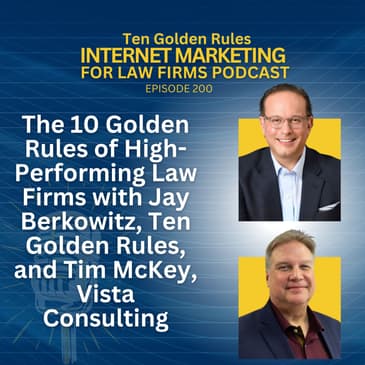
In this special Episode #200 we sat down with a legend in the legal consulting industry Tim McKey of Vista consulting and we created a list of The 10 Golden Rules of High-Performing Law Firms. Many law firms focus on getting more cases but overlook the operational systems that determine whether growth is sustainable. Jay Berkowitz and Tim McKey, CPA and founder of Vista Consulting, discuss the ten characteristics they see most often in high-performing law firms, from working on the business instead of in it to building accountability through operating systems, data tracking, intake excellence, and process improvement. They explain why culture, onboarding, compassionate leadership, and client experience have a direct impact on profitability and long-term success. The conversation also explores how firms can improve case outcomes through better systems, use objective metrics to coach teams, and prepare for future succession or acquisition opportunities. Firms that intentionally build strong operations create better client experiences, stronger financial performance, and greater business value over time.
Key Topics
00:03 – Why law firm owners must work on the business, not just practice law, to create sustainable growth.
06:16 – How operating systems such as EOS help establish accountability, communication, and goal alignment.
09:00 – Using operational metrics and objective data to improve performance and coach team members.
12:05 – The three intake metrics every law firm should track to improve conversion rates.
15:00 – Examining every system and process to increase efficiency, effectiveness, and case value.
17:33 – Questions and client communication strategies that help improve case outcomes and resolution value.
20:12 – Why culture must be intentionally designed rather than allowed to develop by default.
22:17 – The tools, training, and expectations framework for compassionate leadership and employee development.
26:54 – Onboarding strategies that help firms place the right people in the right seats from the start.
30:39 – Developing succession and exit strategies, including how firms can become investment-ready through strong systems and operational excellence.
34:35 – Tune into The Golden Rapid Fire Questions
Resources Mentioned
Technology
- Microsoft SharePoint (Collaboration Platform) – https://www.microsoft.com/microsoft-365/sharepoint
- ClickUp (Project Management Software) – https://clickup.com
- CaseStatus (Client Communication Platform) – https://www.casestatus.com
- Hona (Client Experience Platform) – https://www.hona.com
Books
- The E-Myth Revisited – Michael E. Gerber – https://a.co/d/0duHgn4b
- Traction: Get a Grip on Your Business – Gino Wickman – https://a.co/d/03rTNx2k
- Rocket Fuel – Gino Wickman & Mark C. Winters – https://a.co/d/03rTNx2k
- The 7 Habits of Highly Effective People – Stephen R. Covey – https://a.co/d/03rTNx2k
- Built to Sell – John Warrillow – https://a.co/d/08Rztj2E
Podcast Episodes Mentioned
EP019: Interview with CraigsList.com Founder Craig Newmark - https://www.tengoldenrules.com/captivate-podcast/ep019-interview-with-craigslist-com-founder-craig-newmark/
EP020: Interview with Mahalo.com founder Jason Calacani - https://www.tengoldenrules.com/captivate-podcast/ep020-interview-with-mahalo-com-founder-jason-calacanis/
EP034: Linkin Park’s Mike Shinoda & Selecting a Domain and Internet Presence, WineLibrary TV’s Gary Vaynerchuk & Personal Branding - https://www.tengoldenrules.com/captivate-podcast/ep034-linkin-parks-mike-shinoda-selecting-a-domain-and-internet-presence-winelibrary-tvs-gary-vaynerchuk-personal-branding/
EP064: Law Firm Leadership & Culture with Bills Biggs - https://www.tengoldenrules.com/captivate-podcast/ep064-bill-biggs/
EP078: EOS for Law Firms – The Entrepreneurial Operating System with experts Mike Morse, Gerardo Escalona, and Tyler Smith - https://www.tengoldenrules.com/captivate-podcast/ep078-eos-for-law-firms-the-entrepreneurial-operating-system-with-experts-mike-morse-gerardo-escalona-and-tyler-smith/
EP100: The 6 Parts of Google to Rank Your Law Firm - https://www.tengoldenrules.com/captivate-podcast/ep100-the-6-parts-of-google-to-rank-your-law-firm/
EP117: The App for Law Firm Client Communications – Meet Case Status CEO Andy Seavers - https://www.tengoldenrules.com/captivate-podcast/117-the-app-for-law-firm-client-communications-meet-case-status-ceo-andy-seavers/
EP140: The Texas Showdown Debate with Attorney Angel Reyes – Does Brand matter in Digital? - https://www.tengoldenrules.com/captivate-podcast/140-the-texas-showdown-debate-with-attorney-angel-reyes-does-brand-matter-in-digital/
EP165: BREAKING NEWS!!! Eve Legal Fundraiser Achieves $BILLION Valuation – Meet Co-Founder Jay Madheswaran - https://www.tengoldenrules.com/captivate-podcast/165-title-options-breaking-news-eve-legal-fundraiser-achieves-billion-valuation-meet-co-founder-jay-madheswaran/
EP178: The Truck Accident Authority Joe Fried on Niching Down and Building Personal Brand Expertise - https://www.tengoldenrules.com/captivate-podcast/178-the-truck-accident-authority-joe-fried-on-niching-down-and-building-personal-brand-expertise/
EP198: TGR Live 2026: Immigration Lawyer Julio Oyhanarte on Using Social Media to Drive Law Firm Growth - https://www.tengoldenrules.com/captivate-podcast/198-tgr-live-2026-immigration-lawyer-julio-oyhanarte-on-using-social-media-to-drive-law-firm-growth/
About our Guest:
Tim McKey is the Founder and Managing Partner of McKey Business Group CPAs and Vista Consulting Team, two organizations dedicated to helping plaintiff law firms improve profitability, operational efficiency, and long-term growth. For decades, Tim has advised law firm owners on strategic planning, financial management, organizational structure, and business development, helping firms build stronger, more profitable practices.
Through Vista Consulting Team, Tim and his experienced team provide consulting, training, conferences, and educational programs focused on maximizing case value, improving team performance, increasing lead conversion, and implementing proven operational systems. Widely recognized as a trusted advisor to plaintiff law firms nationwide, Tim is passionate about helping attorneys achieve sustainable growth while creating businesses that support both professional and personal success.
A Certified Public Accountant and sought-after speaker, Tim combines financial expertise with practical law firm management strategies to help firms navigate challenges and capitalize on opportunities in an increasingly competitive legal marketplace.
About Jay Berkowitz:
Jay Berkowitz is a best-selling author and popular keynote speaker. Mr. Berkowitz managed marketing departments at: Coca-Cola, Sprint and McDonald's Restaurants, and he is the Founder and CEO of Ten Golden Rules, a digital marketing agency specialized in working with attorneys.
Mr. Berkowitz is the author of Advanced Internet Marketing for Law Firms, The Ten Golden Rules of Online Marketing and 10 Free Internet Marketing Strategies that went to #1 on Amazon. He is the host of the Ten Golden Rules of Internet Marketing Webinar and Podcast. He has been profiled by the Wall Street Journal, The Business Journals and FOX Business TV.
Mr. Berkowitz was selected for membership as a TITAN for Elite Digital Marketing Agencies, he is the recipient of a SOFIE Award for Most Effective use of Emerging Media, and a Special BERNAY’s Award.
Connect with Ten Golden Rules
Subscribe to Ten Golden Rules on YouTube
Check out our webinars on TenGoldenRules.com
Connect with Ten Golden Rules on LinkedIn
Follow Ten Golden Rules on Facebook
Connect with Jay Berkowitz on LinkedIn
Thanks for listening!
Thanks so much for listening to our podcast! If you enjoyed this episode and think that others could benefit from listening, please share it using the social media buttons on this page.
Do you have some feedback or questions about this episode? Leave a comment in the section below!
Subscribe to the podcast
If you would like to get automatic updates of new podcast episodes, you can subscribe to the podcast on Apple Podcasts or Stitcher. You can also subscribe in your favorite podcast app.
Leave us an Apple Podcast review
Ratings and reviews from our listeners are extremely valuable to us and greatly appreciated. They help our podcast rank higher on Apple Podcasts, which exposes our show to more awesome listeners like you. If you have a minute, please leave an honest review on Apple Podcasts.
[00:00:00] Well, good morning, good afternoon, good evening. Welcome to a very special edition of the Ten Golden Rules Internet Marketing for Law Firms Podcast. This is actually episode 200. It's really exciting to accomplish 200. There's a lot of podfade out there, including we had a little break from episode 50 to episode 51, but we've had some amazing podcasts, including today. We're going to be hearing from Tim Mackey from Vista, and Tim and I created a 10 list.
[00:00:29] The 10 Golden Rules for High-Performing Law Firms. So stick around, but quick review. If you want to go back in the archive, there's some amazing shows. Number one, my friend Mitch Joel, who helped me get started in podcasting. Episode number two, we had Craig from Craigslist, the original founder of the billion-dollar Craigslist. Episode 10, Steve Krug wrote one of my favorite books on website design called Don't Make Me Think. Episode 20, we had Jason Calacanis, who today hosts the All In Podcast,
[00:00:59] the number one podcast in the world, according to them. And Jason was doing a startup called Mahalo, which was a competitor to Google. Episode 34, we had Mike Shinoda from the band Lincoln Park talking about, you know, creating a name that they could get the domain for. Gary Vaynerchuk, the famous Gary V, worked in his dad's wine store at that time, and now he's a famous social media and podcasting star.
[00:01:24] We started specializing in legal. Episode 64, Bill Biggs is one of the top experts on law firm culture. Go back and listen to episode 78 if you want to hear about EOS, the Entrepreneurial Operating System for Law Firms with Mike Morris and my buddy Gerardo Escalona. Episode 100, episode 100, we did the six parts of Google. If you want to get a breakdown on all parts SEO and Google and AI. Episode 117, my friend Andy Sievers from Case Status.
[00:01:53] 140 was the Texas showdown, which was very famous where we were debating SEO and PPC. Very popular episode. At 165, Jay Madden Wason from Eve Legal announced their funding had given them a billion-dollar valuation. Episode 178, Joe Freed is a truck accident expert. Episode 198, Julio Oyhanarte has 3.2 billion social media views.
[00:02:23] So if you want to learn all about social media. So if it's your first episode, definitely check us out on iTunes and YouTube, all the other podcast listings, Spotify, Podbean. Do me a favor. If you like these episodes, give us a five-star review. It really helps us be found a little bit more and get more great guests for the next 200 episodes. Check us out on YouTube. Check us out on all the podcast episodes. And here we go with Tim Mackey from Vista, episode 200.
[00:02:52] Welcome to the 10 Golden Rules of Internet Marketing for Law Firms podcast. Featuring the latest strategies and techniques to drive traffic to your website and convert that traffic into clients. Now, here's the founder and CEO of 10 Golden Rules, Jay Berkowitz. Well, good morning, good afternoon, good evening.
[00:03:19] And welcome to the 10 Golden Rules Internet Marketing Law Firms podcast. Got a great guest today. As always, I start out with a super quick commercial, 10 Golden Rules. My company, we do internet marketing for law firms. If you or anyone you know is down a little bit, your leads are down, you can't figure out Google, traffic's down, social media's not working, you know where to find us, 10goldenrules.com or Jay Berkowitz on any of the socials.
[00:03:50] And with that, we've got a great guest today. And we brainstormed a little bit. And we came up with the 10 Golden Rules of High-Performing Law Firms. So with that, I want to introduce Tim Mackey from Vista Consulting. Tim, thanks for being here. Jay, happy to be here. I'm actually honored. Thank you very much. Oh, thank you. And look, Tim's one of the smartest guys in the biz. We speak on the same stages a lot. And I like what he has to say. So I asked him to join us today for the podcast.
[00:04:19] And we spent about 45 minutes between two meetings coming up with the 10 Golden Rules of High-Performing Law Firms. Tim, why don't we first talk a little bit about your background and tell us a little bit about your journey and Vista Consulting. And then we'll get into the 10 Rules. First of all, again, thank you for allowing me to appear on the podcast. I'm very excited about it. My background is I'm actually a CPA. I'm not a lawyer. So sometimes people are a little bit surprised about that.
[00:04:47] But we started my career with Deloitte. I'm not going to say how many years ago, but it's been a while. And I say I call myself a recovering accountant. We kind of shifted a CPA firm at Deloitte into a consultancy where we help businesses at the time. We've now narrowed it to plaintiff law firms.
[00:05:10] But we help businesses become as good as they can be, serve their clients more efficiently and effectively through systems and processes. And we're going to actually talk about 10 things that we see in the law firm industry that the top performing firms do. We've been doing this about 15 years. We have a team of consultants. I call them thoroughbreds. They're all very, very good at what they do. Very passionate about moving the needle for our clients. So that's us.
[00:05:40] I am based in Louisiana. Our consultants are all across the country. I say we were remote before remote was cool. That's us. That's Vista. And if your firm needs some operational assistance, financial assistance, that's what we do. Yeah. And I have met a bunch of the thoroughbreds and they are all super smart. Sometimes they're on stage with you. So awesome team over at Vista. Why don't we just jump right into it then? The 10 golden rules of high performing law firms.
[00:06:09] And golden rule number one. You've heard this before, but you'll enjoy our take on it. Work on the business, not in the business. Yeah, that's something that I borrowed from a guy named Michael Gerber. He wrote a book called The E-Myth. I read it in the late 80s. And the concept is very simple. You know, we generally, most of us go into business to do what the business does.
[00:06:34] And if you're in the law firm, you're in the business to deliver legal services of some type. But sometimes we get lost in the fact that we also have to run a business that delivers those services. And that can be two different things. For example, if you're a lawyer, you're taking depositions, you're interviewing clients, etc. But you also have to think about the financial success of the business. What do our books and records look like?
[00:07:02] What are the systems and processes we use to deliver those services? And that's the own the business work. And that's actually Vista's plug-in is to help you run a business very well that practices law. So I hope that that difference is clear. Yeah, and I find a lot of firms, like if we were a law firm, Mackey and Berkowitz, Mackey's probably the trial lawyer and really good at law. And Berkowitz runs the business side of things and doesn't like to go to court as much.
[00:07:32] So a lot of times that partnership is a really good fit where one is the technician and one handles finance, the HR, the marketing, the different pieces of the business. Do you find that's often a good partnership? No, absolutely. When you start businesses, a lot of times you have to wear both of those hats. And as the business grows and starts to scale, then you're able to delineate who is going to do what.
[00:07:58] And to be able to grow, you're going to have to have more people in your business. And having good job descriptions, good systems, processes, and knowing what each person is responsible for is where good businesses actually gain traction and move forward. One of the things I do for that mental break in my business, more often than not, I don't book any client meetings or sales meetings on Fridays.
[00:08:24] And Friday, I'll have my marketing meeting and my financial meeting, and I have my same page meeting with my integrator. And so Friday is my day to work on the business, not in the business. Do you find good separation of church and state that way? No, absolutely. And again, depending on the size of operations, I mean, if you're one, two, or three people, you'll find yourself wearing many hats. You're delivering the service and you're running the business.
[00:08:50] And again, as businesses get larger, you want to really delineate more of that. But absolutely, as long as you know where you are and you understand, hey, today I'm working on it, I'm not in it, and you don't get stressed out with juggling too many balls, then absolutely that's the way to do it. All right. The second golden rule of a high-performing law firm is to have an operating system.
[00:09:15] And we like EOS, the Entrepreneurial Operating System, the book Traction and Geno Wickman, but there's a number of different operating systems. Tim, what's your philosophy on different operating systems and programs? We don't necessarily buy into one or the other, but of course, EOS and Wickman's books, Traction and Rocket Fuel, are great places to start. But if you really take a step back and look at those, they're simply goal-setting and review.
[00:09:45] But having a system of communicating to your team members what their job is and then explaining expectations, et cetera, and having a system to review those, that's what we mean by operating system. Identifying what needs to be done, holding people accountable to that through a systematic approach, and that's what EOS does. But any system of goal-setting and review that is consistent and followed is going to work.
[00:10:14] So absolutely, we agree with those. And EOS is a great way to start. Yeah, and if you want to learn more about it, we did a whole session, one of our monthly webinars on EOS, and it's available on our YouTube channel. Mike Morse, who is one of Geno Wickman's first clients and has a 200 million-plus PI firm in Michigan, was on that session. And Gerardo Escalona, who was our implementer, our EOS implementer, was on that session.
[00:10:39] So if you want to learn more about EOS, just go to YouTube, the 10 Golden Rules YouTube channel, and search EOS. Yes. So what I love about EOS is the simplicity, that it's very simple for our management team to execute consistently, and it's simple enough that every employee can understand the terminology. We have an L10 meeting, and it's the same agenda every week in every department.
[00:11:05] If there's a problem or an issue, you do what's called drop it down to the issues list, and there's a software that stores those issues. So you don't have to solve something in a meeting on an impromptu basis. You use the IDS, identify, differentiate, and solve, in the meeting to solve that issue. And you get it done. You solve it, and you move on, and you assign folks to take care of what you solve. So there's a lot of great parts to EOS that we love.
[00:11:35] Number three is embedded in EOS, as you mentioned, or your operating system, is know your data or your data, depending which part of the continent. If you're left-handed, it's data. But no, we 100% agree with that. Back in the early stages of Vista, and I'm not going to say we coined the phrase, but operational metrics.
[00:11:58] You know, being a numbers guy, you know, having an accounting background, creating financial statements is obviously one area of data. But also through the business operations, keeping statistics, for example, in intake. How many leads did you get of those leads? How many do you actually want? What met your criteria to be a case in your firm? And then how many of those did you actually convert to a client?
[00:12:24] That's what we mean by knowing your data from an operational standpoint. In case management, we also have statistics that we view there, and the biggest of which is client contact. You know, we believe that firms should have a systematic way and a timely way of contacting their clients, and then tracking that data through some type of operating system, whether it's a case management system.
[00:12:53] You know, in the beginning, we used tick marks and spreadsheets and notebooks and all that. That was 15 years ago. Things have gotten a little bit more sophisticated. There are actually AI platforms now that help with these things. But identifying what data and statistics you need to know in your business, tracking them and looking at trends, it gives you an opportunity to use objective data when you're actually coaching your team members.
[00:13:21] Instead of just saying, hey, you know, I don't think you're performing very well, when you can say, look, here's an objective measurement of what's going on, that helps very much through the coaching process. We don't think data should, you should know your data, but you shouldn't use it as a hammer. You use that as a coaching tool, and that's very, very important. Yeah, we look at our data every week. It's part of EOS and that software. There's a scorecard.
[00:13:48] And so we have our key eight or 10 data points in every group in our company. There's another line I like from EOS, which is everyone has to own a number. And so everyone in the company is responsible for one or two or three of those data points. They fill out the report every week, and then that's their number that they're responsible for.
[00:14:11] It's not a perfect thing for every job, but it's sure great to have everybody on the same page with tracking data. We totally agree. You know, someone's got to own it. And this is where, you know, we usually talk about the Vista public restroom theory. You know, if you go into public restrooms, they're usually pretty nasty places. And the reason for that is everyone's supposed to keep it clean. And if everyone's supposed to do it, no one does it. And that's why we like, hey, own the numbers.
[00:14:39] Have an individual person own it. Because if not everybody's supposed to do it, then it ends up that no one does it. So that comes back a little bit to accountability as well. I like that one. I might use that. All right. Number four, the fourth golden rule of high-performing law firms is intake process excellence. Yeah.
[00:15:01] You know, you being a marketer in your job being, I assume your job is to help those leads get to the client, right? Your client. And what we find sometimes is that the marketer is doing a great job of getting the leads there. And then the client's fumbling the ball and not actually converting a client, a potential client, to a client. There's coaching that needs to be done at those intake levels.
[00:15:29] You know, at Vista, we use three stats in intake. We want to know the number of leads you got and from what source. We want to know of the leads you get, how many of those actually qualify or you want, when they qualify to be a client. And then of the ones that you want, how many do you actually convert? And by tracking those statistics and tracking the statistics, not just at a high level, but the individual people who are actually in that intake department,
[00:15:58] but if you have more than one, you know, who's performing well and who's not, it actually goes back to know your data. So, you know, your data and then you coach and you have come up with scripts to actually improve those conversion rates. So, if you have intake excellence, you're converting from the ones you want to the clients, at least 93% of the ones you want. That is where the excellence comes in.
[00:16:24] Yeah, we do a lot of work at 10 Golden Rules, like you said, to drive the traffic. We also feel it's part of our responsibility to ourselves and our clients to make sure there's intake excellence. Like, we listen to calls, we give clients, obviously the first thing is some high level feedback. Like, hello, you're not answering the phone. And if you are, you got grumpy people on the phone or, you know, some clients have terrible phone systems. Their intake people are always like, can you repeat that? I can't hear you.
[00:16:54] Speak louder. Come on, people. You got to fix the tech first. You got to answer the phone within three rings and then they need some coaching. And there's a number of the top intake coaches we'll bring in. And we've even developed some software, AI software, that listens to the calls and provides coaching to the intake teams. So, intake process excellence.
[00:17:16] You know, super important for the, you know, PI firms that we're talking about, but it's just as important for every consumer-facing firm and even, frankly, for the B2B firms. You've got to answer the phone with professionalism and have a system to get those leads into the right people's hands. Number five. 100%. Examine every system and process.
[00:17:39] As we talked about before, when we first got into the business of helping when I moved from an accounting posture to a consulting posture, we say we wanted to help affect the score as opposed to just keep the score. So, part of affecting the score is the blocking and tackling. You can look at the scoreboard and say whether we're winning or losing. But the blocking and tackling the things that happen through the business.
[00:18:06] You know, how does your marketing work to your intake to case management to building a demand, et cetera, et cetera, et cetera. Every one of those steps we think should be looked at very closely and made as efficient and effective as possible. And you may wonder, why do I use two words? Why not just efficient? A lot of times cases, to be fast for fast's sake is not what we're here for. We're here to get the best resolution we can.
[00:18:33] And sometimes that means slowing things down, taking that extra deposition, identifying what experts should come in, calling in another lawyer in your firm who has maybe some more expertise in these areas. That's what we call being effective.
[00:19:17] So, profitability is a result of something. And it's a result of good operational systems and processes. How would you inspect the system to increase resolution value? Vista comes in, spends a day with the firm, and goes through the SOPs. How do you do that? Yeah, we actually want to know how they're handling. What does case management look like in each firm that we visit? And you would be surprised.
[00:19:45] You know, case management in some firms may even start an intake. We don't consider that really part of case management. That case management, from our definition, starts when the case is there and from the time that it gets handed to a team or a lawyer or a paralegal through resolution. And, again, what are the questions that are being asked? How are you contacting that client? How are you keeping them in treatment through your discussions with the client?
[00:20:15] Because usually that is an indicator of value. Here's a big one. And it's really kind of at the end of that assembly line, if you will, of case management is asking the client how they're really feeling. They've been released by a doctor and reached what we call MMI or maximum medical improvement. Someone on that team has to have a checklist item that says, ask the client how they're really feeling.
[00:20:41] And that, by the way, needs to be done through Zoom or on a phone call, not by some type of electronic communication. Because if you ask me, Tim, how are you doing? I see you've been released. And I say, eh, you know, I'm okay. If I say it like that, you're probably going to say, wait a minute, you know, what's going on? And you might hear me say, I'm feeling a lot better, but I'm still having some tingling in my left hand. Oh, wait a minute. Let's stop the production. Let's back up.
[00:21:10] And say, look, if you're having tingling, that can mean nerve damage. That can mean this. So we have a system that we take our clients through of questions of how they manage the case through. That's what case manage is. And asking the right question to the client. We don't practice law, by the way. We just help them create the systems to ask the questions that can help them practice law.
[00:21:36] So going through that process with our clients, we've determined in many of the areas, hey, we know we didn't quite get the information we need. So here are the questions to add to our checklist when we're going through it with clients. And again, by the way, how you ask the question is as important sometimes as what the question is. And again, you can be as technologically advanced as you want.
[00:22:03] But at the end of a case or the end of treatment, if someone doesn't look the client in the eye or at least listen to them on the call and say, hey, tell me how you're really doing, then I think you may be missing the boat. I love that one. Yeah, we're very big on systems and processes for ourselves and our clients. We use a project management software called ClickUp, and we have an SOP or standard operating procedures for every single thing we do.
[00:22:31] And we have a process improvement, too. If we find a better way of doing it, we'll rerecord the training videos and retrain the staff on a better way to do it. Number five, examine every system and process. Next up, number six, be intentional about culture. Yeah, we often say, I mean, we come into firms and we'll ask the team, you know, what type of culture do I have here? And they say, well, we don't have a culture. Well, guess what? You have a culture. It's just by default. Okay.
[00:23:00] And we think that culture is an intentional trait. You know, how your team responds, how they treat each other, how they work with their clients is all about culture. You know, we're really strong on something we call performance standards. Some people call them a social contract. It was just a list of things of how we're going to treat each other. And VISTA starts with very simple. We're going to say please and thank you. So that's part of our culture.
[00:23:27] Another big one on our list is if you have a problem with someone, you talk to only them and do that in private. So you don't want to ramp up drama. And I think sometimes if we don't pay attention to how we communicate with each other and we talk about these things, our culture can become one of complaining. It can become one of, you know, I've got a problem with Jay. I'm going to talk to Bill about it. You know, that's not what we do here at VISTA Consulting.
[00:23:56] So paying attention to culture, thinking it through, talking to your team about it and having to be an intentional process as opposed to one by default. The highest performing firms do that a lot. Ironically, you just said talk to Bill about it in reference to culture. And I was just going to say if you want to really deep dive on culture, I love Bill Biggs content on culture. Tim, I'm sure you do too. And there's a 10 Golden Rules YouTube video with Bill Biggs.
[00:24:26] I absolutely love his content on culture. So please go seek that one out if you're trying to figure out how do you get everyone on the same page and what is that page to start with for your internal culture. So number six is culture. Number seven is compassionate leadership. Yeah, we talked about, I touched on it a little bit. But VISTA, we have a pie chart that we look at. It's called tools, training, and expectations.
[00:24:54] So we say if someone happens to be not performing as well as we would like them to perform, usually we use some type of objective measurement for that. We first have to ask ourselves, have we given that team member the tools to their job? Have we trained them to do their job? And have we clearly explained the expectations? And once you do that, if a team member is not performing after that, then there's only two reasons why. They either can't do it or they won't do it. Okay.
[00:25:24] And so when communicating with them, after you've given them the tools and you've trained them and you've explained expectations, then it's a very compassionate conversation. We're not going to say, hey, you're stupid. You can't do this. That's not it at all. Just say, look, if you're unable to do this, is there another seat on our bus where you make them fit in? It gets a little trickier if they can do it and they will not, don't want to do that.
[00:25:48] We say in a very compassionate way, free up their future to find them someplace where they can be higher performing. I think it's very compassionate to have those conversations, to use objective measurements, to coach people up. You're having trouble with a procedure. Let's help you get to there. Let's help you. Look, here's someone that does this very well. Let's bring them in and you watch them do this.
[00:26:15] So instead of being critical, we want to be compassionate leaders and show them the best way. So that's what we mean in that area. I love that. Tools, training, and expectations. Just tactically, like how do you deliver that? Is that part of the training module? Where does it sit? It sits in HR, really. But also every team member usually has, you know, we talked about owning a procedure or owning a process.
[00:26:43] They usually have some type of supervisor or a chief operating officer or someone who's responsible for performance. And it's their job to make sure that each team member, whoever that happens to be, can be one person over many or one over a few. That have those team members gotten the tools, training that they need. And have we clearly explained what's expected of them? So it's something that we go over and over.
[00:27:11] Anytime that we're onboarding a new team member at a client firm, we talk about that. And by the way, we're not just talking to the new team member. We're reminding everyone in the firm that it's their job to make clear the tools, the training, and clearly explain expectations. Then the team member just accepts, hey, this is what you expect of me. I get it. I'm going to do it.
[00:27:34] And if they're not doing it, then maybe there's something that's going on in their life that's causing a problem where they can't do it. Or, hey, this might not be the right fit. So it's something that's iterative on an everyday basis. So that's how we folded into our processes. Yeah. A lot of this overlaps into the EOS terminology that we use called right person, right seat. And right person is alignment with your company's core values.
[00:28:01] So we have four core values, expect excellence, make it fun and easy, own it and solve it, and lead the trends. And so if the person's in alignment with three and a half out of four, they're probably in pretty good shape in terms of believing in and exhibiting your core values. And then the right seat part is do they get it, want it, and have capacity? And that overlapped a little bit with what you said. If there's not a fit on those two parameters, then there's probably a better fit somewhere else for them.
[00:28:30] And everybody will end up happier. Because when people are not a right fit for your company's core values or they don't really get their job or they don't really want their job, they're going to be happier in another place in the organization or in another organization. I believe that. Now, we cheated a little bit because we just did number seven, compassionate leadership, and number eight, training tools and know what's expected of them. So we covered seven and eight.
[00:28:58] What I think we'll talk about there is number eight, though, is onboarding. Onboarding using the tools, training, expectations module. It really allows you to look at that potential team member, that candidate, and making sure that you're totally aligned with what their job description is. So onboarding is a process, by the way. It's not just an interview.
[00:29:23] Once we feel like we have a cultural fit or a team member fit, then you have to get into analyzing, do their technical skills fit? And that's where tools, training, and expectation fold back in. So if you want to take number eight to more of how do we onboard, the top-performing firms use some of these processes in getting the right team members on their bus to begin with.
[00:29:48] So talking about these is extremely important to get the right team on the bus and in the right seat, right people, right place. And number nine is the client experience cycle. Yeah. Yeah. And look, I'll get into a little bit of marketing. At Vista, we don't consider ourselves marketing experts at all. But a big part of marketing is making sure that as the client moves through your firm, their case moves through how you are treating them.
[00:30:17] And by the way, it's important because most of the time the client cannot tell whether you're a good lawyer or not. They don't have the technical ability to know that you've got great deposition skills or you write a great brief. So their experience that they judge you on, because they consider that a table stake. You know, you're in the game. You're a lawyer. You can do those things. But what they do know, hey, you've got good coffee when we visit. You return my phone calls.
[00:30:46] Everything that surrounds your delivery of service is excellent. So, you know, if you go to an automobile repair shop and there's greasy cloths laying everywhere, the couch is nasty, you know, you're drinking the water out of a paper cup. They may be the best mechanic in the world. They can do anything. But you're going to judge them on the things that surround it.
[00:31:11] So the client experience cycle is imperative to get reviews, Google reviews or whatnot, also for them to refer. You've got to be good in all of these areas, not just the technical area. That's my point. Yeah, we do a lot of work with our clients on what we call five-star operations. And it's the same category of considerations where the number one complaint among people to bar associations is my lawyer doesn't get back to me.
[00:31:39] My lawyer doesn't tell me the status of my case. So it's super important that they deliver a five-star operations experience from the first phone call through to dealing with your attorney and your paralegal to resolving the case and even having a relationship after the case. And we're big fans of case status, which is a software. It's like an app that can send updates on your case. And the AI even writes answers that the paralegal can approve and send back to the client when they have questions.
[00:32:09] So again, I'll refer to a podcast interview with Andy Sievers from case status. Another one is Hona. It's really good as well. All right. So number nine, you're going to have five-star operations really manage the client experience cycle. And number 10 is an area of specialty, Tim, that I know is yours as well as you've been working on a lot of exits. So number 10 is developing your exit strategies. Yeah.
[00:32:36] Well, look, one of the seven habits, the second habit in the seven habits of highly effective people that Stephen Covey wrote years and years ago is begin with the end in mind. You know, we always want to help a firm be as good as it can be so that if you want to sell the firm at some point, you can.
[00:32:53] And because of what's going on in the industry, and we could do another maybe a three-hour podcast on what's going on in the industry today with managed service organizations, the potential investment from private equity, et cetera.
[00:33:07] What investors, whether you're a private equity or just another lawyer looking to acquire a firm, is excellence in the operating systems, excellence in profitability, being able to run the firm without it being dependent on one or even two people. To have the systems and processes there. But getting into the actual details of exit strategies, you know, we were very involved. We were a buy side advisor.
[00:33:34] I'm sorry, a sell side advisor to a transaction that occurred in January that was probably the most publicized private equity investment so far into this industry. And, you know, since then, we've been very involved with other firms looking at their operations and making them, for lack of a better term here, investment ready. Not that private equity is right for everyone. It's not.
[00:34:01] But creating a firm that runs extremely well through systems and processes and working on the business, not just in it. Because the in-the-business stuff has become a table stank. You know, everybody thinks the law firm has good lawyers. Maybe not necessarily be true, but most people think that. But if you have good systems and processes that can deliver those services, then you've set your firm up to be a potential target when you are ready to sell.
[00:34:29] I'm not saying that every firm should sell right now and be looking for that. That's not my point at all. It's this beginning with the end in mind to say we need to create something that is sellable. So that's what we mean by exit strategies. We do a lot of work with attorneys on what we call succession planning. How are you going to exit when you want to exit? It's becoming much more of a hot topic because of the introduction of outside capital into the space.
[00:34:58] Yeah, I love how you explained it. And it seems like these acquisitions are happening at the very high level, 100 million and above. But we see in every other industry it's going to work its way down. So I like how you explained that you have to have your business ready to be acquired. You've got to have a brand. You've got to have marketing. You've got to have systems. The business can't be dependent on the owner. The book I love on this topic is called Built to Sell by John Warlow.
[00:35:25] And I got to know John and I think he's also been on one of my podcasts. If not, I got to get him. And that's all about having your business prepared and attractive for an acquisition that it's not reliant on Tim or Jay or the attorney himself. That the business runs real well without us sitting in the seat. Tim, we did it. So quick review. Number one, work on the business, not in the business. Number two, have an operating system. Number three, know your data or your data.
[00:35:55] Number four, intake process excellence. Number five, examine every system and process. Number six, be intentional about culture. Number seven, am I getting these right? Compassionate leadership. Eight is training tools. Know what's expected of them. Number nine, five-star operations in the client experience cycle. And number 10, exit strategies. We have a couple minutes left. And I always ask the quick one-liners.
[00:36:24] We've been asking this question for about 15 years. Number one, do you have a personal system for productivity or any apps you use? We use Avista. I'm sorry. Microsoft SharePoint is kind of the app that we use to keep our data in there. As far as personally, I depend on my number one right-hand two people to help keep me in order. I don't have a hack of an app that I use.
[00:36:54] Other than my notes and my team to keep me in line. Probably a little bit old school in that right now, Jay. But yeah, that's how I run it. My to-do list is still pen and paper. Blogs, podcasts, YouTubes that you subscribe to. Which one, if it hits your feet every week, you stop everything and listen to? Anything that Seth Godin writes, I read. He's a marketer. I bet I could find a book on your shelf behind you.
[00:37:22] Seth Godin, anything he writes, I read. You know, I'm somewhat of a spiritual person. So I have some things. Father Richard Rohr, anything he writes, I read. So I think in other YouTubers, I mean, gosh, Mel Robbins is good. I watch her podcasts. Oh, off the top of my head. And I listen to Gary Vaynerchuk periodically. I read a lot. I actually have three subscription services for books.
[00:37:51] I get book summaries. I'm a reader, but I kind of narrowed it down to first read the summary. And then I go and buy the book if I need it. So I'm a reader. So that's my hack. Well, simple last question. Where can people get in touch with you? VistaCT.com. V-I-S-T-A-C-T.com is our website. T-M-C-K-E-Y at VistaCT.com is me.
[00:38:19] And if anyone goes to my website, they go to our website. They can email me. And I give everyone my cell number. 225-931-7045. Call me. I might not call you back. I mean, I might not answer. But if I do, I always return my call. So I would love to talk to anyone further about this that would want to talk. Jim, this was great. Lots of fun. And I hope everyone enjoyed it. Thank you for your time. Thank you so much, Jay. Again, it was an honor.
[00:38:49] I appreciate you having me on. Take care. Thank you for listening to the 10 Golden Rules of Internet Marketing for Law Firms podcast. Please send questions and comments to podcast at 10goldenrules.com. That is podcast at T-E-N goldenrules.com.