
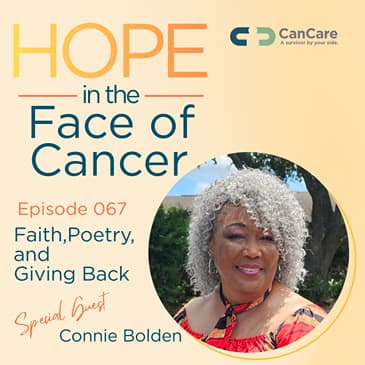
How can faith, writing, and helping others bring hope during and after a breast cancer diagnosis?
Connie Bolden, a breast cancer survivor, writer, poet, and CanCare volunteer, shares how her cancer journey deepened her faith and gave new purpose to her lifelong love of writing. In 2019, Connie discovered a lump that led to a Stage 3 breast cancer diagnosis. Through chemotherapy and radiation, she continued working while caring for her husband after a stroke and her mother, who had dementia.
Connie shares how prayer helped her face each day, sometimes just one hour at a time. Writing became another source of strength, helping her put her fears, pain, and growth into words. Her upcoming devotional, Scars and Ink, brings together poetry, scripture, reflection, and prayer to help others find healing and hope.
Her desire to support others began with simple love baskets for people facing cancer. That act of kindness grew into a church cancer ministry and eventually led her to CanCare, where she now offers emotional support to others.
Connie's story reminds us that even the strongest caregivers need care themselves. No one should have to face cancer alone.
Highlights:
- Finding strength in small moments: How to face overwhelming days without carrying everything at once.
- The healing power of writing: Using poetry and journaling to process difficult emotions.
- Learning to receive support: Why caregivers need permission to be cared for, too.
- Turning compassion into action: Finding meaningful ways to help someone facing cancer.
- The unexpected gifts of volunteering: How supporting others can bring connection and personal growth.
Mentioned Resources:
CanCare- www.cancare.org
About the Guest:
Connie Bolden is a writer, poet, breast cancer survivor, and one of CanCare’s most beloved ambassadors. Words have been part of her life since she was a little girl, and in 2019, after finding a lump at the end of a long workday, they became her lifeline. Through her diagnosis and treatment, she poured her faith into page after page of poetry and prayer. Afterward, she began showing up for members of her church community facing cancer, starting with a single basket filled with love. That basket grew into a calling that led her to CanCare. Her upcoming book of poetry, prayer, and reflection will soon be a gift for many others.
Love the podcast? You’ll be moved by the book. The Hope in the Face of Cancer book shares inspiring, real stories from survivors, caregivers, and healthcare heroes. Raw, uplifting, and full of heart—for anyone seeking hope and connection. Get your copy: cancare.org/hopebook.
About Our Host:
Darcie Champagne Wells is the President and CEO of CanCare, Inc., a nonprofit dedicated to providing support to the cancer community by pairing cancer patients with survivors. Since joining in November 2020 as the third President & CEO, Darcie has driven significant growth, increasing one-to-one support matches by 45% and healthcare referrals by 66%. In 2022, she initiated the Impact Acceleration Initiative to further expand support for cancer patients and caregivers. Her leadership has earned her recognition as a “Most Admired CEO” and “Woman Who Means Business” by the Houston Business Journal, and national “Fundraiser of the Year” by RAISE. Darcie holds a BS in Business Administration from Louisiana State University and an MBA from the University of Houston.
https://www.facebook.com/CanCareInc
https://www.instagram.com/cancare_inc
Thanks for tuning in to Hope in the Face of Cancer!
We’re so glad you’re here. If this episode moved you, inspired you, or brought you a little bit of light, please share it with someone who might need it. Just hit the share button on this page or spread the word on social—your voice helps us reach more hearts.
🎧 Never miss an episode!
Subscribe on Apple Podcasts, Spotify, or wherever you get your favorite podcasts to get updates as soon as new episodes drop.
⭐ Help us grow with a quick review
If you’re enjoying the podcast, leaving a review on Apple Podcasts goes a long way. It helps others discover the show and reminds us that these stories matter. Take a moment to leave a review—we read every one!
📖 Enjoy the podcast? You’ll love the book.
Check out our book, Hope in the Face of Cancer—a powerful collection of real stories from survivors, caregivers, and healthcare heroes. It’s uplifting, raw, and full of heart. Get your copy at cancare.org/hopebook.
[00:00:08] Welcome to Hope In The Face of Cancer, a survivor by your side. Here we share hope and support to anyone in their cancer journey. I'm your host, Darcie Wells, CEO of CanCare and a cancer caregiver. Whether you're a patient, caregiver, survivor, or healthcare provider, we are your cancer support community, together uplifting each other every step of the way. No one should face cancer alone.
[00:00:38] Welcome to Hope In The Face of Cancer, where we share real stories of courageous people in their cancer journey. I am so excited for today's conversation. Our guest is someone who means so much to our CanCare community. Connie Bolden has been a writer and a poet since she was a little girl. Long before she ever imagined the words she would need most would come from walking through cancer herself.
[00:01:01] In 2019, after a long day at work, Connie discovered a lump that would change the direction of her life. What followed was a breast cancer diagnosis, a season of treatment, and a journey of faith that she poured into page after page of poetry and prayer. After her treatment, she began showing up for others in her church community who were facing cancer, starting with something simple, a basket filled with love for someone who needed to know they were not alone.
[00:01:32] That basket grew into a calling which led her to CanCare, where she has become one of our most beloved ambassadors. Today, Connie is going to share her journey with us from the little girl who first found her voice in words to the survivor who found God in the hardest moments. To the woman whose upcoming book of poetry, prayer, and reflection is about to become a gift for so many others. Connie, welcome to Hope In The Face of Cancer.
[00:01:59] Thank you, and thank you guys for having me. Oh, it is such a blessing. It's a blessing to me also. Oh, absolutely. You know, if any of you out there listening have ever seen our little promo video for CanCare, Connie is one of the stars of that video. And she's just such a blessing and such a talent. So I'm honored to finally have you on the show. Thank you. I love to hear about your love basket.
[00:02:29] Tell us about how your love basket came into being. Tell us all about it. Well, when I was diagnosed with cancer, stage three, and I stood in front of my congregation and I informed them of the diagnosis. I said a lot of things that day, and I don't really remember everything I said. But the last thing was, when God brings me through this, I want to use my journey to be a blessing for others.
[00:02:57] Now, I didn't know what I was saying. I didn't know what I was going to look like. I didn't know any of that. But I said it in front of God and everybody. And it took me almost a year before I came up with the idea of doing the love basket.
[00:03:16] So anytime any of our church members or their family members or closest friends was diagnosed, I would do baskets and I would give them to them. And it was a personal thing with me. Nobody knew but me, that person, and God. And then that led into the cancer ministry at my church. Oh, that's incredible.
[00:03:41] I can imagine that it just filled you up so much with love and joy to be able to do something like that, just paying that gift forward. How was that received from the members of your congregation? Nobody knew about it but me, that person, and God. Nobody knew you were behind it. Okay. No. Wow.
[00:04:05] And the congregation found out when one of our elders, his wife's mother, she was diagnosed with cancer. And I did a basket for them. And that's when they made it public, you know. Yeah. Yeah. Yeah. And so that's how I became a part of the, we started the cancer ministry. And I didn't volunteer for it. I was voluntold.
[00:04:34] Some of the best blessings come from being voluntold to do things, right? Yeah. That I was going to be the chair. And I tried to fight against it because, you know, because I'd never done anything like that before. And it took me about a month before I gave in and finally said, okay, I would do this. But that's how it started. Oh, what a blessing. I love that.
[00:04:59] Well, I would love to kind of go back even before your cancer journey because you have this gift and passion for the word in many ways. You've been a writer since you were a child. Like, I mean, if you think back, like, when did you start this writing journey? I started writing in junior high. Okay. But I, you know how people doodle? Yeah.
[00:05:28] I always thought my writing was just some little thing I did like that. I never really took it seriously. And I would write poems and I would let people read them and they fell in love with them. And I said, oh, you can have it. You can have it. So I've given so many away. And then when I was like in my 30s, I had someone to tell me, Connie, you need to stop doing that. And you need to think about doing something else.
[00:05:56] When God gives you a gift, he intends for you to think bigger than what you're thinking. And I still never did. I still never did. And a few years down the road, I thought about it and it changed. And I started doing something else. And the something else was I started writing plays.
[00:06:20] So I started a drama group, a gospel drama group, where I was the writer, director, and all of that. And then that went to writing a book. And the book is called Resurrecting Ghosts. This is the first I've heard about this book. I'm like, oh, my gosh, I'm so excited. Tell us about it. It's called Resurrecting Ghosts. And it is a book about a boy that's in trouble. And there is a man who wants to help him, but he won't listen.
[00:06:49] And, you know, sometimes we bury things in that closet. We push him in that closet and we squeeze that door shut and we try to lock it. Well, sometimes we have to open that door up in order to reach someone else. And that was the only way he was going to reach this young man. And because the young man's thoughts were, how can you help me when you don't understand what I'm going through?
[00:07:13] And sometimes that's vital that we have to go back and pull out all that hurt that we thought that we could bury in order to help someone else. And that's what our lives are supposed to be, is a testimony. We're not supposed to take everything and bury it back. You know, we're supposed to use it to uplift and encourage and motivate someone else. So that's basically what the book is about. Oh, I can't wait to see it. When does it come out? It's already out. I did that book 10 years ago.
[00:07:43] However, however, I'm getting ready to republish the book again. I'm going to do some different things in the book with the book. I was told by a brother from a sister congregation. He had been using the book for his teens for the Wednesday night Bible class. And they said it would be phenomenal if it was a study guide in that. So I'm going to repub the book. I'm going to do a study guide in that.
[00:08:11] But also, I decided to take my journal, my memoirs. Yeah. And I write poems for every emotion that I have when I'm going through things, my ups, my downs, my pains, my woes, my trials, my tribulations, you know, all of that. And I decided at first I was just going to publish the poems. And the moment that I was finished with that and thought I was all done, something said, oh, no, you're not done, sister. You still got work to do.
[00:08:42] And I thought, well, what is the work? So then I thought, well, how about put a scripture to go along with every poem that you do? And then it went from that to doing a reflection. And then it went from that to doing hard work. And then a prayer to close it out. So this is going to be a real workbook and guide. It's a prayer devotional. Yeah. A prayer devotional. And the name of, I decided on the name.
[00:09:10] The title is going to be Scars and Ink. Oh, okay. Tell me a little bit more about why. Why? Because a lot of the poems happened when I was down. I was going through things. I was going through emotional trauma, physical trauma.
[00:09:32] It's when I failed to look up to God, when I failed to take his hand, when I was confused and worried about what to do. And I feel like a lot of people are there where I was. So a lot of it is that. But at the end, it's where I grew. It's where my faith grew. I matured and all. So that's why I decided to call it Scars and Ink.
[00:10:02] And I have a subtitle. I haven't decided quite upon that yet. But it's going to be something about healing and restoration or something. That I'm still working on the subtitle. Well, our audience is hearing this first. So I feel like we are in on the ground floor of this new book. And maybe one day the play, since you're a playwright too, you can turn it into a play. All of my people are ready to go back to work.
[00:10:28] But there's something in me since my treatment. There's something in me that have not had that desire. I've sat down at a computer. I've written maybe the first and second scene. And then I get stuck. Like, that's not where I'm supposed to be. And I think I'm not. That season is going to be different for me now. I think this is my season.
[00:10:55] This season that I'm doing now with this book is going to be the season for now. And that going back to the plays, I think that's going to come along differently. But this book is, I struggled with it because I use my memoirs. Yeah. I use it in journal. So it is. And I ask myself, Connie, are you ready to open yourself up this wide to everybody?
[00:11:24] I had to go in prayer about it because there are things that show a lot of things that I was going through personally. Yeah. Bouts with cancer, relationship issues, kid issues, financial issues. It's everything that we go through on a daily basis, you know, and the journey it took me.
[00:11:49] And so I said, are you going to be ready for people to look at you and stand in judgment? And I thought, well, you know, the people that will stand in judgment, those are not the people that I'm trying to reach. Those are not the people that need help. The people that are needing help are people just like me that are searching. So, yeah, I'm ready. I'm going to open it. I'm going to open up. I'm going to be raw and I'm going to be real to the world. Well, I am so proud of you and can't wait to see it.
[00:12:20] So keep your breath on that. Yes, I absolutely will. No, that's tough to be so raw and intimate with the world. But what a blessing to somebody else reading those words who's going through something similar. So thank you for that gift. You know, I said I wanted to take my journey to be a blessing for others. So this is my journey. But it's not just my cancer journey. It's my life's experience. It's that journey.
[00:12:48] My complete journey. Yeah. From before I was into the Lord, before I thought different kind of ways. And they will see a gradual progression until I finally got there. So let them know, hey, I was in the same place you are. Going through the same things you were. Thinking and feeling the same things you were. I was there. I understand. I know. And this is how I know. I think people are hungry.
[00:13:18] Yeah, I think people are really hungry for real. Yeah. And to feel kindred, you know, in some of those vulnerable, difficult moments. Yeah. And I started out trying to make it all prettied up and everything. But I kept hearing this voice saying, no, no, no, no. That's not what I need. That's not what I want. You need to get raw. You need to get real. You need to show reality the way that it is.
[00:13:47] You need to show your personal experience. And even though you feel like you're not ready to open up like that and be that open, it'll be okay. It'll be okay. So I did. I did. It's too late to turn back now. Is that the truth? Well, I'm so proud of you. We're going to get proofreading, so we're too late now. Well, I better get a signed copy of one of the first that get published. Of course.
[00:14:16] I would imagine that a good deal of that book relates back to your cancer journey. Yes. Tell us. Tell our audience about your diagnosis and your journey. Take us back there. I was a manager of a small business. He had a car lot, an insurance company.
[00:14:44] He did taxes and a couple of other things. And I was office manager. And on the first Thursday of the month, he would do seminars and he would do them for the community, teaching people or coaching people that wanted to better themselves and maybe start businesses or how to do it. And so it was after hours. It was in the evening. So I played hostess. We had refreshments and all of that.
[00:15:12] So I was that, you know, the person at the door that's welcoming you in and taking care of the refreshments and all of that. So that was a long day. It was also in the middle of getting prepared for tax time and we're super busy at tax time. So I had a long, exhausting day and then had to do that on top of it. So when I came home, I was like almost wasted. Wow. I came home and I sat down on my bed and I was preparing to get ready to take a shower.
[00:15:40] And in the process of pulling out, taking off my clothes, my fingernail grazed my breast. And that's when I felt it. And I knew immediately. Yeah. It seems, I mean, you could have easily missed that if it was just a graze. That's amazing. That's something so simple, you know, really brought that to light. Yeah. Because it had it not been for that.
[00:16:10] I don't know when I would have found it. But I did. What were you thinking in that moment? When I felt it, I said, oh, what is that? And I felt it again. And I said, oh, man, that's a lump. That's not a bump. That's a lump. Yeah. And, you know, it's something inside me already knew. I already knew what it was.
[00:16:39] But at the same time, there was something else said, it's a lump. But get punked, honey. Don't freak out because it's going to be OK. It's going to be OK. OK. And so the next morning when my doctor's office opened, I called them and I said, look, I know I don't have a doctor's appointment today. I know you're probably all filled up. But I felt a lump last night. And all I need is just for the doctor to feel it, to tell me I'm feeling what I'm feeling.
[00:17:08] I said, I don't even need a room. Just call me in the hallway and just. So the nurse said, well, Connie, look, let me see what I can do. And she said, I'll give you a call. She said it was going to be about an hour or two. She said no longer than two. And I'll see what I can work out. I said, OK. It took about an hour and 45 minutes. She called me back and she said, Connie, can you be here by two?
[00:17:39] And I said, yes. Now, my doctor's office was right down the street from where I worked. I mean, like maybe eight minutes. So I went there. She felt too. She came up with the same thing that I did. And so she's like, OK, but Connie, you know, I can't tell you that this is what it is. We have to do a mammogram. And I'm going to go ahead and put an order in for a biopsy just in case they feel like it's necessary so we don't have to come back and repeat this process.
[00:18:09] Everything. Everything. And I said, OK. And so that's what we did. Now, I did all of that. And she called me into her office. So I get there and she comes in the room and she has this look on her face. So I knew what she was going to tell me. So she says, Connie, yeah, I hate to tell you this, but it is cancer. And I said, OK, so what are we going to do about it? And she said, well. You knew. You just knew already.
[00:18:38] But you called me into your office. What are we going to do about it? Yeah. So she said, we have to work up a plan. And I said, OK, so you found out that I have cancer. Why didn't you work up a plan and then call me here? So you can tell me this plan. You know? But anyway. So what was the plan that ended up she ended up putting together?
[00:19:01] That plan ended up being four rounds of chemotherapy and six weeks of radiation and then staying on that pill for the five years. What was that time period like for you? It was it was kind of hard and kind of not.
[00:19:26] My first round of chemotherapy, it took about three days before it was set in. I thought I was going to be OK because, you know, I didn't know it took three days. Right. So I'm looking for things to happen immediately. Nothing happened. The next day, nothing happened. The next day, nothing happened. But on that third day, I could not get out of bed.
[00:19:53] But it felt like I had a severe case of the flu. I tried to suffer it and get through it on my own and not call, even though they say when you have problems, call. You know, I'm a tough I'm a tough guy. OK, so I'm going to handle it. I'm going to deal with it. I'm going to be a champ. But it got to the point where I couldn't. So I call. I broke down. I call. So they said, Connie, this is what we want you to do.
[00:20:23] I know it's going to sound kind of weird, but do it anyway. It works. They told me to take Claritin and Gatorade. Really? Yes. I've never heard that before. I'm fussing in my head, right? How is that going to work? That Claritin is not even for anything like that. It's not even for allergies. How is that going to help me?
[00:20:50] And Gatorade, they couldn't give me anything better than Gatorade. So what are they trying to do? You know, they're trying to preserve the medicine for everybody else. No one gives it to me, you know. So anyway, I was alone with just my mom. And my mom is eight. Well, at the time she was 86, 85. And she doesn't drive anymore. And my mom has dementia.
[00:21:19] So I called my husband and he was at work and he was in a meeting. So he couldn't answer. I called my place brother and sister. They didn't answer. I called a couple of other friends. They didn't answer. So I was stuck. I got up out of bed. I forced myself. I put my clothes on. And my mom says, where are you going? I said, I'm going to the drugstore. And she said, why?
[00:21:48] Call somebody. I said, mama, I already tried to do that. I wouldn't be putting my clothes on if they'd answered. So I got dressed. And she said, well, I'm going with you. I'm not going to let you go by yourself. So we're riding down the road. And I have big fat tears rolling down my face. I go into the drugstore. I get everything that I need. These tears are still coming down. I pay for it. And right there, standing right there, even before I gave them my money to pay,
[00:22:15] I took a Claritin and swallowed the Gatorade. Well, did it work? Did it help? It worked. That's amazing. It worked. It did. Later on, I was able to get out of bed and do some things. You know, it actually worked. It surprised me because I said, this stuff is not going to work. They have me spending my money for stuff that's not going to even do anything for me.
[00:22:44] But yet it did. It did. It did. Now, a week before my last round of chemo, my husband had a stroke. He had a stroke that left him barely being able to use the left side of his body. He walks like maybe eight or nine month old, just learning how to walk. So basically around the house, he's in a wheelchair.
[00:23:14] So I had going through my treatment, him and my mom to take care of. I had one more week of chemotherapy and six weeks of radiation. But God is good. So how did you get the support that you needed? In the midst of all that, you're still having to be a primary caregiver. Yes. Yes. I went to work. I went to work every day.
[00:23:43] I missed two days of work during my whole treatment. Now, I'm not going to tell you there were some days that I felt really bad, you know, that I didn't feel bad because I did. I did. But how I got through, I tell people all the time how I, when they ask me, how did I do it? All I did was I prayed and I said, God, just give me an hour. Just give me an hour.
[00:24:12] And that hour passed. And I said, okay, God, can I have another hour? And that hour passed. And I said, okay, God, I'm here again asking for another hour. And I did that all day long until the day was done. And when it was slow and there was no one in the office, then I could lay my head down on the desk and take a moment. But that's how I made it through. My doctor asked me one day, she said, Ms. Bolden, what are you doing?
[00:24:41] And I said, I don't understand. What are you talking about? And she said, most people on chemotherapy lose weight. She said, Ms. Bolden, you're gaining. I said, what? She said, you're gaining weight. What in the world are you doing? I said, I don't know about doing anything special. You know, you go through periods where you can't eat, you lose your taste buds and everything changes. So I said, I find things that I can eat and I just keep eating them. I don't switch it. I don't change it. I just keep eating them.
[00:25:11] And I said, so that's all I can tell you is that. And then say, God is good. Oh, my goodness. Wow. That's incredible, Connie. I can't believe all the stressors that you had in terms of caregiving and work. Were you writing in this time? Yeah. I did journal.
[00:25:39] I heard that that was a very good thing to do. It's a journal when you're going through your journey. And I basically kind of did that anyway. You know, I jotted down my life's experiences and when I was going through different things. And that's where a lot of my poems come from. Instead of journaling, I wrote a poem about how I was feeling or how things were going or what made me mad and how I got mad.
[00:26:07] And, you know, if I did something to get over the feeling that, what did I do? So I was basically already doing that. So I just continued. But the journaling kind of changed and it became all about the cancer and how I was feeling. And what I would get from waiting rooms, sitting there with other people and then talking with them.
[00:26:30] And I would write different things about how they were feeling and how their feeling made me feel. Yeah. And experiences like that. Yeah. Was there any particular poem that you wrote in that time that stands out to you that you've maybe included in your book? Yeah, it is. There's a poem I wrote about a lady who was sitting in the waiting room and a poem is about the clock ticking.
[00:26:59] It's called the quiet room. And we're sitting there and she's waiting on because I was waiting to hear what stage my cancer was in and the plane. And she was there waiting to hear whether or not she had it or not. And so it's like I had an anchor, but she did it.
[00:27:21] And so her mind was like my head was like a mental clutter because here I am. I'm going through this. But at the same time, at the bitter end, I know I'm in God's hands. But she's there and she's totally lost. She's totally in confusion. She's in the mire. She's in the muck. She's there.
[00:27:49] And she doesn't have apparently anyone to lean on because she was there by herself. And so it's just me taking her hand and we're talking together. And so, yeah, I do have things like that. It's called the quiet room. And sitting there listening to the tick tock of the clock, you know, before we kind of get it together. Yeah. I can imagine that sound was very powerful. Yeah.
[00:28:18] And she has another one called In Scorched Places. Because, you know, kind of all feel like, you know, you're close to hell. That's hot. So In Scorched Places. Yeah. But yeah. So you were caring for others, even in the midst of your own treatment. Yes. But, you know, that's how I came up.
[00:28:45] I never remember us being totally in our house alone, just us. My mom always had someone in the house that she was taking care of, be it my aunts, my grandmother, two aunts, as a matter of fact. My house was one of those. Because if you didn't have anything to eat, if you didn't have anywhere to go, then go to the Beasley house. They will help you. They'll take care of you. So that's all I knew. Yeah. My mom would go to work every day. And she worked a very hard job. She worked in a factory.
[00:29:44] So she would come home. You know, it was like, why should we always got to go do this or that? You know, we didn't know. But then as I grew up, then I understood. And my mom is one of the toughest women I know. I don't think there's hardly anything that my mom hasn't gone through. But my mom went through everything and took everything like a champ. And I came up thinking, that's what a woman is supposed to be. And that's how a woman is supposed to do.
[00:30:13] So that's why me doing everything that I had to do, that was a no-brainer. You know, I had to do it and not, you know, feel self-pity or drown myself in sorrow or anything else. Because that was expected. You know, that's what we did. I'm the fixer. And me, I'm so much older than my brothers.
[00:30:40] And 10 years, no, I'm six years older than my first brother. 10 the next one, 11 the next one, 16 the next one, and 21 years older than the last one. Wow. So I've been the fixer for everybody. And not only that, there are elderly people in our church. I took it upon myself to be their caregivers. And I was their caregivers until they transitioned.
[00:31:09] And that was a lot of years. So that's just what I do and have been doing. And so with me, the cancer journey, everything just kept going, just kept flowing into the same, in the same direction. Did you have anyone in your journey to lean on? Or you were pushing yourself forward just with a tenacity to get through it?
[00:31:35] I have friends. I have church sisters and friends who, they offer support. And they've been there in my corner and ask always, what can they do to help? And sometimes I'll allow that, but I'm that person. And I'm struggling hard enough to be. You get a little stubborn sometimes, Connie? Yeah, yeah, yeah.
[00:32:05] And they tell me I have some problems with control issues. But I think that comes from, you know, having to take care of my brothers and, you know, everything I did by myself. And I watched my mom. My mom did everything by herself. And she had no support, you know, just her. And so, but I'm learning in my older years to lean a little bit on others and allow others to come in.
[00:32:34] And that I don't have to keep pouring when I'm empty. You can't pour from an empty cup. Yeah, to allow somebody to pour something into me so that I can keep pouring. I'm learning that. I'm 71 years old. It's never too late to learn. I know. You know, they say you can't teach an old dog a new trick. Well, I'm going to show that differently. Well, I'm glad you're letting people come around you and love on you, too.
[00:33:05] After all, I love you. It's hard. It's hard. But I'm giving in. But I'm doing it. I'm doing it. What? I can see you're such a strong person and you just pushed through your cancer journey. You didn't have a choice. You pushed through. You're taking care of your husband, taking care of your mom. But as you have reflected back, what did cancer teach you and how did it change you?
[00:33:38] Cancer for me, I've heard some people refer to it as the beast and a curse. Cancer for me was none of that. But cancer was a blessing. Cancer made me. It forced me to take a deep look at myself. The good, the bad, and the ugly. Anyway, before, I thought I was a Christian. I was doing the things.
[00:34:07] I was checking off the boxes. I'm going to church. I'm doing Bible study. I'm working in the church. I'm helping the community. I'm doing all these things. But there were some things that I was missing. And cancer helped me to see the things that I was missing. It helped me to see the things that were good in me that I need to grow more of. But then there were some other things in me that cancer showed me I need to get rid of.
[00:34:35] So cancer helped me, I guess you could say, to strive to be better than I was and not just sit there and think that I'm okay. You know? It made me want to be better. But then it made me want to reach out more, to have a deeper, greater commitment to helping people, which I already had that before.
[00:35:05] But it kind of changed. Cancer showed me that it's really important that everybody needs somebody walking along with them. Because that I felt like I didn't have. I went through so many nights where I laid in my bed and thinking that I was so alone. Even though I had people, I was still alone. And I thought nobody should have to feel like that.
[00:35:35] And me knowing what it felt like. And so, yeah, yeah. Cancer changed me in a lot of ways. But I won't take up all the time because I could probably take all day saying that. We'll have to read it in the book. What it did to me. We'll read it in the book. Tell us about the journey to supporting others facing cancer. We know about the Love Baskets was the start of that.
[00:36:02] But taking that step of vulnerability to support people one-on-one and becoming a volunteer. I, after, okay, after my treatment and everything was over, there was a gentleman that was really kind of close to me in my church. He was diagnosed with cancer. And he moved here from Florida to Texas to Fort MD Anderson.
[00:36:32] And he was stage four. So he was already terminal. And that was the first love basket that I gave. Yes. The second was a good friend at my church. And she procrastinated in going to the doctor. She was trying to treat herself and all of this. And when she ended up going to the doctor, I guess you could say it was about too late.
[00:37:01] But it's because the interest that she had was not accepted in a lot of places. And she could not get treatment. And she ended up transitioning. And that broke my heart because I felt like there was nothing I could do to help.
[00:37:28] And something inside said, Connie, there is something that you can do. You just have to seek for it. So it made me search for information. So I started checking with social workers, psychiatrists, oncologists. Because, you know, they say cancer starts in the brain, in the head.
[00:37:58] So looking at different resources, trying to find resources for people that didn't have anywhere to go, didn't know where to go. And they were taking no and sitting at home doing nothing. I had a 29-year-old who was one of the kids in my drama group. So she was diagnosed with cancer.
[00:38:24] And by the time she did anything, it had traveled. It had metastaside. She ended up transitioning also. But since I had done some of that work beforehand, I was able to help her. Because she was sitting at home trying to medicate herself. Because she was being told, no, we can't help you. No, no, no. But I had found out that there were resources.
[00:38:53] So I was able to connect her with different resources. And it was at the end. But I found resources for her. But, so, yeah. Oh, that's. Yeah. That's really emotional. You've experienced a lot of loss. Yeah. Talk about it. In this service, you know. That's got to be really.
[00:39:23] I think we all have a responsibility. To do something. When we go through things. And there are tragic things. And there are things that we know we can only get. We know we only came through. And only can get through by a high power. That should change something in us. And that should drive us to want to give that back. And like I said, when I stood in front of the church. And I said I wanted to take my journey to be a blessing for others. I didn't know what the heck I was talking about.
[00:39:53] What I was opening myself for. Before I had no idea. Hold on, Connie. Here it comes. No idea. Yes. Well, I know that's also when you found your way to us. Yeah. How I found my way there. Man, let me tell you. So, they told me that I was going to be the chair. For the kids to support ministry at my church.
[00:40:20] Well, I didn't know what I was doing. But I knew that if I did it, it had to be successful. And I needed to find out how I was going to make that happen. Because it had to be more than just giving a basket. You know? So, I went, again, looking for information. So, I called American Cancer Society. And I told them what I needed. And we talked for a long time.
[00:40:49] And after that, she asked me questions about what I thought my plan was. And I gave it. And she said, well, Connie, you know what? You're already set. Sounds like you have a good plan. She said, so go ahead with your plan. You'll be fantastic. And it will be great. So, I said, okay. I'm feeling okay now. I'm cool. So, I'm getting ready to get out. And when I do, can't care flashes on my screen.
[00:41:17] And I thought, well, I started to get out. Started to leap and get out. But then I thought, what the heck? It's not going to help her to look at it. So, I did. And I saw a number. So, I called. I said, well, let me see what they're talking about. So, I called. And I think I talked to either Heather or Chris. Not really sure which one. Okay. So, I told them, listen, I'm calling because I'm seeking information.
[00:41:44] And I don't know if you can help me or would be willing to help me. I said, but it's worth a call. And so, they asked, what was I looking for? And I explained everything that was happening to me and what I was going through and how I wanted to make a difference. And how, if I took this ministry, it had to elevate. It had to mean something and become something.
[00:42:11] And that I had no idea what I was doing. And so, I needed all the help I could get. So, we talked about, I'm going to say maybe 45 minutes. And at the end, about the end of the call, we were getting ready to kind of wind it down. They said, you know what, Connie? Sounds like you would be great for care. And I didn't want to hear that. I didn't call for that. You know? So, call and get recruited.
[00:42:39] I said, so, what all does that entail? And so, I was just being nice. Right. You know? What all does that entail? And so, they went on to explain it and everything. And I said, okay. Well, let me think about it. And let me pray on it. And I'll get back with you. And so, in between that time, it kept coming. It kept, you know how things just kept, like, coming in your head? You don't know why.
[00:43:09] You just, every now and then, you have that thought. And so, I called back again about a month later. I called back again. And we started conversing again. And so, I said, so, tell me about training. And they told me what training consists of. And I said, you know, my head is not the same since chemo.
[00:43:36] And I don't know if I can go through learning a whole bunch of things and trying to hold it in my brain anymore. Because I have community issues now after chemo. But they're mostly verbal. Not writing, but verbal. And so, we talked and everything. And she kind of convinced me at least to come to training to see. So, I did. And that's how I got to be a part of CanCare.
[00:44:04] Was there something in that training experience that kind of said, oh, yeah, this is what I'm in? Yes. Well, actually, the training was different than I expected. The training was very informative. It was very laid back. It was not that, I don't know the word I'm looking for.
[00:44:26] It was not that stiff and rigid and like a real, real classroom. Yeah. And it was, I learned a lot in the training, again, about emotions, feelings, and how to express those feelings.
[00:44:55] And I thought, well, wow, this is kind of good. And I think everybody should know these things, whether you're a part of that or not. You know, this is just general information that everybody needs to know just in case. Because everybody's going to come in contact with cancer one way or the other. Be it inside your family, a family member, a friend, a co-worker, somebody, somebody.
[00:45:22] And if you know how to work around that, that's going to be a plus. So, I thought, okay, so I got a whole lot out of this, even though I'm really not sure. But by the end of the training, I said, okay, I'm in. And I never, I have never regretted it.
[00:45:44] Because CanCare, whoa, CanCare did a lot of things that I never expected it to do. First of all, it brought me to a lot of people that I never would have met. Because I have clients that's all over, all different states. And I never would have met them.
[00:46:10] And they became, they grew from being clients to friends to family members. And I thought, you know, my thing was, you know, I'm going to take my journey and be a blessing to others. I had it all wrong. Because those people that I thought I was being a blessing to, they ended up being a blessing to me.
[00:46:36] And so, I don't know how my life would be without CanCare. I would still be going on and I would still be doing my things that I've normally been doing. But CanCare elevated what I was already doing. And so, it's really been a blessing to me. You know, I think I'm getting more out of it than they are.
[00:47:06] And I'm learning so much because talking to different people, you know, cancer changes. And the diagnosis, I mean, it's a diagnosis, but the treatments and everything changes. And they're learning so many different things. So, I'm learning because they're going through things that I never had to go through. Things that weren't there. Mine was in 2019. They have so many new things now that weren't then. But I know. I know.
[00:47:33] Now, I found out two years after my treatment and all of that, I had genetic testing. And I found out I have the gene. I have the PAOB2 gene, which says, they say that my cancer has a 60% chance of recurrence. Okay? But look how much stuff I am learning. Yeah.
[00:48:01] So, if that ever be the case, Lord forbid. But if that ever be the case, I'm not going into that thing as blind as I was the first time. So true. And I'm learning this from all the people that I come in contact with. Yeah. That you're there to support. But in essence, you're getting just as much out of the relationship. Me too. Yes. That's beautiful. Yeah. Thank you. Thank you so much.
[00:48:30] I love you too much. I just feel like we're just kind of like having coffee and just chit chat. No, I love it. I've been told I have a big mouth. Yeah. My brother used to call me mouth almighty. I love that. For those listening today who may be going through a journey like you did. Maybe they're facing it. Maybe they're caregiving for someone.
[00:48:57] What would you want them to walk away with listening to you today? What message of hope would you want to give them? That life isn't about just us. Mm-hmm. We were put here to do some things. And one of those things is to help each other make it through. Everything that we go through in life is supposed to be a testimony.
[00:49:24] And we're supposed to sing that testimony loud and proud and strong because that testimony that we share help other people on their journey. And sometimes it's a hard road when you lose someone. Yeah.
[00:49:43] But there's a blessing in that too because you lose someone but you always know that you touched their lives, that you were there, that it wasn't a journey that they faced all by themselves. And yeah. Yeah. But most importantly, it's fulfilling that thing that we were put here to do. And that's sharing and being a part of each other because it takes all of us. We can't and we're not supposed to.
[00:50:12] The plan was never for us to do it alone ever. And that's how sometimes we want to do it, you know, is alone. But it wasn't meant for that. Yeah. And it's just opening yourself up. Yeah. Well, I thank you so much, Connie, for sharing today and just for being the blessing that you are to so many each and every day. We're honored to have you in our family.
[00:50:38] And I thank you for being raw and intimate today and sharing some things that I know are hard because I know there'll be a blessing to those that are worth it. I thank you for the opportunity to do this. Yeah. I was so nervous about doing this, but it was very, very calming and very easy.
[00:51:02] Very emotional because it brought back things that, you know, from that that's kind of really deep with me. But, you know, that's OK, too, because that's all a part of the journey. All a part of the journey.
[00:51:17] And all I can say is if there are survivors and if there are caregivers, if you've been affected and you had to live through that, because a caregiver, it's almost like you have cancer, too. So if you've gone through that, you have a responsibility. And that responsibility is to help somebody else to make it through.
[00:51:46] And it's it's not a job that you will regret. It's not a job that you will hate to do. It doesn't take up all your time. It's just a little bit of your time. And we have so much time. Think about the time we spend doing absolutely nothing. That time, that little bit of time that we spend doing nothing, we can take that and make that so useful and in such a blessing to somebody else and to ourselves.
[00:52:17] But can care will help you grow as an individual. It helps to mature you. And that's what we're supposed to do anyway. It's mature every day. And can care is. It is. It is. It will is a catalyst for that. So if there's anybody that's sitting there and your head is going, well, I think I can. I think I could or whatever. Just check it out. There's nothing wrong with just checking it out.
[00:52:45] You'll never know if you don't check it out. Don't be put in a situation like I was where I was voluntold. And I had to go seeking for information. Do it on your own because you want to do it. Thank you, Connie. I appreciate you so much. And I know our listeners will really find your message a blessing today. And thank you for being a blessing to so many each and every day. What a gift. I appreciate you guys so much. You will never know.
[00:53:15] Never know. And thank you for joining us for this episode of Hope in the Face of Cancer. If you or someone you love is facing cancer, CanCare is here to support you. Visit us at CanCare.org to learn more. And if you're a cancer survivor or a cancer caregiver, we would love to have you in the CanCare family. You can visit our website to learn more. Until next time, remember, there is always hope in the face of cancer.
[00:53:47] Thank you for joining us on this episode of Hope in the Face of Cancer, a survivor by your side. If you or someone you know is facing cancer or is supporting a loved one through their journey, we invite you to share this podcast. As a cancer survivor, your journey carries invaluable wisdom and insight. We would love for you to get involved in CanCare's mission of becoming a survivor by the side of someone facing cancer.
[00:54:11] Please visit our website at CanCare.org slash volunteer or click the link in the bio for more information on how to get involved. Our survivor volunteers have been a beacon of hope for so many. Thank you for your support and our efforts in the cancer community. No one should face cancer alone.