
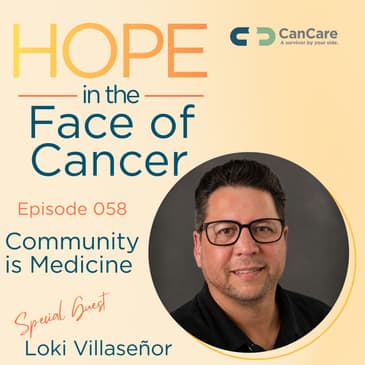
How can community, creativity, and support help someone keep moving forward after cancer treatment ends?
Loki Villaseñor is a father of eight, health and safety professional, writer, and head and neck cancer survivor. After finding a lump on his neck in early 2025, Loki was diagnosed with HPV-positive head and neck cancer and faced seven weeks of chemotherapy and radiation.
Treatment brought pain, exhaustion, feeding challenges, and emotional strain. It also changed the way Loki saw support. Through the Memorial Hermann Canopy Cancer Survivorship Center in The Woodlands, Texas, he found free programs for survivors and families, including men’s lunches, a working professional’s support group, counseling resources for his children, and virtual classes. What began as something he thought might help his family became a source of community and healing for him too.
Loki also turned to writing, creativity, gratitude, faith, and service as tools for processing life after treatment. His experience taught him that progress is not always uphill and that healing can continue long after treatment is complete.
His message is simple: you do not have to climb alone. Support, connection, and hope can help you take the next step. Even small steps can carry you forward each day.
Highlights:
· Why emotional recovery may continue long after cancer treatment officially ends.
·The value of finding people who understand cancer without needing every feeling explained.
· Ways creativity and writing can help give grief, gratitude, and change a place to go.
· How survivorship programs can support not only the person with cancer, but their family too.
· Why accepting help and helping others can become part of moving forward.
Memorial Hermann Canopy Cancer Survivorship Center
A key part of Loki’s story is the support he found through Memorial Hermann Canopy Cancer Survivorship Center in The Woodlands, Texas. Loki first thought its services would be most helpful for his wife and children. He later found a community that supported his own life after treatment.
He participated in men’s lunches, a working professionals cancer support group, Voices of Hope, and an online Spanish class. His children also received access to counseling support. Loki describes Canopy as a place where he could be heard without feeling like a burden or having to explain every part of his cancer experience.
The episode also highlights that Memorial Hermann Canopy offers free in-person and virtual programs, giving cancer survivors and families more ways to find support and connection.
Mentioned Resources:
CanCare- www.cancare.org
About the Guest:
Loki Villaseñor is a head and neck cancer survivor, father of eight, health and safety professional and a writer. In January 2025, he found a lump on his neck. Along the way, he found support through programs at Memorial Hermann's Canopy Survivorship Center and turned to writing and drawing as a creative outlet for healing. Today he is cancer-free and often connects with other survivors to help them through their own journeys.
Love the podcast? You’ll be moved by the book. The Hope in the Face of Cancer book shares inspiring, real stories from survivors, caregivers, and healthcare heroes. Raw, uplifting, and full of heart—for anyone seeking hope and connection. Get your copy: cancare.org/hopebook.
About Our Host:
Darcie Champagne Wells is the President and CEO of CanCare, Inc., a nonprofit dedicated to providing support to the cancer community by pairing cancer patients with survivors. Since joining in November 2020 as the third President & CEO, Darcie has driven significant growth, increasing one-to-one support matches by 45% and healthcare referrals by 66%. In 2022, she initiated the Impact Acceleration Initiative to further expand support for cancer patients and caregivers. Her leadership has earned her recognition as a “Most Admired CEO” and “Woman Who Means Business” by the Houston Business Journal, and national “Fundraiser of the Year” by RAISE. Darcie holds a BS in Business Administration from Louisiana State University and an MBA from the University of Houston.
https://www.facebook.com/CanCareInc
https://www.instagram.com/cancare_inc
Thanks for tuning in to Hope in the Face of Cancer!
We’re so glad you’re here. If this episode moved you, inspired you, or brought you a little bit of light, please share it with someone who might need it. Just hit the share button on this page or spread the word on social—your voice helps us reach more hearts.
🎧 Never miss an episode!
Subscribe on Apple Podcasts, Spotify, or wherever you get your favorite podcasts to get updates as soon as new episodes drop.
⭐ Help us grow with a quick review
If you’re enjoying the podcast, leaving a review on Apple Podcasts goes a long way. It helps others discover the show and reminds us that these stories matter. Take a moment to leave a review—we read every one!
📖 Enjoy the podcast? You’ll love the book.
Check out our book, Hope in the Face of Cancer—a powerful collection of real stories from survivors, caregivers, and healthcare heroes. It’s uplifting, raw, and full of heart. Get your copy at cancare.org/hopebook.
[00:00:08] Welcome to Hope In The Face of Cancer, a survivor by your side. Here we share hope and support to anyone in their cancer journey. I'm your host, Darcie Wells, CEO of CanCare and a cancer caregiver. Whether you're a patient, caregiver, survivor, or healthcare provider, we are your cancer support community. Together, uplifting each other every step of the way. No one should face cancer alone.
[00:00:38] Welcome to Hope In The Face of Cancer, where we share real stories of courageous people in their cancer journey. Long before cancer, Loki Villasenor led a group of scouts up Mount Whitney, the tallest mountain in the continental U.S., one foot in front of the other, keeping everyone moving when the trail got hard. He didn't know yet how much he'd need those same lessons in the future.
[00:01:02] Loki is a father of eight and a health and safety professional whose career is built on protecting people. In January 2025, he found a lump on his neck, a CT scan, biopsy, and then the word he never expected, cancer. No family history and no warning. What followed was one of the most difficult treatment plans of chemo and radiation in the head and neck area.
[00:01:30] He kept working, leaned on his family and his church, and climbed this mountain the way he once climbed Mount Whitney, one step at a time. Through it all, Loki has turned to writing and drawing as a place to hold grief and gratitude at once. He even shaped one of his pieces, called You Are Still the Main Character, into a spoken word performance. And afterward, people came up to him to tell him how much his words had shifted the way they saw their own cancer journey.
[00:02:00] Loki, we're so excited for you to share your story with us today and our audience. So thank you so much for joining us in the show. Yes, I'm excited too. Thanks for having me. Oh, we're excited to have you. And I know you just moved across the country. And so you are starting a new adventure on the West Coast. And we're going to take you back to another adventure in your cancer journey today.
[00:02:27] And I love that you are, you're a writer and throughout your journey, you poured into your writing. So my first question for you today is, if this journey had to fit on a line, like a title from one of your own pieces, what would you title it? I've been thinking about it a little bit. And I guess in keeping with the theme of climbing a mountain, progress isn't always uphill.
[00:02:56] Okay, interesting. I look forward to kind of digging into that a little more. Sure. When you think about that, does that take you back to that Boy Scouts trip? Or tell us a little bit more about what that means. Yeah, that and climbing in general. It kind of, when you're hiking mountains and those kind of things, sometimes you'll get to like a false summit. And you'll think that you can see it, you're climbing, you're almost at the top.
[00:03:25] And then you get there and you're like, oh, this isn't the top, I got to keep going. Or sometimes you got to drop down a few hundred feet or a thousand feet or something down into a small valley and then climb back up again. And you're like, man, I was almost there. And so similar to cancer, you start moving forward, you have setbacks, you know, and it just kind of keeps going that way as you're climbing that mountain. And I've never climbed a mountain myself and probably won't attempt it, but I can really relate. And I appreciate that analogy.
[00:03:55] It's a great picture in our minds. So before we dive deeper into your cancer journey, I'd love for our audience to learn more about Loki before cancer. Eight kids. I mean, that in and of itself is incredible. Tell us about your family and your work. Yeah, so before cancer, it was in 2025. At the beginning of 2025, we have eight kids.
[00:04:22] My wife's in the middle of her nursing program and she's working full time. I'm working on some work goals. I'm working on some creative goals. And so I had just gotten a certification for work. I was going to edit a rough draft of a novel that I had just finished. So I had all these plans. Everything was moving forward. And then you get the news that cancer happens. And so it wasn't like just my health that was affected. It was all of the goals. It was everything. It was life. Life got interrupted.
[00:04:52] Life interrupted, right? So are you the type that, you know, plans everything out and kind of, you know, has your goals and I'm going to attack this goal? Is that kind of your style? Well, I'm not really a goal setter. It was something that I was trying to do so I could get a little more organized. Oh, okay. It was a self-improvement. Yes. And so right as I was starting to get into goal setting, I got thrown off of the path. Of course.
[00:05:21] That is just the way life likes to work, right? Yes. So tell us about that moment when you kind of first figured out something's not quite right. Uh, so I was shaving one morning and I just noticed a small lump on my neck and I, I was like, man, this is weird. And I had just had a, um, cold, a sinus infection. And I just figured, well, it's probably just a swollen lint note or something like that. And showed my wife, she didn't seem too concerned.
[00:05:51] Well, then a month later I'm, I see it again and it's about the size of a grape or an olive at that point. And I'm like, oh, and so my wife saw it and she's concerned. So then I start getting concerned. So I said, well, I'll go talk to the doctor. Um, so I did. And while we were talking to the doctor, her reaction was kind of like, oh, that's not good. We need to get a CT scan. And I'm like, well, now I'm really. That's not what you want to hear. Yeah. Oh my goodness. So you get the CT scan and biopsy results. Tell us about the news. Yeah.
[00:06:20] So I didn't, um, I, so I, I went to an ENT, the ENT had taken a biopsy. And when he took the biopsy, he said, he pretty much knew what it was, that it was an HPV positive cancer. Um, and he said, so he had kind of prepared us all ahead of that time that this is probably what it is. I need to get the biopsy. I need to do all that stuff. Um, and the way he had laid it out was that it was a very highly treatable, very survivable, um, short treatment window, but very intense.
[00:06:49] Uh, and so when we went back for the follow-up and we're sitting there, me and my wife, um, and he, he says, yes, that's what it is. Um, it was kind of, I guess I was in a little bit of a denial because it's like, okay, well, if, if we already know the treatment plan, if we already know everything's laid out that way, I just got to get through that. That's cool. And so my wife says I was in denial. I, I, I guess maybe I was a little in denial, but it was more just, um, I had a plan, you know, there was a plan. We just got to do the plan. Yeah. Yeah.
[00:07:19] Just here's the plan. Follow the plan. That's, you know, a great way, great way of putting it there. I don't think a lot of people would appreciate just why head and neck cancer treatment is so difficult. Can you talk a little bit about that? What is that treatment experience? Like that's, it's different than so many other cancers. Yeah. So, um, it's, it's very intense. It's at seven weeks of treatment.
[00:07:47] Um, I've told that's very standard at the beginning of each week you get, or sometime during the week before you do your treatment, you do a, um, chemo, it's cisplatin. And so you get the infusion of the chemo takes a few hours because they got to give you fluids and that kind of stuff. Uh, when it's time for radiation that happens every day, except weekends and holidays. Um, it was 33 days of the, of it for me. Um, and they have this mask. Um, oh, I should have grabbed it so I could show you, but there's this mask, um, and it
[00:08:17] molds to your face and it bolts you down to the table. So you can't move. So it can target that. And then the machine goes around your head, um, specifically targeting that, that cancer from all these different angles. Um, and so it's about 10, 15 minutes. It's not very, it's not very long. Uh, but it's, you're, you're restrained. Uh, and it doesn't really hurt either. Like it never really hurt, but it does compound over time. And so it, it ends up burning your throat, ends up burning, um, other parts of your body,
[00:08:44] damaging some of your, um, hair and cells and different things like that. Um, and so that's, that's why it's pretty rough. Uh, I, I ended up not being able to eat anything. Um, my throat filled up with mucus a lot. And so, um, I couldn't sleep laying down. I would choke on it if I laid down. So I had to kind of sit in a chair with my head leaned forward when I was trying to sleep. So it was pretty intense, but I will say during all that though, um, I did witness the most, um, kind and loving things for many people.
[00:09:15] Yeah. Yeah. That's wonderful. It's amazing. Um, you see, see beauty in ways maybe that. You hadn't before when you're going through something like this and you definitely were surrounded by, by a lot of love and beauty. A lot of men don't really like to talk a lot about their stories and, or what's going on emotionally, uh, inside of them.
[00:09:40] I mean, I'm not, I'm not sharing any news with you, but let's talk about the emotional part of it. Cause I mean, you said in the beginning that your wife kind of said that you were in a little bit of denial. Was there a point in time when the emotion of it really did hit you? Uh, yeah, probably about week five was when it really hit me. Week four was getting bad. That's when everything got bad. And they even said in the plan, week four is going to be where things start getting bad. Week five, I couldn't eat.
[00:10:09] And so I ended up with a feeding tube. Um, and so that, that got pretty bad. Um, yeah, the, the vulnerability emotion. I mean, even now I kind of feel a little, a little weird sharing some of my vulnerabilities, especially knowing people are going to be listening. Um, but yeah, there, there's definitely emotion to it. Uh, and it was a lot of up and downs, just like, just like the mountain. Um, you know, you don't want to be a burden to anybody. You want to kind of try and hold things back.
[00:10:38] I mean, as a man, I, you don't really want to hurt anybody anyway, or add additional things to anybody anyway. And so, especially when it, you know, you just got to get through these few weeks. All we got to do is get through this week and then I'm going to go back to normal. Obviously it doesn't go back to normal, but that was my, that was my mindset at the time. But yeah, there was definitely some emotion to it. Um, where I broke a few times or almost broke anyway. Yeah. How about the kids? Eight kids.
[00:11:06] How, how did you address what you were going through with them? Uh, we explained it to them. They, I think they were all a little afraid. Everybody's afraid when you hear cancer. Um, and, and honestly, I didn't know that cancer was as easily survivable as some of them are nowadays, especially with the technologies. So I was a little afraid when I first heard it, but, um, my older kids were probably a
[00:11:34] little more, uh, upset about it. The younger ones, they were, I'm sure they were upset. They kind of seem to not be, we, one of the things, and I know we're going to talk a little bit about Canopy. Um, one of the things is there was some counseling that was available that, uh, that Canopy directed some of my younger kids too. We didn't quite get it worked out for some of the middle kids, but the younger kids were able to participate in some creative, um, counseling. Um, so that, that helped them. There was also a camp called Camp Kesem.
[00:12:03] It wasn't something that Canopy directed us to, but Camp Kesem was something, uh, uh, my wife's aunts directed us to, uh, and the kids were able to go to that. And it's, it was just nice knowing that there's stuff out there, um, that can help them, you know, Camp Kesem. I'm sure, I'm sure, you know, it's for kids with, yeah, with, with parents who had cancer. And so it was just nice knowing that there's something there for them when, when you're worried about your kids, when you're worried about not being a burden and all that, that there's these programs out there to help them too.
[00:12:33] Was there someone in, during this journey that you really leaned on? Well, I really leaned on my wife. I mean, that's, I don't, I, during treatment, that was really, it was really my wife, a little bit on my mom. Um, but yeah, probably mostly my wife after treatment, I was able to find more of a community. Um, during treatment, a lot of it was just so rough that, um, especially towards the end,
[00:13:02] I did have friends at work and other things that were, that were there, but yeah, my wife was the one that I leaned on the most. But during, during that time, I don't, you didn't have any. Body in your life who had been through a head and neck cancer before, had you? Not a head and neck cancer. Um, there, there were family, uh, well, my, on my wife's side, um, there had been some that had been through breast cancer. There was a guy that was a volunteer at the radiation office.
[00:13:32] Um, and he just came in, he had a blue vest on, he would come in every morning and he kind of just shared his story with me. Um, and that he was just there to volunteer and he said, yeah, your taste will come back. It'll be like, so there were little things that he said, I don't even remember his name, but. Yeah. But it was good to have somebody who has been on the other side of that and understood what you were going through. Yeah. Yeah. Absolutely. Well, we talked about the mountain and, you know, we know to climb any mountain or tackle
[00:14:02] any challenge you, um, you need help. And you mentioned canopy and canopy was a great help more after your journey even, um, than before. And I, I think sometimes it's after the journey that we really start to process the emotions of the experience. Cause you're, when you're going through, you're just trying to get through. Yes. Tell us a little bit more about, you know, um, getting introduced to programs at canopy
[00:14:29] and what specifically like you really responded to. I know a lot of men don't, they don't want to reach out or find avenues and outlets. Right. And so I think you were a real example in doing that and showing like, Hey, men, men really need support too. Yeah. Yeah. Tell us about that. So I did get to go to canopy ahead of time. So when I first found out, um, a friend from church, Bonnie Hubert, who's one of the counselors there, and I don't know if she even knows how much she's helped my family.
[00:15:00] Well, she will now. So yeah, she's pretty amazing. We've had her on the show before. Yes. Yes. Well, and she had helped us with a challenge with one of my children before that as well. But she, so when we first found out I had, I had cancer, she had talked to my wife a little bit about it and they got me to go down and do a tour of the center, um, before treatment, everything even started. And I saw all the services. It was, it was nice.
[00:15:27] And to know that it's all free and there's so many different programs it's for everybody. It's, it's just so nice. Um, and I thought, man, this will be really good for my wife and kids. That'll help them a lot. And then you weren't even thinking about you. No, no. Yeah. Yeah. And then, and then I just, and then little did I know how, how much it was actually going to help me with the different programs that I was able to, to get into. Oh, that's awesome. Um, so we're talking about, it's the Memorial Hermann Canopy Cancer Survivorship Center and
[00:15:56] it's, you know, located in the Woodlands, Texas. But what's I think really cool about it too, is that they've got virtual programs, um, as well that anyone, anywhere can participate in. Um, so I really encourage anyone, um, listening today, going through a cancer journey to check them out because they've got wonderful free programs, um, both in person and, um, and virtual. Cool. Tell us about a specific moment, um, you know, in one of the canopy programs that was really
[00:16:25] meaningful to you. Once you finally said, okay, it's not just for my wife and kids, it's for me too. And you started participating kind of tell us about, you know, one moment that really stands out to you. Um, well, so I did participate in a few different programs. I ended up going to a few men's lunches. Um, I went to, uh, the, the working professionals group, a cancer support group for working professionals.
[00:16:51] I participated in a, um, voices of hope where I was able to share, um, a story there. I'm in a online Spanish class that that's hosted through there. And then, like I said, my kids were able to do the, um, counseling there. I don't know. There's quite, there's quite a few moments that kind of stand out. I guess one of them that really stood out that got me to see that I, I could use these, that I, that these were helpful was I went to the first man's lunch and that I, the first one I went to.
[00:17:20] And, um, at the time I couldn't even really taste or eat very well. So I was like, why am I even going to the man's lunch? But I was like, I have, I have some time off from work. I'm going to check it out. Um, and so I, I went and, um, as I was there, everybody's so open and accepting. It's all men. A lot of them looked like maybe they had retired already. Um, but everybody was, everybody was just so open and helpful. And there was one guy there, um, and his name's Brooks.
[00:17:52] And his story was, um, just, he, he, I'm, I don't remember the type of cancer he had. Um, but he had gotten to the point where he had given up. He was like, I'm done with love and done with everything. Um, and then he turned to canopy and he just taught so much and praised, praised Bonnie, praised, um, canopy so much that I was like, there's gotta be something that I could do too. Like, I didn't really feel like I needed it that much, but you know, there I'll take advantage of some of these. Why not?
[00:18:22] And so, and so it kind of led me to, to get into the other ones, which led to the other moments, um, that I was able to, to participate in. Well, tell us about some of those other moments. Yeah. Well, some of the other moments, um, the, the working professionals group was, was one of the best ones, I think, um, at least, at least to be able to open up. I mean, and it specifically talked about cancer. Um, whereas like the Spanish class is more focused on, on learning Spanish.
[00:18:46] Um, but yeah, so in there there's, it usually opens up with a message, some kind of a learning or, or something, uh, for working professionals. And then we break into small breakout groups. And what's really nice is it's after work. Um, a lot of the programs are during work, so they're difficult to get to. That's why I only went to a few of the men's lunches. Um, but in there, when you, when you break into those different groups, there was just,
[00:19:12] um, a way that everybody could feel listened to, heard, um, everybody were working with professionals. Mostly everybody had families. Um, and so it was just very, some, a lot of shared understanding and help. And we all just, um, were able to, to help with that. And there was one moment there, um, where it was one of the last groups that I was in when I was, when I was leaving, cause I was able to facilitate some of the groups and, and a few of the women had told me, um, I don't remember the exact words, but basically
[00:19:40] boiled down that they felt that I was, I was a safe man. And I don't know if they realized how much. That's so special. Yeah. I don't know if they realized how much that meant to me because they all made me feel so safe when I was there. I love that. So it sounds like you kind of went into this, not really thinking you needed it, but what did you, what did you take away from these experiences in community with other people
[00:20:09] going through cancer journeys? Did it change you in any way? It did change me. Um, I guess to boil it down to a sentence and then I'll elaborate a little bit to boil it down to a sentence. Cancer kind of convinced me that I was a burden to people that I couldn't elaborate on what I had. Everybody else had kind of moved on. Um, so cancer had convinced me I was a burden where community kind of convinced me that I'm not a burden, that, that there's something out there for, for, for everybody.
[00:20:35] Um, and I guess to kind of boil that down, it was after my treatment, everybody else kind of had moved on. Um, I'm still sitting there in the aftermath and, and just trying to kind of trying to, to get through it. And I don't want to be a burden. I don't want to just have that be the only topic that I talk about what I'm going through. Um, and in that room, I didn't have to, I didn't have to translate that to anybody. I didn't have to hide anything. They got it. Yeah.
[00:21:05] And so that's, that's kind of the biggest part. I love that. And I love how you mentioned too, that the aftermath, because it seems like so much when you're finished with treatment, everyone around you can feel like, oh, great, you're done. You made it. This is great. But sometimes that's like when all the emotions start. Yes. Yes. Did you feel that way too? Yes. Yes, I did. And I still, and even still, you know, I still, it's been a year and I still have some tastes that are off.
[00:21:34] I still have dry mouth a lot. I still have, you know, some of the side effects. And so I still feel like I dealing with some of these emotions where I'm, I'm still grieving things that, cause my life has changed now. I'm grieving that life that I didn't have. I kind of, I know grief a lot of time is connected with death and that kind of thing. But I think every moment that changes is a moment of, of grief. Any, any life where any time in your life has changed from something you want it to, you, you have to agree what could have been. And maybe we don't always fully deal with that trauma.
[00:22:03] That's so, yeah, it's so, so true. Yeah. Grief is not just about the big losses, but the little losses, the everyday little losses that you may not always consider. Well, you may not have walked through those doors because you think you needed it. But for any other man out there who's, who's listening to your story today, who's like, I don't, I don't need that. I don't want that. I don't want to go share my feelings or share with other people.
[00:22:33] How would you, what would you say to them, you know, about taking a chance and finding community? Well, there are other men and there's not a lot, but there are other men there. So, so you won't be alone. That's fun. But whether it's canopy or, or other community type, you know, opportunities. Cause yeah, you, you were, you were one of the fewer men and a lot of, a lot of women there who, uh, who were, were very grateful for you.
[00:23:00] Um, yeah, I, I mean, I don't, I don't, I think people shouldn't hesitate. Um, I think there's a community out there for everybody. Um, I, you shouldn't walk it alone. Um, you know, if, if you're, if you're dealing with the difficult path, then take that time to at least find some type of community. Maybe, maybe it doesn't need to be a support center or something like that. I think that they're beneficial. I think that there's something there for everybody there.
[00:23:27] Um, and you can always walk back out the doors if you feel like there's not something there for you, but I'm pretty sure you'll find something. But if not that at least find a community that does understand that you're able to, uh, share what you're feeling and, um, not feel like a burden and not feel judged. I guess judge isn't the right word. Cause I don't think any of my family or friends judged me, but, um, you feel understood maybe. Yeah. Yeah.
[00:23:55] And I think we can't really ever understand what anybody goes through. Um, but, but you can get a little closer with. People that have gone through something similar, I guess. Yeah. And I think there's a lot of healing too, that comes through supporting others. And even though when you walked through those doors, you were like, I'm going to help somebody else. I don't really need this. You healed too. Yes. Yes.
[00:24:22] I, well, you know, it's interesting cause I think, um, providing service, providing kindness to others does heal you. It changes you. Um, you know, finding the gratitude and things, it does change all of these things change you and help you to grow and become better. Um, so whether, whether you originally started out thinking you're going to help somebody else, yeah, you definitely get like a symbiotic, um, a symbolized symbiotic relationship there where you benefit just as much. Absolutely.
[00:24:52] Well, I know you've, uh, a couple of my questions have choked you up a little bit. Curious. Were you a very emotional person before cancer? Has cancer made you more emotional or in touch with your emotions? Maybe. I think as I became a father, I did get more emotional. Um, I don't think I was as emotional as I am now. Um, I did, you know, the times of joy, um, times of, of happiness, those kinds of things.
[00:25:19] I did still get choked up about things, um, at church, things my kids did, you know, um, but yeah, definitely cancer has changed me to where now I just see little things in nature, uh, music, things that are just so beautiful that I feel like my, my physical body can't contain that, that spiritual emotion and it just overflows. Yeah. And, and yeah. And that's just kind of the way I feel that happens. Yeah. It's Loki 2.0.
[00:25:49] I'm more in touch with your emotions. Well, I know that there was laughter along the way too. Yes. And so tell me about the moment in Spanish class that made you laugh out loud. Um, yeah, so I, there's been a few little, you know, things that have, that have kind of happened. One of the ones that stood out to me the most, I think is, um, when, when I would go around sometimes when I was younger, um, I would use the word embadasada whenever I was saying
[00:26:19] that I was embarrassed. Um, and so in Spanish class, we were able to share stories. And so I shared the story of using embadasada because I thought it meant embarrassed. Cause it sounds like embarrassed. It means pregnant. So all those times that I had been telling people I was embadasada, I was telling them I was, I was pregnant. And so, yeah, we had a pretty good laugh about that. Oh my gosh. That is hilarious. I can imagine there were probably some tears of laughter. I think. Yeah.
[00:26:47] It's been a little while since I told him, but yeah, it was definitely, there was definitely some laughter. I love that. Tell us about your creative part of your journey, man. I know you, you were creative before cancer, but it also was a tool in cancer. So like, you know, through your cancer journey, tell us about how you used creativity to help you in your cancer journey. Yeah.
[00:27:14] So I, I did start just keeping a journal just to kind of write, but it's not the same as, as being creative. You're just more like documenting things. And there were some times that I couldn't even really concentrate enough to even document what was happening. But a few months, I want to say maybe a month after treatment had ended when things had kind of started changing. I, the first time I sat down to start writing again, there was a podcast called Creepy
[00:27:42] and they do a 31 days of Halloween and you can submit your stories and that kind of thing. And so I had this idea for a story that I could do that. So when I sat down and I was able to just go into this other world and leave everything else behind, it would just, it felt so freeing. And then as an added benefit, they did end up buying the story. So I did also end up feeling like a sense of achievement after all that stuff I had gone through. So that was nice. And then from there, I started again, you know, getting more in touch with my feelings,
[00:28:08] felt like I needed an avenue to share some of the things I was feeling, maybe things that can help other people. And so I started a publication on Substack that's called Creativity, A Midlife Crisis. And what I'm hoping that I can share the experiences and the things I've learned from my hard, hard, hardships, and that maybe other people will be able to use that on their difficult claims. I love that. That's fantastic.
[00:28:35] You had a piece called Gratitude as a Lifeline in a Crisis. Yes. Talk about what you're grateful for from your cancer journey. So gratitude, and I don't know if I fully realized this before, but gratitude is an action. It's something you have to do. And that's in regular life, right? You have to find things that you're grateful for because for some reason we always see the negative things.
[00:29:04] But when you're going through something difficult like cancer or any other kind of a hardship, you really have to look for some of those things. And when I was dealing with cancer, I would just focus on little things like, well, at least my blood system is still pumped so that I'm getting the stuff that I need into my body. At least I have a hat to wear so people can't see that my hair is thinning because I'm not eating enough. You know, little things like that.
[00:29:29] One of the moments after cancer that I'm grateful for, and I guess it kind of goes back to the emotion and just slowing down and seeing things is there were these two turtle or not turtle doves. There were these two morning doves that had decided to make a small nest in our front yard garden. And I walked outside and saw them. And for whatever reason, I just sat there.
[00:29:54] I just stood there and watched them as they just were there, just being there. And for some reason, and I always loved nature. I always liked those kind of things. And so I guess the gratitude to be able to see that and to know that they had chosen my garden. It just felt like a sign. I don't know. There's a lot of symbolism with morning doves.
[00:30:20] And one of those is that after a hardship, they're there to promise a new beginning or hope. And so it was just, I don't know. I kind of took it as a sign. Beautiful. I love that. Yeah. I can. I hear from survivors often about the things that maybe they stop and appreciate, especially in nature, in a different way than they ever did before cancer.
[00:30:48] Like the sun's always brighter and the sky's bluer and the, you know, you notice the, you notice the, the dogs. Yes. Yes. You wrote another story called, You Are Still the Main Character about tough times shaping you. Tell us a little bit more about that story and about maybe how you were shaped. And your cancer journey. Yeah.
[00:31:16] So that wasn't really a story, but it did kind of play off of stories. And so what it was is when you, when people say main character energy, that kind of thing, a lot of times you see it as, as power, as control, as that kind of thing. But when you read books or watch movies or something like that, the main character goes through hard times the entire time. It wouldn't be a story. We wouldn't watch it if they did. Right. Yeah. The struggle. By the way. Yeah. So you see the struggle and you see them overcome that struggle.
[00:31:45] And so for me, that piece was more about coming through it, like, like not stopping, taking that step forward. We would, we would put the book down if they, if the people stopped as soon as they met some kind of a struggle. And so that's kind of where that's at is you're still the main character. Keep, remember that push forward, keep moving, that kind of thing. Even if it's small steps, even if it's just little things. One foot in front of the other. Mm-hmm.
[00:32:13] So obviously cancer brings a lot of grief and a lot of fear, but it can also open doors to gratitude, which I know you, you appreciate. Mm-hmm. Tell us about a moment since treatment ended when you suddenly felt grateful in a way that you wouldn't have before cancer. I think I may have already kind of touched on it, but really it's, it's camp Kessom for my kids.
[00:32:43] You know, as a father, you, you really worry about how things are going to affect them. Just anything, but especially something like this, you know, I don't know what was going through their heads. I don't know if they thought, oh no, my dad has cancer. He's good. I don't know. It didn't, in some cases it didn't seem like it really affected them, but I was just so thankful, um, from to hear their stories of what they, what they did when they were at camp Kessom, when they came back.
[00:33:11] Um, and they even went again this year, um, and just to hear the stories and the friends that they've made and that I'm just so grateful. That's awesome. I love that. Is there something that you feel like you gained in the cancer experience that surprised you and maybe that you wouldn't want to give back? I definitely gained a closer relationship with God. Um, I, I feel like I've gotten a closer relationship with my family.
[00:33:41] Um, especially now moving back to California where everybody's at, we're closer, we're having dinners and stuff together. Um, you know, doing things together. Uh, so I, I definitely feel like that happened. Um, I also feel like it gave me the opportunity to help others. Um, so even though I'm still on the mountain now, instead of trying to endure it, it's more about assisting people up the trail. I love that.
[00:34:09] I love, I can picture you like reaching down and helping someone else up and helping them with their footing. Oh, I love that. Okay. A couple of short reflection questions. Okay. A word that describes your cancer journey. Transformative in a lot of, I mean, if you want me to elaborate, I can, but in a few ways, I mean, obviously my body's gone through all the changes that it had to because of the
[00:34:37] radiation and that kind of thing, but also the way that now I see things, the way I, I feel open and, and more emotional and more connected to the things around me, I guess. Yeah. That's awesome. A food you missed the most, or maybe you couldn't taste that you couldn't really wait to fully get a hold of again.
[00:35:03] For some reason I kept craving salt, pepper, shrimp. That was the thing that I was craving the most. And it's interesting because that wasn't the thing that I was the most excited to finally be able to get the flavor back. Like the thing that I was mostly excited to get the taste back for now is, um, gardener salad tacos, um, especially the ones here in California. I don't know. It's a different seasoning. It's a different way to prepare them or something, but, um, it's not the same as Texas tacos. So what wins Texas tacos or California tacos?
[00:35:32] To me, it's California tacos, but I've been born and raised on them. So I'll have to try out a California taco. Okay. How about a song that you relied on to lift your mood? There were actually two that I relied on during, during treatment. And one of them, uh, so one of them kind of, you know, it makes sense. And it's, I feel my, my savior's love, um, and the singer for that one, I know there's
[00:36:01] multiple singers, but the one specifically was John Canaan. Um, and so that one makes sense. The other one is by a band called Disturbed and it's called The Light. And I know they're normally like this heavy metal or whatever, but just the, just the lyrics in that where it's talking about the light and not feeling forsaken. And you know, that coming out of the darkness is one of those things that, um, stood out for that. But so both of those songs, um, got me through it. Okay.
[00:36:30] So if you can imagine your kids retelling the story one day to maybe their own children, what is the one thing that you hope that they took away and carried forward from the cancer journey that you all went through as a family? The thing that I'd like them to take away most is there's always going to be something hard in life.
[00:37:00] Um, it might be cancer. It might be something else. Everybody has a different idea of what hard is depending on what they've experienced. Um, and mostly you're stronger than you think you are. Yeah. Don't give up. Find a community that you can support each other with, um, and don't give up. Yes. I love that. You know, our, um, our board chair for CanCare, she tells her kids, it's, uh, you know,
[00:37:30] anthem, I guess, for their family. She tells her kids, you can do hard things. And I really kept that with me since she first told me that I'm like, you can do hard things. My wife used to have that, that quote on the mirror, on the bathroom mirror, you can do hard things. Yeah. Oh, wow. Yes. That's one I have tucked away for sure. I think she may have got it from church. Yeah. I don't know, but yeah. Love that.
[00:37:55] So if there is a man out there listening to us right now who is going through their own journey, maybe they're going through treatment or maybe they finished treatment and everybody has said, oh, great, you're done. But they're still dealing in that aftermath. What would you want them to know? What would you want to share with them as they're in the middle of their own climb?
[00:38:25] You're not alone. Don't do it alone. You don't have to be alone. I know sometimes you feel like it, like you're alone, or maybe you feel like you can do it alone. And maybe you can, and I'm sure you probably could. We can all do it. But don't. You don't have to. There's so many things out there for you, whether it's Canopy or CanCare or whatever type of support group that's out there, church.
[00:38:51] I had multiple things that kind of helped, but you don't have to do it alone. Even if you feel like you have to, you don't. Thank you, Ricky. Thank you so much for your vulnerability and sharing your story. I know it will be a blessing to many others, and especially to the men who may be more reluctant to reach out and find that community that you found for yourself. So I thank you. I wish you many, many blessings with you and your family.
[00:39:20] And I can't wait to hear what's in the next chapter. I can't wait to read your stories coming forward as they blossom out of this experience. So please keep sharing them with us. Oh, I will. I will. Thank you. And thank you for joining us for this episode of Hope in the Face of Cancer. If you or someone you love is facing cancer today, CanCare is here to support you with a survivor by your side who really understands what you're going through.
[00:39:46] And if you are a cancer survivor or have been a cancer caregiver, we need volunteers like you to be that hope for others. So please visit us at CanCare.org to learn more about how you can get involved. Until next time, remember, there is always hope in the face of cancer. Thank you for joining us on this episode of Hope in the Face of Cancer, a survivor by your side.
[00:40:13] If you or someone you know is facing cancer or is supporting a loved one through their journey, we invite you to share this podcast. As a cancer survivor, your journey carries invaluable wisdom and insight. We would love for you to get involved in CanCare's mission by becoming a survivor by the side of someone facing cancer. Please visit our website at CanCare.org slash volunteer or click the link in the bio for more information on how to get involved.
[00:40:40] Our survivor volunteers have been a beacon of hope for so many. Thank you for your support and our efforts in the cancer community. No one should face cancer alone.