
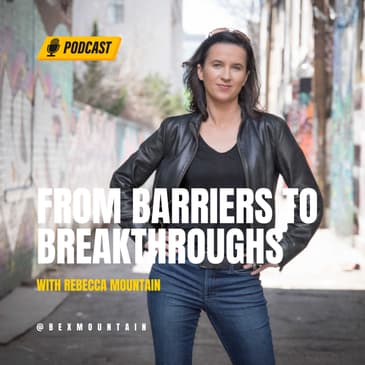
What if the thing holding you back isn't a lack of time, talent, or opportunity, but the belief that you have to choose?
I sat down with Rebecca Powers to talk about what she calls the Power of And. It all started with a surprising confrontation at work over a side project creating yoga-inspired t-shirts. What looked like a small moment became a life-changing lesson. Rebecca realized she didn't have to choose between being a successful sales leader and a creative entrepreneur. She could be both.
Our conversation explores how that simple shift unlocked some of the best years of her life. We talk about holding seemingly opposite emotions at the same time, giving yourself permission to pursue more than one passion, and why forcing yourself into someone else's formula can pull you further away from who you really are. Rebecca also shares the heartbreaking loss of her brother during the launch of her book, Return to Radiance, and how embracing both grief and joy helped her move through one of the hardest seasons of her life. If you've ever felt trapped between two choices, this conversation offers a different path. One built on expansion, acceptance, and the courage to stop shrinking yourself.
Key Takeaways:
- Why high achievers often create false either-or choices that keep them stuck.
- How embracing conflicting emotions can create more freedom and peace.
- The surprising connection between joy, creativity, and professional success.
- What happens when you stop following someone else's formula and start trusting your own path.
- How small acts of self-expression can unlock major personal and business breakthroughs.
About Guest:
About Rebecca:
In 2008, I blew up my life in spectacular fashion. I left a cult, got divorced, and for a time, lost even the few people I had leaned on. I thought greener grasses awaited me. I was wrong. Despite building a wildly successful digital marketing business, remarrying and growing my family to four kids, I felt nothing but dread each morning.
Then came what I now call Epiphany Town. It was that electric moment when I stopped defining my life by what happened to me and began building on purpose. That phase lit me up in a way I had never felt. Now I devote every ounce of my energy to guiding others through their own version of Epiphany Town. I help them find the barriers that are actually holding them back, finally let go of self-sabotaging stories, and leap into a life that is meaningful and deeply fulfilling.
I believe each of us has a story to tell, a gift to offer, and a life worth waking up for. Whether your goal is to impact one person or a million, I am here to help you see your place, claim your voice, and live your life on your terms.
Thanks for listening!
Thanks so much for listening to our podcast! If you enjoyed this episode and think that others could benefit from listening, please share it using the social media buttons on this page.
Do you have some feedback or questions about this episode? Leave a comment in the section below!
Subscribe to the podcast
If you would like to get automatic updates of new podcast episodes, you can follow the podcast on Apple Podcasts or your favorite podcast app.
Leave us an Apple Podcasts review
Ratings and reviews from our listeners are extremely valuable to us and greatly appreciated. They help our podcast rank higher on Apple Podcasts, which exposes our show to more awesome listeners like you. If you are enjoying the show, please leave us a review on Apple Podcasts.
[00:00:04] Welcome to From Barriers to Breakthroughs, the podcast that helps you create the life, business and love you truly want. Not with silver bullets or magical pills, but by removing what's actually holding you back. Here's what nobody tells you about getting unstuck. It has nothing to do with what you know, but it has everything to do with that switch within that
[00:00:28] allows you to turn that knowledge into action. Your breakthrough begins now. Welcome back to another episode of From Barriers to Breakthroughs. I am, as always, your host Rebecca Mountain, and I, in the interest of collecting Rebecca's and sprinkling them more throughout the world, have another one today. And this is Rebecca Powers. And Becca is one of my favorite people in the whole
[00:00:58] world. We were connected through a mutual friend and got on the phone and instantly just basically fell in love with each other. And it's been, you know, jazz hands and stuff all ever since. And so what I'm really excited to have Rebecca talk about today is The Power of AND. So she goes into a lot of want to sort of really showcase, if you're watching this on video, right over her shoulder is the book
[00:01:23] that she wrote called Return to Radiance. I have read it. It is absolutely phenomenal details and incredible story, which she's going to tell us a little bit about today. And I love her story and I love what she's done with her story. So because in this world of increasing polarization, you can only be one. And if you are one, you cannot be the other. There is no way of pulling two pieces together. Or so
[00:01:48] this is how the world appears. You know, we can, um, we feel that if we want to run a really good business, we can't have a social life or we can't have a personal life. I would basically kiss that goodbye, you know? And so what I love about what Rebecca is going to talk about today is first, she's going to share a little bit of story about where this power of AND comes from and you're going to absolutely love it. And then she's going to share with us some strategies of how we can
[00:02:12] stop living in an uncompromising world and build the world more of AND. So Rebecca, thank you so much for joining us today on this podcast. I am so excited and we're Rebecca squared. So who knows what's going to happen, everybody? It'll be awesome. Exponential. Oh yeah, there's a good math joke to start off the podcast. So you're welcome, everyone. Um, so Becca, you have such an amazing, I mean, I love who you are
[00:02:38] now and yet going from, you know, where you started to where you are now has definitely not been a straight line. Talk to us a little bit about like where this power of AND comes from and why you're so passionate about it today. Yeah. And, and, um, the story has many ANDs and, um, that has just become so fundamental in the stories I'm going to share because like Rebecca was saying, you can get polarized,
[00:03:08] you can crumble, or you can choose a different path. And so I'm going to invite you to consider a different path as I share my story. And maybe you can think about how you can apply it to your own life. So here we go. Rewind 12 years. I decided I was a senior sales leader on a board and I was
[00:03:33] bored out of my mind. I love my career. I I've had a great career in fortune 500. I've been a sales person, sales leader, all the things, but there's almost only so much selling and only so much sales leadership you can do when you become a seasoned professional or like your mid career and higher until you're like, I'm not fulfilled anymore. Right. So I have a creative bug in me. It's 2014.
[00:03:59] My kids are in middle school and I'm like, and I'm a yogi. So I was like, I'm going to make, I don't even know if you know this part of the story, but I'm like, this is where it all came. I'm going to make yoga inspired t-shirts. That's what I wanted to do just for fun. You probably also don't know how yoga inspired t-shirts has drama to it, but it does.
[00:04:24] So I decide I'm going to make chakra based yoga t-shirts that say, I am sayings like I am love. I am bold and they match the color of the chakra. And in the spirit of creation, sometimes when you just create for fun, you get opportunities. So I started sharing them on Facebook. I was just happy. I'm like, look at this art thing I made and I can wear it. You should wear one too. Right. I don't know.
[00:04:50] I printed like 10 shirts, whatever. I ended up getting connected to host my t-shirts at yoga journal live. And I'm like, Oh, this is so cool. So rewind 12 years ago or in 2014, I submit PTO to do my yoga expo and sell my t-shirts. What's PTO? I'm not familiar with the pay time off.
[00:05:16] Yes. Oh, pay time off. Right. I haven't worked for another company for like 18 years. So I have no idea when I'm in corporate jargon. So yeah. So I submit, I submit time off. I have to take a Thursday and Friday off and I'm so happy. My daughter's going with me. I'm just like, Hey, this is great. I'm taking pictures. I'm putting them on my Facebook. They're going to my Instagram. I show up Monday
[00:05:39] morning and it's like the principal's office. I get a phone call at my desk. It's like, Becca, can you come into the office? And I'm like, what the hell did someone on my team do? I was only gone for two days. Like I didn't think it was me. Yeah. Right. It wasn't gone that long. It wasn't gone that long. And I get called into the office. My director's talking to me
[00:06:02] and I'm not kidding. I get reamed out for making yoga t-shirts and how it, it is controversial to the leadership team that I'm not. And there's beliefs that I'm not committed to my leadership role because I have a business. Okay. All right. I'm sitting here and like trying to process
[00:06:30] all of this at one time. And I'm like, this is a little ridiculous. I'm like one of the like main leaders, the, uh, I don't know if he was a president or the vice president at the time is in a band. I'm like, how different is me doing yoga shirts on a weekend? Any different than like playing in a band? Yeah. And so I really stood my ground, which was, you know, we're, we're much more liberal in corporate America these days, comparative to 12 years ago. So it was very,
[00:06:58] if the story is kind of funny, but it was really serious at the time. Like I'm, I have a director that I'm sitting face to face with. I'm getting told that my job's on the line because I made yoga t-shirts and I have to choose whether I am going to go shrink and go small. Am I going to stand my ground and hold my, and what am I going to do? And I didn't even call it that then, but I remember
[00:07:26] saying to myself, I'm like, if I don't stand up for myself and I don't make space for both, I'm going to shrivel up and die on the inside because I, yeah. Because otherwise you have to go back to just being a salesperson and not really fulfilled and not really challenged. And that's not a very good existence either. Right. Okay. So I had to be quick on my feet. I'm like, how do I counter this ridiculousness, but also not lose my job in the process.
[00:07:57] And what came out of my mouth was there's room for both. One doesn't compromise the other. Right. I said out loud, I'm like, there's room for and. Hmm. And I felt it like, I always say it was like the Grinch, right? Like I, I felt my heart expand. Like I really did. It was a visceral reaction because not only did I stand up for
[00:08:26] myself, but there was a greater truth, a bigger truth coming in and saying like, there's room for both. Like, Oh my gosh. And when I, when I held that and I said, yes, there's room for both. I get goosebumps still to this day. Um, it shifted so many things because at the time I was a mom with a professional career with four kids. It made me own my mom-ness without shame. If I had to go get my kids, I was like, I'm a mom and I'm a senior sales manager. Like, guess what? How many times
[00:08:55] am I home and logging into the computer to manage the business? Like this layer of shame and guilt just melt it off. So I'll pause and let you come in, but that's really where it started. And then it just went gangbuster after that. So what did they say? So when you said there's room for both and you know, there's room for, and what was their response? Cause they would have had to back down in
[00:09:20] order to allow for that. So what was, what was that? Like, did it ever like, did it create tension or did it just kind of go, Oh, okay. Like this kind of makes sense. Both. There was tension immediately after the words came out of my mouth and I'm just sitting there like, Oh my God. And I use the example of the boss playing in a band and then you could see
[00:09:47] the wheels start turning and them thinking, I really don't have a right to suppress her from creative expression. And then it all stopped. And no one said a goddamn thing about my t-shirts ever again, but the empowerment I got from it gave me the courage to continue to pursue and grow. And, and now, you mean, we can get to that eventually in the storytelling of where I ended
[00:10:15] up taking everything. But, um, you know, fast forward 12 years later, I've had the best years of my career. I had the best years in my personal brand as a writer, author, and speaker. And there's more storytelling in between, but it unlocked, it was a complete unlock. Right. And so like, would you say, cause there's always sort of these catalytic moments in our lives when we're like, ah, yes. Like mine was hanging upside down in a car after careening backwards
[00:10:42] off an on-ramp, you know, because I was so freaked out about trying to leave this call, but so scared about doing it. And that's one of those moments when you, you just know nothing will be same from here on it. Like nothing. And for me, nothing was the same from then on it. And I've had other big moments that are sort of like built on it or that have like blown up, but it's, it's always comes back to, but that was that moment. So would you say that sitting in that
[00:11:07] chair was that catalytic moment for you to be like, okay, so I'm just defending 10 t-shirts, right. Or whatever, how many t-shirts you did. Like, it's just a chakra t-shirt, but then like, I am love on it. But like you've mentioned, it really expanded into more areas of your life. So my question is twofold. One is where did you go with it? Right. So like,
[00:11:32] what was the trajectory in terms of like, how did you build on that? Um, and what did that do for, for you in terms of, cause that again, when hanging upside down, you know, wheel spinning glass everywhere, you're like, something's got to change. And everything I did from that point on was completely different in terms of like very much standing up for myself and whatever, but yours, is it, did it manifest itself in that? Like you always stood up for yourself or is it just
[00:12:02] that, did it go take you in a different direction? Like how did it alter? Answer that with another story because kind of like how you were saying with your car accident, it, that was the defining moment. Like I get the goosebumps talking about it, but normally when you have one of those life-changing moments, there's another moment or two that is in tight sequential order with that one to kind of like cement that this is a thing. And so really probably
[00:12:31] within the same couple of weeks, I was, uh, getting certified as a Kundalini yoga teacher at the time. And two things happened within two weeks of that event. I was at Kundalini yoga one of the weekends and one of the women in my, you know, in my class challenged me and said, I bet you can't wait to quit your soul sucking job once we get certified. And like, I love my career, you know, this, like,
[00:12:58] yeah, I was like, I don't want to quit my job. And I'm like, I'm not going to make any money as a yoga teacher. I make six figures. Like, you know, I just happened to also like yoga. Right. And then when I went to work that next week, one of my peers had asked me like, are you really going to quit our quit working here to be a yoga teacher? And I'm like, why, why can't I just enjoy being a yoga teacher? I'm like, first it's my t-shirts now. Like I can't enjoy being a yoga teacher. Like what is going on?
[00:13:28] But I had learned something from the t-shirt experience. And so I held that space for both and in those conversations. And I felt that same level of empowerment starting again. And I'm like, whoa, like this has to be a thing. And then the third moment, again, in that short period of time, I was in Kundalini yoga. And I think this is really interesting for the listeners too, because
[00:13:53] life is full of duality. It's constantly in polarity. Yeah. We're not conditioned or taught how to hold that. And during my teacher training, I had to do an hour meditation where I had to hold two, two real emotions that were happening in my life that were contrast at the same time.
[00:14:15] I had to sit with sadness and joy and let them both. Yeah. See, I had to let, Oh, I get the goosebumps again. And I really just had to let that space within myself hold both. And I can, I tear thinking about it because not only was it empowerment, you're, you're hearing that side, like it is very
[00:14:45] powerful to hold your ground. Um, but then when you break a societal conditioning, when you feel that happen, like my brain was never the same after I had to hold the emotions for two, you know, polarizing emotions for an hour, I felt freaking liberated. I, I left that meditation, a different person. And then ever since then, I've been calling it the power of hand. I mean, three moments,
[00:15:12] two weeks away from each other. I was like, dude, this is a thing. I think everybody can know about it. I'm like, yeah. Yeah. But I mean, it's, it's interesting because, um, you know, through my therapeutic journey, cause it takes a village to sort of the trauma that I grew up with. Um, you know, we were talking about this one individual and I'm like, I can't forgive them,
[00:15:36] but I want to. And so, because I love them, but I, but their behavior was terrible. Right. So I felt very, very conflicted. So anytime we talk about it, I'm like, well, they didn't mean it. Well, it's okay. And then she was just like, okay, hold up a second. You can hate what someone did, but love them all the same because emotions and, and from there sort of spring an additional philosophy, which is sort of building off of what you just said, where there's no good or bad
[00:16:02] emotions. They just are. And it's their intensity that allows us to either see clearly or to have it distorted. And so, you know, everything when you, but when you can accept the fact that that duality, that we are both these things, we are complex creatures. We can be happy and furious at the same time. We can be proud and devastated. We can be feel guilty and excited. Right. So it's, there's so many different things that people would say, well, you are there one or you're the other.
[00:16:31] It's like, no, we're like, we're actually about like a whole bunch. And even when you look at like neurodivergence that people say, it's like this spectrum, I look at it as a globe and, and the degree to which you kind of move away from that quote unquote neurotypical sort of core, it changes over time. And so like, I love the power of, and, um, and I want to know more about like kind of how you've pushed this out and like, who have you, who have you talked to? Like what have
[00:16:59] your clients? Like, I know you did coaching for a while. Um, you know, and I want to know more about that and all the different transitions that you're making, but how and played a role in all of them. Yeah. So, so tell us a little bit more of the end, um, in my journey. And then I'll, I'll go into, like you said, clients and what I've seen it do for other people. So this, um,
[00:17:22] everything I was talking about was 2014. Let's for fast forward to 2016. I'm now full owning my and as many ways that I can. Um, I'm no longer scared or feeling threatened by someone else's opinion of it. And, and I can now have very strong and eyeopening conversations about it that I would challenge someone and say, you should try it too. Right. And, but as this, as this embodiment
[00:17:51] gained momentum by 2019, I was ready to write my book, my first book, which is harness your inner CEO right up there. And is in that bad boy too. And it's in that one too. I talk about it all the time. Um, so, but I was like, I'm going to write my book. And what I didn't know is that there was more unlocks to come as soon. And I was in the, like the pinnacle of my career. I'd stepped down from
[00:18:17] senior leadership, but I went into executive level sales. I'm doing hard stuff, but I love it. So there's all this passion coming out. And most people, like you said, would probably say, this is a terrible time to write a book. Why would you, you're at the peak of your career, super stressful, but it's super awesome. You should just be focusing on that one thing. And I'm like, but I'm not one thing. Like you, there's no way anybody could tell me by 2019
[00:18:43] that I was singular. And so I was like, no, I'm going to write this. And that passion is going to fuel this because that's the way the and work that and expands the and multiplies. You've got the formula wrong. That's not my fault. I understand it. So I'm going to do it. And that's exactly what happened from 2019 to today. I, um, had the best seven, eight years. I'm now retiring from, from tech, but I had the best run of my career. I made the most money. I got the most awards. I got the
[00:19:13] most accolades. I had the most fun, most importantly. And then my and brand, what I like to call it, I wrote two bestselling books. I have a top 10% global podcast. I built a six figure coaching practice. I was on fortune five. I'm still am, but I got onto fortune 500 stages. I mean, there was no limit to what you could tell me I could do. If it was burning inside, I was like, I'm going to do it.
[00:19:39] And now I have five or six ands versus two and everything just multiplied. So yeah, then I was like, I want to coach this and teach it to other people, but I don't know if you want to. Yeah, I do. Cause I have a question on something that, yeah, there's something that you said that was really important because, you know, if you're looking at just sort of at the end brand, like at the surface, like two things can come together as a duality, a polar, you know, a polarity can become
[00:20:07] one thing and nothing needs to be compromised away. But something you said that that was really interesting when you accept the whole idea of, and everything expands. So it actually has a synergistic result to it. And that's what I'm really interested in because I've experienced the same thing. Cause I'm also like, you know, as soon as you tell me I can't do something and you're like,
[00:20:31] well, here we go. Now you did it. And now I had to figure this out. And just like away we go. Cause you know, I was always told building my, uh, the new programs that I have now, like you have to do it in this way, but it was built in such a way that actually super stressed me out. And I eventually just sat back and I'm like, I don't want to do this. I want to have my business and not have to do all like do anything by date. It's my, my whole, and it's absolutely trauma-based.
[00:21:01] And, um, it's all about the idea that if I have to like get enough people to attend an event, everyone, it seems in their uncle can do this very, very successfully. And I can, and I have, but I nearly like turned myself inside out trying to do it. And my husband has begged me multiple times to stop doing it. Um, you know, but when you can sit back and stop trying to force, right? So in your case, you were like very clear, like I want to do these two things
[00:21:28] for some people, it's not always clear because they think they, they have to do something. Yes. And it's a, I think it's a really awesome. So there are two questions coming out of this clearly. So the, you know, the first one's more of a statement than a question is that the end process can kick off when you're pushing up against something and it's not working for you. So for me, it was the date specific type, like my certification. So you can be certified
[00:21:52] to deliver my methodology called the mountain method. And if you look at how everyone else does a certification nine times out of 10, it's like coming at 10, three or four days, get certified off you go. And that was super stressing me out, but being able to approach the end method methodology of, okay, I have an or going on here. This isn't, I don't like this. I don't like this. How can I sit back and see an end? So just having that perspective,
[00:22:19] but now I'm going to circle back because I get new ideas as I'm even asking you questions. So I'm going to just pop this question out and just save my next question for the next time when I, when I can get in here with you, but it's, what is it? Explain the process. Why is it when we accept the end, right? That I don't have to be one or the other. I don't have to do one or the
[00:22:44] other. I can do both that there's actually a one plus one equals five. Yeah. So there's a lot going on in the psychology container of both and right. But it's simply I've used this phrase, but I'm going to say it again, the end expands and there's a science and psychology around it. Just think energy, right? Or constricts. And so when you're in constriction, you create more constriction.
[00:23:11] That's just the way it goes. And then when you're in an expansive energy, it creates more expansion. So then this is why it moves. In my case, it moved from two things to three things to four things to six things because there were opportunities doors opened and I continued to fall. I continued to say, yes. Now there's also a practical side. At some point you're going to get tired. You can't just say
[00:23:38] yes to everything. Right? So you guys are there's a dark side of and that you have to know that not to fall into. So how do you, how, how do you mitigate that? Like, how does your and not become overwhelming and then crushing? Well, it has gotten overwhelming for me because I did, I came out of what I would say that magical energy of expansion and then went into my logical,
[00:24:03] practical, practical business building self. So I went more into contraction energy. Let me follow formulas and do this and do that. And what I've learned to be true through myself and my clients is that we all have our unique imprint. We all have, you and I were talking offline about chasing more joy and chasing more fun. I think that's a really important element when we are making decisions and
[00:24:30] that lights us up. That's going to put us into that expansive energy. And when we're making decisions and we feel that it's constricting, we normally bypass that with some type of logical thing. Well, I just got to get this and I'll get to the next phase. And even in myself, who I would say is a seasoned and or I, um, that's a word. I lost track of that. I got stuck in the practical and without even
[00:24:55] knowing it, I kind of came out of my magic. And so what I would say to a listener is if you're like, Rebecca was giving some good, um, examples of, or if you find yourself in an, or is there a potential for an, and normally there is, and what is that just allowing two contradictory things to exist at the same time? Is that giving your permission, yourself permission to be two roles at the same time? You, there's a level of self-exploration that needs to happen with that.
[00:25:24] But if you take the time to just ask yourself a quick self-reflection question, you can get untangled pretty easy, but if you don't stop and you just push through and you just power through, that's how we get cycles where we're out of balance or out of harmony. I prefer to say, cause I'm like, I don't know if balance even exists. No, I could get a phone call right now and my whole life could change, right? Like you never know what's going to happen. So, but harmony, I'd like to say is a better word. Um, if you want to stay in harmony,
[00:25:54] take the time to consider what you're doing and what you're feeling. And is there an option to expand or shift your point of view? Yeah. And I think you mentioned something really important, um, is that you, even though you're, like you said, an experienced and, or, um, cause that's now a term and this is what we're going to do that you can still lose sight of that. And, and go into the
[00:26:20] formulaic approach, like, especially as entrepreneurs, everyone and their uncle has said, well, stop doing it that way. Start doing it this way. Don't do it that way. You should do it this way. Drop this, start this. And, you know, so, you know, follow this formula for blah, blah, blah. Um, and you can lose your way. Like I'm a high performer. I teach high performance. I, you know, I answer the question, why do people not do what they know they should be doing? And yet sometimes I fall into this same
[00:26:44] trap everybody does. So here's my question for you. When you, whether you're new to ending, cause now it's a verb. So when you're new to ending, um, or you are a, you get skilled in it, like you read your book or you attend your, your programs and you become a skilled ender and yet you fall away. What are some of the things, like, is it a phrase? Like sometimes if no one, if you've
[00:27:13] never experienced self-discovery, if you've never given yourself permission to discover yourself, you don't know what to ask. Like you don't like how it's like, believe in yourself. Well, how the heck do you do that? Well, when with research, it's the emotions you have about something and then the thoughts you say. So what you feel and what you think becomes what you do because this becomes your belief system. Ah, okay. So believe in yourself as a combination of understanding
[00:27:41] what emotions you're feeling and then being self-aware of your thoughts. So that's sort of a process, a one, two, three, one plus two equals the other feet. Emotions or feelings plus your thoughts will absolutely instruct what you do. So if you're not doing what you should be doing, you just back up the algebraic expression and you just go hunting for that. Right. So that's a very, very linear way of looking at, you know, someone who is just kind of just totally stuck doing a whole
[00:28:09] bunch of things out there that makes them miserable, that they are avoiding something or they're procrastinating or being perfectionist and like whatever, whatever is happening, what they're doing isn't ideal. How do I fix it? You know, a one, two punch is a great way. And by no means is that the whole formula clearly, but it is certainly a place to start. So how do we get ending or if we kind of fall off because I would consider myself also an experienced ander and I
[00:28:35] can lose sight of it. How do I get myself back onto that wagon? I think you'll probably agree with this, but it's, it's, it's simple yet profound. What do I like or what? Aha. I use what makes me happy. Yes, absolutely. It's a question people struggle to answer and they will say what makes other people happy before they'll talk about themselves. Sorry, I had interrupted. I was like, I was hoping you would interject because it's, it's that simple yet
[00:29:03] profound when I got 18 months off my track. Right. And I had high consequences for it. I have a business that I tried to, that, that scaled and failed, um, that I had to reconcile. I've got over six figures worth of debt, which is fine. Like I'm an entrepreneur, it'll get paid off, like whatever. But I'm saying like, there's consequences for not stopping to ask the dang question. Right. And so it
[00:29:25] took me 18 months to be like, Oh, okay. I stayed in boxes. I went in societal programming or entrepreneurial programming or whatever. I fell into someone else's programming. I fell out of mine. What would I like to be doing instead? What makes me happy? And I'm a doer by nature, but I'm a doer through creative expression. So I'm like, Oh, I haven't, when was the last time I was on a keynote?
[00:29:54] Six, seven months. When was the last time I sat down to write anything substantial besides like curriculum, probably a year, you know, like those are the things I like to do. Those are my ands that set the environment for expansion. And so when we get off path, I think it's, it's so simple, but what do you like? What are you missing? What makes you happy? What used to fill you up? I mean,
[00:30:23] you can go through a series of those questions, but you ask yourself three, four or five of like minded questions like that. You're going to find your way out. Yeah. I often find that sometimes people who are really stuck. So, you know, you and I have had very challenging paths. We'll call it that. You know, I'll speak of mine in particular. And so sometimes these kind of entrepreneurial systems
[00:30:49] that we can, we hear about and we get feel very, cause it's anxious, right? It's anxiety. Like, am I going to do it right? Is this going to work? Oh my God. Like I better do it this way. I follow someone who's done it. So I don't fail, you know? Oh yes. And we all know just because they did it doesn't mean you can blah, blah, blah. We think about that afterwards. But one of the things, and one of your opinion on this is sometimes it's, what do I like or what makes me happy is so hard to come up with because we've never given ourselves permission to do that.
[00:31:16] Like you, I have, you know, some people who were like never supposed to rise above a certain station in life. That's how they were raised. Like you do not go to school. You do not make this much money. You do not, you do not, you do not because our family doesn't do that. Women don't do that. Men don't do that. Like there's all these different sort of arbitrary restrictions. And so to say what I like is just not something they ever could go down because it actually would get you into trouble. And that's what happened with me. I would get in trouble for thinking
[00:31:44] about what I like because I was considered selfish. And so I would feel like I was always going to get in trouble, not just for what I did, but for what I thought. And so it creates this massive anxiety, psychosis that I continue to try to pull myself out of. So what I find sometimes, like for instance, I'll give the example of that time-based thing that I was doing with my certification. It's just, that's what people did. Okay. I guess I have to do that, which is usually one indication that
[00:32:11] something is wrong, that you have to do it that way. Fun fact. No, you don't. But what I started with is what don't I like? Is it the certification I don't like? Is it the timing I don't like? Is it the frequency I do? Right. It's like, so you kind of back into the negative space of what makes you happy by looking at the black space of what doesn't and trying to figure out, okay, so if I can pinpoint
[00:32:34] what doesn't make me happy, then sometimes you're like, okay, well, what's the antithesis of that? What is the other, the opposite of that? Like I had a really challenging conversation with someone who wanted to sign up for one of my programs. And he was basically, um, in a very respectful way saying, I'm just like every other coach has ever come along and blah, blah, blah. And you're just touting your same bullshit. And you're going to say the same stuff and whatever, whatever. And he's
[00:33:03] like, what happens if there's something in your life you cannot change? You just cannot change. And I'm like, then you accept it. That's where my brain is. Right. Exactly. Right. Cause you and I have very much the same brain, very much the same training and have pushed through so much. Like something that you and I know there are certain things we're just never going to get around, right? Like I'm never going to get around my neurodivergent
[00:33:28] wiring. It's not like I can, there's no fun fact, no cure for autism. And while you can take medication for ADHD, it doesn't make it go away. It doesn't change your brain structure. I'm so to try to not be me, which I did for a very, very long time, because especially a woman with ADHD and certainly one with autism is this crazy unicorn. Nobody wants around and please don't talk about it. So we mask, especially women, we mask our neuro, a neurodivergence
[00:33:55] when you stop masking and start accepting, right? And that's what I told this gentleman. I said, just like, well, then you accept that that's what it is and you leave it there and you build around it. It's like grief, grief never goes away when you lose someone. And I know you've suffered tremendous loss. So you can probably speak to this even deeper than I could. I'd love to hear your
[00:34:17] thoughts on this. Um, but grief is something that never goes away. We build ourselves bigger around it. So to try to take grief and stuff it or push it aside or tell ourselves like we shouldn't be this sad or no one else seems to really be affected by this. So maybe I shouldn't be. And we start to really stuff our emotions. First of all, it's super dangerous and bad for our health, like our physical
[00:34:41] health, but it's not, it's not allowing us that growth that can come around it to build an and like we can be our grief and our joy. And so just in, in context of some of your really tough experience and share as much of that as you want, we can just leave it at really tough, super shitty experiences, et cetera. Um, you know, but like, what did you do to accept because we've like, cause and sometimes
[00:35:11] includes acceptance of something that we cannot change or that just is like, if someone goes, who's like, if someone passes away, can't bring them back. So I'm going to share the story of losing my, my brother. And it was at the same time I was in second edits with a return to radiance and you want to talk about contradictory things. So, you know, for the audience, for context, I am the, I'm the sole
[00:35:41] survivor of my family. My mom passed away when I was 22. My dad passed away when I was 36. I was 44 when I was writing a return to radiance, which was, you know, talk about dreams come true. I got picked up by a publisher, you know, been chasing my dreams for a long time, but I've been paying for them to come true. And then like you get picked up by a publisher. You're like, it's like, as an author, you're like, I made it. This is the greatest thing ever.
[00:36:08] Woo. And, um, March, this is a really messed up story, but it's a good, good example. So on March 27th, two years ago, so 2024, I get a phone call around three or four in the afternoon that my brother has been rushed to the hospital. And the expectation of him being alive when I get
[00:36:35] there is less than 5%. I think they actually knew that he had transitioned, but didn't want to tell me over the phone. Okay. So I, um, rushed to the hospital with my husband and get there to find my brother passed away. The story behind it is that he had a seizure while he was in the pool with
[00:37:02] my nephew, his son, who was only five. My sister-in-law was at a doctor's appointment. My brother had a seizure kind of unexpectedly. Right. And while he was in the freaking pool and he drowned to death, he was in the pool with my nephew. My nephew's fine, but my nephew was five. He tried to save him with the fire hose, like, or with the water hose. Like it was God awful. Good
[00:37:28] wrenching. He's my only sibling. My brother and I were tight and I was supposed to have dinner with him that night at six o'clock. Oh, Becca. And so my whole world shattered. My whole world shattered. Talk about grief. The grief was so big. I didn't even know where to put it, you know, like,
[00:37:53] and traumatizing and unexpected. He was 42. I was 44. Like now I'm the last supposed to happen. It's not supposed to happen. And now also not only grieving my brother, but now I'm going through a, um, you know, from a psychology perspective. Now I'm also going through orphan. Like I'm the sole survivor of my family now. Like that's a whole nother layer. And so grief is big and I'm still
[00:38:18] in therapy over it. Right. So, but at that same exact time, I was in the second edit for a return to radiance and I had to have my manuscript turned in, in six weeks to stay on schedule. You know, when you're working with a publisher, you're on schedule. Yes, I do. So I provide the news to my publisher and they're wildly compassionate. They're like, listen, we'll move you to the spring
[00:38:44] schedule. They only have a fall schedule and a spring schedule, but I already, I mean, you're an author, you know, like you already got March and October is when the books like, I already have all my plans in place. I've already got like my assets, my support groups, my contractors, everybody is all engaged. We're ramping up for a six month pre-launch. Like everything's guns blazing. Websites are being built. Like, and I'm faced now with a choice. Do I
[00:39:13] just turn everything down so I can grieve or do I make space for both and continue forward? And I had to sit with that for a couple of days, but then I decided I'm like, you know what? This has never done me wrong. I've already, you know, had the experience and how liberating it was, you know, 10 years earlier being in that yoga room and holding two, you know,
[00:39:42] contradictory feelings at the same time. And I'm like, this is life. And so it goes to acceptance too of what you're talking about. It's like, this is life. I have a book that is like, my dreams are in one hand. And the biggest tragedy of my life is in the other. This is my life. And I'm going to say yes to it. I'm just going to continue to show up and I'm going to honor this and when I honor this,
[00:40:08] and it might be messy and will definitely be imperfect. And I get the goosebumps as I say this, but I knew he wouldn't have wanted me to stop either. So that was kind of like helped me be emotionally okay with both. Cause it's how much, some at times I did struggle with, maybe I should just calm down, you know, like stop everything to honor this grief because it was so
[00:40:34] big. And, um, anyways, fast forward, the book releases October 8th, I think it was. And a week later I found out that I hit USA today. So during this period of my life, I hit my biggest grief and my biggest accomplishment all because I gave space for both. And because I chose not to suppress the
[00:41:00] grief while chasing this. Um, it went through me. You have to go through it to get through it. So it's still part of me, but I'm not locked. I'm not taken down by it, you know? And then, um, I got to achieve, I got to be present for my book launch. I got to stay on schedule. I hit USA today. And I was literally talk about another. And when I found out it hit USA today, I was in California
[00:41:27] with your sister actually at sales. That's right. Yeah. Launched and hit the list at the same time. I was at sales champion for overachieving my quota and also going through the biggest grief cycle of my life. So there's this another round coming in just two years ago. That's like, this is the thing that can save your life. Like now before I thought the end liberated me, I think the end saved my life
[00:41:55] for sure. And that's the biggest end experience of your life. Like you said, like the greatest of your achievements and the greatest of your, you know, sadness and tragedy. I absolutely without that kind of perspective of that you can hold it. Cause it was almost like that time when you were holding the joy and the sadness in your hands for an hour. It's that like times a billion. It's like
[00:42:23] the nuclear explosion version of that, that you now had to have, but if you hadn't had that small version of that, okay, let me hold it in a small way. Then when you had to hold it in a big way, you wouldn't have the strategy. And that's what's so wonderful about, um, you know, whenever you're learning anything. So any of the listeners who are listening to what we're talking about today, um, if you've never practiced ending, um, and, uh, just sort of love how we just created
[00:42:50] an adverb soon. Um, but if you, if you've never been ending before, like start with something small, something like, like what do you like, where are you at right now? What are two maybe conflicting emotions you have about this, about something, right? And just sit with those seemingly conflicting emotions. And yet accept that they're actually not in conflict with each other. Like we are not in,
[00:43:18] we are very complex creatures, but we don't have to be conflicted creatures. And I think that's a really big distinction that what you went through was incredibly, incredibly complex and deep and big and intense, but it didn't, you didn't make it conflict. And I think we make our lives conflict. We create these, um, barriers to the joy that we want when really, if we just sort of like broke down
[00:43:45] all the barriers and let everything kind of smoosh together, that wonderful, you know, conglomeration of things is actually where the joy comes from. And you can, like you said, you can say yes to all the things without, okay. Of course, you know, with the tiny little qualifier asterix for those like super overachievers, you know, like you and I like do all the things like perhaps not. So put in some, maybe some guardrails along the way so that we don't explode. But even at the same time,
[00:44:11] like the end process is about those guardrails, because if you're constantly asking yourself, like imagine doing, I'm just, this idea just blew into my head. So of course I'll share it because I overshare everything. Um, like an end audit of your life, where are you ending and where are you or worrying or worrying that that sounds really weird to say that? It sounds like I've got marbles in my mouth, but you know, like, but where are the, where's the end appearing in my life and where is
[00:44:40] the or, and when you do that, when you take a step back and I love doing that, like, um, I'll take a notebook and a pen to the lake and I'll just sit there and look at the water away from my phone, away from my computer. And I'll just sit there and think and not try to force any thoughts. I'm not where do I have resistance? Where am I either creating resistance or where am I, um, forcing
[00:45:05] it? Right. So like I was forcing myself into the certification process, right? And again, I'm just using that because it's an easy example. It's fresh in my mind because I literally blew up something. I took a year and a half certification process too. Yeah, exactly. So I, like I built it. It's all time. I have to like, kind of like pull it apart. And you know, I, I downgraded my tech team. Um, also because of the debt that I, you know, pulled together, putting it, building it and having to kind of scale back. Cause I'm like, I'm going to go out of business if
[00:45:35] I don't do this soon, you know? So understanding that yes, there's going to be some work to get me from where I am in the certification process to what actually makes me happy. But I can't even begin to tell you how much more calm I have been in the last week and a half since making that decision. And it is, it is fantastic because, and that's how you know that you're ending. Yes. Right. Cause when you're in an or frame of mind, there's tension, there's stress,
[00:46:05] there's anxiety, there is fear. And that's kind of, that is when you become like, and again, you and I have worked through this a lot, but when you become very attuned to what's happening in your body, like I'm not sleeping very well. I'm anxious. My tummy's upset. You know, I may be a little bit snippy, you know, with people around me and I'm like, okay, I'm, I'm feeling or behaving off. Where is that? Where's the, the stress coming from? And again,
[00:46:32] that's that book by the leg, take a, take a good hard and audit of your life and kind of go, where am I ending? And what am I, where am I or in, where am I creating resistance and creating stress? Cause most often we make things worse for ourselves. There's always going to be stress in our lives, always going to be stress in our lives. And we need a little bit of stress in order to sort of like shake us out of our boring little familiar tree. And we need a little bit of fear
[00:46:57] in order to grow. But if it goes beyond a certain level, now it starts to really affect us. And so, um, do you do any, like, do, do that? Do you just kind of like take stock of your life every once in a while and kind of like get my, and I'm like smiling because my entry level, um, offer is an and audit. No way. I didn't even know that. Oh man. I wish I could have promoted it. Yeah. Like where are you aligned and where are you out of alignment?
[00:47:26] Oh, that's brilliant. Okay. Well, there you go. Yes. We thought about that. Perfect. So tell me a little bit about, um, cause I want to know more about like, what do you, how do you help people with anding? So clearly it's the end audit, what kind of stuff goes in there? And like, tell me a little bit more about other ways that you help people. Yeah. So right now,
[00:47:50] I'm really just, I love helping professionals create their and brand, right? Like, and I used the word in there. And I also love the power of and so where, where I'm going today is from a philosophy perspective. Like we're talking about now, workshops, podcasts, keynotes, books, like bigger, you know, like huge one to many. Right. But when I'm working one-on-one with people, I like bringing their and
[00:48:19] to life and most high achievers attract other high achievers. So weird, right? And they're not all named Rebecca, but the good ones are. Yeah, exactly. Exactly. And what I have loved doing over the years, and I was just doing it on the side. I didn't actually have an offer for it, but that's how I knew it was when I decided to go full, full on and retire from tech and go solo. I was like,
[00:48:46] I just want to help people bring their hands to life, like, and get them in a position where they can eventually monetize from it. So I call it dream hatching. And sometimes it starts off with just getting reconnected to hobbies before we go deeper into writing a book or going on stages. Like there's definitely outcome driven people that I work with that come to me because they want to do the things that we do, write books, get on stages, start podcasts, get on a board. I mean, all sorts of
[00:49:16] those tangible outcomes, right? But it doesn't start there. The journey starts with permission. We have to give ourselves permission to and in the first place. And to your point, most people aren't used to that. So sometimes we got to start small in the process. And this is, I'm going to give a little like action item for the listeners too, so you can start ending since that's now a
[00:49:39] thing. And so I'm going to give the tip and then I'll finish what, what I do. So, but the tip is get reconnected to something that you love to do. And when we were kids, I always tell people go back to your childhood and we normally go back to our trauma, but even I had a traumatic childhood, but even in my trauma, I would put on Whitney Houston in my bedroom and dance, right? Like it's the eighties.
[00:50:06] That's what happened. And so when I get stuck, I'll just start doing something simple. I'll I'm in a bad mood. Now we talked about emotions we can hold to at the same time. I'm cranky. I'm stressed. I'm frank. I'm recognizing it. I'm going to do something that holds space for the opposite emotion. Gotcha. We just start giving its capacity,
[00:50:34] right? We need to give ourselves capacity to expand so you can start simple like that. The crazy thing is, you know, you, you've presented for our sales team before and, and all that, but even in my, with the sales teams I've worked with or have been on, I introduced this little concept of like just dancing or doing something creative that doesn't have any monetary output to it. And I'll get phone calls a month later, six months later, I got promoted. I got, you know,
[00:51:00] I started doing this thing and then this thing happened and then I got promoted or my sales increased by 20% because I'm happy again. And all I started doing was I had one lady specifically, she just started dancing. Cause you like that Whitney Houston thing I said, she was like, well, that led to me remembering that I used to love to cheer when I was young. And then she signed up to be a cheerleader coach. And then it was so fulfilling working with like 10
[00:51:27] year old girls and her, then she ended up being like a two times sales champ, two year back-to-back sales champion. And I got an email from her that she was in a keynote audience. So she wasn't a client, but I got an email from her like a year, two years later saying, this is what I did. And this is what happened. Wow. That doesn't have to be big. Now what I do for work is do the big thing. I want to
[00:51:51] help you have your career and build the build what's next while you're still in like your best season. And the two compliment each other so well, like we've talked about all the expansive qualities. I did it myself and the outcomes were, I had the best years of my career and I built a whole brand that I could stand on. Yeah, absolutely. And so, um, how, where do people find, cause I know
[00:52:17] you're sort of, you're in rebuild mode. So I know this is our, whenever people are listening, it's going to be like, you know, an evolution because there's always evolutions when we're entrepreneurs, but where, where can people engage with you about ending, doing the audit, finding out more about your programs or just generally hanging out with you? Because like, I like hanging out with you. So I just assume that everybody would also get with you, but I still get special status. So where can people connect with you and find out more? Becca powers.com will have all the ways to get in touch with me,
[00:52:47] depending on when you're listening to it. It may not be reflective of all the ending yet, or maybe by the time you get there, but LinkedIn for sure. Um, I'm at Becca powers, official Instagram, same thing. Becca powers, official DM me. If you, there's anything you liked on this and you have a question, I'm happy to answer. I'm very, very friendly. If you haven't noticed, I will respond. Um, and then my books are found everywhere that books are sold.
[00:53:13] So, right. That's a, that's me. And so the, the one you just read the return to radiance and the other one, what's it called? It's just sort of out of focus on the harness your inner CEO. Okay. Very good. Um, that's, that's awesome. Well, Becca, I am, I'm really, really glad that you came on today, um, in a polarizing and in feeling like it's increasingly polarizing world,
[00:53:38] whether it's with politics or relationships or the economy or work or whatever, um, adopting even just for yourself, more of an end philosophy of being accepting and of doing the and audits on yourself on a consistent basis. Like I, I feel like this is something I definitely want to like grab my book and go to the lake and just do my own and audit. I mean, I know I did one for the certification, but I'm like, where else am I doing that? These is probably hiding other
[00:54:07] places. Right. And so, you know, I think that's really important, but it's also really important. And this is something I've shared on previous podcasts, but it bears repeating here. Um, because some people think they're like, Oh no, I'm fine. I know. I like, I like, I like everything. It's good enough. It's good enough. It's good enough. 70% of our negative self-talk and some of the negative feelings that we have that are actually self-defeating. It's not even that they're negative, but they're self-defeating and their barriers go completely undetected. And the higher performer
[00:54:36] you are, the harder it is to detect these barriers, the harder it is to hear that inner voice of like, maybe, maybe you don't have to do it this way. Maybe you shouldn't do it this way. You know? So I love being able to, you know, to share that audit process. Is there anything sort of just to kind of wrap up our conversation here? Cause I know we could go for hours that you feels like really important for listeners to walk away with and to kind of chew in their heads as
[00:55:05] they're, you know, carrying on with their day after they're done listening. Well, I would say just to piggyback on you, give the and a try. It wouldn't hurt to feel a little bit more joy. It wouldn't hurt to feel a little bit more opportunity. It wouldn't hurt to feel a little bit more expansion. So just try it. You have nothing to lose. It's an experiment. Right. And if you're, if you're scared of it, depending on what kind of life you're leading right now, like if it's high risk, high stress or whatever, just start with something tiny,
[00:55:33] just start with something teeny, teeny, tiny, and just hold space for the, both the fact that you can be many, many different things. We are not just one. We are not just, you know, a one-sided thing. We're not even two-sided. We're like I was talking about at the beginning. It's a global kind of a thing. And there's lots of stuff that's in there. And just to accept what's there and accept that expansion is possible. Becca, thank you so much. I love you to death. We already know that. So always I'll have you, I'll have you again, because I want to know like the evolution
[00:56:02] of what you're doing and like, well, it kind of, we will meet again. But for all my listeners, please do go follow Becca because she is an absolute radiant person inside and out and someone who has lived through it to be able to be someone that you can trust. Like one of the best people that I love to follow are the ones that have been through the fire and come out on the other side, a little bit singed, maybe a little bit smoking, maybe a couple of things on fire still, but you know, still moving and still shaking and still with a beautiful smile on their, on their faces. So Becca,
[00:56:32] you're one of those people to me. Thank you so much. And there you have it. Another step closer to removing what's been blocking your path. Remember, you already have everything you need inside you. Sometimes it just takes finding that one domino that's been holding back the rest. If today's episode helped you identify even one barrier you're ready to remove, then we're making some serious progress. To keep the breakthroughs
[00:57:00] coming, hit subscribe. So you never miss an episode and visit Rebecca mountain.ca for additional resources to help you bridge that gap between knowing and doing this is Rebecca. And you've been listening to for barriers to breakthroughs.