
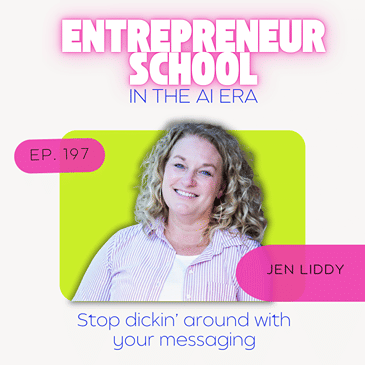
If you're letting AI write your emails, posts and sales pages and wondering why nothing's landing, this one's for you.
Jen Liddy is a messaging diagnostician and former English teacher. She's spent years helping experts find their voice, and she's watched AI change how her clients write. We talk about why you need to know your own voice before you can push back on a robot. We also cover why she stopped building $6,000 messaging guides and the signs that your messaging is the real problem.
The bigger question for you: can you say what you want to say before you ask AI to say it for you?
WHAT YOU'LL LEARN:
- Why AI copy sounds "pretty good" to you and flat to everyone else
- Jen's "say it ugly" rule for getting to your real message
- How she uses AI to break her own bad writing habits
- The signs your messaging is the problem, before you blame your logo, offers or pricing
- Why your audience needs specifics now, and why feelings alone won't land
- Where to start when a full messaging overhaul feels like too much
CHAPTERS
01:35 The bio that says what it means
03:39 The hill Jen will die on with AI
07:03 You have to be able to validate the output
10:58 When AI beats saying nothing at all
12:15 The therapist who stopped trusting her voice
16:50 Say it ugly, then make it better
18:16 Using AI to break your own bad habits
24:26 Why she stopped selling $6,000 messaging guides
29:31 How to know you have a messaging problem
34:11 Start with your website header
>MEET JEN<<
Jen Liddy helps course creators, coaches and expertise-based entrepreneurs stop dickin' around with their messaging, so they get it right whether they're using AI to help them write or not. After watching AI change how her clients approached their own brand voice and messaging, she shifted her focus to messaging diagnostics. Now she shows people how to find the gaps in their messaging that no amount of bot training can fix.
>CONNECT WITH JEN<<
Website: https://jenliddy.com
Instagram: https://instagram.com/heyjenliddy
Grab Jen's resource
Why You're Getting Seen But Not Chosen is a private podcast that runs under 20 minutes. It covers how to evolve your messaging so all that visibility work actually lands. It also includes a self-audit of your messaging patterns and an AI writing checklist you can give your favourite robot so it calls you out when you slip: https://jenliddy.com/evolve
>Introducing wAIv
This episode is brought to you by wAIv—our brand-new platform built for online experts who want to securely build and sell AI tools powered by YOUR thinking, YOUR frameworks and YOUR methodology.
wAIv helps you create Bot Squads—a suite of AI tools that work together to help your clients implement your expertise faster and with better results than ever before.
>Your Next Steps:
Build your first protected AI product. Join the AI Product Build Lab for just $1 with code PODCAST1: https://graviastudio.com/build/?code=PODCAST1&price=1
See what an AI tool built on your expertise actually looks like. Explore wAIv: https://graviastudio.com/waiv
>Thanks for Listening!
If you enjoyed this episode, please help us share it by:
Following the show—this helps you stay updated and supports us!
Leaving a positive review—this boosts our ranking and helps more entrepreneurs find the podcast.
--------------------------
Entrepreneur School is proud to be featured on the Feedspot list of 30 Best Canada CEO Podcasts! https://blog.feedspot.com/canadaceopodcasts/
[00:00:00] If you're only relying on AI to write your stuff, it's going to kill your content, which is going to kill your marketing, which is going to kill your business. Because people can smell it and they're looking for reasons to trust you. Welcome to the next evolution of the podcast, Entrepreneur School (In the AI Era). We are here to figure out how to integrate AI into the business you've worked so hard to build in a way that still feels like you.
[00:00:29] I'm your host, Kelly Sinclair, award-winning marketer turned AI platform co-founder. AI has fundamentally changed how I thought about work, systems, and what's actually possible. This show is about navigating that new reality together. It's going to be a wild ride, my friend, but I truly believe there's a way to leverage AI in a way that's intentional, human-centered, and aligned. It's an ongoing evolution, so let's explore.
[00:00:58] Because AI may just be the unlock you need to achieve the life-first business you truly desire. Welcome back to Entrepreneur School. I have a guest with the best bio that I've ever read on my show. So I'm just going to go straight there because I was laughing so hard when I finally read this out loud. Jen Liddy helps course creators, coaches, and expertise-based entrepreneurs stop dicking around with their messaging so that they get it right,
[00:01:27] whether they're using AI to help them write it or not. I mean, I feel like you did not use AI to help you write that bio, Jen. I did not. I spent hours being frustrated. I have had more generic that, you know, I've had generic bios that did the trick. But I got really pissed one day, and I was talking to my brand voice mentor, actually, and he's just kind of pushing me and pushing me and pushing me. He's like, well, what do you really just want to say to people? And I want to say, stop dicking around with your messaging.
[00:01:57] Like, stop going to ChatGPT. Stop going to Claude. Stop, like, asking a robot to, like, pull out of what your heart, what's in your heart and what's in your brain and what's in your soul. Stop dicking around with it and just freaking put it out there. So that's how I came up with that. It does also. This is kind of funny. If you went to my website, which is JenLiddy.com. So the website is me. It's a beautiful, lovely picture that my brand photographer took of me. Everything is, like, pink and soft.
[00:02:25] And I'm this, like, basic white lady who, like, wears Ann Taylor loft clothing. And it says, stop dicking around with your messaging. And I just love the juxtaposition of it so much because every time somebody, like, I meet somebody new, I'll say something and they'll be like, oh, I didn't expect to hear that out of your mouth. I'm like, I know. The way I look and the way I am are, like, kind of two different things. Oh, I know. It's, like, a secret weapon that you can keep in your pocket.
[00:02:54] Like, when you drop an F-bomb and people are like, what? Do you wear their pearls? Yeah, I do that, too. I'm like, I save it. I save it for the impact, you know? Yes, yes. Okay. I love that we're going to talk about messaging. Like, my people on this podcast know that that is my journey as a brand strategist and marketing and PR and communications. And that just, like, evolved into an AI company for reasons we don't need to talk about today.
[00:03:24] But I think, first of all, like, let's just get your opinion, like, right off the bat. What is the soapbox that you, like, stand on with respect to how AI fits into the world of what you do? Well, here we are in 2026. And I would have had a different opinion in 2024 and a different one in 2025. But here we are in 2026. And I will say I was terribly afraid of it in 2024. Like, I was like, oh, fuck that. Like, that's not even really happening. That's not really a thing.
[00:03:54] Also, I'm not the person who's, like, embracing every trend the second it comes out. So you need to know that about me. Like, in 1988, when Dr. Chilberg told me in my freshman year that there was this thing going to be called electronic mail and we would be emailing each other. I'm like, that's ridiculous. Nobody's doing that. So I am not a person, like, on the cutting edge of anything. So in 2024, I was like, oh, no, it'll be fine. And then in 2025, I was like, shit, this is going to be a thing.
[00:04:21] So I was trying to kind of outpace it or position myself like, oh, I'm for the people who still want to work with a human. And honestly, 2025 was a good year for me. People still did want to work with a human. And we'll talk about that in a minute. But here I am in 2026. And I just, I've stopped feeling pissed off about AI. I mean, it's just like, if you don't embrace it, then, you know, you're like going to get left behind.
[00:04:48] But also, and I've heard you talk about this on your podcast many times where I don't think it's a race to keep up with what's new, because that is just so distracting. I've actually heard you talk about, you know, it gets in the way of your business. Like, it's like just, oh, there's this shiny object. And there's this other thing. And here's a prompt you can use. And here's a skill you can have. And if you're like, just constantly searching for how you can use it in your business, I think people are wasting a lot of time, especially if they have a certain type of business.
[00:05:17] I have a micro consultancy. It's me and my assistant. That's it. My offers are very like one to one. They're not one to many. So I love the way you said this on your podcast with Laura Schoenfeld. She said, if you didn't have 20 people working in your business before, why do you need 20 people working in your business now? And I was like, yeah, that's it. So at this point, the hill I will die on is, especially when it comes to messaging, robots can help us and they should help us.
[00:05:47] But I think that people expect them to help us in ways that are unreasonable. And that if you don't even know what your brand voice is, and you don't even know what your brand messaging is, and you can't say that from your own mouth and your own fingers and your own brain, then how on earth can you expect a robot to do a better job? Because the schlock that it's spitting out to you, it probably sounds pretty good, right? It's probably like, yeah, I'm not a good writer. So this sounds pretty good.
[00:06:14] But to everyone else who's reading it, it just sounds so tamped down and so flat. But you can't see that because you're just so kind of starstruck by it. And unless you can say and push back on your robot and say, no, that is too choppy. No, I don't like that construction. No, I don't ever say those words. No, I don't talk about that. And you can push back on it. You're always going to be at its mercy.
[00:06:42] And so that's, I guess, the hill I would die on. You have to put your brain back on it. And you have to understand it. You have to understand what you want to say and how you want to say it at a fundamental level. Or your robot's going to be running your content. And I think from here on in, people are literally reading your content. And their first question is, did a robot write this? Yeah. Yeah. Ah, couple things. Many things there.
[00:07:08] I feel like, well, one way that I like to phrase this is it's about being able to validate the output of whatever AI gives you. Yes. So if you don't have the expertise of what you're trying to get AI to do for you, you probably will be like, ooh, sounds good. Okay. Let's do it. And maybe there's something else to what you just said that's like, oh, I'm just impressed.
[00:07:35] I'm impressed by this is still new technology. I got something that was so much better than I would have ever been able to do, at least on a first draft. And you have this lovey-dovey, oh my goodness, Claudia, my friend. You've been so strong. And I love it. And I feel it because, like, to your point, the conversation that I had with Laura Schoenfeld on this show, I was like, I am so called out right now.
[00:08:04] Like, I am just, I love building. Yeah, I don't know what happened, but I'm just obsessed with it. And it is distracting. And I have to tell myself, no, you are not allowed to do this shiny thing. Right now, you have to actually respond to the people who said that they wanted to work with you or who are actually trying. I heard you say that. You're like, oh, three people have asked me, how do I give you money? And it's been weeks since I got back to them. I'm like, girl. I just didn't even email them.
[00:08:32] Like, that's a real thing that's happening because of the distraction of AI. Well, to go back to the, like, being starstruck by it. So I'm going to say visuals are by absolute kryptonite. I suck at anything visual, which is why when I had this new messaging of stop dicking around with your messaging, I'm like, oh, God, do I need to change all of the visual branding? And I was like, you don't know. Like, I'm kind of this weird person who looks one way but acts another.
[00:09:01] And I'm not going to change. I did not want to spend $12,000 on a rebrand is really what this came down to because the visuals are so hard for me. So when chat started creating visuals or what is the one? Nano Banana started creating visuals for people. I'm like, this is super fun, especially if you're not good at this. And then you start seeing, like, oh, my God, the ubiquity everywhere. It's all the same.
[00:09:26] And then I started watching brand designers and visual graphic people bitching about the stuff they're seeing that AI creates the way I bitch about the words it creates. And I'm like, oh, but there was something that let me see the ubiquity of it in a way that I don't think people trust themselves with their words. And I think they might have writing trauma from college or high school or whatever.
[00:09:55] But, like, there's a thing that people are afraid to trust their writing, afraid to trust their voice and afraid to say what they want to say in the way they want to say it. Yeah, I was going to say there's something deeper underneath this. Yes. It's not this is not just about throwing spaghetti at the wall. That's right. Because the people I work with are like they're I mean, how many iterations of your own business have you had? Like, how many degrees do you have? How many trainings have you taken?
[00:10:24] How many certifications? Right. And so my people that it's like your people, they are experts. They have a lot of experience. And so they don't you know, they the messaging is frustrating to them because they're like, why is this so hard now? I've done all these other things. Why is this so hard? Yeah, because it is hard. It is hard. And so can robots help us make it easier? And I get I get wanting that. I get it. So I guess that's the hill I would die on.
[00:10:51] Like, please put your freaking brain and your soul back on your writing before you just let the robots do it. Yeah, I'm I don't want to like say this is a contrarian opinion, but on one because I totally respect obviously everything for a contrarian opinion. Yeah, but I'm like, I appreciate the work that you do because I tried to do that work for many years. And here I am with a tech company now. So clearly didn't work out for me that way.
[00:11:20] The contrarian opinion is like, if you're not going to say any words at all, if that's what you're battling with. Right. That, oh, I have just I'm not showing up. I'm not doing any marketing. I don't have a what like you don't have any of those things because there's a block in your way. Yes. Then 100 percent like I will give you what will help you to start making progress.
[00:11:45] But the caveat is probably you need to now look at that as an experiment and go, OK, did this land? Yeah. Does this feel good? And now we go to the next level because I know that where you work is in the massaging and in the next layer of it. Right. Like you're not working with someone who's like, what is my business? You're working with people who are like, OK, I've had iterations and I know that when I do this, I'm getting the wrong people and I know who I don't like working with.
[00:12:13] And then I'm like, so expand on that. Yeah, that's a really great point. Yesterday, I was working with a client who's a therapist and therapists are in a special section of hell for marketing because they have the the themness has been beaten out of them. And so they're never supposed to talk about themselves, especially in sessions. Right. So she's like, how am I supposed to show up in marketing and suddenly be expressing my
[00:12:38] personality and talking about my opinions when I'm just like we called her Mr. Cellophane when she's in therapy sessions. Right. Like she's just supposed to be part of the part of the landscape. And so this thing of like she's actually now afraid to write. She's afraid to write LinkedIn posts. And what she writes feels so blah and meh that it makes her angry because she's like,
[00:13:05] there's so much in me that I want to say, but I don't trust it anymore. And I've had this beaten out of me by my industry. And I don't trust that either. And so her first assignment really was we I pulled some, you know, some gems out of her and I'm like, you're not really ready to say these publicly yet. But you do need to start practicing what it would sound like. And then it's a matter of like, I always like to say there's like bumpers on the bowling alley.
[00:13:32] There's there's boundaries that we have when we're speaking, regardless of whether we're a therapist and it's been beaten out of us or we're somebody who comes to the table with writing trauma or we just don't really trust ourselves anymore because what we've said for so long hasn't worked. Right. So you start practicing and you're like, OK, well, what's what's too private? What don't I want to share? What's off the table? What are my non-negotiables? That's one of the bumpers. And then the other bumper is like, well, where am I so buttoned up? Where am I so invisible?
[00:14:01] Where have I tamped myself down so much that there's nothing there's it's like it's like a nothing burger. Like there's just nothing there when you it's just like it could be anybody that might be your AI stuff. Right. And then you play in the middle of the lane where you're like, OK, I want to say this thing because I'm really either angry about it or I have an opinion. I want to say something contrarian about it. And maybe you're not ready to publish it, but maybe you have to start practicing again.
[00:14:29] Nobody's coming for you with the red pen. Even when you work with a messaging person like I know that people are really afraid that I'm going to tear down their shit and make them burn it down. Nobody comes to me with stuff that I need to say. Like we have to start from scratch. Everything has a kernel, at least a kernel in it. And then you just have to give attention to that and give some of your soul back to that and give some trust there and like let it have some air. And if you're not ready to publish, OK.
[00:14:57] But I guess I really want to convey on this episode, like if you're only relying on AI to write your stuff, it's going to kill your content, which is going to kill your marketing, which is going to kill your business because people can smell it. And they're looking for reasons to trust you. I have never heard that expressed the way that you just said that.
[00:15:23] And I'm like, now I know what my trauma is because I've worked in corporate oil and gas for the first 10 years of my career. And it's always in PR, excuse me, where literally everything was, what is the best way to say this so that it won't like so that it's like platonic all the time? Like it's not going to ruffle any feathers. And we'll use words like, oh, I don't even know what I'm like.
[00:15:49] We're just going to use such blah words, words that I'm trying to like remove from myself. Yes. The truth is the real problem isn't writing, it's feeling comfortable in the space of what you want to, is knowing what you really want to say. What you really want to say. And to go back to stop dicking around with your messaging, I'm like, I leaned into messaging specifically as my lane. I was in content for a long time and then I was like, this is too broad. I want to talk about messaging because it's a really foundational thing. I used to be an English teacher.
[00:16:19] Like messaging is so natural to me. I can see the message in any conversation we're having. And so I was just leaned in. So maybe since 2022, 23, right? And oh my God, where was I going with this shit? There's a lot of trains leaving the station. Oh, and I realized how many people come with this kind of trauma around trusting themselves.
[00:16:48] So I've been doing this since 2023 specifically. And it took me till 2026, the middle of 2026 to finally say the thing I have personally been wanting to say, which is just stop dicking around with your messaging. Stop feeding it in. Stop tweaking it. Stop revising it. Just like say the thing you want to say in the way that you want to say it. And the phrase I have for this is say it ugly. Now we can tweak it later. We can make it better later.
[00:17:15] But if you don't start with the say it ugly piece, if you don't start with the truth of what you want to say, you can't. It's really hard to get to make an impact on people because everybody sounds the same today. Yeah. So this is like the core of thought leadership that we are exploring right now where it's what is your opinion on this? Like, what do you care about? What everybody? I don't know. We need to make a permission slip here around what you get to say what you want to say.
[00:17:45] Like, I'm going to bring you. I think when you sent me an email about being on the show, you're like, I don't know if this is where you want to go. Yes, it is. Like, I want you to come on and say your version. Like, we can go toe to toe if we have different opinions. I am all about existing in a world where people have different opinions and we're not trying to convince them of our own opinions. Right. To just stand in. And it's a hard place to be. Like, that is culturally. Sure. For God's sakes, yes.
[00:18:15] Really? Well, and so while I was anti-AI and angry about AI, I'm not like a fool. I'm not anti. I'm not even AI agnostic. And I will use AI in my writing to help me break my bad habits. So like I said, I used to be an English teacher. And my whole thing was like, I have to meet 27 people at every single class on the standard deviation, make sure everybody gets what they need. Right. So in my writing, I was doing the same thing. I'm hitting a point three different ways, three different times.
[00:18:45] I'm tying everything up in a nice bow, which makes me a really good teacher, but it doesn't make me a good marketer. And so I use AI to like push back on my bad writing habits. And so that's how I need to use it. Somebody else might need to use it. Like, hey, I have this story. And here are my messaging pillars. Here's the shit I talk about all the time. I have this story I want to tell. Can you help me find which messaging pillar it fits into and help me make a bridge?
[00:19:12] Like for that person, that's going to be a really great use of AI. Or you put all of your stories into AI and you have it remembered for you so that you're like, hey, this week I'm selling this thing, which really hits on this messaging pillar. Can you help me pull one of my stories and like help me design something? So I am not here pretending like we're not using AI. I am really just asking people to put their freaking brains and fingers back on it.
[00:19:40] And I can't tell you how many email lists, email lists of my friends and colleagues that I have unsubscribed from. And not because I'm like fundamentally opposed to the fact that they used AI, but just that their shit is so boring to read. Like there's just no soul in it. There's nothing there for me. So I'm not here for just, and I actually don't think our audiences are just here for information anymore. No, no. Which AI is great at, right?
[00:20:07] So if all of your, if you're like churning out emails and you even said this on another podcast of yours, you're like, it makes a lot of content for content marketers. It does that. But does it make good content? And what is that doing? Like, how are your unsubscribes? How are you, how is your engagement? And it really just might be that you like need to put your soul back into it. And what I do think people struggle with at this point is like that lack of trust in themselves that we talked about before.
[00:20:35] And also the habit of like, oh, I can have Claude do this for me. And I can actually have Claude do this for me while I have Claude do something else for me and Claude do another thing for me, right? And while I sleep. Right, right. Like I'm multitasking. So I feel like we just forget that like we have to put ourselves back on it because our audience is desperately craving that.
[00:21:25] Yeah. Like you say, put your soul back into your writing. Quick interruption, because if this conversation has you wondering what your expertise could become as an AI product, I want to help you build it. The AI product build lab is a 90 minute hands on workshop that includes a ready to install skill for Claude.
[00:21:52] It will help you map your expertise into a bot squad, identify what each bot needs to do, and then connect Claude directly to Wave so you can publish it as a paid AI product. You're not going to leave with another page of ideas to figure out later. You're actually going to build the thing. The regular price for this event is $97, but podcast listeners can join for just $1.
[00:22:19] So head to graviastudio.com slash build and use coupon code podcast1. That's graviastudio.com slash graviastudio.com. And use coupon code podcast1. Let's build your bot squad.
[00:22:45] It seems like it's different for each person because they come with different traumas and dramas from, and some of them it's big T trauma, some of them it's little T trauma, from whatever has happened to them in their business life, but also in their writing life and in their school life. So it's different for everybody.
[00:23:13] The client I was telling you about, the therapist, she was really just excited to have that permission slip, as you said before, of like, hey, here's some stuff I pulled out of your brain that you didn't realize was in there. There's some stuff that you feel and you know you want to share that you don't feel safe yet to talk about in your content. Let's start by creating some of those things. And like, you don't have to put them anywhere yet. You just have to practice.
[00:23:42] And that like made her, that made her feel excited about writing again, because she felt like there was hope and possibility. For some people, what it looks like is, oh, like they'll bring me a sales page. And these are smart people who have sales pages that they worked in other times in their business, right? But they're not working now, because we all know everything has changed. And so again, it's not about like taking a match and torching it. But it's like, let me show you the gold here.
[00:24:10] You've usually buried the gold, or you've said something in a way that just needs a little bit of tweaking for a modern audience. And those are the kinds of nuances that a robot really can't do for you. But like, I'm just like, I'm just happened to be that's my thing. That's the one thing I'm really good at in business. And that's what I do, right? So sometimes you just need another human brain to reflect it back to you. So for those people who've been like, I've been working with Claude on this for four hours, and I'm not getting anywhere.
[00:24:40] I'm like, maybe you just need 30 minutes with a human. And that can change everything for you. So it's always different for each person, depending on like what they're presenting with. Yeah. And also, you told me that you shifted the way that you're delivering your services, right? Like, you, we were talking a little bit about, we keep saying like, everything has changed. And that's, yeah, very true. And also, so what does that mean? Right.
[00:25:08] But in terms of the online business space, and I think there's a huge impact on business models and structure and the way that we're delivering things. Obviously, that's why we're building Wave, which is to help create AI tools that your clients can use, which is like, just how I'm seeing or betting on anyways, the online education moving because of what you also said around AI has commoditized information. So it's now about application.
[00:25:38] Yeah. Yeah. And then your work before, like even 2025, it's early as 2025, right? Yeah. Building out these robust messaging guides for people. Yeah. People, like I said, the way I said it to you was like, people paid me $6,000 to build them a custom brand voice and messaging guide. And they took me like 30 hours to put together. Oh, yeah. And I would train them. I would stay with them for a month. I would help them implement it.
[00:26:06] And then after a month, I would start to see their posts and their emails and their LinkedIn posts. And I'd be like, what the hell are they doing with the stuff I gave them? Well, they had put it into, it didn't matter how well we had trained their robot. It still is going to do what I call like taffy pulling your stuff. Unless again, you know how to push back on it. So I felt really like partially I felt demoralized. Like why did I put 30 hours into something, 30 plus hours into something?
[00:26:34] And then it's just like getting fed into a robot. And partially I felt like it's not fair to my clients who clearly like they're not messaging people. They're not marketing people. They're experts in their field, right? So to expect them to be able to do it didn't seem fair. But also I didn't want to be like their assistant or their content creator for them. So I was like, how do I want to work? And what is my genius?
[00:27:03] And I mean, like I said, I used to be a high school teacher and I have graded thousands and thousands and thousands of essays. And I realized like I can take a look at your piece and immediately know why it's not working. And I don't have to like rub your nose in it or shame you about it, but I can explain and show you why it's not working, but also show you how to get it working again. That's what I did for my high schoolers for and my college students for years. Like this isn't working. This is how you make it better for next time.
[00:27:31] They would throw their shit right in the garbage can on their way out the door. Or my clients are like, oh my God, thank you so much for telling me because I'm just too close to it and I can't see it anymore. So I completely changed my business model to be diagnostics where I go in and it's either like I'm looking at one piece or I'm looking at your entire brand. And I'm like, this is why it's not working. And this is how you change it.
[00:27:59] And I can help you or you can do it yourself. But once people see why it's not working, generally they can fix it on their own. But they're always missing that. It's like that whole of like, I'm just lost because everything seems like it should be working because it always did work and I can't see it clearly because I'm too much of an expert. And you're diagnosing the root cause, which is what we're always missing, which is like,
[00:28:24] why is the thing creating the symptom that I have, right? And one time I heard a really great expression of this. It was like, okay, so the symptom somebody has is they get headaches all the time. Well, what's the cause of those headaches? It could be any number of things. Totally. Sleep, blah, blah, blah. What if it was blue light, right? Because you watch, you're on screens all day and you're watching TV later, you're on your phone in your bed or whatever.
[00:28:52] So then I've identified that the cause of your headaches is blue light and therefore the solution is these blue light glasses. Do you want them? Oh my God, yes. Yeah. Yeah. So doing the diagnostic work, well, number one, it's more fun for me. I'm enjoying the work a lot more because the client then doesn't have to guess at how to implement. They're like, this is what I was doing and this is what I can, I can stop doing that and now I can just start doing this. So it's more fun to see them implement.
[00:29:21] And then they send me, I love this, they'll send me like, hey, this is, I changed my website and this, I'm like, oh my God, it's so much better. It's so, it's like, then they can go to Claude, right? Because they know how to push back on it and they have my diagnosis and they're like, hey, no, don't like, stop doing that because Jen said not to do that. It's like, then they can use Claude more effectively. I love that. And also, yeah, so you're giving them the skills.
[00:29:51] And also like, just kudos to you for actually caring and giving a shit about what, how your clients implement what you spend time with. You care about what you do. And you're like, oh, but you, like, this is how, this is how I got into AI in the first place because I would write these great strategies and then they'd be like, he thinks. Never hear anything again. I know. Implement your strategy, right? And I was like, oh my gosh, AI can help you implement the strategy. AI can help you implement and take action and, and like not get stuck in the things that
[00:30:20] are in your way, which always, like as we've even uncovered here, are much further deep. There's that deep. Yeah. Yeah. And you're so like in the weeds of a thing and you're like, I'm smart. I have done a lot of things. Why is this so hard? Why isn't this working? You know? So there is that, you just, like you get that fatigue. Yeah. Mm-hmm. Oh my gosh. Yeah. Ugh. So, okay. One more question on like the logistics, just because if somebody's listening to this and
[00:30:50] going, okay, how do I know if I have a messaging problem? I totally get this question all the time. Right? Because like, what is the thing that, because most people are like, and I had this conversation with somebody else on the show recently where it was like, people don't really know the difference between tactics and strategy. That's right. That's right. So we're, and we're always searching for tactics because we can see, like they just make more sense. Yeah. And they are like easily to implement.
[00:31:19] If I do this, this will happen or could happen. But like, if I start creating podcasts and social media content, but my messaging is shit and it's not landing, no amount. Of tactics will help. That's right. On top of that. That's right. That's so right. Yeah. So there's some questions. Let me tell you what some people do when their messaging is really the problem. They're like, I need a new logo. I need some new offers.
[00:31:50] I need, because my offers aren't working. Oh, maybe my pricing is the problem. I'm either going to lower my pricing or I'm going to raise my pricing because nobody's buying. I keep tweaking this fill in the blank sales page, home page, about page, description page, whatever it is. Like they keep tweaking it, feeling like it's just like the one word difference is going to make the difference. The messaging is your, I would start with messaging. If you're thinking like, I need to invest in a $12,000 rebrand.
[00:32:17] And well, what's at the foundation here? Like that, because messaging is foundations and nobody wants to do foundations because they're all like, I'm too experienced for this. I've been in business a long time. I know what messaging is. I've already done that work. Yes, but we're moving at such a faster pace that people aren't talking to their audiences frequently anymore. So maybe the last time you talked to your audience was a year, maybe two years ago. So your audience has changed.
[00:32:41] You have a messaging problem if you do sales calls and the wrong people show up on the sales calls. And you probably have a messaging problem, or I would look at a messaging problem if you have had a program that you know people are asking for and people need, but the sales page isn't working anymore. And those are like some really top level things that, and you also have a messaging problem
[00:33:11] if you're not sending people to your website and you're embarrassed by your website. And that's probably not like, oh, I just need it to be prettier. It's probably like, it says things on there that I don't believe anymore or haven't caught up to who I am. And it's not expressing where my business is now or what my audience needs to hear now. And one last thing I would say, and this is a very tactical thing for your listeners, audiences need specifics in a way that they almost never have needed them like this before.
[00:33:40] It's not enough to talk about their feelings about a thing. It's not enough to say, I understand that you're busy or that you're overwhelmed or that you're stressed. It's like talking about feelings, you have to reflect with specifics what their lived experience looks like. And many people just don't think to do that because to them it's so obvious. Like, oh, that's just a boundaries problem. No, no, no, no. You need to unpack it for them, not because they're stupid, just because they need to see how it applies to them very specifically at this point. Hmm.
[00:34:09] Oh, I really like that last one particularly. Because it's a tactic and it's doable. Yeah. Well, it's the whole concept of, I sent an email out about this the other day. It was like, you know how you can't unsee something once you see it finally the first time? So it's like your brain also goes, oh, I know this. So therefore, everybody knows this. No, they don't. Exactly right. Exactly. Yes. So like on your messaging, that might sound like, you know, your boundaries are constantly
[00:34:38] being pushed against. So you're like, I don't even really know what that means anymore. Show me what that means. So that's another place where messaging is the problem for you. Mm-hmm. Mm-hmm. Mm-hmm. Oh, okay. Great. I feel like I fire on Steve Kelly. You know, it's just kind of like funny other layer of this conversation because like I used to do this work. I can never like articulate it.
[00:35:07] Like, here's why you need this. Right? Right. Because you just knew it. Yeah. It was like, but this is the problem. But like, how do you like reverse into why this is the problem for you? So I just want to like commend and be like, yes, of course. It is the problem. Like the thing you have to work on, it's almost always messaging. It really is. Yeah. Like, and then like the experiment, like message, adjust, try things. Yes. Yes.
[00:35:35] Information, adjust, try things, get information. Like that's the loop. Right? It's not, maybe, maybe there's overwhelm a little bit and people thinking, oh my God, I have to work on my messaging. Like that is like a reinvention. That's like, that's like, you know, getting to my soul. I'm not in a space where I can do that. Like, what do you say to that? I say, start with the header on your website. Just start there. Start with, or go down, scroll down to your offers.
[00:36:04] Are your offers, your offers. And are they clear about the problem and the solution and the outcomes that people get? People are talking in their offers about like, they're talking in like, just like diffuseness. Like they're just talking in generalities. Like, no, no, no. Your offer has to express, this is what your problem is. This is what you want it to be. This is how I get you there. Like, so go to someplace really specific where it will make an impact. Your bio.
[00:36:31] Does your bio still say something like really generic or fluffy or conceptual? Or does it say, I own an AI, right? I'm digging around with your messaging. Or I own an AI company, or I teach you how to use AI effectively. Like whatever it is, it has to be super dialed in. I think about messaging. You were talking before about like, I need to overhaul my messaging. I need to put all of 2027 aside for this. Please don't. Please don't do that because that will just like flatten you out.
[00:36:59] But I just want to like share this one thing that messaging is everywhere all the time. And it's when you talk to your kids. I used to say to my son when he was little, do you want to wear the red pajamas or do you want to wear the blue pajamas? The messaging was we're putting pajamas on, right? You're getting pajamas on, but we're not going to dick around with, is it time for pajamas yet? And actually, he's 19 now. My whole life with this kid is messaging. And his whole life with me is how he says stuff to me.
[00:37:27] So sometimes he'll do that 19-year-old thing where he's such a 19-year-old and he'll say something to me. And I'm just like, try that again. It's not, I'm taking the car. I need the car. It's, hey, mom, are you using the car tonight? Is it okay if I use, like, that's just different messaging. It's what does your audience need to hear? I'm his audience. And sometimes it's the reverse with, like, you know, whatever I'm asking him to do. It's all messaging.
[00:37:55] And so all day long, I guess I want to empower people. Like, all day long, you're trying to get people in your life to do shit for you that you want them to do, whether it's your kid or your spouse or your partner or whomever, your best friend. But you've got to message it so that they can hear it and that they can respond to it. And that's all I'm asking people to think about when they are thinking about the messaging for their audiences that are going to pay them money someday. Oh, yeah. Yep. Who is receiving this? That's exactly right.
[00:38:24] And what do they need to hear? And how do they need to hear it? And not in a manipulative way, but in a I'm going to meet you where you are kind of way. Mm-hmm. Such a great way to express all of that. Thank you for this great conversation, Jen. I'm so glad we had it. I love talking about this stuff. It's so nerdy, but I really love it. Oh, the opportunity. Nerd out on all of the things. Like, that's what the show is for. Please tell everyone. Well, first of all, did you have any final words?
[00:38:54] Oh, no. I think we have firehose people plenty about messaging. So tell everyone where they can find you, connect with you, get more of you, get your diagnostics too. Yep, yep. If you go to my website, jenliddy.com, everything is there. You can get on my email list if you want to. But I know that the people who are listening to this program, like, they don't need another quiz. They don't need another PDF.
[00:39:19] If you want something really effective, I actually have a private podcast that's 10 minutes, it's less than 20 minutes, and it's called Why You're Getting Seen But Not Chosen. And if you go to jenliddy.com slash evolve, it talks about how you need to evolve your messaging so that you can, all that visibility stuff that we're all doing, like how to make it actually land and why your messaging is keeping you from that. And it's kind of like very quick, under 20 minute, you can implement it.
[00:39:48] It also comes, and your people will love this. It comes with a self audit of your own messaging patterns and an AI writing checklist. So you can throw that into your favorite robot and have that robot push back on you when you do something and like, oh, you're doing that pattern again. Oh, you're doing that pattern again. So it's an under 20 minute private podcast. And then those two resources at jenliddy.com slash evolve.
[00:40:13] And I think that would be like a really impactful thing for your listeners rather than like taking my quiz or downloading anything else. It's just like, if you're listening to a podcast, you like podcasts, and this is in your ear. I think there's a video version too, but I can't remember. But it's like, get it into your head and then start putting it into practice. I love it. Thank you so much, Jen. You're welcome. My pleasure. Thank you for listening. If this episode got you thinking about how AI is impacting your business,
[00:40:43] and what it might look like to integrate it in a way that actually fits, I'd love to help you think that through. You can book an AI strategy chat using the link in the show notes. It's a space to talk about where you are, what's shifting, and how to move forward with intention. And if this episode was helpful, please share it with another business owner who's navigating this evolution too. And make sure you're subscribed so you don't miss what's coming next.