
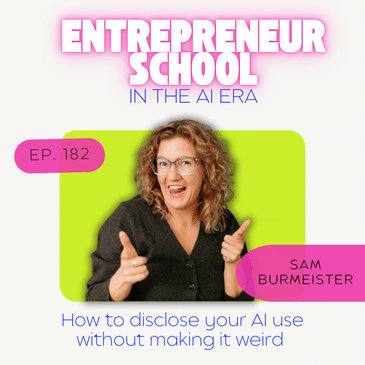
What if the smartest move you could make right now isn't figuring out how to use more AI, but deciding where you draw the line?
I sat down with Samantha Burmeister from Nomad Copy Agency, and we had one of those conversations that doesn't hand you a set of rules. It hands you better questions. Sam is a copywriter who uses AI in her business every single day, but she will not use it to write the copy she delivers to clients. The distinction she makes between those two things is where this episode gets really interesting.
We got into AI disclosure, the values-based decisions behind how you use AI in what you sell, and why being transparent about it might actually be the smartest sales tool you're not using yet. Sam also shared her grandma's microwave story, which is the most perfect analogy for this entire AI moment and I haven't stopped thinking about it.
What you'll learn:
- Why "I don't use AI" isn't actually true for anyone anymore and what that really means for your messaging
- Why your clients deserve to know how AI shows up in what they're buying from you
- How AI disclosure on your sales page can become a trust-building sales tool
- The microwave vs. homemade analogy that reframes the entire AI adoption debate
>>MEET SAM<<
Sam is a sales copywriter and launch strategist. She writes copy for 6 & 7-figure course and program launches. Through her Copy On Demand membership, she works with founders to write copy that sounds like them, but converts better.
>>CONNECT WITH SAM<<
Website: https://nomadcopyagency.com
Instagram & Threads: @nomad.copy
Podcast: Copy And…
Grab Sam's resource:
AI Disclosure Templates — 50+ copy-paste templates for communicating how you use AI across your emails, sales pages, websites, FAQs and policies. Special discount for Entrepreneur School listeners.
>>Introducing wAIv
This episode is brought to you by wAIv—our brand-new platform built for online experts who want to securely build and sell AI tools powered by YOUR thinking, YOUR frameworks and YOUR methodology.
wAIv helps you create Bot Squads—a suite of AI tools that work together to help your clients implement your expertise faster and with better results than ever before.
>>Your Next Steps:
🤖See what an AI tool built on your expertise actually looks like. Explore wAIv
🤖Train AI to sound like you (in under 2 hours) with BrandCalibrator™
Follow our new Instagram account @joinwaiv
>>Thanks for Listening!
- If you enjoyed this episode, please help us share it by:
- ⭐ Following the show—this helps you stay updated and supports us!
- ⭐ Leaving a positive review—this boosts our ranking and helps more entrepreneurs find the podcast.
--------------------------
Entrepreneur School is proud to be featured on the Feedspot list of 30 Best Canada CEO Podcasts!
[00:00:00] It's just a matter of how you choose to use it and what it is putting out for you. Is it part of your brain? Is it a symptom of your brain? Or is it something that is as easy as using search but in a different way? Welcome to the next evolution of the podcast, Entrepreneur School (In the AI Era) We are here to figure out how to integrate AI into the business you've worked so hard to build in a way that still feels like you.
[00:00:28] I'm your host, Kelly Sinclair, award-winning marketer turned AI platform co-founder. AI has fundamentally changed how I thought about work, systems, and what's actually possible. This show is about navigating that new reality together. It's going to be a wild ride, my friend, but I truly believe there's a way to leverage AI in a way that's intentional, human-centered, and aligned. It's an ongoing evolution, so let's explore.
[00:00:57] Because AI may just be the unlock you need to achieve the life-first business you truly desire. Hello, hello! Welcome back to Entrepreneur School In the AI Era, where we are exploring different ways that different people are using AI in their business. And I'm so excited to talk to a copywriter today because this can be juicy. There's lots of different opinions on the spectrum as far as AI use in copywriting.
[00:01:26] And so Samantha Burmeister of Nomad Copy, one of my favorite copywriters on the internet, is here. Welcome, Sam. Thanks, Kelly. I'm stoked to be here and to talk about the sticky side. Because really, copy and AI just seem like they're on opposite ends of the spectrum, and they're not. So I'm stoked to chat through it. Yeah, okay. Well, I definitely agree with the and-they're-not part of what you just said. But help others to see that.
[00:01:54] Tell me, first of all, your own experience with AI, the evolution of, and how it's started to be embedded into what you do and the way that you deliver your copywriting services. Yeah, for sure. Oh, I could go on for a full hour on this question. Yeah, so I, let's see, how I use it in my business is that I don't use it to deliver client copy.
[00:02:20] I don't use it as a co-brain. I think that people hire me for my brain, and I make that really clear on my sales pages. That's not to say that other copywriters are bad or wrong for doing it. And I think there's so much polarization in the conversation that there's, I'm on threads, I'm like chronically on threads. And there's a lot of attacking people happening over there for how they use AI. But I think in a really real way, there's no way around using some AI in your work.
[00:02:49] It's just a matter of how you choose to use it and what it is putting out for you. Is it part of your brain? Is it a symptom of your brain? Or is it something that is as easy as using search but in a different way? Because, I mean, Google is now AI. AI. So there is really no way around using it. It's just a matter of like how we use it and how we talk about how we use it. Because I think people have a right to know what they're receiving as well.
[00:03:18] I think that's such a good point, that transparency and clarity. And also, like I just want to acknowledge the ability to make your own individual choices based on your own values and what you believe. So you're choosing to not use AI for the delivery of the thing that you sell as an expert. But you are using it how? Where are you using it? Yeah. I mean, so starting at the very beginning, like if I search something.
[00:03:46] So if I'm looking up your business and I want to know who your competitors are and I need to do some competitor research and see how people are interacting in the environment, I'm using Google. Google is AI. Something that I do in my business and in my client work is if somebody gives me a folder with like 10 billion testimonials or like an Airtable drive, it is not necessarily worth my time to take an evening and read through every single one of those testimonials.
[00:04:15] So a really great way that I use AI is I will, with permission, plug those into a database. And it's really just a chat GPT chat. Like I don't even need a bot for this. But go through and say, what are the themes that you're seeing? What are people saying over and over? And then I'll go back to that and say, OK, I need a testimonial that supports this idea on the sales page. Give me three examples. And so it's a way to expedite my work, but it's not something that I'm using to do the writing.
[00:04:43] So I'm not going to a bot and saying like, OK, great, based on what they said, now write me a sales page. That's where I draw my line for my client work. How else am I using it in my business? I also have a podcast. I use Descript and their underlord is phenomenal. I think that's the best AI bot that I've interacted with thus far. So I use it to help edit my podcast. What else? Oh, I just downloaded. What is it? The AI that you get to talk to and it like uploads all of your thoughts. What is it called? Wave.
[00:05:13] A whisper flow. Whisper flow. Yes. Just on a little whisper flow this morning. So that's going to come into effect in some way. So, yeah, I'm using it in a ton of ways. I think that's interesting to kind of what I'm hearing you say there is that there's places where human is best and there's places where a human effort is actually not worth the effort. Like what you're saying, like AI can do a very good job of pattern recognition.
[00:05:39] I can do search and respond with data and you can do that. But it's going to be way longer to do that. So you're identifying the places where you can enhance what you're doing. Feel, you know, get that robust access to the information and pull that together and do that pulling. Like, so it's kind of part step one. That's probably step one of your process, I would imagine. Yes. Yeah. Yeah. And my thought, too, is it's actually very similar to when I onboard my clients.
[00:06:09] I don't have them fill out a really long form. I get them on a call and I record it because if they were really good at writing about what they did, they wouldn't be hiring me to write about what they do. So same thing is like they're also hiring me to be really good at writing about them. And the way that I communicate and the way that I'm comfortable doing my job is delivering words that come from my thought processes.
[00:06:33] So, again, if other copywriters are or aren't doing that or if you're doing that in your business and using AI to augment what you're doing, I think like, okay, fine. Go for it. If it's effective, great. Go for it. But, yeah, my thought process around it is I will let it take on tasks, but I won't let it take on my thoughts. So, yeah, that's interesting because it's definitely like a spectrum here.
[00:06:58] I mean, the whole point of the show is to show people how others are making these decisions because we can be easily overwhelmed with, oh, my gosh, I have to use AI because I have to deliver my client report in 37 seconds now because that's what they expect. Is that I'm just going to be able to turn something around immediately. And so you're doing like you're staking your line in the sand around. I will be the human actually delivering this result.
[00:07:27] So I imagine that takes communication, explaining that that's why. Like, are you running into any how are your clients receiving this? Are you having any conversations with people who are like, oh, no, I would expect you to turn this around for me tomorrow or are people like bought into your process? You know, what's so funny is a lot of my done for you work is done in VIP days. So people have been hiring me to turn things around quickly for a long time.
[00:07:56] And now there was a time about two years ago where people were really oscillating towards projects. They really wanted it to be more collaborative. And for me, it's the same work just delivered with more time for feedback. And now I think because I wouldn't necessarily say that AI and language learning models are my competition per se. But I think because people are used to getting things more quickly, they're much more comfortable with me turning around work more quickly. But your question about like how is that conversation happening?
[00:08:26] I'm pretty outspoken about how I do and don't use AI in my work in the first place. So it's not necessarily a conversation that I'm having with my clients as much. What I'm noticing in client conversations is when I'm writing a sales page, I'll ask them as part of their onboarding, how are you using AI in your delivery? And then we're including that in their sales pages and that because people kind of want to know, am I paying $1,000 for something that you're just going to type into a bot and hand over to me?
[00:08:55] And what's the value of that? Or am I paying $1,000 for something because I want Amy the attorney's brain on my business? I want Amy the attorney to write my contract, not Amy the attorney's AI to write my contract. So people just want to know. Some people are fine with either side. They just want to know, again, what they're getting and to communicate that is a huge trust builder on a sales page. Yeah.
[00:09:22] So I imagine this is what inspired you to build the resource that you're working on right now. Do you want to talk about that? Yeah, sure. So it was actually inspired by a conversation with a client where she said, should I, she's like, I noticed my competition is using AI in delivering a very similar course. Should I start incorporating AI into my business? And I was like, I don't know that that's the conversation to have with a copywriter. That's a strategy conversation. That's a business coaching conversation.
[00:09:51] That's a direction of your business conversation. For the course that I'm writing, I was like, I think you just tell people that that's part of how you stand out from the competition is to put it on there. So I wrote it out for her and then I put it in a swipe document in my Google Drive. And I was like, this is going to just be handy later on.
[00:10:10] And then I put it out on threads and I said, hey, if are other people like, do you want to know before you buy something if and how somebody is using AI in the course, in the delivery? When you say you have access to their team, is it their team of bots or is it a team of humans? You know, what does it look like? And people overwhelmingly said, yeah, I want to know. So then I posed a second question.
[00:10:33] I was like, if I put a bunch of copy paste resources together that you can just slap onto your sales page and start communicating this and that you can judge them to match your use case, would that be helpful? And everybody said, yeah. So that's where it came from. And it's just a series of things that you can copy paste, whether you do, don't or kind of use AI in things like emails, sales pages, websites, just wherever it makes sense. So there's like 50 something opportunities in there.
[00:11:01] And I would expect people grab it and use like two or three of them, but they're there for when you need them. Interesting to think. So this is a AI disclosure template that you're talking about, just to clarify. And interesting that there's like 50 different ways to talk about this. So what are you seeing with some of like the patterns or themes in the way that people are sharing this? So your emails are a great example.
[00:11:26] So if your listeners are curious to see it in action, go open one of Kelly's emails, because at the bottom you say something like this was this email was created with the help of AI and edited by a human or something like that. So that's one way. I think it says this email was made by a human with the help of AI. Yeah. Yeah. But like, what does that mean? For me, it means I dictate the email and it like takes the thoughts and threads them together for me. And then I review it and then I send it.
[00:11:56] Mm hmm. Mm hmm. And like, I think there's so much opportunity in that disclosure, too. Like, you could say, like, here's what this means for me. And it's a link out to a resource or a podcast or a piece of content where you're like, this is how I do it. And in your industry, I think I would see that as an opportunity to sell something as well as saying, like, this is how I do it. If you're curious about writing better emails with AI, here's a resource. So, you know, so depending on the industry, disclosing can be a sales opportunity. I'm a copywriter.
[00:12:25] So I'm always like, how can we use our words and our real estate to sell? I'm seeing it on in a lot of people are adding it to their privacy policies so that it's disclosed on their website. I have seen people add a page to their website because there's a lot of changes in SEO and AEO right now. So adding a page to your website that says something like how Nomad Copy Agency uses AI in their work. And it's a page that then the headlines are SEO optimized.
[00:12:55] It links out to examples of work. It's, again, just an opportunity to build that transparency. So I'm seeing people add an additional page or add it to their privacy policy so that it's just in their site's policies. And then on sales pages, like I mentioned, the person that I was working with that had a course. You might be used to getting AI bots and whatever. This, like, here's what you get in this course. And I created all of it without the help of AI.
[00:13:22] And when you get access to my team, it is and will continue to be a team of humans because that's what helped her stand up from the competition. So, yeah, those are a few use cases. So juicy. I'm, like, so tempted to be, like, this is the personal values conversation is what this really is. Because, like, some people will look at me being a human and only offering human created work and human team is the value.
[00:13:52] And some people exact opposite thing. And so this is just an interesting time that we're in where that divide may happen or it's going to kind of keep being fluid, I feel. Mm-hmm. Totally. Totally. And, like I said, if somebody's charging $1,000 for the same output, but one happens by a robot in 12 seconds and the other one happens by a human in 12 days, like you said, it's a values conversation. It's just what do you prefer and what is more important to you?
[00:14:19] And I think at the end of the day, either way, it affects and reflects on our brands. So regardless of who or what is delivering, it has to be quality so that people continue to want to buy from that brand. Hmm. Hmm. Are you seeing in your clients, maybe speak a little bit of, like, whatever experience you have that you can reference. Are you seeing in your clients, like, this, is it like a battle?
[00:14:47] Are people, like, wanting to take more of that, like, human-only approach and value? Or, like, where is it kind of going? When people come to me, it's usually because they didn't get results from using AI to write their copy. So there is a caveat to this conversation. So most of my clients are professional services providers. They are highly educated, often lawyers, accountants. I work with a lot of coaches who were service providers who are scaling into a program, right?
[00:15:16] So that's just something to, like, give context to where my answer comes from. But what I am seeing is that people are overwhelmed by volume. That I've seen a lot of people who are heavy into using AI in their businesses saying, like, it's not that I'm working less. It's not that I can create so much more right now.
[00:15:41] And I think people are really craving a human touch, like, to the point, like, they're kind of craving typos. They're kind of craving imperfect photos that weren't, you know, perfectly symmetrical faces from AI. You know, so I think there's certainly a market for humans and humanity.
[00:16:04] And I think there's a way to augment it with AI and, again, kind of decide for yourself and in your business, like, where does, where's your own line? But when people come to me, it's because they say, hey, I think my emails are just missing something. And I can't figure out what it is. And AI wrote the last set. So can you write my next set of launch emails? And let's see where we go from here. Hmm. Yeah, that makes sense to me.
[00:16:30] Kind of like going through a process of determining what is the most valuable use of my time that I like that I can convert into what I sell as a business owner and what is not. And then and also even thinking about blending with you. Like, I work with clients who are very much blending human and AI. And I think that's a really good approach.
[00:16:53] I really believe in human first AI adoption that we shouldn't be just like, OK, well, let's just go generically get AI to write my emails when I could have AI that was trained by a copywriter potentially. And then still have that reviewed by a human copywriter. Right. Like those kinds of opportunities are definitely on the table as well. Yeah. Yeah.
[00:17:22] In corporate AI use, because I came from a tech sales background, it was called human in the loop use of AI and machine learning. And so it was like there were a series of automations and then a human would check everything and then a series of automations and humans would check something. So this like human in the loop concept, I think we go really all or nothing really quickly. It's like we downloaded a series of cloud skills. And so therefore, I can tie them all together and I just have to dictate something to my cloud. It gives me a podcast script.
[00:17:48] I take the part like and all of a sudden, 12 minutes later, however long it takes whichever version you're using cloud for. It's like, OK, great. I took your podcast transcript and turned it into like six reels and a blog post and show notes. And it's like, that's beautiful. And you have to know what your people want to see. You have to know, you know, objectively, like what is good in this outcome. Yes, I think that's such a good point. It's all about the validation, right?
[00:18:17] So your lawyer client who wrote their sales emails with AI that doesn't know what sales emails necessarily should look like can't really mean that it did a good or not good job until they try to use the sales emails and they don't make sales. Exactly. So now exactly. Exactly. Yep. You hit the nail on the head that things can sound really fun to read.
[00:18:39] But if there's no sales psychology infused into them and they don't know your people and they don't know, you know, like, for example, if it's talking about something like the school pickup line. But if you're speaking to a group of like rural women, like their kids are coming home on the bus. The school pickup line doesn't exist. Yeah. Yeah.
[00:18:59] It's like, you know, drop off like I this is a total sidebar, but I'm like, I never once rotated through a drop off line with someone with pylons and stuff. That just doesn't that's nothing. It doesn't compute. Right. And so your AI wouldn't know that if you're writing to a Canadian audience. Yeah. So there's this like level of storytelling that it just can't do where then it loses that aspect of humanity or what big one that I saw recently was a client.
[00:19:27] And she's a life coach for high net worth individuals. And one of her emails that was spit out by AI was saying something about like when you're in line at the grocery store thinking about blah, blah, blah. And it's like these people do not grocery shop. That is not that is not a baseline for them. So, again, it comes to like client voice testimonials, having human connections, interviewing your clients, doing like there's so much that we can automate and do so well with. And it can give you a really good jumping off point.
[00:19:56] But you have to keep that layer of connection in everything that you write. Yeah, those are such good points that context is everything for AI. Like you can still, you know, give it more of that context and it should get you closer to the outcome. But I feel like it's important to acknowledge that the the human expert has the hard earned like battle wounds of what works, what doesn't.
[00:20:25] And the ability to nuance strategically versus what a robot can do. Mm hmm. Yes. Yeah. A hundred percent. I often talk about my grandma. She was a homemaker and my dad talks about when they got their first microwave and she got it as a gift and she was mortified. Because she was like, no. I read this in one of your emails. Probably. I've talked about it a couple of times. Yeah.
[00:20:53] And she was freaking mortified because that's her job. And she does the cooking. And, you know, I think we could probably all agree that food is better cooked in like, you know, like the cheese gets crispy when you put it in the oven. You know, there's more control over it. But like there's something to be said for just like I'm hungry and I'm going to microwave my leftovers versus like cooking a full meal.
[00:21:17] And, you know, now she's nine as of this week and uses her microwave religiously, you know, 40 years later or however much later. She is an adopter. But, you know, I think it's recognizing the quality of the output is what that comes down to. It was like this is just a new technology and we have to figure out where it fits and how to use it. Mm hmm.
[00:21:42] And then just sometimes like we we can't all be making the best decisions in every area all the time. That's too much pressure. So sometimes we have to like microwave the leftovers instead of making them feel and make a choice to use AI to do something because you need because if you didn't, you would have never done anything. Right. Like just like get something out there. Sometimes these are all important things, too.
[00:22:06] And then and then it becomes like that next layer of decision making around how to improve and what's more important and where you want to spend your money. All of those kind of things. Yes. Yeah. Yeah, exactly. This has been a little juicy debate where we're like showing all the sides and not telling you what to do because you are empowered as a human who's listening to this to make your own choices,
[00:22:33] to decide where you land on this and to, you know, just kind of go with the fluidity of that. Everyone's kind of going to be in a different camp around it and for different reasons. And I think it's important that we kind of all don't don't be judgy. Exactly. So is there anything else that you wanted to talk about with respect to the resource that you put together? You know, I will say somebody beta tested it. I had I always have people look through something before I publish it to the world.
[00:23:01] And she said this feels a little bit black and white and it's meant to be like it because it reads like so every category has three options. If you do use AI, if you don't use AI, if you fall somewhere in the middle and it has tabs for where to put things in your emails, in your sales pages, website pages, in your FAQs, in your policies. And then there's also a whole bunch of extras that I just threw in there for like personality pieces. This would be a fun way to say it.
[00:23:30] Or if you're a copywriter, designer, strategist, et cetera. So I've got, like I said, 50 plus use cases. But the feedback I got was this feels really black and white. Like it's there's there are additional pieces in there to help you fall somewhere in the middle. But ultimately, they are meant to be statements on this is where I stand. And it can be black and white in multiple ways.
[00:23:54] So for me, like I've said already, the black and white for me is that I use AI in my business, but I do not use it to create the copy that I deliver to my clients. Those are two black and white statements that end up falling somewhere in the middle that like we do all use AI in our businesses. So I really worked hard to make it come from a place of being clear and nonjudgmental about how anybody else uses theirs. I think that's really important and some of the nuance that we lose in the AI conversation.
[00:24:22] So I'm really excited about it. And I will create a coupon code to make it half off for your audience as well. Yeah. And we'll make sure the link is in the show notes so that our listeners can grab that resource. And I think you just made a really good point around it's actually important to have a position. Yes.
[00:24:42] That just really aligns with, you know, copywriting best practices is that more clear that you can get the more obvious you are who you are for. Right. You are for people who either do or do not want AI used in the thing that they're getting from you. And if you want to use it in the thing they're getting from you, then you have to be really clear about that. And anybody who doesn't want that should not be your client. Yeah, exactly.
[00:25:10] And people really just value transparency. So they just want to know you will turn away the wrong people. You will attract the right people. And those people are going to be even more excited to continue working with you and buying from you when there's no surprise behind the door. Mm hmm. Yeah, absolutely. OK, one last thing. I often like to give my guests an opportunity to, like, get on the soapbox. So very passionately about.
[00:25:38] And it can be an adjacent line of conversation to what we've talked about today or or like related. But like, I know you and I feel like you have thoughts on things. Like, what is your soapbox moment that's like relevant to you right now in this time that we're recording this at the end of June 2026? End of June 2026. I think we need to all get a lot better at failing at things. And sometimes that means that we're saying things weird or wrong.
[00:26:08] Sometimes that means that we're trying a new AI tool and realize that we hate it. I just think that when life is designed to be so easy, especially we're both in North America, life is just designed to be automated and easy. And then we just have an absolute fit when we hit a red light, whether that's literally or figuratively.
[00:26:30] And I think if we took more time to try things that we knew that we could be bad at or that didn't click right away or got better at quitting things when they weren't going well, that we would have a lot more empathy for other people. And I think that that comes back to a big opportunity to just be more kind to ourselves and to others, especially based on decisions that other people make, like potentially how they use AI or why the heck they didn't stop at the stoplight, you know?
[00:26:59] That's such a beautiful way to actually end this conversation. And I want to make sure that people can connect with you, follow you, your podcast, let them know, podcast, website, and where you are on socials. You said you're a threads person. I know I'm like chronically on threads. I'm going to work on that this coming month. That's something that's that's on my list of like, all right, I need some boundaries. I am on Instagram and threads at nomad.copy.
[00:27:28] My website is nomadcopyagency.com. And my podcast is called Copy. And you can find it on my website or anywhere that you listen to podcasts. Thanks for being here, Sam. Thank you for the platform. I really appreciate it.
[00:28:11] Thank you for listening. Navigating this evolution too. And make sure you're subscribed so you don't miss what's coming next.