
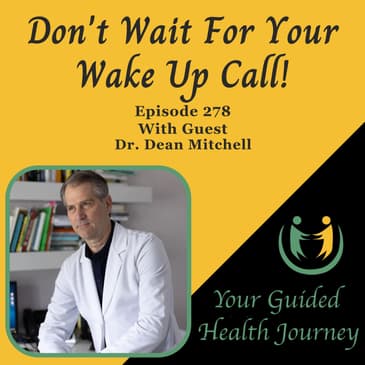
Dr Dean Mitchell dives into a powerful integrative approach to healing 🧬 This is where conventional medicine meets functional insight to uncover the root causes of chronic illness. With over 30 years of experience, Dr. Mitchell shares how issues like fatigue, brain fog, and inflammation often trace back to gut dysbiosis 🌱, Candida overgrowth, and microbiome disruption, especially after antibiotics. The conversation explores cutting-edge solutions like sublingual immunotherapy (SLIT) 💧 for allergies, along with deep insights into Mast Cell Activation Syndrome (MCAS) ⚡ and how triggers like mold, infections, and environmental stressors keep the body in a constant state of reactivity. The core message: true healing happens by addressing the root, calming the system, and restoring balance from within ✨
Dr Dean Mitchell’s lastest book: Conquering Candida: The 30 day protocol
Offers:
Our Book (episode 249) - Empowered: The Journey From Victim Island To Solution City: https://www.amazon.ca/dp/1989849776?psc=1&smid=A3DWYIK6Y9EEQB&ref_=chk_typ_imgToDp
Quantum Life Mastery School: https://amplifyimpactacademy.com/quantum-life-mastery-school
Introduction video about Girls Matter: https://drive.google.com/file/d/1R3-xqzJLZW14om1PhFClcU_oRSZ8zgip/view
The Light Circle Membership:
https://amplifyimpactacademy.com/thelightcircle-aligned-core
Meet Your Unconscious Mind Workshop:
https://amplifyimpactacademy.com/um
FREE 7 Day Trial: NuCalm Products to recalibrate your nervous system / improve your sleep:: https://nucalm.com
Use my promo code at checkout: YGHJ to get 15% off your monthly subscription, every month.
Episode Summary:
- Integrative Approach: Dr. Mitchell combines conventional training (allergist/immunologist) with functional medicine to treat complex, chronic conditions, often for patients who have seen many other doctors.
- Microbiome as Root Cause: He links many chronic issues (fatigue, brain fog) to gut dysbiosis, often triggered by antibiotics or PPIs, and treats it as a clinical diagnosis based on patient history.
- Sublingual Immunotherapy (SLIT): Uses SLIT for environmental allergies and to desensitize patients with dangerous food allergies, protecting against accidental exposure.
- MCAS & Mold: Treats Mast Cell Activation Syndrome (MCAS), a condition amplified by COVID, by stabilizing mast cells and addressing root triggers like mold exposure.
Topics
Dr. Mitchell's Integrative Journey
- Background: Board-certified allergist, immunologist, and integrative medicine specialist with 32 years of experience.
- Motivation: Recognized conventional medicine's limitations after a few years in practice and pursued functional medicine training with his physician wife.
- Advantage: His medical license enables comprehensive testing to rule out other conditions, providing a unique advantage over non-medical practitioners.
- Patient Profile: Often serves as the "10th doctor" for patients with complex, undiagnosed issues.
The Microbiome & Candida Overgrowth
- Core Philosophy: All health starts in the gut; gut dysbiosis is a root cause of many chronic illnesses.
- Candida Overgrowth: A controversial diagnosis in conventional medicine, but a key focus in Dr. Mitchell's practice.
- Triggers: Often follows courses of antibiotics or proton pump inhibitors (PPIs).
- Symptoms: Chronic fatigue, brain fog, and other non-GI manifestations (leaky gut).
- Diagnosis: Primarily clinical, based on detailed patient history, as standard lab tests are often unhelpful.
- Treatment: A multi-pronged approach using vitamin therapy, antifungals, and sublingual immunotherapy.
Allergies & Sublingual Immunotherapy (SLIT)
- Method: Uses SLIT as a safer, more convenient alternative to allergy injections.
- Environmental Allergies: Effective for pollen, dander (cats, dogs), and can help reverse asthma.
- Food Allergies: Treats dangerous food allergies (e.g., peanuts) to desensitize patients.
- Goal: Protect against accidental exposure, not enable unrestricted consumption.
- Impact: Significantly improves patient lifestyle and reduces anxiety for parents.
- Root Causes of Rising Food Allergies:
- Antibiotic use in infancy.
- Cesarean births (bypassing beneficial microbes in the birth canal).
- Diet and environmental toxins.
Mast Cell Activation Syndrome (MCAS)
- Function of Mast Cells: "Patrol cells" found throughout the body (gut, brain, skin) that release histamine in response to threats.
- MCAS: Occurs when mast cells are chronically active, causing a wide range of symptoms.
- COVID-19's Role: The pandemic amplified awareness of MCAS, as infections and vaccines triggered severe reactions in many patients.
- Treatment Strategy:
- Stabilize Mast Cells: Use safe, compounded medications.
- Address Root Cause: Identify and treat the underlying trigger.
- Common Triggers: Mold exposure, Lyme disease, Candida overgrowth, COVID-19.
- Analogy: Turn the immune system's "dial" from a constant boil to a gentle simmer by removing the source of aggravation.
About the Guest:
Dr. Dean Mitchell is a board-certified allergist, immunologist, and integrative medicine specialist with over 25 years of experience. He is the founder of Mitchell Medical Group in New York City and a national leader in sublingual immunotherapy, a safer and more natural treatment for allergies. Dr. Mitchell is the author of Dr. Dean Mitchell’s Allergy and Asthma Solution, which offers an innovative, holistic approach to managing immune and allergic conditions. A graduate of NYU School of Medicine, he is also the host of the Smart Medicine podcast, where he explores cutting-edge strategies for treating chronic illness and restoring vibrant health.
Contact:
Website: mitchellmedicalgroup.com
Podcast: The Smartest Doctor in the Room
About the Host:
Melissa is an Integrative Health Practitioner and a Board Designated Master Trainer of Hypnotherapy, Trainer of NLP, Time Line Therapy®, and NLP Results Coaching, helping people get to the root cause of their health issues and then get lasting results. Melissa neither diagnoses nor cures but helps bring your body back into balance by helping discover your “toxic load” and then removing the toxins. Melissa offers functional medicine lab testing that helps you “see inside” to know exactly what is going on, and then provides a personalized wellness protocol using natural herbs and supplements. Melissa’s business is 100% virtual – the lab tests are mailed directly to your home and she specializes in holding your hand and guiding the way to healing so that you don’t have to figure it all out on your own.
Melissa has launched Amplify Impact Academy, with business partner, Billie Aadmi and together they train other coaches, practitioners and counsellors in the 4 mind-body healing modalities mentioned above, giving them powerful tools to use with clients to get results with greater ease, speed and grace. These courses teach life skills and anyone can take them, if you want to be a better leader, parent, partner, be empowered in your own life, these courses are for you!
Melissa’s passion project is her non-profit, Girls Matter (www.girlsmatter.ca), breaking the poverty cycle 1 girl, 1 family, 1 village at a time. The mission is to keep girls in school and stop teenage marriages, because school isn’t free in over 50 countries around the world and when parents have to make the difficult choices of feeding their kids or paying for school, food wins. And when the girls hit their teen years, they will often be married off so that someone else becomes responsible to feed them. Keeping girls in school instead creates a generational ripple effect, because an educated girl is more than twice as likely to ensure her own children are educated. Educating girls also grows the GDP of countries, when they get into the workforce. This is how together, we can change the world. Guests on this podcast are invited to donate to this important cause. Learn more here in this short video: https://drive.google.com/file/d/1R3-xqzJLZW14om1PhFClcU_oRSZ8zgip/view?usp=share_link
Melissa is also the winner of the 2024 Women in Podcasting Awards in the “inspiration & motivation” category and the 2021 & 2022 Quality Care Award by Business From The Heart and is also the recipient of the Alignable “Local Business Person of the Year “Award 2022, 2023 & 2024 for Whistler.
Melissa has been featured at a number of Health & Wellness Summits, such as the Health, Wealth & Wisdom Summit, The Power To Profit Summit, The Feel Fan-freaking-tas-tic Summit, the Aim Higher Summit and many more! She has also guested on over 90 different podcasts teaching people about the importance of prioritizing our health and how to get started.
Linktree: https://linktr.ee/yourguidedhealthjourney
Thanks for listening!
If you know somebody who would benefit from this message, or would be an awesome addition to our community, please share it using the social media buttons on this page.
Do you have some feedback or questions about this episode? Leave a note in the comment section below!
Subscribe to the podcast!
If you would like to get automatic updates of new podcast episodes, you can subscribe on the podcast app on your mobile device.
Leave us a review!
We appreciate every bit of feedback to make this a value-adding part of your day. Ratings and reviews from our listeners not only help us improve, but also help others find us in their podcast app. If you have a minute, an honest review on Apple Podcasts/iTunes goes a long way! Thank You!!
[00:00:05] Your Unconscious Mind Is Powerful. It's the other 90% of your mind and yet you're not even taught about it at school. What if you could access the other 90%? It would be like driving the highway in 6th gear instead of 1st gear. That's what you're doing when you only know the tools of the conscious mind, the 10%. You're going through life in 1st gear.
[00:00:30] Are you ready to ramp up and go through life in 6th gear? Learn the powerful tools of your unconscious mind? Healing trauma, clearing anxiety in minutes rather than weeks, months and years? Join our next Meet Your Unconscious Mind workshop so that you can start to learn the power that you already hold within and the tools to access it. Look for the link to register in the show notes.
[00:00:58] Imagine getting up every day full of energy as if you were in your 20s again. What would that be like? What would that be worth to you? What is your health worth to you? Think about it. Your health isn't everything, but without it, everything else is nothing. And yet too many of us are taking it for granted until something goes wrong.
[00:01:34] No one wakes up hoping to be diagnosed with a disease or chronic illness. And yet we've never been taught how to be proactive in our health through our school system or public health.
[00:01:44] As a registered health coach and integrative health practitioner, I believe it is time this information is made available to everyone. Combining new knowledge around your health and the ability to do my functional medicine lab tests in the comfort of your own home will allow you to optimize your health for today and all your tomorrows.
[00:02:12] Welcome back to another episode of the Don't Wait For Your Wake Up Call! podcast. My name is Melissa Deally. I am your host and today I have with me the wonderful Dean Mitchell. Welcome to the show, Dean. Hi, thanks for having me, Melissa. Very excited to have you here. And let me just introduce you to the audience. Dr. Dean Mitchell is a board certified allergist, immunologist and integrative medicine specialist with over 25 years of experience.
[00:02:38] He is the founder of Mitchell Medical Group in New York City and a national leader in sublingual immunotherapy, a safer and more natural treatment for allergies. Dr. Mitchell is the author of Dr. Dean Mitchell's allergy and asthma solution, which offers an innovative holistic approach to managing immune and allergic conditions.
[00:02:58] A graduate of NYU School of Medicine, he is also the host of the Smart Medicine podcast where he explores cutting edge strategies for treating chronic illness and restoring vibrant health. And of course, that is also in alignment with everybody in this show. Thank you very much for your time and for being here today.
[00:03:18] And I love to ask what led you to this path of becoming a doctor and then, you know, going broader than many medical doctors do looking at chronic illness, looking at the underlying root causes of allergies, etc. Yeah. Well, I'd say from a very early age, I was very interested in medicine, but I was probably brainwashed by my parents because they do show me a picture when I was like five years old.
[00:03:45] They had a stethoscope draped around my thing. So I think somehow they steered me in that direction. But I actually I kind of always gravitated when I used to watch medical shows on TV or read books about it. I always thought, you know, a doctor's mission was very noble. I loved science. You know, I loved the curiosity, which also I love in practice, learning people's stories. You know, you learn so much from sitting with people one on one.
[00:04:13] I mean, when I went into medicine, I knew for sure I wanted to have a very people doctor relationship, not be like a radiologist in a room looking at x-rays or something or an anesthesiologist putting in. You know, these are all obviously important in professions, but that wasn't for me. I wanted direct patient contact.
[00:04:32] And, you know, to answer sort of the second part of what you asked, that after a few years in private practice here in New York, I started to see some of the limitations of what we would call conventional medicine. And it led my wife, who's also a physician who I met in medical school, for us to explore these other areas, you know, back when it wasn't so popular, you know, aspects of what we would call now today integrative or functional medicine.
[00:04:59] So we traveled around the country or wherever we had to go to train with some of the best people to bring that into our practice. And it's really made for a very rewarding practice on our end and hopefully helping a lot of patients. I'm sure it is. And of course, there is a place for allopathic medicine and the way that it's practiced.
[00:05:21] And there is a place for going beyond that and looking at root cause and then using some of the herbal remedies and natural healing options that are available to us and that have been available to us for many years and in some ways have been forgotten with the introduction of the allopathic medical model and big pharma.
[00:05:44] So I love that, you know, you've gone beyond that initial training, which is a lot of training and kudos to you for having gone through it and all of it and to continue learning. Right. And to recognizing that that education isn't the be all end all. And there's always more. So I love that you've done that together. But right. And I think what's the point what you're saying, you know, by training, there is a lot of years of training going to medicine, which is important. Yeah.
[00:06:11] And I found it to be important, too, because although over the years I met a lot of really smart, interesting, integrative practitioners, I'll call them. A lot of them don't have like a medical license.
[00:06:22] But what I've had the advantage of doing is that when I see a patient, I'm able to really review and do any kind of comprehensive testing that's important to rule out other conditions and yet also use my additional training to help some of those patients with very complex chronic problems.
[00:06:42] Like I used to, I did a video once on this, I called myself the 10th doctor and I was wearing like a basketball jersey with 10 on it because most of my patients have seen at least nine other doctors before they come to me. Yes. Right. And not getting the answers they're looking for and kudos to them to listen to their intuition, to know that there's got to be something more and to keep looking. Right. Absolutely. Yeah. Today patients, you know, what's really fascinating in this, actually I've been practicing about 30 years.
[00:07:12] And what's really fascinating now at this stage in my career to be seeing patients coming in really armed with a lot of information, a lot of good questions. I mean, obviously today went from Dr. Google to now chat GBT, but they are getting a lot of good information. But what I try to tell them, I hope and I believe that, you know, while all that is really good and I'm glad they're doing their homework,
[00:07:35] that if I've treated several thousand patients with a condition, I hopefully know the fastest and best route without making too many, you know, wrong turns and getting them better faster. And this is a big change from back in the day when I first started practice, when patients had to totally rely on their physician because we were the one who got the medical journals and everything. And that was the only way really medical information was disseminated.
[00:07:59] Right. Exactly. And what I love about the people coming in with all of this information, that can still be information overwhelm for them because now it's almost gone the complete other way. And there's so much information and some of it can be conflicting and they don't know. Well, for me, which is the right path? And that's where working with you, you can with all of the knowledge that you have, you can guide them on the right path for them, which might be a slightly different path to the next person.
[00:08:28] Right. Because we're all individuals. You're bringing out one of those points. I'm also talking to patients. I say to them, you know. When I go to a physician myself, but actually the most important decision I make is the physician I choose to go to, because when I go, I am the patient and I will listen. And obviously I'm fairly educated and but I might not be an expert in that particular field that they are. So I really trust their judgment that it makes sense.
[00:08:53] And so that's what's really important to patients is they do their homework to see, make sure they're getting to the right practitioner, the right fit for them. Absolutely. A hundred percent. I love that. So I also love that you spend time focusing on the microbiome. And, you know, I love what Hippocrates said thousands of years ago that all dis-ease starts in the gut. I like to flip that around and say all health starts in the gut.
[00:09:18] But if we can keep our microbiome healthy, then our chance of even ending up with some kind of chronic illness is much lower. And that's an area that you spend a lot of time focusing on. So let's just talk about the microbiome and the importance of that to your patients and having them understand it. I think it was really important to you. You mentioned my first book, Dr. Dean Mitchell's Allergy and Hazard Solution, which I wrote 20 years ago, I think a long time ago.
[00:09:46] But my newer book, Conquering Canada, is really about what you just mentioned. You know, in my private practice over these past several decades, I was seeing a condition which I wasn't taught about in medical school or residency. I was seeing these patients, a lot of them with a lot of unusual chronic illnesses, chronic fatigue, brain fog, you know, things that we kind of associate now with COVID. But I was seeing these patients, you know, for the last two decades.
[00:10:14] And I was actually fortunate. My wife was a little bit more involved first before I was that she was trained with somebody who's familiar with candida overgrowth. Now, candida overgrowth, I can tell you in the United States, I don't know about in other parts of the world, was a very controversial diagnosis. And I can understand why, because I actually I trained in my residency here in New York in the late 1980s, early 1990s at the height of the AIDS epidemic.
[00:10:40] And most conventional doctors would associate candida with an immune compromised patient, like an AIDS patient or a patient on chemotherapy. Right. But not in a person that didn't have any of these medical, you know, issues. In other situations. But what my wife and I were seeing, and this was based on the work of Dr. William Crook, who did this work in the 1980s, a really pioneer in his own way, was that patients were having those symptoms I just described.
[00:11:07] But most of the time, it seemed to come after many courses of antibiotics, sometimes courses of antacid blockers, the powerful ones, like the proton pump inhibitors. This was changing the gut microbiome and causing manifestations even outside of the GI tract. And that's the whole concept of leaky gut.
[00:11:29] So and we found by treating these patients with vitamin therapy, antifungals and even sublingual immunotherapy, we were able to get these patients back to a much better quality of life. By restoring their gut microbiome. Exactly. Beautiful. Love that. And it's also, in my understanding, it can be very difficult for conventional doctors to even diagnose it. Yes.
[00:11:58] It's very, this is what frustrates the clinicians. It frustrates patients too, is that it is essentially a clinical diagnosis. I just had a patient who I think I was mentioning to you came to me from Canada today to New York to see me about this. Exactly. And when they asked me that question, you know, what kind of test? And I explained to him, this is a very clinical diagnosis. That's why I spend the time getting the patient's history. I don't have an assistant do it. I need to be firsthand hearing that.
[00:12:25] Because unfortunately, at this time, stool, urine, blood, they're not very helpful. I'm pushing, hopefully, to get to some companies to do a breath test, which I think will be useful. But we're not there yet. So at this point, I really rely on patient's symptoms and signs to make the diagnosis. And yeah, so that's love that you do that. Because I know in my world that there's people that they spend a lot of time going to doctor, to doctor, to doctor.
[00:12:54] Like you said, the 10th doctor. And getting told there's nothing wrong with you or it's all in your head because their results are normal. And yet they know intuitively something is wrong and that they shouldn't feel this way. They didn't used to feel this way. So why do they feel this way now? Something's changed. And if I could understand that, I could do something about it. Sure. You put that much well. Oh, thank you. And food allergies. Let's talk about that. And not just food allergies.
[00:13:24] You work with all environmental allergies. You mentioned as well. Yeah, that's the other hat I wear in the practice. I actually enjoy it because those patients also can get super healthy. For about 20, 25 years, I've been doing the sublingual immunotherapy. This is in contrast to allergy injections, which I think have a lot of downsides to them. The sublingual immunotherapy we're able to use for environmental allergies. People allergic to the pollen. We're having a pretty heavy pollen season here in New York now.
[00:13:53] I can also do it for animal dander, cats, dogs, even horses. I have a couple of patients that like horseback riding and we're very symptomatic. My daughter could benefit from that. This is very nice because it really relieves their, what we call their allergic rhinitis symptoms. It can help reverse asthma. So it's really nice to do. The more almost exciting thing that I've been doing the last decade is treating children and adults with dangerous food allergies with the sublingual drugs. Interesting.
[00:14:23] It's become a big issue around the world, especially in Western countries where there's been an explosion of food allergies. And then there's a whole bunch of reasons I could go into after possibly why that's happening. But this has become a big problem because a lot of times too, especially the children, it's not even like they have one food allergy. They'll have multiple food allergies. So now they're restricted from going to some of their friends' homes or to certain restaurants or parties and it becomes very, you know, inhibiting.
[00:14:53] What we do with the sublingual drops, we treat them not so they can go out and eat, you know, peanut butter and jelly sandwiches. We treat them so that by accident there's a peanut in the cookie that a friend gives them or a cake that they don't go into a dangerous reaction and they're protected. And I think this is a big service to them as their parents and to help their, you know, socialization and lifestyle. Absolutely. Because, you know, what child wants to be restricted from going to birthday parties or
[00:15:22] not being able to eat the food that other kids eat, et cetera, et cetera. And it's tough. You know, one of my best friends, her daughter, who's now 24, has a peanut allergy. And so she has to be very, very careful about what she eats. Super medial. Yeah. Yes, exactly. And always carry the EpiPen, et cetera, et cetera. And tragically, years ago in Montreal, I heard of a case where a girl was very, very allergic
[00:15:49] and her boyfriend kissed her and he'd had some peanut on his lips from whatever he'd eaten earlier in the day. Didn't realize it was still there. And she had an anaphylactic reaction. So it's a very common thing. And let's talk about that because you just mentioned that, you know, why we're seeing more of these, you know, dangerous food allergies cropping up in today's society than even 20 years ago or 40 years ago. Yeah, I think it circles back to what you talked about the microbiome again.
[00:16:17] I mean, obviously we haven't figured it all out yet, but I have to tell you, I think in my heart of hearts that the issue again is antibiotics early in life. And I think, I think we're hopefully starting to move away from that, but children that were treated with antibiotics within even the first year of life, there's been studies showing that they have an increased allergic asthma. I'm almost sure that it really affects their having increased food allergies.
[00:16:46] There are obviously other factors involved, genetics and probably other things that have disrupted the microbiome. But, you know, this is a big one problem. And it's really increased, like, I think, like two or threefold in the last several decades. And then the other piece to that, in my knowledge, is there's so many more cesarean births because it's easier, you know, the OBGYN doesn't have to get up in the middle of the night. It can be all planned.
[00:17:13] And however, then baby doesn't come through the birth canal and get all of those great microbes as the foundation for that microbiome. Yes, that's something I ask all the time, too. I usually ask how the child was born. Was it vaginal cesarean? I ask if the mom breastfed. And I ask, was the mom on antibiotics during the pregnancy? Was the child treated with antibiotics early in life? Yes, absolutely.
[00:17:37] And I also have learned and find this fascinating that the health of our microbiome goes back four generations on mom's side. And if we go back four generations, like, where was our great-great-great-grandmother living? What kind of food were they eating? And how have we shifted away from that now to the food industry that we have today, which is also damaging our microbiome health with all of the chemicals in the food and the sugars, et cetera, et cetera. Sure.
[00:18:07] So, yeah. Now, something else that you offer is MCAS. Is the acronym that you use for that? Yes. We call it MCAS, Mast Cell Activation Syndrome. Yeah, that's a fascinating topic. I'll hopefully inform your listeners quickly that I learned about mast cells when I was back in my training, and I did my special immunology, allergy, infectious disease training back again in the early 1990s.
[00:18:36] And at the time, you know, this thing called mast cells, we were told had only to do with people that were allergic. Fine. That's what the textbook said. You know, and we saw that. We understood that these cells were joining our tissue. You know, kids, adults that had allergies, the allergen would bind to these cells and then cause the cells to release histamine. And that's why people got allergic conditions. I just remember one thing, because I like to think about things, thinking way back then,
[00:19:05] like, why would God invent a cell just to torture allergy patients? That just didn't do well. There has to be another purpose, right? Right. He's a very benign, you know, God. So, and then over the years, we started, really in the last decade, we started to hear about this condition called mast cell activation syndrome. And one of the similarities to candida was, again, the conventional doctor said, this is a made-up diagnosis. This is not real.
[00:19:30] But then something really dramatically brought this to light, and it was COVID-19. All of a sudden, I was seeing in my practice patients that had never had an allergic reaction in their life to food or anything. Some of my patients were down to eating four foods. They were just reacting to so many different things. Wow. Yeah. And clearly, the COVID infection, or sometimes, unfortunately, the vaccine, triggered this immune response.
[00:19:57] And it really made me do the deep dive to explore more about this idea of mast cell activation. And the more I did it, the more I found out. And it made sense because what was overlooked was that mast cells, which we all have, nope, there's not anybody in existence who's never had their body's never mast cells. You have to have them. But they are what we call a patrol cell. They're the first cells on the scene when you get a cut on your hand, when you get an infection. So we need them. Right.
[00:20:26] But when they're in a chronically active state, it causes multitude type of symptoms. It cause the mast cells. Again, different from what I learned in my training days. They're not just on the skin or in the sinuses. They're in the gut. They're in the female reproductive organs. I mean, they're in the brain. I mean, they're all over because they have to be. And that's why we see such a plethora of symptoms, you know, for patients that have this condition. My goal in treating them is twofold.
[00:20:56] One, to stabilize the mast cells, which I can do. There's certain compounded, very safe medications I get from my patients that does that. And even better, if I can find what's the underlying cause and treat that. Sometimes it's candida. Sometimes, a lot of cases, it's external mold, which is a big problem here in the United States. Sometimes it's due to an infection like Lyme disease or COVID. So each thing really needs to be addressed for that particular patient.
[00:21:26] And they've been activated for a reason. They're doing their job. They're doing their job. Yeah, but they need to be turned off. I make the analogy. It's like putting a pot of water on a stove and turning the dial all the way up so the water's boiling. Right. Don't want it boiling all the time. You really want to dial that down so it's just on a little simmer. And in getting to the root cause of what's going on, the Lyme disease, the mold, the candida, etc.,
[00:21:52] that will help them dial down on their own because they're recognizing it's healing. And then they can back off and not have to work so hard. Exactly. And you're supporting that entire process by addressing the candida and the mast cells as well. Exactly. And just helping speed up the healing process for people. Right. Because once the immune system, what's really great about our bodies, which is really amazing, once you take away the things that are aggravating it, it kind of knows what to do. Exactly. Yeah. Yeah.
[00:22:22] That's why I always love to say that a body in balance won't get sick, doesn't gain weight, etc. However, there's so much going on in our bodies and in our environment that are causing our body to be out of balance. You know, whether we're undernourished, whether, you know, we've got a high toxic load, whether we're stressed out and the body can't do everything and we're demanding it to do everything. Well, you get to another really key point is that I call it the double or triple hit, you know, theory.
[00:22:51] Like, again, sometimes someone, I mean, COVID was a very intense infection for a lot of people. But, you know, sometimes it's like someone's been exposed to mold for a while. Then maybe, again, they were antibiotics a lot for other infections. Like a candida. Then they got COVID. But the double, triple hit is where it tends to break the dam. Yes. And all hell breaks loose. Yes.
[00:23:14] And that mold one is such a tough one because it gets into the body and it just slowly, slowly, slowly causes very slight symptoms that build over time that the person is barely noticing the difference. Just like we don't see our child grow before our eyes. And then when they go to the doctor, the symptoms are just symptoms of so many things that the doctor has a hard time pinpointing, oh, that it could be mold. And so then they might be like, we'll use this antibiotic. And then now we're doing more damage.
[00:23:43] And if that doesn't work, come back and we'll, you know, give you more or something. And it's a tough one. And it's very common. That even surprises me so many times when I, you know, when I'm sort of stuck and, you know, someone doesn't even have a history of being exposed to mold. And I don't understand why they have chronic fatigue. And then we, you know, as a last ditch thing, I'll check the mycotoxins in the urine, which is a very accurate test for real time labs. And then I'll say, oh, my God, their levels are so high. And they were unaware.
[00:24:12] And we're able to treat them and they get much better. But it is like really you point out. It's a very insidious type of illness. You know, I mean, sometimes it's clear cut. You see black mold on a wall or a basement. Yes. OK. You know, you got a problem. A lot of other people, sometimes it's in their airbags or school or where they were. Yes, exactly. I stood on my podcast, The Smartest Doctor in the Room. I just had on actually an attorney, Alan Bell, who wrote a book called Poisoned. It was a dramatic book.
[00:24:40] I mean, really so powerful. How, you know, being exposed to certain toxic chemicals and mold derailed his life. I mean, he had to he was a promising attorney and, you know, working in Miami and he had to quit his job. He had to go to move like to like a little bubble in the Arizona desert to try to regain his health health. Wow. But it was quite a dramatic story. Well, I've experienced mold myself in my work environment.
[00:25:07] And I was only working there part time in sales and marketing two days a week. And the building, the entire building was under renovation. And I started working there and I was enjoying the work. And about a month in, I started getting a migraine every time I went to work. Wow. And I didn't know why I struggle with migraines anyway. And I was so hormonal. I'm like, what's going on with my hormones? And then one day, one of the construction workers came into the office and goes, oh, my God, the amount of mold in this building is unbelievable. And I was in corporate.
[00:25:36] I didn't even know what I knew then. However, my intuition was like, oh, my God, I bet that's what's causing my migraine. So then I just decided I can't do this anymore. I gave my notice. I resigned. I was very smart. Gave them a month's notice. I'm out of here. And the funny thing is, is by the time the month was up, they got all the mold out of the building and they were starting the reconstructive process. And I wasn't getting the migraines anymore. However, it was fine. I was happy to move on.
[00:26:03] Sometimes it could stay in the air for a long time also, even when they supposedly remediate. But yeah. So yeah, mold is a really tough one. So I love this conversation. Dean, I know we could talk for hours about all of the great work that you're doing. And like I said, I just truly appreciate that your focus is on getting to the root cause and
[00:26:27] helping your client heal rather than a quick fix, you know, and no slight to any other doctors. Doctors know what they know. They know what they've been trained. And you've chosen to learn more and that really sets you apart. And you've really dived into the aspect of root cause and helping clients heal. And so kudos to you for doing that, because I know that's a lot more learning that you've embarked on. And I love that. Well, you know, clearly you're not done. You're going to always be learning. Yeah.
[00:26:56] I tease my wife, you know, because again, we've been practiced together and she's probably the smartest doctor in the office here. But I guess I never got over medical student syndrome. I love learning. And, you know, especially without the tests, it's even better. Exactly. Just keep learning. And yeah, you don't have to. I mean, that's why I do my podcast. You know, I've been doing it the last five years. And I initially did it because I said, you know, I really enjoy talking to doctors, but we're always so busy. None of us will take the time.
[00:27:24] And so I embarked on this journey and now I've had over 200 episodes and, you know, people always laugh when they hear the title in my pocket. It's the smartest doctor in the room. They go, oh, ha ha. You think you're so smart. I said, no, it's all my guests. But I could tell you, I could change the name to becoming the smartest doctor in the room because after doing this for five years, I think it really has upped my game, you know, in helping patients. So that's awesome. I love that. So, yes, the audience can also go and check out that podcast becoming or no, the smartest doctor in the room. Yeah.
[00:27:53] Yeah, not that one yet. And so if people want to work with you, Dean, what is the best way for them to be able to reach out, connect with you? And you also very kindly have offered a gift to the audience if you would like to share that as well. Yeah, I would love if they're interested in what we're doing, they can go to my website, Mitchell Medical Group. I think you can learn a lot. There's a lot of information on there and there are videos and also links to podcasts
[00:28:22] we've done on certain topics that you might be interested in learning about. And yeah, we're going to be offering the Conquering Canada book to a set of the listeners. And yeah, I think that's... Awesome. I have that all in the show notes here. And I love to ask every guest that comes on this show, what does don't wait for your wake up call mean to you?
[00:28:51] Yeah, that's a good one. You know, I'm a strong believer that you have to think about what you want to do in your life, but really concrete goals. Because I almost do that every year. Like I'll say to myself, you know, I'll never forget, like when I said I was coming back from a trip five, six years ago, I was one of the few trips I made abroad to Europe. And I was coming back and I said, you know, I want to start a podcast. So I did it.
[00:29:20] You know, I said to myself, I want to treat patients with dangerous food allergies. So I set that up to do that, you know. And I said to myself, I want to write a book about Canada. And I did it. So I think it's really saying to yourself, you know, what do I really want to do to contribute? And then getting down and doing the hard work and doing it. That's awesome. Just deciding, right? It sounds to me, you decided and then you did it.
[00:29:47] And when you write it down, you sort of have it staring at you saying, you know, I still haven't done this yet. Are you going to do it? Write it on the fridge or somewhere where it's obvious. So yeah, that's awesome. I love that. Don't wait, just do it. And as we wrap this episode, thank you so much for your time here. What last words of wisdom would you like to share with the audience? I think as we've discussed today, definitely be proactive in your health.
[00:30:17] There are a lot of good practitioners. But again, you have the most skin in the game. So do your homework. Find out about whatever is bothering you. Find the best practitioner, hopefully, that you can find and get as healthy as you can. Beautiful. I love that because we all have one life. Let's be healthy and live it for as long as we can. So thank you very much for coming on the show. And thank you too to my audience for being curious, for tuning in, wanting to learn about
[00:30:47] your health, for showing up each and every week. And if this episode resonated with somebody that you know, please share it with them as well. Thank you for investing this time with me on the Don't Wait for Your Wake Up Call podcast. I'm so glad you joined in. If you can take two minutes to share this episode with someone you think can benefit and have a positive impact on their life, that would be wonderful.
[00:31:12] Please leave a review by going to your favorite podcast listening app and let me know what you enjoy or would like to hear more of. It will support me in my effort to bring the possibility of natural healing to a wider audience and help disrupt the sick care system we have today and make human health a global priority. Health is your true wealth.