
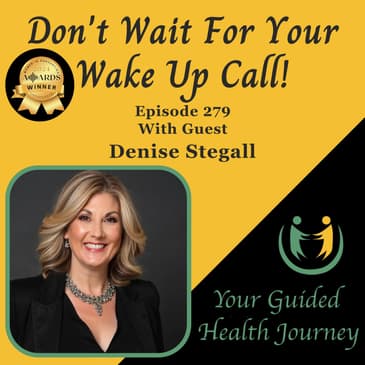
✨ In this powerful episode, Denise Stegall shares how her own early perimenopause journey led her to become a guide for women navigating midlife hormonal changes.
💤 Melissa and Denise talk about sleep, stress, nutrition, weight gain, hot flashes, brain fog, and why so many women are left without real answers.
🌿 This conversation is a beautiful reminder that menopause is not something to fear. It is a transition that can be supported with knowledge, care, and the right tools.
🔥 A must-listen for any woman ready to stop guessing, understand her body, and feel like herself again.
Gift: Menopause Hormone Clarity Tool Menopause Hormone Clarity Tool
Offers:
Our Book (episode 249) - Empowered: The Journey From Victim Island To Solution City: https://www.amazon.ca/dp/1989849776?psc=1&smid=A3DWYIK6Y9EEQB&ref_=chk_typ_imgToDp
Quantum Life Mastery School: https://amplifyimpactacademy.com/quantum-life-mastery-school
Introduction video about Girls Matter: https://drive.google.com/file/d/1R3-xqzJLZW14om1PhFClcU_oRSZ8zgip/view
The Light Circle Membership:
https://amplifyimpactacademy.com/thelightcircle-aligned-core
Meet Your Unconscious Mind Workshop:
https://amplifyimpactacademy.com/um
FREE 7 Day Trial: NuCalm Products to recalibrate your nervous system / improve your sleep:: https://nucalm.com
Use my promo code at checkout: YGHJ to get 15% off your monthly subscription, every month.
Episode Summary
In this empowering Podapalooza episode, Melissa sits down with Denise Stegall, The Menopause Mentor, to unpack the confusion, frustration, and silence that so often surround perimenopause and menopause. Denise shares her own story of entering perimenopause in her late 30s, noticing shifts in her mood, sleep, and overall sense of self, only to be dismissed by doctors and left without clear answers.
That personal experience led Denise into deep research and years of learning about hormones, nervous system regulation, sleep, stress, and midlife wellness. Today, she helps women understand what is really happening in their bodies so they can stop normalizing symptoms like brain fog, weight gain, irritability, hot flashes, and exhaustion. Her work focuses on helping women identify which hormones are most affected, uncover the true root causes behind their symptoms, and restore a sense of rhythm and vitality through practical lifestyle changes.
Melissa and Denise explore the critical role of sleep, the impact of cortisol and chronic stress, the relationship between nutrition and hormonal health, and the importance of viewing menopause as a transition into wisdom rather than decline. This episode is a refreshing reminder that menopause is not something women simply have to endure. With the right support, it can become a powerful new chapter.
Key Takeaways
- Perimenopause can begin earlier than many women realize. Denise’s journey began at 37, which is far more common than most people are taught.
- Women are often dismissed during this transition. Many are told their symptoms are normal, vague, or simply something to tolerate.
- Sleep is one of the most important starting points. When sleep improves, many other symptoms begin to shift as well.
- Stress affects hormones deeply. Even when women do not feel obviously stressed, their nervous system may still be carrying a heavy load.
- Hormonal health is about harmony. Denise emphasizes helping hormones work together in a more supportive, synchronized way.
- Nutrition matters. Irregular eating, late-night meals, and poor nourishment can intensify midlife symptoms.
- Weight gain is often connected to deeper imbalances. Cortisol, poor sleep, and hormonal shifts can all contribute to changes in body composition.
- Menopause is not the end. It is an evolution, a new chapter, and an invitation to live with more wisdom, intention, and self-awareness.
- Women deserve answers. They do not need to stay stuck in confusion or normalize feeling miserable.
About the Guest:
Denise Stegall, the Menopause Mentor, is a dynamic speaker, international best-selling author, and coach who has spent over 25 years helping successful businesswomen thrive through midlife with clarity, confidence, and calm. Denise brings science, strategy, guiding women 40–60 through hormonal shifts, brain fog, and fatigue into a lifestyle of vitality and joy. Denise's system helps women stop guessing, start healing, and feel like themselves again, without dieting or burnout.
Contact:
Website: https://denisestegall.com
Social Media
https://www.linkedin.com/in/menopausementormn/
https://www.facebook.com/denise.stegall.18/ https://www.facebook.com/MenopauseMentorMN/
https://www.instagram.com/menopausementormn/
YouTube https://www.youtube.com/@menopausementormn
About the Host:
Melissa is an Integrative Health Practitioner and a Board Designated Master Trainer of Hypnotherapy, Trainer of NLP, Time Line Therapy®, and NLP Results Coaching, helping people get to the root cause of their health issues and then get lasting results. Melissa neither diagnoses nor cures but helps bring your body back into balance by helping discover your “toxic load” and then removing the toxins. Melissa offers functional medicine lab testing that helps you “see inside” to know exactly what is going on, and then provides a personalized wellness protocol using natural herbs and supplements. Melissa’s business is 100% virtual – the lab tests are mailed directly to your home and she specializes in holding your hand and guiding the way to healing so that you don’t have to figure it all out on your own.
Melissa has launched Amplify Impact Academy, with business partner, Billie Aadmi and together they train other coaches, practitioners and counsellors in the 4 mind-body healing modalities mentioned above, giving them powerful tools to use with clients to get results with greater ease, speed and grace. These courses teach life skills and anyone can take them, if you want to be a better leader, parent, partner, be empowered in your own life, these courses are for you!
Melissa’s passion project is her non-profit, Girls Matter (www.girlsmatter.ca), breaking the poverty cycle 1 girl, 1 family, 1 village at a time. The mission is to keep girls in school and stop teenage marriages, because school isn’t free in over 50 countries around the world and when parents have to make the difficult choices of feeding their kids or paying for school, food wins. And when the girls hit their teen years, they will often be married off so that someone else becomes responsible to feed them. Keeping girls in school instead creates a generational ripple effect, because an educated girl is more than twice as likely to ensure her own children are educated. Educating girls also grows the GDP of countries, when they get into the workforce. This is how together, we can change the world. Guests on this podcast are invited to donate to this important cause. Learn more here in this short video: https://drive.google.com/file/d/1R3-xqzJLZW14om1PhFClcU_oRSZ8zgip/view?usp=share_link
Melissa is also the winner of the 2024 Women in Podcasting Awards in the “inspiration & motivation” category and the 2021 & 2022 Quality Care Award by Business From The Heart and is also the recipient of the Alignable “Local Business Person of the Year “Award 2022, 2023 & 2024 for Whistler.
Melissa has been featured at a number of Health & Wellness Summits, such as the Health, Wealth & Wisdom Summit, The Power To Profit Summit, The Feel Fan-freaking-tas-tic Summit, the Aim Higher Summit and many more! She has also guested on over 90 different podcasts teaching people about the importance of prioritizing our health and how to get started.
Linktree: https://linktr.ee/yourguidedhealthjourney
Thanks for listening!
If you know somebody who would benefit from this message, or would be an awesome addition to our community, please share it using the social media buttons on this page.
Do you have some feedback or questions about this episode? Leave a note in the comment section below!
Subscribe to the podcast!
If you would like to get automatic updates of new podcast episodes, you can subscribe on the podcast app on your mobile device.
Leave us a review!
We appreciate every bit of feedback to make this a value-adding part of your day. Ratings and reviews from our listeners not only help us improve, but also help others find us in their podcast app. If you have a minute, an honest review on Apple Podcasts/iTunes goes a long way! Thank You!!
[00:00:04] I am pleased to share with you a new training called Karma Code Timeline Therapy Practitioner Certification. This training is a powerful 3-day live on Zoom session teaching you how to help others in clearing all of their stuffed down emotion of anger, sadness, fear, hurt, guilt, rage and
[00:00:31] shame, without them having to talk about any of the situations that ever caused the root of that anger and release it from the cells in their body and have them feeling light and also to release all of the BS stories running around in our head of being unlovable, unworthy, not good enough, powerless, etc, etc. and get rid of all of that chatter and allow them to have peace and quiet in their head.
[00:00:58] This training is transformational for your clients and for you because during the training you get to experience it both as a practitioner and a client and release all of that garbage for yourself and clear out your emotional body, your mental body and keep them clear so that all of that stuffed down emotion isn't causing dis-ease later in your life. Check out the show notes for the link.
[00:01:26] Our first training is happening in 2026. Imagine getting up every day full of energy as if you were in your 20s again. What would that be like? What would that be worth to you? What is your health worth to you? Think about it.
[00:01:52] Your health isn't everything, but without it, everything else is nothing. And yet too many of us are taking it for granted until something goes wrong. No one wakes up hoping to be diagnosed with a disease or chronic illness, and yet we've never been taught how to be proactive in our health through our school system or public health. As a registered health coach and integrative health practitioner, I believe it is time this information is made available to everyone.
[00:02:22] Combining new knowledge around your health and the ability to do my functional medicine lab tests in the comfort of your own home will allow you to optimize your health for today and all your tomorrows. Don't Wait For Your Wake Up Call Welcome back to another edition of the Don't Wait For Your Wake Up Call. I am Melissa Deally, and this is a special Potapalooza show, and I'm here with Denise Stigal.
[00:02:51] Welcome to the show, Denise. Hello, Melissa. Thank you for having me. I'm excited to have you here and have this conversation with you, and first I want to introduce you to the audience. Denise, the menopause mentor, is a dynamic speaker, international bestselling author, and coach who has spent over 25 years helping successful businesswomen thrive through midlife with clarity, confidence, and calm.
[00:03:15] Denise brings science strategy and guiding women 40 through 60 through the hormonal shifts, brain fog, and fatigue into a lifestyle of vitality and joy. Denise's system helps women stop guessing and start healing and feel like themselves again without dieting or burnout. And I love this topic, Denise, because women aren't taught about menopause. And so as a result, they fall into this place of, well, I talked to my mother or I talked
[00:03:44] to my sister and whatever their symptoms are, that must be what I can expect. And they normalize the symptoms versus recognizing that those symptoms are saying that their body's out of balance. And that's where you come in and help people. So please share how you help women and even how you got into this work in the first place. Exactly. Well, why don't I start with how I got involved in this work in the beginning?
[00:04:09] So I was in my mid to late 30s when I started to notice that my personality kind of started to change. I'm a very happy, sunny kind of woman. And all of a sudden I was getting a little angry and a little irritated. I started not sleeping so well, which made me more angry and irritated. So of course, what do I do? I go to the doctor who pats me on the shoulder and said, it's just a phase you'll be fine.
[00:04:39] And I thought as I was sitting there ready to attack the man with my claws, I'm not fine. If I was, I wouldn't be sitting here asking for your help. And I had gone then to several other doctors for support, guidance, answers, anything. And I was really frustrated because I knew something was wrong, but I didn't know what was going on in my body because conversations with my mother that it never crossed her mind
[00:05:09] that I could be experiencing menopausal symptoms because I was only 37. That's not something that happens until you're older. So I spent a good chunk of time studying, researching, learning, picking the brains of doctors and OBJYNs and people in that area of expertise who really just even still struggled to pinpoint what was going on with me.
[00:05:37] And it was in my doing my research that I realized that I was in perimenopause. And at the time, no one ever used that phrase. Not one of the doctors and professionals that I went to see said that that could be it. Right. So I decided with everything that I've learned and tried, and I mean, I kind of use myself as a bit of the guinea pig. I've tried eat. I've tried different supplements and diets and workout programs.
[00:06:06] I, you name it, I've probably tried it. And because of that, I thought, you know, they don't want women behind me having to deal with this. Um, I have experience. I have knowledge. I know what's going on now. I understand hormones. So that is how I became the menopause mentor. Well, while I, I love your story and sorry that you had to go through it. However, you had to go through it to learn what you needed to learn in order to be the person
[00:06:36] you are today. Exactly. And we both know that you're not alone. And so I love that you're helping others because I know countless women who have started experiencing symptoms, whether they're, you know, 37 or 47 and go to the doctor and the doctor just says, you know, there's nothing wrong with you or it's just menopause, you know, suck it up. You'll get through it without any compassion or empathy for the struggle.
[00:07:05] The woman is in, in that moment, because for them to even get to the doctor in the first place, you know, they've been enduring the symptoms for quite some time. Absolutely. And they're done with it. So by the time they get to the doctor and then they get told, Oh, you'll just have to put up with it for a bit longer. Right. And that bit longer could be a year, two years, five years. It could be many years, depending on how early you started in perimenopause. So it is incredibly frustrating for women.
[00:07:33] And what I liked, how I like to help them first and foremost is to go through a self-assessment and it asks all sorts of questions about what they're feeling, what they're experiencing in their sleep, in weight gain, libido, all of the things that we know that women struggle with and don't talk about during the menopause transition.
[00:08:02] And so once they go through that assessment, we can actually see which hormones are really affecting them the most. And we start there by addressing those hormones. Very often people will say, you know, I, you know, I don't have the energy, you know, I'm, I've got brain fog and I'm not doing well at work. But when we actually start looking through and tracking what's going on, those things stem from the fact that they're not sleeping.
[00:08:32] Right. So we, we really try to get to like, what is that root cause of what's all of what's happening? Yes. And, and so often the not sleeping, when we can resolve that, when we rebalance the circadian rhythms and get our cortisol back in, back on track and our melatonin functioning properly, et cetera, when we fix that, it then allows the hormones to be produced at optimal levels
[00:08:59] so that all of the other symptoms of either being estrogen dominant or not enough estrogen or not enough progesterone or not enough testosterone are mitigated once we resolve the sleep issue. And people don't realize how important sleep is. And society often teaches us, you know, push through and do more. And as women, you know, we're in today's world, we have busy careers and then we're looking after the kids and taking them to soccer and dance and everything else that we're doing.
[00:09:29] And we're not allowing ourselves time to care for ourselves and calm our nervous system. And we might be living on coffee or energy drinks or whatever it takes to get through the day, not realizing how that's negative, negatively impacting our sleep cycle. So, right. So many women don't understand the connection of their central nervous system and stress. They think they have to feel stressed for their nervous system to be stressed.
[00:09:57] And even a little bit of stress, like as we get older and our estrogen and progesterone starts to decline, whether it's slowly or dramatically, depending on whether it's natural or medically induced. And the estrogen and progesterone are declining, which right there, that protection that they give to our central nervous system is depleting.
[00:10:26] And so it's declining at a time when we do have this additional stress. So it's really important to understand that, yes, the physical things and the emotional things that are going on, but also biologically what's happening in your body is also affecting your central nervous system. Absolutely. And it's only very recently where more research has been going into this and there are more books coming out.
[00:10:52] You know, our medical model, all of the research up until very recently has been done entirely on the male body. Because the female body was always seen as weak. We were the weaker ones. And so they couldn't do studies on us. Or the opposite of that, not opposite, however, but too complicated because of our cycle. They didn't want to do the research on us because it was too complicated.
[00:11:18] The exciting thing about that now is there are so many more female physicians and researchers that are in the fields now. So there is research being done. But yes, 20, 30, 40 years ago, there really was nothing. And you're right. It was all studies were on men. And so they just kind of looked at women as, yes, a complicated case, but just like small men. And we're not.
[00:11:46] And then they wonder why the symptoms that you have don't make any sense to them because men don't experience it. They have their own hormonal changes as they go through life. And the symptoms are different because we're talking about different hormones. Exactly. And they tend to happen later in men than in women. Yes, absolutely. So I would love for you to share, you know, one or two examples of clients that you have worked with and not naming any names.
[00:12:14] However, they came to you and they were really struggling. And then as a result of you guiding them through rebalancing their sleep, rebalancing their hormones, their life has changed profoundly for the better and in a relatively short amount of time. Sure. Sure. So one of my most recent clients, when she first came to me, I hadn't seen her. She's somebody who I knew.
[00:12:42] I hadn't seen her in quite some time, like several years. And when I saw her and she had seen what I was doing on social media. So when she saw me, she ran up to me and said, you've got to help me with these hot flashes. And like, I thought, okay, hold on. What's going on? Okay. Tell me what's going on. And so when we had our first real conversation, I asked her, well, if you know, working together, what's the one goal that you want to accomplish?
[00:13:10] And she said, I want to lose the weight that I've gained. And I went, okay, not what I was expecting, but it is actually what most women want when they come to me. They may have these other symptoms, but they really want to lose this weight that they have just, it was magically just appeared on their middle. And so I had her go through the self-assessment and she really didn't want to believe that she
[00:13:37] had the amount of stress that she did, but she was always, she was a self-assessment since I've known her, she's a single mom. She had her own business for many years and then got to a point where, you know, she needed more stability. So had quite recently sold that business and started working for a different, for a company
[00:14:00] and just all of those changes in her life, in her, I mean, it really affected her emotionally. Um, and so the challenges she was having, yes, she wasn't sleeping. So that was the similar thing, right? She wasn't sleeping. She was getting hot flashes, which was keeping her up all night. And so she was sleeping maybe three, four hours a night. So that was affecting everything.
[00:14:28] And we know as cortisol rises, um, we have lucky us women, we tend to hold onto weight. So that was actually, um, affecting her and, and really one of the causes of her weight gain. So the first thing we did after the assessment is we really tried to focus on her sleep and her nutrition. Her nutrition was all over the place.
[00:14:52] And just by focusing on those two things within the first three weeks, she felt better. She said, actually, she felt different. Those were her words. Um, she was sleeping a little bit better. Um, it took us about eight weeks for her to actually start to feel like she was, she would sleep. Maybe she'd wake up once or twice in the night, but she'd still wake up feeling quite rested. Right.
[00:15:19] And so that to me was, um, was really what needed to happen first was for her to be able to sleep in order to live a normal life and, and feel like she was accomplishing something. The nutrition of course helped because she was eating proper foods. Um, she was eating on a more regular schedule. She wasn't eating late at night before she was trying to go to bed, which affected her sleep. Right. So there were a lot of things going on.
[00:15:46] Um, but it overall, um, her sleep got better. She started to lose weight. So she started to lose inches first, not necessarily the weight on the scale, but she started to notice that her clothes started to fit better. Um, so that was, to me, that was one of the, or to her specifically, that was one of the more exciting things that her clothes fit better. She looked better and started to feel better. That's awesome. And that is what, you know, that's kind of a gauge for people.
[00:16:14] Cause you look in your mirror and you see that you see how you look and you can notice your clothes fitting better. Whereas you don't really notice on a day-to-day basis, your hormones changing, right? It's very hard for someone to measure that for themselves. Whereas the clothes fitting better and feeling better in our body as a result of our clothes fitting better and being happier as we look in the mirror, that's, you know, something that they can notice and feel proud of for the work that they're doing because they do have to put effort in, right? There is no magic pill to this.
[00:16:42] And again, we've been programmed by society to think that there's an, a pill for every ill and we go to the doctor and, you know, they'll fix us. We're not broken. We are not broken. Our hormones are changing as we go through menopause. So it's simply that they're out of balance and we just need to be able to bring them back into balance. And when we improve the sleep and we reduce the stress, that's a huge first step in doing that. And then of course, nutrition as well. Right. It really is about harmony.
[00:17:12] Like, I don't think if it's so much as equal balance, cause there's a lot of, a lot of things at play here, but everything kind of working in a better harmony than like they did maybe when we were younger. And once they start working in better harmony, as we get older and our hormones are still changing, there's, they can still work together in, in this nice, this nice way and still decline because it's what happens, you know, our estrogen and progesterone and testosterone levels are dropping. Yes.
[00:17:42] But if they're, if they're, they're dropping in a, in a more, I mean, use the word harmonious, harmonious, synchronous, synchronous way. That's a word I was looking for a synchronized way, rather than things just kind of dropping sporadically, we'll feel a lot better through the transition and we'll manage our, our moods, our sleep and our weight through the transition. Beautiful.
[00:18:08] So you mentioned an assessment and I know that you have a lovely gift for the audience. Can you please share what that gift is and then how people can get hold of you? Cause you know, I'm sure there's thousands of menopausal women that might want to be reaching out to you. Certainly. So the, the tool that I mentioned, the assessment is called the, the menopause hormone clarity tool, because we're looking for clarity here. What are the hormones that are affecting us right now?
[00:18:38] So that is it's a, I think it's a six page assessment and it goes through several different hormones. And it is, it's a free tool that you can go onto my website. You can take the tool, you'll find out, you'll get some answers right away. And then if you want to have a call based on those answers, the ability to do that is right there as well. Beautiful. So what is your website then? So people can find that tool on your website.
[00:19:07] My website is Denise Stigall.com. Beautiful. I will make sure all of that is in the show notes. And Denise, I love to ask every guest that comes on the show. What does don't wait for your wake up call mean to you? To me, that means. Know what, know what is out there for you. Don't wait for something to happen. Learn experience. Be curious.
[00:19:39] Rather than just waiting for something to fall in your lap, go out and grab it, whatever it may be. I love that great answer. And I've asked every guest that's been on this show and I've never had the same answer twice. And I love the idea of being curious. Yes. And as we wrap this episode, do you have any last words of wisdom that you would like to share with the audience? Yes. This is something I think is really important for us to understand. And menopause is not the end.
[00:20:08] It truly is our evolution. Beautiful. Beautiful. The beginning of the rest of our lives, right? When women come into our wisdom and the kids have left home in many cases, and now we get to live our mission, our passion and be who we were. Absolutely. We get to live our lives again and the way that we want to. Yes. Yes. So that's another piece is when women can look at menopause through that lens and celebrate
[00:20:36] it rather than through the lens of it's just all of these symptoms that make you feel awful. Absolutely. And if you do feel awful, then reach out to Denise because she can help you get over that so that you can get back to living your best life. So thank you so much, Denise, for coming onto the show and sharing your wisdom with the audience. I truly love this episode. And to my audience, thank you for tuning in each and every week and learning about your
[00:21:04] health and your wellness and seeking tools in order for you to be able to live your best life. And if something in this episode resonates with you, reach out to Denise. Or if you know someone that needs this episode, please share it with them. Thank you for investing this time with me on the Don't Wait for Your Wake Up Call podcast. I'm so glad you joined in. If you can take two minutes to share this episode with someone you think can benefit and have
[00:21:32] a positive impact on their life, that would be wonderful. Please leave a review by going to your favorite podcast listening app and let me know what you enjoy or would like to hear more of. It will support me in my effort to bring the possibility of natural healing to a wider audience and help disrupt the sick care system we have today and make human health a global priority. Health is your true wealth.