
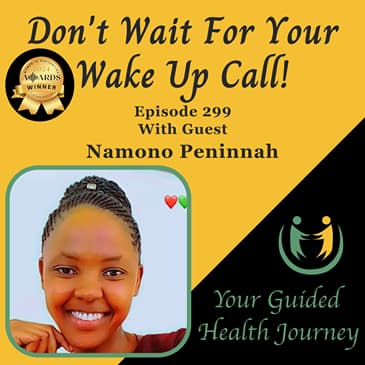
🌟 What if ONE opportunity could change the entire direction of your life—and empower you to change the lives of others?
In this incredibly inspiring episode of Don't Wait For Your Wake Up Call, Melissa welcomes Peninnah, whose extraordinary journey from a remote village in Uganda to becoming a university graduate and international professional is living proof of the power of education, resilience, and opportunity! 💖
👣 From running barefoot for an hour to reach school, working long days on her family's farm, and facing financial barriers to education, Peninnah's future changed when Girls Matter sponsored her schooling at just 13 years old.
🎓 Today, she's a university graduate working in Liberia, helping develop an innovative healthcare app designed to improve access to healthcare and create employment opportunities!
💫 Discover how one act of generosity created a ripple effect of transformation, how unexpected detours can reveal new possibilities, and why your circumstances don't have to define your destiny.
🔥 One girl. One opportunity. Infinite impact.
🎧 Tune in to this milestone episode and discover why investing in one person's future can change so many lives!
My Non-Profit – Girls Matter - https://girlsmatter.ca
Our Book (episode 249) - Empowered: The Journey From Victim Island To Solution City: https://www.amazon.ca/dp/1989849776?psc=1&smid=A3DWYIK6Y9EEQB&ref_=chk_typ_imgToDp”
Introduction video about Girls Matter: https://drive.google.com/file/d/1R3-xqzJLZW14om1PhFClcU_oRSZ8zgip/view
Personal Growth and CertifiacatonTrainings:
Impact Maker Alliance: https://ima-hub.base44.app/explore?ref=melissa
DHARMA PATH™ 4 – in – 1 designation trainings: https://amplifyimpactacademy.com/quantum-life-mastery-school
Meet Your Unconscious Mind Workshop:
https://amplifyimpactacademy.com/um
FREE 7 Day Trial: NuCalm Products to recalibrate your nervous system / improve your sleep:: https://nucalm.com
Use my promo code at checkout: YGHJ to get 15% off your monthly subscription, every month.
Episode Summary:
Key Takeaways
- Transformative Education: Girls Matter sponsored Peninnah's education, moving her from a remote Ugandan village to a boarding school and then university, where she earned a degree in Procurement & Logistics Management.
- Career Pivot: A COVID-19 lockdown forced a pivot from nursing to procurement, as the latter could be studied online. This decision proved critical, leading directly to her current role.
- Impactful Role: Peninnah now works in Liberia on a healthcare app, solving critical problems like hospital congestion and graduate unemployment. She holds three roles: Business Analyst, Project Coordinator, and Engagement Manager.
Topics
Early Life & Educational Barriers
- Grew up in Buyaya, Uganda, a remote village on Mount Elgon with limited services.
- Daily routine from age 5–6 involved farm work and chores from 6 AM to 6 PM.
- School was a 1-hour run away, often barefoot through mudslides, with shared notebooks and no shoes to avoid losing them.
- School attendance was inconsistent due to financial constraints; siblings alternated semesters.
Girls Matter Sponsorship
- At age 13, Peninnah received a full sponsorship from Girls Matter, a Rotary Club initiative.
- This provided a complete transformation:
- New School: Moved to a quiet, enclosed boarding school, a stark contrast to her old classroom where animals wandered in.
- Full Support: Tuition, supplies, meals, and healthcare were covered.
- Reliable Funding: Payments were made 3 weeks in advance, ensuring no missed school days.
- Mentorship: Girls Matter leaders (Esther, Mary) provided ongoing support and checked in regularly.
University & Career Pivot
- Girls Matter extended sponsorship for university.
- Initial Path: Began a nursing degree.
- COVID-19 Pivot: A 1-year lockdown halted in-person classes, which were essential for nursing practicals.
- To avoid losing a year, Peninnah switched to Procurement & Logistics Management, a course adaptable to online learning.
- Graduated in 2025 with a Bachelor's degree.
Current Role & Impact
- Girls Matter connected Peninnah with Nell for a Logistics Coordinator role in Liberia.
- Initial Role Mismatch: The role was not a good fit, and Nell provided a supportive environment to explore other opportunities.
- New Project: Peninnah now works on a healthcare app being built from scratch.
- Problem Solved: Designed to reduce hospital congestion, create jobs for unemployed healthcare graduates, and prevent financial exploitation of sponsors.
- Responsibilities:
- Business Analyst: Bridges client needs and the development team.
- Project Coordinator: Manages the project's timeline and scope.
- Engagement Manager: Coordinates a global team (5+ countries) across mobile and Salesforce backend development.
Podcast Philosophy
- "Don't Wait for Your Wake-Up Call": Seize opportunities immediately, even if it feels risky.
- Overcoming Limitations: Life's challenges do not have to define our limits. Find the "small space to breathe" and use it for growth, as new experiences can reveal unexpected skills.
About the Guest:
Namono Peninnah is a Procurement and Logistics Professional, Project Analyst, and Project Operations Specialist with an advancing focus on Business Analysis. She holds a Bachelor’s degree in Procurement and Logistics Management and brings hands-on expertise in project coordination, operational workflows, procurement governance, stakeholder engagement, and cross-functional team leadership.
Currently based in Liberia, Namono is expanding her analytical capabilities through an intensive Business Analyst mentorship and training program led by Wonyi and Askiya. Each mentor provides specialized guidance to sharpen her skills in identifying business needs, modeling processes, translating complex requirements into actionable solutions, and driving efficient project delivery.
Driven by a desire to create lasting social impact, Namono is deeply committed to initiatives that advance girls’ education, youth empowerment, and equitable access to opportunities. She combines a strong foundation in supply chain and operations with strategic analytical thinking and a continuous drive for professional excellence.
About the Host:
Melissa is an Integrative Health Practitioner and a Board Designated Master Trainer of Hypnotherapy, Trainer of NLP, Time Line Therapy®, and NLP Results Coaching, helping people get to the root cause of their health issues and then get lasting results. Melissa neither diagnoses nor cures but helps bring your body back into balance by helping discover your “toxic load” and then removing the toxins. Melissa offers functional medicine lab testing that helps you “see inside” to know exactly what is going on, and then provides a personalized wellness protocol using natural herbs and supplements. Melissa’s business is 100% virtual – the lab tests are mailed directly to your home and she specializes in holding your hand and guiding the way to healing so that you don’t have to figure it all out on your own.
Melissa has launched Amplify Impact Academy, with business partner, Billie Aadmi and together they train other coaches, practitioners and counsellors in the 4 mind-body healing modalities mentioned above, giving them powerful tools to use with clients to get results with greater ease, speed and grace. These courses teach life skills and anyone can take them, if you want to be a better leader, parent, partner, be empowered in your own life, these courses are for you!
Melissa’s passion project is her non-profit, Girls Matter (www.girlsmatter.ca), breaking the poverty cycle 1 girl, 1 family, 1 village at a time. The mission is to keep girls in school and stop teenage marriages, because school isn’t free in over 50 countries around the world and when parents have to make the difficult choices of feeding their kids or paying for school, food wins. And when the girls hit their teen years, they will often be married off so that someone else becomes responsible to feed them. Keeping girls in school instead creates a generational ripple effect, because an educated girl is more than twice as likely to ensure her own children are educated. Educating girls also grows the GDP of countries, when they get into the workforce. This is how together, we can change the world.Guests on this podcast are invited to donate to this important cause. Learn more here in this short video: https://drive.google.com/file/d/1R3-xqzJLZW14om1PhFClcU_oRSZ8zgip/view?usp=share_link
Melissa is also the winner of the 2024 Women in Podcasting Awards in the “inspiration & motivation” category and the 2021 & 2022 Quality Care Award by Business From The Heart and is also the recipient of the Alignable “Local Business Person of the Year “Award 2022, 2023 & 2024 for Whistler.
Melissa has been featured at a number of Health & Wellness Summits, such as the Health, Wealth & Wisdom Summit, The Power To Profit Summit, The Feel Fan-freaking-tas-tic Summit, the Aim Higher Summit and many more! She has also guested on over 90 different podcasts teaching people about the importance of prioritizing our health and how to get started.
Linktree: https://linktr.ee/yourguidedhealthjourney
Thanks for listening!
If you know somebody who would benefit from this message, or would be an awesome addition to our community, please share it using the social media buttons on this page.
Do you have some feedback or questions about this episode? Leave a note in the comment section below!
Subscribe to the podcast!
If you would like to get automatic updates of new podcast episodes, you can subscribe on the podcast app on your mobile device.
Leave us a review!
We appreciate every bit of feedback to make this a value-adding part of your day. Ratings and reviews from our listeners not only help us improve, but also help others find us in their podcast app. If you have a minute, an honest review on Apple Podcasts/iTunes goes a long way! Thank You!!
[00:00:03] Today's podcast episode is brought to you by Freedom Health, a Canadian company with a simple yet powerful mission. Give people convenient, affordable access to life-saving and life-enhancing medications without gatekeepers. Born out of the COVID era, the team behind Freedom Health has already helped tens of thousands of Canadians. Let them help you today. All of their products are compounded, packaged and shipped from Canada by Canadians.
[00:00:31] Quality Assured, Competitively Priced and Delivered Right to Your Front Door. Because, Saving Lives Matters. Use code YGHJSAVE15 on your next order to save $15. Visit www.healthfreedom.is today.
[00:00:52] Imagine getting up every day full of energy as if you were in your twenties again. What would that be like? What would that be worth to you? What is your health worth to you? Think about it. Your health isn't everything, but without it, everything else is nothing. And yet too many of us are taking it for granted until something goes wrong. No one wakes up hoping to be diagnosed with a disease or chronic illness. And yet we've never been taught how to be a disease or chronic illness.
[00:01:33] We've never been taught how to be proactive in our health through our school system or public health. As a registered health coach and integrative health practitioner, I believe it is time this information is made available to everyone. Combining new knowledge around your health and the ability to do my functional medicine lab tests in the comfort of your own home will allow you to optimize your health for today and all your tomorrows. Don't wait for your wake-up call.
[00:02:05] Welcome back to another episode of the Don't Wait For Your Wake Up Call! podcast. I am Melissa Deally, your host. And today I have with me the lovely Namono Penina. Welcome to the show. Thank you. Thank you, Melissa. I'm so excited and eager to be part of this show.
[00:02:26] I am very excited to have you on the show and I just want to introduce you a little bit to the audience. Namono Penina is a procurement and logistics professional, project analyst, and project operations specialist with an advancing focus on business analytics.
[00:02:46] She holds a bachelor's degree in procurement and logistics management and brings hands-on expertise in project coordination, operational workflows, procurement governance, stakeholder engagement, and cross-functional team leadership. Now, you might be wondering, why is this person on a show that is about holistic health and wellness? And I'll tell you why.
[00:03:10] You know that this show is sponsored by Girls Matter and every guest that comes on this show donates to Girls Matter to be on the show. And well, today I want to introduce you to Penina because she is one of our Girls Matter graduates. And this episode is all about what happens when you educate a girl.
[00:03:39] And if you want to read more stories and learn more about Girls Matter, just go back to the previous episode where I highlighted Girls Matter through a book fundraiser, our second volume of the Empowered Book, and shared stories there. And Penina's story is also featured there.
[00:03:57] So today, Penina, I would love to start out with you sharing with us what your life was like as a little girl in the village of Buyaya on the side of Mount Elgon in Uganda. Thank you very much. Thank you very much. My life has been, a lot has happened. I am born of a family of six.
[00:04:26] In a small community named Buyaya in Sironko, in Uganda, actually. But it's the small community is on the slopes of Mount Elgon. Now, as a little girl, I have four siblings, two girls, me and my sister and then my other two brothers.
[00:04:52] In our small community, it's not, let me say it's a remote area because most of services are not available. Yeah. Even by now, let me say it's at 50%. You find that education, medical care, it's not like education. It's not, before it wasn't a priority.
[00:05:20] Because you find that in, let me say, in our community of Buyaya, you find like maybe five schools or three. On five, three are functioning. Then hospitals, let me say on three, two or one are functioning. So you can imagine that small community. Services were not prioritized.
[00:05:49] And so we could find a way of surviving. Yeah, we could find a way of surviving. You are sick. There's a way you could survive. You can just take one painkiller and you get back on foot. So we could survive in every condition. And that community, since we are in the slopes, rain was a daily bread. Daily bread. So it became part of us.
[00:06:18] It became part of our life because daybreak, it rains in the night, it rains during the day. So it was our daily bread. And then let me take you through a normal day. Yes, please. Yeah. My normal day. We wake up at five or sometimes at six. It depends on the activities to be done on a day. Now, this is a day.
[00:06:47] Let me say this is a day of not going to school. Let me say a weekend. Now for a weekend, we wake up at six. Wake up at six. We go. We first do some farm work. Because our family, every child is given, let me say, a share on the plot of land. We go all of us. But then they demarcate your part. So you have to finish it. Before you do what?
[00:07:16] You go back home. So that was the experience we had. So we go. Even though it's raining or it's not raining. Because we have to eat. We have to feed. And farming was the only source of income or source of food. Because we used to grow cash crops and food crops. Yeah. So we could feed on them. So if you don't do the farm work, it means that you don't eat too much. So we had to go. At six.
[00:07:47] So you go. They demarcate your area. It doesn't matter if you finish it within 30 or 45 minutes. But it has to be done. That is on the weekend. You come back home. As two girls, there are some light, some house colors you do, domestic work. Then the boys do some cattle railing. They do some hard work. But the girls, they do some light house work.
[00:08:16] But to me, when I moved and a bit experienced, it was a bit, it was a hard work to me, actually. When I compare, since I have moved a lot, a bit exposed, when I compare, I was like, ah, ours was really hard. You had to work hard. Now that you see how other people live, you realize how hard you worked. Yeah. Yeah.
[00:08:44] But at that point, to us, you see it as it's normal. Right. You're like, yeah, it's normal. But when you get exposed and realize that, yeah, it was really a hard work. So you are done with all that. But as a kid, we have to do all the related house activities or work.
[00:09:09] And then we would also love to have time as children to play, yeah, like as children. So you could figure it that by before the day ends, like at six, you are done with all your work. So you can go enjoy yourself as a kid. But if you're not done, if you're not done with your daily house activities, you will not have fun as a child.
[00:09:39] Yeah. That's the way. You were motivated to do it quickly so you could get outside and play with your friends. And yet, it was still a 12-hour day. You were waking up at 6 a.m. and you weren't finished all your chores until 6 p.m. Yeah. That is a day on a weekend. Now let me take you a day, a school day. Yes. Now, a school day, that is when you wake up at 5 or 5.45.
[00:10:08] Because you have to finish all the work before you do what? You run to school. So you wake up at 5 or 5.45. It depends on the farm work. If it's too much, that is 5. If it's not too much, that is 5.45. So you go to the farm, you do your farm work, you come back home, you do the housekeeping activities, washing dishes, everything. Then school starts at 8 or 9.
[00:10:36] So you have to make sure that at least by 7.40 or 30, you are done with all your house work and farm work. Then you get ready for school. Now let me give a day that it is now raining. A day now it is raining. Ah! That experience. Then it's raining.
[00:11:02] And then school was, actually, to me and my siblings, the parents showed us that school is a priority. So no matter what happens, the future, you future lies in what? In education. So provided how the day is, provided how the rain is, it doesn't matter. So you have to go where? To school. So you get ready, your uniform.
[00:11:33] We didn't have shoes at that time. Shoes was not a priority. As long as you have, even uniform actually. As long as you have your one white shirt, then you pair it with any black skirt or trouser. Your books. It seems to be one book. Because they remember, they could get one book, pick for a book. Then they divide it into two. You share it with your sibling.
[00:12:01] Then you take half each. Right. You read a small book. This is a notebook for writing, for doing homework in writing. Right? Not a book that you read. It's a notebook for doing your homework. Yeah, it's a book. But remember, in school materials, in normal school, charters have like 12 books. But then for us, you could have five. Sometimes one.
[00:12:30] Then they divide it so that you can share it with your siblings. So that all of you, at least, you benefit. So you carry your book. One book. Because there are plenty. You find a way. Since it's raining, you find a way of protecting your book. You can either put it in the polyphen back. Or you can just push it inside your shirt. Then you run. Then you run off. You run off to school. But it's raining. It's a muddy day.
[00:13:00] The slides are pouring. No shoes. Some had shoes, some students. But then since we had that climatic issue, so most of them didn't bring shoes to school. Because when you come with your shoes, the slides will wash them away when you are climbing. Right. Yeah. The mud sucks the shoe off your foot and you lose it. Yeah. Then you lose the shoe and it's the only pair.
[00:13:29] So they were like, no. To protect it, let it stay at home. So you just run with your bare foot. Sometimes you slide. Yeah. So you could reach school. You are wet. You're dirty. Yeah. Sometimes, remember, you sleep during the wake coming. Sometimes you reach dirty. But then the school, since the school knew the area where it was, so some issues, they need to care about them. Yeah. They're like, as long as you're at school.
[00:13:59] So it doesn't matter. Either you're dirty or you have one shot or your buttons are missing. So at least you're at school, you have reached. So that was the life. And sometimes financial issues, you'd find that not all of us who go to school. So they could send two, then two remain for a semester.
[00:14:25] Then when funds are maybe a stable, then you all go. So that was the life. They push some, some stay. Some of you went to school and some of you stayed home when your parents didn't have the funds to pay the school fees. Yeah. They would alternate you? Or did the boys always go and the girls always stay home? No, they could alternate. Right. Yeah, they could alternate.
[00:14:54] If this semester the girls go, the next semester the boys will go. Got it. Yeah. That is how it was done. And it's reached a point where since we had an elder brother, so for him, he reached a state. Then he was laid off, not even laid off. They gave him a stop of one year so they could push us, the girls, since we were still young,
[00:15:19] they could push us at least to a full year and then he comes back. Right. So that is, yeah, that alternation. It depends on how the finances were. So that is the life I grew up in. Life of, can I say predicting, you don't know the next day how it will be. You don't know if this day will be as the next day.
[00:15:50] And you don't know if you get to go to school next year or next semester. It's very different to, you know, life for children in North America and the Western world. Yeah. It was really, that experience to me, I don't know, I learned a lot from it, but it was not, because we were still children at that time, so you could not visualize everything.
[00:16:18] So it's after you getting that sense of maturity is when you start picturing out everything. Yeah. But at that time, we were, the good thing that our parents, like I said earlier, they prioritized education. So the school was far. It was really far, because imagine you're preparing at 7.30, and you have to be at school at 8.
[00:16:47] And the distance can take you like an hour. So you could just go running. Yeah, you're like beat time. Yeah. So you could just go running. You just reach out to school, you're panting so heavily because of the distance. Yeah. And sometimes the delays of the rain, the water slide. So the school was so far, and that is one of the major reasons why some children, most especially girls,
[00:17:16] even boys dropped out because the distance was too, too, too far. Yeah. The school is, there are only two kindergarten schools in the community, and it's very far. Because I suppose we are located in, let me say, the places where maybe near the road, then for us, we are in, let me say, the interior part. Right. Yeah.
[00:17:42] So the distance became a really, a big issue. That's why most of them, now they dropped off. Since the parents were prioritizing education, so it became part of me. I'm like, no, this is, yeah, there's a point you reach that this is part of your life. So now, then we grew up, that was the life. Years passed.
[00:18:11] I've grown up, eight years. That is the life. And then farm work begins at the age of six, six, five. That's where the farm work begins. Six? At age five or six years old. Yeah, yeah, yeah. You start farm work. If you are five and six, no one is left home. Right. All of you carry, yeah, you go. Only the young ones, but even the young ones, because we grew up, they also carry.
[00:18:39] Your fellow siblings carry you, so you reach the farm, you make yourself busy. Provided you are young, but since you can't be left home alone, so you also follow. So all of you end up going to the farm, yeah. So I grew up with that experience of school. Sometimes you attend, sometimes you don't. Then when I reached eight years, then that's when Girls Matter came into the picture.
[00:19:09] So we had... I think if I recall, you were a little older than eight years, more like 13. You were going into high school. Yeah, yeah, yeah, yeah, yeah, yeah. It's true. I was... But then because, you know, for us, you will find a girl. She can tell you she's 18 years, but then the appearance, you're like, no, you are eight. You are... You are... Yeah.
[00:19:37] But she's telling you the fact, I'm 18, I'm 15. And so we were in that, let me say that confusion of age alternation. So you find someone is 18, but then in actual sense, when the physical appearance, person is eight years or 10 years. Because that issue came in because of maybe the farm work or the condition. Yeah. Yeah, that's...
[00:20:07] That was the main issue. The way we live our lives in the interior. So that's why you find someone. The age bracket they're claiming is not portrayed physically. Yeah. Because of hard work and also lack of nutrition, that their body hasn't grown the way that it should grow. Yeah. Yeah. It's true. So at the age of 13, then Esther and Mary came into the picture.
[00:20:35] That's when Girls Matter came into the picture. At that time, that semester, I didn't go to school. I was loitering around a small community. I remember that day. So that's when Esther and Mary came into the picture. They were educating. They emphasized girls. And then they called all the community members because all of us needed to be educated what is happening.
[00:21:04] So they informed us. They indicated us what's going on. This is a Rotary Club. It's coming to leverage us, mostly girls. They're focusing on girls. At first, you know how sinful were. I don't know. Maybe ignorant. Some people used to criticize. They're like, that's how they come and they go. That's how they come. But it's time Esther and Mary said, this is a serious issue.
[00:21:31] But then because the community was full of, let me say, some people were illiterate. And so they didn't take it that serious. So by the time they knew that the things were serious, it was too late. So they educated us. This is a program. It's coming to help girls. So well-wishers. You can submit in your details. You undergo the screening.
[00:22:02] I was like, hmm. At that point, I felt hope in me. I'm like, yeah. I'm feeling that hope. I'm seeing, I'm already picturing out life changing. Though, you know, as a kid, I don't know. I was like, I feel this call is for me. So they collected all our details. They submitted. Their applications. Yeah. Yeah.
[00:22:32] It took some time to get the response. At that faithful day, we were in the farm. I remember very well. And that day, the sun was really scorching. We were harvesting rice. So when I got that good news, when Mary and Esther came and called my parents, they told
[00:22:58] them, your girl, one of your girls is lucky. She has gotten the sponsorship from Girls Matter. She has gotten the help. When I heard that, I almost, I don't know. I said it was too much. I'm like, wow. This is too much for me to be. I was 13 years old. And most people didn't believe it.
[00:23:23] But because it took a long time to get the response. Yeah. So most, some of us were like, we reached a point where like losing hope. Yeah. Because they're like, it's a long time now. But when Mary and Esther finally replied us, I smiled age to age. I was like, wow. My life is coming to change right now.
[00:23:49] At least I knew that with education, I'm covered. Yeah. With education, everything is sorted for my end. You know? So, I was so eager. I remember that day. Like I said earlier, a full semester. I didn't attend school. So I knew this is going to stop now. No missing. No missing semester. No missing any day.
[00:24:17] At least I'll have a full book by myself. No division of books. Like they always used to do it. At least I'll have my own book by myself. No, I pictured a lot of things. I knew that day became my turning point in my life. Because I didn't expect it. And just from nowhere. Then Mary and Esther, then they oriented me. They oriented us.
[00:24:46] What's going to happen next? She said, the girl now, she's gotten the sponsorship. So, at that point, I even changed school. I'm like, now? I felt so high. I'm like, now I'm on a higher level. I live, but live. You know, as a kid, I don't know. I changed school. That experience. Visiting a new school. You know, a school that is different.
[00:25:14] You know, our schools that side, no windows. The door is open. Yeah. You know, you're in class, but you can hear all the sound and noise from outside. The chicken, the goat. You're in class with every animal in class. They would wander into the classroom? Yeah. They could make noise. So, you could have a passport ingesting them out. So, that was the classroom we had.
[00:25:45] And then, this changed to another classroom. It's an enclosure. Yeah. Everything's organized, yeah? It's just stable. So, it looked new to me. Yeah. It looked new to me, actually. Because I've changed school. I'm now in a better school. In fact, to me, it was the best school. It was the best school. Everyone is enclosed. The environment was so clean and so quiet, yeah?
[00:26:13] For a girl child like me, with that worst experience I had of a classroom where, I don't know. But then, so I changed school. They provided girls' matter. Girls' matter could provide us plastic materials like books, pens. I remember Mary and Esther could come and issue books, pens, sanitary pads to girls. They could also sometimes come and mentor us.
[00:26:43] Like, you know, as girls, sometimes we reach a breaking point. But then, if you have someone who keeps pushing, keeps advising, yeah? Like, no, you have to continue, yeah? So, they also provided that, actually. So, it gave us a push. It gave me, personally, a push. Then, I changed school. That experience was so good for me. Esther and Mary could come and check on us. How, do you like the school?
[00:27:11] I'm like, yeah, you didn't have to ask that. Did you like the school? I changed. A lot in me changed, actually. I grew fat. I don't know. I looked so healthy. Is it because of the peace of mind I experienced? Because the school they took me, it was a boarding school. Remember, if you are in a boarding school, just know, to me, I had escaped from work. I knew how. You escaped the farm work, yes. Yeah.
[00:27:41] And at boarding school, you had meals every day. Yeah. Yeah. Your health care was covered. And you had a place to sleep. Your tuition was covered. Your school supplies were covered. Yeah. Very different learning experience than the village school. Yeah. It was really, really, really different experience. Because, you know, going to school, what I liked about Galsmata was like, everything comes,
[00:28:10] the payment, everything comes in time. Right. In three weeks' time. Yeah. Before even you join the school, all the school opens. You already sorted. So you didn't have any days of school waiting for payment to come through. No. Yeah. No, no, no, no. Three weeks' time, I'm already sorted. So I'm just waiting when the school opens. I'm at the gate, actually. Because I knew I am sorted. That's awesome. So let's advance forward, Penina.
[00:28:38] So your high school education was at the boarding school. And from there, you were able to apply for university. So let's talk about your university experience. Yeah. So when I was done with my 12th grade, I asked myself, is the sponsorship ending at this point? That's the first question I asked myself. I was like, no, I'm not. So that I'm not grateful.
[00:29:05] I really appreciate what Girls Matter has done for me. But then, to me, I felt like, so I approached Esther and Mary. I was like, is the opportunity still open for me to send in my application? Is there a chance for me, for Girls Matter to push me to this second level of my education? They said, yeah. Submit. Bring the application. I said, wow. So I gave in my application.
[00:29:34] And that didn't take long, actually. I don't know, maybe because I was motivated or maybe because Galsmata saw that this girl should just finish, but then she still wants to push. Because that didn't take long. Within a few weeks, they came back and told me, you know what I've been granted? I'm like, wow. Thank God.
[00:29:57] And what I loved about Girls Matter was that they keep on checking in. How are our girls? How are they? Are they okay? Are they comfortable? Are they feeling? Are they living with their expectation? So that's why Esther and Mary could come. They take pictures of us at school.
[00:30:24] They take pictures of all of us together. They're like, we're updating your sponsors. We're updating your sponsors. We're like, it's okay. Come on, take us pictures in class. So there was that connection between us and you, Girls Matter. So it's not that we are in blue out, we are in shadows, no. There was that connection between us and you.
[00:30:50] So they wanted that offer of me to the university. But then I had opted for nursing. I went for nursing. That was, I just began one year, then COVID came into the picture. Yeah. So when COVID came into the picture, I'm like, wow. Because the lockdown took like a full year.
[00:31:17] So before lockdown taking a full year, I was like, we already sat home for like two, three months. I'm like, wow. That was at my care. I'm like, is this? Because to me, I'm losing time. Okay. I'm not growing young every day. And I'm like, and this course I'm doing requires more attention, more physical appearance. Like when I need to go to school. Okay. We had some practicals. So there's no way we could do it online.
[00:31:46] I'm like, let me transition. Let me change into something else that I can adapt online. Because with nursing, it's a medical course. I can't do it online. So I transitioned, I changed from nursing to procurement. That is in business school. So I changed procurement. That was after five months of lockdown. But I didn't regret that decision because I'm like lockdown took a full year.
[00:32:16] So I'll be sick. If I didn't change, I'll be still home for a full year waiting for the lockdown to do what? For the government to open the schools, I'm like, no, I don't regret that decision I made. Because at least I didn't waste time. You see? So I changed to another course. I did my procurement and logistics management for three years. All that is through Girls Matter.
[00:32:41] So I attained that, I attained my degree, my bachelor's in procurement. I don't regret changing the course. I don't regret the course I did. Okay. Because it has carried me far to where I am right now. You know? Absolutely has. Yeah, it has. Because I don't know if with nursing, if I'll be here. Okay? Probably not. Yeah.
[00:33:08] So yeah, let's share your experience after you graduated from university, which congratulations. That's such a feat for, you know, a girl from your village to graduate from university. And then what happened after that? Yeah. When I graduated, my graduation really, really impacted many people in Buyaya. Yeah. Many girls in Boyaya, actually.
[00:33:35] Because when I compare myself with my agements that we grew up with, most of them right now, they're having 10 kids. They dropped out. They're like, ah, Penina, you managed. How? Yeah? How? How did you? They were so surprised, actually. Because, in fact, all of my, let me say, my agements that I went to school with, I think were only two or three that I've reached somewhere. And it's only me who has attained the bachelor's.
[00:34:05] Can you imagine? I really, thank you very much, girls, for this opportunity. Because when I look at my friends, I don't know where I would, maybe I would, if not for you, maybe I would be like them. Okay? I don't know how it will be. So after my graduation, that was 2025, then I'm like, yes, I'm going with education. What's next? So this is the life of job hunting, job seeking.
[00:34:35] You know, I had to put my skills in action. But then, after that time, girls' matter didn't stop there. Melissa, you kept on checking in. How is Penina? How is she? Has she gotten something to do? Has she established herself financially? I'm like, no, I'm not yet. I'm still applying here and there. Sending applications here and there. They call you for interviews. You are not successful.
[00:35:05] When you get some contracts, they're like five months, three months. You know, that's not permanent. So it will end. You do, maybe you hope they'll retain you, but they don't. They're like, no, for us, we are full now. That was the experience I was in. And then in November, that's when Esther and Mary put the offer to me.
[00:35:31] They're like, Melissa has a job offer for you in Liberia to work as a logistics holding intellect. So she was asking me, would you, do you like the offer? Do you accept the offer? I told her, rush quickly. Don't even have to ask me because I'm doing nothing. Okay. Tell her, yes. No time to waste. Even tomorrow, I'm ready to go because I have nothing to do.
[00:35:58] And I was like, I'm wasting time just sitting here at home. Okay. I told her, give her a yes. To me, from my side, it's a yes. I'm open to it. Doesn't matter, but I'm open. So I told her, she was like, wow, you're a really brave girl. I didn't expect you to say that, to say a yes. You know, I'm like, in this life, you just have to take risks. Because sometimes in those risks, you find yourself.
[00:36:26] So that's, in risks, you find opportunities. So I'm like, let me grab the offer. To you, it looks like a risk, but to me, it's an opportunity. Okay. So everything was done. I prepared. It was so fast that, I don't know. Everything was done so fast. I thought maybe it would take time, but no. In a few months, boom.
[00:36:56] I saw my ticket landing on the phone. I'm like, wow. That's what it's really proactive. You know? I received my ticket. I'm like, now it's time to prepare myself. Like, emotionally, mentally, because now I'm going to a new place. You know? I'm changing. In fact, I'm flying. I'm flying to another place, another country. I've never experienced airplane before. I've never flied before.
[00:37:26] So it was a really, a new change in me. I'm like, I don't know the experience in planes. Okay. But then what I loved about Girls Matter, about Melissa, you introduced me to another, I think I've forgotten her name. Ellen. And yeah, Ellen. That mentored me, guided me, you know, on what happens, yeah?
[00:37:54] What to park as you're traveling, you know? I don't know how everything, different people came into, different people came into my life at different stages, you know? I was like, I've never flied before. How am I going to prepare myself? But then from nowhere, Melissa said, there's Ellen. Okay. So in a way, I don't know, in different stages, I got people who can guide me. Okay.
[00:38:21] So she mentored me, pack this, do this, don't carry this, do that, do this. So the day I reached, I was like, now I'm prepared. Okay. Not at 100% because emotionally, mentally, but material-wise, I'm good. I'm good to go. So I reached, I, that experience in the plane. Yeah.
[00:38:47] I don't know even how to explain it because to me, I was just saying things booming in my head. Vroom, vroom. I'm like, what's this? I'm really flying, yeah? I'm like, what? That experience. We were just hearing sounds in the air. I'm like, I was like, I'm really flying. Naclosons were flying. But I didn't notice it. Yeah, so the flight took like five hours.
[00:39:17] I think, I didn't know, the part in me was like, where am I going? Is Nell going to accept me? Is she going to like me? You know, I had a lot of questions in me. Is she like me? Okay. You know, to me- She met you at the, it was two flights to get to Monrovia, Liberia. And then Nell met you at the airport, right? And Nell was the one who offered you the job and she greeted you at the airport. Yeah, she did. She picked me up.
[00:39:46] She brought me up to her home. I'm like, it's not common for someone to welcome a stranger into a family home, you know? Because she doesn't know me. I don't know her. Nothing. I don't know. She doesn't know anything about me, but she welcomed me to her home. You know, I'm now, I feel at home, not staying with her. I'm now part of her family. So, I did the training and then along the way, she noticed I'm not fit for the role.
[00:40:16] Then she was like, let me give you different opportunities, you know, for you to explore at them. Through those opportunities, you will be able to discover yourself and you'll be able to know the skills you are best in. I said, wow, this is okay because it's not common to most employers to give their employees different chances or different opportunities. You know? She was like, I can't let you go. They're not part of me.
[00:40:46] Okay? So, I really appreciate that from her. She looked at me at that perspective of a child. She looked me like her child. I'm like, I have to help this. Yeah? I have to help her like a mother. Yes. Yeah. And that's why it's such a great partnership that Girls Matter has with Nell is because
[00:41:08] she also has the resources to be able to help people retrain and to be able to help people figure out what their passion is, what their dream is, what their skill sets are. And so, that's why this partnership is so wonderful. And it's been really wonderful for Girls Matter to see you go through this process with her and deep in our partnership with her. Yeah.
[00:41:38] This whole process has really helped me identify myself, discover myself, what I can do best. But I realized there are some things I can do that I didn't even think that I can do. Okay? And it's kind of... You simply didn't know before. Yeah. I didn't know. You hadn't had the opportunity to experience it before. Yeah. So, she gave me... She placed me part of a project. And this project, she gave me three roles.
[00:42:08] Three roles. A business analyst, a project coordinator, then an engagement manager. Then she said, with these three roles, try to acquaint yourself with them. Try to show your skills. You know? In all these roles, you emerge the best in any. Okay? So, at that time, I was like, this is too much for me.
[00:42:38] But since I'm that person who grabs every opportunity, I'm that person who gives a push in my life. I said, I've come a long way. So, I can't break from here. Anything that comes, yeah, I'll push. I'll take it. Okay? So, in this project that we are part of, it's a healthcare project.
[00:43:07] We are developing an application. This application, we are building it from scratch. So, this application is to help people to attain medical services from anywhere. Provided anywhere you are. You just have to open the app. You're signing. You choose a role. Whether you're a sponsor.
[00:43:37] You're sponsoring a patient. Or you are a patient. Or you are a dependent. Okay? So, it doesn't matter what you are, but you choose a role. You sign in. Or you request for care. So, a vetted medical care provider locates you using your GPS on your phone. So, they visit you. They administer care for you.
[00:44:06] You don't have to stress yourself. So, with this project, the problems we are trying to solve is congestion from hospitals. Yeah. Overcrowding in the hospitals. Online. Yeah. Okay. Yeah. You don't have to join the Q's for any service. But through this, you can get services. Right. Another challenge we are trying to solve is healthcare graduates that don't have jobs. Okay? Right. Yeah. So, through this, we vet them.
[00:44:36] They are qualified. So, they can be part of the care provider team. So, through that, they are paid something small. Okay? So, they're also trying. Supporting unemployment of the recent graduates as nurses and doctors. Yeah. Yeah. Yeah. Yeah. Then another problem is exploitation from foreign families. We find that that's where the role of a sponsor comes in in the app.
[00:45:02] A sponsor can be abroad and sponsors their family members in Liberia. You see? So, through that, they are not exploited. They can log in in the app. They pay directly through the app. Okay? So, they don't get to be exploited by their family members. Let me say the care was supposed to be physical. It was supposed to be $500. But then they tell the sponsor that it's $1,000. Okay? But through the app, you do your transaction yourself.
[00:45:32] You see it yourself. Yeah. Even it's $500 and you pay $500. Yeah. They don't get to be exploited. Yeah. And so, then there's also another problem. I recall you telling me that the app solved. And that is also the long distances people have to travel to get to hospitals when they're sick, which is very stressful and can be very difficult for them. And they don't have to travel because the app allows the vetted nurse or doctor to see them at home. Yeah.
[00:46:03] Yeah, yeah, yeah. You're right. Yeah. That's one of the... Because nowadays, in Africa, I don't know if in other places, but in Africa, the traffic can be too much. Sometimes, yeah. And your medical condition is not that urgent, not an emergency. Right. Okay? Yeah, you're just having something like a common flu or a common cold. So, you can just, instead of stressing yourself in traffic, you just sit home, you order. Right. They are provided this year at home.
[00:46:32] So, on this project, my role as a business analyst, what I do, as a business analyst, I visualize business needs to the developers. Okay? Right. But, yeah, I'm the link between the client and the building team.
[00:46:59] So, I communicate the building team what the client wants. Okay? So, I'm that bridge between the development team and the client. So, the development team has to understand what the client wants. Okay? They have to understand the client's expectations. They have to understand what the client wants to be part of the application. Okay?
[00:47:25] So, it is through me as a business analyst that they get to understand all that. So, I'm that bridge. Right. So, that's one of the aspects. Yeah. So, one of the role I play as a business analyst, we design solution documents. Okay? We design architecture documents. How we want the application to look like. Okay? Who are the different persons in the application?
[00:47:55] Okay? We design architecture documents. The documents have to portray what our client wants to be part of the what? Of the application. So, I also play a role of an engagement manager. With this project, we have different teams. We have, of course, functional teams. We have the mobile team that builds the application.
[00:48:22] Then we have the Salesforce team. This application is going to run on two, let me say, two softwares or two applications. There's the backend and the frontend. The frontend is what we use as C on the app. Okay? But the backend is the brain running through the app. Okay? The brain that is this moving the information within the app. So, that's the Salesforce team. So, I coordinate both teams.
[00:48:53] The mobile app team and the Salesforce team for them to function. Okay? There should be that alignment between the two. Okay? So, I connect both teams. I coordinate the meetings. I schedule the meetings. Okay? For them to align. So, that we all be within the scope. And in this team, most of them are foreign-based. Okay? Some are Nigerians. We have Indians. We have Ethiopians. Okay? We have...
[00:49:21] So, you are working with a global team now. Yeah. Yeah. And how many countries are represented? It's like five. We have Nigeria. We have Ethiopia. We have India. We have one from Senegal. We have one from the U.S. So, yes. Many countries involved and you are working with a global team. And who would have thought, even when you were at university, let alone high school, that
[00:49:49] you would be living in a new country and working with a global team on developing an app to solve major health issues and congestion in hospitals in Liberia. Yeah. Yeah. Because you received an education, you have the ability to do this.
[00:50:11] And now that you're working with Nell and she has the ability to see in you even things you didn't know you were capable of and give you these opportunities. So, Penina, I love how far you have come and what you are doing today and to see that smile on your face and to know that you are thriving in Liberia. And it's just such a joy because you are a shining example of why we started Girls Matter.
[00:50:42] Because when we educate a girl, that girl is then empowered to be able to live her own life independently and use her skill set, follow her passions, follow her dreams, rather than becoming dependent on a husband and repeating the poverty of her own family. Absolutely. So, I love all that you have accomplished, Penina.
[00:51:08] I love your attitude that when there's an opportunity, you just say yes, you take the risks, you keep moving forward. And it has served you very well. And so, thank you so much for coming on this show and sharing your experience so that people elsewhere in the world can realize what life is like for children in Africa and the difference that an education makes.
[00:51:34] Because when we all contribute a little bit, we can have a profound impact on many girls around the world that wouldn't otherwise have access to education. So, I love to ask everyone that comes on this show, Penina. What does don't wait for your wake-up call mean to you? Don't wait for your wake-up call. Actually, that's my journey so far.
[00:52:00] You don't have to wait for the right time. No. When that time comes at that moment, it doesn't matter how far you have gone. Just grab the time. Okay? Now, for me, the opportunity came. At that time, it didn't seem to be the right time. But I grabbed it. Okay?
[00:52:25] When the offer came for sponsorship with Girls Matter, at that time, I would have said, I'm done. Okay? I'm done with school. Because the offer took long. But then I did what? I grabbed it. Okay? So, I didn't wait to wake up. No. When the offer came to come and work in Liberia, I grabbed it. Okay? I would have said, no, I want to get married. I want to settle down in Uganda. But I said, no. I grabbed the offer.
[00:52:54] So, don't wait to wake up. If you are sleeping, wake up in your sleep. Grab the offer. Wow. That's me. Anything that comes my way, I grab it because I believe it has an impact. It will make an impact in me. Okay? And it comes for a reason. So, once it comes, you have to grab it. I love that. And it not only makes an impact in you now because you grabbed that offer,
[00:53:24] it's also now creating impact for others as you develop this app that will help so many have more access to healthcare and also help doctors and nurses who are unemployed gain employment. So, there's a ripple effect of impact. So, there's a ripple effect of impact that you don't even know how far that will go. So, I love all of this. I'm so proud of you, the courage that you have to grab every offer. And, Penina, I just want to ask if you have any last words of wisdom that you would like to share with the audience.
[00:53:56] What I would share, that's my last word of wisdom, is life can push us to the wall, but it should not be the limit. It should not be our end. Okay? Because my experience, the way I grew up, it was a life of pushing me to the wall, but I didn't give up. Okay?
[00:54:22] I still had that hope that one day, my day will shine bright. Okay? So, it doesn't matter how you are squeezed through the wall, there's always that small space for you to breathe. And through that small space is where you get to shine. Okay? If you can explore more, okay?
[00:54:50] It provides you with different opportunities. Okay? Different connections. Okay? In that way, you identify yourself. You get to know your skills. You get to know what you are good at. Okay? You get to know. Because sometimes what we say we want may not be the best idea or best solution for us. But the other way tends to be the best for us. You see? Not like for me.
[00:55:19] I'm a procurement profession. Okay? I have wide knowledge in procurement processes. But then, because I have that knowledge in procurement, it doesn't mean that I should stop at that. Okay? I should also grab other opportunities that come my way. In that way, I'm able to widen my knowledge. Not in procurement, but also in different professions.
[00:55:46] And through that, you get to grow in different professions. You get to add on what I knew. So, what I knew in procurement, I've been able to add it on. Okay? In these new fields that I've explored. I don't know what I've said. I love this. I love what you've said, Penina. The wisdom of a 26-year-old. And it's true. You know, life pushes us up against a wall.
[00:56:14] However, there's always that space to breathe. And through that space, we can shine our light. Through that space, we can look for growth and look for something different. Instead of staying on this side of the wall feeling stuck. There's always more we can learn and grow. And as we say in our training school, Amplify Impact Academy, we're never done. We always, there's always more to learn. And I love that attitude that you have and the wisdom that you have. So, again, thank you so much for being on the show, Penina.
[00:56:42] It's so wonderful to be able to share your story with the world and let the world know the difference that it makes when we educate a girl. And we so appreciate you being that shining example. Thank you for the beautiful ripple effects you are creating in the world today. Yeah. Thank you very much. I really appreciate Girls Matter has carried me so far.
[00:57:09] You know, it has made a very big change in my life that I didn't expect. You know, I've reached so far to me. Though life does not end here. You know, I still have something. I still hope to add on. Okay? And another thing is that sometimes I tell myself, I'm still here. So, that is a motivation to me. Age is just a number.
[00:57:39] But I tell myself, I'm still here. So, no matter what comes my way, I grab it to add it on me. So, as I always say, I'm still here. Okay? Because of that motivation, it keeps on making me to take on different offers that come my way. Thank you very much. I love that. And you are so welcome. Thank you so much for being here today, Penina.
[00:58:04] And to our audience, thank you for tuning in each and every week and listening and learning with an interest in your own health and your own personal growth. And I hope that this episode has inspired you. And if you know someone else that needs to listen to it, please share it with them. Thank you for investing this time with me on the Don't Wait for Your Wake Up Call podcast. I'm so glad you joined in.
[00:58:28] If you can take two minutes to share this episode with someone you think can benefit and have a positive impact on their life, that would be wonderful. Please leave a review by going to your favorite podcast listening app. And let me know what you enjoy or would like to hear more of. It will support me in my effort to bring the possibility of natural healing to a wider audience and help disrupt the sick care system we have today and make human health a global priority.
[00:58:56] Health is your true wealth.