
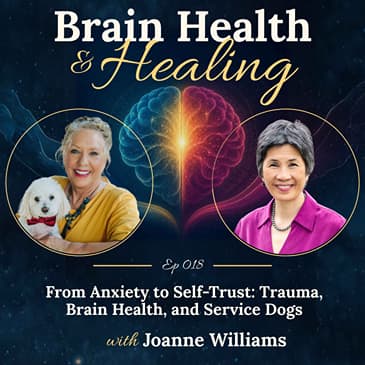
Can service dogs, nervous system awareness, and rebuilding self-trust offer new possibilities for people navigating anxiety, trauma, or brain health challenges?
When past experiences leave you feeling constantly on alert, it can be difficult to feel safe, trust yourself, or move through everyday life with confidence. Even when circumstances have changed, familiar fears and emotional responses may continue to shape how you experience the world.
Sandra Lee welcomes Joanne Williams, a therapist specializing in anxiety and PTSD, whose own experiences of childhood adversity inspired her to help others find new ways forward.
Together, they explore how trauma may influence our sense of safety, the connection between our thoughts and physical responses, and the importance of feeling understood rather than judged.
Joanne shares her personal journey with anxiety and an unexpected source of reassurance: her dog. Their conversation opens the door to considering how dogs, breathing, body awareness, and compassionate professional support may help people reconnect with themselves and begin rebuilding trust in their own experiences.
What might change if, instead of judging your reactions or trying to push through them, you became curious about what helps you feel safe, supported, and more connected to yourself?
What You Are Invited to Discover:
- The ways early experiences may influence your sense of safety, even when life circumstances have changed.
- An unexpected role dogs can play in helping some people navigate anxiety and everyday uncertainty.
- The connection between breathing, body awareness, and the possibility of reconnecting with your inner sense of direction.
- Where shame, self-blame, or familiar patterns of avoidance may be making an already difficult experience feel heavier.
- A different perspective on rebuilding self-trust and finding support without needing to navigate everything alone.
Free Gift:
Healing Through Life’s Hurts - Why “Moving On” Hasn’t Worked and What Does Work.
Steps to Heal - Life’s Hurts-Abandonment Workbook
https://acrobat.adobe.com/id/urn:aaid:sc:VA6C2:b6f52f50-f9cb-4549-9e19-cf6c2b6e6f25
About the Guest:
Joanne is a trauma therapist. This is part of the series of episodes about approaches to healing from trauma and brain injuries.
Joanne Williams, LCSW As someone who came from a family with anxiety and narcissism. She became a therapist specializing in anxiety reduction and PTSD recovery. She offers 1-1 sessions to empower individuals and families with tools and strategies, and personally and professionally specializes in how to use your own dog as a Psychiatric Service Dog to reduce anxiety.
Contact:
Website: https://servicedogpro.com/
Welcome to Brain Health and Healing. I'm Sondra Lee.
Speaker:This show is for people living with head injuries and the families and supporters who
Speaker:love them. If you are ready to reclaim your life, identity,
Speaker:and dreams for the future, you are in the right place.
Speaker:Welcome to Brain Health and Healing,
Speaker:Receiving Adversity's Gifts. I
Speaker:have a really wonderful guest with me today who's doing
Speaker:something a little bit different. I have been bringing people
Speaker:on who have experienced brain injuries and
Speaker:recovered from them. This is a person who talks about something a
Speaker:little different. She talks about post-traumatic stress
Speaker:disorder and thinking of it as a brain injury,
Speaker:as do I. So it's just like, I think about
Speaker:whatever it is that Affects my thoughts and
Speaker:my beliefs. I think of them as being thought injuries and
Speaker:belief injuries. And post-traumatic stress
Speaker:definitely qualifies as this. And through her own
Speaker:experience of trauma, she now serves
Speaker:other people as a therapist. And so
Speaker:it's wonderful that we get to speak with her today and hear about a really
Speaker:fun thing that she does. It's like I talk about
Speaker:receiving adversity as gifts. Joanne took her
Speaker:experience of trauma and turn it into something that I think is pretty cool.
Speaker:So please meet Joanne Williams. As someone who came from
Speaker:a family with anxiety and— a family
Speaker:with anxiety and narcissism, I became a therapist
Speaker:specializing in anxiety reduction and PTSD recovery,
Speaker:offering one-to-one sessions to empower individuals and families
Speaker:with tools and strategies. She personally and professionally
Speaker:specializes in how to use their own dog
Speaker:as a psychiatric service dog to reduce
Speaker:anxiety. So much fun. So welcome to
Speaker:Brain Health and Healing, Joanne. Please tell us a little bit about
Speaker:your story. Oh, thank you, Sandra.
Speaker:Yeah, you know, I think there's a little life
Speaker:adversity in all of us, but you know, some of us have it a little
Speaker:bit deeper, darker, and maybe a little bit
Speaker:stuck. And I call it stuck when you—
Speaker:that part of the brain, the amygdala, that's a fight, flight, and freeze just
Speaker:keeps this stuff like it's happening now. I had a family.
Speaker:My mother's quote was, if you worry about it, it won't happen.
Speaker:So we were taught to worry. And I know that sounds a little cuckoo, but
Speaker:yeah, worry, worry, worry, then it won't happen. So there was this
Speaker:piece that anxiety lived within us
Speaker:and that was normal, as well as a
Speaker:father who really was not very interested
Speaker:in his family and a brother who was completely
Speaker:abusive and out of control. And nobody in the family
Speaker:knew any parenting skills and what to do. And he was
Speaker:the abuser on me, a younger
Speaker:sister. And, you know, and it's even hard to
Speaker:blame him because there was just no structure. It was just a
Speaker:chaotic, unstructured, kind of
Speaker:dangerous— household that a young, I'm gonna call
Speaker:myself a sensitive child that was
Speaker:intuitive about all these things, but overloaded
Speaker:in my mind about what to do about. I had no idea.
Speaker:You know, I think I did the classic what a child does,
Speaker:pull the covers over their head and hope it goes away as a way to
Speaker:deal with things. So from that, you know, I really
Speaker:Knew I have to figure. And then, of course, then
Speaker:I married a narcissist alcoholic fisherman that
Speaker:this continued until I got counseling
Speaker:myself. And that was some 30 years ago, but I'm like,
Speaker:all right, this is it. I want to teach people. I want to show people
Speaker:that there is hope. There is a way out,
Speaker:even with what I call post-traumatic stress disorder that I consider a brain
Speaker:injury that keeps that brain just on alert all the
Speaker:time, all the time, all It's kind of like a house on fire. It's
Speaker:just like the alarms are going off all the time in your head thinking
Speaker:everything bad's gonna happen everywhere you go. And I
Speaker:had to learn skills to calm that brain. And I did it
Speaker:through counseling. And now that's what I do with my own
Speaker:one-to-one counseling and coaching. So talk about
Speaker:service dogs. Mm-hmm. All right.
Speaker:So that was about 10 years ago. 13
Speaker:years ago, I was on an airplane panicking,
Speaker:kind of grabbing the person next to me, holding on with
Speaker:white knuckles. And I had a little dog with me, but he was
Speaker:not at that point what they were called, uh, an emotional
Speaker:support animal. I didn't know about it. He was in a little bag
Speaker:underneath the seat. And the stewardess
Speaker:could see I was in distress. And I even was taking the little
Speaker:dog out of the bag and hiding him and people were helping me keep him
Speaker:back in the bag so the stewardess wouldn't yell at me. And
Speaker:so finally she came up to me and said, do you know there's a program
Speaker:that if you get a letter from your therapist, your little dog could be on
Speaker:your lap the entire time to fly?
Speaker:So I'm like, I'm a therapist. How come I didn't know about
Speaker:this program? So I researched it and found out the laws
Speaker:and ever since then I have been helping my clients
Speaker:Understand there's actually three laws: the the Fair Housing Act
Speaker:for housing, the flying law to fly with your dog, and the Americans with
Speaker:Disabilities Act if your dog helps you with some of your
Speaker:psychological symptoms. So ever since then, I
Speaker:got my little dog certified, and now he flies on my lap.
Speaker:And to me, it's life-changing. It it's like it's
Speaker:like when you have your best friend next to you,
Speaker:it just feels reassuring, and it helps to stop
Speaker:that unsafety feeling. feeling in my brain that's always
Speaker:telling me something, the plane's gonna crash, it's gonna be bad. Oh my God, this
Speaker:da-da-da is gonna happen. And with him, it's just like,
Speaker:we're good. So I've really helped a lot, and a lot of my
Speaker:clients, I think most of my clients with, because they do have post-traumatic
Speaker:stress disorder from these adverse life
Speaker:experiences, this becomes, I find, their
Speaker:first step possibly ever. out
Speaker:of this crushing fear and
Speaker:anxiety about going and doing things in life.
Speaker:So for people who have brain injuries,
Speaker:car accidents, strokes, falls, there's a
Speaker:lot of emotions. They get all over the place and they
Speaker:can have, you know, angry outbursts or
Speaker:some people have no emotion at all. I mean, their emotions get all
Speaker:dysregulated because of the injury to the brain and the imbalances in
Speaker:and the hormones and all of these things. Would people who
Speaker:have brain injuries, would some of them
Speaker:benefit from having service dogs? Yeah.
Speaker:Actually, I had a client last week that she fell, well, she
Speaker:fell and got a concussion, but bad enough that she's
Speaker:dizzy all the time. She's nervous. She's afraid she's gonna
Speaker:fall again. So she's got this, what she called, this
Speaker:anxious feeling about going and doing anything. So
Speaker:she got a dog. And she
Speaker:immediately felt the difference of
Speaker:reassurance. And when your brain feels
Speaker:reassured, that just changes the way the
Speaker:stories that you tell yourself about going
Speaker:into the world and doing more things. And,
Speaker:you know, the dog itself did not help the actual
Speaker:brain injury, but I'll tell you, I think it might help her
Speaker:heal better because if you're not anxious and stressed
Speaker:Rest, I think that's not sending the cortisol
Speaker:and the other stress hormones in there, and it would allow some of the calming.
Speaker:You know, the other thing I teach every single
Speaker:client is a breathing technique that was
Speaker:researched to send a calming chemical into your
Speaker:body and calm you even within 1 minute. And it's called the
Speaker:4 and 8 breathing, and it stimulates the vagus nerve.
Speaker:So that's another one that I think Anyone and everyone.
Speaker:It really helps to reset the
Speaker:thoughts that can get in a loop that you get in that you
Speaker:can't get out of because of the brain injury.
Speaker:Brings you back down into grounded and centered and gives you
Speaker:a chance to practice getting into a new mindset or a new
Speaker:way of looking at something. But you can literally feel this calming
Speaker:come into your body. In minutes. And then
Speaker:again, you just have that chance to feel
Speaker:calmer in moments. Yes. So valuable.
Speaker:So a really common experience that people have when they've had
Speaker:brain injuries is of things being kind of out of
Speaker:control and this, this, you know, fear
Speaker:and as well, um, the experience of not being
Speaker:seen. Or feeling like they're not seen because
Speaker:if it's not visible and they feel
Speaker:like people don't realize that they're injured. And so
Speaker:having this experience of not being seen and then,
Speaker:you know, just this anxiety and
Speaker:maybe not so much about what's going to happen, but
Speaker:what's not happening or what, you know. Mm-hmm. So it's like there's
Speaker:so many things that lead to this
Speaker:imbalanced emotional Mm-hmm. And so, um,
Speaker:practic— I like, I like having people take away practical
Speaker:strategies that they can apply to their life
Speaker:from the show. So a practical strategy that
Speaker:anyone here can use, whether you've got a brain injury
Speaker:or post-traumatic stress or trauma, or just having
Speaker:difficulty with whatever it is you have during the day, if you feel this
Speaker:anxiety, to do the breathing.
Speaker:Absolutely. And I know— Minutes. Minutes. Yes.
Speaker:And in my experience, part of the value of that
Speaker:is that it brings you into the present moment,
Speaker:paying attention to physical sensations.
Speaker:Yes. You can't be stuck in the past. You can't be stuck in the
Speaker:future. It brings you to right now. And that alone
Speaker:is calming. And
Speaker:then another practical strategy is possibly getting a dog.
Speaker:Absolutely. I'm going to add another one because, you know,
Speaker:our nervous system really doesn't know the difference between a threat from the past or
Speaker:the present. So it's getting in your
Speaker:nervous system. And so I think there's a lot of
Speaker:shame and blame that goes into this also. I don't want
Speaker:people to know that I'm nervous about this because I can't think straight like I
Speaker:used to. And so There's that other emotional
Speaker:piece that I think is really important to take off
Speaker:yourself and just be, you know,
Speaker:work on some more of acceptance about
Speaker:the current situation that's going on
Speaker:that you can do something about. The other
Speaker:technique that I've done, I've used a lot and I
Speaker:did a podcast, I can't, Anxiety Simplified. I don't remember the number of it.
Speaker:But it is also getting into your body,
Speaker:getting into your gut. And that's part of
Speaker:that breathing will help you get into your intuition. Because
Speaker:I think that's part of this whole process to trust yourself again,
Speaker:instead of looking out there, are they going to be okay? And, you know,
Speaker:them believe in me. No, believe in yourself. But your
Speaker:intuition is our in— instinctual
Speaker:way to understand things about your own needs.
Speaker:And I think with, well, especially with PTSD, I
Speaker:know we get cut off from our head to our body
Speaker:and it just stays in your head. And that's why a lot of this is
Speaker:just repetition and rote about, I can't, I don't know how, and I don't know
Speaker:where to go. When you can breathe and get to
Speaker:feel into your body, where is it going on? Is it
Speaker:panic in your heart? Is it in your gut? Because
Speaker:that's to me another key. Get into your body. If it is
Speaker:movement, if it is the breathing, any way you can, and
Speaker:then that is where you can start to build trust again
Speaker:within yourself. Oh yes. And is a dog that can help you do that?
Speaker:Yes. I see this
Speaker:energetically, right? When I am working with people, I am working with the
Speaker:flow of the energy going through the body. And when energy's
Speaker:flowing through the body, connecting to the earth, then I can think,
Speaker:And my body works. And this is part of what helps the
Speaker:brain to be able to repair itself is having that
Speaker:energetic flow. And I work with that energetic flow. And
Speaker:like Joanne was just saying, when I get worried or
Speaker:stuck or afraid or in this trauma, it's like it cuts
Speaker:off the energy flow right here. Yes. And it's
Speaker:like, like she was describing this, in my head
Speaker:and disconnected from my body. And so the thing that I tell my
Speaker:people all the time, time is allow the energy that's stuck in your
Speaker:head to go down your body, be in your body, and
Speaker:connect you to the earth. And this makes the difference
Speaker:often immediately. Immediately.
Speaker:I agree. And you know, you know, I think the reason why
Speaker:that happens, and I think this is important for people to
Speaker:understand too, that part, one of the
Speaker:symptoms, one of the major coping ways Is
Speaker:avoidance. It's like we get taught
Speaker:to not do what you just described. Avoid, avoid. It'll go away if I
Speaker:don't look at it. If I don't feel it, it'll go away. It does
Speaker:not go away. It gets stuck in your body, just like you're showing it in
Speaker:energetic ways. You can see it, feel it.
Speaker:And so this is like the little kid in the
Speaker:fire. They just pull their head out or go in the closet
Speaker:and they hope it's going to be okay because that is the level of avoidance
Speaker:of coping skills they only No. So building coping skills
Speaker:beyond, a lot of times avoidance
Speaker:is usually somebody, you need some help. A professional may
Speaker:need to help you, but don't let thinking, oh, I'll put it off
Speaker:to tomorrow that it'll be better. Sooner or later, it's a
Speaker:sooner or later. It has to be dealt with. Yes.
Speaker:So people here on Brain Health and Healing have heard me say
Speaker:Where do these things come from? They come from
Speaker:early in life, usually when we were
Speaker:really young and did not have logical capacities.
Speaker:Exactly. So we developed these belief systems, these
Speaker:compensation patterns, survival mechanisms. There's our
Speaker:dog. We developed these survival mechanisms, right?
Speaker:Then, and then they're, they're in the closet. And then when
Speaker:something happens, we pull in the survival
Speaker:mechanism and have this non-adult adult
Speaker:behavior. And, you know, it's
Speaker:just like, it makes sense that we do this. And so to take
Speaker:care of that child self, we need
Speaker:someone like a trauma therapist or an NLP practitioner
Speaker:or someone to help us because we can't do it ourselves.
Speaker:I'm too close to it to be able to do it myself. Yes.
Speaker:And so you here on Breath and Health and Healing have heard me say this
Speaker:many times. I need outside
Speaker:help. I can't do it alone. And so
Speaker:Joanna, as a trauma therapist, is wonderful at
Speaker:doing exactly this, helping you to be
Speaker:inside yourself and stay grounded and stay
Speaker:yourself. Yeah. And it's
Speaker:really that integration. And that's what's getting kind of
Speaker:above it, like you're saying, so you can see it because You are too
Speaker:close. And that avoidance again is
Speaker:one of the symptoms in this disorder,
Speaker:post-traumatic stress disorder. That's
Speaker:what you learn when you're a little kid. What else can you do if you're
Speaker:little and you don't have logic yet? Avoid. So you
Speaker:can build skills. You can do something,
Speaker:especially starting With, I like, that's why I like learning to
Speaker:trust yourself. So you dare kind of to look
Speaker:at this stuff and trust yourself that you can figure it out.
Speaker:Figuring it out makes so much difference. When I
Speaker:think this just happens to me and it's out of my control
Speaker:and I'm helpless about it, then I feel helpless
Speaker:and it's like, ugh, I gotta just give up. And it's
Speaker:like when it's like, oh, This actually makes
Speaker:sense. There's logic to it. It
Speaker:takes some of the charge off of it.
Speaker:And it's like, oh, I'm doing that again. And it gives
Speaker:me the ability to choose. Sometimes I may choose and sometimes I
Speaker:won't, but awareness and then being able to
Speaker:identify, it's like, oh, this makes sense why I am doing this.
Speaker:That gives you a door. to be able to change the pattern.
Speaker:I agree. And now I think part of this also what you're
Speaker:talking about is with brain injuries,
Speaker:it really does scramble our body's internal
Speaker:compass and to understand this
Speaker:stuff that we're talking about. So again, I hope
Speaker:people will take it off themselves. A lot of times when I work with
Speaker:people, I wanna, 'cause I wanna set here, I want them to know this is
Speaker:not your personality. This is because something
Speaker:happened to you adversely from the
Speaker:outside that you're now internalizing and just trying to figure it
Speaker:out. But this, just please don't blame yourself
Speaker:because that adds insult to injury and it
Speaker:doesn't really help. Because to me, what PTSD
Speaker:causes is false perspectives.
Speaker:When you look at the past and think it's still happening now,
Speaker:it's not giving you good information. Because your brain is just to
Speaker:keep you safe, right? That's all. But that's where the gut
Speaker:can come in and your gut feelings and that intuition,
Speaker:because that can give you more of the truth.
Speaker:Am I safe right now? Look around. Yeah,
Speaker:I've got my whatever so I don't fall down again. I've got my dog so
Speaker:I can feel reassured, you know, or all the things, whatever you need to do,
Speaker:do it. So that you can build that reassurance
Speaker:and trust again. And I'll tell you, building that gut to me is a real
Speaker:key with all of this.
Speaker:This has been wonderful. So for you in the audience,
Speaker:this was kind of like an accident. We wound up recording
Speaker:today because we had it on the schedule. I thought I was gonna be on
Speaker:her podcast and I guess she thought she was gonna be on mine. We didn't
Speaker:have a plan and it wound up being just right.
Speaker:Because one of the things that I am doing here is not just bringing
Speaker:in people who have experienced head injuries and recovered from them, we're
Speaker:bringing in tools, we're bringing in experts to
Speaker:help you know we can
Speaker:heal from these things. And so getting Joanne's
Speaker:wonderful perspective as a trauma therapist
Speaker:on what these things are like. And it so crosses
Speaker:over, right? Trauma is trauma. Yes.
Speaker:And the responses that we have to them are
Speaker:com— they make sense when we allow ourselves
Speaker:to see them that way. And getting the objective
Speaker:perspective of an experienced practitioner is so
Speaker:helpful. So thank you for bringing that wonderful
Speaker:perspective to us today, Joanne. Oh, thank you.
Speaker:And I do have a gift. And because I do want to share more of
Speaker:this, because, and I actually did my
Speaker:300th podcast on my
Speaker:podcast, Anxiety Simplified, on this whole issue of
Speaker:healing through life hurts. The Mind-Body Recovery
Speaker:Guide is what I have as a gift because I go into
Speaker:more of how this even echoes through life.
Speaker:As the echo effect, because it's usually not one thing that
Speaker:happens here. There is accumulation of hurts that can happen
Speaker:through time. So yes, I want you to have
Speaker:this gift, use it. It's practical. It's like a workbook
Speaker:journal. Or to find out more, you can find, go
Speaker:to servicedogpro.com. And I love working with people and their dogs. I know
Speaker:my guy came up here and if you noticed, he was looking at me
Speaker:because Because I was probably getting a little wound up or
Speaker:anxious, right? So he picks that up
Speaker:and comes up and gets in my lap to
Speaker:be able to again calm me.
Speaker:That's wonderful. Thank you. So it's going to be in
Speaker:the show notes, how to get Joanne's wonderful gift and how to
Speaker:connect with her. Before
Speaker:we go, I have a different kind of a question for you. So
Speaker:Joanne, imagine the future you want to
Speaker:have in the world, whatever that might
Speaker:be for yourself, for the world. What are you seeing
Speaker:and what are you doing when the world is being the world
Speaker:as you envision it? I see
Speaker:a world without judgment. I see a
Speaker:world that is open and
Speaker:inviting with everybody's different brains,
Speaker:every different kind of brain there is that we don't see it as the
Speaker:right, the wrong brain. It's like your right and left hand, which is
Speaker:better. I just see it as part of who we
Speaker:are and what we came here To share with
Speaker:each other. And that, that becomes
Speaker:really what this world is about, is about
Speaker:sharing each other's truths and
Speaker:really sensitivities. Because I feel like
Speaker:most people are very sensitive, and especially with a
Speaker:brain injury, I think it makes you more
Speaker:sensitive. And that I think we need more
Speaker:support. And more acceptance
Speaker:without judgment. Love that. What I hear in
Speaker:that is the fundamental need that all humans have to
Speaker:be seen. Yes. As you
Speaker:are. Yes. Seen and accepted as
Speaker:who you are, whatever that looks like. Whatever that looks
Speaker:like. Yeah. So what is
Speaker:the last thing you want the audience to remember?
Speaker:And there's support out there. Don't try to do this alone.
Speaker:And I think there's more than medical to be able to treat things.
Speaker:And, you know, especially, yes, you might've had a physical injury,
Speaker:but there's also an emotional component to it that can
Speaker:affect not only your brain, but also your
Speaker:heart and your gut. And that just getting in touch with
Speaker:our own intuition is a really, really
Speaker:critical piece. This is something too, I talked to my
Speaker:clients about. I was talking to somebody the other day and her dog kept coming
Speaker:up and pushing her hand up. And he's like trying to push him
Speaker:away, push. I said, no, he's alerting you. You're getting
Speaker:anxious. Notice how your dog actually may be
Speaker:helping you, noticing your energy,
Speaker:and that they're there to calm you if you use them in that way.
Speaker:Wonderful message. Thank you so much
Speaker:for being with us today, Joanne. It has been delightful.
Speaker:And thanks to all of you for being here for
Speaker:Brain Health and Healing: Receiving Adversity's Gifts. We'll see you
Speaker:again next time.
Speaker:Bye. It was so wonderful having Joanne with us
Speaker:talking about trauma therapy.
Speaker:And how it's really a similar experience
Speaker:for people with brain injuries and people with trauma,
Speaker:PTSD, whatever it is that's going on that
Speaker:leads to this experience of chaos
Speaker:and disintegration and not knowing how to regulate and
Speaker:not knowing how to be in yourself, in your life,
Speaker:and just being calm and centered. And balanced.
Speaker:So there's so many different ways to help yourself,
Speaker:so many different people who are able to provide
Speaker:support. So it was wonderful to bring Joanne in and get
Speaker:her perspective on that. Thank you very much. So
Speaker:what practical things did you take away? What
Speaker:gems did she offer about how you
Speaker:can support yourself? Whether you have a brain injury
Speaker:or any other trauma, what practical things
Speaker:can you draw from this that you can put into your life today?
Speaker:And if you have a brain injury or, you know, receiving adversity's
Speaker:gifts, adversity that you've overcome, if you wanna talk to me
Speaker:about your story, I would love to talk with you. I
Speaker:invite you to a 10-minute share your story call with me,
Speaker:complimentary. It's not a sales call. Oh, good. It's just an opportunity to
Speaker:share your experience. And then if you wanna work with me, we can talk about
Speaker:that later. So I look forward to talking with you
Speaker:sometime soon. Oh, and if you want to know more
Speaker:about the messages your body may be giving you, maybe through
Speaker:anxiety or through upset, then I invite you to
Speaker:receive my audio gift, Imagine What's
Speaker:Possible, helping you tap into your body's
Speaker:messages. So that's shinewithsandra.com.
Speaker:And to, for the Share Your Story call. It's
Speaker:shinewithsandra.com/brainstory.
Speaker:Thank you. Your brain heals itself
Speaker:every day of your life. Imagine what's possible.