
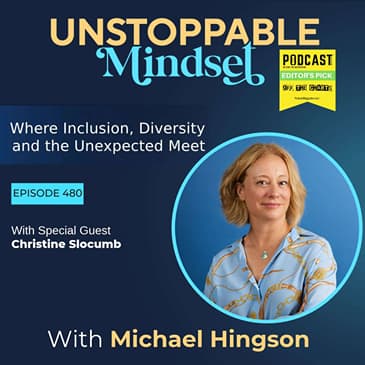
What happens when an engineer discovers that great technology alone isn’t enough to build a successful business? My guest, Christine Slocumb, began her career as an electrical engineer before moving into marketing, entrepreneurship, and eventually building and selling her own agency, Clarity Quest. Christine and I talk about why marketing and sales need to work together, how SEO and AI are changing business, and why website accessibility is simply good business. We also explore something I believe matters even more: how we treat people. Christine shares why she built a company where employees could feel respected, how she balanced entrepreneurship with putting her family first, and what she learned during the long process of selling her business. Now, she is helping other entrepreneurs prepare for business exits and discover who they want to become afterward. I think you will enjoy Christine’s thoughts about authentic leadership, embracing change, and taking the time to discover what comes next in life.
Highlights:
04:53 - How growing up without gender-based limits shaped Christine’s confidence and career choices.
11:17 - Why great technology still needs strong marketing to succeed.
21:35 - How website accessibility can benefit customers, businesses, and search visibility.
35:25 - Why AI can transform marketing without replacing human creativity and relationships.
45:25 - The choices Christine made to grow a business while keeping family first.
55:43 - Why selling a business can create an unexpected search for identity and purpose.
.
About the Guest:
Chris Slocumb started her career as an electrical engineer at Motorola, where she witnessed firsthand how poor marketing could tank great technology. That insight sparked a career pivot that would eventually lead her to founding Clarity Quest Marketing and writing the 2024 book “Stop Starvation Marketing: 23 Power Moves For Healthcare, Biotech and IT Companies”.
For over 20 years, Chris built Clarity Quest Marketing, growing it into a two-time Agency of the Year winner. When she sold the agency in 2023, she stayed on as Chief Growth Officer at the buyer’s holding company, driving 88% revenue growth for the holding company.
From the outside it looked easy. In reality, selling her company and finding a new identity was a gauntlet.
In February 2025, Chris made her exit from the buyer’s company complete and launched her exit advisory practice helping B2B founders successfully exit with their heads held high and values intact. Unlike traditional M\&A advisors focused solely on financial readiness, Chris addresses the complete founder experience: emotional preparation, successful transaction, and post-exit life design.
Her upcoming book "Mastering the Exit Gauntlet" (April 2026) captures the raw reality of her journey in the moments she felt lost, questioned everything, and learned to celebrate the sale in order to design a new identity.
Her core message challenges the exit narrative: A technically successful exit can become a disaster without organizational, financial, and emotional preparation. Chris brings the same nerve and grit that got her through the tech startup world’s engineering floors to helping founders exit on their own terms—living proof that life after exit can be purposeful, grounded, and entirely your own.
Ways to connect with Christine**:**
My website is https://christineslocumb.com/
Link to my upcoming book's teaser page: https://christineslocumb.com/my-books/mastering-the-exit-gauntlet/
LinkedIn: https://www.linkedin.com/in/chrisslocumb/
Instagram: https://www.instagram.com/cmslocumb/
About the Host:
Michael Hingson is a New York Times best-selling author, international lecturer, and Chief Vision Officer for accessiBe. Michael, blind since birth, survived the 9/11 attacks with the help of his guide dog Roselle. This story is the subject of his best-selling book, Thunder Dog.
Michael gives over 100 presentations around the world each year speaking to influential groups such as Exxon Mobile, AT\&T, Federal Express, Scripps College, Rutgers University, Children’s Hospital, and the American Red Cross just to name a few. He is Ambassador for the National Braille Literacy Campaign for the National Federation of the Blind and also serves as Ambassador for the American Humane Association’s 2012 Hero Dog Awards.
https://www.facebook.com/michael.hingson.author.speaker/
https://www.youtube.com/user/mhingson
https://www.linkedin.com/in/michaelhingson/
Thanks for listening!
Thanks so much for listening to our podcast! If you enjoyed this episode and think that others could benefit from listening, please share it using the social media buttons on this page. Do you have some feedback or questions about this episode? Leave a comment in the section below!
Subscribe to the podcast
If you would like to get automatic updates of new podcast episodes, you can subscribe to the podcast on Apple Podcasts or Stitcher. You can subscribe in your favorite podcast app. You can also support our podcast through our tip jar https://tips.pinecast.com/jar/unstoppable-mindset .
Leave us an Apple Podcasts review
Ratings and reviews from our listeners are extremely valuable to us and greatly appreciated. They help our podcast rank higher on Apple Podcasts, which exposes our show to more awesome listeners like you. If you have a minute, please leave an honest review on Apple Podcasts.
Transcription Notes:
[00:00:03] [SPEAKER_02] What if the biggest thing holding you back isn't what's in front of you, but rather what you believe? Welcome to Unstoppable Mindset, where inclusion, diversity, and the unexpected meet. I'm your host, Michael Hingson, speaker, author, and advocate for inclusion and possibilities. This podcast explores how the beliefs we carry shape the way we live, lead, and connect with others.
[00:00:32] [SPEAKER_02] Each week I talk with people who challenge assumptions, face adversity head-on, and show what's possible when we choose curiosity over fear. Together, we focus on mindset, resilience, and the small shifts that lead to meaningful change. Let's get started.
[00:00:58] [SPEAKER_02] Hi everyone, and welcome wherever you happen to be to another episode of Unstoppable Mindset. Glad you're here, and we hope that you enjoy our episode today. We have Christine Slocum as our guest. Chris Slocum has done a number of things in her life, including starting as an electrical engineer. She eventually started her own marketing company, and we'll get to all of that. We'll be able to talk peacefully with each other.
[00:01:27] [SPEAKER_02] I have my master's degree in physics. She was an engineer. No problem! So we cover all aspects of science that way. So, Chris, welcome to Unstoppable Mindset. We're glad you're here.
[00:01:38] [SPEAKER_01] Thank you, Michael. I'm so happy to be here with you.
[00:01:40] [SPEAKER_02] Well, and you're up in New Hampshire, and it's nice and nippy up there, and it's a little warmer here, but I'd still rather be inside than outside.
[00:01:50] [SPEAKER_01] Absolutely. I'm looking at it, and it looks beautiful today, but I wouldn't want to be sitting outside in it. Still a couple feet of snow here. It's great for skiing, but not much else.
[00:02:02] [SPEAKER_02] Oh, gosh, yeah. Well, my brother-in-law lives in Ketchum, Idaho, in Sun Valley. And he's been grousing most of the winter because they haven't gotten a lot of snow. They've gotten enough that he's kind of been able to ski. But, you know, he has been a skier his whole life. He was a master cabinet maker and a general contractor. And until he started to retire from doing that, which he's been doing over the last year, skiing took precedence over anything in the winter.
[00:02:30] [SPEAKER_02] And actually, for years, he conducted professional tours to France, over to La Grave and in that area. And he became a master certified ski guide. So he would take people over to France to do skiing. And he's actually talking about going over this year just on his own, probably because there hasn't been enough snow for him.
[00:02:53] [SPEAKER_01] It's been brutal in the West. I know. I have some friends out in Denver area and they're not happy campers, although it just snowed recently.
[00:03:01] [SPEAKER_02] So, yeah, well, a couple of weeks ago when the football game between Denver and New England was going on, they had they had snow. And I didn't even I hadn't even kept up with it. I didn't realize until I turned on the game just to see what the score was that they were playing in Denver and they were having crazy weather. But whatever. I'm glad to be inside. So I'm not going to complain. Well, why don't we start?
[00:03:27] [SPEAKER_02] Why don't you tell us a little bit maybe about the kind of the early Chris growing up? I might as well start at the beginning.
[00:03:34] [SPEAKER_01] We're going to start way there. OK, sure.
[00:03:37] [SPEAKER_02] Why not?
[00:03:39] [SPEAKER_01] I grew up in Bergen County, New Jersey, just outside of New York City. And small Irish Italian Catholic communities, very close knit. And I actually grew up kind of musical, not technical. I played the piano and organ for 16 years.
[00:04:03] [SPEAKER_01] And when it came the choice between going to college for music or going for engineering, I ended up picking up engineering because I didn't have an ear. Sure. My brother and my father were blessed with having an ear for music. They could listen to something and play it right back. And most great musicians have that talent. I did not.
[00:04:29] [SPEAKER_01] So I could read music, play it, you know, do all the technical aspects of it. But I didn't have that skill. But I liked a lot of the the way music worked in your brain. Yeah. Yeah. And it's very close to physics and engineering, actually. And it actually hones your brain to think in mathematical terms, because if you're going to read sheet music, you have to understand math. So, yeah.
[00:04:57] [SPEAKER_01] So I ended up going to engineering for college. Where did you go to college? I went to Villanova. Okay. Yeah. One year after they won the first basketball championship. So there you go. I didn't get I didn't get that party, but that was super fun.
[00:05:17] [SPEAKER_01] And yeah, I went from an all girls high school in New Jersey to one of 17 female engineers in college. But it was it was fun.
[00:05:31] [SPEAKER_02] So it was a pretty major transition going from an all girls high school to a co-ed type of educational environment in college.
[00:05:40] [SPEAKER_01] It was it was a big transition. I'd say not as much of a transition as going into the corporate world, but we can talk about that in a bit. But but it certainly was. But it it really set a foundation for me being in that all girls school, because I believe that women didn't have limitations. We could do anything. You know, the nuns and the lay teachers there were mostly all women. We had a couple of men.
[00:06:07] [SPEAKER_01] But, you know, there was like there was not even talk about like you can't do something. Yeah. That you're a woman. So I think that that was really great to have that foundation in early formative years.
[00:06:19] [SPEAKER_02] Yeah. Isn't that great that people sometimes don't put limitations on you? I know people tried to do that with me. The doctors told my parents when it was discovered that I was blind, that I thought I'd just be sent to a home because no blind child could ever amount to anything. And my parents said, no, you're wrong. He can grow up to do whatever he wants. And it's great to have parents and environments that are supportive like that, isn't it?
[00:06:41] [SPEAKER_01] It's absolutely. Absolutely. And I came from one side of my family is very Italian patriarchal. But my grandfather never said it to me. He was always like, you can be something, go to college. He would call it your sheepskin, go get your sheepskin or your basket, get your document and then do anything you want, which I felt was really interesting because towards other women, he was like much more patriarchal.
[00:07:09] [SPEAKER_01] But with me, it was like you could do anything you want. So, yeah, I had a great foundation in growing up in not facing limitations. It sounds like you had similar parents being very supportive.
[00:07:21] [SPEAKER_02] You were the only granddaughter.
[00:07:24] [SPEAKER_01] I was the first. I wasn't the first. OK, but I was the first.
[00:07:27] [SPEAKER_02] Well, hopefully he treated other grandchildren somewhat the same way.
[00:07:33] [SPEAKER_01] He did. It was different when it was his family and grandchildren. Yeah.
[00:07:38] [SPEAKER_02] That's cool. Well, so you went off and you got an engineering degree, which was cool. Did you go do any advanced degrees or just bachelors?
[00:07:48] [SPEAKER_01] I did. I did. I went for my master's right after my bachelor's. I had. Yeah, I had a fabulous professor. I'll mention his name, Dr. Singh, who was at Villanova. He's still there years later. And he's a great mentor. And he convinced me to stay on and do some work in solar energy.
[00:08:10] [SPEAKER_01] And I was really interested in climate even back then and hoping to save the climate. And so I had this fabulous research project and I was a teacher assistant. And I had job offers, but I really love that two years staying on for my master's. I was the only white woman in the entire graduate program.
[00:08:37] [SPEAKER_01] There were a lot of people from India, both male and female in that. And then some people who would do some evening programs. But that was a really fun experience and enlightening because in undergrad it was majority Catholic white folks in there. And then graduate school, I found myself suddenly in the minority in many different aspects.
[00:09:02] [SPEAKER_01] But I learned a lot in speaking to those folks and just even hanging out. We'd go to the cafeteria and they would literally cover their plates in black pepper. And I'd be like, what are you doing? An inch of black pepper. And they're like, your food over here is so bland. Oh, OK. That's a story I remember. But just also folks didn't judge you in grad school by color of skin or gender.
[00:09:30] [SPEAKER_01] It was just on your merit, which I found really enlightening.
[00:09:34] [SPEAKER_02] How long has Dr. Singh been at Villanova?
[00:09:38] [SPEAKER_01] Wow. I mean, I graduated in 90 and I think he might have started in 1988. OK.
[00:09:47] [SPEAKER_02] I'll tell you why I asked. There was a woman, a professor who joined about the last year or maybe the year before my last year. So 1974 or 75, she joined the physics faculty at UC Irvine.
[00:10:06] [SPEAKER_02] And in 2023, I was contacted by someone who works for the magazine that primarily supports her. It's a magazine about Sigma Pi Sigma, which is the physics honor society. And I mentioned in the course of the interview, we had a discussion and I'm happy to mention that in my last year at UC Irvine in the physics department, they were organizing a Phi Beta Kappa chapter. But it was kind of too late for me to be able to join.
[00:10:36] [SPEAKER_02] Well, this professor read that and Dr. Trimble called me in early night or 2024 and introduced herself and we knew each other. We had known each other. But here it is like 50 years since she joined the department and she's still there. And she was the now historic or historian for the Mu chapter of Phi Beta Kappa at UC Irvine.
[00:11:04] [SPEAKER_02] And anyway, they wanted me to join and become an alumni member, which I did. But she'd been there 50 years. My gosh, that's crazy. Whatever.
[00:11:13] [SPEAKER_01] I think when you do what you love, it's all the years go by quickly and you still want to continue doing it. And he was he loves teaching. Yeah.
[00:11:25] [SPEAKER_02] And I think she did. She did as well. It was it was great to reconnect with her a couple of years ago. It was kind of fun. But yeah, when you when especially with something like teaching where you know that you're accomplishing something and where students who study it seriously and and do the work that needs to be done and you get to see how they progress. That's a good thing. And why wouldn't you want to continue to do that as long as you can?
[00:11:53] [SPEAKER_01] Absolutely. Absolutely. Absolutely.
[00:11:56] [SPEAKER_02] So anyway, so you got a master's degree. And then what did you do? And then I went to work for Motorola. Wow.
[00:12:05] [SPEAKER_01] Yeah. So physics major, you probably knew that that whole story. But I was there in that heyday when they went from, you know, pagers to having the first flip phones. And yeah, it was, you know, Fortune 50. Really exciting. Lots of stuff going on. And then I also saw the downfall.
[00:12:29] [SPEAKER_01] And it was interesting before the downfall, I decided I really like left brain and right brain combination work. So I went for my MBA and they graciously sent me for my MBA in marketing. And I saw kind of the writing of the wall, like, oh, man, we are not investing enough in marketing. We have technology and we have great electronics and great engineers, but we are not doing the work in marketing. And that ended up really biting the company.
[00:12:58] [SPEAKER_01] And so, you know, they're a shell of what they were in that heyday Fortune 50 because of marketing. So I kind of looked at that insight and took that with me the rest of my life and saying, the companies that succeed. Yeah, they have good technology, but they have great marketing. And that got proven by Nokia, Motorola, and then Apple ate everyone's lunch.
[00:13:22] [SPEAKER_02] Yeah. Well, I remember after September 11th, well, even before, I worked for companies that sold products manufactured and developed by Sun Microsystems. And I was I never really kept up with a lot of the marketing, but eventually Sun got sold. And I could never believe it that that happened. They were doing so well.
[00:13:46] [SPEAKER_01] Yeah. Yeah. Yeah. It's interesting. Even to this day, we're sitting here, what, like 40 years later? Yeah. Especially business to business, technology companies, they don't invest in marketing. And I see a lot of startups and technical companies, healthcare companies who are not investing in their marketing when that could be the solution to a lot of their problems.
[00:14:14] [SPEAKER_01] But there seems to be like bad juju in PR around like, yeah, I should spend on marketing. It's not going to do the returns. There's some people who've seen the light and they have been rewarded mightily when they do.
[00:14:30] [SPEAKER_02] Why? Why is it? I mean, it ought to be so obvious, but why does that? Why does that happen? Why is it that people decide that they're just not going to spend a lot of time in marketing? What's the mindset that brings that out?
[00:14:44] [SPEAKER_01] Yeah. Well, after we're kind of going in a historical basis, I ended up working for Motorola and then I ended up working for some startups and then formed my own agency because I saw this problem out there. Right. Right. I saw that companies were not investing in their marketing and I was going to help tech companies first as a consultant and then agency owner do this. And I spent 25 years trying to convince founders, investors, boards to spend more in their marketing and showing them data.
[00:15:13] [SPEAKER_01] And then I ended up, you know, just saying, I'm going to pull my hair out if I don't write a book on this. So I wrote a book called Stop Starvation Marketing and gave dozens of case studies that showed, look at some of these people. We had a couple really small clients. They were investing maybe 30 percent of their revenue on marketing, which is a huge amount. Right. Yeah. They ended up getting sold really successfully, growing hockey stick.
[00:15:39] [SPEAKER_01] People would tell them, oh, you look like you were 10 times the size of the company that you really were. So I knew it worked. And I set about to try and convince people. And I think it's changing a little bit. It depends on the industry. But I still think we have a lot of people who are in leadership who were either technologists. Right. They're either engineers, software developers, physics majors, or they are salespeople. Yeah.
[00:16:09] [SPEAKER_01] Right. So the marketing or the folks in the corner over there making the pretty booth and nice sales slicks in historical basis. But now marketing is driving awareness. It's your whole online. It's how you found me. Right. It is. It is everything to drive your pipeline. Yeah.
[00:16:32] [SPEAKER_02] And it is so important for marketing and sales to work together because they really are so interrelated. And I remember being involved in companies where they were treated as two completely separate entities. And the reality is that doesn't work either.
[00:16:49] [SPEAKER_01] It does not work. It does not work. And sales and marketing misalignment is still a big issue. Yeah. But if you find a company and individuals, if you find a good VP of sales who understands marketing or a CMO and VP of marketing that get along, watch out. That company is going to do extremely well. Because if you can bring those two together and not have them be disparate departments at each other's throats blaming or saying, oh, that was our lead. Yeah. Yeah. Right.
[00:17:18] [SPEAKER_01] Then it's a really powerful combination when sales and marketing are working together on all cylinders.
[00:17:24] [SPEAKER_02] Well, you mentioned Apple before, and that is a really appropriate organization to talk about because Steve Jobs truly in some way understood marketing, but clearly he also understood sales. And he's one of those people that could and did work both sides of the fence and really took control of the company and not only developed products, but he developed products that clearly people wanted.
[00:17:54] [SPEAKER_02] And he made them work really well.
[00:17:57] [SPEAKER_01] Yeah. And I think he listened to his inner voice. Mm-hmm. And then he said, I'm going to make this brand so airtight that people will stand alone for three hours.
[00:18:11] [SPEAKER_02] Well, he and Apple did some things like they were very reluctant to make products accessible for people who are blind and have low vision. And it took the threat of a lawsuit to get them to finally deal with it. But they did, again, something that other companies had kind of sort of to a degree, maybe a little bit sort of did. But he did it all the way. And that is he built accessibility into the basic iOS operating system.
[00:18:40] [SPEAKER_02] So you can today buy any Apple product and you can activate full accessibility across the line. You don't need to buy anything else. He spread the cost over every single solitary device that they made and still do. So if you buy a Mac, you can make it accessible by activating it. iPhones, the same way.
[00:19:05] [SPEAKER_02] You know, and well, then iPods came along and they did the same thing with that. And the reality in iPads, the same way. So everything is accessible because accessibility is built into it. And that's really the way to do it. Although other than in an iPhone environment, probably the best technology for verbalizing what comes across a screen for blind and low vision people
[00:19:33] [SPEAKER_02] isn't from within a product that's built in the operating system like Narrator for Windows or whatever. It's a different product called JAWS from Freedom Scientific. It's got the biggest market share because it's been around a long time and you have to pay for it. But they've also adjusted their pricing so it's more affordable than it used to be. But they continue to expand it and have done some really clever things.
[00:19:56] [SPEAKER_02] You can now use it to actually describe photographs and graphs to a good degree because of the fact that AI is involved. But Steve Jobs, really, when he put his mind to it, made things work.
[00:20:11] [SPEAKER_01] But you said you had to, the community had to threaten legal action first. And then once you got over that hump, then you saw all the improvements.
[00:20:22] [SPEAKER_02] Well, so what happened was that Target was refusing to make their website accessible. And it started in 2000. But by 2007, the case was still going on. But it became pretty obvious that Target wasn't really doing what they needed to do to make the whole system accessible. And so eventually they settled their case.
[00:20:47] [SPEAKER_02] And the belief is it would have probably cost about $40,000 roughly if they had just made the website accessible. But they didn't view it as enough of a market share that they needed to do it. But the National Federation of the Blind continued the lawsuit. And eventually when Target settled, it cost them $8 million because the lawsuit was brought out in California where you can sue for – you can actually sue for damages, which you can't do under the ADA.
[00:21:17] [SPEAKER_02] And then the next lawsuit was going to be Apple. And literally the day before the suit was going to be filed, Apple called and said, no, we'll deal with it. And they did.
[00:21:27] [SPEAKER_03] Wow.
[00:21:27] [SPEAKER_02] Because Apple wasn't making iTunes U available. It wasn't making the iPhone available. It wasn't making Mac or anything available in an accessible form. But not only did they do it, they did it in a clever way. Now, I still think there's one small part that Apple hasn't done. This is my opinion. But, you know, Apple wants you to do things in a particular way if you're going to have an app that goes into the App Store. You don't want something that looks like Microsoft Windows, for example.
[00:21:55] [SPEAKER_02] What they didn't do was they didn't require that app developers make their products accessible. They are of the opinion that they'll provide the information and that over time most app developers will do it. Well, I think a lot of them are. But I think they could have done more to have stiffer requirements to make apps accessible from the outset. But that's my opinion.
[00:22:21] [SPEAKER_01] Yeah. When I was in the agency, we did a lot of web development. And I was surprised how few companies required that we add the accessibility. It did improve over the past, I'd say, five years. And we were definitely getting more requests to at least put accessibility plugins. It wasn't 100%. 100%. I'm sure in your view, like not the best, but at least it had something on there.
[00:22:49] [SPEAKER_01] And, you know, this was healthcare and life science and people who were interacting with the public. So I always liked when we saw requests for that come over because if you actually build a website for accessibility, it's good for everyone. Not just people who have accessibility challenges. It also happens to be quite good for organic search and today for generative search. Sure.
[00:23:17] [SPEAKER_02] And the reality is that still only about 3% of websites have truly worked to become accessible. I work with a company called Accessibee that began by using AI. And they didn't totally help because one of the things that they did was they said, we've got AI and it fixes everything. And they shouldn't have done that. And they now know that. And so they don't.
[00:23:46] [SPEAKER_02] And there's a lot more to it because AI won't fix everything. But AI can help. And so they've worked and have a pretty significant customer base that is growing daily, that is actually working to make websites. Well, they're making websites accessible and the customer base growth is proving that. But still, it is illegal to not have a website accessible.
[00:24:13] [SPEAKER_02] Under the ADA, it took a while, but the government finally said that the Internet is a place of business. And so since under the ADA, any place of business is supposed to be accessible, the reality is that companies should be making their websites accessible. And I'm not going to say they should do it because they're going to get sued if they don't. That will happen to companies.
[00:24:41] [SPEAKER_02] But I think your point is a much better one. There have been enough studies by even companies like Nielsen and so on that have looked at branding and looked at websites and so on and point out that up in the CDC, of course, talks about the fact that up to 25 percent of people in the United States have a so-called disability.
[00:25:05] [SPEAKER_02] So the reality is it's good business to make the website accessible in your company because otherwise you're losing up to 25 percent of your potential business. Do you really want to do that?
[00:25:17] [SPEAKER_01] Absolutely. And if you really think about it in those terms and think about that amount of detail when you're building your site, you're also building a better site for everyone.
[00:25:26] [SPEAKER_02] Sure. And the reality is that some people will use the technologies that go into making a website accessible. Even if they can see, there are still things that they'll use. And you're right. The reality is accessibility is just good business all the way around for everyone. Apple built their operating system with this technology called voiceover. So everything verbalizes.
[00:25:52] [SPEAKER_02] And I don't know that Apple is really publicizing it as much as they really should. Since so many people have iPhones and they have them in their cars, I would think that Apple could do more to make their voice technology more a part of what people use their iPhones for on a regular basis in a vehicle. So they don't have to look at the screen, for example, when somebody calls. It automatically will identify it.
[00:26:17] [SPEAKER_02] And they can do other things to make the technology even more usable because the facilities are there to do it.
[00:26:25] [SPEAKER_01] Yeah, I love that example of driving. Yeah, you're absolutely right. Hopefully they hear this, Michael. Yeah, I hope they do.
[00:26:32] [SPEAKER_02] Or you'll have to go back and rebuy your company and market it.
[00:26:40] [SPEAKER_00] If you enjoy Unstoppable Mindset and would like to help us continue bringing these conversations to you each week, we've created a way for you to support the show. Your contribution helps us cover production costs and continue sharing stories, insights, and ideas that inspire people to live with purpose and possibility. If supporting the podcast feels right for you, you'll find the link in the show notes. Thank you for being part of the Unstoppable Mindset community.
[00:27:13] [SPEAKER_02] So you've lived all over. You've lived in like eight states. And how has that affected your outlook and all that you did to go into marketing and start your company, Clarity Quest?
[00:27:26] [SPEAKER_01] Yeah, well, in our big, beautiful country, we have different pockets of culture and personality. And growing up in the East Coast, outside of New York City, it was very fast. I'm talking very slow for a Jersey person right now. Very fast. I learned, you know, get things done. Hard to meet friends, but once you made them, they were friends for life. Right. Went to Arizona, very different culture.
[00:27:53] [SPEAKER_01] Everyone was your friend within two seconds, but they could not be your friend the next two seconds. But beautiful country and appreciation for nature. And being able to get away from people, you know, and just being able to think in the high desert as you're used to. So that's beautiful. Then I spent time in the Pacific Northwest, and that was startup culture.
[00:28:20] [SPEAKER_01] And just no one had, everyone was just like young and no one feared risk. And we'd be in Starbucks, and they'd have conference rooms that you could sign up for. It was remote work before it was cool, way before it was cool. And everyone was starting something, doing something. That's where I started my agency. It was almost expected of you. It's like, what company are you starting tomorrow?
[00:28:46] [SPEAKER_01] So that was really fun and also invigorating and to learn and be involved in that culture when I was in my 20s. And then I went to Michigan and experienced hardworking, super ethical people who were in my agency for a really long time. I'm still friends and work with them in some capacities.
[00:29:12] [SPEAKER_01] And so I tried to take something from every single place that I lived and incorporate it both into my life, into my identity and being and into the business, trying to take the good parts of it all.
[00:29:27] [SPEAKER_02] I know exactly what you're saying in terms of just the different cultures in different parts of the country. So my question for you is, did you ever go to the McDonald's on Wall Street? No. They actually have a piano. And somebody like at lunch, especially, there's a piano in the lobby and they're playing piano. Oh, that's amazing. People told me about that and I had to go one day and see it. So I'm sitting there eating a quarter pounder listening to the piano.
[00:29:58] [SPEAKER_01] I'm going to have to check it out. Is it still there?
[00:30:00] [SPEAKER_02] I don't know. But if you check it out, let me know.
[00:30:05] [SPEAKER_01] Okay. Okay. Yeah. I spend my time between New Hampshire and Connecticut. So when I'm in Connecticut, I'm not too, too far from big city and have to get down there. And I will check out and see if the piano is still there and in Wall Street McDonald's.
[00:30:19] [SPEAKER_02] Going back to Seinfeld, I'm assuming the suit Nazi is still around, but I don't know.
[00:30:24] [SPEAKER_01] We had a great one in Michigan, actually. That was the funny one. When Seinfeld was out and I was in Ann Arbor, like we actually had our own suit. Really? It was the best soup ever. So that was really funny that I was out at the same time as Seinfeld. I guess you can find a suit Nazi in every city.
[00:30:42] [SPEAKER_02] Yeah, probably can. But being in different parts of the country is just so fascinating. And that's what makes the U.S. such a great place because everywhere you go, you find different things, you see different things. And mostly people are pretty accepting of people who are different than they are. There's a little bit of that sometimes in the way of a challenge in places like Massachusetts. You have to break through the veneer. But when you do it, then you get to be friends.
[00:31:12] [SPEAKER_01] Absolutely. They're your friends for life. It takes a while. But then you're friends for life. But, yeah, I think we're just this lovely melting pot of different nationalities and different personality types in those communities that grew up because they had different immigration styles. And, yeah, I loved it. Like, Michigan, I had competitors who would invite me in to do co-working. I don't like to be with you, you know.
[00:31:42] [SPEAKER_01] And they were like, yeah, we don't care. So, it's really fascinating. You're right. Most people are good and good-hearted. And, you know, and it's really interesting to experience that as you're building a business. I think my business would have been very different, for example, if I had just stayed in Seattle because that's a very different culture than a Michigan or even a New York.
[00:32:07] [SPEAKER_02] Yeah, certainly different from New York. But, yeah, you're right. And I haven't spent a lot of time in Ann Arbor, but I've been to Ann Arbor and I've been to Michigan. But I've lived in the Boston area. I've lived in New Jersey, of course, at various places in California. And I had a job for 18 months that took me to various places around the country. And, of course, now as a keynote speaker traveling around, it is so much fun. I've been to so many different places and seen so many different kinds of environments.
[00:32:37] [SPEAKER_02] But the one thing that binds everyone together is we're all part of the same country and people love that.
[00:32:45] [SPEAKER_01] Amen. We need more of that thinking.
[00:32:49] [SPEAKER_02] I do stay away from politics. And I figure that, you know, it is a lot worse now that you can't really talk about those kinds of things because people just take it way too seriously, which is unfortunate. But what I point out to everyone is I stay away from it because I'm an equal opportunity abuser anyway. I'm still with Mark Twain. I wonder if God invented man because he was disappointed in the monkeys. So, you know, that's my philosophy. I'll stick with it.
[00:33:20] [SPEAKER_01] We're all imperfect just trying to do our best here.
[00:33:24] [SPEAKER_02] That's it. But, you know, it is just so much fun to see various parts of the country and to hopefully make a difference. And that's what I try to do whenever I speak and have a lot of fun doing it. But, you know, you one of the things that that I would think is is a visionary sort of part of marketing is that a lot of times you see trends, you have to connect the dots and so on. So you you tend to be a dot connector, I would assume.
[00:33:52] [SPEAKER_02] Have you ever had a situation kind of maybe earlier in your career where you you connected dots that nobody else saw?
[00:34:00] [SPEAKER_01] Yeah, very early on when I started the agency, it was when people had the one page websites and they were very new. Websites were very new. They certainly weren't accessible.
[00:34:12] [SPEAKER_02] No, I can tell you about early Martha Stewart living. It was totally inaccessible.
[00:34:18] [SPEAKER_01] But this was, you know, like when I look back, you can go in the time machine and see what your website looked in 2001. And you're like, oh, my gosh, no. Did I create that thing? No.
[00:34:29] [SPEAKER_01] So but I saw very, very early on that search and Google and being able to find things, whether it was Yahoo at first or then through a Google browser, being able to type in and find what you're looking for through an organic search was going to be a game changing leveler for small companies. So very early on, I got interested in search engine optimization.
[00:34:59] [SPEAKER_01] And that was because I was in Seattle and there was a guy called Rand Fishkin. And there was a whole bunch of people that were really into the early days of SEO and promoting that. And I saw that as, wow, all of a sudden I can compete with Edelman, you know, and a big PR agency. And if I narrow myself down to say like, hey, I understand tech. I understand marketing. I can speak fluent technology. I can speak fluent technology. Edelman can't.
[00:35:27] [SPEAKER_01] I can promote that via a website and folks can find me. And so I like to say my husband went back to medical school. He's an engineer, too. He went to medical school. And when we put our daughter to bed at night, he studied biology and I studied SEO.
[00:35:40] [SPEAKER_03] There you go.
[00:35:42] [SPEAKER_01] And so that was connecting those dots. And I found it to be fascinating. I love games. I love like online games. And SEO is and now generative search with AI is the ultimate game. You know, can you play Google's game and get that information out so that people can find you?
[00:36:05] [SPEAKER_01] Um, it's a little less gamified now, but in those days, it very much was a game of trying to figure out what are Google's algorithms looking for? And how can I build my website and my content such that anyone can find me and as a small business? And so, yeah, those are some dots I connected the very early days of the Internet.
[00:36:27] [SPEAKER_02] So what do you think now with the whole advent of of AI and what's going on? Because it certainly has made a huge difference. And I appreciate that there are challenges or some people that are going to misuse it. But still.
[00:36:43] [SPEAKER_01] Yeah, I think it's it's it's definitely changing the entire marketing landscape. Now, you can you can understand and analyze data so quickly where you couldn't before. The companies who have a lot of data right now are at a big advantage. So it is tending, I think, right now to give the bigger companies, the bigger marketing agencies a little bit more of an advantage.
[00:37:10] [SPEAKER_01] They're the ones showing up more in generative AI searches. And whereas in the early days of SEO, it was very level playing field because the big companies were slow. Now, that being said, there's some smaller companies who were harnessing AI very quickly. And all of a sudden you can look like a 300 person agency and you're 20 people with a lot of chatbots or a lot of AI behind it.
[00:37:39] [SPEAKER_01] So I think you have to be really clever as a smaller agency these days. And then you have to have some investment and changing your mindset because it isn't just the traditional marketing anymore. It's like, how do I use that tool? Which it is right now. It's a tool. I don't know if that's going to change. But right now it's a helper. It's a tool. But not lose your sense of creativity because AI is so iterative.
[00:38:07] [SPEAKER_01] I find the branding really boring. Like, would you ever come up with a Just Do It by Nike, right? I don't think it would. I don't think it would come up with that. Human beings still need to be involved in the creative aspect and the brand and the relationship building. But from the data analytics, digital implementation side of advertising and stuff, it's going to be a game changer. It already is.
[00:38:32] [SPEAKER_02] Well, so before you started ClarityQuest, what was kind of the maybe one thing or experience that made you realize and decide, I got to do this on my own. I can't do what I've been doing.
[00:38:44] [SPEAKER_01] I was working for a company that had a technology that was the precursor to Google Glass. So, yeah, if you were a person who had sight, it would write to your retina. And helicopter pilots were one of the first users, military helicopter pilots. And so today, you know, if folks are used to seeing the heads-up display in their BMW, that was what we put on people's heads.
[00:39:12] [SPEAKER_01] And that very early experience with technology and a very technical company, it was hard to explain what we were doing to a layperson. So we had to spend a lot of time with our agencies about how things worked. And even then, they couldn't understand the technology very quickly. So I saw there was this gap out there, right?
[00:39:40] [SPEAKER_01] And I said, okay, I'm going to make a marketing agency. And my friend Rick came up with this tagline that speaks fluent technology. A marketing agency that speaks fluent technology. And so we had folks who could understand healthcare tech, biotech, general tech at that time when I first started, but also be extremely creative. And at that time when I started it, there just weren't many agencies.
[00:40:08] [SPEAKER_01] The agencies were all like New York ad agencies, really slick, used to doing TV commercials. They could come up with a name or maybe an advertising campaign for you. But beyond that, they couldn't do much. And especially like create a website. Imagine that, Michael, right? You know, create a website where you have to write all the copy and you don't understand what you're writing about. You can't translate it to the public or to lay people if you don't understand the underlying technology.
[00:40:36] [SPEAKER_02] So that was a flash. And the bottom line is that out of that came ClarityQuest.
[00:40:41] [SPEAKER_01] That came ClarityQuest. I said, there's no agencies here who can do this. So I'm going to try it. And I had worked for Motorola, which as I mentioned, and that was a very, I would say, ethical company, a lot of focus on diversity, Midwestern roots, racial diversity, gender diversity, disabled. It was a microcosm of society. And there were a lot of programs.
[00:41:07] [SPEAKER_01] And I went to the startup world in Seattle, and that was like bro culture on steroids. People think it's bad now. You're like, oh, man, it was very much bottom line. Who's driving the Porsche in the parking lot? How can I get rich quick? And not so much focus.
[00:41:27] [SPEAKER_01] And I saw people of difference, with different genders, sexuality, you know, skill levels, not being treated well. And so I took that combination of saying like, okay, there's a gap here in the market where agencies don't understand tech. And I also see companies here in this environment not treating people fairly.
[00:41:51] [SPEAKER_01] And so how can I combine those two things and have an agency that's going to be valuable in the marketplace, attract customers, but also be a place where people really want to come to work every day. They love it. They're treated well, and they are respected, and it's just.
[00:42:10] [SPEAKER_02] Yeah, which is really the issue, right? So often people aren't treated like they ought to be, and then people wonder why they have problems.
[00:42:21] [SPEAKER_01] Absolutely. I mean, I saw horrid behavior. And coming from Motorola, I was like, oh, my gosh, you know, like you would have got thrown out of the company if you did this kind of stuff. Yeah. Like going into people's calendars and deleting their meetings and no sense of privacy and, oh, just, you know, insulting people in front of others about their looks or weight. And I was like, oh, my goodness. Like this is not. I literally had a door slammed in my face. People say, you know, you have the door slammed in your face.
[00:42:49] [SPEAKER_01] Like I had a literal door slammed in my face because some person did not want me to attend to board meeting. I'm like the CEO asked me to be in this. I have to get through the door. So I said, oh, that is just not. That is such a negative culture. No one's going to really succeed in that. The company's not going to succeed in that. So I said, there's got to be a way to make money and also treat people well.
[00:43:18] [SPEAKER_01] And so that was my mission in starting a company.
[00:43:20] [SPEAKER_02] Well, I believe that you're absolutely right. I remember my, well, technically my second job, but it was now growth of my first job, was working for Ray Kurzweil, the guy, the futurist who invented the singularity concept and all that. And his first technology that he developed was an Omnifont optical character recognition system. The first Omnifont optical character recognition system.
[00:43:43] [SPEAKER_02] And then he wanted the first application for that to be a machine that would read material out loud to blind people. And so I first worked for the National Federation of the Blind. And we did a series of machine placements so that blind people could use the machine and give all of us feedback that we fed back to Ray about what needed to be in the machine. Then I went to work for Ray.
[00:44:10] [SPEAKER_02] And eventually Xerox decided that they wanted to buy the company. They bought the company, slowly started laying off salespeople. By that time, I was in sales and I was the last salesperson to be laid off. And over time, I've realized what a dumb thing to do. All they wanted was the technology and they lost all that tribal knowledge that they could have had. Well, then their stock has gone down. So they got what they deserve.
[00:44:38] [SPEAKER_01] Yeah, Motorola and Xerox had similar paths.
[00:44:42] Yeah.
[00:44:43] [SPEAKER_01] Not quite as bad as Kodak, but yeah, similar paths. Yeah.
[00:44:46] [SPEAKER_02] It's amazing that that kind of thing continues to happen. People are just not one trial learners, are they?
[00:44:54] [SPEAKER_01] No, no. And I think it's the stats are to this day that like the majority of merger and acquisition still doesn't work because people only look at balance sheets when they go to merge companies. They don't look at culture. But I'm seeing some. I'm seeing some that actually bring in consultants and coaches to work through really powerful integrations and how they work together, which is fabulous.
[00:45:21] [SPEAKER_01] And those are the companies that usually really, really succeed well in doing that. But yeah, you can't just look at the balance sheets and merge them. I've seen some really bad ones where they try it. I had some clients who were getting acquired and boy, oil and vinegar in terms of culture. And they tried to mix them and they just did not make good solid dressing.
[00:45:43] [SPEAKER_02] Oh, what do you do? People need to just be clever about it, but they're not. As I said, we're not one trial learners, it seems so much.
[00:45:53] [SPEAKER_03] No.
[00:45:55] [SPEAKER_02] You started a company. You've raised a daughter. How did you do both of those and make it all work?
[00:46:00] [SPEAKER_01] Oh, boy.
[00:46:02] [SPEAKER_02] You're still wondering that, right?
[00:46:03] [SPEAKER_01] Yeah, I look back at it now and go, holy moly. How old is your daughter? I get bored very easily. So I like a lot.
[00:46:13] [SPEAKER_02] How old is your daughter?
[00:46:14] [SPEAKER_01] My daughter is 21. She graduated from college this May. Engineering? No. Okay. She's a studio art major. Oh, there you go. She is a very creative woman, but a wonderful student and a kind and loving person. That's the most important thing.
[00:46:36] [SPEAKER_02] Well, clearly you all did something right.
[00:46:41] [SPEAKER_01] Yes, I look at that. And it's, you know, it's a mixture of things. I put her first. I only missed one performance in all the years I was running the company and like you traveling the globe and speaking and doing this or that. I missed one and I still remember that one. And I was like, oh, I shouldn't have missed that one. Right. But yeah, she always came first. I picked her up at three o'clock.
[00:47:06] [SPEAKER_01] Honing my own business allowed me to do that, which was a real honor and blessing to be able to have that. But could I have had a bigger company if I, you know, deprioritized her? Yes, I could have had that. But she was the most important in doing that. You have to make choices and there are tradeoffs. But I don't look back and say, you know, I shouldn't have chose her first in any of those occasions.
[00:47:35] [SPEAKER_02] I know that it was a little different. But when my wife and I got married, my wife was always in a wheelchair and she decided she didn't want to have children. And I respected that and we didn't. So we decided that we would spoil nieces and nephews because we could just throw them out at the door at the end of the day. So that worked out really well.
[00:47:53] [SPEAKER_02] You know, but but whenever I traveled, whenever I went anywhere, I made sure that we chatted a lot during the day, more probably at night than at other times. But even sometimes during the day, I would just call to check in because I also believe putting her first was important. The only time we had a real challenge was I was working for a company in Southern California in Carlsbad.
[00:48:22] [SPEAKER_02] And I was selling to Wall Street and Wall Street likes manufacturers to actually have a presence in the city. So my boss came to me one day and he said, I want you to relocate to New Jersey. He had talked about us relocating to the D.C. area to sell to the government. But then he had this epiphany of moving to New Jersey or moving to the New York area.
[00:48:49] [SPEAKER_02] And we ended up going to New Jersey where we could build an accessible house for her. But she didn't want to move to New York, New Jersey. She wanted to go to D.C. and had her heart set on it. And that caused some challenges, but we worked through it. And needless to say, in the long run, it worked out very well. So I can't grouse a whole lot. But I hear what you're saying. Putting people first is so crucial to do.
[00:49:18] [SPEAKER_01] Absolutely. And whether that's, you know, creating a just work environment or putting your family first. First, we're all people at the end of the day and people are what's important. And I think we're losing a little of that, you know, in terms of that. I certainly saw certain cultures and, you know, VC culture and stuff. Where it's just bottom line, bottom line, money, money, money. But at the end of the day, if you can look at yourself in the mirror and say,
[00:49:47] [SPEAKER_01] I treated people just. I love my family. Isn't that it at the end of the day? Right? Yeah. And you're going to succeed. You know, it's just going to be there if you act like that.
[00:50:01] [SPEAKER_02] I know one of the things I told every person I ever hired, especially all my salespeople, was, yeah, I'm the person you report to, but I'm not here to be your boss and boss you around and all that. I assume you can sell the product that we hired you to sell. But my job is to use my talents and blend my talents with your talents to help make you better by the two of us working together and succeeding. And the people who got that did really well.
[00:50:29] [SPEAKER_02] The people who didn't, didn't do well. But my belief is that it's not my job to sit there and be a dictator. It's my job to enhance what everybody else in the company did.
[00:50:40] [SPEAKER_01] Absolutely. I've never seen micromanagement work well anywhere.
[00:50:44] [SPEAKER_02] No.
[00:50:45] [SPEAKER_01] So bravo to you.
[00:50:47] [SPEAKER_02] Well, you talk about voice being one of your superpowers. Tell me more about that.
[00:50:52] [SPEAKER_01] Yeah. I'm blessed with a skill that people trust me rather quickly. I don't know what that is. But I try and be authentic all the time. And it was a great skill to have in sales, as you know. And it's a great skill to have in life. So I always try and be authentic. Sometimes I cringe on my own videos. But, you know, I try and be who I am and not put on airs.
[00:51:22] [SPEAKER_01] And what you see is what you get.
[00:51:26] [SPEAKER_02] Yeah. Well, and I go back and watch recordings of talks I've made and like to do that. And as I've learned over the years, I put it in a positive light. It's not I'm my own worst critic. I'm my own best teacher because I'm the one that has to teach me. And I've learned that by watching them, I learn. And I'd love to observe other people as well.
[00:51:49] [SPEAKER_01] Yeah, absolutely. Absolutely. I think that's true. And you seem to have found an authentic voice in the causes that you believe in. And I'm trying to do the same for what I believe in.
[00:52:02] [SPEAKER_02] So what was it like selling Clarity Quest and moving forward?
[00:52:07] [SPEAKER_01] I like to say it's the gauntlet, the exit gauntlet. And so a small agency. We were 20 people at the height. We actually did really, really well through COVID because we were in health care. And we were a digital agency. And so all the trade show budget went towards digital. And people wanted to be found online. So COVID was both like a horrible thing because I got it very early on.
[00:52:37] [SPEAKER_01] But it was a great thing for my business in that. So I decided, though, actually during COVID, I said, I'm kind of done. I want to do something different. And so I started looking seriously into selling it. And it took me three years. I had over 10 offers. I had three sequential deals that kind of the first two went to the altar and they dumped me there.
[00:53:05] [SPEAKER_03] Ten years.
[00:53:06] [SPEAKER_01] Which was terrible on there. And then the third was a very, very successful deal that I'm quite happy with. And so it very much is, though, an emotional journey. It is a lot of work because you're running your company while you're trying to sell your company. Like go from one call where I was trying to sell our services and be the salesperson to trying to sell the company.
[00:53:34] [SPEAKER_01] I make the salesperson at a different level. Right. So there's a lot. There's a lot that goes on when and trying to figure out when should I do it. You can't time the market just like a regular stock market either. But what path should you take? And so that's my mission now is to help folks so that they don't have to go through this gauntlet. Because I couldn't find anyone in my circle who had sold.
[00:54:02] [SPEAKER_01] There were some competitors, but you don't want to call up a competitor, you know, as that. They're going to tell everyone you're on the market. Right. And so I found that there was just no information. And there certainly were not a lot of female voices of women who had sold their companies. So that's my new mission now is to help all folks, but especially women and minorities, to have a guide through the gauntlet.
[00:54:31] [SPEAKER_02] Well, you sold the company, but you stayed with them in capacity for a while, didn't you?
[00:54:36] [SPEAKER_01] I did. I did. Usually buyers want the owner to stay in most situations because of that transition of what we were talking about and M&A being so hard. So I stayed on and I ran all of sales. We beat our goals. And then I kind of put in my time. I told the buyer one to two years and I was at about 21 months.
[00:55:04] [SPEAKER_01] And all of a sudden I turned around and the company was like 300, 400 people. And I said, that's not where I like to play. I like small. I know everyone's name. And so it wasn't the right culture for me anymore. And it required someone else at a different level to go run sales and run things. So I stepped away. And that was about a year ago today.
[00:55:32] [SPEAKER_01] And it's been quite a journey in figuring out who I want to be next.
[00:55:37] [SPEAKER_02] Is the company succeeding still?
[00:55:39] [SPEAKER_01] Oh, yes. Yes. The company Supreme Group. Yeah. And they've bought about seven, eight, nine other agencies now. So they are quite a large holding company agency.
[00:55:51] [SPEAKER_02] Is growing too fast, though, a danger?
[00:55:55] [SPEAKER_01] Well, in the private equity financed world, that is the name of the game. It's, you know, acquire, merge people and then dominate the market. So it can be. But in their case, they seem to be managing it quite well and growing. And they're in a very nice space that has a lot of demand in life sciences and biotech.
[00:56:18] [SPEAKER_02] Well, that's, of course, the issue. And again, it goes back to how you treat your people. Well, I'll bet it's probably the most important aspect of it because they know what they're buying in terms of technologies and so on. But treating people right is what's going to really make a company succeed or not.
[00:56:32] [SPEAKER_01] Yeah. I must say, like, private equity gets a bad rap. But the folks who bought me are, I can only say great things about them. They are super ethical and treat the owners that they buy extremely well.
[00:56:49] [SPEAKER_02] So you left about a year ago. And what are you doing now?
[00:56:55] [SPEAKER_01] Yeah. So now I'm doing all sorts of things. I'm sampling from the buffet of life, Michael. There you go. And I advise anyone who's going through transition to do the same thing, because I think your first gut reaction as an entrepreneur is, oh, my goodness. What am I doing next? What's on my checklist? I think it's Andrew Wilkinson who has a saying that successful people are all walking anxiety disorders, going for productivity.
[00:57:26] [SPEAKER_01] And we are to an extent. So I think there's that urge, like, what's next? What am I going to do? And I've seen some people rebound, like, go into rebound career relationship. And I didn't want to do that. So I have been spending the past year figuring out what I want to do. I am doing some exit advisory work with some female founders, a minority founder. And that's really fun.
[00:57:56] [SPEAKER_01] But it's very part time. And I love that. I don't have to work 50 hours a week anymore. And I'm writing a book with all my lessons learned. I had kept a journal. So all my lessons learned over that three-year gauntlet of trying to sell the company, all the things I did wrong, all the things I wish I would have done, I poured out my heart and soul into my book, Mastering the Exit Gauntlet, which is coming out in May.
[00:58:24] [SPEAKER_02] Wow. So you haven't written a book totally yet?
[00:58:27] [SPEAKER_01] Oh, it's written. It's with the editor right now.
[00:58:31] [SPEAKER_02] Well, when it comes out and you have it, please send us a picture of the book cover because I want to make sure that we put it in the show notes.
[00:58:40] [SPEAKER_01] Oh, fabulous. I actually sent you an email. So you should have it.
[00:58:45] [SPEAKER_02] Oh, OK. Then it's in there already. All right. I think I sort of remember that. But yeah, great. Well, definitely we want to promote the book and all that. Yeah. And so you're doing retreats and a variety of things to help people with exit strategies and strategies of life in general, I guess I would say.
[00:59:05] [SPEAKER_01] Yeah, because I see a lot of former owners who have sold who are going through this identity search and transformation. You know, you go from your Zoom meeting after Zoom meeting. Your calendar is completely full. You have 500 emails a day to the day you leave. You're like, OK, I have five emails. Hit refresh. Is that true? And it feels really great for about the first two or three weeks.
[00:59:35] [SPEAKER_01] And then you're like, wow, this is strange. I don't know who I am anymore. So really trying to help those people honor the process, figure out what's next, not rush into something, but then find really what they want to do. Because if you exited well, you can do a passion project. You can do that charity you've always wanted to do. You can help entrepreneurs who are younger. There's a myriad of things you can do.
[01:00:02] [SPEAKER_01] And you have this opportunity to do something that not a lot of people have the honor or blessing to do.
[01:00:08] [SPEAKER_02] And hopefully people are smart enough to recognize that and are willing to listen and to learn and grow because of what you, for example, offer. So what's next for you?
[01:00:21] [SPEAKER_01] Yeah, so I have launched my own brand and advisory called christineslocum.com. I will be continuing to work with that. And then I am just really enjoying my hobbies in life, which are skiing, golfing, hiking. And then my daughter will be coming back home after college graduation. So I'm looking forward to spending time with my family.
[01:00:48] [SPEAKER_01] And then after that, I'm going to figure out I'm really going to try and help folks with this book and help folks through my advisory. I'm helping some entrepreneurs to start up young women who are getting off the ground. And that's really fulfilling to me as well.
[01:01:07] [SPEAKER_02] Well, you're definitely making progress. And it'll be exciting to see how things go. You'll have to come back and tell us about it as the adventure continues. And I think life is an adventure. And it's so much fun. And it's what we make of it. And it can always be positive if that's what we choose to do. Absolutely.
[01:01:26] [SPEAKER_01] It's all mindset, Michael.
[01:01:27] [SPEAKER_02] You're absolutely right. So for you, if people want to reach out to you, and I hope people will want to do that. How do they do that?
[01:01:36] [SPEAKER_01] Yes, they can go to Christine Slocum, which is C-H. And Slocum is S-L-O-C-U-M-B. Or they can find me on LinkedIn. And I'm pretty easy to find through all the social media channels as well.
[01:01:53] [SPEAKER_02] Okay. Well, I hope people will reach out. I think it will be a lot of fun. And I want to thank you for spending an hour with us. Can you believe it's already been an hour?
[01:02:03] [SPEAKER_01] Oh, it's been such a pleasure, Michael. This has been a fun hour.
[01:02:08] [SPEAKER_02] Well, I appreciate you being here. And I want to thank all of you for sticking with us. I'd love to hear from you. Please feel free to email me at speaker at michaelhingson.com. Michael Hingson is M-I-C-H-A-E-L-H-I-N-G-S-O-N.com. And wherever you're listening, please give us a review. And we'd love it to be a positive review. Give us a great review because people love to find out what others think of podcasts before
[01:02:35] [SPEAKER_02] they spend a lot of time listening to something they hadn't heard before. So we appreciate your reviews. And I know that Christine will appreciate it as well. So please do that. If anyone knows of anyone who ought to be a guest on our podcast, Christine, including you, we are always looking for more folks. So please feel free to introduce us. We're always looking, as I said, for people to come on and we value people being introduced. So that's great.
[01:03:04] [SPEAKER_02] But again, Christine, I want to just thank you for being here. This has been a lot of fun and I appreciate your time.
[01:03:11] [SPEAKER_01] Thank you, Michael. It's been an honor.
[01:03:12] [SPEAKER_02] Thank you for being here with me on Unstoppable Mindset. I hope today's conversation left you with a fresh perspective, a new insight, or at least something worth thinking about. If you're ready to go deeper into the ideas that shape how we see ourselves and others, I have a free gift for you. Head over to michaelhingson.com and download my free e-book, Blinded by Fear.
[01:03:41] [SPEAKER_02] It explores the invisible beliefs that hold us back and shows you how to reframe them so you can move forward with clarity and confidence. Be sure to subscribe to our podcast, leave a review, and share this show with someone who can use a reminder that growth starts with mindset. When people think differently, we all move forward together. Thanks again for listening.
[01:04:10] [SPEAKER_02] Keep learning, keep questioning, and keep choosing to live with an unstoppable mindset.
[01:04:16] Thank you.