
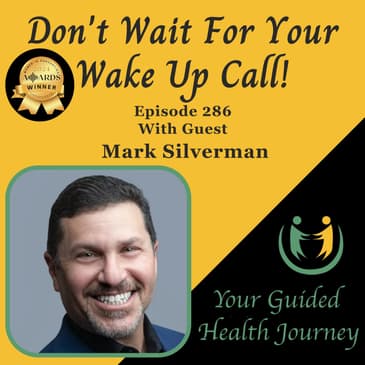
Episode 286 features executive coach and leadership expert Mark Silverman, who helps high-performing leaders break free from the hidden stress and emotional patterns that limit their success 🚀.
After overcoming homelessness, addiction, and a serious health scare, Mark rebuilt his life through intentional habits, bold goals, and deep inner work 💪. In this conversation, he explains how many executives operate with a high level of chronic stress ⚡, keeping them in a near-constant fight-or-flight state that impacts their decision-making, health, and relationships.
Drawing from his work with leaders and entrepreneurs, Mark shares why lasting transformation comes from addressing root causes rather than managing symptoms, and how practices like meditation 🧘, journaling ✍️, exercise 🏃, and vulnerability ❤️ can unlock greater freedom, resilience, and fulfillment. His message is a powerful one: don't wait for a crisis to become your wake-up call—start listening to the whispers now 🌟.
Gift: Get your FREE copy of “Only 10s 2.0” https://www.markjsilverman.com/free-copy-of-only10s-2-0/
Offers:
Our Book (episode 249) - Empowered: The Journey From Victim Island To Solution City: https://www.amazon.ca/dp/1989849776?psc=1&smid=A3DWYIK6Y9EEQB&ref_=chk_typ_imgToDp
Quantum Life Mastery School: https://amplifyimpactacademy.com/quantum-life-mastery-school
Introduction video about Girls Matter: https://drive.google.com/file/d/1R3-xqzJLZW14om1PhFClcU_oRSZ8zgip/view
Meet Your Unconscious Mind Workshop:
https://amplifyimpactacademy.com/um
FREE 7 Day Trial: NuCalm Products to recalibrate your nervous system / improve your sleep:: https://nucalm.com
Use my promo code at checkout: YGHJ to get 15% off your monthly subscription, every month.
Episode Summary
Key Takeaways
- Origin Story: Overcame homelessness and addiction by setting three life-saving goals (earn $1M, donate $60k, run a marathon) after a health scare, which forced him to build new habits and tools.
- Core Philosophy: A high "allostatic load" (baseline stress) keeps leaders near fight-or-flight, causing them to lose control. The solution is healing root-cause trauma, not just managing symptoms.
- "Don't Wait for Your Wake Up Call": The body gives warnings ("whispers") before a crisis ("wrecking ball"). Proactive self-care is essential to avoid a forced, painful wake-up call.
- Audience Gift: A free copy of the book Only 10s, a guide to prioritization and boundary-setting for high achievers.
Topics
The Problem: High Allostatic Load & Root Cause Trauma
- High Allostatic Load: Constant baseline stress from modern life (inflation, social media, groundlessness) keeps leaders near fight-or-flight, eroding their capacity for calm decision-making.
- Root Cause Trauma: Unresolved childhood trauma (0–7 years) is the true source of many adult triggers, not just the surface-level issue.
- Example: A $100M client's panic over a large expense was a trigger for an unconscious fear of financial insecurity, not a rational concern.
- Healing Process: Trauma surfaces when the body feels safe enough to release it. This process is uncomfortable ("bifurcation point") but leads to freedom and joy.
- Example: A client's "bull in a china closet" behavior was healed by addressing its root cause, which also resolved his high blood pressure and lactose intolerance.
The Solution: Proactive Self-Care & Vulnerability
- Mark's Origin Story: A health scare after a decade of sobriety forced a crisis and a new path.
- Goals: Earn $1M, donate $60k to charity, and run the Marine Corps Marathon.
- Catalyst: Training with ultramarathoner Stu Middleman and listening to self-help audiobooks while running.
- Tools: Meditation, journaling, and exercise became non-negotiable habits.
- Vulnerability as a Tool: Sharing personal stories creates connection and inspires others.
- Example: A video about childhood molestation went viral, prompting a close friend to disclose their own similar, previously unshared experience.
About the Guest:
Mark J. Silverman is known for transforming high achievers into leaders who inspire, build trust, and deliver real results. As the bestselling author of Only 10s 2.0 (75,000), the new The Rising Leader Handbook, host of The Rising Leader Podcast, and a trusted executive coach, Mark brings a rare combination of hard-earned business success and genuine, actionable wisdom to every conversation. From overcoming homelessness to generating over $90 million in sales, Mark has lived the challenges leaders face and now guides them to expand their capacity, lead with courage, and handle the pressures of leadership without losing themselves in the process. His mission is to equip leaders with the clarity, presence, and practical strategies they need to grow themselves while driving meaningful impact for their teams, organizations and personal life.
Contact:
Website: https://www.markjsilverman.com
Email: mark@markjsilverman.com
https://www.facebook.com/mark.silverman.54
https://www.linkedin.com/in/mark22102/
https://www.instagram.com/markjsilverman/
About the Host:
Melissa is an Integrative Health Practitioner and a Board Designated Master Trainer of Hypnotherapy, Trainer of NLP, Time Line Therapy®, and NLP Results Coaching, helping people get to the root cause of their health issues and then get lasting results. Melissa neither diagnoses nor cures but helps bring your body back into balance by helping discover your “toxic load” and then removing the toxins. Melissa offers functional medicine lab testing that helps you “see inside” to know exactly what is going on, and then provides a personalized wellness protocol using natural herbs and supplements. Melissa’s business is 100% virtual – the lab tests are mailed directly to your home and she specializes in holding your hand and guiding the way to healing so that you don’t have to figure it all out on your own.
Melissa has launched Amplify Impact Academy, with business partner, Billie Aadmi and together they train other coaches, practitioners and counsellors in the 4 mind-body healing modalities mentioned above, giving them powerful tools to use with clients to get results with greater ease, speed and grace. These courses teach life skills and anyone can take them, if you want to be a better leader, parent, partner, be empowered in your own life, these courses are for you!
Melissa’s passion project is her non-profit, Girls Matter (www.girlsmatter.ca), breaking the poverty cycle 1 girl, 1 family, 1 village at a time. The mission is to keep girls in school and stop teenage marriages, because school isn’t free in over 50 countries around the world and when parents have to make the difficult choices of feeding their kids or paying for school, food wins. And when the girls hit their teen years, they will often be married off so that someone else becomes responsible to feed them. Keeping girls in school instead creates a generational ripple effect, because an educated girl is more than twice as likely to ensure her own children are educated. Educating girls also grows the GDP of countries, when they get into the workforce. This is how together, we can change the world. Guests on this podcast are invited to donate to this important cause. Learn more here in this short video: https://drive.google.com/file/d/1R3-xqzJLZW14om1PhFClcU_oRSZ8zgip/view?usp=share_link
Melissa is also the winner of the 2024 Women in Podcasting Awards in the “inspiration & motivation” category and the 2021 & 2022 Quality Care Award by Business From The Heart and is also the recipient of the Alignable “Local Business Person of the Year “Award 2022, 2023 & 2024 for Whistler.
Melissa has been featured at a number of Health & Wellness Summits, such as the Health, Wealth & Wisdom Summit, The Power To Profit Summit, The Feel Fan-freaking-tas-tic Summit, the Aim Higher Summit and many more! She has also guested on over 90 different podcasts teaching people about the importance of prioritizing our health and how to get started.
Linktree: https://linktr.ee/yourguidedhealthjourney
Thanks for listening!
If you know somebody who would benefit from this message, or would be an awesome addition to our community, please share it using the social media buttons on this page.
Do you have some feedback or questions about this episode? Leave a note in the comment section below!
Subscribe to the podcast!
If you would like to get automatic updates of new podcast episodes, you can subscribe on the podcast app on your mobile device.
Leave us a review!
We appreciate every bit of feedback to make this a value-adding part of your day. Ratings and reviews from our listeners not only help us improve, but also help others find us in their podcast app. If you have a minute, an honest review on Apple Podcasts/iTunes goes a long way! Thank You!!
[00:00:04] I am pleased to share with you a new training called Karma Code Timeline Therapy Practitioner Certification. This training is a powerful three-day live on Zoom session teaching you how to help others in clearing all of their stuffed down emotion of anger, sadness, fear, hurt, guilt, rage and shame.
[00:00:31] Without them having to talk about any of the situations that ever caused the root of that anger and release it from the cells in their body and have them feeling light. And also to release all of the BS stories running around in our head of being unlovable, unworthy, not good enough, powerless, etc, etc. And get rid of all of that chatter and allow them to have peace and quiet in their head.
[00:00:58] This training is transformational for your clients and for you because during the training you get to experience it both as a practitioner and a client and release all of that garbage for yourself and clear out your emotional body, your mental body and keep them clear so that all of that stuffed down emotion isn't causing dis-ease later in your life. Check out the show notes for the link.
[00:01:26] Our first training is happening in 2026. Imagine getting up every day full of energy as if you were in your twenties again. What would that be like? What would that be worth to you? What is your health worth to you? Think about it.
[00:01:52] Your health isn't everything, but without it, everything else is nothing. And yet too many of us are taking it for granted until something goes wrong. No one wakes up hoping to be diagnosed with a disease or chronic illness. And yet we've never been taught how to be proactive in our health through our school system or public health. As a registered health coach and integrative health practitioner, I believe it is time this information is made available to everyone.
[00:02:22] Combining new knowledge around your health and the ability to do my functional medicine lab tests in the comfort of your own home will allow you to optimize your health for today and all your tomorrows. Don't wait for your wake up call. Welcome back to another episode of the don't wait for your wake up call podcast. I am Melissa Deally, your host, and today I have with me Mark Silverman. Welcome to the show, Mark.
[00:02:52] Thank you for having me. I really appreciate it. I'm excited for this conversation and just to introduce you to the audience a little bit before we take it away. Mark Silverman is known for transforming high achievers into leaders who inspire, build trust and deliver real results. As the bestselling author of only tens 2.0, the new rising leader handbook, the host of the rising leader podcast and a trusted executive coach.
[00:03:20] Mark brings a rare combination of hard earned business success and genuine actionable wisdom to every conversation from overcoming homelessness to generating over 90 million in sales. Mark has lived the challenges leaders face and now guides them to expand their capacity, lead with courage and handle the pressures of leadership without losing themselves in the process.
[00:03:42] His mission is to equip leaders with clarity, presence and practical strategies they need to grow themselves while driving meaningful impact for teams, organizations and personal life. And I just want to comment there, Mark. I love that you added and personal life there because we are leaders in our personal life.
[00:04:04] And if there's, you know, people listening right here at the beginning going, oh, that doesn't relate to me because I'm not in the corporate world, et cetera, et cetera. I want you to rethink that. It absolutely relates to you because no matter where you are in your life, you are still a leader and we can grow our leadership skills. So I'm excited for this conversation.
[00:04:26] And I want to start out right away, Mark, just by touching on the comment that, you know, you've been in that place of homelessness and I would love you to share that story if you're willing. And, you know, how you move through that and overcame that to where you're at today. Sure.
[00:04:46] So just if everybody would just forgive my froggy voice, I have a pretty bad cold and makes me sound like, you know, a little more gravitas here when I'm talking about my story. The story is less about homelessness and more about addiction and not being equipped to be out in the world.
[00:05:06] So for me, when I was in my teens, the only thing that that helped the crippling social anxiety and trying trying to fit in was drugs and alcohol. When so when I was drunk or when I was dealing drugs or when I was doing when anything that got me into a group of people that got me someplace where I could function and have community and have and have community, even though the community was vicious and horrible.
[00:05:34] And and, you know, like I look back now that it was it was just absolute torture. But at least it was like I wasn't completely ostracized. And that was my high school career after graduating high school and going off to college. That didn't stop. And that was that was that was a problem where a lot of people were able to go to college and do drugs and drink and party and get a college degree. I couldn't do two things at one time.
[00:06:03] So I I wound up bartending and then, you know, just leaving college the first couple of weeks. And because I was making one hundred dollars a night in the in the in the bars and that became my career for the next decade. So it was it was just bartending and drugs and alcohol and having a good time until I didn't until, you know, all the counters went to zero as they as it says in the big book that, you know, there was no I had no place. I was thrown out of where I was living.
[00:06:31] I had no place to go. I had my pickup truck and a guitar and a camera. I didn't know how to use. And that was all I had in a couple of credit cards. And I called my brother who is living here in Washington, D.C. And he owned a bunch of restaurants to borrow some money. But this was back in 1989. We didn't have Venmo then like we didn't even have cell phones. So so we were, you know, I was calling him collect from pay phones and trying to figure out how to wire me money, which, again, never worked.
[00:07:01] So I drove across country and I got here to Washington, D.C. on September 1st, 1989. I was twenty seven years old. I was one hundred and thirty pounds. It was it was it was pretty funny. And I and I met my brother and his friends and they looked different. I hadn't seen my brother in probably seven years and everybody looked different. And what I noticed was everybody's head looks small. I was like, why does my brother's head look so small?
[00:07:29] And it was because they were all bodybuilding and they're all bulking up because at that time they were in their 30s. And and and and what I learned was newly sober. So all his friends were sober people from A.A. and N.A. And their new obsession was was bodybuilding. So I lived with my brother and he said, if you're going to live with me, what you need to do is go to the gym, go to the gym with me.
[00:07:57] You're going to start running with my friends and you're going to go to college. You're going to take one at least at least one college class. And that's what I did. I got a job waiting tables, went to A.A. and then A meetings with him and joined the gym and started running. And that was that was the start of my sober life. Thirty, thirty six, thirty seven years ago now. Almost thirty. He'll be thirty seven years in September. Congratulations. Thank you. So that so that was that was that was the start of it.
[00:08:26] For me again, at twenty seven years old, I was a stunted teenager. I didn't I didn't really have skills. I didn't understand the world. I'd actually gone away and kind of was part of a cult that was it was actually very useful. The cult saved my life. It got me to to to stop doing drugs at that point.
[00:08:50] But it also again, I didn't have the the tools that most people have at twenty seven years old. But as I went to A.A. and N.A. and I joined men's groups and I and I and I got mentors and and started to grow. I wound up getting married and having a couple of kids. And the thing for me, which was interesting, was my father was in the restaurant business. My brother was in the restaurant business.
[00:09:19] You know, I was taking one college class at a time and it looked like it was going to take forever. And I finally did get my degree in my 40s, but I got a job in sales. I was I was, you know, my ex-wife. Well, we she's my ex-wife now, but we had we had we had a kid. And I said, I got to do something to be able to take care of the family. I cannot take care of the family waiting on tables making twenty five thousand dollars a year. I just can't do that. But I didn't know what I could do.
[00:09:48] So I tried sales and I was very introverted. Very yeah, once I once I quit drinking, I it was it was very hard for me to come out of my shell. So but sales was really, really hard. And every day I woke up terrified to go out into the world. And the first year I doubled my income. I went from twenty five thousand to fifty thousand. Next year, I doubled my income again. Next year, I doubled my income again.
[00:10:14] Next thing I know, like I remember when I asked my wife to to to marry me, I said, you know, I may never be anything more than a waiter. Like I don't like that. May. And she was fine with that. Now I'm making a couple hundred thousand dollars a year, you know, and we have our second kid and she's staying home with the kids. So now I'm in status symbol and we buy a million dollar house. We live in we live in the suburbs of Washington, D.C. I'm the committee chair for the Boy Scouts.
[00:10:42] I'm a third grade basketball coach and I am upstanding citizen number one. Right. And hiding this little secret. Right. And we talked about, you know, the thing that you and I have have in common and talking about our nervous system and and and all those hidden triggers. What I didn't know what was lurking underneath all that was the unresolved trauma was the resolved
[00:11:10] ADHD that I didn't know was the the kicker for a lot of this stuff. I didn't know any of it. And all of a sudden the cracks started happening in my 40s between my wife and I were fighting all the time. I was having panic attacks and I didn't know what was going on. I know in hindsight now all that stuff was coming to the surface. Right. Right. And what I just want to add in there. I don't know if it's your perspective, our perspective when we're training people is all
[00:11:39] of that is coming to the surface to be healed because your unconscious mind is saying, hey, Mark, you're ready now to heal this. And yet society so often teaches us to, you know, avoid the triggers, ignore the triggers, push it back down. And as men hide, hide, hide that things that things are coming apart at the seams. And exactly a really bad couples therapy therapist at the time who hit us. She just did some undermining in hindsight.
[00:12:07] That was really, really insidious. So we wound up breaking up. And after we broke up, my wife went into a depression. I went into depression. I was suicidal and it was just it was just horrible. I was like, I don't understand. I haven't taken a drink. I've done everything right. What is what did I do wrong? I don't know what I did wrong. And all of a sudden my career started going in the toilet because I was breaking out in hives and having these panic attacks and I couldn't sell anymore. So my family life was was in the toilet. My career was in toilet.
[00:12:37] My health was in the toilet. And I didn't know what to do. Stone cold sober because I was the poster child for sobriety. Right. And as you said, you've done all the things. And then why is my life still falling apart? So I got really sick. And this is this. This is a story of actually only tens the book. The I thought I was going to die. I was misdiagnosed with something and I was pretty sure I was going to die and not going to make it. And I decided that if I was going to die, I needed to do three things.
[00:13:07] I needed to make a million dollars somehow to leave to my ex-wife and kids. I needed to give $60,000 to charity because all my medical bills and all that stuff that insurance, I felt I didn't feel worthy of insurance taking care of my medical bills. So I felt like I had to give back somehow. And then I was going to run the Marine Corps marathon. So my kids could see me do something substantial. And I couldn't run a mile. I could not. I couldn't. I couldn't walk. I had lost all my muscle mass. I was so sick.
[00:13:37] And I called this guy I heard on the radio once. And he said, he's an ultra marathoner named Stu Middleman. And he was on the radio and he said, everybody can run. We're bipedal. We're meant to run. We're meant to walk. Everybody can do that. And I'm like, yes. So I called him. And again, this is before Zoom and all this stuff. He was in California. I said, can you coach me to run the Marine Corps marathon? And he said, yeah, it'll take you about a year and a half. I said, no, I have to do it this year because I'll probably be dead in a year and a half.
[00:14:06] So we trained. And as soon as I signed up for the marathon, I got a new job with a new startup. And that and they paired me with another sober person. I was a sales guy. They were the engineer for the tech stuff. And he was someone I had known, but he had gotten sober also. So we were a tag team. So that year I wound up almost making the million dollars. It took about a year and a half to make the million dollars. I, but I, I almost made a million dollars that year.
[00:14:36] I ran the Marine Corps marathon, drove checks for $60,000 to, to charity. And, you know, it was on my feet. My family was doing better. My health was back. My career was on track. And the thing that would really, I think was the catalyst was one having goals. Yes. But two was while I was running and training for the marathon, I would listen to summaries
[00:15:06] of all the best books in the world called a philosopher's notes. It's a little 20 minute summaries of all these great books. And then whatever book I liked, I would get that. And I would listen to that while I ran. And I learned to journal and I learned to meditate. And I learned, you know, I just, I learned all these habits that I didn't know, you know, in order to build back a Mark J. Silverman that was different than the one before. And giving you tools, you were learning the tools in order to help manage yourself as you
[00:15:35] went through life and manage the stress levels, et cetera, et cetera. The tools that you never had before. A hundred percent. And all tools I still use today, 15, 20, 20, you know, yeah, about how long, how long? This was 2008, 2009. So yes, 15, 16, 17 years since then. It's still, still meditate, still journal like a fiend, right? It's still, still exercise. But the number one thing was Pema Trojan once said that, you know, if you, do you know who Pema Trojan is?
[00:16:05] I do not. She's a Buddhist nun who's written some of the most amazing books on, on being kind to yourself as being a human. And her books are the places that scare you or when things fall apart, perfect titles for when your flies falling apart. And in one of those books, she said, when tragedy hits, you have two options. You can harden and close or soften and open.
[00:16:28] And I remember reading that book, making the decision to soften and open that I was going to use my, my falling down to be compassionate and to help other people in human thing is really hard. Yes. So I became an ex smoker. Like I became like, Oh my God, anybody who would meet anyone, which I would talk about the tools. I would talk about, did you do journal? Did you do this? Like, did you read this book? Did you read this book? I'd be giving books away all the time.
[00:16:57] Just trying to help everybody. Because, you know, I had found a new way to live in a new way to be. So that's my origin story. Well, I love that. And clearly you have a great big heart and you want to help others and save them some of the journey, shorten the journey for them. Like that. From what you've learned in order to help them navigate their path. And I love that you're here sharing this story, which is a very vulnerable story.
[00:17:24] And because you've chosen to soften and open, you share it, you know, from that place of not the victim hood, the fact that you've been able to rise and now you can help other people rise. And that's the point of this podcast is having guests like yourself, come on and inspire others because we don't know who might hear this. That is in a similar place to where you were and they're looking for something that will help them get out.
[00:17:51] And just hearing you share your story can make a difference. And you'll never know the ripple effect of how many people you've helped. And that doesn't matter. It's just keep sharing your story and letting people know that if you've managed to rise up and overcome your addictions and create success in your life, that they can as well. Yeah, it's funny. I recorded a video every Thursday morning when I walked to the gym, whatever's on my heart, whatever.
[00:18:19] And one morning I, and remember I'm an executive coach in corporate America. And I shared, it was around the time the Epstein files were huge in the news. And I just shared, I said, look, if you're a victim of any of this, any sexual abuse or anything, this has got to be a trying time for you. And I said, I was molested as a kid over and over again. And I talked about that in this little three minute video. Oh my God. The response to that video.
[00:18:48] I didn't even think twice about sharing something so vulnerable. But the tens of thousands of share, like it went crazy. And I was really, it was really interesting. And then someone very close to me came to me and said, I didn't know that about you. That happened to me and I haven't told anybody. Yeah. So it came all the way around. Yeah. To someone close to me. And that was just what was on my heart.
[00:19:16] So I shared it without thought of what it would mean for my career or something like that. And beautiful again, how many people related to that and felt like they weren't alone because you chose to share it and felt like they could speak of their own experience, even to just admit it to you. The first person they've ever admitted it to because you shared it. And that's the power of this.
[00:19:45] So I love this and thank you for your courage and thank you for your desire to help others. And now I'd love to dive into the work that you do today in corporate America, helping others. And, you know, there's so much pressure in the world today and, you know, people feel that pressure and it just builds and builds. And let's talk about about why even the most capable leaders can lose control in high stake moments.
[00:20:15] And what's what's going on there? It's interesting. I think these times are different than any times. I'm 64. I think these times are different than any times I've ever lived through. There's there's there's not only the stress of making a living, the cost of living, inflation, trying to, you know, trying to have health insurance for your family, trying to be a spouse, a parent, like it's that's been the stress always.
[00:20:43] And on top of it, the noise that is coming in, that is just yelling at you and how to think, who to hate, who to protect, who like just the groundlessness. Yes. To believe where where is the truth? Is there justice anywhere? And and why am I drowning?
[00:21:18] Mm hmm. Allostatic load is when you leave the house and someone cuts you off and you're like, oh, you go along your merrily way. God bless you. And I'm fine. Allostatic load is high. You chase them down and see how much insurance you have and see if you can ram them. Right. The road rage scenario. So I think all of our allostatic load is super high. Yes. Just walking out the door.
[00:21:40] If you open social media, you know, a cousin, an uncle is going to say something that pisses you off and just feel and it goes to and it's very threatening to your own safety, especially if you're a person of color or female in this country. Like it's it's it's a it's a little nerve wracking.
[00:21:58] So take that and and add that to the regular stress, which means that in that instead of being in the flow, instead of being in your creative space where inches from fight or flight at almost at any given time. 100 percent. And when when we're when we're rested and peaceful and had time with family and friends and all that stuff, we have so much room before we get into that trigger. Now we don't have that. We don't have that. We absolutely do.
[00:22:27] What I'm seeing with leaders is their people are sick more often. Their people are going are are breaking down more often. And and then they're doing the same thing and trying trying to hold their leadership bearings while their allostatic load is pushing them into fight or flight. And once you're in fight or flight, unless you're practiced at being like I like I have I speak, you know, I've done thousands of talks on stage. I still get scared on stage. I walk out. I lose my breath.
[00:22:58] That's fight or flight. I know how to be OK with being in fight or flight on a stage. Right. I know to take a beat, take a minute. Breath will come back. I'll be good. Doesn't scare me to be in fight or flight. But everybody else, you know, if you're in the office and someone says something and it triggers you and you're supposed to be a mature leader. But all of a sudden there's a little part of you that is scared. All the training that you've had, everything, you know, to do is out the window.
[00:23:27] You know, you are just a hungry little five year old, you know, trying to manage this this wild energy. And that's what I'm seeing is a lot of these leaders know what to do. They've read all the books. They they know how to handle situations. It's the it's the five o'clock, five alarm fire that's going on inside that has them mishandle situations. And I totally agree with you with where the world's at right now.
[00:23:52] And I often say that the world is the most stressed out than it's ever been. And in fact, it was like that before the pandemic. And then we had to live through the pandemic, which just built on that. And as you said, you know, we just keep building on it and going deeper and deeper into that fight or flight state, which we're never supposed to live our life in. That fight or flight state is designed just in order for us to get to safety. Right.
[00:24:22] And then the body is supposed to be able to calm and we get into our rest and digest parasympathetic nervous system and can get out of that fight or flight. And the problem is in today's world that our stressors are just stacking one on top of the other on top of the other. And there's no reprieve. And they seem unsolvable. Yes. So running away, lions chasing you, you run away, you climb a tree, you do what you need to do. In this environment, what do I do?
[00:24:52] There's nothing I can do and there's nobody helping us to figure it out. Exactly. Exactly. And so it's no surprise, really, that our leaders, and as I said at the very beginning, we're all leaders, are struggling in moments of pressure and behaving in ways that are not our normal behavior. And we walk away from it afterwards going, what the heck just happened to me?
[00:25:17] And it's the cumulative effect of all of these stresses and then our tools going out the window, as you said. Yes. And so this is an area where you are helping people to recognize this and giving them additional tools. As you said, you can walk out on stage, you can feel that fight or flight and be okay with it. And I know for me, I do a lot of talks as well.
[00:25:44] And I used to think, why do I get nervous every single time? Will I ever not be nervous? And somebody said to me, and I love this reframe, you're nervous because you care. Mm-hmm. So embrace that and keep going. And for you, you have that fight or flight response and you embrace it and keep going.
[00:26:12] And when we have the tools, we're able to do that. And it's a matter of the work that you do now teaching people the tools. So as we're talking about the nervous system, let's just dive deeper into that and talk about the fact that when our nervous system is firing, it's inhibiting our decision making. It's inhibiting our communication.
[00:26:39] And how having a regulated nervous system allows us to show up as our best version of ourselves. Or at least have a fighting start to it. Because we never know what's going to happen. So we have to kind of get a groove going so that we don't start at fight or flight. We know the warning signs of what's about to happen.
[00:27:03] Because again, the most practiced enlightened person in the world can hit a trigger at any point. It's how do you practice ahead of time. I was looking at all the episodes of your podcast and I was going through all of your former guests kind of doing research for here. And your whole podcast is a library of everything we're about to talk about and how to do that practice so that you're your best whatever comes your way.
[00:27:32] Right? Because it could be a serious problem. You know, your biggest client is about to fire you because someone made a big mistake. That's a real problem. That could sit up your fight or flight. Or someone could just say something to you in passing by the coffee machine in a certain tone. And that could send you off into spinning and you don't even know why.
[00:27:59] You can smell a perfume and go off spinning and not know why. So, you have to go out into the wild and into the world knowing that there's something happening everywhere that could hit that. But if you start off with yourself, you know, knowing who you are, knowing what you care about, right? Knowing what pieces in your life make you feel safe and stable, right? How do you feel safe?
[00:28:26] You know, like again, some people are looking at the money in the, you know, what is this number in the bank account? I was just talking to a client before we got on here and his wife had spent a ton of money this month. And like, and when he told me how much she spent, even I kind of was back. And he goes, and I just wanted to hit a certain number for the month and we're not going to hit that number. And he was in a panic.
[00:28:53] This guy's worth a hundred million dollars easy. So like, whatever his wife spent was nothing. But that, that trigger for him was as if they were overdrawn on the bank account. Right. Right. So I had to slow him down. I was like, I understand you wanted to hit a number. I understand she spent a lot of money. I understand what's really the problem here. What's really scaring you? Right.
[00:29:23] And we had to drill down and drill down and drill down to find out why he was in a panic instead of, instead of going, oh, okay, we overspent next month. We will pair it back. And that's, that's kind of the way we do it is just go underneath, underneath and underneath and figure out what something's touching. I love that. And it's so aligned with the work that I do, because we always say if the client can, whatever the client shows up with and says, this is the problem. And then we always say, that ain't it.
[00:29:51] That's the problem they're consciously aware of. And there's something deeper and something deeper and something deeper until we get down to the unconscious problem, which is stemming from very often a childhood program that they have no idea has been running. And then when we get to that depth, that's when we can create the shifts for them. And whenever I do a workshop, I always have to say, look, I'm so sorry. I am really sorry.
[00:30:21] But we have to talk about the child trauma in the room. Like, like, I know it's almost cliche now to talk about it, but it's just so true. You're not upset in the meeting because someone did such a, you're upset because it touched something from your childhood and we have to get it out. Exactly. Literally in the work that I do, all of our programming is created in the ages zero to seven years of our life.
[00:30:47] And it's installed into the unconscious mind. And that is how we run our life. Our unconscious mind has so many other jobs to do, including running our body, preserving our body, despite what we may do to it. But once it finds a program that runs, it isn't going to change it until we choose to update it. It's interesting because when, when we, when we went over my life story, I never, I never, I haven't thought, I've told the story like a thousand times. I didn't think about it. Right. I was running.
[00:31:17] So I was exercising. I was meditating. I was journaling. I was doing all the right things. But I didn't know until hindsight that it was childhood trauma that was coming up. And it wasn't until EMDR. Right. Yeah. Which again, is some trauma, is trauma work. Yep. That it loosened its grip so that it could work on it. Yeah. All of that stuff was great. Got me on an even keel.
[00:31:46] But until there was a safe place for it to come up and out, then it wasn't, it wasn't, it wasn't going to happen. I was thinking about the, you know, Michael Singer talks about this and Dr. David Hawkins talks about it. When this stuff starts to come up, and you said it at the beginning of the call, this stuff starts to come up because all of a sudden it feels safe enough to come up because it wants to come up and leave. All this stuff is stored experience.
[00:32:16] And it doesn't want to stay here. The good experiences and the bad experiences. So these things, when they come up, if I had had a good therapist at the time while we were married, if I had someone who understood what was happening to me, this would have come up and we would have been able to work because it wanted to leave. Right? Yes, exactly. So being a, but it takes a while to get comfortable with it.
[00:32:39] And it's often, it's going on weekend workshops or working with a therapist like you or something, you know, where, oh my God, something's coming up. It's super uncomfortable. It's super painful. It was painful when it got stored down there. So it's going to be painful when it comes up, but there's light on the other side. And once you start to get that, that experience that, oh shit, this stuff's coming up. Oh, this hurts really bad. Thank God I have friends or a therapist or someone around. Now when it leaves, all of a sudden joy. Exactly.
[00:33:08] So all of a sudden freedom. And, and that's, that's a hard thing to teach. And it takes a while to teach that. And we call that the bifurcation point. It's that point where you want to, it feels so uncomfortable. You want to give up and go back to where you were, except that you can't go back to where you were. It's changed already. You've changed. And at that bifurcation point, you're 80% of the way there.
[00:33:30] And when it comes to like a storm, the bulls know to just run through the storm because it's the fastest way to get to what's on the other side. And it's the same here. When you're at that bifurcation point, the fastest way is just to suck it up and keep going. And b, get uncomfortable, get comfortable being uncomfortable because it's in the discomfort where you experience the growth. Sure, if we sit around in our comfort zone, that's very comfortable. We can sit there for our whole life.
[00:34:00] It's boring. We're not growing. It's the same old, same old. And yes, getting out of our comfort zone is uncomfortable. However, the more comfortable you get with being uncomfortable, the more you can grow, the more you can evolve. And life is actually more joyful than just sitting in the comfort zone. 100%. 100%. I do have a warning for people though.
[00:34:27] Consciousness is a double-edged sword because if you decide to kind of be awake to all this stuff and to let this stuff come up, your access to joy, your access to connection and intimacy is tenfold, 20fold. Like it's just amazing. And now the uncomfortable stuff knows it can come out. It's going to come out. When you're suppressing, you're suppressing it all. So, yes, I want you to be present and conscious.
[00:34:56] But there's a reason why Netflix is an addiction. There's a reason why we have our phones. Do not like to be present because it's uncomfortable in here. But everything likes to move. So, if you can get into that practice, you're going to have so much joy and you're going to have uncomfortable stuff. But you're going to be in full contact with real life instead of kind of having that veil between you and life. Absolutely. And you improve your health as well.
[00:35:22] Because all of that suppression of all the stuff down negative emotions that you don't want to feel and deal with is actually causing energetic blockages in your body and damage to your cellular makeup and causes dis-ease along the way. And look at all the chronic illness we have in the world today. And it's not the only aspect of it. However, it's a part of it.
[00:35:49] And when we can clear it from the body, which we are capable of doing, and I personally use timeline therapy to do that, we are helping improve people's health as well as the other aspects in their life that they're wanting to resolve. Whether it's their relationship that's an issue or their career that's an issue, whatever it is, it always has a positive health impact as well.
[00:36:13] I was working with a client and I was brought in because he was a bull in a china closet and he was just trashing everybody in his organization and they couldn't have it. So they asked me to work with him to help him. So after three months, he felt like a completely different person. And he said, Mark, I went to the doctor. They've taken me off my blood pressure medicine. Nice.
[00:36:41] And he says, and the really weird thing is they can't explain is I'm no longer lactose intolerant. I'm like, well, I'm a miracle worker. But like we got, we got to the cause, we got to the root cause of why he was just blowing up all the time. And I'm not a therapist or anything like that. He had just never done any work whatsoever. Right. So actually putting a light on it changed. Everything changed his marriage.
[00:37:08] His wife said he was completely different because he started to understand why this thing would erupt in him. And he would just, it would just be wreckage everywhere. Super talented, but he was going to get fired. And yeah, that's so such a great example because all of that suppression was firing his nervous system. And then all that stress was causing the high blood pressure.
[00:37:34] And then once the suppression didn't have to happen anymore, because now it had come up and it had been healed, the blood pressure goes down. And in all of that process, just when we reduce the stress on the body, our immune system can be stronger. Our gut health improves. And so now we're no longer lactose intolerant. Not that I'm going to say that happens for everybody. Everybody's situation is unique and different. And everybody's healing journey is unique and different.
[00:38:03] However, yes, this work that you're doing has powerful positive health impacts. So I really love that. There was a time when I thought green juice was the cure for everything. If I just alkalized enough and drank green juice, then I would never get cancer. My body would never hurt. Got mine here. It's not the answer for everything. However, it's again, a part of my tools of looking at my health. What I learned was it helps.
[00:38:33] Exactly. With your odds on being healthier, feeling better and all that stuff. I just, for a while, I believed every infomercial ever. Well, you were looking for solutions, right? And so as we go through that process, we're trying different things to see what works for us. And so, yeah, I love this conversation, Mark. And it just segues beautifully into what does don't wait for your wake-up call mean to you?
[00:39:04] It's so interesting. I call myself the ghost of Christmas future because I coach a lot of young men who married kids, burning the candles at both ends, feeling indestructible. And I let them know, like, I am the ghost of Christmas future. If you don't start taking care of and going on date nights and taking care of your relationship, that the love of your life will be your ex-wife or husband.
[00:39:34] If you don't find time to coach the kids in a team or be at their games or something like that, you're going to have teenagers who you don't know. And then your health. Like, I am 64 years old. And I said, if I look better than you at 35 years old, there's something wrong, right? And the body can take it and take it and take it. And then at some point, something's going to happen, right? The body is super resilient. It may take five years. It may take 10 years.
[00:40:03] But at some point, if you're not taking care of your spiritual health, if you're not taking care of your mental health, you're not taking care of your physical health and your relationships, something's going to blow, right? For women, it's adrenal fatigue. One day, they're duking it out with the men in the corporate office. And next thing you know, they're face flat because they try to be a man instead of a powerful woman, right? And you probably know that way more than I do.
[00:40:32] With men, we tend to blow shit up. We tend to blow up our marriages, blow up our businesses, do something horrible. You have to attend to those things. And the wake-up call, as you said, is hopefully people like us talking about it or a scare, right? Like if there's a scare, that's your wake-up call. That's the scare before the real scare. Unfortunately, like most of us alcoholics and drug addicts, we have to fall on our face to find that out.
[00:41:00] But what you're doing here, again, if you just listen through your podcast alone, if you listen to no other podcast, you have so many experts and your own insights that I subscribe to everything that you're talking about. Well, thank you very much. And yes, absolutely agree with that. And the body will always get what it needs. And so I always say, you know, it'll first talk to you in the form of the whisper of the butterfly wings.
[00:41:29] And so often we ignore those symptoms and we put it down to, you know, it's my genetics or, you know, society tells us to suck it up and push through or blame it on our genes or blame it on aging even, that we're supposed to feel worse and have aches and pains as we age. And that is so not true. Those are all our body whispering to us. And if we ignore it, it's going to come along and whack us with a two by four.
[00:41:56] And if we still ignore that, watch out for the wrecking ball. And you're absolutely right. I've had guests on this show that have, you know, landed in the ICU doing everything they thought they were supposed to be doing based on what they were taught by society. And they were ignoring their body and they were ignoring the symptoms and they end up in ICU. So don't let that be you. Love how you talked about that, Mark. And I love asking every single guest that question.
[00:42:22] Now, if there's listeners that would like to get in touch with you, work with you, what is the best way for people to get hold of you? Going to my website, markjsilverman.com. Mark, the letter J, silverman.com. It's the best way to get a hold of me. There you can get a free copy of Only Tens. I love giving away that book. You just go to the resource section. And for those who don't want to read, I made little videos because my clients don't want to read either. So a little five-minute videos of everything there.
[00:42:50] It's a hug tons of resources there for free. Beautiful. And just for the audience to understand, can you just give a little synopsis of what Only Tens is about and why they would want to go download it? I do have the link to that in the show notes. And thank you for offering that. Only Tens was my understanding of how to be an entrepreneur with ADD. I didn't understand why I could not get things done.
[00:43:16] And it was my coach who helped me figure out that we tend to do what we want to do and we don't do what we don't want to do, kind of only always. And that's the crux of my ADD, whether it's dopamine, whether it's fear. So Only Tens is a way to be honest with yourself about prioritization. And what I learned also is it was my learning how to set boundaries, asking for what I want, right? Speaking my truths.
[00:43:43] So it was me growing up in that book. Beautiful. Thank you very much for offering that as a gift to the audience. And thank you for coming today and sharing your wisdom, being so vulnerable, sharing your story, knowing that in doing so, you are helping others recognize that, hey, if he can do it, I can do. And reaching out and getting the support. Any last words of wisdom that you would like to share with the audience?
[00:44:12] Yeah, put this particular podcast, your playlist in the car because there's a whole bunch of good guests that are here. Any wisdom I have has already been talked about here. Thank you very much, Mark, for being here and sharing your wisdom. And to the audience, thank you for tuning in each and every week. And choosing to learn about your health, whether it's physical, mental, emotional, spiritual, and choosing to grow.
[00:44:41] And if this particular episode resonated with you and you know someone else that needs to hear it, please share it with them. Thank you very much. And we'll be back next week. Thank you for investing this time with me on the Don't Wait for Your Wake Up Call podcast. I'm so glad you joined in. If you can take two minutes to share this episode with someone you think can benefit and have a positive impact on their life, that would be wonderful.
[00:45:09] Please leave a review by going to your favorite podcast listening app. And let me know what you enjoy or would like to hear more of. It will support me in my effort to bring the possibility of natural healing to a wider audience and help disrupt the sick care system we have today and make human health a global priority. Health is your true wealth. è innych ederim hogy yang naik фильма E% dejak kina apas E% ha