
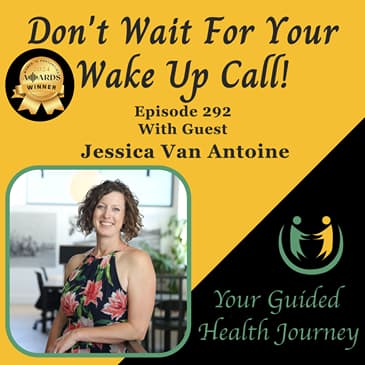
What if your body is already warning you long before the health crisis arrives? 🚨🌿 In this episode, Jessica, founder of Phoenix Functional Health, shares how 90-hour workweeks led to a public breakdown—and ultimately transformed the direction of her life and career.
Jessica explains why symptoms like fatigue, headaches, poor sleep, and caffeine dependence may be common, yet aren't signs to be ignored. Through functional lab testing and personalized health strategies, she helps entrepreneurs listen to the body's "whispers" before they become screams. 🧬✨ Her message: your health is one of your greatest business assets—invest in it before you're forced to. 💛
Free gift: The Adrenal Mocktail Guide: https://phoenixfunctionalhealth.com/adrenal-mocktail-guide/&utm_source=podcast&utm_medium=referral&utm_campaign=evergreen&utm_content=show_notes
If you’re eating well but still running out of energy - or relying on another cup of coffee to keep going—your body may need better resources, not more pressure.
The Adrenal Mocktail Guide includes 10 simple, mineral-rich drink recipes designed to support hydration, steady energy, stress resilience, and recovery. They’re quick, practical, and easy to work into a busy day, because supporting your body shouldn’t become another full-time job.
My Non-Profit – Girls Matter - https://girlsmatter.ca
Our Book (episode 249) - Empowered: The Journey From Victim Island To Solution City: https://www.amazon.ca/dp/1989849776?psc=1&smid=A3DWYIK6Y9EEQB&ref_=chk_typ_imgToDp”
Introduction video about Girls Matter: https://drive.google.com/file/d/1R3-xqzJLZW14om1PhFClcU_oRSZ8zgip/view
Personal Growth and CertifiacatonTrainings:
Impact Maker Alliance: https://ima-hub.base44.app/explore?ref=melissa
DHARMA PATH™ 4 – in – 1 designation trainings: https://amplifyimpactacademy.com/quantum-life-mastery-school
Meet Your Unconscious Mind Workshop:
https://amplifyimpactacademy.com/um
FREE 7 Day Trial: NuCalm Products to recalibrate your nervous system / improve your sleep:: https://nucalm.com
Use my promo code at checkout: YGHJ to get 15% off your monthly subscription, every month.
Episode Summary:
Key Takeaways
- Personal Burnout as Catalyst: Jessica's 90-hour workweeks led to a public nervous breakdown, which she recovered from using functional health. This experience became the foundation for her practice, Phoenix Functional Health.
- Proactive Health Strategy: The core message is to address health issues early ("whispers") to prevent major crises ("screaming"). This proactive approach treats health as a business asset, enabling founders to operate at their peak.
- Functional Labs for Precision: Functional lab tests are the cornerstone of the method. Unlike standard medical tests, they use optimal health ranges to identify subtle imbalances in hormones, gut health, and more, eliminating guesswork.
- Holistic, Phased Implementation: A 6-month program uses comprehensive lab data to create a "Performance Blueprint." Implementation is phased, starting with small, high-impact changes to avoid client overwhelm.
Topics
Jessica's Origin Story: Burnout & Functional Health
- Jessica's career began in massage therapy (2008), focusing on the mind-body connection through Shiatsu and Qigong.
- A period of extreme overwork (90-hour weeks) led to a public nervous breakdown, characterized by severe irritability and feeling physically fragile.
- Key Insight: Recovery showed the limits of "soft" healing arts alone. Functional health testing revealed fundamental imbalances (gut, hormones, stress) that were the root cause.
- Outcome: Correcting these imbalances restored her resilience, allowing her to handle a 70-hour workweek without feeling overwhelmed. This experience inspired her to help other founders avoid the same path.
The Problem: Normalizing "Common" Symptoms
- A critical distinction was made between "common" (frequently experienced) and "normal" (a sign of optimal health).
- Common but Not Normal Symptoms:
- Headaches
- Over-reliance on caffeine
- Fatigue
- Poor sleep (e.g., waking at 2–3 a.m.)
- The Body's Communication Analogy:
- Whispers: Early, subtle symptoms.
- Yelling: Major crises or disease.
- Societal Pattern: Waiting for a major crisis before addressing health, which leads to longer, more difficult recovery.
The Solution: Functional Lab Testing & Personalized Plans
- Functional lab tests provide objective data to interpret the body's signals, removing guesswork and client self-blame.
- Key Differences from Standard Medical Tests:
- Standard: Uses broad "normal" ranges based on a sick population, often missing subtle issues.
- Functional: Uses optimal ranges for thriving health, identifying imbalances before they become severe.
- Melissa's Example: Daily migraines were resolved by identifying and correcting low progesterone via functional labs, a cause her doctor missed.
- Core Principle: Symptoms are not isolated.
- Same System → Different Symptoms: Hormonal imbalance can cause headaches in one person and fatigue in another.
- Same Symptom → Different Systems: Headaches can stem from hormones for one person and inflammation for another.
- Conclusion: This requires a personalized, non-cookie-cutter approach.
Phoenix Functional Health Process
- 1. Comprehensive Lab Testing: A suite of tests provides a full picture of interconnected systems.
- Tests Cover: Hormones, immune function, inflammation, gut balance, minerals, food sensitivities, detox capacity, blood sugar, and thyroid function.
- 2. Performance Blueprint: A personalized plan is developed from lab data and client history.
- Includes: Diet, exercise, stress management, sleep hygiene, and targeted supplementation to resource the body.
- 3. Phased Implementation: The 6-month program introduces changes incrementally.
- Rationale: Prevents overwhelm by focusing on small, high-impact steps.
- Goal: Not perfection, but learning the body's language to make informed choices.
About the Guest:
Jessica Van Antoine, FDN-P, is the founder of Phoenix Functional Health, a performance health practice for high-achieving female founders who are doing many of the “right” things—eating well, exercising, taking supplements, trying to manage stress—and still don’t quite feel like themselves.
After nearly 20 years in health and wellness, Jessica has learned that fatigue, brain fog, restless sleep, irritability, and slower recovery rarely belong in separate boxes. They’re signals. Her work combines functional lab testing with personalized nutrition, lifestyle, and nervous-system support to uncover the larger pattern, reduce the guesswork, and identify what matters first.
This work is personal. During a chapter of 90-hour workweeks, Jessica kept pushing until the glass finally shattered: she found herself curled beneath her desk, sobbing, unable to carry one more demand. Rebuilding taught her that the answer wasn’t less ambition. Her body needed better resources.
Today, Jessica helps women listen before their bodies have to scream. Her goal isn’t to hand them another overwhelming wellness plan, but to help them understand what’s draining the body and brain their business depends on—so they can feel like themselves again and have enough of themselves left for the lives they’re building.
Contact info:
LinkedIn: https://www.linkedin.com/in/jessica-van-antoine-fdnp/
About the Host:
Melissa is an Integrative Health Practitioner and a Board Designated Master Trainer of Hypnotherapy, Trainer of NLP, Time Line Therapy®, and NLP Results Coaching, helping people get to the root cause of their health issues and then get lasting results. Melissa neither diagnoses nor cures but helps bring your body back into balance by helping discover your “toxic load” and then removing the toxins. Melissa offers functional medicine lab testing that helps you “see inside” to know exactly what is going on, and then provides a personalized wellness protocol using natural herbs and supplements. Melissa’s business is 100% virtual – the lab tests are mailed directly to your home and she specializes in holding your hand and guiding the way to healing so that you don’t have to figure it all out on your own.
Melissa has launched Amplify Impact Academy, with business partner, Billie Aadmi and together they train other coaches, practitioners and counsellors in the 4 mind-body healing modalities mentioned above, giving them powerful tools to use with clients to get results with greater ease, speed and grace. These courses teach life skills and anyone can take them, if you want to be a better leader, parent, partner, be empowered in your own life, these courses are for you!
Melissa’s passion project is her non-profit, Girls Matter (www.girlsmatter.ca), breaking the poverty cycle 1 girl, 1 family, 1 village at a time. The mission is to keep girls in school and stop teenage marriages, because school isn’t free in over 50 countries around the world and when parents have to make the difficult choices of feeding their kids or paying for school, food wins. And when the girls hit their teen years, they will often be married off so that someone else becomes responsible to feed them. Keeping girls in school instead creates a generational ripple effect, because an educated girl is more than twice as likely to ensure her own children are educated. Educating girls also grows the GDP of countries, when they get into the workforce. This is how together, we can change the world.Guests on this podcast are invited to donate to this important cause. Learn more here in this short video: https://drive.google.com/file/d/1R3-xqzJLZW14om1PhFClcU_oRSZ8zgip/view?usp=share_link
Melissa is also the winner of the 2024 Women in Podcasting Awards in the “inspiration & motivation” category and the 2021 & 2022 Quality Care Award by Business From The Heart and is also the recipient of the Alignable “Local Business Person of the Year “Award 2022, 2023 & 2024 for Whistler.
Melissa has been featured at a number of Health & Wellness Summits, such as the Health, Wealth & Wisdom Summit, The Power To Profit Summit, The Feel Fan-freaking-tas-tic Summit, the Aim Higher Summit and many more! She has also guested on over 90 different podcasts teaching people about the importance of prioritizing our health and how to get started.
Linktree: https://linktr.ee/yourguidedhealthjourney
Thanks for listening!
If you know somebody who would benefit from this message, or would be an awesome addition to our community, please share it using the social media buttons on this page.
Do you have some feedback or questions about this episode? Leave a note in the comment section below!
Subscribe to the podcast!
If you would like to get automatic updates of new podcast episodes, you can subscribe on the podcast app on your mobile device.
Leave us a review!
We appreciate every bit of feedback to make this a value-adding part of your day. Ratings and reviews from our listeners not only help us improve, but also help others find us in their podcast app. If you have a minute, an honest review on Apple Podcasts/iTunes goes a long way! Thank You!!
[00:00:05] I am excited to share with you Quantum Life Mastery School. This is what we offer through Amplify Impact Academy, among many other trainings. However, this is our gold standard training. This is the training that allows you to become one of the top 1% of coaches in the world. That as a master practitioner, once you complete this training, you will be able to guarantee your results in writing to your clients.
[00:00:34] Because you are working with neurology and they will no longer be able to do their problem after you've rewired that neurology. Through this Quantum Life Mastery Schools, you will get four designations as a Master Practitioner of NLP, a Master Practitioner of Timeline Therapy, a Master Practitioner of Hypnotherapy and a Master Practitioner of NLP Results Coaching.
[00:00:57] Throughout this program, we build on the learnings as you go through the practitioner training as well as some personal growth trainings to get to that Master Practitioner level. And this work is so powerful. You will literally, in just working with clients for 10 to 12 hours, transform their lives.
[00:01:22] And even better, this isn't just for coaches. We call it Quantum Life Mastery Skills because this is literally life skills. We've had people come through that want to be better parents, better partners, better leaders at work. One fellow came through because he knew the power of mindset with his golf game. He wanted to improve his golf game. When you do this work for yourself, your life improves, regardless of whether you're a coach.
[00:01:48] And the ripple effect of your life improving and up-leveling yourself has profound positive impact on your family and loved ones as well. So check out the link in the show notes to the Amplify Impact Academy Quantum Life Mastery School.
[00:02:17] Imagine getting up every day full of energy as if you were in your 20s again. What would that be like? What would that be worth to you? What is your health worth to you? Think about it. Your health isn't everything, but without it, everything else is nothing. And yet too many of us are taking it for granted until something goes wrong. No one wakes up hoping to be diagnosed with a disease or chronic illness.
[00:02:45] And yet we've never been taught how to be proactive in our health through our school system or public health. As a registered health coach and integrative health practitioner, I believe it is time this information is made available to everyone. Combining new knowledge around your health and the ability to do my functional medicine lab tests in the comfort of your own home will allow you to optimize your health for today and all your tomorrows. Don't wait for your wake-up call.
[00:03:19] Welcome back to another episode of the Don't Wait For Your Wake Up Call! I am Melissa Deally and today with me, I have the wonderful Jessica Van Antoine. Welcome to the show, Jessica. Thanks for having me, Melissa. I'm excited for this episode. You and I met recently. We're connected by a mutual friend. And I will just share a little bit of your bio with the audience so they have a little bit of foundation for this episode. And then we will dive into your story.
[00:03:48] So Jessica Van Antoine is the founder of Phoenix Functional Health, a performance health practice for high-achieving female founders who are doing many of the right things, eating well, exercising, taking supplements, trying to manage stress, and still don't feel quite like themselves.
[00:04:08] After nearly 20 years in health and wellness, Jessica has learned that fatigue, brain fog, restless sleep, irritability, and slower recovery rarely belong in separate boxes. They're signals. Her work combines functional lab testing with personalized nutrition, lifestyle, and nervous system support to uncover the larger pattern, reduce the guesswork, and identify what matters most.
[00:04:32] So I'll stop there because I know this work is personal to you, and I want you to share your story of how you got from where you were into this line of work helping others, which is so often the story of people in the holistic field of wellness. That's right. It's often said in this field that we seek the healing that we ourselves need. Exactly.
[00:04:56] So my career in health and wellness started, as you said, almost 20 years ago in 2008 in massage therapy. I had been a bartender for a number of years, and even outside of my bartending career, I'd often find people having conversations with people, and I would often hear them say, I don't know why I'm telling you this. I've never told anybody this, or this is not something I share publicly.
[00:05:23] And so I just, there was something about me that made people feel comfortable in sharing. And I wanted to develop some skills to be able to help them in a more tangible way, rather than just listening and offering whatever, you know, immature advice that my 20-something self had to offer. So in my exploration of various career paths, transpersonal psychology, yoga, and massage therapy,
[00:05:52] massage therapy was the door that opened for me. And I have always been one to follow my heart. And so that was the door that I walked through. It was the day that I went to sit in on a class at this school was the first day I actually visually saw energy for the first time, which I had never experienced before. I didn't even know what I was experiencing, but I met the owner of the school. We made eye contact and I could see like sparkles in the air between us.
[00:06:20] And we've had a relationship, a friendship, and have worked together as colleagues for these, you know, ever since then, almost 20 years. Anyway, that really led me into a deeper exploration of my emotional and mental body and my spiritual body. I'd been on the spiritual journey already since college. And I really fell deeply in love in massage school with shiatsu,
[00:06:48] which is the Chinese medicine, like version of it's the body work version of acupuncture. And that was the kind of theory or way of thinking that really allowed all of that stuff to come into focus for me, like how my personality, my past, my emotional wounds actually show up in my physical body. So it made everything make sense through all the layers of my being.
[00:07:14] The style of shiatsu that I studied placed a very strong emphasis on personal chi cultivation or energy cultivation. So I learned about qigong. I dove into that world. I became a certified qigong instructor, brought that into my practice with cranial sacral and really helping people. And even in my massage therapy practice,
[00:07:39] always focusing on the emotional side of things and the energy that was within their bodies. I think that was one of my gifts as a massage therapist is really helping physically move energy and not just addressing the muscles from a mechanical perspective. And, you know, so my whole career in this industry was really taking off. And I took on a role as a director of business development for a wellness center. I was also on the board of directors for a shiatsu program at the time.
[00:08:09] We were developing a 500-hour nationally certified shiatsu training program. I was taking that training. I was working my massage therapy practice. I was working and opening this wellness center. I was working 90 hours a week. And I was going to say it sounds like you had more access to more hours in the week than any of the rest of us with all of that that you were working on. And I thought I did, but my body disagreed and I crashed and burned.
[00:08:37] I had a very public breakdown, nervous breakdown at work one day in a meeting. I had to excuse myself from that meeting. Well, and leading up to that, actually, there were some signs that something was not right. And I just kept ignoring them essentially and pushing through. I was in my late 20s. That's what society teaches us to do. Yep. I was in my late 20s. And I had something to prove, right?
[00:09:04] But really, the biggest warning sign for me was my level of irritability. Like I was snapping at people, which was very unusual for me. And I had reached a state of overwhelm and fragility that if someone so much has said my name, it felt like glass was cracking inside my body. And the day that I had this breakdown, I felt like that glass shattered.
[00:09:26] I had to excuse myself from this meeting, go into my office, curl up in a ball on the floor underneath my desk and just ugly cry. So essentially what I took from all of that is that there are limitations to what the body can handle, first of all. And in my recovery, I also learned about the limitations to what yoga, meditation, these kind of softer healing arts can do for you.
[00:09:55] And the day that this occurred, a gentleman walked into our studio to talk about teaching functional health classes. He was a functional health practitioner. And in learning about what he did, I immediately jumped on board, discovered some fundamental imbalances in my body, my gut, my hormones, my stress levels. And so that was what was predisposing me to this irritability and sense of overwhelm.
[00:10:22] And once my body was resourced, very little about my external circumstances changed. I was still working like 70 hours a week. I did cut back a little bit, but I just felt bigger than my responsibilities. Like I no longer felt like the weight of the world was crushing me. It was like, oh, I'm out here and everything else is down there. I got this. So that is really what put me further down, brought me to where I am today, essentially.
[00:10:51] Like using functional health as a foundation to help female founders specifically, because I'm just an entrepreneur at heart. I've experienced what it is to sacrifice your health for the sake of the business. And I wish that on no one. So we start with rebalancing the physical body and then kind of move outward from there. We address the mental body, the emotional body. And if people are open to it, then we can get out into the spiritual bodies as well.
[00:11:20] I love that you share that story and how you share it because it's so aligned with the work that I do. And, you know, we both know that the body is designed to self-heal. However, if it's under-resourced, it simply can't do that. And all the stress we have in the world today, all the toxins we have in the world today that are getting in the way of nutrients even getting to ourselves and bogging down our poor liver and it's unable to do its job properly.
[00:11:48] The lack of nutrients in so much of the food that we have access to is causing our body to be toxic, undernourished, overstressed. And as a result, the body isn't in this place of balance where it can heal. And so using the functional medicine lab test to determine where are the toxicities and address them, where are the nutrient deficiencies and support them.
[00:12:14] And then addressing the nervous system, you know, cortisol levels, et cetera, et cetera, such that the body can get out of that place of stress. Exactly. Allows us to be resourced and almost be superhuman because the body is getting everything that it needs. And then we can go out and be our best version of ourselves in the world without burning out, without the irritability, the crankiness, et cetera, et cetera.
[00:12:42] And really serve because ultimately that's what everybody is wanting to do. So while I'm sorry you went through it, I'm also grateful that you did because if you hadn't, you wouldn't be here where you are now helping other women. That's right. And that's such a big part of it. You know, I went through my education and then, you know, got in the corporate world and then got let go and then was led to health coaching and learning all of this for myself.
[00:13:07] And I was like, if every single person in the world just took one health coaching course, it would change how we all show up in the world. Yep. Because we don't have access to this education, you know, and we go to school and we study what we want. We get into our career and we don't learn this along the way. And so it takes someone like you to bring that education to people before they need it. Exactly. That's the key right there.
[00:13:35] And so I love that you're doing this. And you also mentioned or actually it was in your bio when I was reading it that you were talking about some of the signs that women experience. And I know for you, you said there were signs and you kept pushing through. So let's talk about that.
[00:13:53] Some of those signs that the audience listening to this can be like, OK, that's something I need to pay attention to as opposed to just accept as being normal because society's told me that I need to push through. So and I want to draw a distinction before we dive into the actual signs, a distinction between common and normal. Right. Because I think so often we interpret things as, quote unquote, normal when really they're common.
[00:14:23] A lot of people experience them. And so we see we we tend to conflate the two. Right. But what and I love that distinction. And what I normally say, too, is that we look around and see everyone else is experiencing it and we normalize it. Exactly. So the common becomes normal. Right. Because it's so frequently seen.
[00:14:47] So headaches, for example, headaches are not normal when your body is in, you know, in health and optimal function and you're in alignment. You don't experience and you're hydrated and nourished. You don't experience headaches. So headaches are definitely something that has been normalized like, oh, it's just a migraine or oh, it's just a headache. Like, no, there's there's something behind that. There's something that your body is trying to communicate to you.
[00:15:16] Over reliance on caffeine, fatigue in general, not sleeping well, waking up at two or three a.m. and just being awake in the middle of the night for seemingly no reason. These are all signs from your body that something is out of balance. And our culture, unfortunately, has normalized, to use the word, waiting until there's something really wrong in order to address the situation.
[00:15:43] Like waiting until you're literally can't function to where you're either diagnosed with a disease, by which point you're really far down that progression of just, you know, a little sign from your body. If you don't listen to your body while it's speaking to you, it will eventually yell at you. Yes, I love that saying. So true. Yeah, the yelling is the disease, right? Is the thing that makes you pay attention finally.
[00:16:12] And so I'm on a mission to help women address things before they become issues so that they don't reach that point. They don't reach the point of burnout and breakdown like I did. They don't reach the point of disease that we can actually be proactive with our health to your point so that we can live our truths and live out our purposes on this planet. Right. Well, and I love that you do that.
[00:16:38] And I want to share, we were introduced by another previous guest on my podcast, Michelle Drew, and she connected us. And her episode, if anybody wants to go back and listen to it, is episode number 166. And she is a classic story of someone who, again, was doing all of the right things, everything that she thought was expected of her. And she ended up in ICU. And, you know, when I talked to her in that episode and I said, hey, did you have signs before you ended up in ICU?
[00:17:08] And she did. In hindsight, she saw the signs. Right. And we all have the signs. It's a question of are we paying attention? And so, you know, listening to podcasts like this starts to have you pay attention. I've had many people like Michelle's story on this podcast. And love that, again, with your work and your education, that you're bringing this into people's awareness as well, that we don't have to wait until it's really bad.
[00:17:36] Because when we wait that long, it takes the recovery takes so much longer. If we instead recognize it earlier on, the recovery doesn't have to take as long. And it's just small, simple changes in our lifestyle that can bring about big results at that point. That's so true.
[00:17:57] And I really also want to just acknowledge all the women out there who are trying, who are like eating well and exercising and doing the right things, like listening and paying attention to their body, and yet are still not getting the results that they want to see. Their symptoms are still persisting. And so there is this also kind of gap between like, yes, I'm listening to my body, but I don't understand what it's telling me. Right.
[00:18:25] And I think that's where the functional labs like really play a huge part because the data, we get the data about what's going on internally, and then you don't have to guess anymore. You don't have to guess about which intervention is actually going to move the needle for you because you know exactly what it is that your body needs. Whether it's balancing hormones or addressing an imbalance in your gut or regulating cortisol levels, whatever it may be. It takes the guesswork out of it.
[00:18:53] And also for my clients, the immense relief that they get from getting that data, it really takes out some of the sort of personal responsibility that they feel for not being able to figure it out on their own or for not being able to kind of fix their symptoms on their own with whatever random wellness hack, you know, is going around the internet. Yes. These days. So, so yes, they're definitely learning to listen to your body.
[00:19:21] But then also, if you need that help with interpretation, there is another step that can be taken. And let's just also highlight the fact that the functional medicine labs that we run are different to labs that you can get through your regular doctor. You know, very often that's blood work and the scale of what is normal on that blood work is very large.
[00:19:46] And we are all individuals with a gut microbiome that is as unique as our fingerprints. And what may be normal for some people may not be normal for someone else. And it could be a sign of something going wrong. And the functional medicine lab tests are based on somebody's ability to be really well resourced.
[00:20:10] In other words, to thrive, not just an accepted base of normal where you're doing okay. And so it really tunes in to exactly what's going on for your body. And I know for me, when I first was using functional medicine lab tests before I was even an integrative health practitioner, it was really beneficial because I was going through changes in my cycle. And I was getting migraines.
[00:20:37] And I'd always got them at the onset of my cycle since I was like 18. So I knew that was my cycle and then I could address it. However, now they started to get worse. And I was getting them daily. And I'm like, why is this happening? Right? And that's always such an important question to ask rather than just accepting it. Why is it happening? Because if I know why it's happening, I can do something about it. And when I went to my doctor, she had no answer as to why and just gave me a stronger prescription. I didn't want that.
[00:21:04] So then I found functional medicine lab testing, which showed my progesterone levels were really low. And so then I was prescribed, admittedly, a vial tonic that I had to take. A teaspoon of daily for two weeks of my cycle for the next two months. And even in the first two weeks, the headaches ended. I didn't get them the next cycle. I took the tonic for the two weeks to finish the course. And I didn't get headaches for seven years. And then I got headaches again. Guess what?
[00:21:33] I went back and asked for that vial stuff. And she's like, maybe we should run labs again. And I said, I tell you what, this worked last time. If it doesn't work, we'll do labs again. However, if it works, then we know it works. It was the same thing. My progesterone was low. It worked for a whole bunch more years. And then I got headaches again. And now they're different. So I went back to run the labs again. I said, they're different now. So I don't think it's the same thing. Well, now I was well into menopause.
[00:22:02] And it was low progesterone, low estrogen, low testosterone. And my body's way of talking to me was via headaches. In someone else, it could be a different symptom. Exactly. And this was so helpful to me because I was able to move through menopause with so much ease and grace as a result of having this information. And by then I was an integrative health practitioner anyway.
[00:22:26] Again, back to normalizing things is menopause is a time that all women go through and we're not taught about at all. And so we listen to what our sisters say, our mothers say, our friends say. And when you hear all about the hot flashes and the night sweats and the poor sleep, we accept that as being normal instead of recognizing that's my body's way of telling me something
[00:22:56] thing is out of balance. That's right. And what is it? And these functional medicine labs will show you so you can do what I did and get the, you know, supplements that I needed for my body to be able to produce the hormones to the level that I needed them at in order for me to function. That's right. I think you really highlighted something that I talk about in my live trainings a lot, which
[00:23:20] is that like one system can lead to different symptoms for different people. Yes. So your hormonal imbalance for you manifested as headaches. Hormonal imbalances for others can manifest as weight gain, can manifest as poor sleep or really low energy. And then same thing in terms of symptoms. So two people experiencing the same symptom. So you have headaches. Maybe someone else was having headaches for you.
[00:23:50] It came from the hormones. Yeah. For someone else, it may not be from that same system. Exactly. So same symptom, different systems. Same system, different symptoms. Yes. Comes back to there isn't a cookie cutter approach to our health. That's right. That's where these lab tests are so informative because it lets you know the imbalances and the deficiencies in your system. In your body. Right.
[00:24:20] I mean, you go to a doctor, they're going to give you the same treatment they gave the last person that walked through the door and the last person in the last 10 people that walked through the door. And that may not be the thing that your body needs. It's not to mention the fact that I have much respect for doctors and Western medicine in certain cases. Right. But if you've got a broken bone or you're in a car accident, there's no better place that you want to be to be put back together. They're great at emergency medicine. Yes.
[00:24:49] They are not great at healing. They, you know, and it's a whole industry wide thing going back to pharmaceutical companies and money and capitalism and just wanting to make a bunch of money. There's no money in healing people's bodies. Yeah. They want to put you on a pharmaceutical and keep you on that for the rest of your life. I want to help your body heal such that you don't need this thing for maybe seven years,
[00:25:14] like in your case, you know, and the body has regained its own innate intelligence and resources to keep itself in a state of homeostasis for a while until all of the toxins, environmental, emotional, you know, our lifestyles of stress kind of come back in and slowly make withdrawals from our body's bank account to the point that we're not overdrawn and need to address things again. Love that. We talk the same language. Yes, we do.
[00:25:44] We have the same favorite sayings, et cetera. And so let's share, you know, what does it look like for that woman that's listening to this now and going, oh my goodness, I think I need her help because I have, you know, now as I stopped to think about it, I have some of these symptoms. So they reach out to you, connect, just walk me through the process of how you would guide somebody through their journey with you.
[00:26:12] And I realize it's going to be different for every person. However, I'm sure there's a process that's similar for people to be aware of. Yes. So we do start with the functional lab tests. I do a suite of tests that measures hormones, immune function, inflammation, gut balance, mineral levels, and any food sensitivities. So we're, oh, and detox capacity, blood sugar, thyroid function.
[00:26:39] So we're really getting a whole picture of how everything is working at once, because I find that if you just test one system at a time, you end up playing whack-a-mole. Like you make some adjustments over here, but that system in your body doesn't work in isolation of everything else. It all works in harmony together. So if you change something over here, other things are going to respond, which is why I test everything at once.
[00:27:06] So we get the full picture of how everything is interacting, compensating for one another, et cetera. And then we address everything. So the rising tide lifts all boats. But with that data, along with lifestyle and medical history, I develop a personal, I call it a performance blueprint for each person that includes a personalized diet, exercise plan, stress management, rest, sleep hygiene.
[00:27:33] And then of course the targeted supplementation that's really going to resource the body until it regains that capacity on its own. And then the implementation, I really like to just give out a few little nuggets at a time to my clients, rather than like this whole plan of everything that you need to do can be overwhelming. Yeah. So I work with people for a period of six months. I meet with them every couple of weeks and we just add the next layer.
[00:28:02] I always try to start with the smallest steps that are going to make the biggest impact for them. So we really get at the root cause of what it is that they're experiencing. Not just for example, that the hormones are out of balance, but why are the hormones out of balance? Is it because of a, you know, a cellular signaling issue? Is it because of inflammation? Is it because of chronic stress? And so we really start to address those root cause issues. Yeah. So that's, that's pretty much what it looks like.
[00:28:32] Yeah. I love that. And I also love what you said about the interconnectedness of our bodily systems that we don't just look at, you know, one area and we look at it all. Cause often when you go to the doctor and, you know, they diagnose you with heart disease, they're only looking at your heart and they're not looking at how that's impacted by other organ systems, et cetera, et cetera.
[00:28:54] And it's so true that this interconnectedness has that downline effect. So for instance, if your liver is overloaded and you know, the too many toxins, it can't cope with them. It can't do its job properly. So it's no longer, you know, detoxing excess estrogen in your system.
[00:29:18] And so as a result of that, now your body can appear to be low in progesterone because it's actually high in estrogen because we're not detoxing the estrogen that the liver under good conditions could detox. However, under this overloaded condition, it can't. And that's just one example of the interconnectedness of our bodies.
[00:29:42] And so these labs are providing such a beautiful, well-rounded look at all aspects and totally agree with you though, about giving the clients one piece at a time and not all of it because it can be overwhelming to be adjusting our lifestyle in this busy world. However, when we do it step by step, it's absolutely doable. And over the course of a year, you look back and you go, wow, look at how my diet changed or look at how my exercise has changed over the course of the year. And are you perfect at this point?
[00:30:11] Have you completed everything? Maybe not. However, you've come so far. I know. And for me, the goal is not perfection. You know, it's not to like never eat sugar again or never have an alcoholic beverage. It's knowing how your body responds, learning to speak the language of your body, you know, having limits being and, you know, enjoying things in moderation, not being super rigid, but also knowing things that the things that will really move the needle for you.
[00:30:42] Yeah. And then getting learning to be curious as well, because as you go through this process, you are forming a deeper connection with your own body. And you will if you're staying that place of curiosity, you'll notice things earlier than you ever did before. And you can just be curious about it. You know, why is this showing up for me? What is my body trying to tell me? What do I need to know? What can I adjust?
[00:31:09] Is it time to do the labs again to see where I'm at, et cetera? Exactly. Exactly. Even talking to your body in that way, like literally asking it, sitting with that sensation or just contemplating your experience. Like what, what is this trying to teach me? What are you trying to teach me? And yeah, when we sit with it, the answer can come. And I'm sure you say this too, that you know your body best.
[00:31:34] You've lived in it for your entire life and you are your own best doctor. And as a result, when you tune in, those answers can come. That's right. That's right. So I love all of this work that you do, Jessica. And I'm sure there are many women out there who you have absolutely supported and many more
[00:31:56] women that need to know of this work so that they literally can pay attention and listen to their body before it starts screaming at them. Because the thing is, our body doesn't give up on us. And so it wants to survive. It wants to survive. And if you, you know, at first might sound like a little whisper of butterfly wings. And if you don't listen, then it could come along with a two by four to slow you down enough
[00:32:26] to get the rest that you need. And if you're still not listening, then watch out because there might be a wrecking ball down here. And we definitely want people to start realizing that just those little whispers. Are enough for you to stop and question and seek out answers. And be able to stay on the path of overall health versus getting knocked off that path. That's right. And to kind of bring it back to business, right?
[00:32:57] Leveraging your health as a business strategy. I mean, your body, you are your business's greatest asset. And so if you're, if you're only operating at like a six out of a 10 on a daily basis, like you feel okay or fine, but not great. Then your business, like that's being reflected in your, in your business and your work. Also, that's the level at which the business is operating to. A hundred percent. It's how we do. One thing is how we do everything. That's right. Right.
[00:33:27] And so, yeah, it, it's so important. We have to have our health before we can have our business before we can have, you know, be an awesome parent before we can be a wonderful partner. And society has taught us to just discount our health. Just take it for granted. Really? Yes. It's built on a model of, you know, if you get sick, you go to the doctor and they'll fix you. Right. I, so I talk about this, um, like the term patient in Western medicine, you're a patient, right?
[00:33:57] But it's such a disempowering word. It's like, Oh, just sit over there and be, be patient while we figure it out for you instead of being active and actually taking an active role in healing your own body. And, um, and I really think that again, from that business perspective, like when you show up with energy and motivation and you slept well, and you're passionate about what it is
[00:34:24] that you're doing, then every other aspect of your life, even outside of business, it becomes easier. There's more of you to be present in every situation. So we, as women have often been taught to like give and provide and take care of everyone else and put ourselves last. And that serves everyone else. But then we are the ones that suffer for it.
[00:34:48] Whereas if we put ourselves first, take care of ourselves in this way and other ways, um, then not only does it serve everyone else, because again, there's more of you available to those people. It also serves you. So it's a win-win when, when you just put yourself, prioritize yourself and take care of, listen to your body, do your best to interpret its needs, and then take some steps to give it what it needs. Absolutely.
[00:35:17] And my audience has heard me talk about that many times. It's something I had to learn myself. And so many women have to learn, right? I used to think that it was selfish to look after yourself first. And then I remember being in health coaching school when they said self-care is the most selfless act. And I went, huh? And I was, I was so foreign to me. Right. And then they said it again because it's important. And then I went, oh my goodness, they're right. I've had it wrong all of this time.
[00:35:46] And then I had to choose to shift how I looked after myself and myself and prioritize myself. And that was, wow, almost 10 years ago now. And such a difference in how I can show up for myself, my family. And I made a mantra that I share often on this podcast, which is that self-care is the most selfless act because it allows you to show up and give the world the best of you instead of what's left of you.
[00:36:15] Oh, I love that last part. Yeah, that's amazing. I still get goosebumps when I share it. And people really resonate with it because they realize, you know, we know we can't serve from an empty cup. That's right. That's right. You got to fill your cup. And yet, as you said, women are taught to look after everybody else first. You've been there. I've been there. And I'm sure most of the audience has been there.
[00:36:41] And this is the audience's chance now to say, hey, that's got to stop. I need to look after me so that I don't get to the two by four or the wrecking ball. Yes. Let's prevent it from happening in the first place. Let's make that the new normal. Exactly. That's the deeper mission, you know, is getting out of this place of reactivity with our health, waiting until something goes wrong and then reacting to it.
[00:37:10] It's that old adage, right? An ounce of prevention is worth a pound of cure. It really will save you so much money, so much time, so much physical ache and pain and heartache if you don't wait. 100%. So you've just answered my question ahead of me asking it, which was, what does don't wait for your wake-up call mean to you? Because I love to ask all of my guests that. So I don't know if you want to add anything more to that answer.
[00:37:41] I think that was pretty well said. It was actually. So the answer came before the question. Love it. So Jessica, for people that are listening to this and want to learn how to work with you, get in touch with you, please share what is the best way for them to be able to reach out. Phoenixfunctionalhealth.com is my website. There's a contact us page there where you can reach out to me directly.
[00:38:09] I'm also on LinkedIn as my primary social channel. So Jessica Van Antoine on LinkedIn. Find me, connect with me, send me a message. You know, there's all the ways to book. And then you had also very generously offered to this audience your adrenal mocktail guide. I'd love for you to share a little bit more about that. Yes. I was thinking as we were talking, I was like, I should, I don't, I didn't remember offering
[00:38:39] a freebie, but I was like, which freebie do I want to give these people? So the adrenal mocktail guide is a collection of 10 drinks, beverages that are designed to replenish some basic minerals in your body. And I have put together a collection of different recipes for different types of day times of day. So whether it's the morning and you need help getting going, whether it's the evening and you need help calming down or you've just worked out and you need some electrolyte replenishment.
[00:39:09] There's, there's a recipe in there for you. There are also some specific low sugar recipes as well for anyone diabetic or struggling with blood sugar issues. That's awesome. I love that. What a great idea. So I definitely encourage all of the audience to download the adrenal mocktail guide. And as we wrap this episode, Jessica, you and I could talk for hours. We're so in alignment with all of this work.
[00:39:36] However, I want to just ask, is there any other words of wisdom that you would like to share with the audience? I think we've done a great job of covering it, but I would just kind of sum it up with three words. You are the asset. You are the greatest asset to yourself, to all the people in your life, to your business, to everything that you do. So treat yourself like that number one asset. Love that. Thank you.
[00:40:03] Thank you so much for your time coming on the show, Jessica, sharing your wisdom, your experience, and how you help others now navigate that path so much more easily, having the benefit of all that you've learned along the way. And thank you to my audience for tuning in each and every week with a desire to learn about your health, how you can support yourself so you can show up as your best version of yourself each and every day. And if you know someone that needs to hear this episode, please share it with them.
[00:40:32] Thank you for investing this time with me on the Don't Wait for Your Wake Up Call podcast. I'm so glad you joined in. If you can take two minutes to share this episode with someone you think can benefit and have a positive impact on their life, that would be wonderful. Please leave a review by going to your favorite podcast listening app and let me know what you enjoy or would like to hear more of.
[00:40:54] It will support me in my effort to bring the possibility of natural healing to a wider audience and help disrupt the sick care system we have today and make human health a global priority. Health is your true wealth.